A Sterling Take

It’s always nice when someone reaches out via email who you haven’t heard from in a while. It’s even better when they leave you with a treat link that you follow for some knowledge. Bryan Alexander is classic for this, and that’s why I love him. But yesterday’s came from Fabio Nascimbeni with a link to Bruce Sterling’s talk from the Dream Syndicate seminar in Rome called “Whatever Happens to Music Will Happen to AI.”

Sterling always has an interesting take, and his comparing the the red hot AI craze we are currently in to the Jazz Age of the 1920s (and music more generally) is compelling. It suggests there’s both a before and after (not to mention the during), even if the after irrevocably transforms the before. One of the most interesting bits from the essay was the following:

The models are modelling computers, while the computers can’t compute AI. The new way is overwhelming the old way.

This pithy summation of how AI is changing the world in which we live and why it’s both an “Age” that has a definite beginning and end as well as a transformative moment in how we understand the role of computers versus a broader paradigm shift to models modelling computers (and all the potential variables that explode in that space) kinda helps me wrap my small brain around some of this insanity. I think.

Anyway, thinking in historical epochs can be helpful given you seldom can understand the epoch you are in until it has already happened.

Posted in AI | Tagged | Leave a comment

Cheyenne Light Gun

A couple of days ago one of my regulars (a 12 year old golden age video game connoisseur) let me know the Cheyenne gun was not working. I had this issue before, and thought it was going to be a pretty routine repair. In some ways it was, but just not the routine I knew.

Image of Exidy's Cheyenne cabinet

Cheyenne

I tried checking all the wires connecting the gun to the Exidy 440 FPGA board, but everything checked out. Next step was to check out the game diagnostics, and ChatGPT was useless on this kind of niche repair, so I went to the source of truth, the 1985 manual. In particular, there’s a bit on the optical sensitivity adjustment which is connected to the PCB board that controls the light gun.

The part that really helped was the 1980s manual drawings trying to demonstrate what the diagnostic screen for “Optical Sensitivity Adjustments” might look like. The drawing in figure 6A is actually trying to show a waving series of lines, and the rectangular space where the light gun is pointed on top of that ( I have a video below demonstrating what that looks like):

Here is the video of what the optical sensitivity adjustments looks like for figure 6A:

The light gun PCB has a potentiometer that you can adjust once you see these yellow/brown lines.

Cheyenne Light Gun

What the actual optical alignment screen looks like from figure 6 of the manual

You need to remove the barrel of the shotgun to access the board.

Cheyenne Light Gun

Cheyenne gun without casing to get access to the PCB potentiometer

Once you remove that you can access the potentiometer for the light gun to align things correctly—you move things clockwise until the wavering lines disappear. After that, for good measure, turn the pot another quarter of a turn clockwise and the light should be good to go.

Cheyenne Light Gun Potentiometer

Small screw head is linked to the PCB board and adjusts optical light sensitivity

The last piece is going to the “Gun Sight Alignment” diagnostic tool and align the gun’s shot by shooting in the middle of the sight.

Gun Sight Alignment directions from Cheyenne manual

Anyway, just more fodder for the bavacade category of the blog to make finding this fix that much easier next time when I totally forget what it is I did this time.

Posted in bavacade, bavarcade | Tagged , , | 1 Comment

A Very Smurfy 3D Printer

As a kid I collected smurfs. In fact, I got so into collecting smurfs that my mom bought the display case from the local stationary store one Christmas. I needed it more than the store.

How Smurfy

It started when my brother came back from Germany after a year abroad and brought me this card carrying smurf.

How Smurfy

It was was actually packaged with playing cards that had all the various smurf characters, but I lost those long ago. Soon after he gave me that smurf they started showing up in our local stationary store, and soon enough became one of those toy phenomenons of the early 80s. Not as frenzy-inducing as the Cabbage Patch Kids, but enough to get their own Saturday Morning cartoon.

How Smurfy

There were basically two kinds of smurfs you could buy at the store. Stock figures like the lantern bearer and the wooden mallet wielder pictured above. And if you wanted to go next level, you could get a Super Smurf, which came with various accessories. For example, the below tricycle riding, gardening, and disc throwing smurfs were all Super Smurfs.

How Smurfy

They came in their own boxes (unlike the stock smurfs) with the various plastic pieces to be assembled.

I loved the Super Smurfs, and I had a good amount of them, but the problem was that inevitably in the 40 years of moves and relocations (I’ve always kept my smurf collection close) these pieces would either break or get lost.

How Smurfy

So, quite recently I got one of those Bambu A1 printers that are ridiculously priced at 369 euros, and baby have we come a long way from Makerbot’s Cupcake printer. This thing was easy to assemble and really easy to use. I’m still feeling my way around modelling and printing, so I figured trying to print small, fairly straightforward pieces for my 1970s and 80s Super Smurfs would be a fun way to cut my teeth. Boy was I right.

Image of the original, all intact Hockey Super Smurf

In honor of the Women’s and Men’s US Hockey teams that both took the gold here in Italy a couple of months ago,* I figured the Hockey Super Smurf would be a good first attempt. The image above of the intact original shows the stick as brown with a puck attached to the end of it. The goal is white and the netting quite tight. I searched the thing-a-verse because I’m not at the stage of paying for models, and found a stick, net, and puck that I could work with.

How Smurfy

These prints used next to no material, so they were awesome to experiment with. Bambu has its own application for modifying and printing, so I started playing with that. The stick needed to be 55% scale of the original and I added .25 thickness so the stick fit cleanly in the smurf’s gloves. The net worked at 50% scale, but I needed to add a support so it printed cleanly. Finally, the puck was at 10% scale and worked a treat.

How Smurfy

I need to fine tune the goal and add tighter netting and perhaps make it a tad taller and wider, but you get the idea. A smurf that couldn’t stand up straight for decades after losing the plastic accessories has found new life on the living room book shelf.

How Smurfy

This provided me with a tremendous amount of joy. I’m surprised other collectors haven’t modelled these already and shared them with others, so I wonder if that might be yet another calling I have to heed 🙂

_________________________________

*Talk all the shit you want about America, those creeps can skate!

Posted in 3D Printing, Smurfs | Tagged , , | 2 Comments

Cavallo Pazzo

I remember almost two decades ago driving down College Avenue seeing a dude with long, curly blonde hair briskly walking along the sidewalk. “Hey, that’s Patrick” I told Antonella. He was taking a familiar UMW jaunt from Campbell to DuPont Hall, heading back to headquarters of the Division of Teaching and Learning Technologies (DTLT). Antonella remarked on the long, golden locks following loosely in his wake: “cavallo pazzo” (crazy horse). We’ve been calling him that for near on 20 years now.

Patrick Explains Mashups

“Patrick explains Mashups” Image credit: Alan Levine

Patrick was my colleague at UMW from December 2005 until Spring 2011. Patrick died far too soon just a few days ago.

The Bullpen. From R to L, Joe McMahon, Martha Burtis, Andy Rush, Patrick MJ, and Jim Groom. Image credit: Jerry Slezak

One of my favorite memories of Patrick is when he finally got tired of my cocky shit talking on the emergent field of Digital Humanities and told me to go fuck myself. A little bit of humble pie was always the order of the day at DTLT. He was absolutely a pillar of the weird, sensitive, and unrelentingly honest spirit that made DTLT what it was. We started work the same exact day in the same year doing the very same job, and I think we smoked the same amount of cigarettes. He was thoughtful, funny, and a genuinely nerdy guy that could move as easily between Medieval Literature as RDF. In fact, he saw those two arcane languages as fundamentally related.

Patrick imagining the ‘fishtank.’ Image credit: Jerry Slezak

His vision of open educational data as a kind of ‘fishtank’ that could be visualized, made accessible, and ultimately routable was the clearest articulation of what would ultimately become a holy grail for our team. Namely, open education as a dynamic, personable process rather than static content. Moreover, his refusal to tie his idea to any specific technology, like WordPress, made it all that much more noble and abstractable—which is very much where he lived.

Patrick at work in the DTLT bullpen circa 2008. Image credit: Jerry Slezak

His life and work impacted me on a personal and professional level, and he will be missed. I’m sorry to have to even write any of this.

R.I.P. Cavallo Pazzo.

Posted in dtlt | Tagged , | 9 Comments

5 Hours To Live: Security in the Age of AI and the New Arms Race

I’m trying to get as much of Cloudfest 2026 Gen Xfest 2026 out of my head and on to the blog before it all disappears. I was new to this conference and knew absolutely no one. Add to that I attended alone, so I had nothing to do but sit in on sessions. So that’s what I did. I must have sat through 40+ sessions over 4 days.*

Anyway, I covered two of the major themes at the conference in my previous posts about digital sovereignty in Europe and the AI bonanza, so this one will be about the third major theme running through most sessions: security [gasp!]. This one will be pretty easy in some ways because there was a truism going around that while in the before times malware and other malicious code would generally take weeks, or even months, before being exploited.

This meant that patching could actually work and you might have a snowball’s chance in hell at keeping things secure. Now, in the after AI times, malicious code is being exploited, on average, 5 hours after it hits the server. That means all sysadmins have to sleep in 4-hour shifts now. Or better yet, buy predictive software with three million pre-cogs in a pool somewhere that can stop the crime before it happens. Security has gone just as batshit crazy as AI, or maybe because of AI.

I have enough anxiety about our server fleet at night already, I don’t need any more. We’re not stupid, we buy all the software, but the whole security/AI arms race is getting out of control. Another oft-repeated phrase “with AI the attack surface is much larger.” Translation, all these apps, plugins, and themes vibe-coded into existence can be huge attack vectors.

The “attack surface” line is usually followed by: “with AI able to help folks easily create and update malware at a rate heretofore unimaginable, we need more AI to fight that AI.” The arms race in security is already hard at work. It’s so easy to see how AI can quickly create as many problems as it solves in this department.

One of the most salient questions asked on a security panel—mostly delivered by vendors, so with the usual dose of fear, uncertainty, and doubt—was this:

As risks scale exponentially, are we funding open source maintainers to help stem the tide?

Crickets.†

That really highlighted no matter how much money you throw at the predictive security game, the underlying infrastructure the internet runs on is fundamentally at risk because it’s underfunded. It’s funny how software reflects the same problems as society: concentration of wealth, chronic underfunding, and just enough fear and uncertainty to keep us all in line.

________________________________________

*I’ll do a quick post at some point where I just quickly jot as many of them down as possible for memories sake. The other piece about Gen Xfest worth noting is I didn’t join any of the extra-curriculars. I was all business all the time. I’m sure I missed a whole different side of the conference. But I just didn’t have it in me, I needed to read and write—so that’s what I did.

†The age-old problems of folks making money on top of open source without contributing reared its uncomfortable head. This is why Matt Mullenweg went nuclear a couple of years ago. His methods were extreme and  ultimately backfired, but his core sense of being pissed off and fed up was right-on. I imagine his ire grows greater and greater everyday with all the agentic AI web building shit for WordPress being pushed to market faster than big American banks could take a bonus before begging for a bailout.

Posted in AI | Tagged , , | 3 Comments

Who Pays for AI?

I remember being at SXSW in 2009 and it seemed like all anyone could talk about was Twitter. It’s as if it hadn’t been around for a couple of years already. Tom Woodward and I were joking about it, but we were also like where’ve you been? The water is great! Then Twitter hit peak awesome for me during 2011/2012 when ds106 made the web fun again.* Fast forward 5-10 years and we all know what happened to the platform formerly known as Twitter. A simple cautionary tale, one I’m sure we’ll learn from …

Enter 2022/2023, OpenAI hits the scene and we all pretty much spend the next few years losing our shit. Keep in mind I’m not excluding myself from that narrative. I’m not comfortably outside the gates laughing at all the inmates. Believe me, I tried to resist the tractor beam, I stuck my head in the Italian sand for at least a year or two.

When I realized ignoring it was futile. I started using it for hobby projects like creating the media landscape for a season of Madden 2001 to “understand it.” I drew the line at my hosting work. Instead, I started experimenting with AI to re-visit old grad school papers—exploring the extent to which it can clean-up my writing—and inevitably do the heavy lifting for me.

It quickly becomes a slippery slope, much like the Twitter epidemic—but on a whole different scale. Not only am I at risk of abandoning the bava.blog all together, I’m strongly considering bartering my youngest for a lifetime supply of AI credits. That’s one of their lesser known payment plans still in beta.

One of the truly eye-opening anecdotes I heard yesterday at Cloudfest 2026 Gen Xfest 2026 was how Sam Altman came up with the pricing for OpenAI’s monthly plans.† Market research? No. Cost modeling? Nope. Some careful balance of burn rate and revenue? Not even close.

They simply asked their Discord channel how much they would be willing to pay monthly, and the general consensus was $20. And on the 7th day Altman created pricing! 

If that’s not bad enough, the various start-ups—as well as current, viable businesses—trying to get in on the big kill taker have decided on pricing, guess how much? $20 per month. If it’s good enough for Uncle Sam, why not any other upstart that wants to be competitive with the biggest venture capital hound in history. What could go wrong? Fake it until you make it? Or at least can’t afford it.

So, the basic idea that pricing is completely detached from costs in the AI market is definitely not a great sign as to the health of this space when it comes to simple economics.  It may payoff for companies getting 100s of billions of dollars of runway. The bailout will always be there for the rich, the rest of us will be picking up the bill as the billionaires dine and dash. Feels familiar. 2008 anyone? Any midsize to small host trying to break into this game right now is more likely to experience not a long, slow bleed-out, but a short one.

But who will tell their story?

At Gen Xfest the sense of moving towards an industry apex (at least in terms of financials) was real. More than a few hosts and agencies were there, like me, trying to figure out where things are heading—but you can’t really get that from the presentations cause they’re all sales pitches. You have to read between the lines, trying to measure the level of desperation in the room—how much of this is confidence, and how much is survival.

I remember at one of the later Northern Voices (2011 I believe) the money was drying up and the subsequent breakup of various smaller Web 2.0 companies was already underway. There were questions about what happened to this company or that, and the Flock browser CEO was walking around bombed telling folks the party was over. By that point, trying to read the tea leaves was not necessary, it was depressingly evident.

_____________________________

*There’s a slogan I could get behind: Make the Web Fun Again

†Apocryphal or not, it works for this post 🙂

Posted in AI | Tagged , , | 8 Comments

Gen Xfest and the Better Suit Industrial Complex

I’m still within the gravitational pull of CloudFest 2026 Gen Xfest 2026, which is always a dangerous thing—but not bad for the bavablog post count!

At the same time I’ve been reading Shadow Ticket by Thomas Pynchon, and somewhere between the booths, the buzzwords, and the frank and beans, the two started bleeding into one another.

Because what I’m seeing  at Gen XFest—and what Pynchon is doing with 1930s private investigators—feels like the same story: an entire field “upgrading” itself while quietly reorganizing around wherever the money is currently sloshing.

In Pynchon’s case, the industry is P.I.s, which already gives you a sense of the joke. It often reads like he handed a draft to the Coen brothers and said, “make it worse.” Our guy, Hicks McTaggart, is a recovering labor-smashing goon turned penitent detective, and at one point his boss, Boynt Crosstown, sits him down to explain the future of the racket—which, naturally, starts with the suit:

“Nothing against the suit, Hicks… a just-folks image that may’ve worked fine once… but the more we expect to be face-to-face with the well-to-do, you get it? Hiring gorillas… that’s so out-of-date now—these days they’re looking more for William Powell, some brainwork, some class…”

In other words: stop looking like a goon and start looking like money. Reading that while wandering Gen Xfest trying to figure out where the hosting industry is headed—and just how deep the bullshit pile can get before it collapses under its own weight—I had to laugh.

Disruption, baby. All day, every day. Even as far back as Prohibition-era Milwaukee. The more I think about it, the less any of it feels like disruption and the more it seems like something else. I’m sure every field has these moments where everything suddenly needs to be rebranded: new language, new posture, new aesthetic. You’re not a hosting company anymore, you’re a platform. You’re not running servers, you’re delivering solutions. You’re not behind the curve, you’re “AI-ready.”

And everyone at this conference is trying to sell me a better suit. Pynchon spells out what’s actually happening:

“. . . as the P.I. field in general begins to shift from skips and small-time offenses into more of an espionage racket…”

The work changes, sure. But more importantly, who the work is for changes. That’s where Gen XFest started to make sense to me. What I was seeing on the floor wasn’t just innovation (though AI can still blow your mind pretty quickly). It was an industry repositioning. The scrappy, independent hosting outfits are being written out of the geopolitical narrative. I kept hearing voices in my head like Janet Leigh’s character behind the wheel in Psycho—that anxious, looping self-justification: “it’s time to grow up and become a platform; it’s time to adopt AI or die.” Which, of course, means signing up for someone else’s white-labeled product. Less and less independence, more and more alignment. More gravity pulling everything toward the center: AI-enhanced infrastructure, enterprise contracts, serious tech—all the usual suspects.

It’s there in every pitch. It’s the unspoken assumption in every conversation. You can watch it happen in real time if you take an anthropologist’s approach—which I tried for a while walking around today—as good people tried on new identities like slightly uncomfortable jackets they think they’ll have to wear to get with the program. “Better clients. Bigger deals. More ‘important’ problems to concern yourself with.” Let us do the work for you. Wait, we have hosting companies telling other, smaller hosting companies to not worry about hosting any more and focus on… what? It’s fucking bonkers.

But that’s the part that’s eating at me. Taken from within the hosting machine it can feel like an upgrade. Offload all those problems so you can just focus on all the endless, automated returns you’ll get—you just got to be decisive and get in early on the kill taker—you might even already be too late. But from the outside, it looks a lot like absorption.

The hosting world that once revolved around running your own stack, doing your own thing, figuring it out as you went, is being reorganized around a different set of priorities—scale, abstraction, proximity to power, and above all, proximity to money.

And once that shift happens, everything else follows. What counts as valuable work. Who gets to do it. Even what it means to belong in the field at all. So yeah, maybe what I saw at Gen Xfest wasn’t exactly disruption, but more like an industry following the money. I mean with all the rhetoric around independence from the US hyperscalers, it seemed very much like an attempt to establish that same logic across different borders with even more protections to ensure that a new group holding the purse-strings would be able to decide who gets what, when, and how.

Posted in AI, bavatuesdays, blogging, books | Tagged , , , , | 7 Comments

The European Cloud Revolution

Gen Xfest 2026

Part of what’s been interesting at Cloudfest 2026 Gen Xfest beyond the AI bonanza—which feels like oxygen casino’s pump into the room to keep people gambling—is the notion of Europe reclaiming its digital infrastructure from big US hyperscalers (AWS, Google, Azure, etc.). Session  after session, vendor stand after stand, announce a strong, unified front that Europe is launching a not-so-subtle revolution by declaring independence from the US cloud.

Gen Xfest 2026

More than a few vendor/presenters* suggested this insurgence is being fought with tightened economic-zone RFP requirements that will force institutional purchasing to “re-align,” or come back home 🙂

Gen Xfest 2026

What’s very clear is there’s big money to be had, and that might be why folks are almost as giddy about this declaration of independence as they are about AI. In fact, it could be argued that this push for digital sovereignty is even bigger than AI given it will not only define the conditions of these new EU clouds, but also how tools like AI are regulated within them.

Gen Xfest 2026

One of the most prominent corporate sponsors, HPE, is a company I wasn’t familiar with until realizing it was an acronym for Hewlett Packard Enterprise. Hmmm, European-washing?  I guess if you change the name you might get access to the game? The presenter was strategically Danish/American (the Europeans are not going to forgive the Greenland advances anytime soon!) and made a point of highlighting that.

Gen Xfest 2026

David Cattler’s talk was a breath of fresh air. He was damn sharp and he did his homework. His take, from the point of view of a self-proclaimed “reformed regulator,” was that trust was becoming the new infrastructure in Europe—more important than cost, speed, and reliability. Right now US companies don’t have it and this will make business in the EU a slog at best, near-on impossible at worst. Thanks Obama.

Gen Xfest 2026

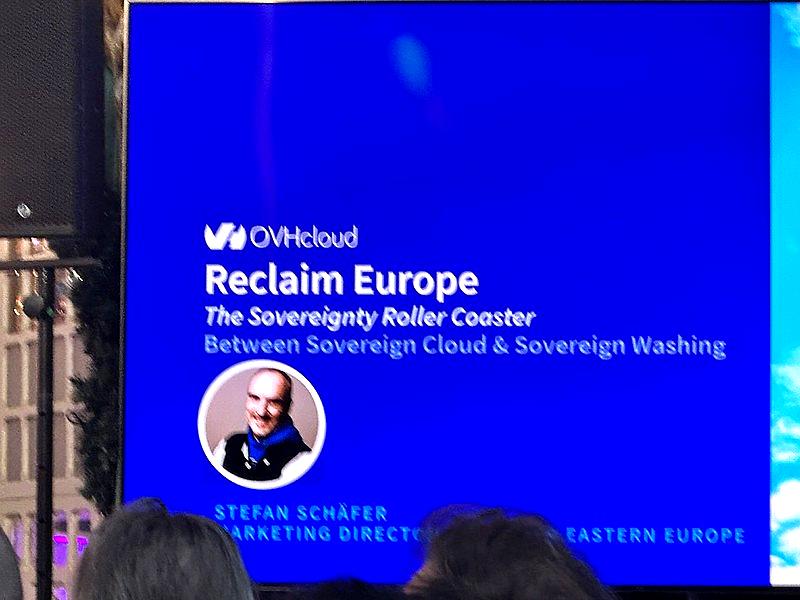
The “Reclaim Europe” movement was everywhere apparent, and OVHcloud’s presentation was lowkey hostile to US cloud providers, even though it seems France/OVH has its own issues with tech ‘freedom’. Nonetheless, can’t blame the bad blood given US tech companies are doing everything they can to erode trust. That said, this isn’t a conference you would expect big cloud vendors taking shots.

Even Canada was in the crosshairs of being removed from OVHcloud’s circle of trust given an ongoing case in which a thr RCMP are demanding data from an OVH server in Europe. The outcome of that case could determine whether the firewall between OVHcloud EU and US infrastructure extends to Canada. It’s interesting because the borders between nations and economic zones are now re-writing themselves in the cloud, and that might be the biggest lesson of Gen Xfest.

Gen Xfest 2026

This is very much a “Europe First” movement and the data centers need to be in Europe and the employees need to be working in and paid by EU companies. The lines are being drawn pretty clearly.

Gen Xfest 2026

The OVHcloud presenter, Stefan Schafer, is the only person I heard actually trying to define sovereignty, as well as looking specifically at the various domains that covers.

Gen Xfest 2026

The sovereign-washing has already begun, or at least the various providers are accusing the others of just that. Whose more sovereign than whom? SAF!

Gen Xfest 2026

What comes with the discussions of sovereign is a return to servers. Now this is my first Gen Xfest, but I’ve not been at a conference where I’ve actually seen hardware. To be fair this is my first big hosting conference, but there was a lot of heavy metal!

Gen Xfest 2026

There was even an 90s living room, I felt seen 🙂 I have no idea what company this was linked to, but I loved it—a much needed break from the endless images of server racks.

Gen Xfest 2026

Also, GDPR was definitely invoked again and again, but there was no mention of all the unbearable click-throughs it has forced upon us.

Gen Xfest 2026

I’m no Tom Woodward behind the camera, but I tried to capture something of the zeitgeist of this sovereignty uprising as told by the vendor booths.

Gen Xfest 2026

No compromise! European cloud.

Gen Xfest 2026

Again, if you have a European cloud you will need European security for that European cloud.

Gen Xfest 2026

Take the elevator to the European Cloud level.

Gen Xfest 2026

This was fun, and also highlights how so much of this push for sovereignty is a reaction to the irresponsible and unpredictable actions of the US president. What’s more, there were no US apologists to be found, all the tech companies I saw seemed fully on-board.

Gen Xfest 2026

“Make Cloud Yours Again.”

Gen Xfest 2026

Get your sovereign cloud in-a-box

Gen Xfest 2026

That idea of trust is what is undergirding all of this. Put bluntly, the trust between Europe and the US has got to be close to an all-time low post WWII. The fascinating piece is that all of that is being mapped onto the cloud and a new world of real and stringent digital borders seem to be the logical next steps.

_____________________________________________

*There is no distinction from presentation and sales pitch at this conference—and next to no questions taken.

Posted in Sovereign Cloud | Tagged , , , | 3 Comments

Gen Xfest: the Quiet Desperation of a Soon to be Forgotten Generation

The title is probably overstating things, but I couldn’t resist. At a certain age, you start to notice that the events shaping the tech industry don’t feel new so much as rhymed. Not because tech or capitalism or anything else is inevitable, but because at scale we seem to fall into the same grooves over and over again.

In my twenty-odd years in tech, I’ve watched the same warning lights flash with almost comic reliability. The particulars change (web 2.0, blockchain, crypto, and now AI), but the pattern doesn’t. Someone—usually early—points out the risks: this will concentrate power; this will marginalize huge swaths of the population; this is ripe for abuse; this will move faster than our ability to manage it. The alarms are clear, well-articulated, and widely shared.

And we do it anyway.

Not blindly, and not even reluctantly. We do it eyes wide open, buoyed as much by the promise of growth curves as by the fear of what we stand to lose by not getting in early—preferably as the one doing the taking. There’s a shared belief undergirding everything: that the trade-offs will be manageable, or at least someone else’s problem. “Danger, Will Robinson” isn’t ignored so much as acknowledged and then promptly de-prioritized.

That’s the part that’s been hard to shake after my first two days at Cloudfest—or what I’m affectionately calling Gen Xfest. It’s not that we fail to see the signposts; they’re everywhere, practically screaming. It’s that we’ve chosen to surround ourselves with environments that make them easier to ignore. The conference is set inside a kind of off-brand Disneyworld, a place built on curated reality and cheerful illusion, where everything is “frictionless” (a term repeated like a mantra in sessions) and consequences are politely kept just out of frame.*

And maybe that’s the point. It’s not that we can’t see the warnings. It’s that we’ve learned how to live with them—absorbed them, normalized them, priced them in. We didn’t learn much from 2008; we adapted to it. And here we are again, crowding the trough, feeding with the same urgency, telling ourselves the same stories—right up until the system decides it’s time to retire us.

I think that’s where the “Gen Xfest” line comes in—and it’s not even mine. During the pre-conference day for WordPress agencies, emcee Raquel Manriquez was doing everything she could to breathe some life into a fairly moribund crowd. The Germans, in particular, were not especially receptive to the American pep rally approach.

But she was sharp, perceptive, and genuinely funny. One of her jokes, riffing on the average age of attendees (mid-40s to late-50s), was that the conference should really be called “Gen Xfest.” It landed because it was true, and it also connected a few dots for me.

A lot of the WordPress agency folks in the room were, quietly, freaking out. More than a few presenters were cocky and occasionally tone-deaf while confidently declaring that programming was no longer a viable market, that AI was already driving prices toward zero. You could feel the floor drop out from under people.

AI wasn’t being discussed so much as wielded like a bat swung from session to session, seeing how many agency owners it could knock off balance. And yet the refrain was familiar: stay curious, adapt, this is just the next industrial revolution. Third, fourth—who’s counting.

It didn’t land. Because beneath it you could feel something else: not excitement, but recognition. A sense of professional (and maybe personal) exposure. The same pattern, again, just wearing a new skin.

The punchline came in a session I attended towards the end of the day:

It’s worth remembering that no one has figured out AI pricing yet.

Which is… something. We’re being told, over and over, that the cost of software development is racing toward zero. And maybe it is. But the cost of AI? That’s still being heavily underwritten by investment capital. The buffet is open, the plates are full, and everyone’s pretending this is the new normal.

It’s not. It’s just the latest version of the same trade-off: scale now, price it later, and hope you’re not the one left holding what promises to be yet another enormous bill.

The uncomfortable part is that I’m sitting there very much a part of the problem. I’m worrying about my business, nervously preparing to send my kid off to college, trying to piece together some kind of future I can retire in while all of these economic, geopolitical, and technical forces churn around me. I’ve been through some of this before, and I can’t say I’ve learned much—much like the culture at large.

I’m running alongside everyone else toward the same cliff.

I just happen to know it’s there. I’m not sure that’s growth—maybe just honesty?


*Europeworld is a total trip. It recreates simulacra of its own monuments—places people could just go and see for themselves—yet everything is miniaturized, contained, and inward-facing. It’s hard not to see a parallel with the conference itself, especially as re-entrenched nationalism (and the business opportunities that follow) gets repackaged as “digital sovereignty.”

Posted in AI | Tagged , | 8 Comments

Trans-Europe Express

Yesterday I took a train 11 hours from Trento, Italy to Rust, Germany. It should have come in closer to 9 and a half hours, but I missed my connection in both Munich and Stuttgart. Thankfully missing a connection on a train is not nearly as harrowing as that of a plane.I just got a brezel or two in Munich and hit the BK Lounge in Stuttgart while waiting 30 minutes for the next train.


View on Mastodon


I’ve taken at least 20 to 30 trans-Atlantic flights since moving to Italy, I can count on one hand the number of pleasurable experiences I have had. It’s just not enjoyable. On the contrary,  yesterday’s trip was a joy. My first 4 hour stint to Munich was through Alto Adige (Sud Tirol) and some of the most stunning mountains in all of Europe. All the time sipping my cappuccino—with pinky extended—while nibbling on a croissant. After cleaning out the Reclaim ticket queue, I broke open Thomas Pynchon’s latest novel Shadow Ticket, a strange cross between Dashiell Hammett’s Red Harvest and The Big Lebowski (amongst other Coen Brothers film scripts).  I read 100 pages throughout the trip. It’s hard to enjoy a book that much when sardined between two strangers equally as disgruntled.

I’ve been listening to Kraftwerk’s Trans-Europe Express a lot these days*while co-working with Tommy in the basement. He’s into hip hop, and like me, he gets a kick out of the fact that Kraftwerk’s “Metal on Metal” is sampled widely in early rap. More than that, we love the whole “Europe Endless” opening and closing tracks of that album. Unlike the other songs, which are far more brooding, it’s a utopian anthem celebrating the vision of a borderless Europe—and as much shit as I talk about Europe—Kraftwerk makes me love it. Now put me on a train for 11 hours from Italy to Germany with that song in my head the whole time and bava’s got that old world glow. Even if the Europeans don’t want me, I’m up in their continent consuming their culture. I’ve even hybridized my offspring, so those mother truckers have to put up with me.

Anyway, I finally did make it to Rust, Germany to attend the “Gen Xfest” conference, but more about that in my next post.

_______________________________________

*It’s one of the CDs I ripped for the mini-disc player which I use quite regularly as my walk around music.

Posted in travel | 1 Comment