#tic104: How it Works Guide

How it Works Guide

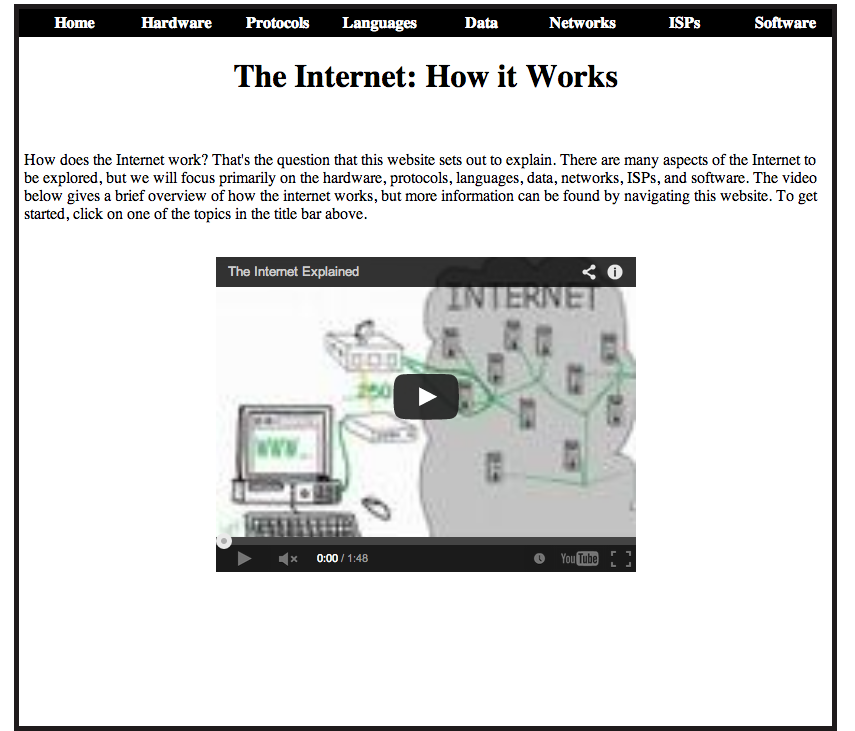
The Internet Course, which I can’t stop writing about :), continues to blow me away in thought and deed. This post will focus on a deed done dirt cheap! Last week the course focused on the topic “How it Works,” and the idea was that all seven students focus on succinctly and clearly describing how the various technologies that make up the itnernet work. And that’s what they did to great effect, and major kudos are due to auditor (that’s right, auditor!) Steven Hartzell for running week three so seamlessly. [How many classes are there in which an auditor runs the course for a week? None, that’s how many.]

Steven came into week 3 with a clear plan, he broke down how it works into six categories: hardware, protocols, languages, data, networks, and ISPs. We brainstormed what might fall under each category—you can read more about the process and brainstorming here—and after some discussion we came up with one more category: software. Each student took one category and based on the brainstorming went off to research their work and popualte the wiki page for week 3 with what they found. We spent much of Tuesday discussing what they found, vetting the sources, and generally deciding on an agreed upon format.

By Wednesday all the research was basically done and Steven kicked in part 2of his plan: the class would code their own resource page in HTML and style it with CSS. Learn how it works by creating it, baby! He guided us through a tutorial on how to write HTML, use a local editor, uploading .html pages and media to public_html through the file manager on cPanel (did I mention how much I love Domain of One’s Own for making this dead simple?), exploring relative links, and generally playing with HTML. It was awesome, the entire class was actively learning how it works, and it was all business because it was directly related to the project at hand. Everyone was required to code the information for the topic they did their research on.

On Thursday we reviewed each person’s HTML page to make sure they were working properly. After that, we dug into CSS (which blew me away because I didn’t think we could get that far). Steven asked the simple question, “How do we want out site to look?” We talked about inline styles, internal stylesheets, external stylesheets, the revoltuion of cascading stylesheets for design, and more. It was a fun discussion, and by the end of two hours everyone created their own local stylesheets thanks to Steven’s guidance, at the same time they all agreed on a very minimalist, yet effective, design for their collection of old gold HTML pages discussing how the internet works.

Steven took up the rear with collecting everyone’s HTML pages via email, and then making sure the pages linked, the styles were consistent, and the links were realtive and posted it on his site. After that he sent me all the HTML pages, and I uploaded them to a subdirectory  on the course site and they all work perfectly. Check out their “How It Works” guide custom-made in HTML and CSS lcoally in Fredericskburg, Virginia 🙂 Did I mention Steven was an auditor? How awesome is he? NOBODY!!!
Posted in The Internet Course | Tagged , | Leave a comment

What’s Next? The Future of Edtech in 1983

The Internet Course is rolling right along, and I’m enjoying this class tremendously. And it doesn’t hurt that the students’ blogging has become a late night rabbit hole for me. Last week Jessi Clark turned me onto an early 1980s Canadian kids’ show about technology  called Bits and Bytes.

 More recently she blogged about the final episode of the Bits and Bytes series titled  “What’s Next?” (embedded above). It’s a little under 30 minutes, and proves to be a fascinating window into the world of computing in the early 1980s. A horizon report for the future of computing, and the list is really wild in retrospect. As Martin Weller noted on Twitter the other day, what will the MOOC predictions look like to us thirty years later?

I recommend watching the video, but knowing time and energy is short on the internets, let me take you through it really quickly below as a kind of teaser.

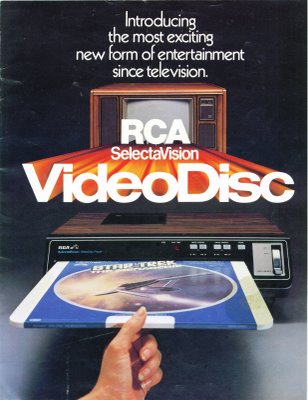
Feb_11_B_VideoDiscFirst up, the future is all about the Videodisc! Those lovable laserdiscs that I have a modest collection of in my basement—although the rest of the world has all but forgotten them. The highlight of this section of the episode was how the episode framed videodiscs as a great way to provide learning modules for training. The approach being showcased seemed somehow modern in some really depressing ways.
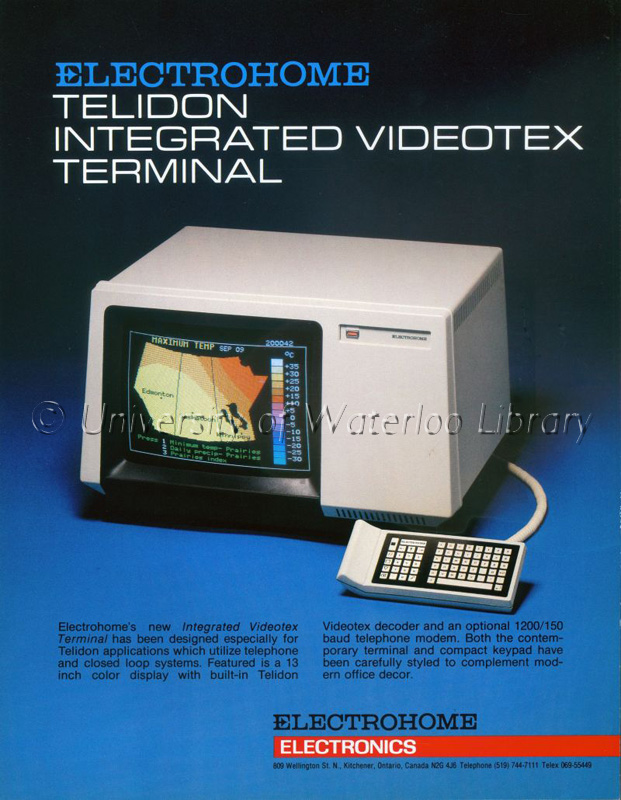
After that, at about 6:30, the episode transitions to the computer as a communication device, discussing the modem as a means of sharing information. What’s interesting is that communication with the modem was still very much conceptualized as unilateral. There was no mention of email, but rather the discussion focused on teletext and videotext technologies. They featured one in particualr, called Telidon, which was imagined as a means of marrying the computer and television to present “interactive” information in a graphical form. The graphcis are wild, and in many ways it was a very early vision of interactive digital signage. So cool.

Telidon

Around 13 minutes in Adele Goldberg discusses Smalltalk, the programming language developed at Xerox PARC during the 1970s that introduced the first true object-oriented programming language. And it came out of ARPA funded research, which it’s hard to deny defined much of the modern world of computing. 

After that the episode talks about Pilot, what is described as an overhead projector for graphics/doodling. What we might think fo as an early smartboard. There’s also a whole segment on music finger painting by an awesome professor who is entranced by the idea of using these digital technologies to bridge the gap between sound and vision. So cool.

Finally, the last couple of minutes of the episode are dedicated to talking to teachers and administrators in various Ontario area schools about the future of computers in education. It’s truly amazing how similar the fault lines in 1983 are to those in 2014. The transformative power of comptuers to augment the classroom versus there presence as a distraction. It’s really sobering to hear just how controlled the narrative around comuters and eduation has been for more than three decades.

Posted in The Internet Course | Tagged , , , | Leave a comment

A Networked History of UMW’s DTLT

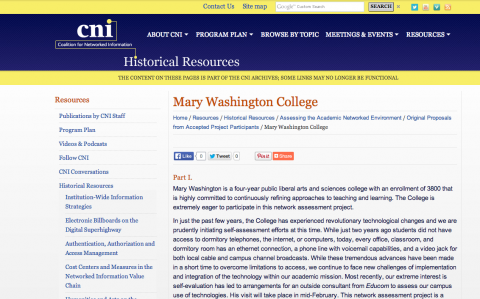
Mary Washington College's Proposal for CNI’s Assessing the Academic Networked Environment Project

Mary Washington College’s Proposal for CNI’s Assessing the Academic Networked Environment Project

One of the things I derive great pleasure from is learning about the long history of the edtech field. It’s such a strange, intersitital “discipline” between IT support and academics on one hand, and revolution and conformity on the other. It’s a deeply shizophrenic field in so many ways, and I think that’s why it appeals to me so much 🙂 Within the long, sordid history of edtech, nothing interests me more than the particulars of the group I currently work with, UMW’s DTLT. When Martha, Andy, and Jerry tell stories of the past it’s like sitting around the dinner table hearing stories about my ancestors. Overblown simile, I know, but I can’t help it. I’m intrigued to no end of what came before me. The same is true when Brian Lamb starts getting on a roll about the history of learning objects in edtech during the early 2000s.

So, I was thrilled when more than a month ago Martha pointed me to the Coailition for Networked Information (CNI)  site which has a public archive of the original proposals from the nine institutions accepted into CNI’s 1997 proejct  “Assessing the Academic Networked Environment Project.” The project is described as follows:

Nine institutions are participating in CNI’s Assessing the Academic Networked Environment Project, which has been developed to field test measures of the impact of networks and networked information resources on higher education institutions.

I love the idea of exploring the impact of networks and networked information resources on educational institutons back in 1997—before email truly took hold at Mary Washington. I think this kind of project would be interesting to revisit. Not only anew, but for exploring where the nine schools that particpated in this project are twenty years later. I mean examing the history between 1997 and 2017 hen it comes to networks would be insane. How have networks impacted the learning landscape at UMW? Let me count the ways! 🙂

Below are some of the assessment questions this project was exploring:

  • How has access to and use of networked information resources and services affected teaching and learning?
  • How and where are users connecting to the network?
  • What is the frequency of use of information resources on the library web?
  • How effective are electronic help services compared to print or in person help services?
  • What are the annual information technology expenditures on the campus?

First and foremost is the question of instuctional technologies. Exploring the impact of networks in regards to teaching and learning is a  concept that can be traced back to 1995 at UMW Mary Washington College. What’s so awesome is that CNI both archived and made public the original proposals from those nine institutions, so I can get a sense of the narrative around instructional technology at Mary Washington circa 1996. Here is the archived page of UMW’s application to take part in Assessing the Academic Networked Environment Project. What’s wild to me is that you can see the kernel of what would become DTLT over the next two decades in this proposal. While talking about Mary Washington’s recent networking of the entire campus in 1994, and a major overhaul of technology in classrooms, etc, the proposal notes:

As the physical aspects of the project near completion, attention is more intensively turning toward how we plan to utilize the network and equipment to achieve our educational goals and objectives.
…..
To address the technological training needs of faculty, staff, and students, the College established a Center for Instructional Technology in 1995. In spite of its small staff, the Center works closely with other campus agencies and has accomplished several important objectives. First, the Center established a Faculty and Staff Technology Training Center in which faculty and staff receive training in state-of-the-art networking technologies as they apply to the teaching/learning process. Faculty are increasingly enhancing their curricula with technology so a forum for sharing these experiences was created. The CIT developed an annual three-dayFaculty Academy focusing on examinations of pedagogy and technology as a method of facilitating communication regarding these experiences.

Isn’t that crazy? The long history of DTLT can be dated back to 1995 in this proposal, and I think the constant investment in developing faculty in “state-of-the-art networking technologies as they apply to the teaching/learning process” has remained a consistent focus for what we do. The fact that over the last twenty years there has been so much expertise in this field that’s played a crucial role in the work we’re doing today is humbling. This wouldn’t have been possible if there wasn’t an early belief as the web was emerging into public consciousness that these technologies wouldn’t dramtically change how we share what it is we do. People often ask what’s in the water at UMW when it comes to all things edtech, and it’s increasingly apparent that that questions wouldn’t even be asked if those waters weren’t so deep. An early understanding that investing in instuctional technology as a means of understanding networks as the technological infrastructure premised on conencting the work of people was defining for the course we’ve been on since 1995. As we open up yet another era of DTLT’s illustrious hsitory whenw e move into the Convergence Center next moth, it’s cool to think about how many folks over the last 19 years got us there.

Posted in dtlt | Tagged , , , , | 5 Comments

Bits and Bytes explain Digital

The Internet Course is putting together a set of resources explaining how a variety of internet technologies work. You can see their progress thus far on the “How it Works” wiki page, all of this will ultimately be written as HTML pages because they are hardcore! During class today Jessi Clark was talking about the video she discovered to explain the concept of digital, it’s a total gem. After a bit of research I discovered it is from Episode 8 of the 1983 Canadian educational television series Bits and Bytes, which starred Luba Goy and Billy Van. I found their YouTube channel, which has 78 videos with entire episodes, bits of episodes, and other assorted  treasure for explaining how a wide range of technology works to kids. I wonder if this is why the Canadians are so good at edtech. I would pay big money to see a revival of this series starring Stephen Downes and George Siemens 😉

What’s interesting about the video—besides describing digital using fish– is that it defines the advantages of the analog over digital in terms of smooth, graphical representations. Can we still argue that’s the case? We problably crossed that barrier for sound in the 90s, and video in the 00s. What’s the true advantage of analog today? Is there really a purity we’d be missing moving forward? Also, it got me thinking of analog being digital (at least according to this video’s definition) at its core as well. Isn’t 35 MM film the stitching together of fragmented stills to create the illusions of movement?

Reminds me of a tweet I saw early today by William Friedkin in regards to Quentin Tarantino bemoaning the passing of 35 mm films (a reality I can’t help but side with Tarantino).

It’s a digital world, and I feel fine.

Posted in The Internet Course | Tagged , | 5 Comments

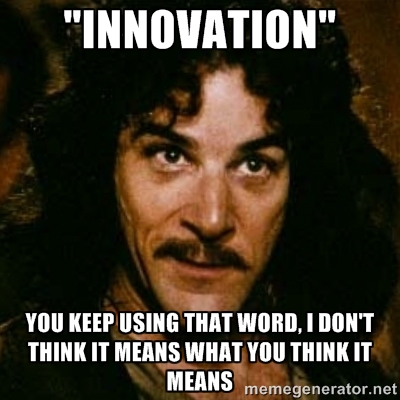
Reclaiming Innovation

Screen Shot 2014-06-03 at 5.12.26 PM

Click image to go to article

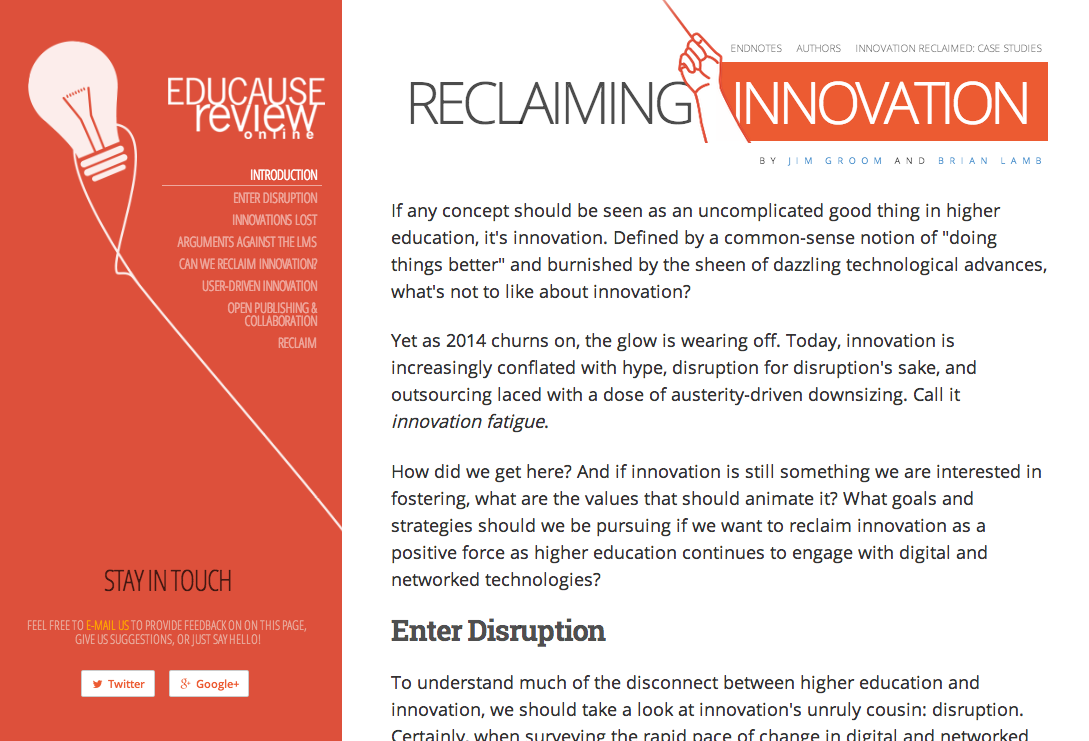
Yesterday the online version of the EDUCAUSE Review article Brian Lamb and I co-authored went live on the web. I’m really blown away by how much time and energy the good folks at EDUCAUSE Review spent on the web presentation. It looks amazing, and I have to acknowledge right up front that ER editor, Teddy Diggs, was nothing short of amazing throughout the entire process. I had a lot of fun writing this article, and it’s really rewarding to see it both online and in print. It represents yet another proud moment within an  on-going intellectuall (and degenerate) collaboration I’ve had with Brian for going on eight years.

More selfishly, this article helped me both crystallize and abstract a series of ideas around Domain of One’s Own that needed to be generalized beyond UMW. Originally the idea behind this article was to write a piece about Domain of One’s Own touting its awesomeness (and it is!). But when I started talking  it over with Brian it quickly became apparent that a broader rumination on the state of innovation and technology in higher education would get at some of the deeper underlying issues that Domain of One’s Own addresses. What exactly do we mean when we say innovation? What is this disruption we keep talking about? What is the state of innovation in higher ed when it comes to IT infrastructure? How have we fared in terms of providing spaces for our intellectual communiities to explore the possibilities of the the radical “disruptor” know as the web? Is empowerment a part of innovation?

The article is an attempt to answer just those questions, and I think it helped me re-focus some of the reasons why I think Domain of One’s Own, and the Reclaim Your Domain movement more generally, remains my chosen future. The online piece provides a series of extras, such as clips of a conversation between Brian and I embedded in the article about the process. Also, there are a series of examples of schools like UMW, UBC, and various CUNY colleges that are enacting the values at the heart of building a technological infrastructure for teaching and learning around people. In addition, for the online version I spent many hours alongside Andy Rush interviewing staff, faculty, and students at UMW to explain what exactly Domain of One’s Own means to our campus. The following 12 minute video, embedded below, is the result of that exploration.

And if that’s not enough, Brian and Jon Fulton were, as luck would have it, able to sit down with both Audrey Watters and Kin Lane at Thompson River University to discuss what exactly this whole “reclaim” thing is all about. I think they both lay out a brilliant frame for what this might mean on a personal level.


I’d like to think their vision is complemented by Domain of One’s Own at UMW, suggesting that such an ethos can work on several levels: personal, professional, institutional, etc. There’s a spectrum to reclaim. It’s not a reaction; it’s a proactive move to start demanding we have more control over who we are in cyberspace. For UMW, reclaim is about factoring the importance of taking ownership of your information into the work you do not only as a student, but as a citizen.

Brian and I fashioned this piece as a re-visiting of the “Nevermind the EDUPUNKs” article we wrote for EDUCAUSE Review in 2010. Four years on I remain confident that empowering individuals to reclaim their work online is not just an idea, but an infrastructure that folks can and will actually work towards impelementing. If we think that teaching and learning in the 21st century needs to deeply interrogate the role of the web in education, and that’s becoming readily apparent, then I can’t imagine how the vision of the student, faculty, and staff member as various nodes within a broader learning network framed by the course or the unviersity or the world at lerge can’t be anything but imminent. Here’s to hoping.

Posted in reclaim, reclaimopen | Tagged , , , , | 3 Comments

How does the Internet Course Work? Awesomely!

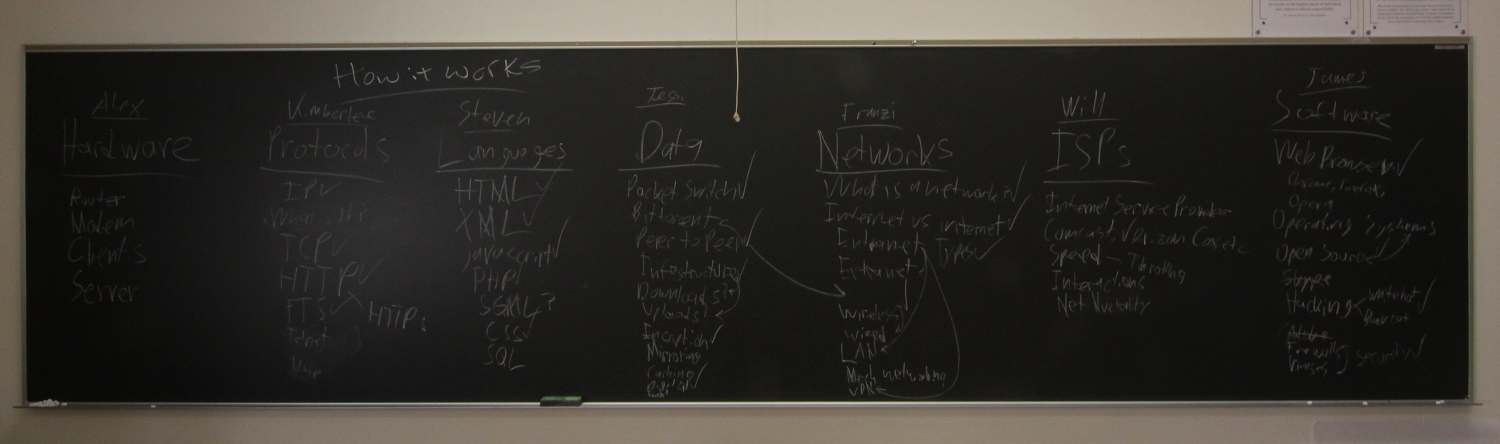
Image of black board of brainstorming how the itnernet works.

Image of black board of brainstorming how the itnernet works. Click on image for larger version.

Today’s class was awesome. The summer edition of the Internet Course is proving pretty epic, and this morning was a good example as to why. Last Friday we decided we were going to create a site to try and explain how the internet works in as clearly and plainly as possible—inspired by the explainlikeimfive (ELI5) Reddit (thanks to James Dawson for the suggestion!).

E is for explain. This is for concepts you’d like to understand better; not for simple one word answers, walkthroughs, or personal problems.

LI5 means friendly, simplified and layman-accessible explanations, not for responses aimed at literal five year olds (which can be patronizing).

With that idea in mind, this week’s director, Steven Hartzell, came out of the gate running. He broke down the internet into six categories to explain: hardware, protocols, languages, data, networks, and ISPs. The separation of data into its own category was interesting to me, and I think it worked. ISPs as its own was less compelling, but at the same time I think the categories themselves made everyone start to think and discuss how the internet works. We came up with one more category: software.

Steven had us brainstorm the various examples for each category we would want to have explained, that list is recorded in the image above, as well as the wiki page for “how it works.” Each category has 4-5 topics that have to then be explained in as simple a fashion as possible. Each student volunteered, or was assigned, a category and by tomorrow they need to find and link to as many specific sources that explain how each topic works in the wiki under their category. The creation of a resource explaining as many as 30 technical topics to total beginners should be done by Wednesday. By Thursday, they’ll each have to code their section in HTML and post it to their server, another lesson in how the internet works Steven came up with 🙂 I like it!

It could be argued that such technical content as how the internet works would demand the use of a good textbook, or at least predefined content that I choose and present in as boring and alienating a process as possible 🙂 The Internet Course says no to the tyranny of content as infrastructure. The web is infrastructure and “educational” content (at least the stuff branded as such) is just one small piece of it. I’m finding that the creation of that content with students is far more useful as a residue of what’s been learned in terms of the course, than text as the defining tool through which we learn.

Posted in The Internet Course | Tagged , | 1 Comment

The Internet Course on LSD

Far out!

Last Wednesday while the Internet Course was sharing where we’re at with the timeline, one of UMW’s fine art professors, Carole Garmon, dropped by class and asked if she could stay. Why not? While we were talking about internet related events during the 1980s, I mentioned that while we listed cyberpunk, we didn’t have much about the hippie cyber movement often associated with the Whole Earth ‘Lectronic Link, a.k.a. the WELL. The WELL is associated with the birth of online communities, as well as the greatest Terms of Service ever. While we were exploring this topic Carole Garmon jumped in noting she had a copy of the Whole Earth Catalog in her office upstairs. She ran up and brought down the May 1974 (Updated) Last Whole Earth Catalog by Stewart Brand. It was wild to think this over-sized catalog for back-to-nature hippie communalists would become the basis for virtual communities.

Howard Rheingold Image credit: Standford’s SCOPE blog

On the other hand, when you hear Howard Rheingold talk about it, it’s not strange at all. I’ve been working alongside Howard for the last four or five months to design an open, online course about teaching, “connected courses” (more on that in a forthcoming post). I came into closer contact with Howard thanks to ds106, and we really hit it off. After this nudge from Mike Caulfield (who spends too much time in my comments 🙂 ), I asked Howard if he wouldn’t mind dropping into The Internet Course virtually and talking about the WELL. As luck would have it, he said yes. YES!  The next day, Thursday, May 29th, he talked to us for 20 minutes about everything from the WELL to cypherpunk to the 60s student protests to LSD to Kevin Kelly’s Wired magazine. It was awesome, and his passion was infectious. The students were enthralled. It’s pretty magical and illuminating to hear someone share their understanding of a history they lived through. In fact, Howard was so compelling the class asked that we try and have him come back next week for social impacts, we’ll see if that’s possible, but in the mean time enjoy some vintage Howard Rheingold!

Special thanks to tic104 internaut Alex Marshall for capturing this audio recording. We tried to archive the Google hangout, but YouTube’s ban on all things Jim Groom sometimes makes that difficult.

Posted in The Internet Course | Tagged , , | 1 Comment

An Internet Timeline

We’re just starting week 3 of the 5 week summer iteration of the Internet Course. It’s been intense (a Repo Man’s life is always intense), but also awesome! Last week we collaboratively built the first of four projects this course will produce: an internet history timeline. It covers more than five decades of history, and does a pretty remarkable job framing the history of the internet from Vannever Bush’s “As We May Think” up and until the latest rules surrounding net neutrality released on April 1, 2014. There are 123 points on the timeline, and it is a remarkable breadth of historical moments collected in less than a week—four days to be exact!

The creation process of this timeline was an amalgm of several approaches. First, as a class we decided on using a timeline to learn the history of the web, inspired by this student group’s timeline from last semester narrating the history of ARPANET. After that, we reached out to Jack Hylan, one of the four students who worked on that project, and asked if we could copy their timelineJS template and build off that. He was cool enough to say yes, and we went into the week with the 1950s and 60s done for us. Why reproduce the effort if it’s already been done so well? From there, Alex Marshall and Kimberlee Vizzi  brilliantly directed the project for the week making sure each student in the class took a decade and was adding their work to this wiki page dedicated to the timeline. They also negotiated questions of organization, curation, and then spent the past weekend populating the timelineJS’s Google Spreadsheet with all the dates, titles, descritpions, media, etc.

This was an awesome experience, and I’m really digging the idea of transforming each week into a project focused on producing something that will help others learn about the content we’re covering. And given the way this class designed the timeline in the wiki, I’m imagining the next Internet Course in Fall could further their work by building out this resource with more detailed research about particular elements on the timeline. I’m really fired up with how this class is gelling, and what they’re producing. So good!

Posted in The Internet Course | Tagged , , , | Leave a comment

31

This is post number 31, and it comes on the 31st day of May, 2014. While it might seem like cheap filler for the bava to get to 31 posts in 31 days, it’s actually a way for me to talk about my blogging process so far this year. At the beginning of 2014 I decided to try and get as many blog posts in a month as there are days. I actually didn’t meet that goal until this month, and in many ways the actual number of posts was not the point. The idea was to push me to blog more regularly. To create a certain urgency to share what I’m doing, thinking, learning, etc. whether or not I think other people will find it useful. I find most folks fall down on blogging because they assume they have nothing to say. That’s the wrong approach, in my opinion. The act of pushing yourself to write is far more about creating and learning, than having some pre-packaged thing to say. It’s a commitment to try and communicate something with words. Work your way through an idea to understand it better; a generative process of creating, learning, and sharing all at once.

I never put the limitation on myself to publish daily (I write in bursts), but blogging is the lion’s share of my work so without some regularity to my posts my work suffers. I feel Tony Hirst’s pain in the tweet above, when you’ve grown accustomed to sharing your ideas for years (and he’s one of the greats), the idea of stopping for “work” is akin to the idea of learning lost. When work becomes antithetical to open communication, it’s loses its wonder. I don’t wanna stop learning, on the other had I also don’t want the blog to be the land of obligation. It needs to remain a freezone to explore and share whatever I want, and so far it has because UMW continues to rule.

Posted in blogging | Tagged | Leave a comment

Is Content Infrastructure or the Residue of Social Learning?

I love Vanessa Genneralli, let me get that out of the way up front. Her laugh can sail a thousand ships, and her infectious, joyful energy makes talking to her akin to waterskiing on Skittles. But enough about her, let’s talk about me! 🙂 I was actually interviewed by Vanessa yesterday for a P2PU course she is creating, and we talked about designing for open. This is something I have some experience with as a result of ds106, and explored that craziness for the first eighteen minutes.

At about 18:36 vanessa asked a question about the role of content in an open, online social experience like ds106. What follows was for me the best part of the twenty minute discussion. One of the ideas I was riffing off was David Wiley’s assertion back at the 2007 Open Education 2007 that “content is infrastructure.” Read the linked article because his argument around this claim is solid, and I don’t want to discount that. However, more and more I am finding with my own teaching content is not so much infrastructure as the residue of the learning happening as a result of the course.

In other words, the Internet Course, and ds106 before it, were not designed around pre-determined content, often packaged as textbooks (so much of the open education movement is still premised on this idea of the authoritative text), but rather on an open educational experience. For example, in ds106 students could choose from a series of assignments, create their own, and navigate a series of resources other shared, etc. But that wasn’t a text in any strict sense, content as a concept was far more elastic and slippery that this hulking, unmoveable metaphor of insfrastrucutre. It was constantly negotiable, remixable, and fluid in its relevance. In the Internet Course there is no pre-exisiting syllabus or readings,  rather the students in the course immediately start brainstorming a set of topics and then start researching and reinforcing what was what. Content plays a crucial role, no doubt, but it’s not predetermined or pre-existing in it’s layout like this idea of infrastructure. It’s malleable and part of the larger negotiation of the course. And, I would argue, once that course works through the content, digests it, and comes to terms with it, it becomes a by-product of the learning that happened.

I guess the point I am exploring here is that the infrastructure, when it comes to content for teaching and learning specifically, might better be imagined as a product of the interactive experience of learning than the foundation on which it’s all built upon. It seems counterintuitive, but more and more the oral and narrative forms Wiley discounts undergird a sense of what makes the classroom experience so powerful for learning (more on thsi in my next post). Whether or not all the infrastructure we are creating in the form of open content as textbooks is even being used remains one of the biggest questions of the whole movement, and I wonder if the focus was on experience and relationships as a negotiation of the pre-exiting content as an exploration rather than a deleiverable challenges some of these assumptions around content as infrastructure. I write this, because seven years on I am still struggling with that idea.

Posted in open education | Tagged , , | 31 Comments