Installing WordPress Multisite and Using FeedWordPress

Yesterday I sat down with UBC Philosophy faculty and ds106 rockstar Christina Hendricks to record a walk-through of how to install and manage WordPress Multisite using the script-installer Installatron. Additionally, we covered the following:

  • How to manage your multisite account, with a special focus on the  level of abstraction from the site to the network
  • How to export and import a WordPress site
  • How to use the syndication plugin FeedWordPress

The more I work with faculty and students on managing their own web hosting and domain, the more I am convinced it’s not only manageable for just about anyone, but it’s near on getting dead simple. This is by no means to suggest Christina isn’t tech savvy—quite the opposite! However, she’s represents a demographic of faculty who’ve been rocking open source applications like WordPress for teaching and leanring on amazing platforms like UBC Blogs or UMW Blogs  for a while now. Given that, they’ve come to the point where they want to start managing some of their own sites, and exploring beyond the confines of these systems. That’s awesome because in my mind that’s why we started platforms like this in the first palce, so folks would start to move beyond them.

Nonethless, I emphasize some of her sites above because Christina is not planning on exporting and managing all of her numerous course sites on her own domain. Rather, she’s bringing in a few sites that make sense to be on her own domain: her blog, her portfolio site, her ds106 tumblr, etc. It’s not all or nothing, rather the two systems working brilliantly together, and the above video is a testament to how awesome open publishing platforms like UBC Blogs and UMW Blogs can be when faculty (or students, staff, etc.) can export their work from a university’s platform and seamlessly import that work into their own domain. THAT’S PROGRESS, KIDS!

In effect, by setting up her own WordPress multisite she is able to move from the concept of a site to that of a network of sites that she manages and controls. It’s weird for me, but I just really wrapped my head around this idea of the personal network while talking to Christina over the last couple of days. The WordPress Multisite network nomenclature gets at the idea that you, by way of your domain, become a multichanneled space for publishing, sharing, syndicating, aggregating, etc. As Andy Rush has noted before, a “Network of One’s Own!” And that’s exactly what Christina is demonstrating in this walk-through.

If you are interested in how to install your own WordPress Multisite (via Installatron, which you can get through Reclaim Hosting 🙂 ), manage WordPress  Multisite, export/import WP, oand/or use FeedWordPress this video might prove very useful. I am hoping Christina and I can get together again and do a few more about managing your own domain and demonstrating that managing your own oiece of a server has never been simpler!

Posted in reclaimopen, UMW Blogs, WordPress | Tagged , , , | 2 Comments

Teaching as Collaboration

Lebowski Reflecting

I’ve been reflecting about my teaching a bit over the last week or so, and I’ve been on a bit of a journey the last four years. It started with ds106 in Spring 2010, and it’s been rolling ever since. I’ve learned a few things over the last four years, and all of them have to do with letting go. In Fall 2010, after having taught ds106 twice,  I planned, alongside Martha BurtisTom Woodward and Alan Levine, to open the class up for anyone interested. That was made reality in Spring 2011 when Martha and I collaboratively taught the class on the ground at UMW. While we both had our own sections, we worked together on the course planning, assignments, radio broadcasts, and more—all of which made the course 1000 times better.

“Say it Like Peanut Butter” Assignment in the Assignment Bank

Martha taught the course again in the first sumemr session of 2011, the very next session all of DTLT (including a then green ITS by the name of Tim Owens) taught the class as a group. In fact, the course was a spoof on the limited imagination when it comes to teaching online in higher ed. So often that notion gets packaged as a single-shot video of a professor talking at his or her students in front of a wall of books.

We pushed hard on the notion of the assumed and sacred constructs of academic identity, pedagogy, and the talking-head font of information. All of which gave way to quite possibly unquestionably the most insane teaching exepreince I have yet to be a part of, namely the Summer of Oblivion.

A Younger Dr. Oblivion

Less than a year later Alan Levine was on the ground at UMW, and both Martha and I took turns collaboratively teaching ds106 with him. There was a shared sense of ds106 as both a class as well as a community. Working together on our teaching became the norm. This is nowhere more apparent then in Alan and Martha’s co-taught summer ds106 class known as Camp Magic MacGuffin. In fact, ds106 was (and continues to be) an odyssey spanning several years that has proven generative in all kinds of ways I’m still discovering.

But teaching the same class again and again can get tiring, and for close to five or six semesters ds106 was all I taught. By Fall 2012 I was asked to teach a Freshman Seminar on Detective Fiction. I’d taught a hardboiled literature class before at SUNY Old Westbury during the Summer of 2001, so I figured I could work something out. I came up with a syllabus for a  hardboiled class, and I was pretty stoked. I went to graduate school for literature, and it had been a dog’s age since I taught a class based exclusively on novels and films. I was really looking forward to the change.

Goodfellas “He cuts the Garlic with a razorblade”

As I started teaching the Hardboiled class something cool happened. As  early as week 2,  Paul Bond, who had been part of the opne, online community for ds106,  was regularly listening in and blogging aboutthe class—each sessionw as broadcast to ds106radio. I  then started bringing him in via Google Hangouts. Soon enough we started unofficially collaborating on that course. The following Fall we consummated the relationship of co-teachers, and it’s been pretty awesome since. We worked together on the True Crime freshman seminar this past fall, which was a total blast, and worked together to design CPSC 104: The Internet. As Paul and I became fullblown collaborators in the classroom, I got one of the most valuable lessons yet, let the students drive the experience. Paul is really amazing at stepping back and letting the students claim ownership of their learning. What’s more, he is a master at designing an experience wherein the role of the insturctor is radically de-emphasized.

De-emphasizing my presence as the “head” of the class is something I continue to struggle with (which has soething to do with my big personality), but teaching with Paul forces me to be vigilant in this regard. Three semesters later I am really seeing the rewards in my teaching, for both True Crime and the Internet Course the amount of engagemnt, student ownership of the experience, and curiosity-driven discussions have been astounding. Collaborating with Paul has opened up a whole new world of re-thnking the design of a course, the structure of material, the possibilties for project-based learning, and the necessity of student-driven discussion. It’s been a truly rewarding two years of teaching, and I feel like it’s building on top of the collaborative teaching experiments that started as a result of ds106.

What’s happening now that Paul and I have gotten in the groove of teaching together, is that we can really play off each others strenghts. Paul likes to frame the design of the course and let the students own their role in it, but disappear into the fabric during the actual session. I, on the otehr hand, contribute to the dicussion throughout the course, tell stories, crack jokes, and generally get on people’s last nerve. We’re learing how each other works, and improvising around that. What’s more, Paul’s latest post “Chalk Talk” is a summary of yesterday’s in-class discussion based on brainstorming the students did for the decades-based timeline. This is a post I was meaning to write, but thanks to the fact Paul did, and better than I ever could hvae, I can write this one. Where in a very tight synchronization right now, it it’s a beautiful thing. Collaborative teaching continues to push me beyond my comfort level, and I’m increasingly convinced I might not ever be able to teach a class alone again.

As a final note, it would be unfair not to recognize how awesome so many of the UMW students have been not only going along with thee various course experiments, but fully engagaing the possibilties and making it not only tolerable. but absolutely enjoyable—it takes a village to re-imagine your teaching along the lines of collaboration.

Posted in Teaching, Uncategorized | 1 Comment

Like Punched Cards in the System

Tim Owens pointed me to the 1964 IBM promotional/instructional video “Once Upon a Punchcard”. It is yet another video in a growing collection of media resources for the Internet Course I’m teaching alongside Paul Bond this summer. This one is interesting because it frames an alternative vision of computing in the mid 1960s. Rather than far out visionaries like J.C.R. Licklider imagining an integrated network of virtual connections, computing in this video is framed as a machine organized around the principles of business efficiencies, streamlining processes and scaling operations. Punching your timecard becomes metaphor for routinized factory work under the watchful eyes of the bosses. The punchcard became a symbol of power and control, and it was based to some large degree around organizing and storing information. In Wikipedia article about punch cards includes this bit under the cultural impact of punch cards:

In the 1964–65 Free Speech Movement, punched cards became a … symbol of the “system”—first the registration system and then bureaucratic systems more generally … a symbol of alienation … Punched cards were the symbol of information machines, and so they became the symbolic point of attack. Punched cards, used for class registration, were first and foremost a symbol of uniformity. …. A student might feel “he is one of out of 27,500 IBM cards” … The president of the Undergraduate Association criticized the University as “a machine … IBM pattern of education.”… Robert Blaumer explicated the symbolism: he referred to the “sense of impersonality… symbolized by the IBM technology.”… ––Steven Lubar[51]

I love this, the UC Berkeley student protests were framed around the broader, data driven culture that makes students feel like an insignificant number within a lifeless, soul sucking system. At least the UC system had affordable tuition back then 😉 This instructional video belies a deeper discontent with the idea of machines as extensions of an increasingly impersonal and pernicious educational system.

Posted in The Internet Course | Tagged , , , | 4 Comments

Internet History: Watch the Movie

One of the things I am excited about this go around with the Internet Course are all the resources I’m finding thanks to awesome folks like Alan Levine and Micahel Berman. In the comments of my last post, Alan linked me to Ted Nelson’s YouTube channel. On it you can watch Nelson give his own, very particular, history of the world wide web as seen through his “much misundertood initiative” hypertext Xanadu.

So crazy, not only can we talk about Nelson’s pioneering work in the world of hypertext, but we can hear him ran t about the  history of the web just a easily. Something that embitters him to no end given his own hypertext project Xanadu was jettisoned on the rocky shores of historical obscurity.

If that’s not enough, in the same comment thread Michaal links me to yet another awesome internet history gem on the Internet Archive (he was responsible for pointing me to this gem starring Alan Key talking computer interfaces) about the Internet Superhighway.

Here’s the description:

It wasn’t quite the World Wide Web yet, but everybody started hearing about this thing called “the Internet” in 1993. It was being called the Information Superhighway then. This program looks at the earliest stages of the Internet including Aladdin Systems SITComm, a Macintosh communications program for Internet access, and the WELL (Whole Earth Lectronic Link), an early online community. Also featured is a visit to the former Bell Labs in New Jersey (now Bellcore) for demonstrations of internet based teleconferencing, video on demand, ISDN, and optical network technology; a preview of the World Wide Web as used at NASA; a visit to where it all began, ARPA, the Advanced Research Projects Agency in Virgnia; and a look at the Internet Multicasting Service in Washington, the first Internet radio station. Guests include Brendan Kehoe, author of “Zen and the Art of the Internet”, Howard Rheingold, author of “The Virtual Community”, Dr. Robert Kahn, former found of ARPA, and Carl Malamud, author of “Exploring the Internet”. Originally broadcast in 1993.

The role of documentaries and other resources for framing this relatively recent history is part of the process we need to dig deeper into, and I am really loving this.

Posted in The Internet Course | Tagged , , | 3 Comments

Lost in the Stacks

I saw the following tweet and got intereted…

And as a result of my curiosity I spent the last hour listening to a discussion about expunging your digital history from a pretty awesome group of librarians at Georgia Tech, including Charlie Bennett, Ameet Doshi, Alexandra Low, Perry Shuman, Cody Turner, and Anthony Nguyen. The show is called “Lost in the Stacks,” and I believe it airs once a week on Georgia Tech’s student-run radio station WREK. Their show description rules:

The one and only Research Library Rock’n’Roll show! Ameet and Charlie from the Georgia Tech Library pick a theme and free-associate an hour of music, interviews, and library talk every Friday for lunch. You’ll hear indie rock, pop rock, alt rock, New Wave, and the occasional oddity in between interviews with students, faculty, and librarians.

How come they aren’t being X-cast to ds106radio? I might have to fix that. This week’s show featured an interview with UCLA (my alma mater!) professor Jean-François Blanchette (UCLA) talking about the changing nature of discovering personal records on the web. The show revolved around the questions and cahllenges of trying the manage one’s digital identity through a series of third party, corporate services that have no real concern for your interests. It also usefully framed the U.S. context—largely driven by media and advertising interest groups—to the European stage tht is actually making decisions that enable it’s citizens to be forgotten by search engines like Google. Great stuff!

  The interview was broken up into a couple of parts, and the music played throughout the show was themed around disappearing. It was really quite brilliantly done. Much of the conversation was deeply relevant to the work we are doing at UMW currently, so it was a total treat when they gave a shout-out to Domain of One’s Own.

I have to say I love that Charlie Bennett refers to Domain of One’s Own as a movement in higher ed. I;m not sure it has the critical mass of a movement jsut yet, but I think the more and more folks listen to shows like this and realize how essential it is to start engaging and interrogating the issues around who we and who owns us in these digital spaces, the more apparent how necessary a reclamation movement like Domain of One’s Own is, or at least I hope on my better days.

Posted in Domain of One's Own | Tagged , , , | Leave a comment

Computers before the Web

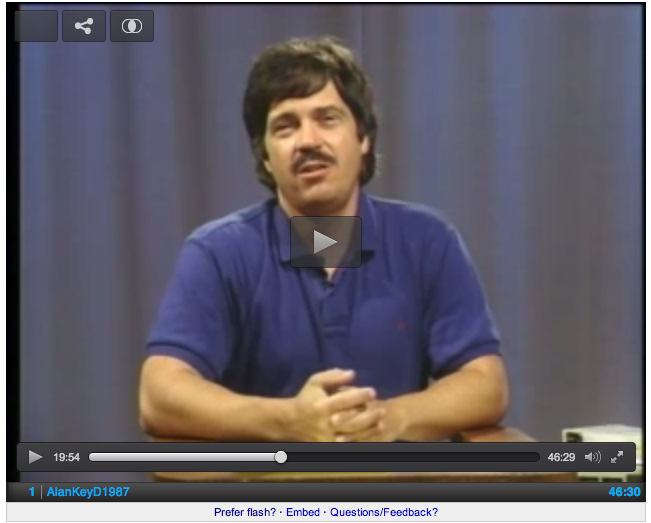
My brother-in-law sent me the above tweet this morning, knowing I’ve been ensconced in computer history the last few months. The “Kids React to Old Computers” video he pointed me to is going viral, and it provides an interesting premise the think about computer history. Namely, just how unintuitive computing thrity five years ago seems to us today. The role of personal computing in defining current moment is something I’ve been thinking about a lot lately, and no one frames that evolution better than Alan Kay in this 1987 video.

It’s also interesting how folks like Wes Clark, back in 1967, saw personal computing and the nascent internet as somewhat antithetical movements. In fact, I’ve been reading Stephen Levy’s 1984 book Hackers about the emergence of a whole movment of computer hackers who were best know for breakthroughs in hardware and software for personal computing. That said, there is only tangential discussion of the internet as the force we understand it as now. That seems odd primarily because so much of our current understanding of computing history is defined through the lens of the world wide web. It seems to me the mid-1990s was the moment when these realted, but seemingly distinct, histories of the internet and personal computing became less and less distinguishable. The mid-1990s, thanks to this brave new protocol for sharing resources, marks a moment when personal computers and the internet became more and more synonymous.

Posted in The Internet Course | Tagged | 8 Comments

You’ve Got the Network Inside Out

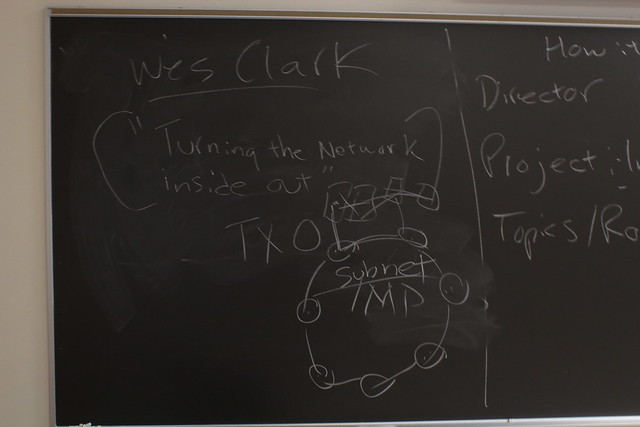
BlackBoard from Class 5-22-14

Black board from Class 5-22-14

One of the anecdotes related in The Wizards that Stay Up Late that I love occurs during a meeting in Ann Arbor, Michigan in 1967. It was a meeting of all of ARPA‘s principal investigators intended to hash out the architecture of what the ARPANET network would actually look like. Computer pioneers like Larry Roberts, Bob Taylor, Doug Engelbart, Len Kleinrock, and many others, were in attendance. The idea of how to link the various computers at each of the four universities that would make up the original network was being discussed. Fact is, many in attendace didn’t necessarily see the need for resource sharing via a network, they had everything they needed on their own computer.

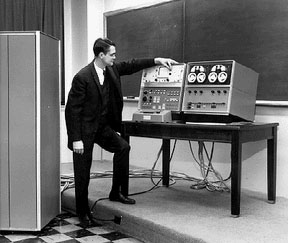
Wes Clark and the LINC, Lincoln Laboratory, MIT, 1962

On top of that, the challenge of making four distinct host computers talk to one another seemed far too much work to warrant something few people seemed to need. As the conference was ending, Wes Clark (one of the pioneers of personal computing) passed a message on to Larry Roberts: “You’ve got the network inside out.” The idea was an interesting approach to the challenge of conencting the computers:

 Leave the host computers out of it as much as possible and instead insert a small computer between each host computer and the network of transmission lines.

The way Clark explained it, the solution was obvious: a subnetwork with small, identical nodes, all interconnected. The idea solved several problems. It placed far fewer demands on all the host computers and correspondingly fewer demands on the people in charge of them. The smaller computers composing this inner network would all speak the same language, of course, and they, not the host computers, would be in charge of all the routing. Furthermore, the host computers would have to adjust their language just once—to speak to the subnet. Not only did Clark’s idea make good sense technically, it was an administrative solution as well. ARPA could have the entire network under its direct control and not worry much about the characteristics of each host. Moreover, providing each site with its own identical computer would lend uniformity to the experiment.

I love how the idea of the subnetwork solves the issues of each of these machines talking to one another, and this is exactly what Larry Roberts architected into ARPANET. Each of the original four universities on the ARPANET had a Interface Message Processor (IMP) that linked with their computer and was networked with the other three. What I love about the anecdote was that the idea came from Wes Clark, here is the rest of it from WTWSUP:

The most curious thing about the idea was that Clark thought it up. He hadn’t been paying much attention to the proceedings in Ann Arbor. In fact, he was a bit bored by it all. He had already told Roberts in no uncertain terms that he had no desire to put his computer at Washington University in St. Louis on the network. Clark was not friendly toward time-sharing, or even resource-sharing. He had been working on computers designed for individual use and saw no particular reason to share his facility with people on a network. But when he heard the discord over how the ARPA experiment should be deployed, he couldn’t help but hazard a suggestion. Perhaps it was Clark’s antipathy toward time-sharing that enabled him to think of this. By assigning the task of routing to the host computers, Roberts and others were essentially adding another time sharing function. Clark’s idea was to spare the hosts that extra burden and build a network of identical, nonshared computers dedicated to routing.

The historicizing of how these ideas came about is not only fascinating on a technical level, but even more so on a human one. The stories around the individuals who were imagining this remarkable invention make it all real for me. Something imagined and built by poeple with all kinds of different ideas, perspectives, and antipathies. For me this anecdote is a great example that even the most important breakthroughs can be contributed  by someone who isn’t even interested in the project. It’s actually the best argument for sharing resources against one’s will you can make 🙂

Posted in The Internet Course | Tagged | Leave a comment

Alan Kay: Doing with Images Makes Symbols

Alan Kay's Doing with Images Makes Symbols Pt 1 (1987)
I have to thank Michael Berman for sharing a link in this comment to a 1987 video featuring Alan Kay discussing the history of computer interface design. It’s really an excellent history lesson in the development of human interfaces for computers. He discusses Ivan Sutherland‘s groundbreaking Sketchpad, Douglas Engelbart’s Mother of All Demos, the FLEX MachineSeymour Papert’s LOGO, the RAND tablet and  Smalltalk. It’s really compelling to listen to Kay frame these various developments so clearly and intelligently. This video is gem if you want a  solid history of human intereaction with computers from the 1960s through the early 1980s.

Posted in The Internet Course | Tagged , | 3 Comments

#tic104: Wrapping Week 1, Look Forward to Week 2

We covered a lot in class today, and that goes for week 1 more generally. I’ll be writing a separate post about our discussion of chapter 2 of Where the Wizards Stay Up Late, so this post will mainly be covering deadlines, requirements and what to expect as we move into week 2.

Research and Summaries
The researching and summaries are coming along, though a couple of folks need to get the ball rolling on this pronto. Life moves pretty fast during summer session. If you don’t stop and do your work once in a while, you could fail it.

ferris-quote_small

Six summeries due today, six more by this Saturday at 11:59 PM. Let us know if there are any issues. Also, reminder that next week there’s no class on Monday, May 26th, but we will be making that day up by meeting Friday, May 30th.

Additional Readings

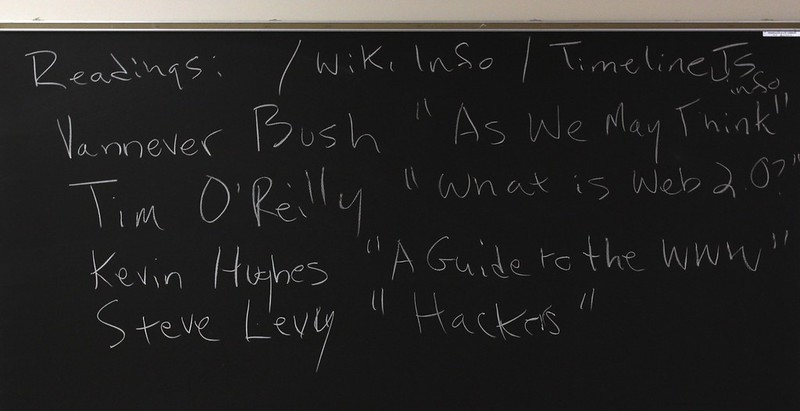
Readings for Week 2

A few more readings for next week:

Steven Levy’s Hackers doesn’t really work here. While I wanted more historical context for the 70s and 80s, much of this is hardware and software rather than internet—so one less thing to do.

The Internet Course Wiki
I’ll be adding each of you to The Internet Course wiki, you can see the week two page here.  The tutorial for how to use MediaWiki can be found here. Both pages link off the main page of the wiki. The wiki should be a space you all start tracking add your contributions, sharing links, and generally organize the resource you’ll be building for Week 2.

Week 2 Project: History of the Internet Timeline
Kimberlee and Alex will be the directors for week 2, and we decided during class that the overarching project we will be building is a timeline of the Internet, which will be due by 11:59 PM, Monday, June 2nd.

The ARPANET research group from last semester has kindly agreed to let you copy and build on their timeline on the early history of the internet that they built in TimelineJS. So you have a  great start, you only have four and a half more decades to go. ROughly a decade a day next week!  I’ll share the spreadsheet with all of you, and we’ll talk about how to use it Tuesday.

You all might want to start brainstorming and communicating via email, Google Docs, on the wiki, etc. How to handle this precisely will be up to this week’s directors to decide.

Posted in The Internet Course | Tagged | 1 Comment

Computer Networks – The Heralds Of Resource Sharing (Arpanet, 1972)

While writing my last post about today’s discussion in the Internet Course, I stumbled upon this 1972 gem of a documentary by Steven King (not that Steven King) about the formation of ARPANET. It’s 30 minutes long and features many of the minds behind the internet, including J.C.R. Licklider, Donald Davies, Larry Roberts, Fernando J. Corbatò, and several more. This is an awesome discovery, and given its on the Internet Archvie it’s most likely in the public domain and feely distributed and re-used. Yay!!! This might prove to be a nice resource for next week when we focus on the History of the Internet more intently as we build out a resource around it.

Posted in The Internet Course | Tagged , | 10 Comments