After re-watching The Searchers (1956) for episode 43 of the Family Pictures Podcast, I was struck by the way director John Ford constantly uses thresholds or portals to visualize the moral structure of the film. It isn’t so much about the chase, the raids, or even the racism that drives the narrative—it’s this idea of space. Doorways, caves, and framed interiors recur throughout the film as a way for Ford to think through the central contradiction of the Western: the violence that creates the domestic world is the same violence that must be kept outside it.
The film opens from inside the Edwards cabin looking outward as Martha opens the door to Monument Valley. The domestic interior—order, family, light—is instantly placed in visual opposition to the vast, blinding wilderness. And then Ethan (John Wayne) rides into the frame from that wilderness. From his first appearance, he is already a figure of the threshold: half inside civilization, half permanently outside it.
This is a Western that tells us immediately: entry into the home is conditional. Once the Edwards homestead is destroyed, the threshold no longer protects—but rather conceals. Ethan prevents Martin (Jeffrey Hunter) from entering the ruined house to see the bodies of Martha, Aaron, and Ben. The doorway that once separated safety from danger now separates knowledge from survival. Trauma is contained, not shared.
When Lucy is later found dead (likely sexually violated), Ethan again seals the threshold with silence: “Don’t ever ask me about it.” Violence becomes something the patriarch absorbs alone, not to heal, but to keep the structure of the family psychologically intact. The burden of blood is individualized so the myth of home can persist. This is the quiet logic the film never let’s us ignore: domestic peace requires someone else to carry the violence.
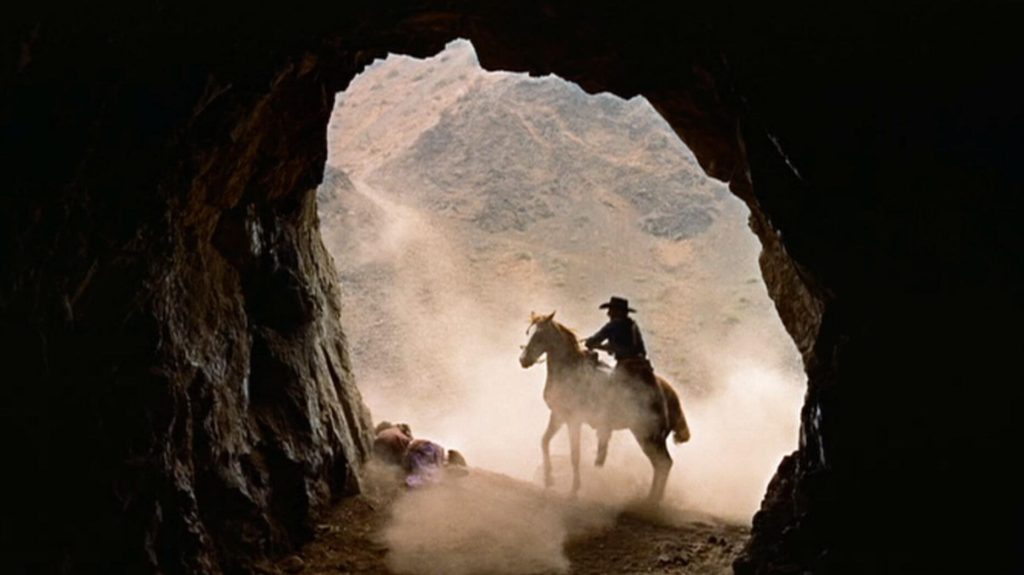
Threshold of the cave where Ethan finds and ultimately saves Debbie
But not all thresholds are doors—some are caves. The cave where Debbie (Natalie Wood) hides later in the film becomes the darkest version of the threshold: a space between worlds, between white family and Comanche family, between rescue and execution. Debbie has crossed a racial and cultural boundary that Ethan believes marks a point of no return. At the fort earlier while visiting the women and children rescued from their removals, he declares of them: “They ain’t white no more.” Race, for Ethan, is not blood, it’s contamination.
This makes the cave scene unbearable. For one moment, the film seems ready to fulfil its most brutal conclusion: that Debbie must die to preserve the fantasy of racial purity. There is no way she can return across the threshold alive. Instead, Ford breaks his own moral machinery. Ethan lifts her as he once did when she was a child and says, “Let’s go home.” It’s an act of mercy, but it does not redeem the system that made murder feel inevitable in the first place.
The film’s closing image mirrors its opening. Again we are inside a doorway. Debbie enters the domestic space. Martin follows. The family reforms itself inside the frame, but Ethan remains outside. He does not attempt to cross the final threshold. He turns away and walks back into the wilderness alone.
This is the Western’s deepest confession: like we saw in Shane, violence may found and protect the home, but it can never live inside it. It must be expelled. Not because it has been defeated, but because the illusion of domestic peace depends on its disappearance from view. Ethan’s exile is not justice, but rather displacement. The violence does not end as much as it simply moves offscreen.
What makes this reading of The Searchers so unnerving today is that this logic still structures our world. Systems built through violence like colonialism, extraction, racial hierarchy, surveillance, etc., still require that violence to be hidden in order for everyday life to feel “normal.” Someone else always absorbs the cost so the interior can remain warm.
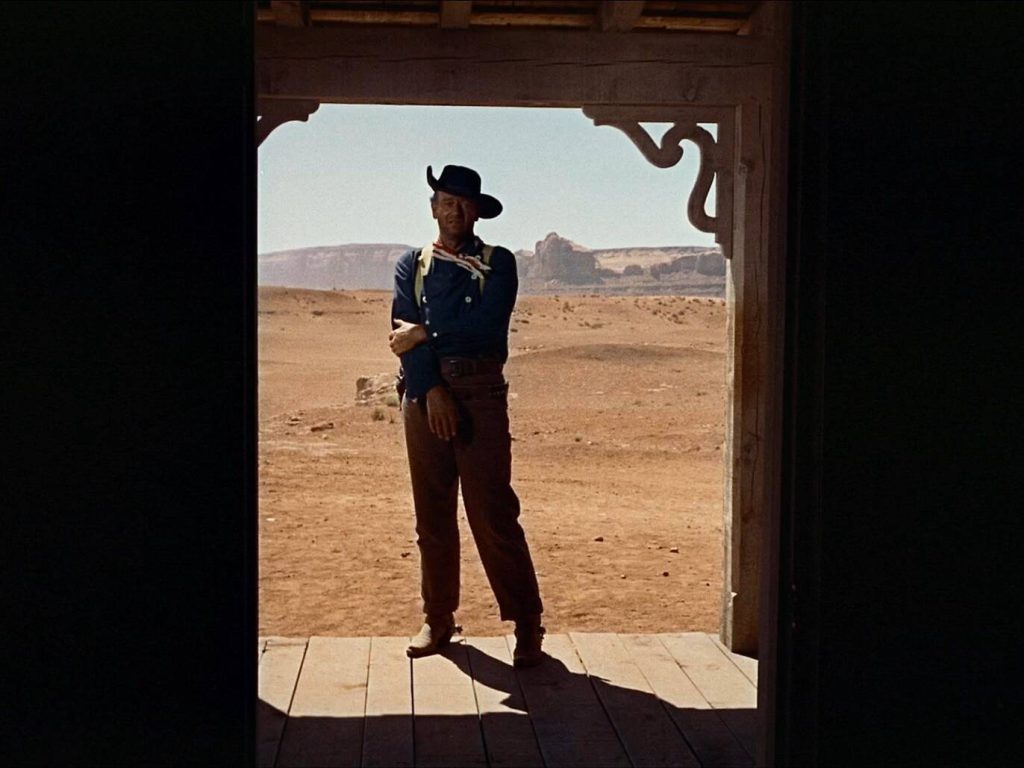
Ethan standing uncomfortably at the threshold of the door to his Bjornson’s home to close the movie
The Western once imagined this as tragic necessity. The Searchers goes further: it shows us that the man who makes the home possible is the same man who can never belong to it and that might be the most honest thing the genre ever admitted.
I want to see Tommy doing charcoal drawings of these. They’re pretty much custom made for that kind of drawing.
I agree, I have to convince him the Western is valuable, been a hard sell. But one of the artists on Youtube only draws and paints Western scenes, so that might be my leverage.
You an go full circle with Moebius and the comic he was doing for years https://en.wikipedia.org/wiki/Blueberry_(comics)