
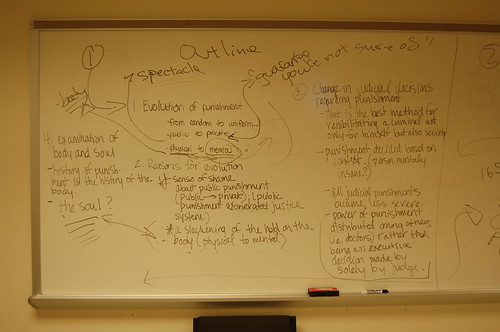
OK, so last night’s class was so inspiring (a.k.a. sick) that I thought I would blog about it right quick. I have been leaving traces of some of the resources I have been finding on YouTube, and alluding to some ideas about categories, tagging, and WordPress -but last night demonstrated a couple of amazing things for me. The image above is the last “physical’ remnant of an amazing discussion about the first chapter of Michel Foucault’s Discipline and Punish, “The body of the tortured.” This chapter is, in many ways, a twenty-eight page outline of his overarching argument throughout the rest of the book, he defines the terms of transformation for crime, criminality and the penal system as well as his methods and notion of body, soul, power, knowledge and genealogy. Amazing stuff, yet for the last ten to twelve pages this chapter is intensely dense and abstracted to conceptualize the fields of power in relationship to the im/materiality (a necessary forward slash) of something he terms the “Soul.” In fact, an extremely difficult concept that walking in to class I was not certain I could entirely get my own head around, no less articulate intelligently. I’m glad I wasn’t alone in working through this text! In effect, the discussion was a distributed space of attempting to work through his argument using the tools to define the overarching points he outlines throughout the chapter, as well as a focused close reading of particular sections of the text.
But this post is not about how well the class went (well, it is, but not really) or how good a teacher I am (well, it is, but not really), yadda, yadda, yadda, it’s about an approach I stumbled upon while discussing the notion of history, categories, and generalizations with my wife, Antonella. The approach is quite simple: have the students respond to each and every reading through the class blog by selecting three or more categories that define their understanding of the text, then they need to explain their choice of this category (which is wide open) with a close reading (read more about the approach here). Simple enough.
While preparing for class yesterday and foregoing an awesome conversation with Laura Blankenship and a whole host of folks from Faculty Academy, I started to think about how I was framing (through my “lecture” notes) my own reading of this chapter (you can see them on the class syllabus/wiki here) according to a very structured notion of his argument. This approach was the very thing that would provide me a way to start talking about this insane text in some orderly, syncopated fashion. So, it dawned on me that they have all done the reading, they have created their own categories independently on the blog about this reading, why not ask them to take the first 20-30 minutes of class and do something similar. Can they together, as a class, outline the argument Foucault is making throughout this chapter on the board? I asked them as much, left the classroom for a half an hour, then came back -and wow! I have never, ever, in my now eight years of college teaching had a groovier experience in my life.
What you see in the image above is an outline (a trace) that they created together and thereafter were each asked to explain its logic at some length. What is the trajectory of the chapter, where is the evidence for this reading, what do you think Foucault means by “loosening hold upon the body?” How do we understand the notion of body in this text in relationship to what he terms the soul? What is the “medico-juridical complex”? It was all there, I wish the outline on the board was even more indicative of the rich, brilliant discussion that emerged from them explaining their readings to me, both individually and as a class. I was blown away, everyone was engaged, everyone had something to say, and the argument/reading was theirs -I couldn’t help from chiming in because I wanted to play too!
Moreover, the class ended in an epiphany of light when one student reading the following two lines quite closely and beautifully summarized our entire discussion, “A ‘soul’ inhabits him and brings him to existence, which is itself a factor in the mastery that power exercises over the body. The soul is the effect and instrument of a political anatomy; the soul is the prison of the body.” I fumbled around to do the teacherly thing and rephrase it, but couldn’t -she nailed it! She framed and summarized the class better than I ever could have. And, me, well I was all fired up. So fired up I had to go and find a camera and take a picture of the white board to remind myself of this class for a long, long time.
What does this all mean? I don’t know exactly, and the class is still young and things could still flop (I’ve had one of them all too recently!). For the moment, however, my thinking about language, categories, definitions, tags, and taxonomy more generally due to my work in instructional technology and a general engagement in the concepts and issues surrounding the questions of knowledge, relations of power, the body, and the “soul” in this fascinating line of work made me a much better teacher and student, at least for an ever-fleeting two and a half hours.

Jim, this class can only and irreversibly be called a success. You may never again reach the pinnacle that you reached last night, or maybe you will surpass it in a night in the future. It sounds like you did everything right. Plant the seed, wonder if the students would get it, LET THEM ALONE to figure it out, and then beg to get back into the game. Not only that but you are capturing digitally the whole thing. Anything else that you do this semester is gravy because you have already taught them how to THINK in this class. Way to go!
Oh and “right quick?” That is a total Southern phrase. Welcome to the South! 😉
Bwahahaha!!! Soon he’ll start whistling Dixie!
Seriously, Jim, this is an amazing description of a class that obviously affected you and your students deeply. I couldn’t put my laptop down!
Thanks for sharing.
Martha and Andy,
Funny enough, we were talking about the idea of power and knowledge as a relational notion, something I really started to understand once I joined Dat LAt! In fact, I find I am channelling the edtech folks, DTLT, and other UMW faculty, all the time. The ways in which we all move within and between disciplines and grapple with far-ranging conceptual ideas in the work we do has been invaluable for me in just about every as pect of my being. So, in fact, you were both (as were several others) an integral part of that class last night -a perpetual, communal teaching beta (or is it motion machine?) -to quote McClurken.
Wow – is to too late to add your class to my schedule? 🙂 Great work Jim – looking forward to hearing more about it in the bullpen soon.
I bet your students love you! I can’t wait to see/hear more classes.
Pingback: instructional technology » Blog Archive » Tales from the Teaching Crypt: Discipline and…
Again I’ll have to reiterate how I am jealous of all the lucky students who get to take your class. I can sense from your post how intense it is, I was holding my breath as I was reading. Can’t wait to see how the rest of the course goes, keep at it Rev. Jim, I mean Prof. Jim.
@Jerry -You can only take my class if you don’t pick on me the whole time 🙂
@Laura: “But does fear last longer than love?”
@Shannon To be honest, I’d actually suggest you lament missing Gardner’s second session “From Mimex to YouTube” Class -now there’s a vision, praxis, and genius that is going to be unleashed on students in good ol’ Freddy very soon. He won’t let me take it until the second go around:( Mary Wash rocks! And, dare I say ELS in particular?!
Dear Jim,
You are running so hot these days, I am afraid your cerebral core is in danger of meltdown.
Yr slavish admirer,
Brian
You declared, “I wish the outline on the board was even more indicative of the rich, brilliant discussion that emerged from them explaining their readings to me, both individually and as a class.”
How often I’ve had the same thought. Wouldn’t it be cool if we could record our class sessions and make them more broadly available to folks? Realistically, I probably wouldn’t want to save all of mine, but certainly the ones that work out as well as this session did.
Jim… last night, from Kung Fu Panda, I learned that there are no coincidences. But, in looking for web resources for teaching Foucault’s first chapter in my Sociological Theory course next semester, I found this wonderful post.
The non/coincidence lies in two places. First, I have been using wordpress blogs – since leaving blogger – in my classes seeking to generate what you succeeded in getting. Three to five students post engaged/critical summaries of each days readings two nights before class meets followed by, the night before class, three to five responses. In the best of classes, this web exchange translates into the students starting the class by further developing their points. In the more common situation, I review what they’ve done, asking questions along the way, in order to tease out from them a tendency to teach each other than to rely on me. Learned this in a grad seminar at UC Santa Cruz.
The second element lies in there being an open position in Sociology – with a focus on sociology of science and environmental sociology – at Mary Washington that I’m really interested in… and one thing I’m always intrigued by is how actively faculty use instructional technologies like blogs, wikis, google docs, etc. Very cool.
Jim, I just stumbled upon your blog while googling for ideas for my own class I’m teaching in (gulp) one week’s time. I’m putting together the syllabus and looking for secondary reading materials. My class is Le roman policier, in French, a class that traces the genre from Poe (Baudelaire’s translation) to contemporary stuff.
First of all, bravo on this post! I would love to try something similar. My question to you is 1. is this a grad or undergrad class? 2. Did you say it was the first class meeting? Or second or something? 3. In what department was the class offered?
Thanks for the inspiration!
I just used a modified version of this format to teach selections from Discipline and Punish, and it was amazing! Rather than ask my students to outline the argument, I asked them to (1) conceptualize disciplinary power, (2) describe the panopticon and explain it’s significance to Foucault’s argument, and (3) conceptualize docile bodies. I was planning to leave the room, but I chickened out (**what if they all just left?!**), and ended up pacing around the room reading my copy of the text as my students worked their way through their own. I had them work in groups of 5-6 rather than as a class and it was so fun listening to them read passages to one another and try to understand them.
They wrote all kinds of fascinating quotations on the board under the corresponding questions. (I had to push the first group to go up and write, but after that the flood gates really opened; there was even a line of students waiting to write on the board!) They brought up most of my “go to” passages in the text all on their own.
Thanks so much for this post. It truly generated a meaningful class for my students and myself and I’ll certainly remember it for a long time.
Taught this today as a theoretical intro to a lit class focused on crime and punishment, using your suggestion of letting the students outline. It went really well! Thanks for making this public and talking about your approach.