

Part of what’s been interesting at Cloudfest 2026 Gen Xfest beyond the AI bonanza—which feels like oxygen casino’s pump into the room to keep people gambling—is the notion of Europe reclaiming its digital infrastructure from big US hyperscalers (AWS, Google, Azure, etc.). Session after session, vendor stand after stand, announce a strong, unified front that Europe is launching a not-so-subtle revolution by declaring independence from the US cloud.

More than a few vendor/presenters* suggested this insurgence is being fought with tightened economic-zone RFP requirements that will force institutional purchasing to “re-align,” or come back home 🙂

What’s very clear is there’s big money to be had, and that might be why folks are almost as giddy about this declaration of independence as they are about AI. In fact, it could be argued that this push for digital sovereignty is even bigger than AI given it will not only define the conditions of these new EU clouds, but also how tools like AI are regulated within them.

One of the most prominent corporate sponsors, HPE, is a company I wasn’t familiar with until realizing it was an acronym for Hewlett Packard Enterprise. Hmmm, European-washing? I guess if you change the name you might get access to the game? The presenter was strategically Danish/American (the Europeans are not going to forgive the Greenland advances anytime soon!) and made a point of highlighting that.

David Cattler’s talk was a breath of fresh air. He was damn sharp and he did his homework. His take, from the point of view of a self-proclaimed “reformed regulator,” was that trust was becoming the new infrastructure in Europe—more important than cost, speed, and reliability. Right now US companies don’t have it and this will make business in the EU a slog at best, near-on impossible at worst. Thanks Obama.

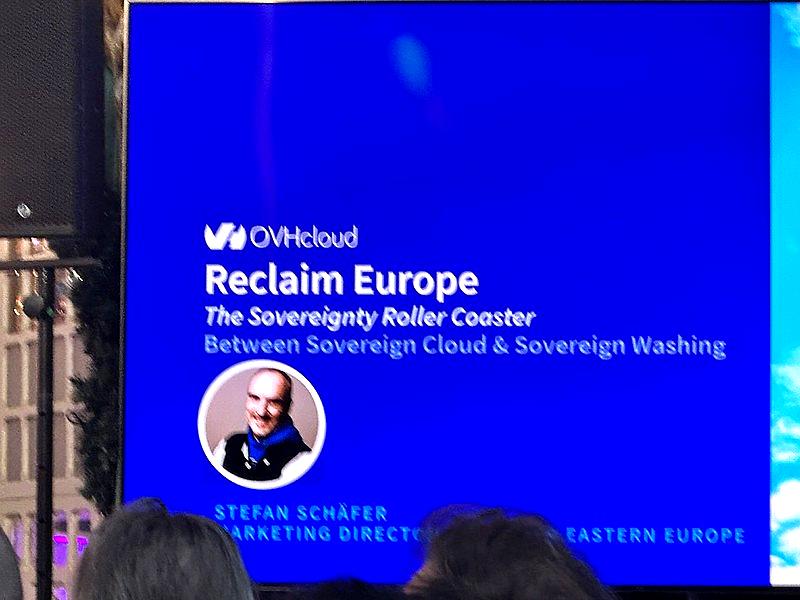
The “Reclaim Europe” movement was everywhere apparent, and OVHcloud’s presentation was lowkey hostile to US cloud providers, even though it seems France/OVH has its own issues with tech ‘freedom’. Nonetheless, can’t blame the bad blood given US tech companies are doing everything they can to erode trust. That said, this isn’t a conference you would expect big cloud vendors taking shots.
Even Canada was in the crosshairs of being removed from OVHcloud’s circle of trust given an ongoing case in which a thr RCMP are demanding data from an OVH server in Europe. The outcome of that case could determine whether the firewall between OVHcloud EU and US infrastructure extends to Canada. It’s interesting because the borders between nations and economic zones are now re-writing themselves in the cloud, and that might be the biggest lesson of Gen Xfest.

This is very much a “Europe First” movement and the data centers need to be in Europe and the employees need to be working in and paid by EU companies. The lines are being drawn pretty clearly.

The OVHcloud presenter, Stefan Schafer, is the only person I heard actually trying to define sovereignty, as well as looking specifically at the various domains that covers.

The sovereign-washing has already begun, or at least the various providers are accusing the others of just that. Whose more sovereign than whom? SAF!

What comes with the discussions of sovereign is a return to servers. Now this is my first Gen Xfest, but I’ve not been at a conference where I’ve actually seen hardware. To be fair this is my first big hosting conference, but there was a lot of heavy metal!

There was even an 90s living room, I felt seen 🙂 I have no idea what company this was linked to, but I loved it—a much needed break from the endless images of server racks.

Also, GDPR was definitely invoked again and again, but there was no mention of all the unbearable click-throughs it has forced upon us.

I’m no Tom Woodward behind the camera, but I tried to capture something of the zeitgeist of this sovereignty uprising as told by the vendor booths.

No compromise! European cloud.

Again, if you have a European cloud you will need European security for that European cloud.

Take the elevator to the European Cloud level.

This was fun, and also highlights how so much of this push for sovereignty is a reaction to the irresponsible and unpredictable actions of the US president. What’s more, there were no US apologists to be found, all the tech companies I saw seemed fully on-board.

“Make Cloud Yours Again.”

Get your sovereign cloud in-a-box

That idea of trust is what is undergirding all of this. Put bluntly, the trust between Europe and the US has got to be close to an all-time low post WWII. The fascinating piece is that all of that is being mapped onto the cloud and a new world of real and stringent digital borders seem to be the logical next steps.
_____________________________________________
*There is no distinction from presentation and sales pitch at this conference—and next to no questions taken.

I am doing a talk (more trying to instigate a conversation) in early May for a bunch of librarians titled “Digital Sovereignty: What is it, Why it Matters, And Why it’s Difficult” and as usual I have to fight my tendency to scream “oh so you’re finally waking up sheeple!” Because that’s probably not very helpful.
But, like, this article was written 10 YEARS AGO https://medium.com/@brian.greenberg/there-is-no-cloud-its-just-someone-else-s-computer-fe8b62a027a5 and to be honest, was already totally obvious at that point. I guess Mark Carney was right, it took the US “electing” a criminal before the rest of the world woke up to the threat and how it had been happy to coast along and enable until now.
Scott,
Absolutely right, and it was interesting because the whole shift to talking about hosting in terms of computing versus hyperscaling or the CLloud pretty much simply meant getting of US servers. I totally understand it, but th real problem that more than a few folks brought up is in that 10-15 years Europe lost a ton of expertise and opportunity so now things will be a lot more expensive. It’s some edtech is having to deal with now too, the last 10-15 years has been offloading so much expertise to vendors that it’s almost hard to remember what it is we did.
But I have the say the final talk from Brewster Kahle helped remind me of the good internet, and I am saving that one for last. It would have been fun to have you at this conference with me, as much as you would have hated it. But I think it suffered from very few people pointing out the obvious—that what pushed me to blog just to make sure if anyone was looking there may be some meager counterpoint out there.