
I’m trying to catch up on some of my thoughts that I’ve been circling as a result of recent episodes of the Family Pictures Podcast, which continues to be an absolute blast. We’ve started to dig into Westerns with our “Frontier Families” series, and it’s amazing how fertile the thematic soil is out there 🙂 In fact, this post is evidence of just that. I’m moving past just getting comfortable with having watched and discussed the films, and I’m trying to push myself to reflect on some of those themes on the bava—to try and integrate them into something that’s somewhat cogent and cohesive. One of those is the idea of home, labor, and the persistence of the American dream.
For many reasons, the postwar boom of the 1950s reaffirmed the idea of the home as paramount, even as it quietly struggled to account for the violence it had been built on (arguably the long shadow of World War II). What struck me on the recent clustered watching of Shane (1953), The Searchers (1956), and The New Land (1972) is how much more legible the Western suddenly feels as a framework for our current moment: a kind of technological feudal state ruled by data barons and platform ranchers. Replace cattle with user data, land with digital infrastructure, and homesteads with content channels—and the frontier logic starts to look eerily familiar.
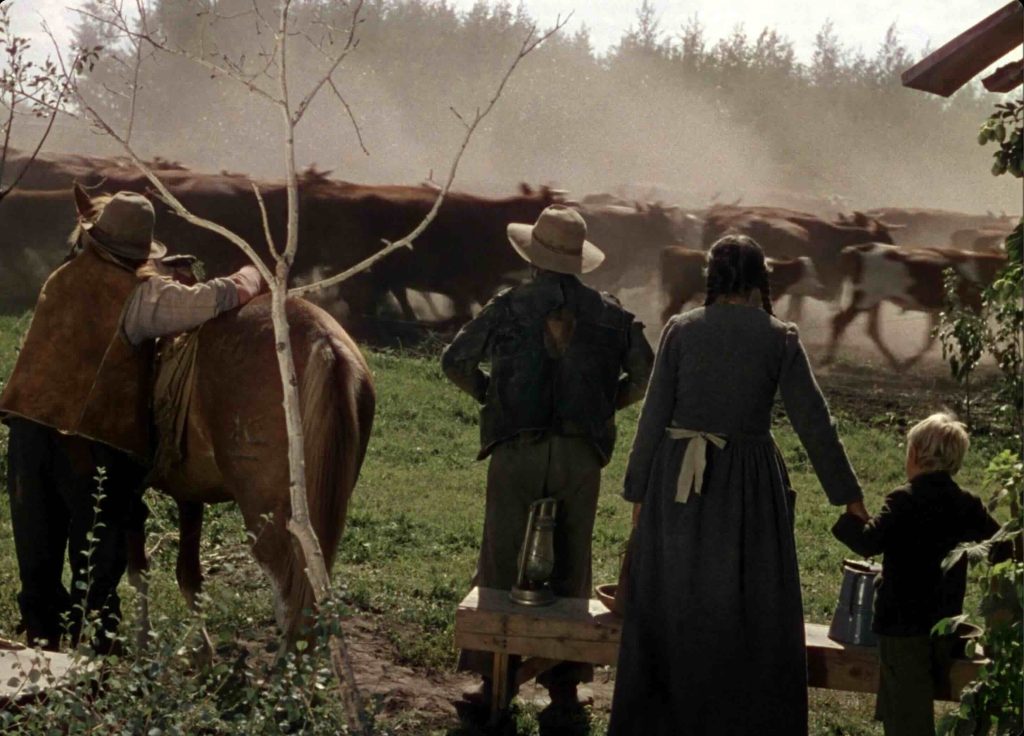
Ryker running cattle through one of the homesteaders’ crops in Shane
What unites these three films is their shared obsession with family as both refuge and burden—home as something fought for, sustained through labor, and endlessly threatened by larger systems of extraction and power. In Shane, that struggle takes its most idealized form in the way the homesteaders gather quietly at Grafton’s Store to decide whether they will finally stand together against Ryker and his hired guns. This isn’t a heroic rally—it’s a whispered, fearful negotiation conducted inside the very space where credit, supplies, and survival are brokered. The economic center of the community becomes its political nerve center. Even the famous stump-pulling scene wherein Shane (Alan Ladd) and Joe Starrett (Van Heflin) are straining together to tear dead weight from the earth—turns frontier labor into a WPA-like metaphor for collective resistance. This is work that is still visible, shared, and socially meaningful: muscle against muscle, bodies against power, community against enclosure.
The Searchers fractures that optimism almost immediately. The Edwards homestead is not defended—it’s annihilated. The burned cabin and slow revelation of the massacre mark a darker turn: the family as collateral damage of a violent system that cannot be reformed through solidarity alone. Ethan’s (John Wayne) obsessive pursuit masquerades as rescue, but it increasingly resembles a closed circuit of rage and racialized violence that produces nothing but more ruin. And yet John Ford ends on that excruciating doorway shot—Ethan framed outside the domestic world he helped restore but can never inhabit. Home survives, but exclusion is baked into its foundations.
Then The New Land strips the mythology down to the ledger of survival itself. Now the frontier is no longer a site of moral testing through gunfire, but of economic and bodily endurance through labor. This is nowhere clearer than in the blizzard scene, when Karl Oskar (Max von Sydow) kills the family’s prized ox and cuts it open to warm his freezing son. This is not symbolic violence—it’s pure, devastating utility. The family is preserved, but only by liquidating its most valuable asset. Frontier heroism becomes an act of emergency economics. Survival here looks eerily like what we increasingly recognize as modern precarity: sacrifice without security, endurance without upward mobility.
Together, these three films form an accidental but coherent trilogy about labor and enclosure. Shane imagines labor organizing itself into collective resistance. The Searchers exposes how violence and exclusion hollow out that project. The New Land shows us what remains when both redemption and triumph are stripped away: labor reduced to survival under conditions it did not choose.
That historical arc makes the turn to science fiction feel less like a genre shift than a political inevitability.
Earlier this week, I watched Outland (1981), starring Sean Connery as Marshal O’Neil, and the contrast couldn’t have been sharper. What struck me is how many sci-fi films of the 1980s now feel less like speculative fiction and more like corporate realism: massive companies committing routine atrocities while everyone shrugs, logs the harm, and clocks back in. It turns out Peter Hyams originally wanted to make a straight Western, but after Star Wars the genre was commercially radioactive. So he took the story of High Noon and reframed it as a sci-fi tale set in a mining colony on a moon of Jupiter.
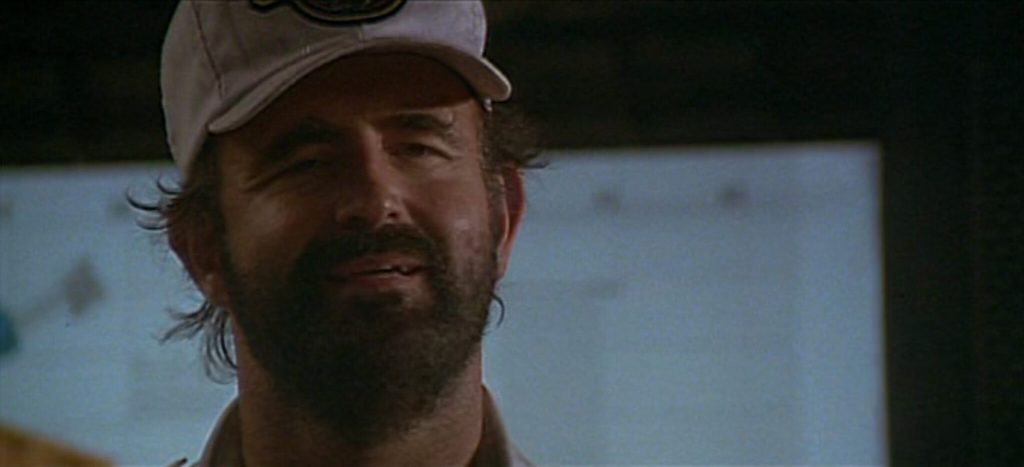
Peter Boyle plays corrupt mine manager in Outland, reminding O’Neil he’s just part of the machine
This is where the genre fork becomes unmistakable. The Western asks whether justice is possible. Sci-fi increasingly assumes it’s not.
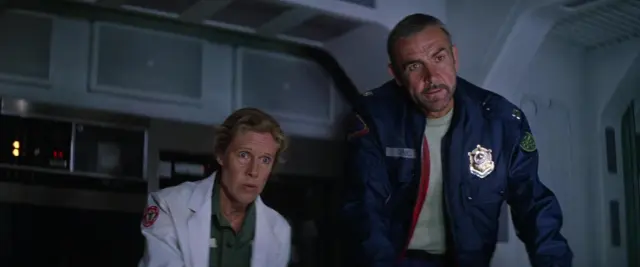
Outsiders O’Neil and Lazarus (Frances Sternhagen) resist the company despite its futility in Outland
Compare that to the climax of Shane, where the hired gun walks into town so the family doesn’t have to—where violence is still imagined as tragic but socially meaningful, a necessary risk taken on behalf of a collective future. In Outland, violence is procedural. Replaceable. Already absorbed into the operating costs of the system.
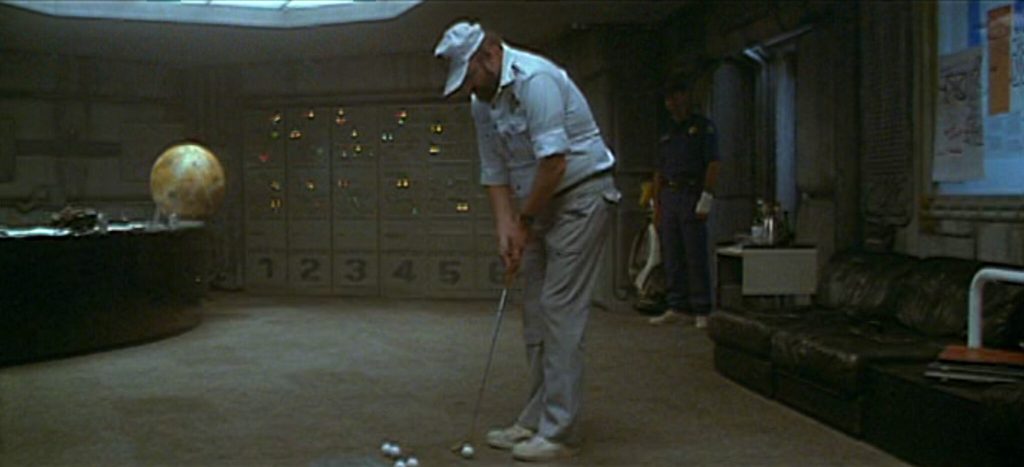
“If you’re looking for money, you’re smarter than you look. If you’re not, you’re a lot dumber.”
What makes The New Land so crucial in this sequence is that it anticipates our present more accurately than either genre alone. It neither indulges the Western’s moral clarity nor fully embraces sci-fi’s corporate nihilism. Instead, it locates meaning in exhausted persistence: Kristina’s (Liv Ullman) childbirth in the face of loss, meals scraped together from scarcity, freezing migrations across impossible terrain. The frontier is no longer conquered—it’s endured. The family doesn’t defeat the system; it outlasts it, barely.
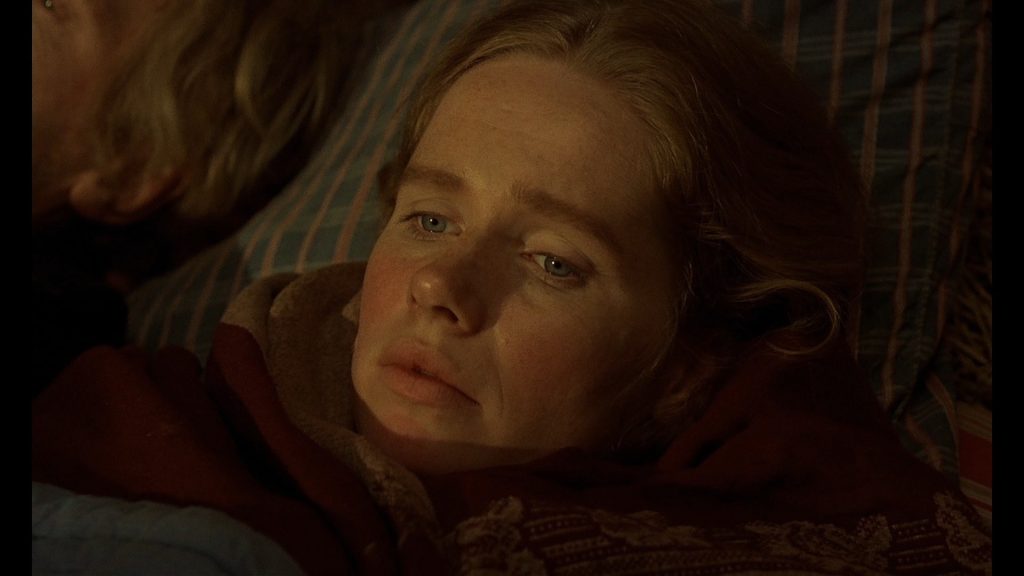
Liv Ullman as Kristina in The new Land, brilliantly epitomizing the existential angst of a young wife and mother 7,000 miles away from her native Sweden in the Minnesota territories
And this is precisely why, in a strange reversal, science fiction now feels less speculative than the Western. Corporate dystopia no longer requires imagination—it has become infrastructure. Platform capitalism, algorithmic enclosure, and digital piecework have normalized a world in which labor is endlessly extracted, risk is individualized, and resistance is systematically defanged.
Which is exactly why the Western suddenly feels urgent again. Not as nostalgia. Not as cosplay. But as a symbolic language for imagining collective resistance, moral accountability, and solidarity at a time when platform culture insists that all three are obsolete.
If sci-fi taught us how the system wins, maybe the Western is where we relearn how people fight back.

Jack Palance .. The Meanest Guy That Ever Lived https://youtu.be/mkYku5mmPag?si=I4-4AZJA6VZ0vDwJ
Watched Silent Running a couple weeks ago – a space western: doomed outlaw pursued by a posse sacrifices himself to resist and preserve his ideals. https://en.wikipedia.org/wiki/Silent_Running
Definitely out of the Sci-Fi movies that hit the market from 2001: A Space Odyssey onward, the Corporate entity, viewpoint got diffused and permeated the story. Dunno if that was Kubrick’s intent or merely an observation. Our “own” space program at that point in time wasn’t owned by Hilton Hotels or American Airlines for sure. But I can tell you they were owned by North American Aviation, Rocketdyne, and Grumman Aerospace (and lucky for us NASA didn’t allow branding back then, can you imagine?!)
Anyways, a proposed future is always better than a hopeless one. And anything that can suggest a possible better one is a relief. A New Hope (Lucasian style) is not the new hope. It is Shane as you point out, that is truly the new New Hope.
Now the bava blog intensity is HOT there’s sparks flying off the pages. Thanks for the window into “The New Land” new to me. Wondering about any influence of the times the films were made, that one in the 1970s vs the first two in the 1950s.
And I’m digging into your looking beyond the usual “Sci fi as westerns in space”, although it’s a tinge of nostalgia from my ninth grade English class when Miss Walker announced a field trip to the movie theater to see a new film that was a Western, indeed for me like this opening credits was a long long time ago…
Anxious to tune in to the next episode with MBS.
God I love this:
“a kind of technological feudal state ruled by data barons and platform ranchers. Replace cattle with user data, land with digital infrastructure, and homesteads with content channels—and the frontier logic starts to look eerily familiar.”
cattle as user data = soylent green is people
land as digital infrastructure = death stars
homesteads as content channels = Fahrenheit 451, “seashells” and “palor walls”