
David Wiley’s post about using WordPress.com as OpenCourseWare to republish a course of his has me excited. The site looks pretty damn sharp. Very clean and easy to scan, an excellent model for using these tools to create attractive, low-overhead sites.
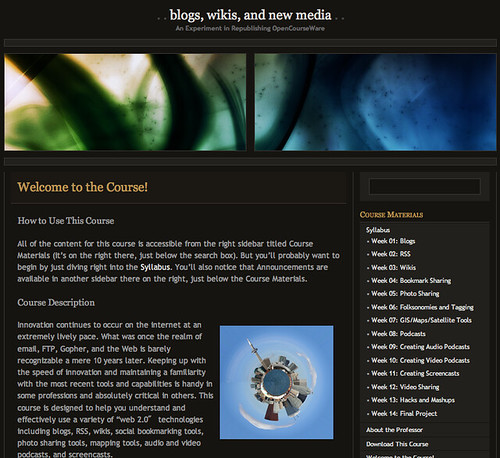
And after talking with the other David Wiley re-blogger, I was yet again energized by the idea that LMSs are inefficient, expensive (even in the case of Moodle after an institution takes the hosting bath), educationally useless and technologically defunct — an easy line of reasoning for many conscious individuals to venture down, mind you. Making this well thought-out and designed course syllabus (accompanied by numerous resources) that much more encouraging. And while these resources are in many ways already published on the web in one repository or another, making them freely available online in social networked services like WordPress.com, Blogger, TypePad, etc. still seems so much more akin to making this stuff open in the regards to being discovered through serendipity, search engines, etc.
But most importantly, examples like this will help turn people on to an educational publishing platform that anyone with a pulse could use to republish their own work online in minutes, literally. A loosely joined OpenCourseWare, is still OpenCourseWare in my humble opinion 🙂

Thanks for the lead, Rev… great resource and model.
If you like that, Luke, check out D’Arcy Norman’s OpenContent DIY wordpress.com site that takes you through how to do in a few simple steps. A great resource: http://opencontentdiy.wordpress.com/
Many blogging platforms allow you to import a series of posts via an RSS feed.
The OpenLearn OER site ( http://openlearn.open.ac.uk/course/index.php ) produces full content RSS feeds of all the OpenLearn units, which means they can be easily imported in to many blogging platforms (you may have to reverse the order of posts in the feed by passing it through a basic feed processor, so that the reverse chronological ordering of the blog displays the items in the ‘proper’ order once they are imported).
If anyone has a go at importing one of these RSS feeds into a blogging engine in this way, please post about it (my filters should pick it up 😉
I reused the OpenLearn content feeds in a slightly different way, displaying them in a Grazr widget (for example, http://feedlearner.com and just click on the title of any of the courses listed there. Here’s an example – http://openlearnigg.corank.com/tech/story/living-with-the-internet-keeping-it-sa
Pingback: Ruminate » Blog Archive » Confused About the Blog Uproar
Sorry to nitpick, but I have to challenge you on one point: “educationally useless and technologically defunct” as adjectives for LMSs strikes me as extremely hyperbolic. To state this so universally basically condemns 95% of current e-learning practices, and I think we’d all agree that it ain’t that bad.
There are good reasons for favoring an LMS-less approach, however I don’t think either of educational uselessness or technological deficiencies are primary arguments. More important are claims of inauthenticity, lack of ownership, and waning meaningfulness.
5tein,
I definitely tends towards extremely hyperbolic, but I’m not so sure I am exaggerating when it comes to Learning Management Systems like Bb and the like. Reason being is that their whole architecture and over-bearing requirements really do prove to be more of a barrier to education given the emergence of a whole bunch of different approaches. And I would argue that about 95% of elearning practices (if that means proprietary CMS which do nothing for education but everything for high overhead file storage) as of now don’t really work. We have yet to see a really powerful model adopted more wildly.
Pingback: Gardner Writes » Blog Archive » An open container is not an open experience
Pingback: Weblog Tools Collection » Blog Archive » WordPress.com as OpenCourseWare
Pingback: Go to MIT for Free at nyc.locationscout.us
Pingback: Courseware through Wordpress | Maslow Forgot about Beer â„¢
Pingback: incorporated subversion - education, media, community » Blog Archive » More Edublogs stuff than you can take in one hit. Yet still, apparently, it is not enough…
Pingback: e-learning 2.0: Usare WordPress come OpenCourseWare : Catepol 3.0
This is the way to go!
Here at the UNU we published three courses last year in WordPress. It is super versatile. Two of them had wikis linked in.
http://sea.unu.edu/
http://eia.unu.edu
The third is a standalone WP site: http://foper.unu.edu
The content is a bit serious, but you can see how flexible the tool is.
What is more, we exported the database, so you can download the entire course module, run it locally, or import into your own WP site. This is great for the occasionally connected, especially those in the developing world!
We got interested in using WP back in 2006, after we had built a course (2005) in Flash and realized what a dead end that was. In fact, I remember talking to David Wiley about the idea of using WP at the Kyoto Opencourseware conference back in April 2006. So it is good that these ideas are now reaching maturity.
The other interest idea is to customize the WP plug-ins. We are using polygot for our Media Studio blog (http://www.mediastudio.unu.edu), and it allows you to integrate more than one language into Wordpres. In the case of our blog, we have English and Japanese. We will share the changes we made with the developing community in a couple of weeks.
So basically, we really like WP as a tool to support opencourseware! An inexpensive authoring tool (from anywhere), hosting service and learning management system rolled into one!
Thanks for moving these ideas on!
Pingback: Wordpress per l’e-learning « Scioglilingua digitale
I’ll give you that WordPress can be an excellent way to organize and present a course, but I see no way to track the training. The whole point of the LMS is tracking!
Yes, you can deliver training on the web without using an LMS. If that is all you wanted to do, then don’t use an LMS. I have to assign and track classroom based training and web based training for over 2,000 employees across 3 states. I will continue using an LMS to manage training.
I also use WordPress to promote the training. WordPress is an excellent platform for delivering audio interviews, video clips and articles!
Re: tracking – i’m not really into individual level tracking (academic analytics), but I have been thinking about tracking aggregated behaviour across a site by all users using google analytics (course analytics).
Taking them together, I see potential for elearning analytics as a whole in the coming months and years…
Please, check out also one of the few experiences in open courseware in Italy: http://www.federica.unina.it.
It’s a project released by the University of Naples “Federico II” where you can find 52 courses available to everyone in the world who speaks italian.
All the lessons are open and are structured in text, images, audio, video, links and downloadable documents. The lessons are also delivered through podcasts.
Finally, the entire website is based on WordPress.
re. tracking:
I’m not sure I’d go as far as Tony in saying that I don’t use the tracking in a VLE at all, it’s useful to find out who’s not taking part in a course – so that I can follow it up to try to find out why – just as I’d try to contact a student who didn’t show up to a face to face class for a few weeks without letting us know.
However, I woulnd’t reject something just because it didn’t track; I’d try to ensure that I had another way of monitoring students. (assuming it’s an online only course). I also don’t see tracking as the only reason to use tracking … I’d see an LMS as a way of linking together several resources. Perhaps not in the most pedagogically sound way, but I strongly believe that the way something is used is far more important than the tool in most cases. A face to face teacher can teach the best class in the world under a tree with a stick to draw in the sand. She can teach a terrible class in a top of the range classroom equipped with every gadget under the sun. Just the same with online environments.
Zachary mentions that he’s (or she’s) “training” students. I wonder if those of us who see ourselves as “educators”, rather than “trainers”, have a different view. Or, perhaps the difference that I see between “training” and “education” is a UK based difference, one that’s not so defined in the US.
Just a question. With these wordpress based courses how you managing assessments ? WordPress is great of working with content and what I see LMS as being great for is assessment and tracking.
Pingback: links for 2008-02-20 |
Pingback: Wordpressi Eğitim Amaçlı Kullanma | YusufWeb.Net
I use my blog to post articles and assignments for my graduate courses. I don’t require students to leave comments, because the blog is public. Some of my students have limited Internet access, and FeedBurner has been lets students receive blog postings by email if they wish.
I use TurnItIn.com to receive and return assignments, and to maintain the gradebook. TurnItIn has an excellent authentication system, and I would rather not keep student data on my own web server.
The problem with using wp.com for this is that you get lumped in with all of the non-educational blogs that exist over there. That would probably violate most school district’s policies concerning adult material and the like. Simply clicking on the “Next” link within their blue bar along the top might drop Little Timmy into Mistress Jackie’s House of Pain which would probably upset Little Timmy’s mother.
A site that caters to such setups, like http://edublogs.org would probably be a much better choice.
Also considering that David Wiley is talking about custom themes and plugins, he may not be aware of what wp.com can do as those things are not available over at wp.com unless you buy into their VIP program which costs hundreds of dollars a month.
Pingback: Weblog Tools Collection: WordPress.com as OpenCourseWare | Pittsburgh Punch
thank you
hey- i like the blog… i’m going to toss my 2 bits in.
i’ve been looking at a different way to use blogs in the elearning environment and i’ve found that it’s not that difficult to tie the 2 together.
so i wrote a simple php page and put in in the in the wp app dir. it gets some blogApp.user info and uses it to build a launch request to my LMS. it’s a little like deep linking, but in this case the LMS user authentication is automatic.
i can also do the same thing the other way around;
i build a SCO and imported it into the LMS, it’s an html page that uses the SCORM api to get learner info.
it builds a post request that is sent to a php page on wordpress that creates the wp user and/or logs them in.
next i’m going to play with passing bit’s of data back to the lms so that actual work from the blog can be captured/measured.
for now, i’ve got:
launch a course from the blog
go to the blog from the LMS
it opens things up for some interesting applications.
interestingly, i found a plug-in (Courseware) for WordPress at
http://wordpress.org/extend/plugins/scholarpress-courseware/
i’am testing it now.
offcial Dev website of this plug-in
http://scholarpress.net/plugins/
I have evaluated a lot of commercial and open source LMS systems and have been a little overwhelmed at the complexity of each one of in terms of setting up and on-going maintenance. I keep going back to the idea of using WordPress as a platform for creating a simple LMS system that is free, easy to use and easy to maintain.
I currently have a working site where the user goes to a WP page that simply lists the courses. The links take the user to the wbt module and then to a link for a quiz. If the user passes the quiz, the results are automatically put into a mysql database and are also emailed to whatever email address you designate.
I would like to enhance this system using a simple WordPress LMS.
I have a wish list for such a wordpress LMS (not necessarily in the right order):
– A login and separate page(s) for each user.
– A way to incorporate test results in each users page (in my case I would tap into the quiz results database to get course data and test results data).
– A way to schedule courses and communicate a course schedule to each user.
– A way to remind students (Employees) that courses are overdue.
– A way to keep track of courses taken and courses needed for each user.
– A way to easily add/change username and login information for larger companies with hundreds of Employees, including batch importing of login data for new systems.
If anyone is interested in participating in some kind of user group to collectively work on a project like this, please email me at grantmaker@juno.com.
I’m thinking of setting up a WP site as a kind of clearing house for ideas, programming solutions, etc. Whatcha think?
Thanks,
JR
Pingback: The Education of an Un-Artist » Radical Reuse
I’m entertaining this idea in more full depth, please contribute to this brain storming post to fulfill this wordpress lms idea.
http://wordpress.org/support/topic/420863?replies=0#post-1588265