
For episode 20 — we’re obviously committed at this point, so subscribe already! — we take a long stroll through the shifting sands of Èric Rohmer’s Pauline at the Beach, a breezy yet piercingly sharp entry in his “Comedies and Proverbs” cycle. The proverb this time? “A wagging tongue bites itself” — and over the course of one summer holiday in Normandy, just about every character manages to do exactly that.*
Rohmer, the elder statesman of the French New Wave and former editor of Cahiers du Cinéma, wasn’t the enfant terrible type like Godard or Truffaut. He was more of a formalist and a moralist, quietly shaping an enduring cinematic philosophy of speech, desire, and self-deception. With Pauline at the Beach, he gave us one of his most layered and subtle explorations of love and lust, anchored by Amanda Langlet’s quietly perceptive performance as the titular Pauline.
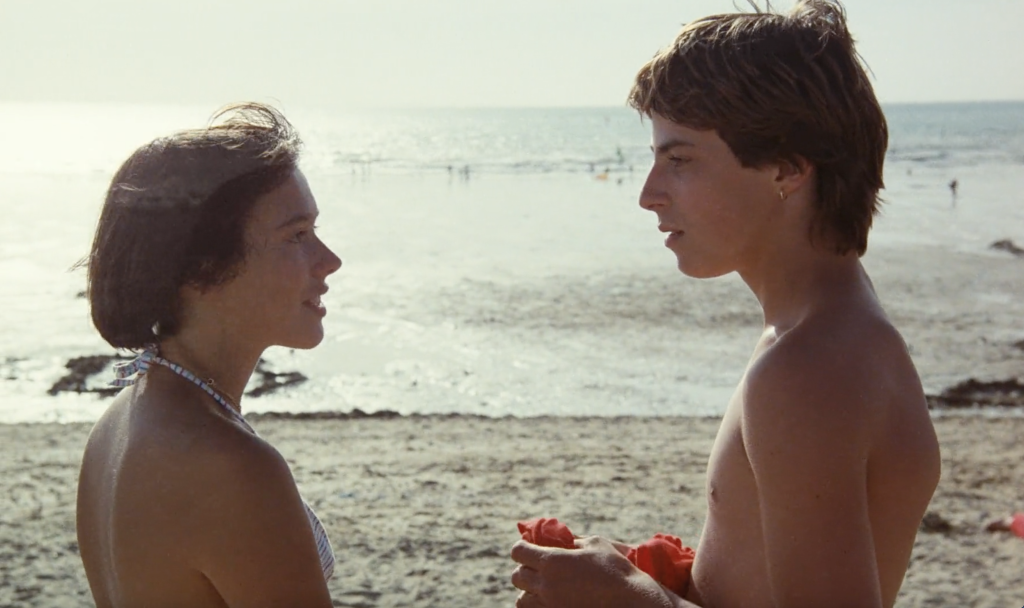
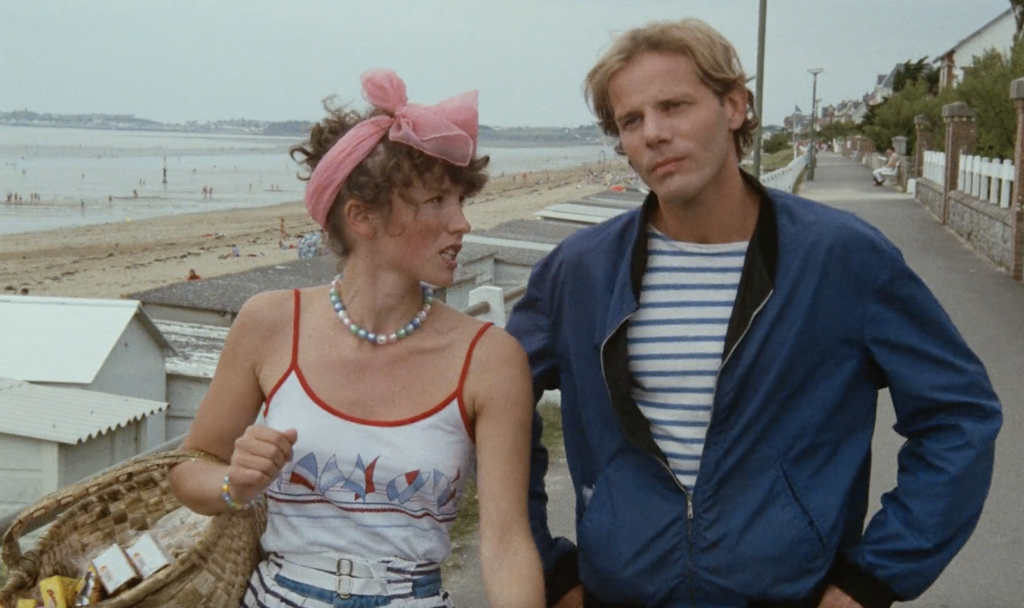
Pauline and Sylvain together at the beach
The film opens with Pauline and her older cousin Marion (Arielle Dombasle) arriving at a seaside villa. Marion is recently divorced and eager for a new start. Pauline, 15, is observant but tentative, open to experience but skeptical of the romantic myths adults seem eager to sell her.
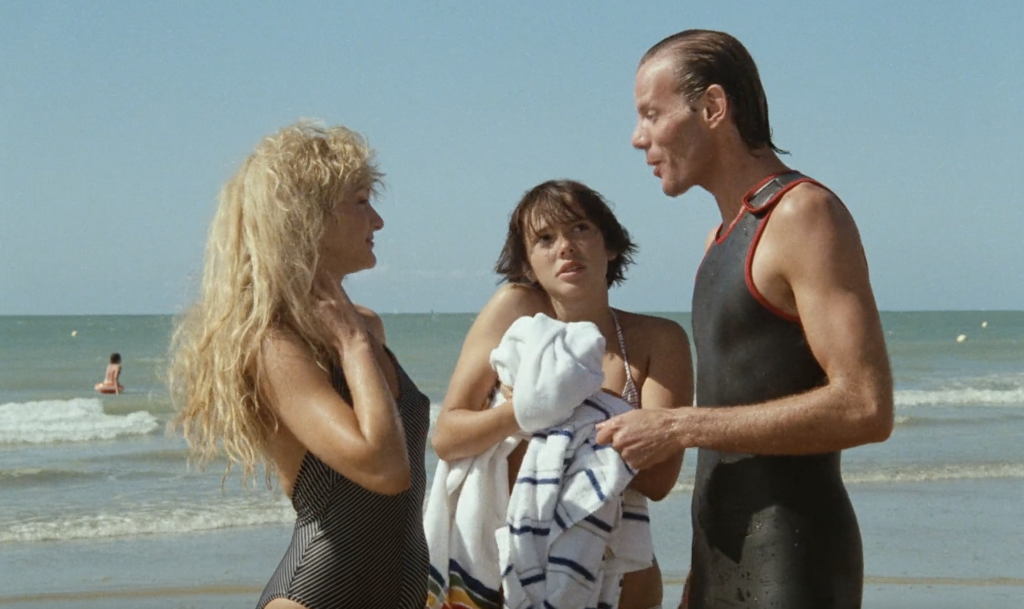
Pauline caught between the adults, this time her cousin Marion and her old flame Pierre
Soon, they’re joined by Pierre (Pascal Greggory), a brooding, judgmental ex of Marion’s, and Henri (Féodor Atkine), a libertine with a penchant for manipulation and a kimono robe that would make Larry Dallas jealous (more on this connection soon). Rounding out the cast is Sylvain, a local boy Pauline takes an interest in, and Louisette, a.k.a. the Candy Lady, whose casual approach to sex and relationships throws everyone into a tizzy.
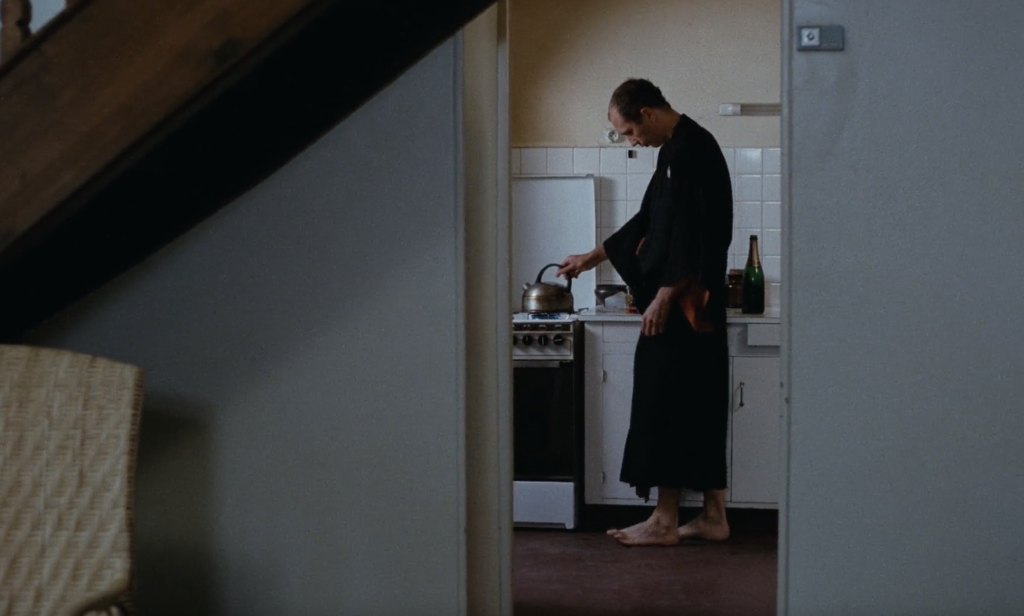
Henri in is “Larry Dallas” kimono
The center piece dinner early in the film lays out the central philosophies. Marion wants love to be instant and burning; Pierre seeks something slow, stable, and rational; Henri postures about freedom and honesty but lies as easily as he breathes. Meanwhile, Pauline watches and listens, less interested in asserting a theory than in quietly spotting the contradictions.
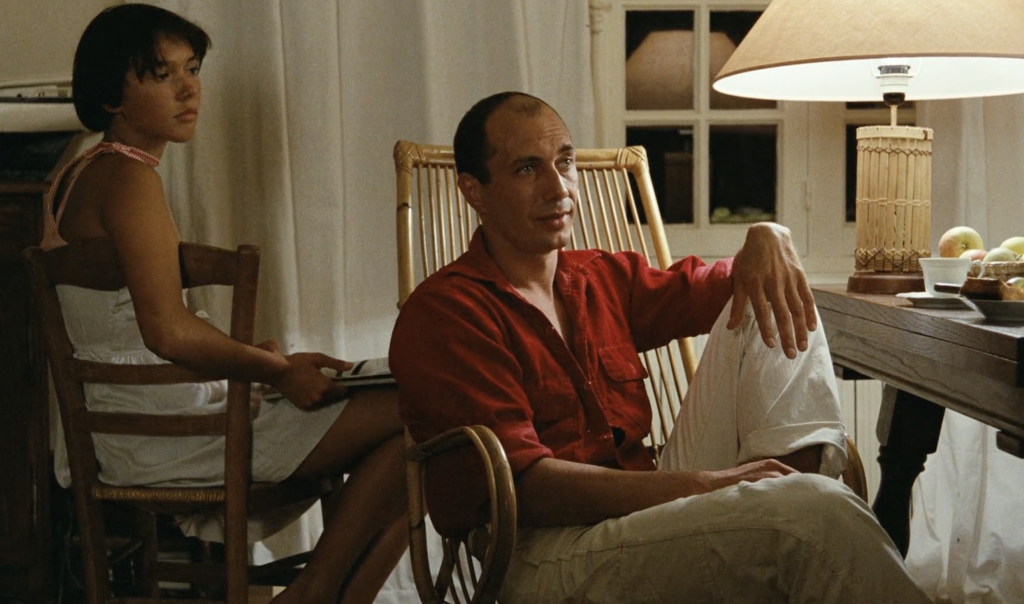
Puline watching and listening to the adults like Henri weave their web of lies
By the end, Marion begs Pauline to believe a pleasant lie—that things worked out for everyone. And Pauline does, not out of naïveté, but maybe because she knows better than to waste breath correcting grown-up fantasies.
What makes Pauline at the Beach so brilliant (and so funny) is how casually its characters drift into morally iffy territory. Marion encourages Pierre (lates 20s) to pursue Pauline (15)—yikes! Henri’s interest in young women ranges from creepy to criminal. Sylvain ends up as an accessory to a cover-up. And through it all, Rohmer lets it unfold without heavy-handedness, trusting his audience to squirm accordingly.
Pierre and the Candy Lady
The Candy Lady sees through everyone, even as she’s used as a pawn in their games. Pierre thinks he knows best for everyone and instead just makes things worse. Marion tries to play it cool but ends up tangled in romantic melodrama. And Henri… well, Henri just Henri’s.

Hot take: Pauline at the Beach is a French rip-off of Three’s Company —fight MBS!
Too busy to listen, you philistine, here’s MBS’s hot take, and it’s pretty damn good: Pauline at the Beach is a French art-house remake of Three’s Company.
- Henri is Larry Dallas in a kimono, always ready for sex, always scheming.
- Marion is Chrissy, all romantic idealism and bizarre logic.
- Louisette is Janet: smart, pragmatic, and constantly underestimated.
- Pierre is Mr. Roper/Mr. Furley, the prudish interloper always barging in and misreading the situation.
- Sylvain is Jack Tripper, always caught in the middle of the adults’ drama.
- Pauline is either the studio audience or every kid of the ’80s forced to watch adult shows because there was nothing else on.
Seriously, just add some laugh tracks and freeze frames and it works perfectly.
Pauline at the Beach is funny, discomfiting, delicate, and precise. It’s a coming-of-age story where the teenager comes away more clear-eyed than any of the adults. It’s about people talking too much, lying to themselves, and blaming others for it. It’s about how desire tangles up with delusion. And it’s about how sometimes, the smartest person at the party is the one who says the least.
And hey, it’s also about how very French people can still be while making a complete mess of their lives.
Bonnes vacances!
______________________________________________
*The bones of this post were created by ChatGPT trained on my Family Pictures Podcast category. Post coming to explain in more detail, but just being transparent for all you machine-hating purists 🙂

Maybe it was a French ripoff of the British show that was remade as Three’s Company? https://en.wikipedia.org/wiki/Man_About_the_House
Fair point and I like your hot take. I need to train ChatGPT better 🙂 Also, this is news to me, I spent all these years thinking Three’s Company was original