Wire 106: Week 1 –“The Setup”

Week 1 Introduction/Setup 8/25
all work is due midnight August 31, 2014
The first week is dedicated to getting setup for ds106; install your WordPress site and create other social media accounts such as Twitter, Flickr, SoundCloud, YouTube, etc. Complete Introductions via posts, twitter, Flickr, video, audio, etc. Watch The Wire through episode 9, and watch the commentaries on each episode.
Open course resource: http://ds106.us/open-course/unit-1-bootcamp/

Welcome to Week 1 of ds106. In the above video—which runs about 25 minutes—Paul Bond and I introduce the course, our expectations, and this week’s work. Below is a detail list of what’s to be completed this week.

1) Domain and Webhosting: You need to signup for a domain and web hosting through UMW Domains (login with your UMW netid). Detailed instructions can be fund here. If you already have this done, then you are one step ahead 🙂

For more details on how to get navigate your web hosting account, i.e. cPanel, subdomains, Installatron, etc., we have extensive documentation here: docs.umwdomains.com

2) Install WordPress: This tutorial will take you through installing the publishing platform WordPress. Keep in mind if you already have WordPress installed on your UMW Domains, you can use your existing site (and just tag or categorize your ds106 work accordingly) or choose to create a new WordPress site in a separate subdomain, such as ds106.myawesomedomains.com. Also, here is a detailed overview on how to use WordPress.

3) Once your blog is available on the web (it should be almost immediate) register yourself and your new blog on the DS106 site. You MUST do this in order for everyone to see the posts you’ll be writing for the class.

3) Class Avatar: Select an “avatar” for yourself, an icon or image that can represent you online (it need not be your face). This should preferrabyt by a square image. Create a “gravatar” for yourself at http://gravatar.com using the email address you most likely will use for course work (and keep in mind you can associate your gravatar with several email accounts). Many sites (such as our class site) will automatically use this image as your avatar.

4) Social Media: Create accounts and fill out profiles for yourself (use the same icon as you sent to gravatar) on:

  • Flickr (photo sharing) http://flickr.com You should post at least 5 images to your flickr account; it may not consider you “real” until there are 5 images in your site. Tag your photos with ds106
  • Soundcloud (audio publishing) http://soundcloud.com/
  • Google / Youtube http://www.google.com/accounts/ If you have a Gmail account, you are already set with this. If not create a Google account. This is what will allow you to join any synchronous video discussions we have (in Google Hangout) and gives you access to YouTube.
  • Vimeo: Alternatively, if you don’t want to (or can’t) get a YouTube account (like me), feel free to use Vimeo for your videos.
  • Twitter http://twitter.com Twitter will one of the main channels for communication in ds106. If you already have an account for personal purposes, you are welcome to use it or create a new account for communication related to this class. Make sure you customize your profile! Send your first message of greeting and be sure to use #ds106 hashtag in your tweets. Learn how to search on the #ds106 hashtag.

5) Multimodal Introductions: Now that you have all your accounts, it’s time to use them to introduce yourself to the class. Use Twitter, SoundCloud, YouTube, and Flickr to introduce yourself to the community, be creative. Once you’ve done that you need to embed them all into a WordPress blog post. Here are some tips for embedding media in WordPress.

Are you exhausted yet? There a lot more still 🙂 If you wait until Saturday to do your work you will be crushed!

6) The Wire: Watch the first nine episodes of The Wire Season 1.

7) Wire106 Discussions: Catch up in the discussion Paul and I have had thus far about the first six episodes of The Wire, as well as the three discussions taking place this week about episodes 7, 8, and 9. Details as to when these will be taking place coming soon.

8) Weekly Summary: Finally, you need to post a weekly summary post narrating everything you’ve done the first week. This is how you get credit for what you’ve done, so don’t forget. These weekly summaries need to link to the various social media sites you created, the various introductions you made, your thoughts on the first nine episodes of The Wire, and reactions to the discussions.

All this by no later than 11:59 PM Sunday, August 31st. There is no credit for late work in ds106. We are professionals, we get it done.
 

Posted in digital storytelling | Tagged , , | 1 Comment

Wire 106: S01E06 “The Wire”

With this discussion of the eponymous episode of season 1, Paul and I wrap-up the pre-season for the Wire 106 class—a themed version of ds106 being taught at UMW, but up for anyone to play along. The class officially gets underway this coming Monday, the 25th. We’ll be continuing the discussion of episodes 7, 8, and 9this coming week as folks settle into their online digs. We started discussing the episodes a couple of weeks early because we wanted to get a head start on our process. I think we’ve started to get into a rhythm. Paul shares his close readings of the visual, audio, and filmic elements through his awesome blog posts about the episodes. And I try and dig in on some thematic and cultural references around those same episodes. The post from each of us feeds into a discussion of that episode during the week.*

I think this rhythm provides a good model for the semester. One difference is we’ll be inviting both UMW students and interested open, online participants to join the party as well. In fact, enrolled students will be expected to be a part of at least three episode discussions over the course of the semester, and lead at least one. That’s one of the benefits of starting a bit early, having something resembling a plan 🙂

d297daf431b1de593e52583562af5855

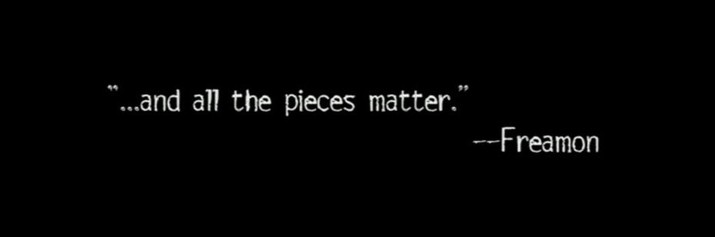
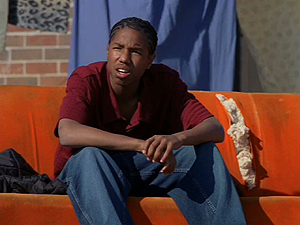
Returning to our discussion of the episode, I think the epigraph frames the broader frame Paul and I have been returning to again and again for the first six discussions. All the pieces of each of these episodes matter. Paul’s close readings unearth so many visual and aural details you might otherwise miss. The gutted Wallace sitting on a gutted coach. The continues references to pawns and chess visually to complement D’Angelo’s analogy of the game of drug dealing with the game of chess. The wire as not just a tap on a series of pay phones in the projects, but the means of survival for packs of abandoned children in the condemned rowhouses of West Baltimore.
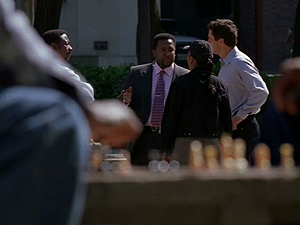
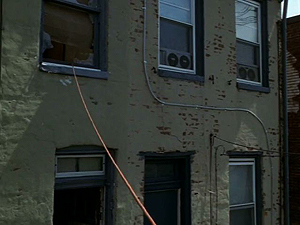
In this episode Lester is schooling Prez on how to listen to the wire, how to search for a deeper understanding of what’s pertinent and what’s not. It can be argued the episode is doing the same thing for the audience. Admonishing us to watch it closely, read it deeply, and search for broader signs of “conspiracy” —to quote Lester. The game being played in downtown Baltimore has drastic implications on the rest of the city as the two images above illustrate, and it’s our job to struggle with that. So, this was a good episode to end the preseason of the class on—a reminder that all the pieces matter and this semester will be all about close reading and making art from those readings.

* One of the things I really want to do is ditch Google Hangouts, and we’ll see if I can accomplish that.

Posted in digital storytelling | Tagged , , , | Leave a comment

Wire 106: S01E05 “The Pager”

In our discussion of episode 5, “The Pager,” Paul Bond once again provides a great post that demonstrates how the themes of surveillance and paranoia are reinforced in the set design, shot composition, lighting, and audio elements. He also explores the filmic foreshadowing that you may have missed the first time through. Paul’s posts provide a really useful model for close reading these episodes, and an excellent incentive for slowing down each episode and looking and listening closely beyond the dialogue. It’s a good exercise to push yourself to think about what is happening in a particular scene, or even shot, beyond the script. The anatomy of scene, so to speak.

The title of this episode, “The Pager,” highlights a throwback technology—even in 2002—that underscores a broader cultural critiques happening in The Wire. We already discussed the surveillance society everywhere apparent in this series, and this episode starts to evidence the concomitant paranoia that necessarily accompanies this enw reality. In fact, being watched is not a conspiracy because everyone in this show is already being watched, and we have regular evidence of that. Technology, surveillance and paranoia is a theme that I’ll be returning to again and again this semester, and in our current post-NSA climate, it’s almost a given we’re being watched not only by ubiquitous cameras in the built environment, but everywhere we go in virtual space as well.

Posted in digital storytelling | Tagged , , , | 1 Comment

Wire 106: S01E04 “Old Cases”

In this discussion of episode 4, “Old Cases,” Paul Bond provides a clinic on examining this episodes use of color, visual rhyming, the noir aesthetic, and more. His post here provides some excellent notes for this discussion, or even a great resource on its own. This discussion provides close analysis of the visual themes at work in The Wire that you might miss on the first run.

Another part of the discussion covers this idea of institutional noir in The Wire. In the 1940s film noir provided a vision of a violent, criminal post-war America. Noir was defined by ethically borderline characters that often stood outside institutions. In Simon’s series, the institutional power structure are now producing these shady characters. A post-industrial, institutional reality reflecting the dehumanizing horror of late capital. An institutional noir filled with cubicals, high-rises, burnt out projects, and abandoned row houses. A word dystopian world of haves and have-nots that isn’t scifi.

And there was even more, so check out the video, follow the links to the posts, or get blogging your own ideas, hippies!

Posted in digital storytelling | Tagged , , | Leave a comment

“The Pager” -Technology, Surveillance, and Paranoia

“Boops Beeper” by Jared Aubel Art was a visual that struck me for episode 5 of The Wire‘s first season: “The Pager.” The dated technology in The Wire is part of its appeal to me. As John Hendel argues in this piece in The Atlantic that the details like dated technology and the post-9/11 surveillance state marks it as a document of cultural specificty:

These details are dated in the best sense of the word. Few ever understand their present until it becomes past, but The Wire’s brilliance was its understanding and articulation of contemporary life. The drama was an authentic mirror. What worked about The Wire was its very grounding in these years and in the geography of Baltimore.

The pager as throwback technology becomes the technology the street uses to avoid surveillance. Lester Freamon calls it “a discipline” on the part of Barksdale’s crew in episode 4. The discipline he is referring to is the work it takes to eschew being surveyed. As Paul Bond notes in his reflections of episode 5, this attention to detail and avoidance of phones and photography is why Avon Barksdale has been successful. At the same time the opening scene of episode five suggests a constant paranoia in Avon reminiscent of Harry Caul in Francis Ford Coppola‘s The Conversation. It’s interesting that the show exists in a moment right after 9/11 but before the explosion of social media—it would almost be hard to believe Barksdale’s ability to remain off the grid just a year or two later.

The opening scene of episode 5 brilliantly sets up all the themes of technology, surveillance, and paranoia in the opening scene of episode 5. It’s one of my favorites—and highlights a character that often doesn’t get enough love: Avon Barksdale.

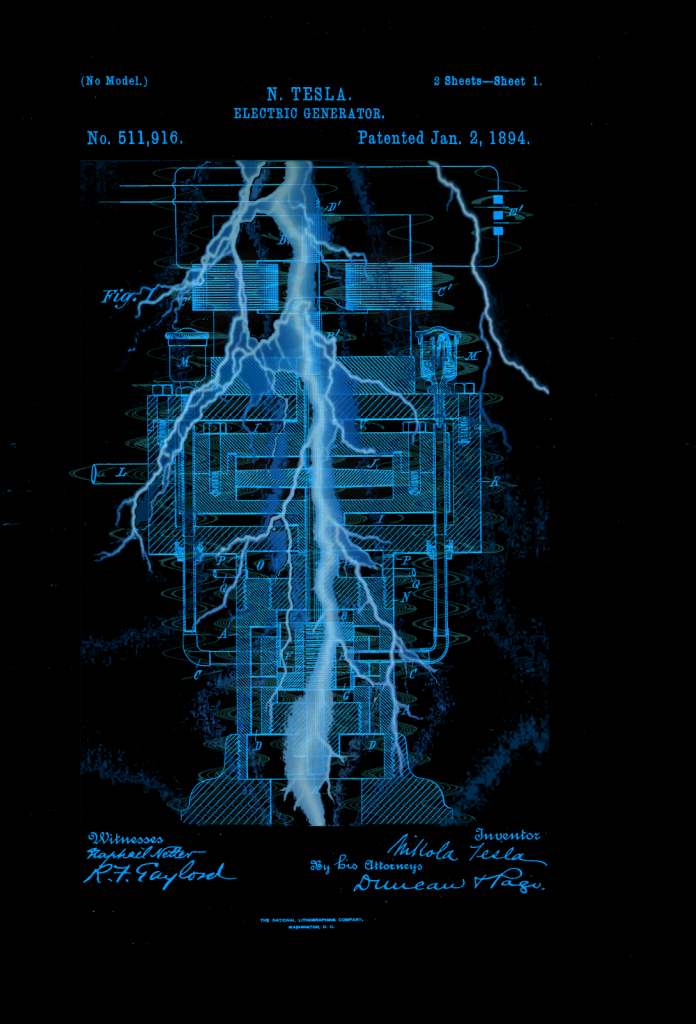
I think the gorgeous patent pending schematic visual assignment Tom Woodward created last Spring would be an awesome take on this episode—in particular the technology of the pager. I was looking at the patent pending assignment examples done, and these two examples by Shane Freeman are awesome.

ds106 reactor

Tesla Patent DS106

Woodward has a way with the assignments 😉

Posted in digital storytelling | Tagged , , , | 2 Comments

Institutional Noir

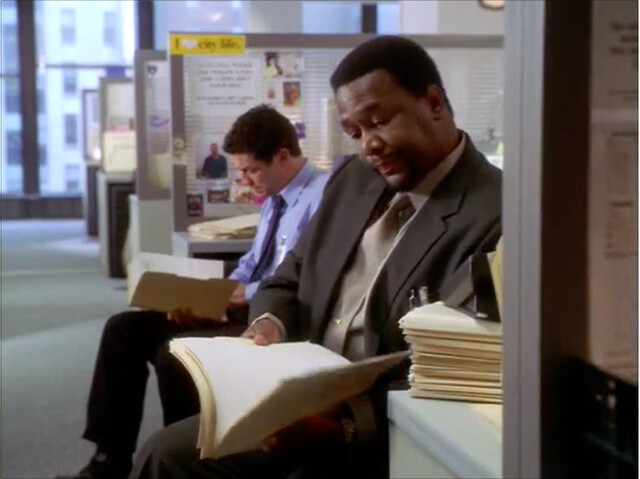
A shot Paul Bond captured from episode 4 of The Wire, “Old Cases,” highlights the corporate institutional spaces much of the police work revolves around in this season. In his commentary for episode 1 of the season, David Simon refers to the office furniture as more akin to an insurance office than an old school police department. Unlike the reassuring heavy wood furniture reminiscent of Barney Miller, the furniture in police headquarters is alienating and impersonal (although the detail’s basement office begins to take on the feel of another era, when they actually did police work?). The set design reinforces a broader shift in the culture. Thinking about Simon’s comment about insurance agencies reminded me of Billy Wilder’s classic noir Double Indemnity (1944).


The murder in Double Indemnity was investigated by an insurance agency, rather than a police department. It’s as if the vision Wilder had in the 1940s had become a reality fifty years later. Police departments being run by numbers and margins much like insurance agencies, and Keyes discussion of statistics in the following scene of Double Indemnity might be a sign of things to come for police work with CompStat:

The alienation at the heart of one of Double Indemnity is everywhere apparent in the design of the modern institutional spaces, not unlike The Wire. James Naremore’s book More than Night isolates the offices and locations of this film to discuss the “industrialized dehumanization” at work in the culture at large:

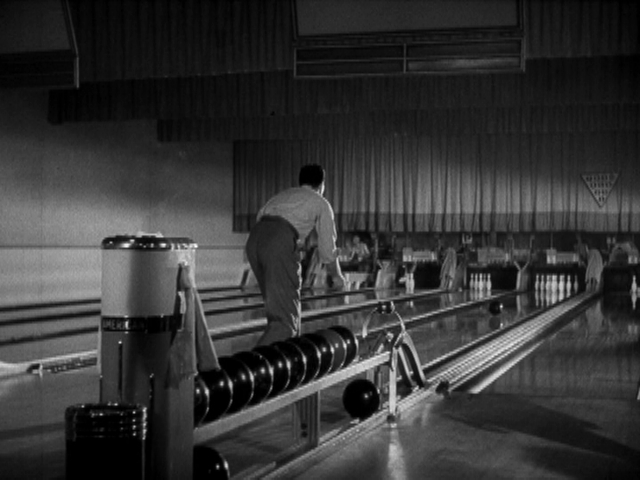
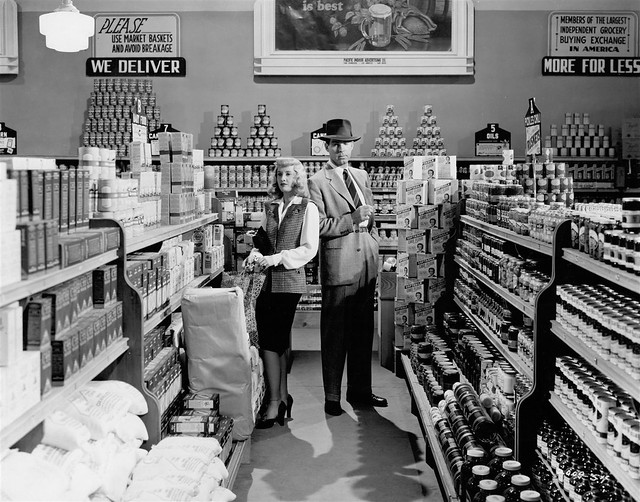
Wilder frames the dehumanizing design of industrial capitalism in 1940s Los Angeles through bowling alleys and grocery stores—massification of the moment.


The Wire similarly explores the dehumanizing design of post-industrial capitalism in contemporary Baltimore through a sterile police department. But what’s also striking in this series are the cuts from the pit and the project towers to the power elite. The show constantly reinforces how deeply divided the haves and have-nots are in the city, and the following shot is an excellent example of just that from episode 4. The following scene takes you from the pit directly into Judge Phelan’s office by way of a nice angle that shows you, as the episode epigraph notes, there’s a thin line between heaven and here.

Posted in digital storytelling | Tagged , , , , | 3 Comments

Wire 106: S01E03 “The Buys”

Paul Bond and I discussed “The Buys” last Thursday, and above is the video. We range in our discussion and I just did a pretty extensive post on it that I lost in Known (sometimes I am spoiled by WordPress). I’ll keep this one very short. Below are the three video clips we discussed in some detail. After that we explored the recurrence of noir aesthetics through sight and sound that Paul breaks down nicely in this post. I want to talk more about the idea of “institutional noir” —which I’m starting to feel is one name for the aesthetic of Simon’s series.

It Ain’t Gotta be Played Like That

All Business

King Stay the King

Posted in digital storytelling | Tagged , , | Leave a comment

The Wire Everywhere

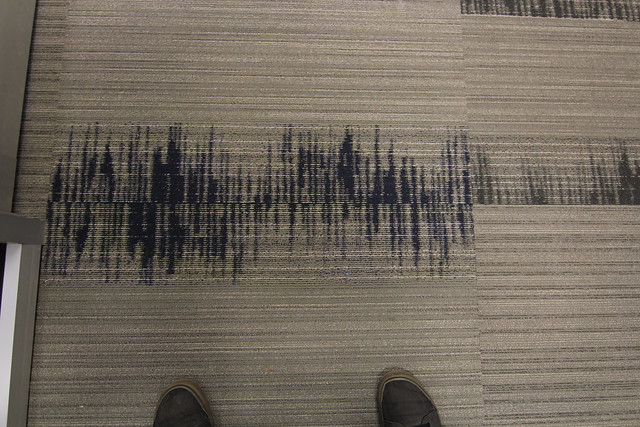
While walking around the new building I now work in at UMW—I realized I was seeing The Wire everywhere. Specifically, in the carpet.

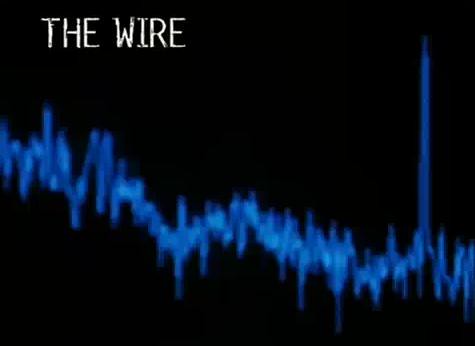
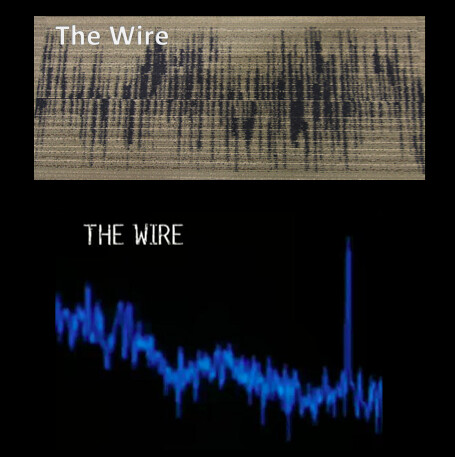
The carpet is a constant reminder, at least for me, of the iconic image that is associated with the series on its main Wikipedia page.

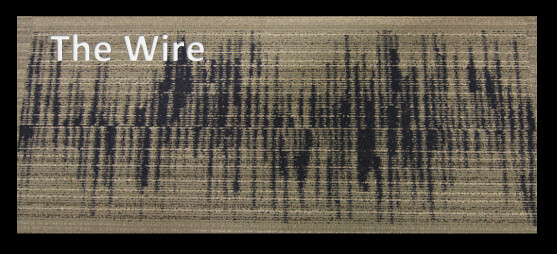
So I took a picture of the rug and then add a quick title (still working in PowerPoint  ;)) and took a screenshot.

You can see a comparison here. 

I would give myself one of the two stars I attributed to “The Wire Everywhere” assignment I created for this semester’s ds106 visual assignments. For it to be awesome, I would need to use Photoshop or GIMP to make the colors of the rug match those of the series icon. I’ll revisit this, but for now consider it yet another star, and a new #wire106 assignment to boot 🙂

Posted in digital storytelling | Tagged , , , , | 1 Comment

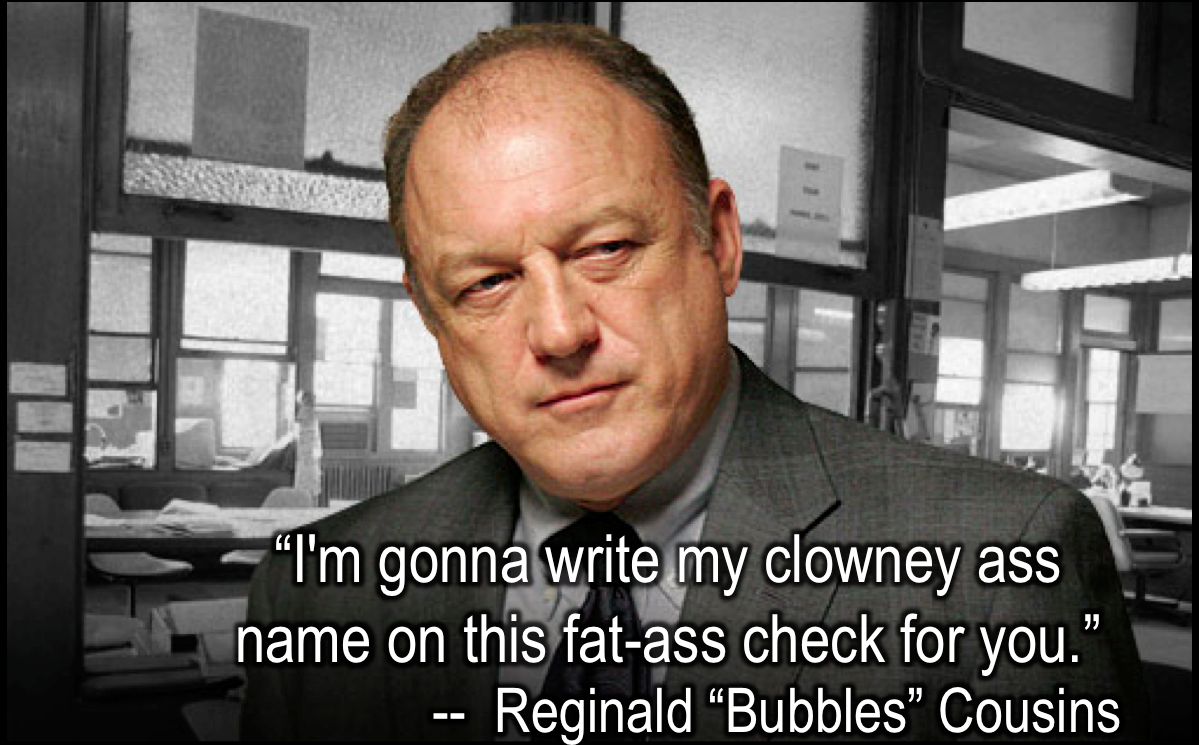
Clowny Ass Troll Quotes

Triple Troll Eiphraphs (Rawls, D'Angelo, Bubbles)

While not a distinguished Triple Troll Wire Epigraph, I couldn’t resist doing an old gold Troll Quote assignment—and this quote from D’Angelo‘s treatise on power, capital and reward was hard to get out of my head. Interestingly enough, Rawls very well could have been saying this venomously to McNulty—or anyone else for that matter. And who has a more clowny ass name than Bubbles?

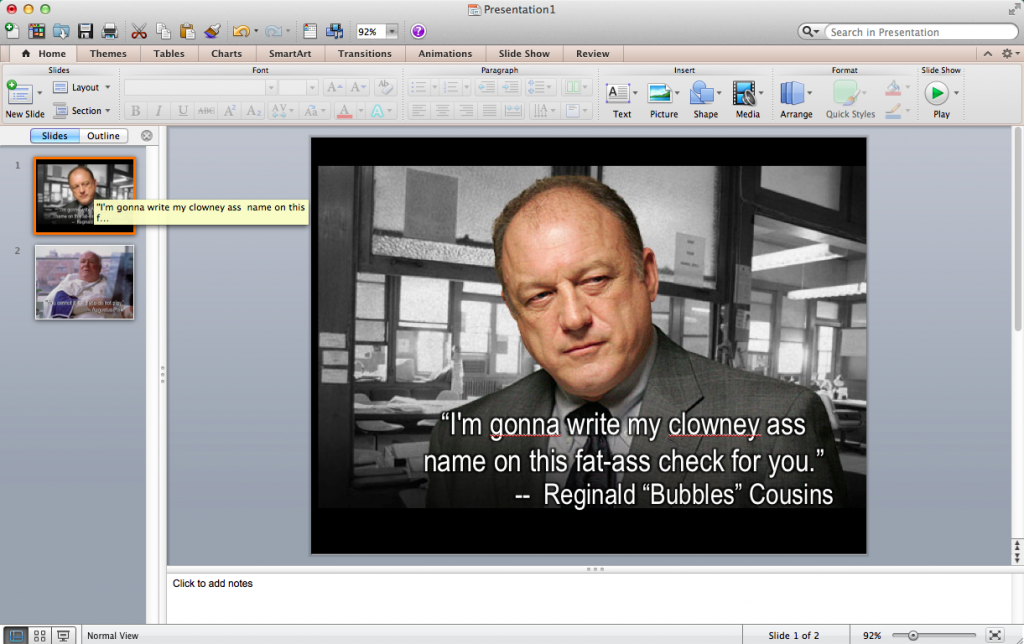
Screen Shot 2014-08-16 at 6.59.41 PM

I did this one in PowerPoint because that’s all I had on my new computer, and it was dead simple. I broke it down quickly in my previous post. That’s two more stars of visual assignments. I’m rolling now 🙂

Posted in digital storytelling | Tagged , , , , | 2 Comments

Triple Troll Wire Epigraphs

While writing my last post about The Wire, It struck me that the epigraphs for each episode might make for an awesome twist on the Troll Quotes assignment. So, be the badass that I am, I created a new assignment called titled Triple Troll Wire Epigraphs. Here the description:

Take an epigraph from one of the episodes and attribute it to another, related figure. Finally, adorn the quote and author with an image of a third character from the series. This way, nothing about your image is correct, and you’re trolling fans of The Wire with all three characters at once.

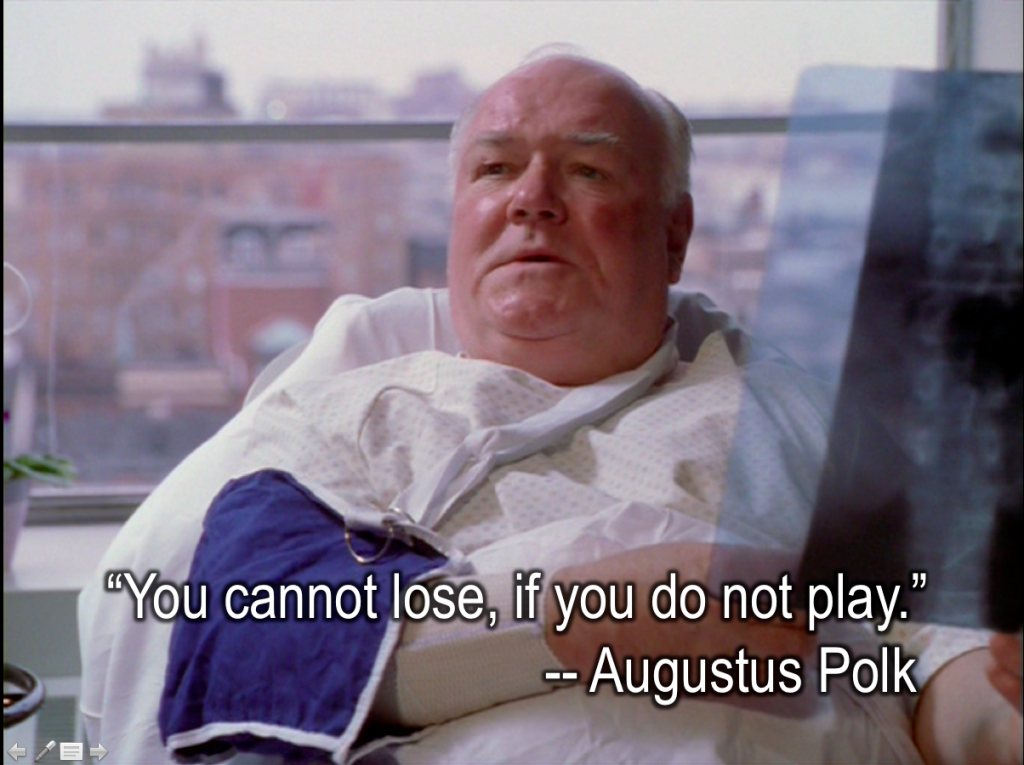
So, here is my take on the epigraph from episode 2, “The Detail:”

Screen Shot 2014-08-16 at 4.50.51 PM

I kind of like the way Marla Daniels‘ profound advice to her husband to stay out the game can be re-casted for the veteran cop Patrick Mahone, and his partner Augustus Polk, who are incapable of really playing the game anymore. This stuck me when I read Joe Murphy‘s tweet about the play with these characters names:

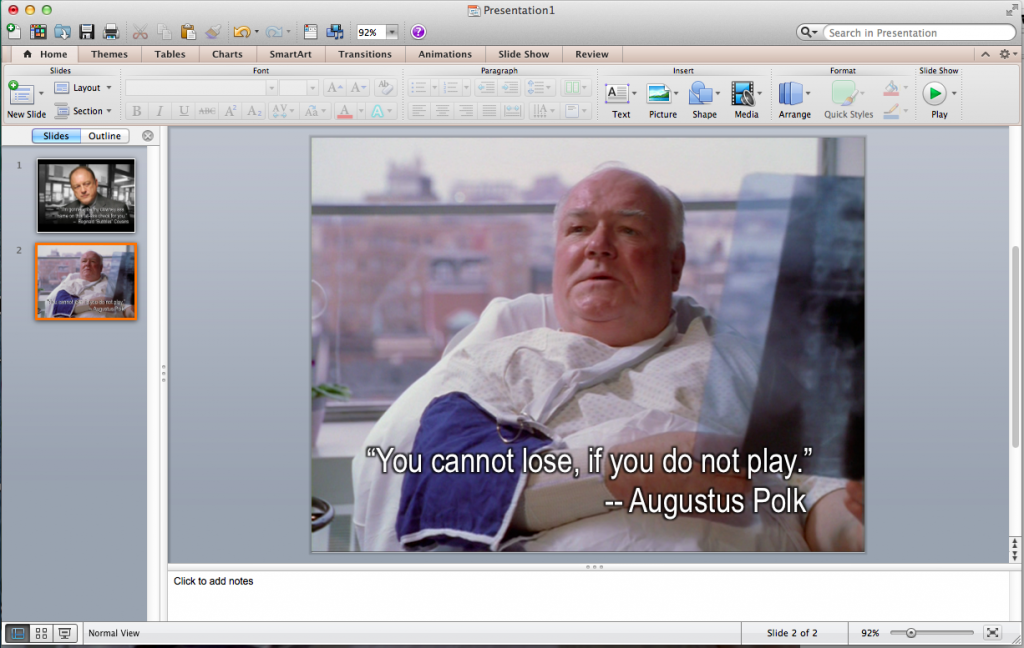
Polk and Mahone or pogue mahone, which is Irish for kiss my ass. Man, it just keep getting better 🙂 I actually have a brand new computer so I don’t have any applications but the Office suite that came pre-installed. So I fired up PowerPoint, typed the epigraph in Arial font, and inserted an image of Mahone big enough to fill the entire slide at high resolution. I then sent the image to the background behind the text. After that, I formatted the white text to have a black aura around it so it could be read easily. That’s it, dead simple. Two stars, thank you!

Screen Shot 2014-08-16 at 4.51.04 PM


Posted in digital storytelling | Tagged , , , | 4 Comments