Back in February of 2006 I did my first Movie List #1″ post (which inspired my epic “The Horror, the Horror” horror movie list post (probabaly the most visited ‘serious’ post on the bava over the last six years) , it was an idea I had for an ongoing series, but after two posts realized how much work it is to blog like that. It was actually fun stuff, but it took a ton of time. A year later I did “Movie List #2” which was dedicated to film noirs and then never touched another movie list for 5 years.
But that has all changed now, I’ve been on a bit of a movie watching binge while I was sick over the last two weeks. I am re-watching a ton of stuff, and the only film below I haven’t yet seen is Yasujir? Ozu’s Tokyo Story, which is ironic because it is on almost every film critics best film of all time list.
Anyway, it has been fun going back through some old films, and I got the opportunity by simply strolling around campus on a lazy Summer day. I walked over to UMW’s library and raided their DVD collection. It is far too small, but it has some real gems, and I’ll be going back regularly. Another interesting note is several of them are on the National Film Registry list (Harlan County, USA, Gun Crazy, and Kiss Me Deadly) and this is great research for my upcoming class, I have the feeling I’ll be watching more and more film as time goes on, here’s to such an awesome possible future.
Watched
Harlan County, USA (1976) 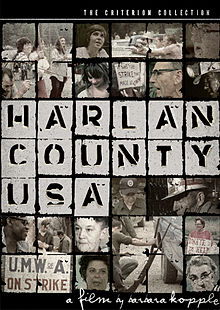 I previously linked to a video of John Sayles talking about the influence this documentary had on his film Matewan (1987) (another classic) and his analysis is pretty spot on. I came to this film after I watched another film of Barbara Kopple’s called American Dream (1990) about the Hormel workers strikes that doesn’t end nearly as well as the mine workers strike in this film. The idea at the end of Harlan County, USA is that while these mineworkers might have won a hard fought victory, such success is fleeting and labor must be always vigilant and ready to carry on the struggle. American Dream is the manifestation of that concern, labor takes a hard hit in the Reagan 80s and the demise sprawls over two decades through these two films. Take together, these two films make for an amazing chronicle of US labor over the 70s and 80s. Go to school, watch Barbara Kopple’s remarkable documentaries about the decline of US labor, an interesting note for me is Kopple worked with two other titans of documentary film the Maysles Brothers in the 60s before taking up this project.
Check out the trailer:
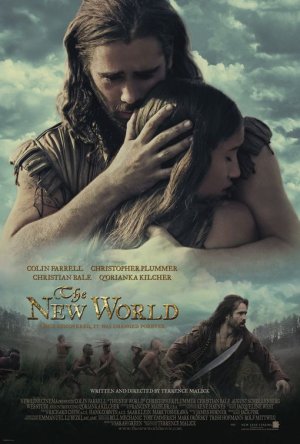 The New World (1995) This is my second time through this film. I watched it when I first got to Virginia in 2006, but it was an unpleasant experience because my TV was, and remains, too small for this film. I actually don’t think there is a TV big enough for it. It needs to be experienced on the big screen, and I think it will become a lock for the Film Registry in a few more years. It brings the Pocahontas myth back to life with a sense of veracity and mystery all at once. It reminds me why the exploratory and colonial periods of history are so fascinating, Malick imagines this moment with all its wonder and horror and magic, but it’s not an argument or an essay, it’s a poem. I think the best review I have read about the film is Mick LaSalle’s from The San Francisco Chronicle:
Terence Malick’s one-of-a-kind film, about the life of Pocahontas and the dawn of American history, contains some of the best filmmaking imaginable – some of it beyond imagining. I have seen it at least five times and have no idea how Malick knew, when he put it all together, that the movie would even make sense. It’s difficult to write a great short poem. It’s difficult to write a great long novel. But to write a great long poem that’s the size of a great long novel – one that makes sense, doesn’t flag and is exponentially better than the short poem or the long novel ever would have been – that’s almost impossible. Malick did it. With images.
Yeah its slow, yeah it can be hard to watch at times, but it is art dammit, take your Ritalin and eat your film vitamins!
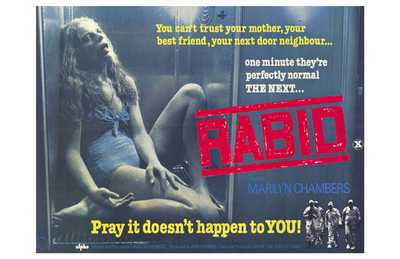 Rabid (1977) I love David Cronenberg. And I love nothing more than Cronenberg from 1975 to 1983. For many Cronenberg’s body horror films have a specific arc, they really start with the early, overtly sexually transmitted horror films of Shivers (1975) and Rabid (1977) —starring the convincing pornstar Marilyn Chambers. In these two films the idea of an epidemic that changes the face of the world is at stake, kind of Soderbergh’s Contagion before he made it, and with more sex, surgeons, and skin grafts. The middle period—and my personal favorite period—of his body horror work is The Brood (1979), Scanners (1981), Videodrome (1983), and The Dead Zone (1983) —all in some way moving the horror back from the societal to the personal. All of these films are far more contained, and while the implications of the plot always seem global, they always return to a more personalized bodily transformations that in turn shapes their story. Max Renn of Videodrome is a perfect example of this, as is Johnny Smith from The Dead Zone. The final period of Cronenberg’s body horror, and my least favorite, is typified by The Fly and Dead Ringers—which is more about indulgent, egotistical, and emotionally disturbed scientists—and in neither films were the scientists all that intriguing.
As for Rabid, the motorcycle opening is rad, and Marilyn Chambers is hard not to constantly stare at, there is something hypnotic about this film, as if you were already infected and just waiting to go mad. The 70s style, architecture, and general feel of Montreal is beautiful. The way in which Cronenberg captures the possibility of Marshall Law in the city in the event of such an epidemic is both frightening and deeply intriguing. The “what if” is always there.
Finally, check out this CBC TV interview with Cronenberg in the late 70s wherein he explains why they cast a porn star in the lead.
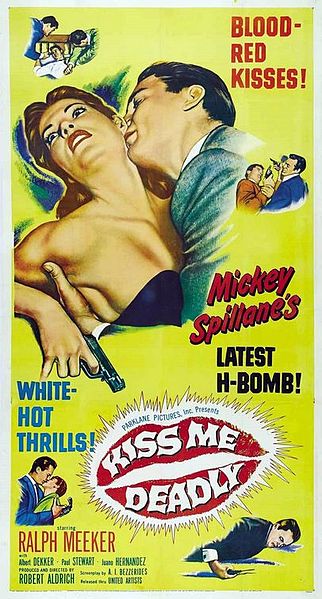 Kiss Me Deadly (1955) I talked a bit my experience watching this film in this post with a couple of animated GIFs to boot. What really struck me about this film on the second or third watching was how beautiful and perfect the opening scene is. It’s 8 or 9 minutes of some amazing cinema that nails it on all levels: the back and forth between Hammer and Cristina in the car is amazing; the shots of the road and the Lost Highway sense of darkness, and the storytelling that hints at things but gives nothing away–it shows without telling. What’s more it is stark, cold, and mean with a small trace of compassion that seems to get tortured out of the film after only the first 8 minutes. Go and get the film and watch it in its entirety. In the meantime check out the opening scene:
Gun Crazy (1949) 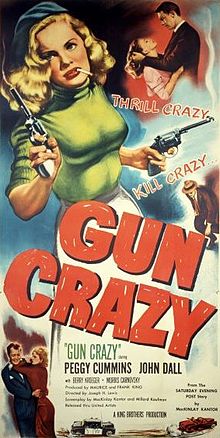 I have a whole blog post dedicated to this one. There are numerous scenes I want to rip and post to YouTube because they are so rich, as well as at least one animated GIF. Gun Crazy is one of those great b-movie noirs that produces the textbook femme fatale. The truly bad woman that can’t help it, and the poor sap of a guy who can only be her dog. It seems remarkably two-dimensional and empty when you write it, but when you see them together on film robbing and killing for love and passion it seems that Bonnie and Clyde was made almost twenty years early. I will write that blog post and include a few more scenes, but in the interim check out this short scene wherein Annie (Peggy Cummins) tells Bart (John Dall) that she wants more than $40 a week, she “wants things, a lot of things, big things.” Her speech is brilliant, and those things are more than just money, they’re an idea of living—a razor’s edge approach to life. This film is full of moments like this, it’s a total gem—not to mention the deep dark commentary on America’s fascination with guns that is everywhere in this film (with no small thanks to blacklisted screenwriter Dalton Trumbo).
On Tap:
Tokyo Story (1953) 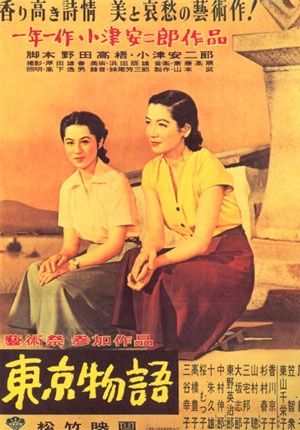 Next up is Tokyo Story, and I have to admit this is one of those films I should have seen a while ago but never did. I have seen it repeatedly talked about as one of the greatest films ever made, but still haven’t been pushed to see it. I think while I was watching Sansho the Bailiff by Kenji Mizoguchi recently I started realizing Japan has a whole film history besides Kurosawa that is amazing. A few years back I saw a film by another Japanese director Tomu Uchida’s Chikamatsu’s Love in Osaka (1959) and I really wanted to return to all these directors films and see more. The films are beautiful, precise, and human in a way film seems to have become denatured to these days—save perhaps Malick’s films.
Friday the 13th (1980)  Perhaps one of the most maligned films of all time? The slasher cycle is in full effect with this one, while a terrible film in many ways it also serves to codify the plot devices that drove Carpenter’s 1978 masterpiece Halloween into the national consciousness. Friday the 13th was a cheap jam on a theme that created one of the most memorable mask wearing mindless murderer of last 30 years . This watching will be with Camp Magic Macguffin in mind all the way 🙂 I’m going to make this one of the films I try and argue belongs on the National Film Registry list, it may be a hard sell for many aesthetically (whihc I would agree with), but I think there is a solid argument for its cultural significance over the last 30 years.