One of the things that emerged in our discussion of Shane (1953) in episode 44 of the Family Pictures Podcast is just how explicitly the film is rooted in real labor history, specifically the Johnson County War of the late 19th century. Wealthy Wyoming cattle barons, threatened by homesteaders organizing collectively, hired guns from Texas to assassinate labor organizers. When the small ranchers fought back, federal power intervened not on behalf of justice, but to quietly protect capital. No one of consequence was punished. The powerful walked free. That historical context matters, because Shane softens (but never erases) that class war.
That’s what gives the film its socialist undercurrent. The homesteaders don’t survive through rugged individualism—they survive through mutual aid. Their meetings, their shared rides into town, even the way they pay collectively for damages after the barroom brawl—all of it frames community as the only counterweight to private power. This is frontier labor politics, not mythic lone-wolf heroism.
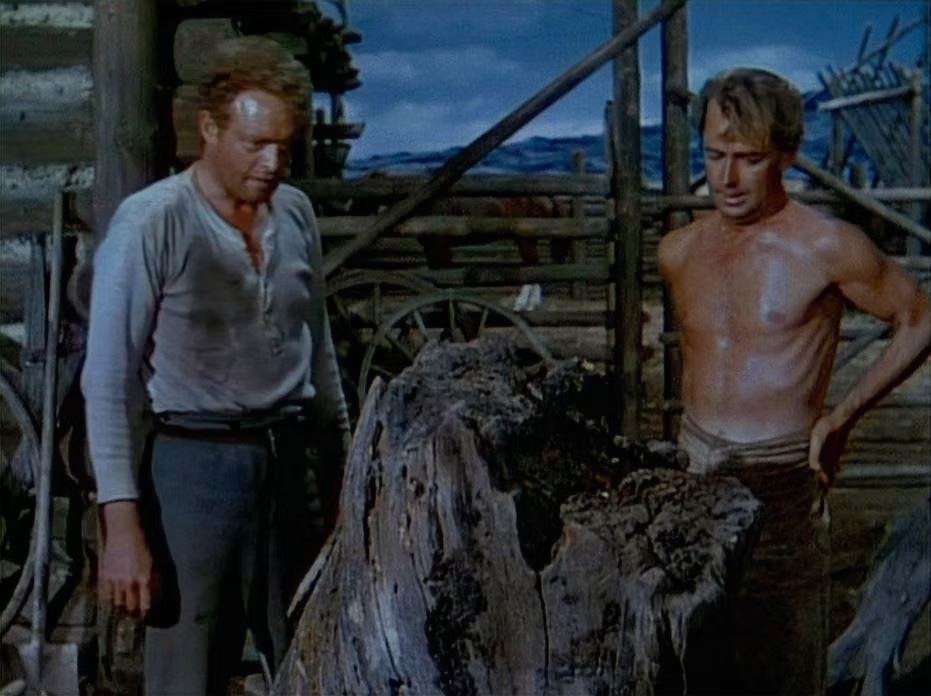
Shane and Joe work together, WPA style, to root out an old tree trunk (and injustice)
But where Shane becomes truly strange and profound is in the way it stages violence inside the family. Joe Starrett (Van Heflin) is presented as an ideal postwar father: gentle, domestic, emotionally present, and committed to cooperation. And yet the violent work of frontier protection cannot fully belong to him if the family is to survive. That violence must be displaced outward—onto Shane (Alan Ladd).
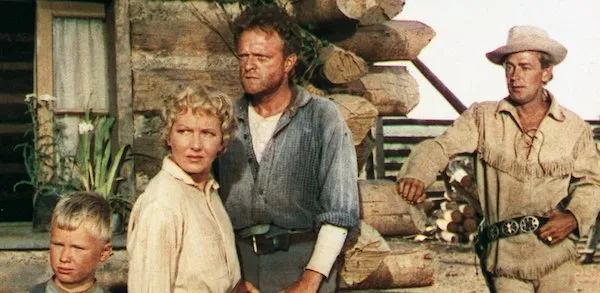
Shane both part of the family and not, but once you see him as Van Heflin’s Tyler Durden–like alter ego, it’s everywhere in the film
Shane is not just a hired gun. He is the externalized violent self Joe cannot be if he wants to remain a husband and father. This is where MBS’s lightbulb moment mid-podcast wherein he notes how much Shane and Joe’s relationship resembles that of Tyler Durden and the narrator in Fight Club (1999)—but moving opposite directions.
In Fight Club, Tyler Durden exists to pull the narrator away from domesticity and into violence to feel alive. In Shane, the function is reversed: Shane exists so Joe can remain inside the home and suppress his rage. Shane absorbs the violence so Joe doesn’t have to become akin to the hollowed-out shell of a man that is Ethan Edwards in The Searchers.
Their physical and psychic equality is uncanny. They fight back-to-back in the saloon and Joey’s earlier question of whether his dad could lick Shane is increasingly harder to answer. What’s more, at the funeral of a fellow homesteader murdered by a hired gun, Shane helps Joe by finishing his aborted speech to admonish the homesteaders to stay and resist.
Probably the most striking example of their being two sides of the same moral coin is when they fight each other in a kind of father vs. shadow-self brawl. As this long fight proceeds (the extensive and graphic fight scenes in Shane seem right out of Fight Club, frankly) the very firmament around them seems to be upended. The horses and cattle freak out as if nature itself were being attacked, suggesting this final fight as a fissure of this doubled ego. They are the same man split in two directions: one toward family, one toward killing.
And little Joey sees this.
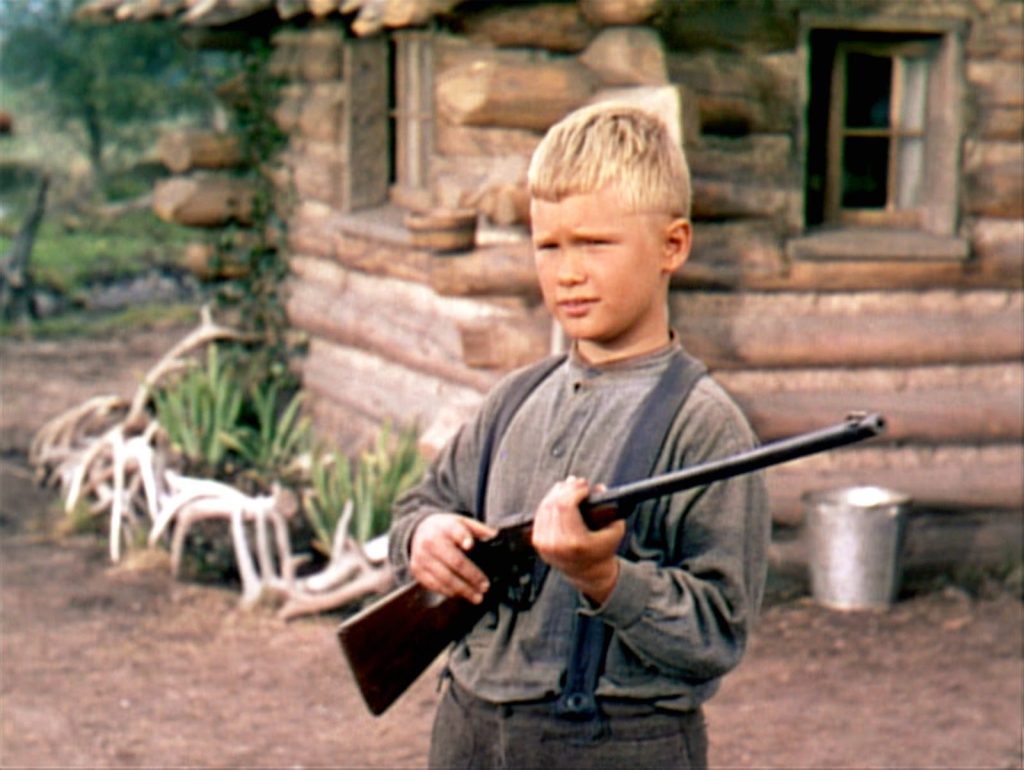
Little Joey and his toy gun that is a constant throughout the film
Joey’s obsession with Shane isn’t just childish hero worship—it’s the seductive pull of violence itself. He watches every fight. He chews candy while men beat each other senseless. He dreams of guns. He follows Shane into danger. Violence is being imprinted on him as an inheritance.
This is what makes the film truly postwar. The child is absorbing the spectacle of masculinity just as a generation of boys had absorbed World War II. Shane ultimately tells Joey that “there’s no living with a killing,” but the damage is already partly done. Joey has already watched the transformation.
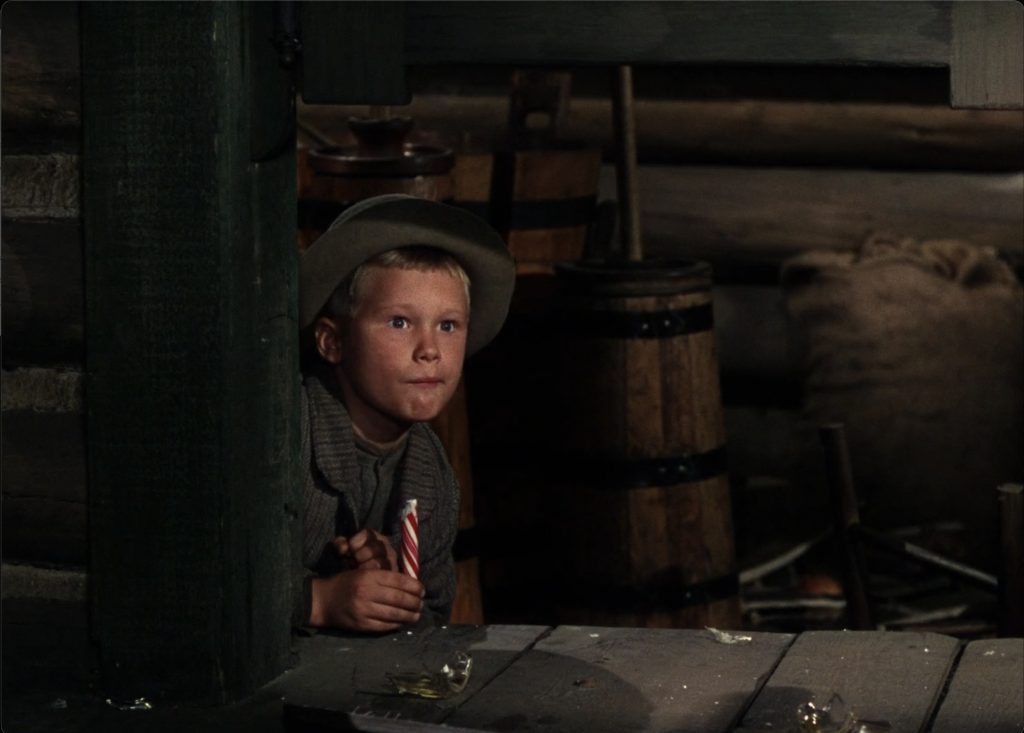
Joey chewing on the bar fight as if it were an oversized candy cane
Marian (Jean Arthur) understands this most clearly. She desires Shane, but she constantly re-routes that desire into maternal care—bandaging wounds, sending him out of the rain, feeding him. She tries to neutralize the erotic charge of violence by domesticating it. The gun may just be a tool, as Shane lectures, but Marian would feel much better if Shane’s were not around. That tension never fully resolves. The home can only survive by expelling the man who saved it.
That’s the central tragedy/paradox: Good families need bad men—but bad men cannot live in good families.
This is why Shane must leave. Not because he is unwelcome—but because his presence threatens the very conditions he made possible, just as Ethan sits outside the threshold of the Bjornson’s home at the end of The Searchers.
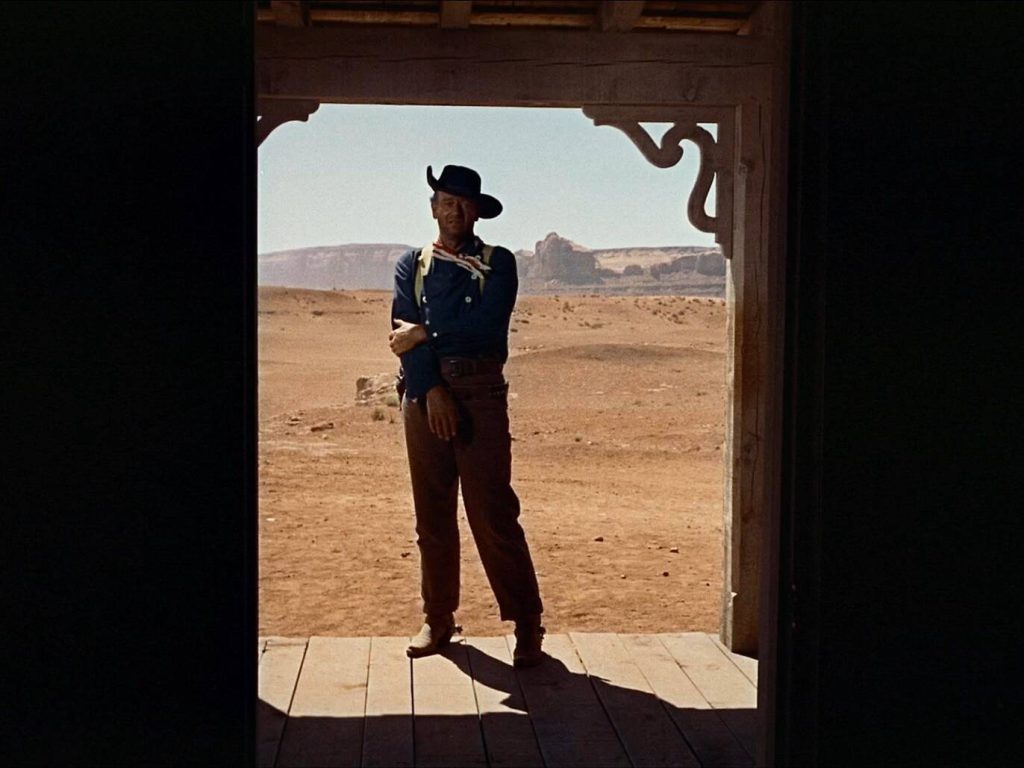
Ethan standing uncomfortably at the threshold of the door to his Bjornson’s home to close the movie
And this is where MBS’s Fight Club reading lands perfectly. Tyler Durden explodes the home to free the violent self. Shane destroys himself to save the home from violence. Same mechanism, but opposite moral trajectories.
Somehow, being the uncultured philistine that I am, I managed to have never seen Shane until I read this post and watched it last night. I don’t know that I would have thought of Fight Club independently, but having that idea in mind going into the film deepened my appreciation.
Paul,
That is so awesome to here. There is definitely something to MBS’s reading on this one, I do love it so. As soon as he said it in the podcast I was like “brilliant!” It makes an already awesome film that much more fun to watch—the best criticism does [patting self on back for Michael’s insights]. Almost as fun as watching bava … almost.