
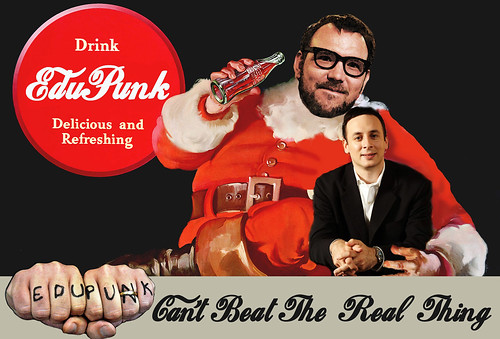
Image credit: Tom Woodward’s “Michael Chasen sits on edupunk Santa’s lap and hopes not to suck so much this Xmas”
At the EDUCAUSE main conference in Orlando this past October, Gerry Bayne asked Gardner and I if we would be interested in sitting down to discuss the finer points of EDUPUNK. I was thrilled about the idea because there are few things in this world as stimulating as a sit-down, drag-out conversation with Dr. Glu, so I jumped at the chance. What followed was one of the better conversations I’ve ever had….period. It was a free-ranging—at times heated, yet always respectful—discussion about ideas we both hold near and dear. We don’t always agree on a number of issues surrounding organizations and leadership, and it is in those moments when our relationship becomes all the more important to me.
The first part here is an introduction and six or seven minute flail on my part to dodge defining EDUPUNK, after that Gardner kicks in and gets the ball rolling. The next four episodes should be released periodically over the next few weeks, which is awesome for me cause it means at least four more posts 🙂 Special thanks to Gerry Bayne for being an awesome interlocutor and production artist, as well as for making this happen above and beyond the mass of work he was already faced with at EDUCAUSE. And also a big shout out to Catherine (Pumkiny) Yang for quietly working behind the scenes to see that this is reproduced in its entirety, sans editorial (it’s funny Cathy is everywhere doing cool stuff for EDUCAUSE but she does it all so gracefully and without pomp and circumstance, unlike some—namely me 🙂 ).
And now, bring it on Campbell, you finally met your Clubber Lang!

edupunk has no finer points. that’s the whole point. this video is awesome.
Awesome indeed. Can’t wait to see the rest.
D’Arcy- If you think this video is awesome, wait til they start punching each other in the head!
Revolution –> Counterrevolution. Yep. The latter doesn’t have to succeed, of course.
But if Gardner is looking for a metaphor for something sustainable, then we might look to John Robb’s notion of resilient communities, or to Green ideas of sustainability, that often emphasize the local, the community-based, the improvised over the global, corporate, and packaged. It all depends on how seriously we take the word ‘punk’ and what we associate it with. It doesn’t have to be about Sid & Nancy, and Malcolm McLaren pulling a huge con trick on us – it could be about the real DIYers, the garage bands and pub rockers.
“simmering, simmering, simmering, and then Jim Groom brought me to a boil” amen!
The warmth in my heart that kicked in during that intro… priceless. And it gets better from there. Love the Whitman/Emerson riff…
I wish Gardner would reread Lester Bang’s piece on The Clash for a better analogy for what I view as the punk tenor with regard to the metaphor. (I can understand his issue if indeed the McLaren-owned Sex Pistols are the vehicle).
Maybe rereading that last paragraph I should reverse the uses of tenor and vehicle, or dispense with the metaphoric consideration entirely. Ah hell, three chords and a cloud of smoke baby…
This just makes me want to see Bavacon happen even more. So many things I’m missing out on. At least I get to watch these videos.
Blackboard, WebCt, Moodle etc as florescent lighted learning is brilliant. (Pun intended)
@Steven E – what do we have to do to make Bavacon a reality? Sacrifice a Bb rep to Cthulhu?
“I want to build something that’s sustainable.” I’m feeling like that’s not entirely possible within institutions, especially in this economic climate. I have a big fear that institutions will hole up within their LMS’s and hide. The silver lining, I guess, is that there will always be some faculty (with or without the help of their staff) who will venture off to do “small pieces loosely joined.” Since the LMS is part of the administrations and faculty tend to not like the administration, maybe there’s hope. I’m wondering if Edupunk is institutionalized, is it punky anymore?
Great video though!
I second a lot of what Ed Webb said – I will take umbrage with the notion that punk was a manufactured movement – that’s buying into what McLaren and Bernie Rhodes believes (or Blackboard and WebCT if you will). It’s like saying that Blackboard and WebCT are the best LMS’s. Sure, they may be what you like, and may be useful, but they are not the best tool for every job (and IMO it’s pretty certain they are not the best tool for any job).
There was already a groundswell of folks pre-1976 who were interested in more interesting music, and there’s lots of little known bands that were scattered throughout history that were punk/DIY in spirit. Desperate Bicycles were a little known band who have come to the forefront of record collectors’ collections – part of the song that makes them great is the sentiment of DIY expressed in the lyrics “It was easy, it was cheap, go and do it.”
There’s a nice parrallel between the commercialization of punk (reborn as grunge) circa 1991 and the commercialization of education.
As for sustainability, sure punk burned bright, and post-1979, it dropped out of public consciousness. It is still sustainable, it still exists, in many pockets across the world. Where it was ending in the UK and US and morphing into hardcore punk, it was starting in places like Mexico, Japan, Poland. I don’t think you were stating otherwise, except that it seems from the statement that you think punk died in 1979 or something. I suspect you know better.
What’s kept punk going is the belief in the value of what one is doing, and the same will happen in education. Educators will always be ahead of administration, as punk music (circa 1977) was ahead of it’s time. Innovative people will always find new and interesting ways to help people learn.
For me, the “punk” in “edupunk” isn’t the Sex Pistols or the Clash (both of whom I love), but the kids I knew who wore flannels from K-Mart, listened to The Meat Puppet sand the Minutemen, and were more interested in figuring out how to creatively make sense of their world rather than lashing out at it out of nihilistic frustration. It was more about creating with what you have than destroying what others deny you.
I agree with Mikhail about the punk part. For me, it’s about those who refuse to just use what’s handed to them; they want to use what makes sense for them. They may indeed take down the establishment as they go off and create their own thing, but it’s not because they directly attacked the establishment. It’s because what they created was better than what the establishment had to offer.
Crap–you’re going to have to merge Lsura and Laura if I’m ever to make it to the bava 10.
[Laura–I changed it, and I’m searching the database now, you are a shoe-in at this rate for the bava 10. Now I just have to hold my own end of the bargain 😉 Jim]
This is just my .02 on the “punk” metaphor:
I think the debate about whether “punk” is inherently nihilistic or really just creative community building with a goal of breaking down or changing the establishment or just creating something new and better- is too simplistic, a non-argument about edupunk.
One can reasonably say that punk *did* have very deep-rooted destructive and nihilistic (or at least hopeless) attitudes. It’s undeniable. Look at the bands like Fear (Let’s have a war/we need the space), The Germs (Just a pill and a dream/It’s a suicide machine), The Misfits (The pleasantries are gone/We’re stripped of all we were), X (She wasn’t what you’d call living really/But she was still awake). And if you’d like to abandon the lyric track, may I point you to one Mr. Darby Crash or one Mr. GG Allin, neither of whom are still with us. Yes, hippies died in their era too, but *their* fans weren’t cheering it on.
But it punk wasn’t devoid of hope and creative spirit either. Much of it involved building community, centered around the music and DIY aspects of the punk rebellion. It was made up of people who wanted to turn their backs on the way mainstream culture/business/social-norms were conducted and find something new. Something more real and less manufactured. I think of the communities of squatters in England in the mid-70s, arguably where punk began, and the family-like atmosphere they created.
It seems obvious to me that this second aspect is what Groom is trying to express substantively and the first part is what he is trying to express *stylistically*.
So I think getting too hung up on whether punk was this or wasn’t this is missing the point. But again, that’s just my .02.
So far Jim and Gardner both seem right. Punk *became* a manufactured movement, but that manufacturing came from an authentic source. In the modern world, for something to even be recognized as a movement, much less a revolution, necessitates that the something in question has at least been partially co-opted by at least a few groups who have their own agendas. Otherwise there’s no voice– functionally it makes no difference if all the microphones are on or off.
I don’t know that the manufacturing can be avoided. And sustainability operationally entails the kind of constraints that will finally result in a whole new edupunk. Garnder’s a lot more optimistic than I.
I’m looking forward to the rest of the conversation. I’ll throw in some apropos Whitman too:
“Urge and urge and urge,
Always the procreant urge of the world.”
I’ll see your Whitman and raise you some Camus:
“The struggle itself toward the summit is enough to fill a human heart”
Rage, rage!
See, Jim – poetry everywhere…
Every generation needs a new revolution. We seem overdue.
I’d like a good fire to burn away the accumulated crud of ages, leave the solid steel of the foundation behind. I’d like to see what survives a real purge, what’s strong enough to survive.
I don’t have much hope for that. At best we can hope for some “sustainable” hedge trimming. At worst the vocabulary will change and nothing else.
I think Gardner misses the point of what punk is. It sounds as if he never lived it, never made it, or watched it morph into something else completely unintended. The Sex Pistols were “named” punk, the Clash “were” punk. And the Clash grew, expanded, and fell out in a “blaze of glory.” But in this process, by lighting the way, they passed the torch on to others. Without the Clash we would not have had Nirvana or M.I.A. or dozens of other artists that stood apart from the labels (pun intended). Punk as an ethos was a reaction to the shiny, candy-coated world. It was never intended to be a revolution, but it did serve as a response to the world. Similarly, I, like the Reverend, contend that Edupunk is a way of seeing, not a religion or a movement. For many, the term seems like a hammer, wherein everything educational becomes a nail.
Borrowing from Clark Aldrich, the term Edupunk is a trigger. It is “a condition in a system that, in reaction to a specific condition, brings about some discrete and significant change, or at least presentation of information.” The primary variable is corporate learning management systemization. It pulled the trigger — the need to rebel against such a scenario and the desire by many to do-it-ourselves (Edupunk). The edupunk ethos captures that desire to address the system by not fighting it or revolutionizing it, but instead creating our own alternatives.
Of course the term edupunk will morph and change, but the spirit it embodies will never die. It might rust, not fade away.
“I think Gardner misses the point of what punk is. It sounds as if he never lived it, never made it, or watched it morph into something else completely unintended. ”
You’re entitled to your opinion of my life and actions and observations.
I was in London in 1979 watching a roster of Stiff artists on the stage of the Marquee Club in Soho. I saw the guy who was glam with Mott the Hoople onstage playing with Dave Kubineck. Meet the new boss, same as the old boss. Good music, but a revolution? Don’t think so. Lotsa safety pins, lotsa attitudes. DIY? Maybe, until you got to the money circuit.
I’m a fan of the Clash. Great music.
What else to say? It was more interesting to me that the Bee Gees and Ian Dury and the Blockheads were both in the top 5 at the same time. “Too Much Heaven” and “Hit Me With Your Rhythm Stick” occupied the top two spots on the charts during that January. Juxtapositions like that can drive poetry.
Punk was contemptuous, dismissive. The Ramones were a pop band. They had the sense to work with Phil Spector on an album. Great music. And if it’s true that Kurt Cobain listened to Boston, then that’s genius. Back before Greil Marcus decided punk was the one true religion, he had the guts to praise “A Man I’ll Never Be” as a great rock song, which it is.
OK, rant over.
@gardo – best. response. evar. love it.
My only thought is that “punk” is meant more as a theme than a literal movement to reproduce. Whether or not Punk got corrupted by Big Music (which, of course, it did – as does all successful music) it started out by running counter to the establishment. It also wasn’t the only counter movement. If we were older, we might have identified with Elvis, or any of a long list of artists that began outside Mainstream Culture, running counter to it, before being absorbed and corrupted into caricatures of their former selves.
Imagine Blackboard 2012 – now with AutoBava Blogging integrated as a core feature. This “edupunk” stuff is doomed to be absorbed by Mainstream Education – but that’s actually a good thing. That’s how change happens.
What interests me more isn’t the exact definition of the movement, or the identification of the perfect historical model to look for inspiration. I’m far more interested in how far we can push things outside the envelope of Big Education, to see how far we can get, and to see what winds up being absorbed, integrated, and corrupted as part of the process.
The one thing that sets “edupunk” apart from Punk is the money. None of the people hacking on “edupunk” stuff are raking in the cash. There’s little chance of Spector managing things for a juicy slice of the pie. The only ones making money off this are the Established Mainstream Education entities – companies and institutions – and we just might be able to help move them toward some more interesting patterns.
@Gardner I don’t think there’s any doubt Cobain listened to Boston. I’m sure I saw or read an interview in which he specifically talked about the genesis of “Smells Like Teen Spirit” being listening to “More Than a Feeling” and trying to write the ultimate pop song…
No, this has nothing to do with edupunk, but it’s more interesting than fighting over what punk was/is/could’ve been/should’ve been/oughta be/came to/started as/ended up being/did/didn’t do/transformed/didn’t transform etc
Arguments of who is punk or not aside, while it is done cutely, I’m rather disappointed in the set up of this discussion as a “battle” between two people I respect and tune in most with in the world, who to me are much more on the same side of the issue.
It’s a Cheap Trick, and as divided as the comments are falling in this post, seems to be not fostering much towards the real issues. All this arm waving over what is edupunk, how it is different or not from “real” punk (which to me has little interest), I turn to Clara Peller and seek the location of the beef.
I wanrt to know what we do with this “ethod” (not that I even know what an ethos is). What are we creating, doing, fostering– I want more on the DIY approaches and less on the prose on a metaphor. Shall we talk about “change” or do some? How? Let’s get down to that.
If the rest of this series is more of this staged set up between Gardner and Jim, I’m not feeling all that interested in tuning in. Drop the gloves and the bells, please.
Dog,
I take full responsibility for the smack down frame, I thought it would be fun, and I proposed it. I like the b-movie boxing appeal.
Oddly enough, I thought the moment of EDUPUNK was far gone enough that we would move beyond the musical questions rather quickly, and I didn’t expect so much commentary along those lines. In fact, I think most of the talk is rather congenial and fun, and deals a lot more with questions of political theory, leadership, Early American figures, and a platform of creative connection. That said, there aren’t many examples on the table in this talk, but that’s because I think Gardner and I were having too much fun with the ideas, and the time went quick. What surprises me most, is how much the questions surrounding the music and the ethos still weigh this all down to some great degree, because I agree with you, Gardner and I are on the same side of the issue as it relates to teaching and learning. Getting hung up on the term is dangerous, I just liked it, but I don’t think the term will save us in the end, I do, however, think some concerted action and fun will.
The reality is that everything we do is now framed in a sense that we do have to be careful of the terms that we use – things that we say offhand can be taken and exploded and run with (and remixed…). With that said, DOA said, “Talk – Action = 0”.
The punk sense of anti-authoritarian, subversion appeals to people. I believe that we’re coming to a major change in the systems that govern us. That will also fundamentally change how we are educated and how we function interpersonally. Punk is a charged word, lots of educators are punks, have punk backgrounds – it’s personal.
I like what D’Arcy says above about some of this being absorbed by Big Education. And I think some of it is. Blackboard is making an effort to be more Web 2.0. It may not do it well and it may, in fact, be too little too late, but at least it recognizes it needs to change something. I actually met our Bb rep for the first time not long before I left and he said that in every conversation he had with people within the three schools that shared our Bb install, my name came up again and again because I was out there blogging about what was wrong with Bb and pushing on the idea that Bb was the be all end all of online education. He claimed it was me and people like Jim and others who caused Bb to move toward the changes they’ve made in the last release.
What I’ve found is that people who won’t use blogs in the open will use them within Bb, but that they very quickly see the limitations and start wanting something more, usually outside of Bb. So to me there are roughly 4 groups of faculty–those that would never use Bb because they would never use *any* online component for teaching; those that would never use Bb because they already use some kind of other online component (blogs, wikis, etc.) and find Bb lacking; those that use Bb for a while, push it to its limits and then move on; and those that use it as document storage and convenient email list. I think what really needs to change is the people–that last group, at least at my school, was over 50%. These are the people who don’t see the value of creating an online space for students to interact with each other, with the material, with the world, to build their learning. How do you convince them? Is it with the idea of Edupunk? I think Gardner’s right. That appeals to those who are already going against the grain, but scares those who are doing document storage. I think it’s a hard road, one I obviously gave up on within my own institution, but not as a greater cause. I’m unsatisfied with the argument that we need to reach digital natives and so we have to use these tools. So I think we need to all think together about how to convince people to change their ideas about teaching. We are 50 years past the Woods Hole where ideas about teaching that we still hold dear have *still* not been fully implemented. So how do we make this happen?
@Laura – the ‘how’ is possibly about virality and modeling. At my institution (Dickinson College) we have a fellowship program for faculty learning to use tech in productive ways, building a community of practice who then can act as evangelists and/or modelers. Good ideas spread. The key is to get the best ideas out of the blogosphere and into the classroom, and then feed back the experiences into the blogosphere and our meatspace communities, so others can learn, copy, adapt etc. In other words, it happens through happening. Let’s do the show right here! It’s as much Cliff Richard “Summer Holiday” or any number of other cheesy, cheerful 50s and 60s movies about the kids just doing it for themselves as it is about Jim’s sharpie-adorned knuckles.
I must be out in left field or middle of nowhere, as I have zero concerns that Bb or some other Evil Fill in Name Here company will “take over” web 2.0ness. Firstly, if they try to emulate, they shall continue to fail miserably. Whatever they try to wrap in a container will be a pale imitation at best.
They don’t have anywhere the power needed nor the agility to match the domain. And they are losing ground daily. Their tactics and moves get more transparent all the time.
Interesting how the fear approach is being applied within the edtech circle. I laugh in the face of Bb being any potent threat to the free and open web space
@Ed I agree with you on the tactics. I do know a handful of people who are turned off by even those tactics–these are the curmudgeons–I ignore them.
@Alan I’m not afraid of Bb “taking over” anything. What I’m afraid of is institutions continuing to settle for Bb and things like it because it seems easier than trying to DIY. And it is easier because I think to do it the DIY way means having to rethink how you teach and too few teachers *still* are unwilling to do that. It’s kind of a vicious cycle because I think more teachers would be willing to go DIY and do the hard work of rethinking if they felt like they had support from their institutions, but instead what they see is lots of money and time invested into CMS’s.
Pingback: Affecting Educational Change | TechTicker