N.B.: Another cyborg post: half-bava, half-ChatGPT, and all right! I am now officially using ChatGPT to push out these Family Pictures Podcast posts, sue me! Which part is bava, which ChatGPT? Can you guess? Are you even reading, my big, beautiful bavabot-following!
Directed by Michael Ritchie (Fletch, The Bad News Bears), this one stars Holly Hunter in full Emmy-winning mode as Wanda Holloway, a Texas mom whose ambition for her daughter’s cheerleading career knows no bounds—including murder plots, sugar-filled bribes, and truly iconic hair.
Set in the refinery-shadowed town of Channelview, Texas, the film paints a portrait of a mother desperate to escape the fence-lined, dog-filled sameness of suburban life. And how does one escape? Through cheerleading, obviously. It’s Texas. That’s how social mobility works here. The film’s satire is sharp: moms with clipboards, pep rally politics, and training montages that could go toe-to-toe with Hoosiers. Except instead of boys and basketball, it’s daughters in sequins—and the stakes are murderous.
This film aired on HBO, which gives it that 90s prestige TV sheen, but let’s be honest—this is pure tabloid dynamite. Based on a true story, with a script sharp enough to cut pom-poms, the movie walks the line between camp and critique. We get fake murder contracts, late-night phone calls, courtroom dramatics, and a cheerleading constitution, all while Holly Hunter sips Diet Coke out of a gigantic sippy cup and plots her rival’s downfall with chilling precision.
Wanda (Holly Hunter) with gigantic sippy cup politely pissed the world is scheming against here and her daughter
So, why did we cover it? Primarily because it was MBS’s choice (blame this one on him 🙂 ), but also because Family Pictures isn’t just about haute taute movies with Criterion releases. Sometimes it’s about movies that mirror America’s obsession with ambition, status, and the perfect Texas ponytail. Female Trouble gave us camp via filth. Cheerleader Murdering Mom gives us satire via felony. And if that’s not family, what is?
N.B: The following post summary is predominantly written by ChatGPT 4.0. I couldn’t help but experiment with taking the extensive notes Michael Branson Smith and I wrote-up for this episode and feeding them into the machine. I asked it to use the notes and create a summary of the podcast in the style of my posts from bavatuesdays Family Pictures Podcast category.
The result is strange, it apes some of my over-the-top language, but at the same time is able to remain far more pithy and succinct. It describes what we talk about in the podcast pretty well and skates along the surfaces of topics and themes that we outline in the episode, but it seems to also glean language from the web, so it’s both ours and not ours at the same time—although that idea of ownership and language seems antiquated to me at this moment.
The whole sense of simulacra of thought, language, and communication—in a Philip K. Dick kind of way—is truly unnerving. At the same time, I can see why people might be tempted to take these AI summaries and run with them given the amount of time and energy it takes to write a simple summary post for a podcast (I’ll spend 2-3 hours on any given podcast summary). To that point, we’re moving in on episode 25 and I’m just getting around to posting about episode 16 — the struggle of blogging from behind is real.
Anyway, I re-wrote ChatGPT’s original take, but only parts of it, in many ways the bones of the posts are the machine’s. I have no intentions of using ChatGPT to blog—let’s be clear about that—but I’m interested in getting a sense from anyone who might read this what are the tell-tale signs that help you know its not mine. What is the Voight-Kampff test for a bava post?
Maybe admitting it’s not mine from the beginning ruins any real validity of such a test, but at the same time I have my own idea about this that I’ll be writing about soon. That said, I’d be interested in getting a sense from people if I truly have a style, and if so how easily it’s faked. I wonder if what Blonde Redhead says is true, can “fake be just as good?”
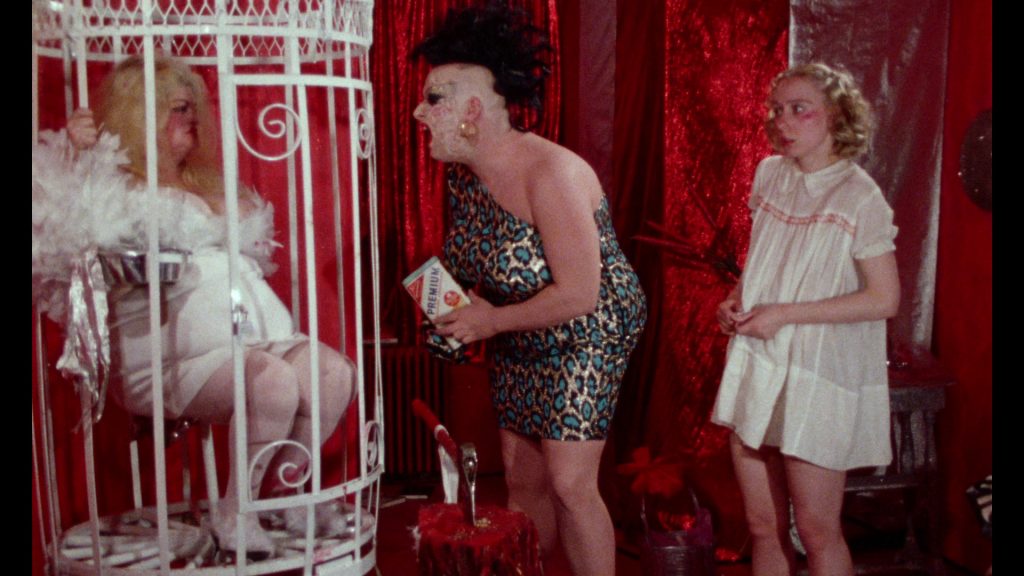
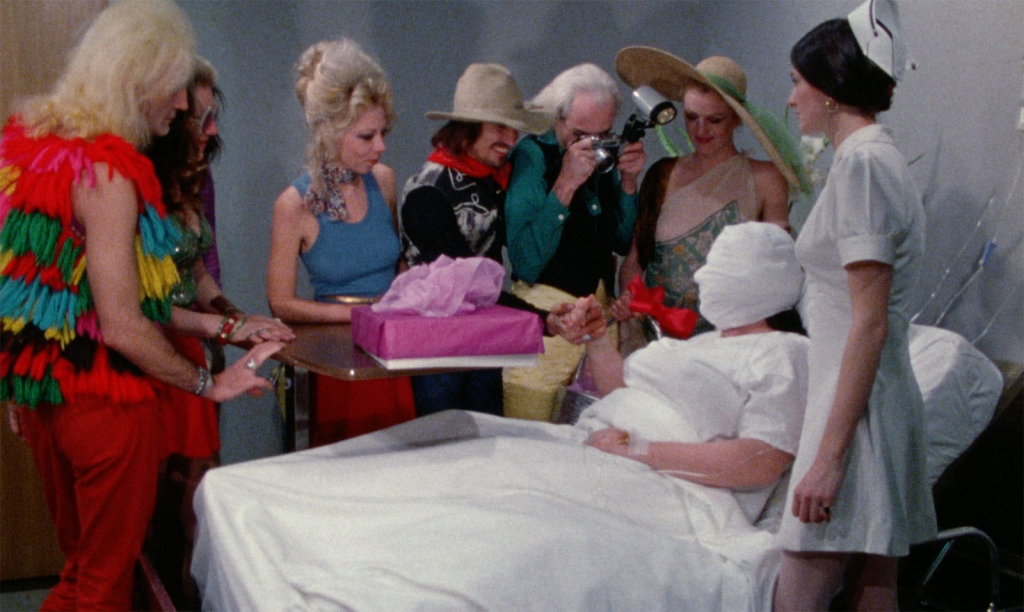
Divine glitching out in John Water’s Female Trouble
Our 16th Family Pictures Podcast episode goes deep into John Waters’ anti-family values masterpiece, Female Trouble, and it might just be our trashiest episode yet (I mean that as high praise, not so sure yhe same is true for my co-host MBS). Released in 1974 and riding the shockwave of Pink Flamingos, Female Trouble is a high-camp hellscape of melodrama, delinquency, and pure filth—all lovingly dissected by the greatest unknown film podcasters on the web.
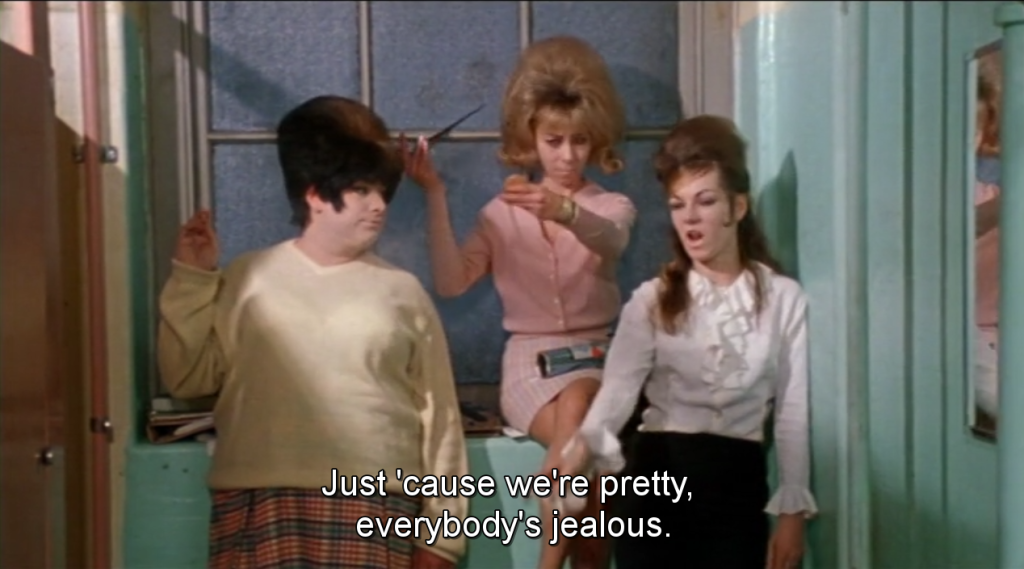
Female Trouble opening in the spirit of a JD film: “Just ’cause we’re pretty everybody’s jealous”
We open on Dawn (played in all her scenery-devouring glory by Divine) terrorizing the halls of her Baltimore high school. She’s flunking, fighting, and dreaming of a pair of cha-cha heels that never arrive—thus triggering perhaps the most unhinged Christmas morning this side of a department store clearance sale. When Dawn’s rampage leads her out of the house and into the arms (and mattress) of a mustachioed trucker (also Divine), we begin our descent into a kind of mythic trash-epic—a bildungsroman rewritten by Warhol, Anger, and a punch to the face.
The technicolor torture chambers of Female Trouble
One thing we spent time marveling over in this episode is how Female Trouble wears its squalidness like a badge of honor. Vincent Peranio’s production design turns condemned Baltimore buildings into lurid dens of beauty, debauchery, and bedazzled squalor. From the Lipstick Beauty Salon (headquarters of Donna and Donald Dasher’s aesthetic fascism) to Dawn’s row house turned technicolor torture chamber, it’s a setting-based storytelling clinic for all aspiring no-budget auteurs.
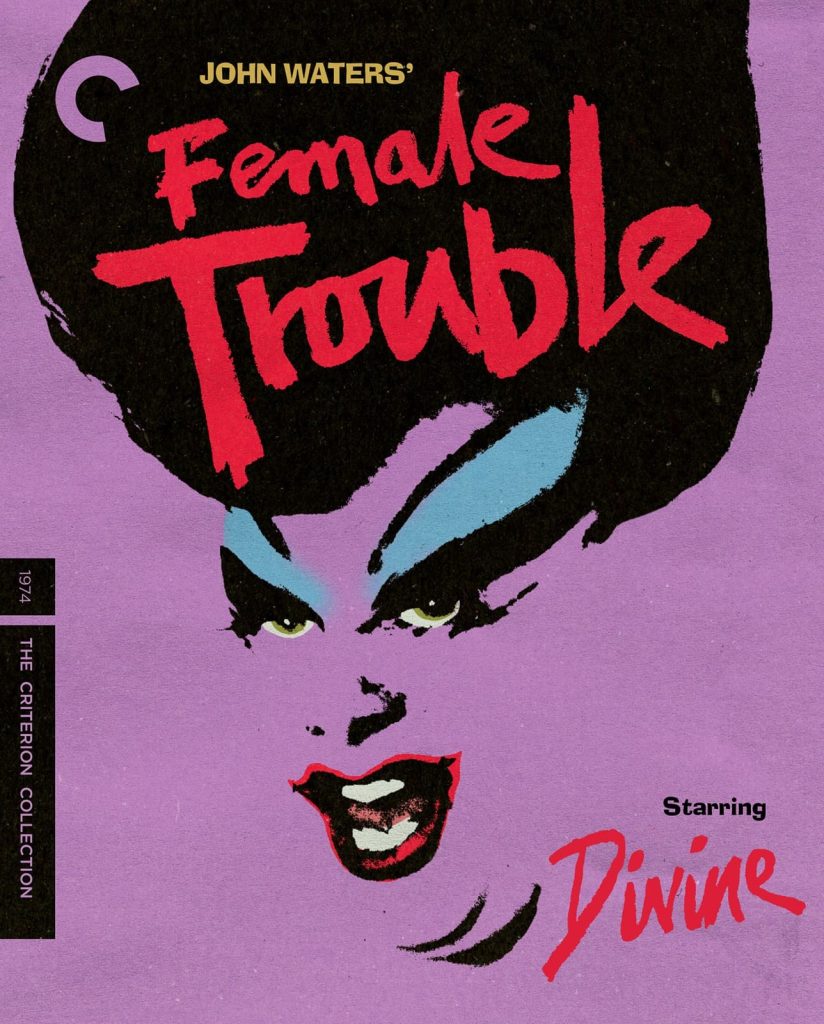
There’s a Criterion Collection version of this film, so you know it has to be good! 🙂
Ed Halter, writing on Criterion’s site, summed it up best by describing Peranio’s interiors as “the ultimate in mise-en-kitsch”—garish wallpaper, outdated furniture, and so much suburban sleaze that it starts to feel like art. Or maybe it always was.
Dawn Davenport reminding Taffy why she can’t go to school, have friends over, or do anything else that might annoy her.
It wouldn’t be Family Pictures without a family—and Female Trouble gives us a doozy. Dawn becomes a mother (to Taffy, played by Mink Stole), but parenting here involves more chain-link bondage than PTA meetings. Taffy’s rebellion grows with each passing year, culminating in patricide, folk music, and one of the all-time great cinematic insults involving oxygen and testicles.
From Aunt Ida’s dream that her nephew becomes queer, to Divine’s descent into acid-scarred celebrity, the film charts a “domestic” arc that takes a sharp detour through arson, assault, and art-murder. By the end, Dawn’s death-row monologue—equal parts self-pity and righteous fury—feels eerily prescient. “Who wants to die for art?” she screams, and honestly, it’s hard not to cheer.
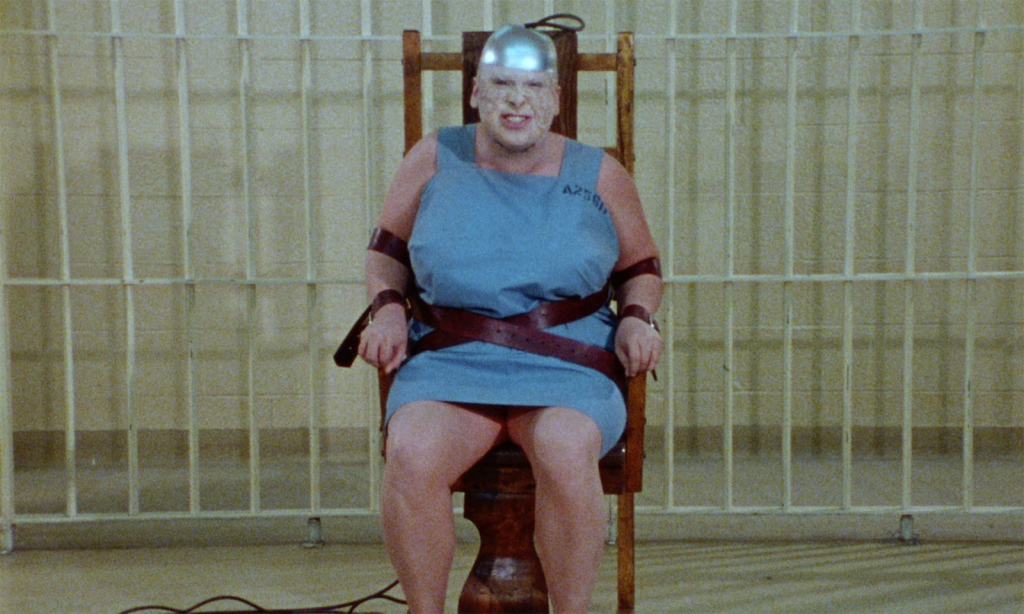
Divine’s final monologue from the electric chair. Image credit: Criterion Blog
Waters may be staging a drag farce, but the satire bites deeper than expected. The film sees into a future of tabloid talk shows, reality TV, and spectacle-driven infamy long before Geraldo got his nose broken on live television. Dawn’s fame is forged through violence, fetishized disfigurement, and glamorized crime—a grotesque mirror of American celebrity culture.
And through it all, the Dreamlanders deliver. Divine is a force of nature, but let’s not forget Cookie Mueller, Mary Vivian Pearce, Edie Massey, and David Lochary, all of whom elevate this chaos into something that transcends camp and becomes… well, family.
Female Trouble may prove to be the most misanthropic, degenerate, absurdly hilarious entry in our Family Pictures Podcast catalog—and I loved every minute of it. It’s a film that says “no” to morality, “hell yes” to filth, and “pretty pretty?” to every warped idea of beauty you’ve ever held—even re-visiting Twilight Zone‘s “Eye of the Beholder” episode with a not-so-pretty twist.
John Waters’ spoofing the “Eye of the Beholder” scene from Twilight Zone. Image credit: Criterion Blog
This one’s for the delinquents, the outsiders, the folks who never got their cha-cha heels but learned to strut anyway. Press play, prepare to gag (in every sense), and as always, keep watching the family pictures—even if they’re soaked in Aqua Net and set to screaming.
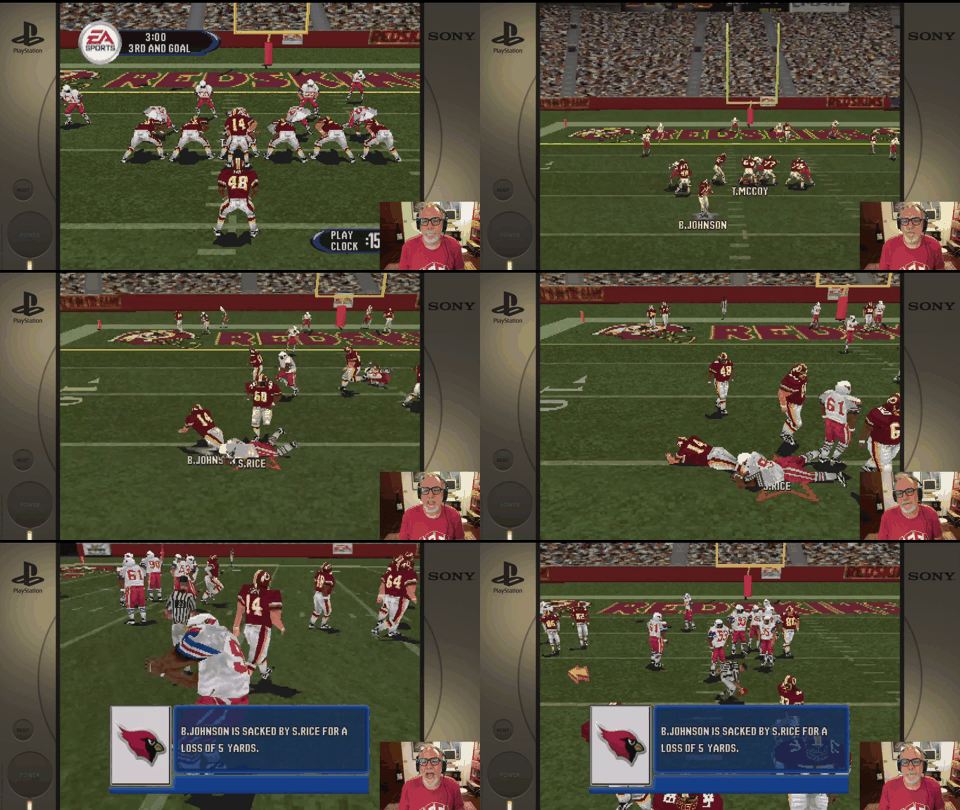
ChatGPT created this GIF from a uploaded video featuring a Madden 2001 play
Also, you can find highlights of certain plays from the game on the AI Maddeness site. ChatGPT provided quick summaries after analyzing short video clips of particular play I fed it, like Simeon Rice’s third down sack to force a field goal, the 50-yard Jake Plummer-Frank Sanders touchdown connection, or Stephen Davis’s game-winning reception. The machine’s ability to parse and describe the videos was very impressive. More than that, it offered to turn the short clips into GIFs, which it did brilliantly. The way in which it recommends things you might not consider is really slick, like the fact it can create GIFs from the clips, or even telestrated images (although those were not as successful).
ChatGPT suggestions are proving to be both useful and a blast
The fact it follows up with suggestions is not only useful, but it has proven a lot of fun. As I was providing more context about the game, explaining it was week 17 of the season and the Redskins had to win to ensure a spot in the playoffs, it suggested the following:
We can turn your summary into a sharp, immersive article — maybe in the style of ESPN, NFL.com, or even with a nostalgic, NFL Films-style tone. Want to build this out together?
An NFL Films-style tone was an absolutely brilliant idea! It made me giddy and had me laughing to myself all morning. The idea of having the gravitas of those epic films contrasted with the ridiculous graphics of Madden 2001 seemed perfect. So, I had it write the script, which was perfectly over-the-top.
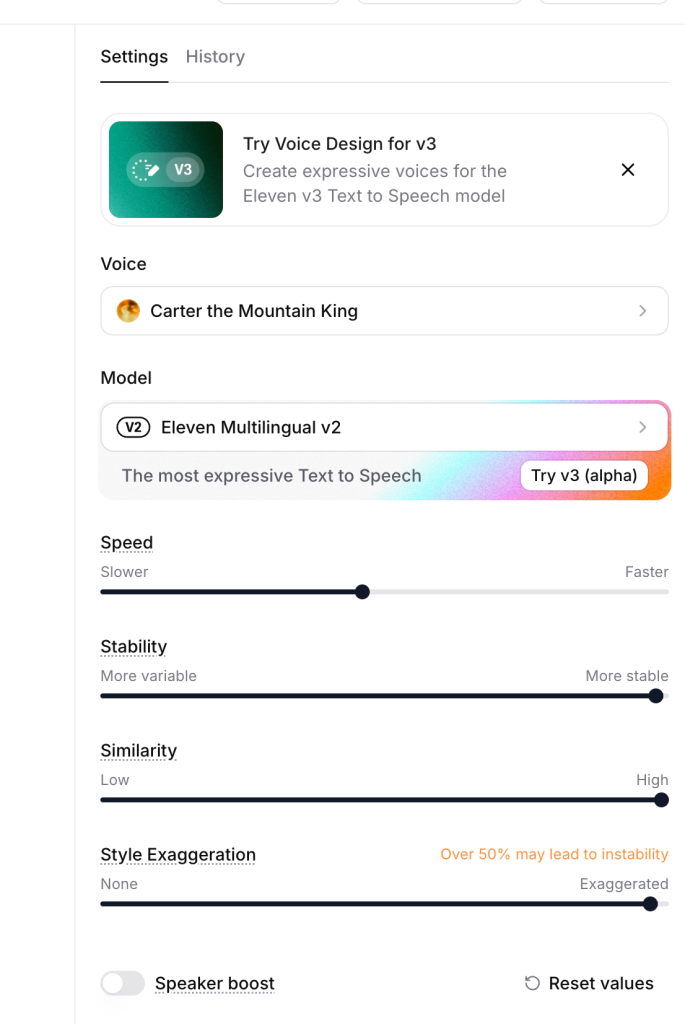
ElevenLabs Text to Speech tool using the “Carter the Mountain King” voice they provide
After that, it recommended where I might find possible epic music scores and a John Facenda-like narrator to read the script. I’m not gonna lie, this was fucking awesome and I had a smile on my face all day. I got one of the male, baritone voices from Eleven Labs (“Carter the Mountain King”) to read the script and used the “Buccaneers March” theme YouTube provides for the background music. Those pieces were easy, I now had a script, a soundtrack, and an overly monotone Sam Elliott-like narrator. Only thing left was to edit the recording of the game down to 2 minutes of highlights, which I’d already staked out. So, without much more ado, here is my NFL Films-style recap of a Madden 2001 game—I really couldn’t be happier with the absurdity of it all!
This is post number 3,935 on this here blog. By December 13th, this blog’s 20th birthday, I’m hoping to make it an even 4,000 posts because I love symmetry: 4,000 posts over 20 years averaging out to 200 posts a year. That’s a lot of fish and GIFs.
Earlier this year I was skeptical I would make 4,000 given these days anything close to 150 posts in a year is daunting. But in the last 6 months I cut that number down by more than half (January and June have been solid months) and with just 65 more posts until 4,000 I can almost taste it.
But why? What’s in it for me? Fame, glory, and riches? Yes, of course, but besides all that I like the idea of blogging towards something. Just like I enjoy hiking when an awesome Italian meal and a glorious vista of the Dolomites awaits. I already know I’m 4life, but the idea of building in a sense of purpose for what has become a regular habit makes the whole process that much more enjoyable.
I love blogging. I love that I’ve been blogging for almost twenty years straight. I also love that I may live to see post 4,000 on what was just a throw away experiment two decades ago. You never know what little things you start will make a huge impact on your life. Long live the bava!
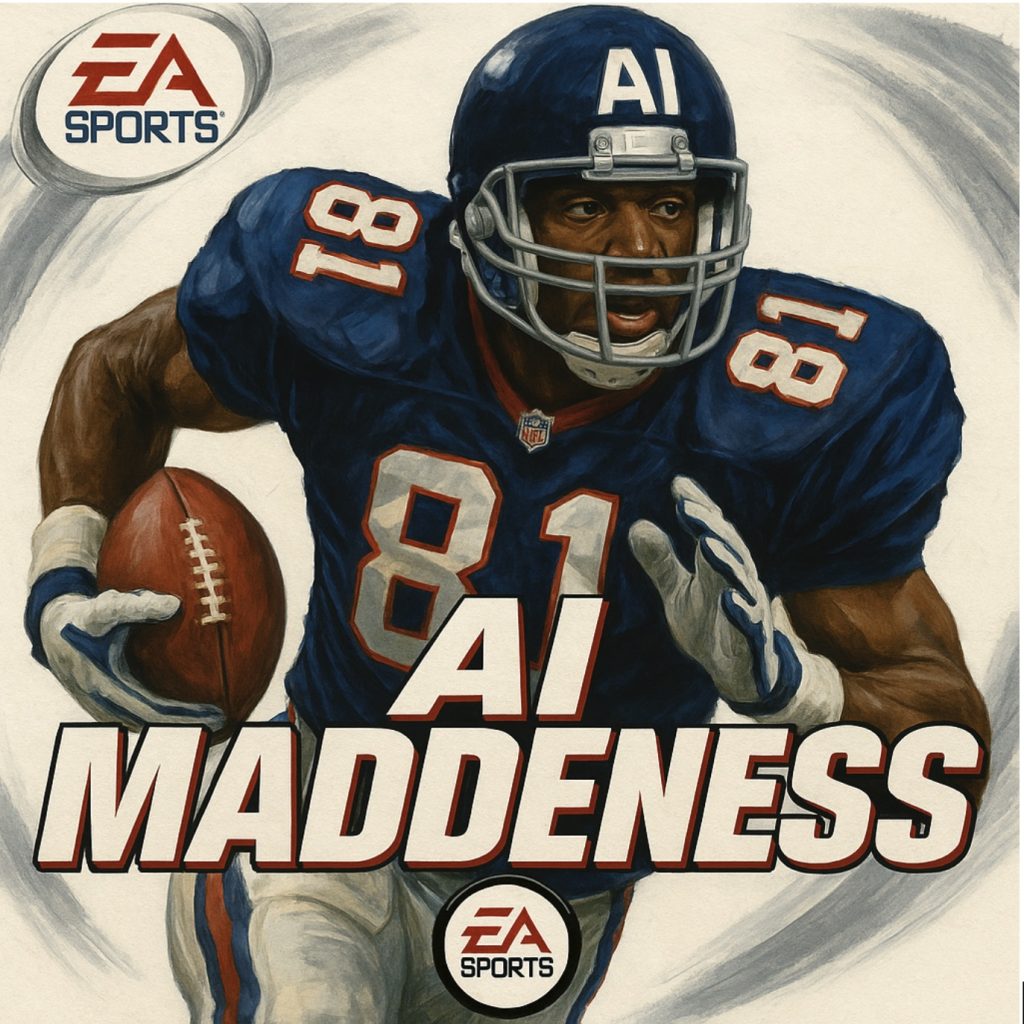
I already hinted at the AI Maddeness project that will build out a sports media universe around the NY Jets 2000 season as created by Madden 2001 on the PS1 (emulated). The idea is to try and understand the various AI tools out there by focusing them on an imaginary season of football using 25 year old rosters, schedules, and rules. I’m not sure it makes a lot of sense, but that’s kinda what I like about it. At a more basic level I chose Madden 2001 because it was one of the first video games that really got me wondering about the AI under the hood.
Ai Maddeness Logo Created by Tom Woodward using AI. I love it so!
This post is an attempt to capture the various details that go into determining which teams get a playoff berth. If you’re a fan of the game, you’ll know “playoff picture” is a term pundits start using to talk about various post-season scenarios as the regular season winds down. The NFL prides itself on league parity (and does a fairly decent job), so the final weeks of a season can be dominated by playing out various scenarios for those teams in the playoff hunt. It’s the time of year when the accounting for divisional records, conference records, head-to-head wins, common games win percentage, etc. starts in earnest.
Recently I’ve been playing a test season of Madden 2001 to re-familiarize myself with the game, one thing I realized too late is that Madden 2001 doesn’t share each team’s division or conference records as part of its statistics. This makes determining the playoff picture a lot harder for tight races. The “Your Self-Assurance Annoys Me” post was all about trying to get ChatGPT to read and translate screenshots of game results from the first 16 weeks of the season to give me the division and conference records for every team—that didn’t work so well.
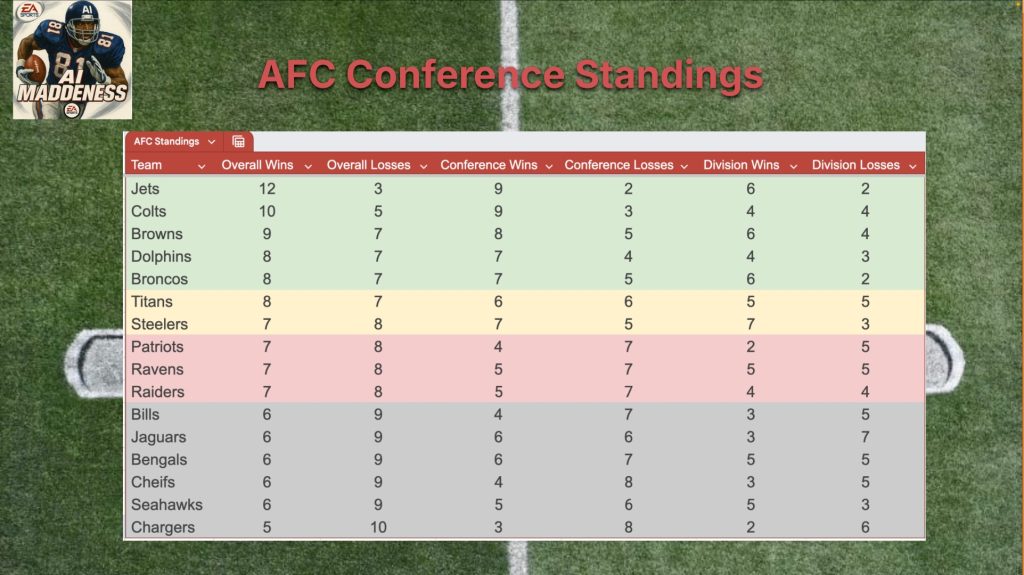
AFC overall, conference, and divisional records going into Week 17
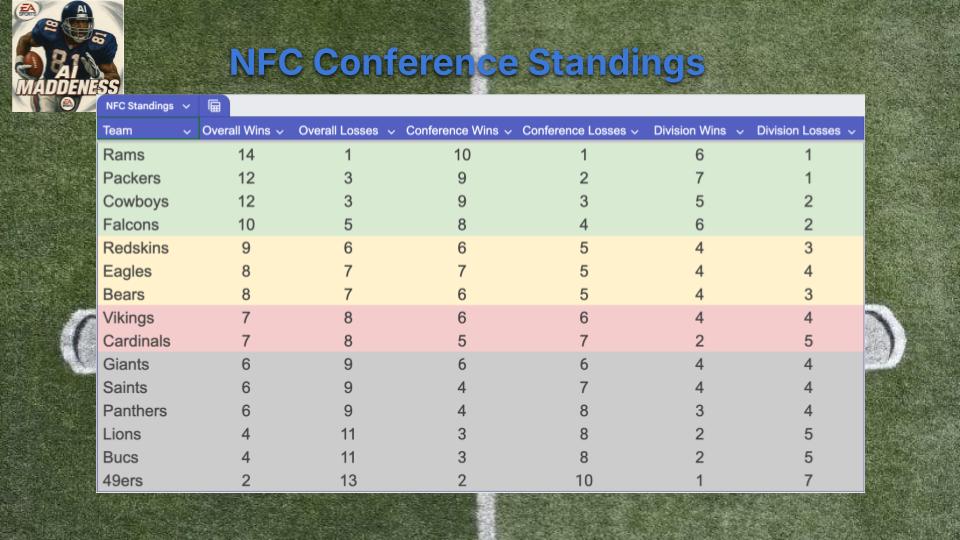
So, I did it the old fashioned way: I WORKED FOR IT! 🙂 And it was mindless and painful and took way too many hours, but now it’s done and I’ll not make that mistake again. Anyway, here are the overall, divisional and conference records for AFC and NFC teams. Breaking it down by conference is useful because non-conference games do not impact the playoff picture and all playoff games are intra-conference until the Super Bowl.
NFC overall, conference, and divisional records going into Week 17
The above conference standings as we move into week 17 tell us who’s in, who’s out, and who’s in the hunt. All teams in green have sealed a playoff spot. Any teams highlighted in yellow are still in the hunt, but are not guaranteed a spot. Teams highlighted in red or gray are out of the playoff picture. The difference between the red and gray teams are the red teams were on the bubble and may have had a shot if they had better conference or divisional records.
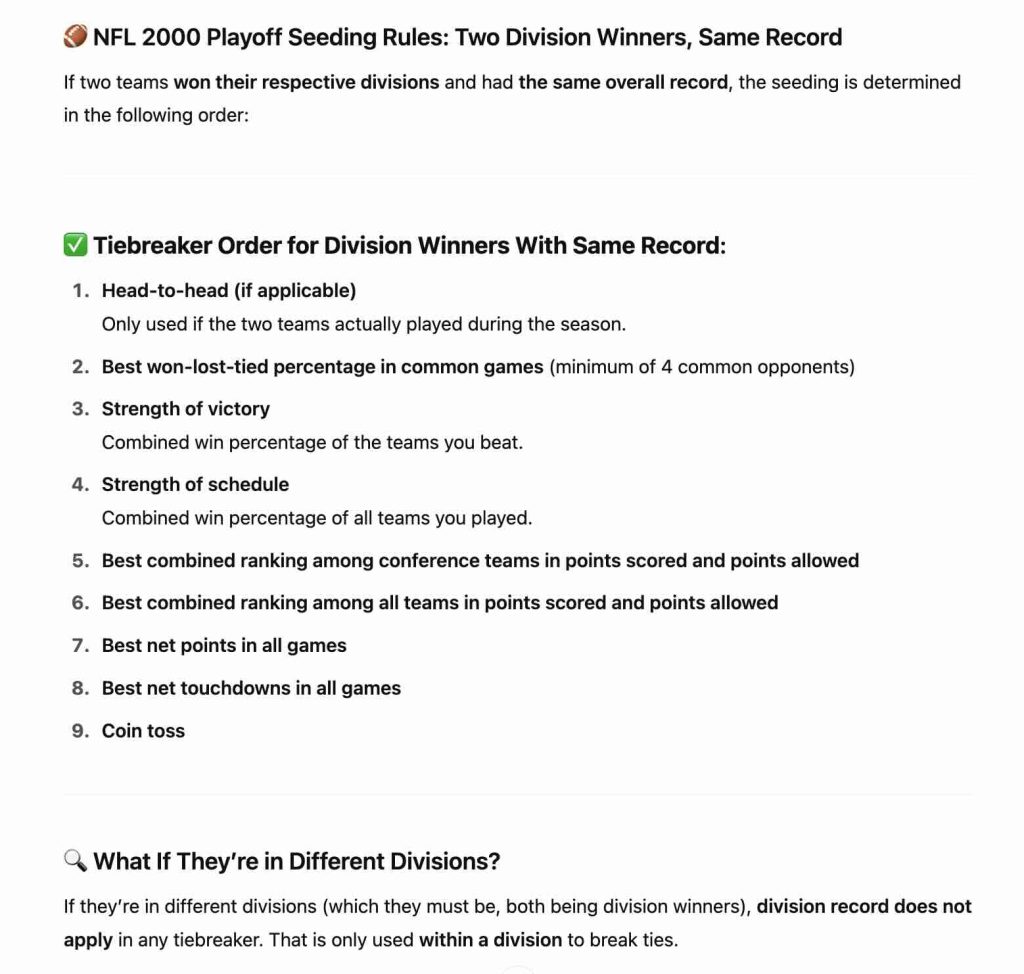
NFL 2000 Playoff Seeding Rules as told by ChatGPT
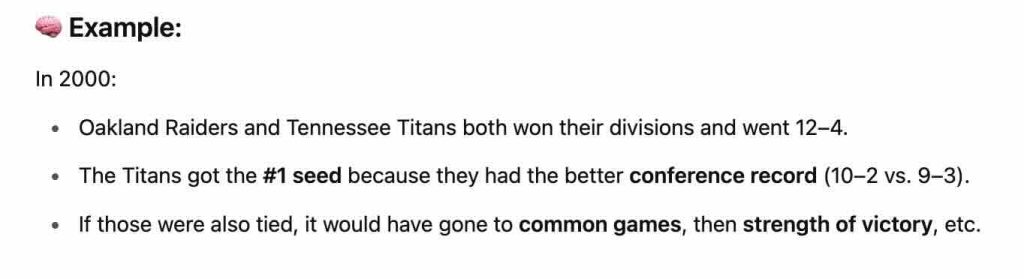
One of the things I had to figure out were the particular rules in place during the 2000-01 NFL season for the playoffs (these are subject to change) to determine tie-breakers, so I asked ChatGPT to give me playoff rules for seeding when it comes to divisional tie-breakers (potentially the case for the AFC Central and the AFC West). These checked out, and it provided a great example from the real-life 2000 season wherein the Oakland Raiders and the Tennessee Titans had the same overall record but were in different divisions, but because the Titans won more conference games they got the 1 seed.
Example from the real-life 2000 season wherein the Titans and Raiders had identical records but the Titans got top seed because they won more conference games
Not surprising given how competitive the NFL can be, by week 16 several possible scenarios emerged after figuring out all the conference and division records. I tried to break things down even more with the following charts for each conference, let’s start with the AFC:
AFC Playoff Picture breakdown heading into week 17 of the 2000-01 NFL season as played on Madden 2001 for the PS1
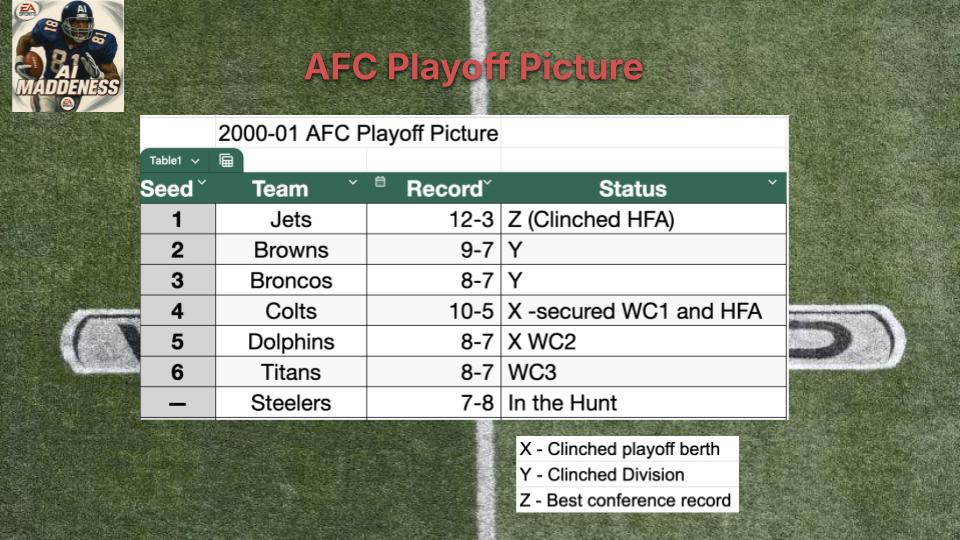
The Jets are free and clear at seed 1, nobody can touch them and they get a first round bye. The Browns end the season with a 9-7 overall record, which is is enough to clinch the AFC Central divisional championship win or lose along with seed 2. Even if the Titans win and the Browns lose, the Browns still have a better divisional record. The Broncos are only 8-7, but win or lose they will clinch the AFC West division and take seed 3 given the Raiders have a weaker divisional record. So seeds 1, 2, and 3 in thr AFC are already determined before week 17 is even played.
Various scenarios for seeds 4, 5, and 6 and in the AFC Playoff Picture moving into week 17
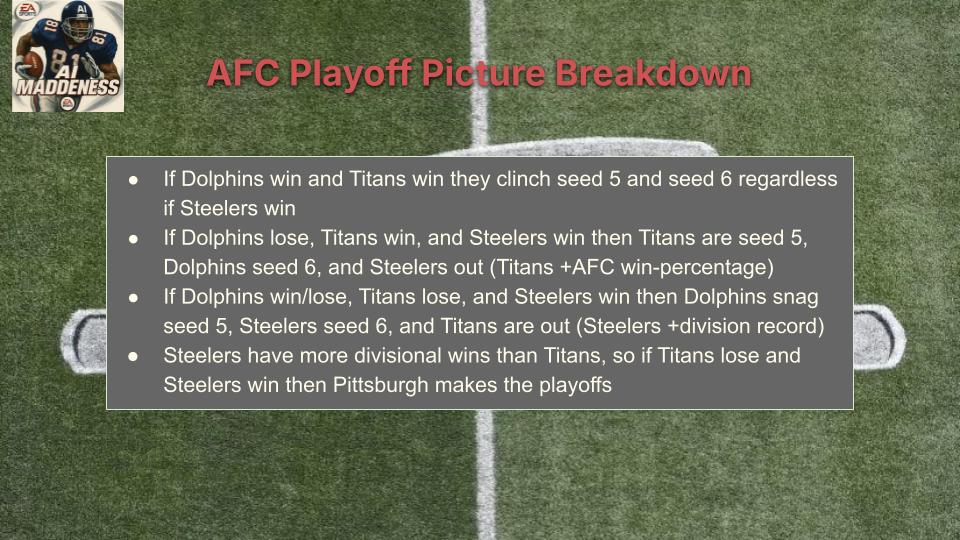
As for seeds 4, 5, and 6, there ‘s a bit more in flux. While the Colts have the second best record in the conference, they are in the AFC East with the mighty Jets at 12-3, so they’re delegated to seed 4. As for seed 5 and 6, right now that’s the Dolphins and Titans respectively. But if the Titans win and the Dolphins lose the Dolphins will go to seed 6 and the Titans take seed 5—not a huge shift to be honest. But, if the Titans and the Dolphins lose and the Steelers win the Steelers grab seed 6 and the Titans are out of the playoffs—the Dolphins remain seed 5. The reason the Steelers make the playoffs over the Titans with the same overall record is the Steelers have a better record in the division. Whereas if the Titans win and the Dolphins lose they claim a higher seed cause they have a better conference winning percentage. It’s kinda fun to get lost in these weeds.
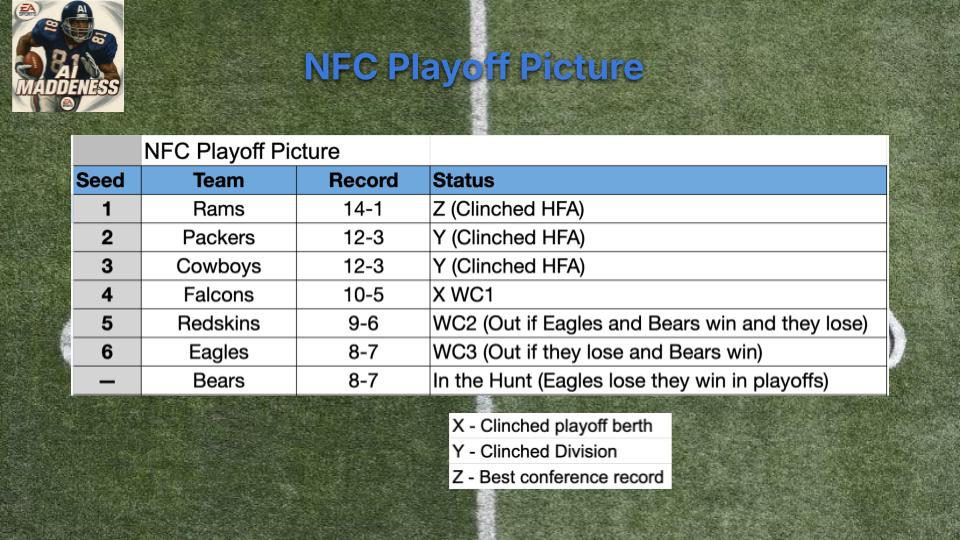
NFC playoff picture going into week 17
The NFC has even more playoff picture drama. To start, while the Packers have the 2 seed and the Cowboys are 3, if the Packers lose and the Cowboys win then the Cowboys get seed 2 and first round playoff bye. If both the Cowboys and Packers lose then they have the save overall and conference records, so it comes down to common games, and I believe the Packers will win out there, but still need to do the math.
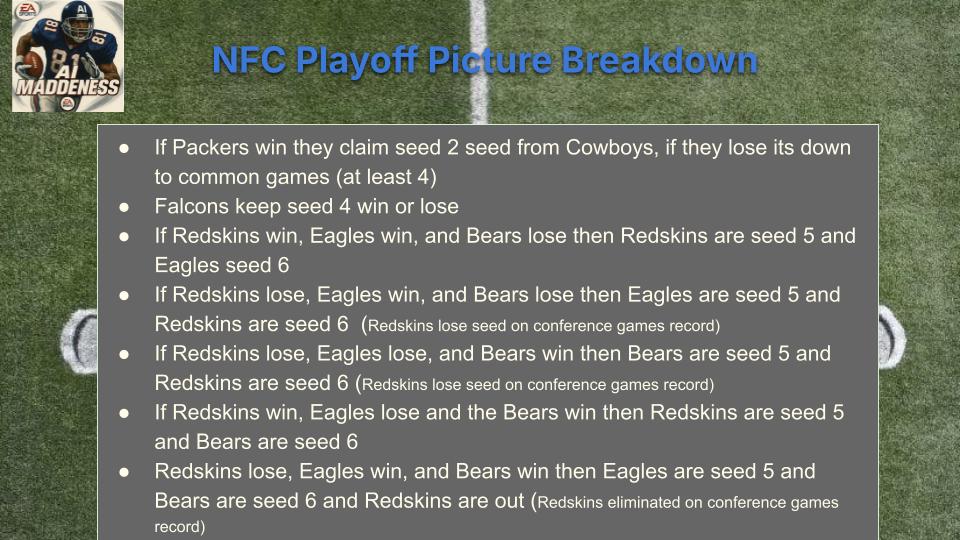
NFC Playoff scenarios going into week 17
As for seeds 4, 5, and 6 in the NFC, Falcons (like the Colts in the AFC) have the 4 seed locked win or lose. But for seeds 5 and 6 in the NFC its a three-way playoff between the Redskins, Eagles and Bears with all kinds of scenarios:
If Redskins win, Eagles win, and Bears lose then Redskins are seed 5 and Eagles seed 6
If Redskins lose, Eagles win, and Bears lose then Eagles are seed 5 and Redskins are seed 6 (Redskins lose seed on conference games record)
If Redskins lose, Eagles lose, and Bears win then Bears are seed 5 and Redskins are seed 6 (Redskins lose seed on conference games record)
If Redskins win, Eagles lose and the Bears win then Redskins are seed 5 and Bears are seed 6
Redskins lose, Eagles win, and Bears win then Eagles are seed 5 and Bears are seed 6 and Redskins are out (Redskins eliminated on conference games record)
It’s a lot! I’m a terrible logical thinker and this shit makes my head spin, and that might be part of my interest. But Madden 2001 just does all these calculations behind the scenes, and many of my scenarios hold-up, but I couldn’t help but think I was missing something, but this is an imaginary season played as a test for the real imaginary season, if you follow me.
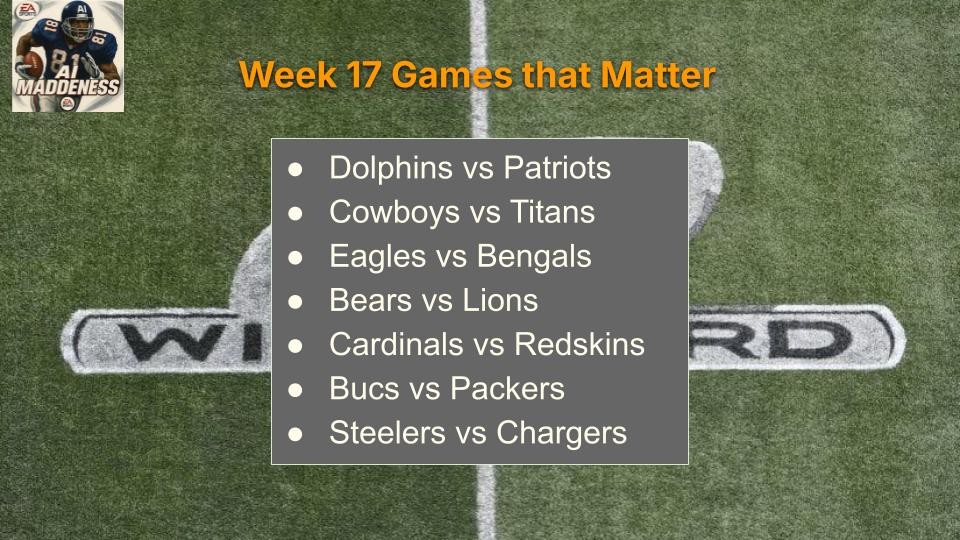
Week 17 Games that Matter
Anyway, here are all the week 17 games that matter. The outcome of any of these games will potentially impact the playoff picture, so those are the ones I’ll be playing through over the next week or so as a way to start having AI produce quick game summaries, insights, predictions, etc.
On top of all that, this past weekend I made a 20 minute video that takes you through the playoff picture because I’ve become obsessed. I like the exercise of trying to make the various complexities understandable with some basic charts and visual summaries from Google sheets. Not sure it was all effective, or even correct, but I do know that for it to be any good it needs to be done in 1/10th the time. Thankfully this is a game I’m pretty much playing alone in more ways than one.
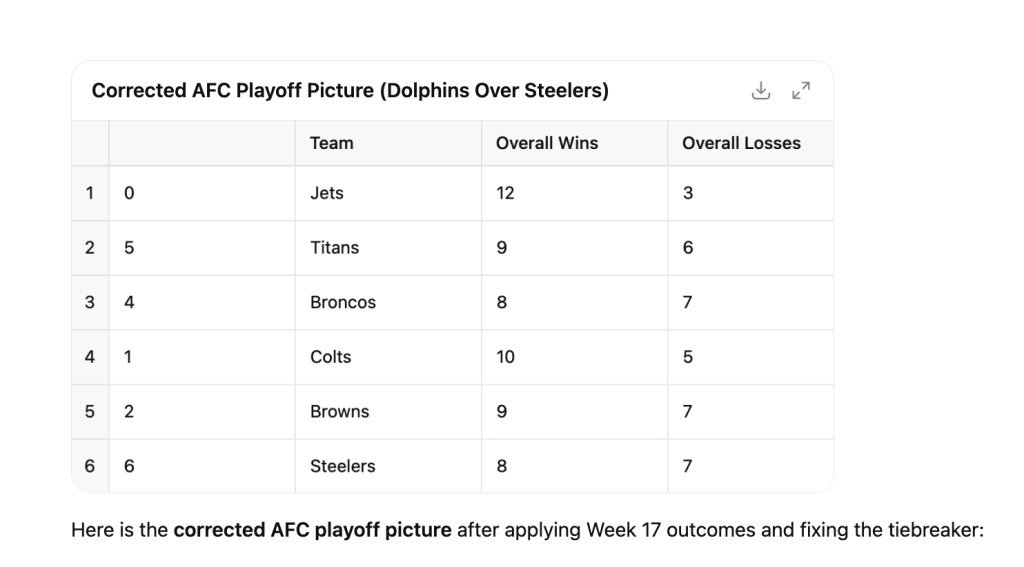
Given the lingering feelings I was missing some possible scenarios mentioned earlier, I ran the data I had through ChatGPT to see if it came up with similar results going into week 17. It inevitably got confused. The AFC playoff picture was pretty much a cluster, it could not deal with the AFC Central at all and insisting the Titans would be the AFC Central winners. As it so happens, this scenario is not even possible given the two teams can only have the same schedule if the Titans win given the Browns will still have a better division record (the Browns have a week 17 bye).
Corrected AFC standing in ChatGPT getting confused. Titans cannot win AFC Central (yet they do here) and the Dolphins are guaranteed a spot based on number, so the machine is confused
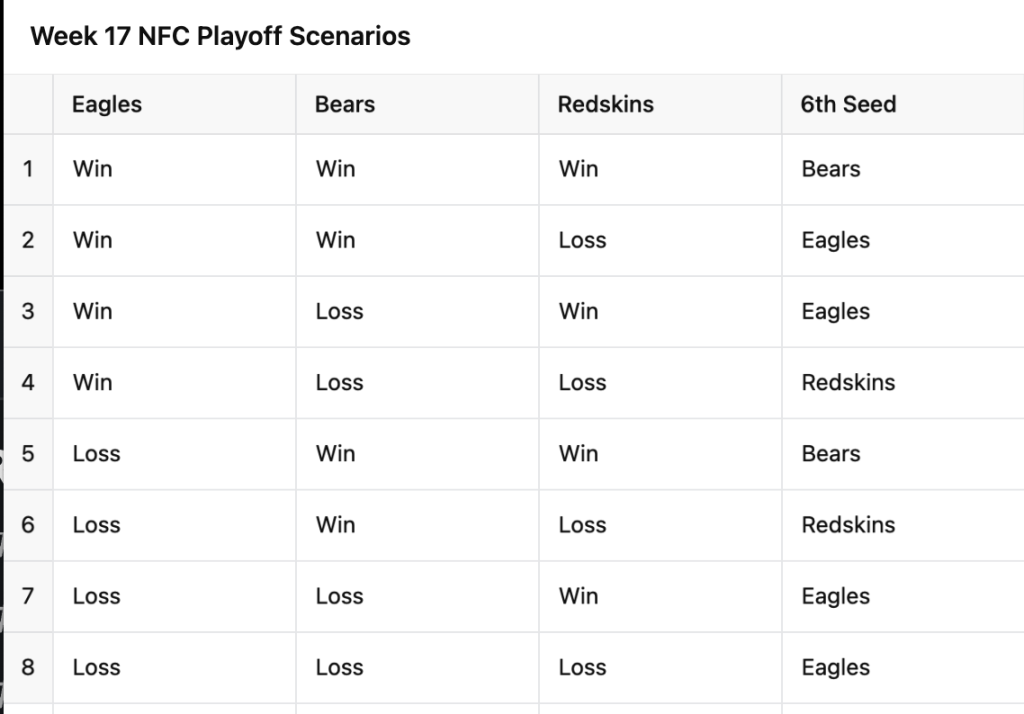
To be fair, the AFC playoff picture as told by ChatGPT was close at first, but it’s inability to calculate division and conference win percentage correctly started a slide it couldn’t recover from. Once I tried to correct the mistakes it just got more and more confused. On the upside, it provided me a nice chart for calculating scenarios for a potential 3-way tie in the NFC between the Redskins, Eagles and Bears. It lines up each team by wins and losses and then states who the 6th seed could be:
ChatGPT breaks down playoff scenarios for Redskins, Bears, and Eagles based on wins or losses in week 17
I had only figured 5 of these scenarios, I missed the possibilities of all 3 teams winning, all 3 losing, and if the Redskins win and the Bears and Eagles lose. There’s some basic probability statistics I’m missing that ChatGPT’s chart helped me out with. Another thing I realized while digging into these scenarios with ChatGPT is that if the Bears win and the Eagles win they have identical overall win-loss records and conference records, so it comes down to common games played (they did not have any head-to-head encounters during the season). I still need to account for that, so my playoff picture is not entirely complete and the above chart’s 6th seed assumptions is potentially wrong for at least half the scenarios. Finding holes in my predictions thanks to ChatGPT was useful, so there’s that.
What this all reinforces, at least during my early explorations, is that the more you know going into any exchange with the machine the better off you and your assumptions will be. Also, I am appreciating some of the templates for tracking these games, even if its results are nonsense. The containers for the data are more useful then what ChatGPT puts in them, and that has been true more then a couple of times now.
_____________________________________________
*You can see I’m really getting into my lost (rightfully so) career as sports broadcaster.
The “On Writing” series marches on, and for last week’s episode we were joined by Lee Skallerup Bessette. As I mention during the conversation, Reclaim Hosting has been continually going back to the well by asking Lee to lead our community chat in April, share her blogging journey post on our blog, and now we dig even deeper into her career as writer during this hour long conversation. The reason we keep coming back to Lee is not only because she is so damned smart and engaging, but also for her generosity and kindness as a speaker and writer. All of these elements make for a joyful discussion and that’s what we want from our “On Writing” episodes!
Anyway, I had a bit of a plan going into this one because I was personally fascinated by Lee’s growing up in the bi-lingual world in and aroundQuebec. She has published scholarship in both English and French and I wanted to know more about what it means to write in different languages. What follows is a fascinating discussion of the role the politics of language played in her own education as a writer. The way in which her strong memories speak to her gravitation towards memoir across. all her various forms of online writing is not surprising. She understand all the writing she does across various medium as a kind of hyper-texted memoir that is a powerful way to understand one’s work across the time and space that is the web. In many ways Lee’s mind works like the best web, a series of connections that are constantly enriching the dialogue and widening the space for intellectual exploration.
I love talking to Lee. Ever since we communed at Domains 19 over the edtech world in which we live and write, I’ve found her to be a strong, authentic voice that speaks openly and honestly—something that’s not easy to do, but such a voice invariably reminds us that the web we inhabit is made up of real people in and of the world.
I’m happy to introduce the latest additions to bavastudio, even if a pivot from 80s aesthetic. While walking though a flea market in Trento last weekend I spotted a couple of stuffed animals (in the taxidermical sense) that I would normally pay no mind. But once you have a diorama, everything becomes a subject for a diorama. Anyway, the European Badger featured above was the first to catch my eye, and I immediately thought of the American Museum of Natural History (AMNH) dioramas—in many ways where this weird diorama hang-up all started.
The AMNH is the greatest museum ever, but not because I necessarily love science, biology, or even animals, rather because the majority of that museum is made up of the most awesome dioramas ever. The whole thing is like strolling through a cinema of wildlife tableaux, the lights are dimmed and the action surrounds you as you move from one diorama to the next. How can you not love the intensity of the life-size frozen moment featuring a pack of wild dogs surrounding a Sambar:
Or the unsuspecting hare being stalked by a lynx:
Canada Lynx stalks Snowshoe Hare diorama at AMNH
These scenes were imprinted on my adolescent brain during childhood field trips through those landscape stage designs featuring various stuffed animals as the talent. I’ve returned to that museum innumerable times since (more recently with my kids in tow) and it’s absolutely ground zero for the idea of building a life-size window diorama at bavastudio. So, when I saw Tasso and his sidekick Erminia (pictured below) on a random table at the local market I couldn’t help but think we have to do a diorama in the style of those from the AMNH.
Erminia the stuffed Ermine
For now the pair are just part of the offie scenery, and they fit in surprisingly well—something I was not expecting.
Tasso the European Badger in bavastudio with teeth showing and claws out
The initial idea for the diorama is to have the bottom third of the window reveal a badger tunnel system, featuring Tasso walking through its domain. Whereas the upper two-thirds reproduce a scene similar to the American Badger in Jackson Hole, Wyoming from the AMNH, but just change the backdrop to highlights the beautiful Dolomiti that help define the natural wonder of the Trentino region. Given Erminia’s reaction/pose, it might make sense to have it be a reaction to a raptor trying to have her for lunch. Maybe a Eurasian Goshawk swooping in for the kill?
Eurasian Goshawk finishing up lunch
I’m not necessarily a fan of stuffing animals, and I have no plans on pursuing something “custom,” but if there’s something already made that could be used to help create a multi-level, dynamic nature scene worthy of the AMNH dioramas it would be a fun way to pay homage to a brilliantly conceived museum that has dioramas at the very heart of their educational mission.
Over the last few months I have been struggling to get my Exidy Cheyenne cabinet back up and running. It’s a beautiful specimen that’s given me some issues over the years needing a chassis overhaul and some power supply love here and there, but in general it’s been solid. It’s a beast of a cabinet standing well over 6′ tall and weighing 200+ pounds, what’s more it has a unique control panel with an articulating cast iron light-gun rifle making it that much more special.
I put off getting it on wheels to the very end, but given it was time to bring it to bavastudio I figured a complete strip down and clean-up was in order. I also sent out both boards (one Cheyenne one Crossbow) for testing and they came back in good working order, even though only the Cheyenne board was working properly perviously.
Cheyenne PCB with Crossbow Sound Board
Anyway, long story short, after rebuilding the game in bavastudio I couldn’t get either game board to work. While both worked initially, after a short time the Crossbow board was throwing garbage again and both boards were having intermittent audio issues. The Crossbow board kept blowing out the speakers, and thanks to my laziness/stupidity re-wiring a new speaker I shorted out an audio resistor on the Cheyenne board—which was the only one that kinda worked.
Residue from burnt resistor on Cheyenne’s sound board
It was frustrating to say the least. I tried replacing the resistor and testing things, but the sound was still dead, so I had to step away. Luckily I had a diorama to distract me, but I also knew the Exidy 440 boards were notorious for being fragile, much like many of the Williams boards.
Multi-Williams FPGA Board for Joust, Robotron, Defender, Stargate, and more
While I do want to make sure the original boards are intact, I’m not such a purist that I won’t use modern solutions like FPGA substitute boards to avoid constantly repairing problem boards. Sending in boards to be fixed starts to add up if you can’t do the work yourself.
But let’s take a quick step back, what exactly are FPGA boards? FPGA (Field-Programmable Gate Array) boards provide a hardware-based approach to game emulation that provide near-perfect accuracy by replicating the original hardware at a low level. I have FPGA boards for Joust, Robotron, Defender, and Stargate and the difference in gameplay is undetectable. Given FPGA boards use modern hardware they can do more with less: a single board can run multiple games which would be an ideal solution for Cheyenne, given there are a number of light gun games that use the same 440 system:
In 1983, Exidy began creating light gun games, which had not been popular in the arcades since the heyday of electro-mechanical games. Crossbow (1983) was a success, establishing the Exidy 440 hardware system and prompting the release of more light gun games in the same style. The ‘c’ series consisted of Cheyenne, Combat, Crackshot, Clay Pigeon, and Chiller (1986).
As luck would have it, Exidy 440 FPGA boards had been developed so I decided to take the plunge and get one so that this game is fixed once and for all (I cannot tolerate a non-working game in the collection). The cool thing about the Exidy 440 FPGA is it includes 12 different light-gun games that will all play perfectly on Cheyenne—my favorite being Crossbow. In fact, a few years back I already installed an Exidy 440 multi-game kit but one of the chips went south and it never really worked cleanly again. While a chip-based 440 multi-game solution cost less than a modern replacement board, I would argue the FPGA is a better bet given it helps you preserve a notoriously unreliable board system that will, sooner than later, give you headaches.
Exidy 440 FPGA Board
As illustrated above, the FPGA board is a fraction of the original board’s size, and it has various inputs for edge connectors for everything from the power source to the control panel to the coin door to the speakers to the video input for the monitor. There’s an easily accessible volume pot as well as a USB drive where you can load the ROMs for the various Exidy 440 games—you can see a full list of those games in the video below.
The FPGA board gives you a range of options for controlling settings for the cabinet as well as on a game-by-game basis.
In the Cabinet settings you can control things like global free play, determine if audio is stereo or mono, decide what game you want to boot at startup, etc.
In the individual game settings you decide the number of lives (for Crossbow “friends”), difficulty, free play, coins, etc.
The FPGA pretty much solved all my board problems and gave me a dozen more games to boot, which is a definite win. I love it when a single board can play multiple games through upgrades like this.
With the board working the final piece was to swap out the speakers I’d blown with some relatively cheap ($26 on Amazon) 6″ car speakers that are 600W and 4 Ohm. With two of those installed with no shorting issues, I was able to enjoy the stereo effect for the first time with this game. Also, I have to assume the sound issues were board related, but that doesn’t make any sense given they checked out working with Mike (and were working briefly for me)—that mystery is yet to be solved and may be a wiring issue, but wouldn’t that show up with the FPGA board? Nonetheless, I have a working Cheyenne and Crossbow with 11 additional games so the light gun situation at bavacade is on point!
Below are instructions I lifted from the KLOV forums and copied here for posterity. Finally, big thanks to the wonderful community on KLOV, in particular BigDogs, for making things like the 440 FPGA a reality—it’s the stuff dreams are made of.
______________________________
INSTALLATION:
Disconnect the original harness from the logic board OR EMI board. (some CABs have the EMI board and some don’t) All the connectors are different number of pins/pitch EXCEPT P4 (monitor) and P8 (speakers) . You may want to label these two before unplugging if you can’t easily determine which is which.
Power up the game and verify the +5V. It’s common on these CABs for the 5V to be running significantly higher due to the large current draw and the loss in the wiring. If the 5V is higher than 5.2V you will want to adjust it down on the power supply. Instructions for this can be found in any of the Exidy 440 manuals. The board will run fine from 4.7V – 5.2V
Power down the game and connect P3 (power), P8 (speakers), P4 (monitor), P16 (coin door), P12 (control panel) and P2 (gun). The “ramp” side of the harness connectors should face the “ramp” side of the connectors on the board. Note that the connectors on the FPGA board are orientated OPPOSITE of the original boards. You may have to remove (unscrew) one or more harness anchors to get enough slack to plug in all the connectors.
Make sure no metal comes in contact with the edge connector or any of the component connections on the FPGA board.
Power up the game and verify operation.
LOADING ROMS:
Prepare a USB drive by copying the rom files to the root of the USB drive. Filenames are CASE sensitive so make sure the names EXACTLY match the names in the file list.
Insert the drive into the USB connector on the FPGA board.
Power up the game.
While the files are copying the green active LED will flash/stay lit. When it goes out all the files are copied over.
Power down the game and remove the drive.
SWITCHING GAMES:
There are two methods to switch games. The first method is hold the start button down and after 2 – 3 seconds start pulling the trigger. After 5 seconds each trigger pull will advance to the next game. You will see the selected game name show up at the bottom of the screen. When you get to the game you want to play just release the start and the game will run. The second method is to hold the start button down and DON’T pull the trigger for 5 seconds. This will bring up the title screen. Pulling the trigger will advance to the selection screen. You can then use the start button to highlight the game you want to play and then pull the trigger to load it.
SERVICE MENU:
The service menu can be entered any time there is a game running. (not from the selection screen or title screen) You enter the service menu by holding start AND trigger for 5 seconds. The service menu allows you to set the game options for each game and whether the game is “enabled” or not. (if it appears in the selection menu and game rotation) It also has the CABINET settings described below:
FREE PLAY- This is a “GLOBAL” setting that overrides all individual game settings. If it is enabled ALL games will be on free play.
FAST BOOT- When enabled the games will skip the power on tests and boot right into the game. If the EEPROM gets corrupted (high score table scrambled) OR on the very first time a game is run turn this off and the game will reset the EEPROM during the power on tests.
DIAGNOSTICS- When enabled causes all games to go into their diagnostics menus instead of running. This is where you will find the gun calibration and other tests specific to each game. Once enabled just switch games as you normally would but instead of running the game it will run the diagnostics.
AUDIO OUT- This allows you to select the type of audio to output, choices are:
STEREO- This is the default setting and should be used for EXIDY cabs with TWO separate speakers, OR with Jamma alternate stereo speaker wiring. (+ = left, -=right, ground both speakers to a ground connection)
MONO- This setting should be used for EXIDY cabinets with ONE speaker. (It will force ALL sounds in the stereo games to play out both channels)
BRIDGED- This setting should be used with standard Jamma wiring where spk+ and spk- connect directly to the speaker and NO ground is used. It is mono but uses both amplifier channels in a bridged mode to increase the output power.
USE XBOW CAL- This setting causes all games to use the calibration data stored in the Crossbow EEPROM. I’ve found some games don’t seem to work well with this data so if you are having gun calibration issues I recommend calibrating each game using their respective diagnostic menus.
BOOT TO- This setting allows you to change the power up operation of the game. You can select a specific game to start up to OR the game selection or service menus. If the game you choose is not enabled, the next enabled game will run. If none are enabled the service menu will run.
My friend and podcasting partner Michael Branson Smith (MBS) proclaimed before a recent recording that “GIFs are dead.” This coming from one of the foremost artists in the field. I was not only taken aback, but deeply hurt. Some of my very best blog posts are simple GIFs from the heady days of ds106, are they now just meaningless artifacts forever looping in a vacuum during this post-GIF era? I don’t want to believe that GIFs are dead, so to counter MBS’s irresponsible claim I’m back to making GIFs. I’ll die for GIFs!
Part of the famous scene in Female Trouble when Divine asks: “Who wants to die for GIFs?”
If you too want to fight back, join me in Making GIFs Great Again (MGGA)!
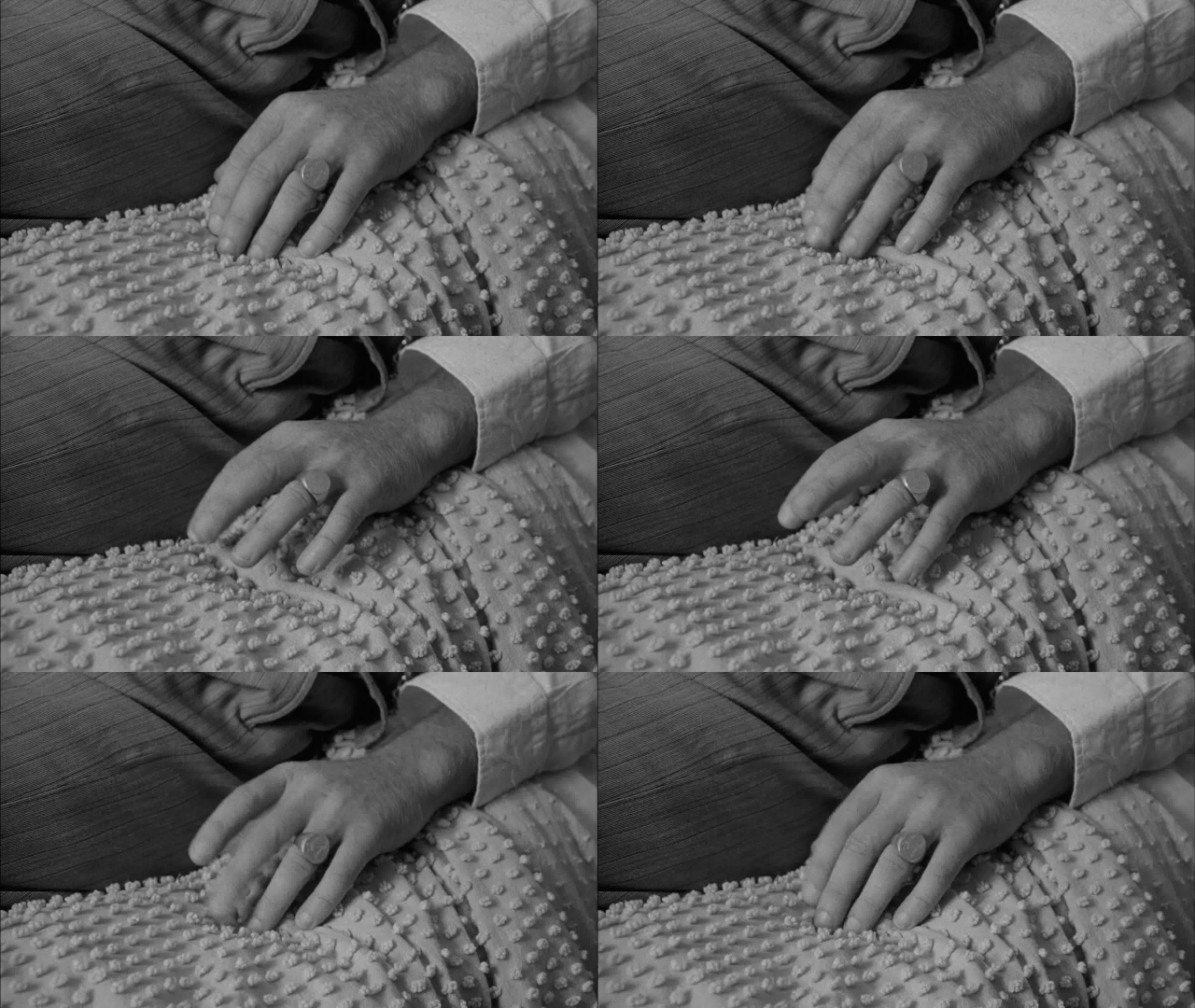
One of the things I did immediately was return to my GIF making guide for GIMP I documented for ds106 almost 15 years ago because I found my best GIFs were often hand-crafted. The problem with that guide is MPEG Streamclip is no longer supported on Mac, so I needed to find another tool to break a movie clip down to individual images. I ultimately landed on loading ffmpeg on my Mac using Homebrew:
brew install ffmpeg
After that, I used terminal to navigate to the folder where my clip(s) lives and ran the following command with the name of the movie clip you want to breakdown to isolated images. I recommend the clips be about a second long for best results with this method.
I found using the jpg extension versus png keeps the GIF much smaller, and it should weigh not much more than 1 MB or so if you have about 15 images—which I found to me the sweet spot thus far. Anyway, if you are gonna die for anything in these tumultuous times it might as well be Art GIFs, let’s show MBS that he’s not above the law!
I know you’ve been drumming your fingers impatiently for my next blog post highlighting episode 15 of THE Family Pictures Podcast, but I’VE BEEN BUSY! Nonetheless, it’s time to dig into one of my favorite episodes that’s all about the 1973 comedy Paper Moon directed by Peter Bogdanovich starring father-daughter duo Ryan and Tatum O’Neal. Neither Michael nor I watched this film before we decided to talk about it, and it was a revelation. I’d seen this VHS/DVD in video stores innumerable timed over the years, but given the title was impenetrable, it was filmed in black and white, set in the 1930s, and starring Ryan O’Neal whose time had come and gone meant I never took the jump.
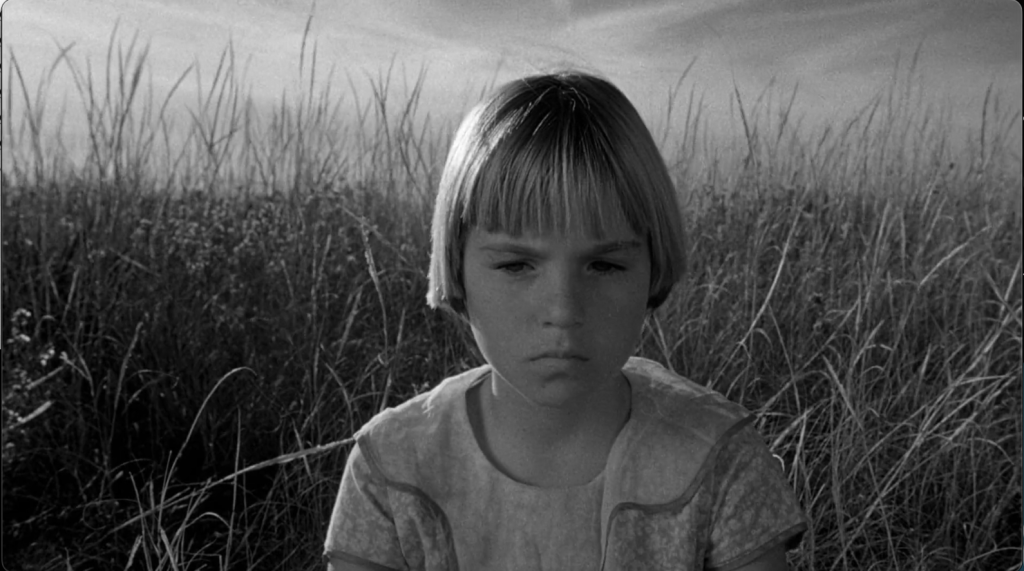
But having finally watched the movie I’m now a big fan. The interplay between Ryan and Tatum on screen is magic, even if it might have been just the beginning of their struggles off-screen. In many ways this film is a wandering road movie wherein Addie (Tatum O’Neal) and Mose (Ryan O’Neal) go from grift to grift before orphaned Addie is dropped off at her Aunt’s house. The joy of the film is watching their relationship blossom as they start to work together and get to know one another. Given biographical details like her parents’ divorce, her mom’s addiction, and the resulting strained relationship with her dad, it’s hard not to imagine art imitating life on-screen.
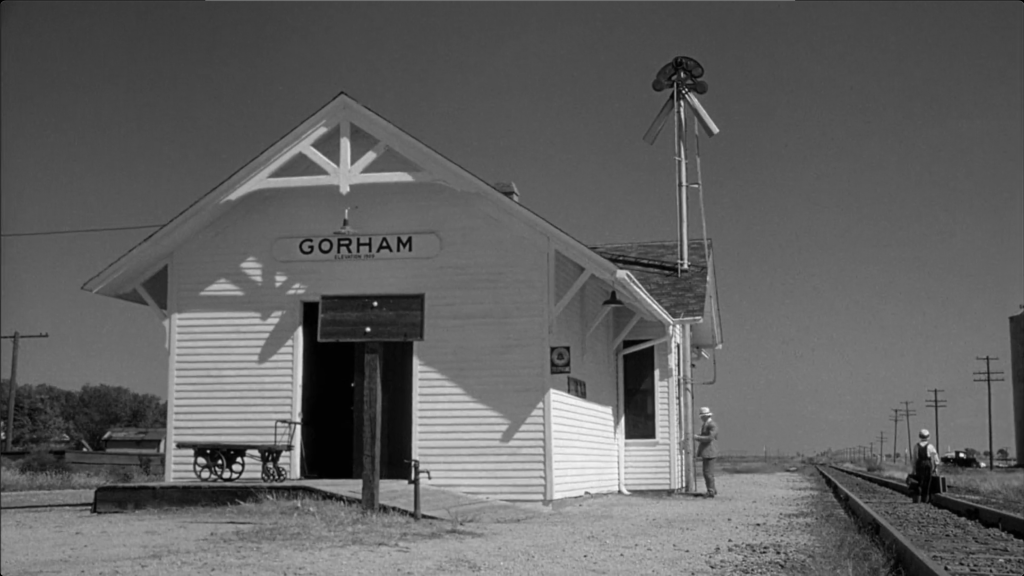
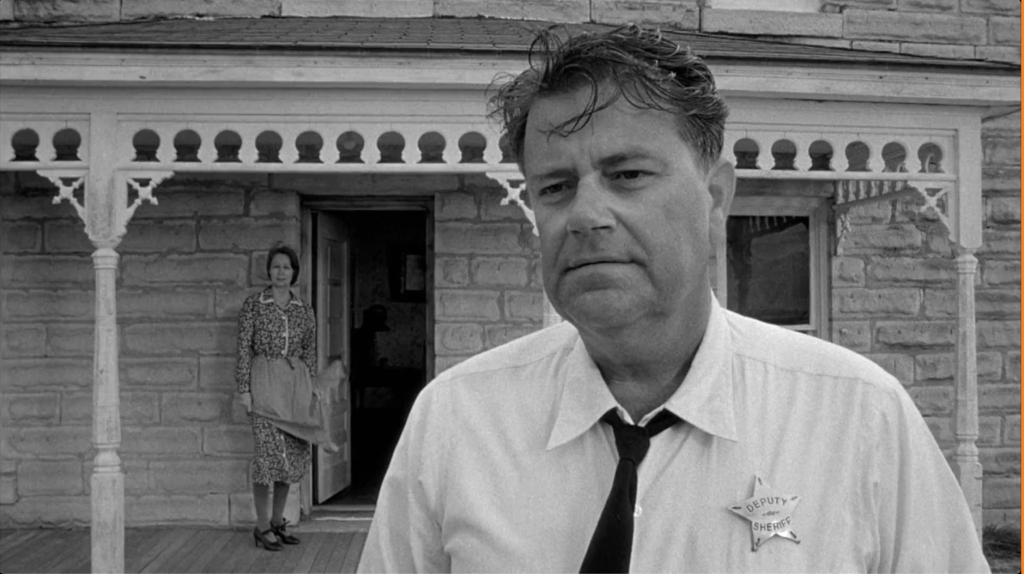
Addie and Mose on the road in Paper Moon
How much were father and daughter actually getting to know and understand one another while making this movie? How much of that contributed to the subsequent strain and pain in their relationship afterwards? A 10-year old Tatum won the coveted Oscar for her performance in Paper Moon (still the youngest to do so), meaning she surpassed her superstar father at his own trade in her first movie, what new strains for their relationship might that introduce?
Reading Paper Moon through a rear-view mirror (technically side-view mirror, but who is counting?)
It’s hard not to watch this film through the rear-view mirror, so to speak, but our podcast is all about family dynamics in movies. Paper Moon offers a truly unique dynamic between father and daughter that captures not only brilliant performances, but also belies the real-life struggles when the movie ends.
Tatum O’Neal’s performance in Paper Moon as Addie wins her an Oscar, still the youngest person to win that coveted award.
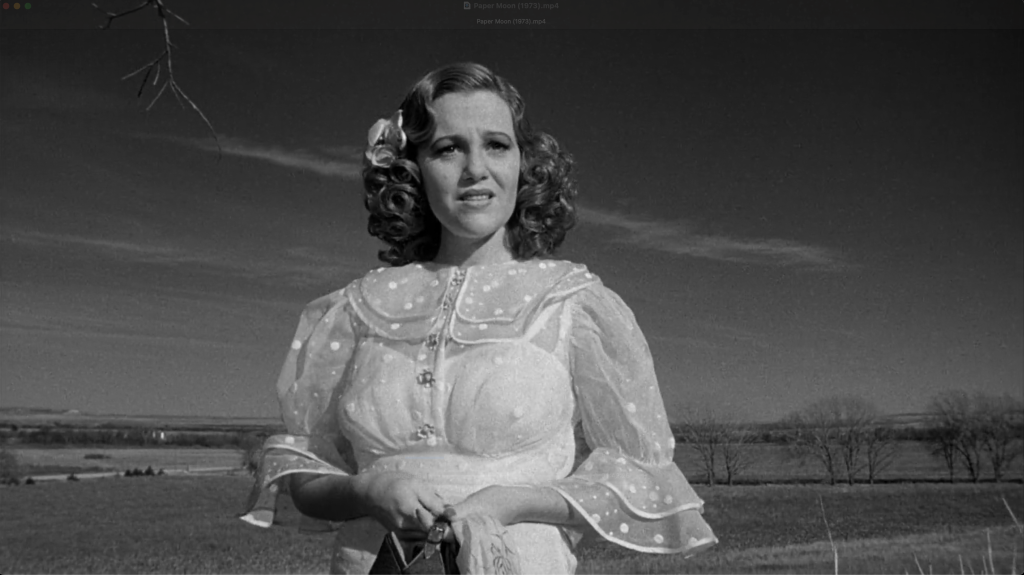
Another element of this film worth noting is just how gorgeously it’s shot in glorious black and white by László Kovács—a regular collaborator with Bogdanovich and one of the most important visual interpreters of the New Hollywood movement.
The presence of Walker Percy’s photos from the 1930s permeates this film in shots like this
There are a number of magical scenes throughout this peripatetic film, but possibly the most powerful (both dramatically and visually) is when Addie refuses to get back in the car after Mose picks up fellow con-woman Trixie Delight (played brilliantly by Madeline Khan) which then drives a wedge between them.
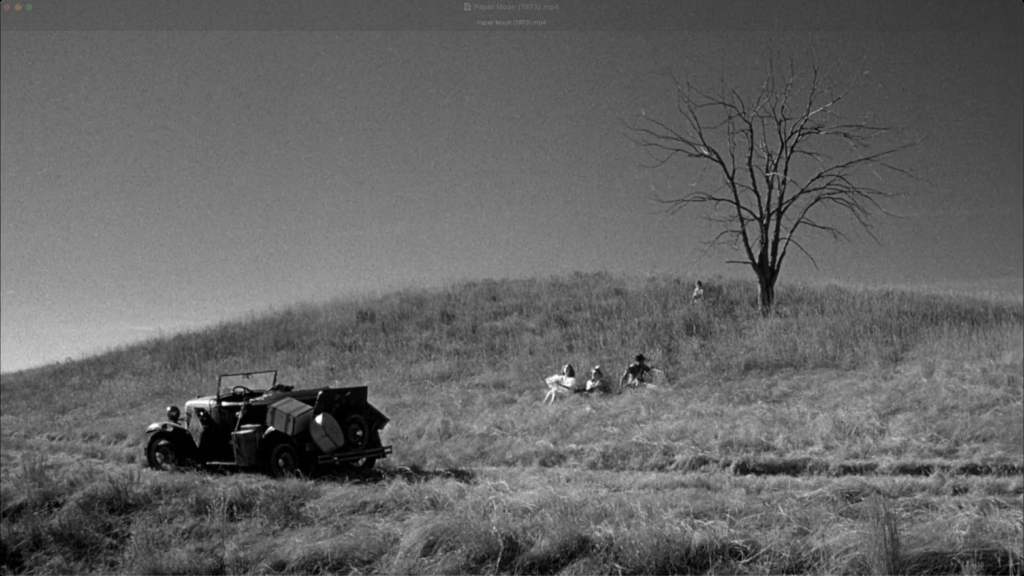
A shot of the grifters picnicking on a hill
While Madeline Khan had a relatively small role, it garnered her a supporting actress Oscar nomination in only her second movie (I mistakenly claim it’s her first during the podcast). Trixie’s heart-to-heart with Addie encouraging her to just tolerate her presence for a little whole longer ’cause there hasn’t been anything in her life she hasn’t ruined is a moment of depth and pathos that punches through the comedic veneer. This effortless and entirely believable moment of humanity in the face of the lean years of the depression is transcendent, and has to be the moment the Oscar committee gave her the nod.
The great Madeline Khan as Trixie Delight gives a brilliant performance, just another reason to see Paper Moon
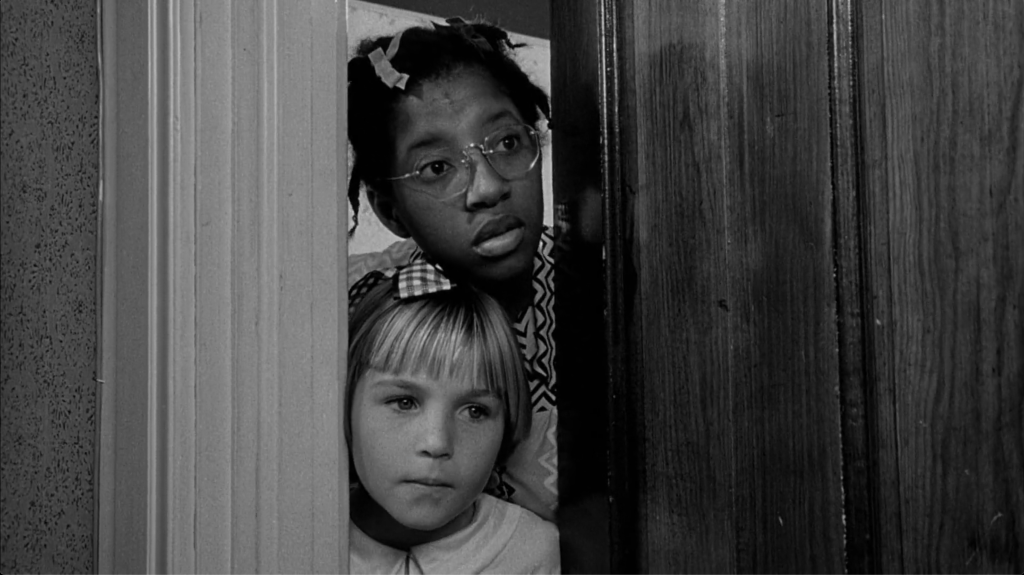
Trixie’s temporary traveling partner Imogene offers an African-American counterpart to Addie, both supporting their respective con-artists. These depression-era children are thrust into a world where surviving was the primary goal. And just like the adults they apprentice with, they grow up way too fast and quickly come to understand the crude and cruel forces that shape the world they live in.
Imogene and Addie planning to drive Trixie away once and for all
I understand that some of the above is just rambling, but it’s all in service of trying to highlight not only how beautiful Paper Moon looks, but also how deep it burrows into the heart of the messiness of human relationships on and off screen. Never mind the podcast, see the movie—it’s an absolute gem I waited far too long to watch.
is an ongoing conversation about media of all kinds ...
Testimonials:
Generations from now, they won't call it the Internet anymore. They'll just say, "I logged on to the Jim Groom this morning.
-Joe McMahon
Everything Jim Groom touches is gold. He's like King Midas, but with the Internet.
-Serena Epstein
My understanding is that an essential requirement of the internet is to do whatever Jim Groom asks of you while you're online.
-James D. Calder
@jimgroom is the Billy Martin of edtech.
-Luke Waltzer
My 3yr old son is VERY intrigued by @jimgroom's avatar. "Is he a superhero?" "Well, yes, son, to many he is."
-Clint Lalonde
Jim Groom is a fiery man.
-Antonella Dalla Torre
“Reverend” Jim “The Bava” Groom, alias “Snake Pliskin” is a charlatan and a fraud, a self-confessed “used car salesman” clawing his way into the glamour of the education technology keynote circuit via the efforts of his oppressed minions at the University of Mary Washington’s DTLT and beyond. The monster behind educational time-sink ds106 and still recovering from his bid for hipster stardom with “Edupunk”, Jim spends his days using his dwindling credibility to sell cheap webhosting to gullible undergraduates and getting banned from YouTube for gross piracy.