Over the last couple of weeks a number of requests have come in at Reclaim Hosting from folks who what to map their domain (or a subdomain) on another service. I’ve been writing about domain mapping for years on the bava, and I never get tired of the magical idea of pointing your domain (or a subdomain) to another service in order to maintain your identity in relationship to a URL rather than a service. Two sites I have done this for recently are GitHub and Squarespace, so I’ll document the process for these two and then transfer it over to Reclaim Hosting’s documentation. There are many more services you can map your domain to including Tumblr, WordPress.com, Blogger, Wix, Google Sites, etc., but I’ll start with GitHub in this post, SquareSpace in the next, and then try and build out the rest over the next few weeks.
But first a bit about A Records vs. CNAME Records
When you are mapping aa domain on GitHub pages (or on any site really) an important concept you want to try and wrap your head around is the difference between A Records and CNAME Records. I’m getting closer to full comprehension, but a little help never hurts so I took the following definition from DNS Simple:
The A record points a name to a specific IP. For example, if you want blog.dnsimple.com to point to the server 185.31.17.133 you will configure
blog.dnsimple.com. A 185.31.17.133
The CNAME record points a name to another name, instead of an IP. The CNAME source represents an alias for the target name and inherits its entire resolution chain. Let’s take our blog as example.
blog.dnsimple.com. CNAME aetrion.github.io.
To summarize, an A record points a name to an IP. CNAME record can point a name to another CNAME...
It’s good practice to point domains using CNAME Records when possible because IP addresses can change, and when they do an A Record will break because it is hardcoded. You might think of CNAME Records as relative hostnames, hence the IP address can change regularly but the mapped domain will not break.
One issue is that root domains (sometimes called “zone apex” or “naked domain”) have to be setup as an A Record, not a CNAME. This means that with most DNS providers you can setup a subdomain CNAME (blog.jimgroom.me) to point to a service like GitHub, but you cannot setup your root domain (jimgroom.me) as a CNAME. That root domain would have to be an A Record. Make sense? Good.
Mapping your Domain on GitHub
As you might have guessed from the above definitions, there are two methods for mapping a custom domain on GitHub: CNAME and A Records. You can get a good overview of how Custom Domains work on GitHub here. Mapping a subdomain using a CNAME is recommended so the domain doesn’t break if the server IP changes, which may very well happen. That said, we understand sometimes you just need that root domain mapped, so an A Record is nice and will suffice.
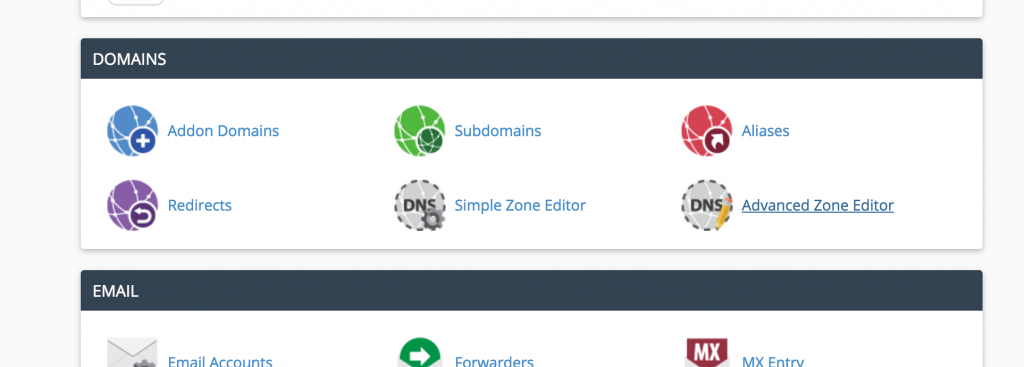
First you need to find the Advanced Zone Editor under the Domains section in CPanel.
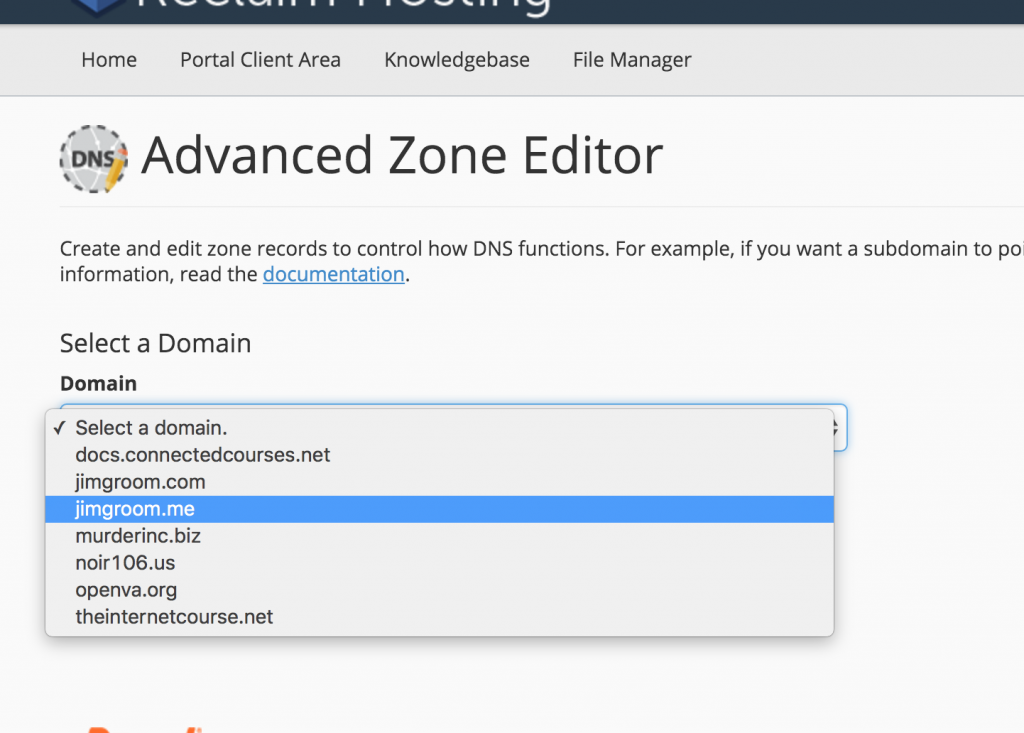
After that you need to choose the root domain you will be mapping. In the example screenshot below you’ll see I have several, but you may only have one which would be the default.
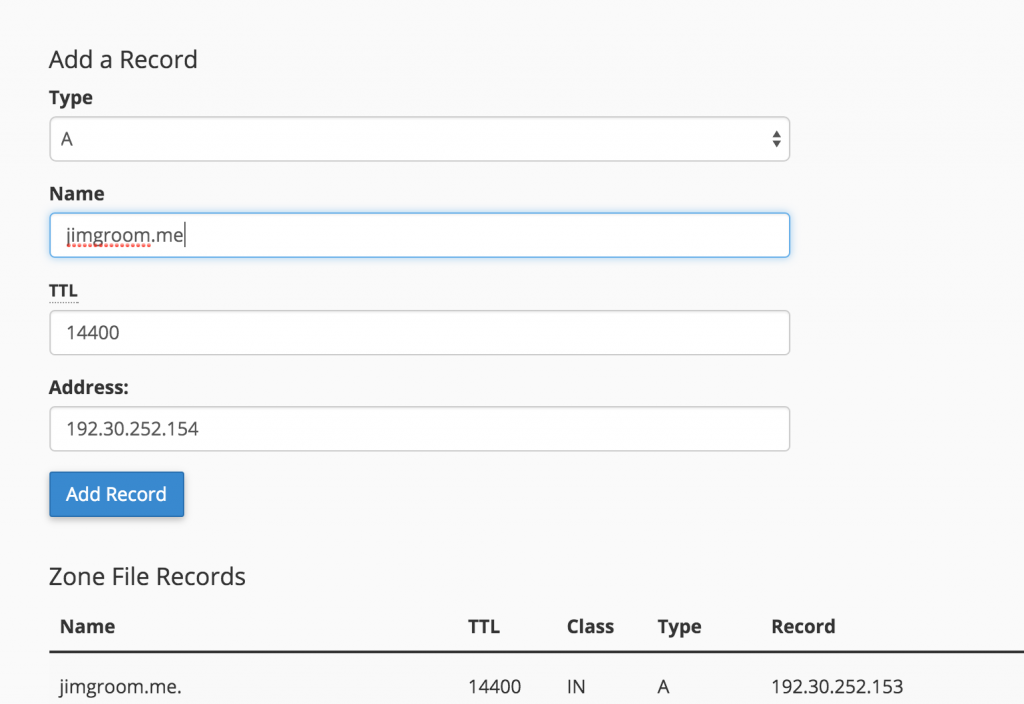
Once you select the domain you need to create two A Records for it using the below screenshot as a template, through the Name will obviously be different depending on the root domain you are mapping. The two a Records will point to the following IP addresses on GitHub: 192.30.252.153 and 192.30.252.154. You need to create a separate A Record for each of these IPs.
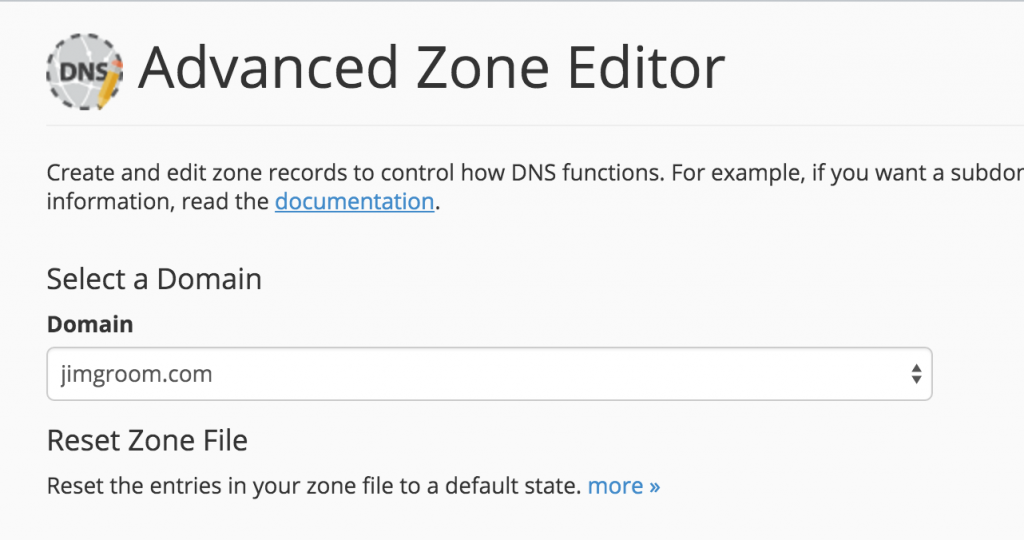
Once there, select the domain you will be mapping to if you have more than one.
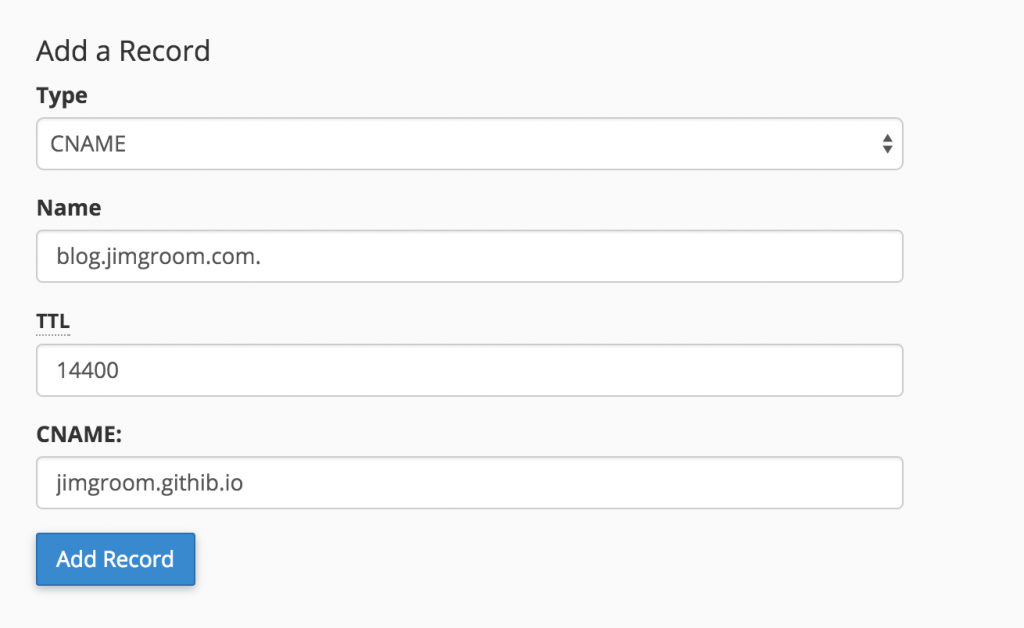
Now you name to add a CNAME Record with the subdomain you are mapping in the Name field and the URL of your GitHub account in the CNAME field.
After that you should be set. I found even if your repository is jimgroom.github.io/blog like mine is in this instance, you only need jimgroom.githib.io in the CNAME field.
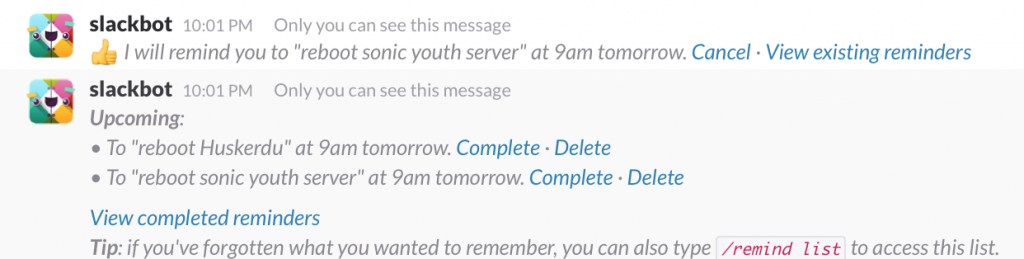
Tomorrow morning at 9 AM I have to run the reboot now command on one of our servers in order to get Cloud Linux up and running. It’s my job because while it’s morning here in Italy, most everyone on that server is sleeping somewhere in North America while it goes down for 30 seconds to reboot. Tim showed me a cool trick in Slack that I love. The /remind command. I can tell Slack to remind me to do something and some later time and it will. For example, the following command will remind me to reboot the Sonic Youth server at 9 AM tomorrow.
/remind me to reboot sonic youth server at 9AM tomorrow
It’s the little things that impress me most. God is in the details of Slack. When I first saw it I was like, “Ho hum, another ‘communication’ tool.” But once we started using it as an aggregation hub for the various services we run at Reclaim Hosting, I was blown away. And now that I live there, I’m loving how versatile it is. Turns out it’s also a damn good personal organizer. Who knew?
Last night we recorded over 10,000 users through our customer support tool Intercom. Of those, 3000 have been reported as active in their Client Area over the last month. I’m sure there is some slippage in the 10,000 number, and not all of them are still customers. But it does point to the fact that over the last two and a half years there has been an a groundswell of interest in Reclaim Hosting services beyond our wildest dreams—well, except the one involving handcuffs and Drano.
Anyway, what Tim and I imagined as a niche interest in other schools running Domain of One’s Own pilots quickly unearthed the fact that just about everyone in educational institutions from IT to libraries to academic departments to individual courses were looking to host off-campus. And while most folks turn to the big hosts initially, it quickly becomes apparent that nobody can support students and educators using open source web applications like Reclaim Hosting. #NOBODY!!! We know what you need before you do [said while waving arms creepily, yet gracefully].
But the aggregate is just that, and numbers can quickly become a telescopic hammer that only provide vague outlines of what’s happening. So let’s get microscopic and look at just one. Yesterday I got a question from Anna E. Kijas, Senior Digital Scholarship Librarian at Boston College Libraries, regarding some thumbnails that weren’t working on her Omeka install. Turns out the path on the server to the ImageMagick library Omeka requires was off, preventing the resizing and generation of thumbnails for images. We got that fixed, and the site was back to its original glory.
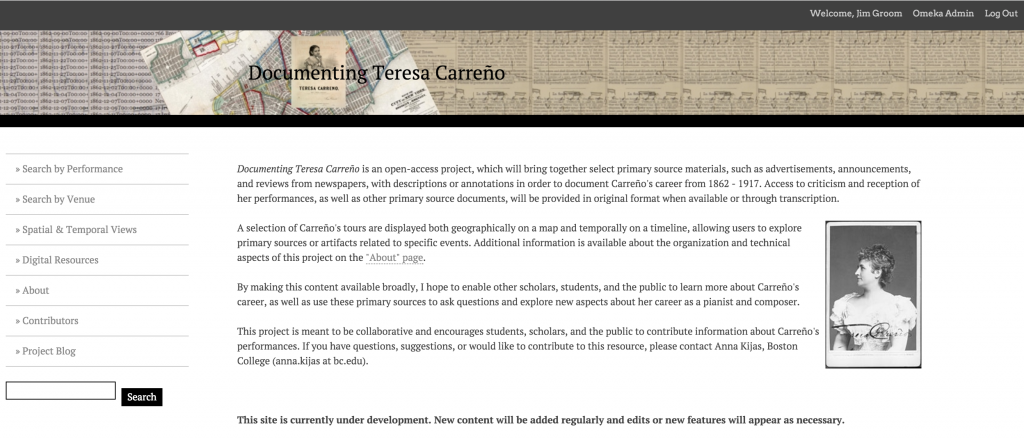
Documenting Teresa
Out of curiosity I looked around Anna’s site, discovering the open access scholarly research site Documenting Teresa Carreño, dedicated to the nineteenth-century Venezuelan pianist, singer, composer, and conductor Teresa Carreño. I was learning about this world renowned pianist for the first time, and I love how each item in the collectionis based on a documented performance she gave between 1862 and 1917. Here’s a random entry featuring a write-up from the The Evening World about her performance at Carnegie Hall on December 8, 1916, noting she had “maintained her power, her art, and her musicianship unimpaired.”
A perfect example of the web of sharing that I love supporting.
I love this GIF. It’s taken from this video by my friend Giorgio, which is reminiscent of a sped-up scene from The Benny Hill Show my dad used to watch on TV in the early 80s. I love it because it succinctly captures a kind of balance in my life right now. Here I am on a see-saw in Mezzocorona, Italy with all my children (as well as a family friend). The way my kids are both balancing and anchoring me here is important, because it’s exactly how I feel right now. I spend a ton of time with them and Antonella these days, and it’s been really healthy for me to refocus my attention and let other things go. For example, I’m not caught up in the nonsense that comes with institutional culture and hierarchies. I never realized just how soul-sucking that element of work was for me until I finally left.
Leaving was important. I got lucky enough that I could walk away and not have to run to another institution. Without Reclaim Hosting I would have most certainly been in the position of finding a job at a another university (I love you Tim Owens!), and I’m not sure that would have changed much in terms of this balance. In fact, it would mean I needed to navigate a whole new institutional culture, and nothing seems less compelling to me than that at the moment. Being able to check out of institutional higher ed, while at the same time still doing what I love to do, has been a crucial part of this new found balance. While it was scary to think about leaving, once it was done I started asking myself, “What was I thinking?” “Why didn’t I do this sooner?” “How did I stay there so long?” While there were many good reasons I stayed at UMW as long as I did, the break was long overdue.
During the spring of 2011 I made the pilgrimage to visit Alan Levine in Strawberry, Arizona. I remember he was talking about the idea of taking a retirement year mid-career.* I was enamored with the thought, particularly given I’d just come off my first open, online version of ds106 which aged me about 15 years in 15 weeks. I needed a break. And when Tim joined DTLT that summer the work we were doing sped up exponentially over the following 3 or 4 years. I’m an all-in type of person which has its benefits (I’m #4life) and it’s drawbacks (sleep-deprived obsession).
By comparison, this fall has seemed kinda like a retirement year to me, but without all the AARP paperwork. Don’t get me wrong, I’m working hard for Reclaim Hosting. The differences are I am working for myself, my business partner totally rules, and my family and I are where we want to be. It’s a totally new headspace. It’s like the smog-filled heavens opened up, and there is a break in the relentless work mentality that began to sprawl like LA over my life: managing a group, doing frontline edtech support, teaching, blogging, freelancing, traveling, presenting, trying to be “innovative” (whatever that means)—and all of it became expected.
Doing one thing these last two months, namely running Reclaim Hosting with Tim Owens, is like being retired because it’s the first time in about 20 years I’ve had just one job. Only one thing I have to do. I was so used to working at least two or three jobs at any given time that doing one things seems like I’m somehow slacking. I think this mentality is a result of having been an adjunct professor since 1997. It’s increasingly apparent to me that working only one job, having time to spend with family, and doing something you care about will bring balance into your life quicker than any drug or exercise regime—I’ve tried at least one of these two latter solutions to no avail 🙂
For the first time in a long time I feel like I am working with a long-game in mind. I’m working to create something I am proud of professionally, while also preserving space and time to be with my family and experience my kids’ formative family years before they figure out how much of a loser I am. These are the “wonder years,” and I want to share it with them.
_________________________________
*In academia they call this a sabbatical 🙂 But I was never gonna get one of those.
I’m deeply skeptical of meetings. Ten years in higher ed will do this to you. I spent much of the last four years intentionally removing myself from the meeting culture that everywhere pervades. The thing that drove me craziest about meetings was the twisted logic that by simply being there you’re working. It was like Woody Allen’s quote “Showing up is 80 percent of life” immortalized through institutional cultures. Now my reaction may be a bit extreme, but that’s probably because in higher ed the extra bonus of meetings being conducted as pseudo-seminars is particularly painful. My approach is simpler: regularly share what you’re working on through your blog and we can meet in the comments. While I recognize that isn’t always feasible or even appropriate (and no one comments anymore), I can still dream, right?
Reclaim Hosting’s first all-hands meeting
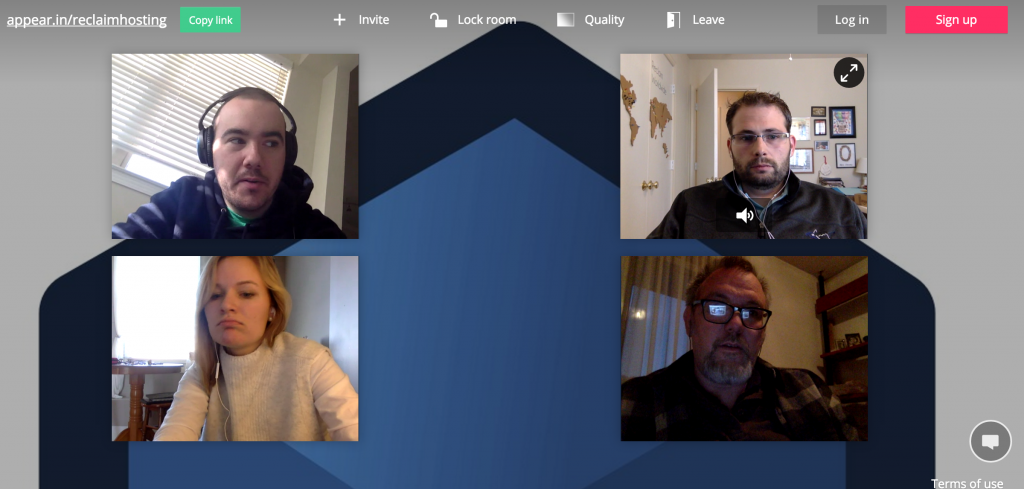
Anyway, today Reclaim Hosting had it’s first official all-hands meeting after two and a half years as a company. We held out pretty long, I’m proud of us. And as much as I kid on Twitter, this isn’t the beginning of the end. Rather, it is the beginning of the beginning. Joe McMahon called for the meeting given he thought it would be nice to convene regularly at some point during the week. And meetings are definitely better when you’re not forcing them down people’s throat. Hell, it was fun to catch up with everyone for an hour to learn tricks in CPanel, sharing about various projects, reminiscing about how awesome Fall has been, and project what’s to come. I could get used to it once a week, but I’ll just say now, for the record, we must be vigilant.
Meeting creep is akin to The Blob‘s (1958) plotline. It starts out as an innocent kiss at Lover’s Lane and quickly ends up eating you alive…
Ultimately resulting in an Air Force air-lift to the Arctic for who knows what’s next 🙂
You’ve been warned Reclaim, and this ain’t no juvenile delinquent scare tactic either, this comes from a hardened veteran whose very being is evidence of the deleterious effects of meeting culture in the workplace. AVENGE ME!
Reg: All right, but apart from the sanitation, the medicine, education, wine, public order, irrigation, roads, the fresh-water system, and public health, what have the Romans ever done for us?
PFJ Member: Brought peace?
Reg: Oh, peace? SHUT UP!
While WordPress hasn’t brought peace just yet, it certainly has helped power huge swaths of the web—25% of all sites according to recent counts. And when Andrea Rennick reached out to folks on Twitter asking how WordPress has changed their life I thought almost immediately about the above scene from Monty Python’s Life of Brian when Reg (John Cleese) starts off asking, “What have the Romans ever done for us?”, only to get a laundry list of positive things in response. Similarly, when preparing to answer Andrea’s simple question with my critical glasses on, I quickly came up with a long list of things WordPress has done that has changed my personal and professional life for the better. So, let me begin…
When I first heard of WordPress in 2004 I was teaching high school in Brooklyn. I had been making old gold HTML pages for my classes, and my friend Zach Davis told me about this open source application I could install on my web hosting account that would make posting a lot easier. It was around the time when blogging was start to get popular, and I was fairly skeptical of the whole thing. That said, my oldest son had just been born, and we were looking for a way to share pictures and videos with our family in Italy. WordPress quickly became a solution to this, and it sent me down the rabbit hole of figuring out how a PHP/MySQL driven site works. That was all magic to me prior to 2004 and WordPress was the gateway drug. Out of this experimentation Planet Miles was born in 2005.
At the same time I had left my job as a high school teacher in Brooklyn and started working as an Instructional Technology Fellow at CUNY’s Honors College. Between finishing my dissertation, teaching high school full time, and becoming a new dad something had to give, and the first to go was teaching high school. The dissertation wasn’t far behind though 🙂 That CUNY fellowship, which was initially a means to the end of finishing my dissertation, quickly became a portal to a whole new world of instructional technology. I remember Zack Davis pulled up Stephen Downes’s blog/newsletter the OL Daily at one of our first meetings talking about this crazy educational technologist from Canada who provided a great orientation point for someone new to the field like myself. Little did I know how important that crazy Canadian’s work and thinking would be to my own over the next ten years. What’s more, I later found out Downes had been down a similar path to mine in terms of his career in edtech. It was about that time (January/February of 2005) when I began my long, illustrious career peddling WordPress in higher ed. I had been playing with WordPress for a few months by then fine-tuning Planet Miles, and I figured it was time to try see if we couldn’t use something similar for classes that would provide a much simpler, customizable experience than BlackBoard (the LMS of choice at CUNY). I was struck by the idea that you could customize both the header image and sidebar of a WordPress blog with fairly little HTML and PHP hacking knowledge (this was the early days of the Kubrick theme, long before widgets and upload-able/resize-able header images). I learned a ton about how the “new web” worked. I learned how PHP makes calls to a database for specific information that can then be dynamically rendered in HTML. I learned how CSS was used to cascade styles across potentially thousands of dynamically created HTML pages that effectively separate function and form. These were two of the earlier revolutionary concepts that I was exposed to as an instructional technologist that helped me conceptualization how the web was changing in the early 2000s.
I had my first blogging workshop in March of 2005 wherein I got students and faculty on Blogger. I was never a huge fan of that system given I started from a position of being able to hack my own self-hosted blog, but it was hard not to be amazed that you could create a website so quickly and easily with Blogger. It was a sign that posting online no longer had to be a chore; it could actually be easy and elegant. And that was the start of the long love affair with WordPress because unlike Blogger, WordPress was something you controlled (this was just before the creation of WordPress.com). I could edit the header.php file on my web server to include a picture of a Smurf in the Planet Miles’s header. I could integrate albums from this new fangled photo site Flickr into a WordPress page using a plugin (remember Joe Tan’s TanTan Flickr anyone?). It was an infrastructure that provided a pseudo, wanna-be tech person like myself a real platform to start from and build on. It struck me that if it could help someone like me gain a deeper understanding of how the web works, then why couldn’t it do the same for faculty and students—a fairly simple vision that still drives the work I do today.
And that might be a good place to transition because during the Fall of 2005 I had convinced a couple of professors to use WordPress for their course sites instead of BlackBoard. The students were posting their work to a blog page. (We figured out how to make the default homepage a static page thanks to a hack we got from the forums.*) It was an open, accessible learning management system, and it had the benefit of being a real web-based resource and having its own style/personality.
At the same time, all that I had learned over the previous 6 months turned into a way for my family and I to leave NYC and actually move somewhere affordable with a steady income, benefits, etc. The idea was that Antonella and I could get some breathing room and actually finish our dissertations. Turns out University of Mary Washington (UMW) was looking for an instructional technologist with some LAMP server chops (which thanks to playing with WordPress I had) to experiment with open source applications like, you guessed it, WordPress, MediaWiki, Drupal, etc. It was a very forward-looking positon at the time, and I kinda stumbled on to it. But, in retrospect, it would eventually define the next decade of my life, and WordPress was very much at its core.
Our work with WordPress at UMW has a long, rich history. I have chronicled much of it already on this blog (proudly powered by WordPress), which, by the way, I started on my first day of work. Bavatuesdays will turn ten years old in less than two weeks, and this space has seen some mileage with almost 3000 posts, 13,000 comments, and a coupla million page views over that time period. Modest stats in the big picture, but truly amazing when you think about the fact this blog started out—and has pretty much remained—a small outpost on the web where I openly share what I think and learn about edtech, movies, GIFs, books, etc. This blog has also been ground zero for my professional transformation, and once I got started in December of 2015, I never really stopped. It became a much needed alternative to academic writing I had learned to hate over the previous 8 years, and I was actually excited about writing again. But it was a very different kind of writing. In many ways much simpler. I was just narrating what I had learned about my work.
From 2006 through 2010 I predominantly wrote about the work I was doing with WordPress. This included building one-off WordPress sites for faculty that were loosely integrated with MediaWiki (often for creating editable syllabi and for collaborative work) in 2006; building a multi-user platform for UMW in 2007 (UMW Blogs); framing WordPress as a more humane, web-friendly alternative to the LMS á la EDUPUNK in 2008; and for much of 2009 and 2010 I went on the the road sharing the work we did at UMW using WordPress to build an alternative infrastructure for teaching and learning. All the while we were playing with syndication that enabled students and faculty to control their own work in their own space, but aggregated for the purposes of a course, etc. WordPress was the foundational open source technology we choose to build just about everything on top of at UMW’s Division of Teaching and Learning Technologies and, in retrospect, we were smart and right. It was an excellent choice, and in 2011 it would drive our entire university’s website. The great Cathy Derecki was one of the first to push WordPress beyond the ubiquitous dismissal used by enterprise IT folks that WordPress was “not a real CMS, it’s only a blog.” All the while the entire web was becoming more and more like a blog, and university websites were becoming more and more cumbersome and outdated.
From 2011 until 2013 were the ds106 days. We went rogue at UMW and built an entire open, online course on top of WordPress that was unique in that we were building the platform as we went along. We started with a pretty standard aggregation hub, but then added an assignment bank, daily create, inspire, remix machine, etc. And the thing is we didn’t necessarily build everything—parts of the infrastructure were created by the students—making the shift in usability and accessibility that WordPress made possible all the more apparent. But perhaps the biggest shift in 2010 is when were able to take the elegance and ease-of-use that has made WordPress so popular to the next level for our community by requiring students in ds106 to get their own domain and web hosting and install their own WordPress sites for the course. A crash course in how the web works that I had personally undergone five years earlier. The evolution of WordPress into an easy-to-use, powerful, and elegant publishing platform over that period of time is astounding. The idea of empowering faculty and students to manage and build their own online spaces was more than rhetoric, it was a fairly quotidian reality.
A reality that was then rolled out at UMW campus-wide when Tim Owens effectively built a web hosting service for UMW that was built around WordPress. We ran it using CPanel and WHMCS, but integrated the whole environment on top of WordPress—making it effectively the portal to the Domain of One’s Own project we officially rolled out at UMW in 2015. This gave every interested student, staff, and faculty member their own domain and web hosting for the duration of their time at UMW. What’s more, the vast majority of the applications installed (over 80%) were WordPress, reinforcing just how synonymous this technology had become with building web sites. So UMW had become one of the main hubs for pushing WordPress as a viable alternative for just about everything: “sanitation, medicine, education, wine, public order, irrigation, roads, the fresh-water system, and public health, etc. “But what the hell had WordPress ever done for us?
Well, it helped change the direction of my life yet again just a couple of years ago. In July 2013 Tim Owens and I started our own web hosting company called Reclaim Hosting with the idea of supporting other universities that might want to explore the Domain of One’s Own concept on their campus. We built our hosting around WordPress (it is effectively the integration point for WHMCS and CPanel), and two years later we have seen an outpouring of interest in this work. More and more universities and colleges see shared web hosting as one way of enabling faculty and students to manage their own work, create a personal space, and learn more about how the web works. What’s more, WordPress continues to drive a vast amount of that work—more than 80% on Reclaim’s servers—which is almost at 10,000 accounts.
So, I can thank WordPress for giving me a job, allowing me to define my professional identity, helping me experiment with new ways of teaching, supporting me empower faculty and students to take control of their digital identity, providing me a great business opportunity, and even enabling me to quit my day job and move my family to Italy. One might say “WordPress MADE ME!” But you could also say I was one of the many who helped make WordPress, which is the single greatest thing about this open source software as well as the community that drives it. You truly get out of it what you put into it. What has WordPress done for me? Well, as much as I have done for WordPress. This application embodies the virtuous circle of open software in my mind, and deciding to fall down the WordPress rabbit hole back in 2004 was, in hindsight, one of the smartest things I ever did personally and professionally. Thanks WordPress, I remain you’re #1 Fan!
____________________________
I also remember we had to hack the header.php file of the theme to re-arrange the order of the pages in the menu—another feature now baked in.
I remembered that I had wanted to make sure there was at least one animate GIF of the Wood Beast on the internet. I did a fairly thorough search and I came up short. So I figured I would do my good deep of the day and fix this minor bug in the internet. It was easy with this YouTube video and Imgur’s Video to GIF tool. Making GIFs has never been easier!
http://i.imgur.com/5HGW2Zs.gif
In fact, it was so easy, I made two.
http://i.imgur.com/iB40DaO.gif
One of the things I did find, however, was this GIF of one of the seers from Flash Gordon who rock back and forth and are the all-seeing eyes of Ming the Merciless’s empire. It’s a good one.
I’ve been on what seems like a two month vacation, and it isn’t getting old one bit. I’ve been taking advantage of my new found freedom from more traditional ideas of work, and spending a lot more time hanging out with my family. I’ve been working hard too, but I love what I do so that just feels like part of the fun. The huge bonus is I can work from where ever I am, and that has changed everything. I finally got the bavaphone so that I can be more present and online for Reclaim Hosting, and that’s working out well.
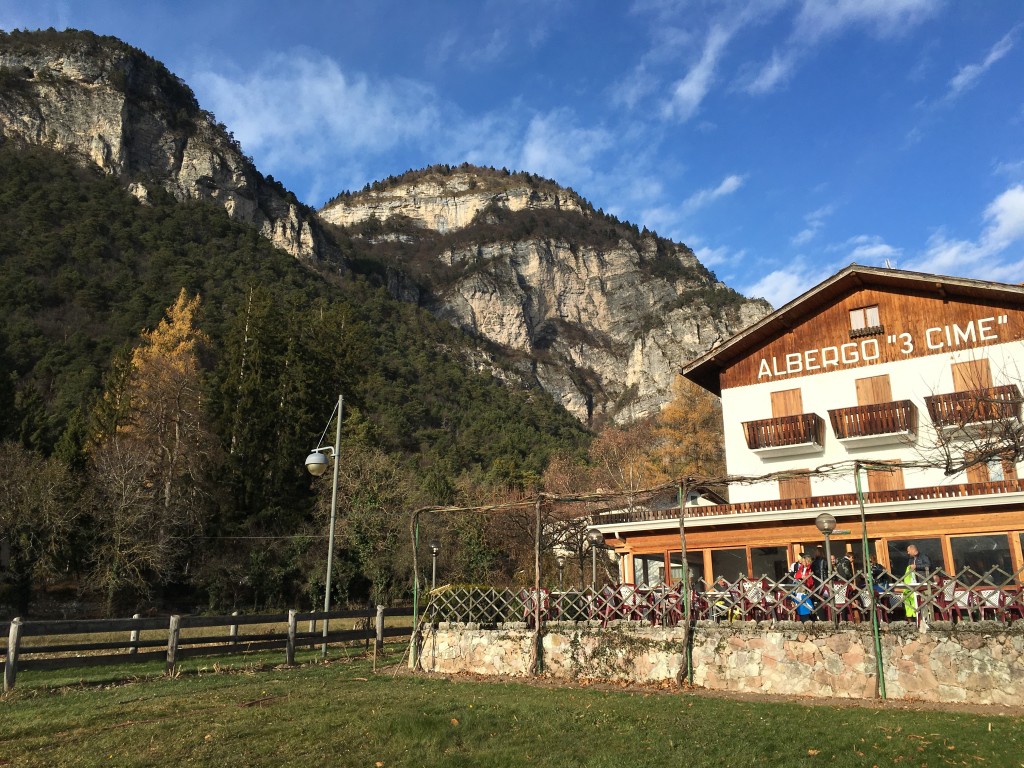
Albergo “3 Cima”
But the other reason I got it was to start capturing all those little moments I missed without it. I always wanted to be like Tom Woodward; his camera has literally been a part of his body for years, and as a result he takes awesome photos. But I’m not him. I’m a producer of convenience, and lugging a big camera around is not convenient, which made not having a small device in my pocket at all times more and more of a drag. And once I came to Italy in October it was impossible to resist the mobile siren’s call, there were just too many awesome things I needed to capture. What’s more, I could almost immediately bombard my social media accounts with them to make bragging about living abroad even easier—it was a done deal in my mind.
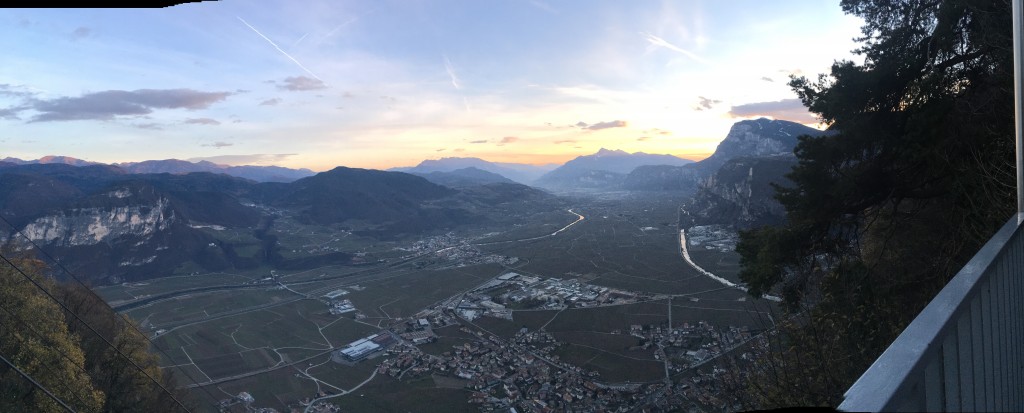
Panorama from Mezzolomardo
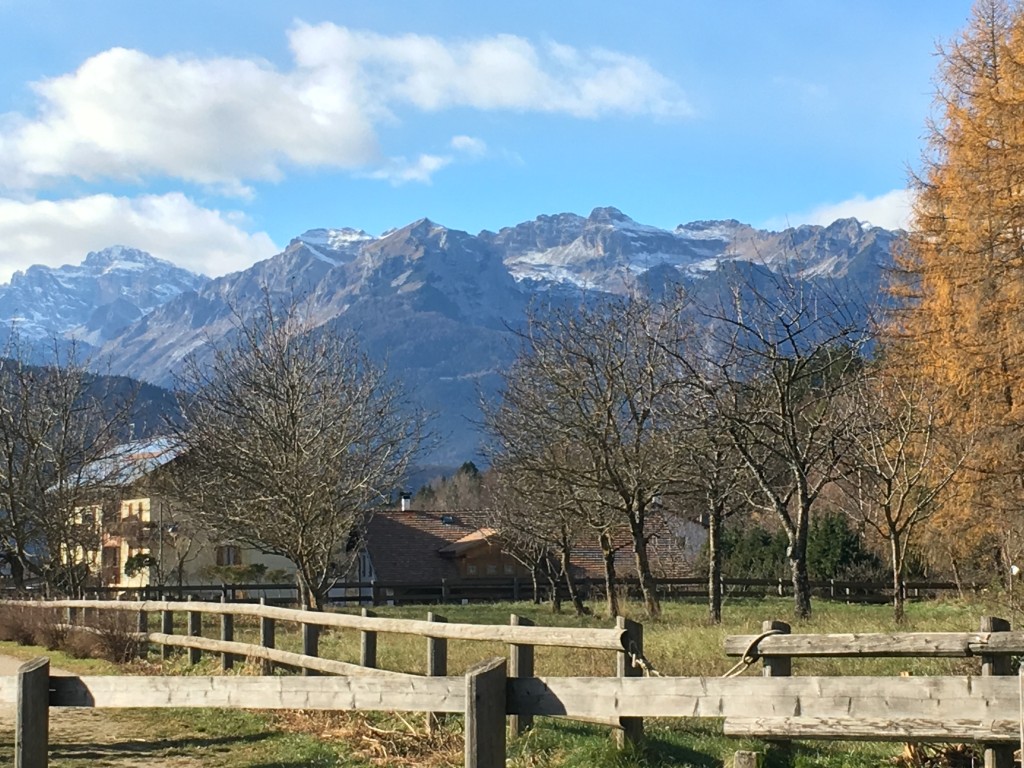
All the images above are shots I took today while visiting the upper half of Mezzocorona, a small town 1800 feet up in the Italian alps that you can only reach by foot, cable car, or helicopter. We took the cable car, and the panorama directly above is a look out over the valley, the one above that is a shot of the hotel/restaurant “3 Cimas” (or 3 peaks) that we ate at, and the first is a shot of the Dolemite mountain range you can hike to from Mezzocorona. It’s a stunning environment, and I had my camera with me to capture it all. What’s more, I’ve started playing with the video on my phone, and the following two videos capture the cable car ride up the mountain, as well as the return trip using the time-lapse filter. So awesome.
While we were walking around Mezzocorona our friends Claudia and Giorgio’s son Ruggiero—and avid basketball player (it’s HUGE in Italy!)—had brought along his ball and he, Miles and Tommaso were playing around with it. We ultimately landed on a big old tree that had fallen, and we started taking slow-motion videos of the kids jumping off of it. But as luck would have it there was an empty trash can nearby that was about the size of a hoop, and the rest is slow motion history. Quickly the game “Who could sink the ball in the garbage can from the dead tree” was established and captured in beautiful slow motion on high definition video thanks to the devil in my pocket!
This stuff never gets old for me. I love the idea of these tiny, compact moments captured and shared on the spot and beyond. It’s what I have always loved about blogging, and it’s what got me started with Planet Miles. I missed having this possibility for the last ten years or so, but I’m a stubborn man. That said, I promise I’ll make up for it now that I have changed my evil ways 🙂
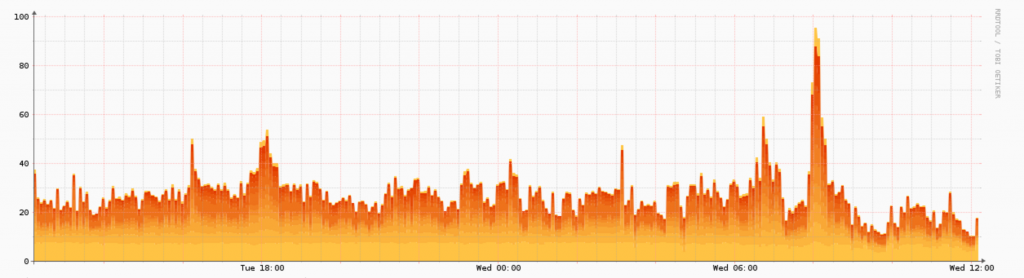
Graph of server resources as monitored by Observium
The first project we set Joe McMahon loose on when he started contracting with us a few months back was to setup a monitoring system for our servers. We were dealing with server downtime on a case-by-case basis, and Tim knew we needed a system to manage this more and more urgently as the number of servers we were dealing with was growing exponentially. Joe did a scan of the existing solutions and recommended we start out with Observium. Sounded good to us, and for the last couple of months (he has since come on part-time with us) he has been building it out. Last week, as his post on the Reclaim Hosting blog delineates, the project has gone out of beta and is now just about done.* He even took the occasion of that post to get a dig in on my “cult of personality” dynamism—bastard!
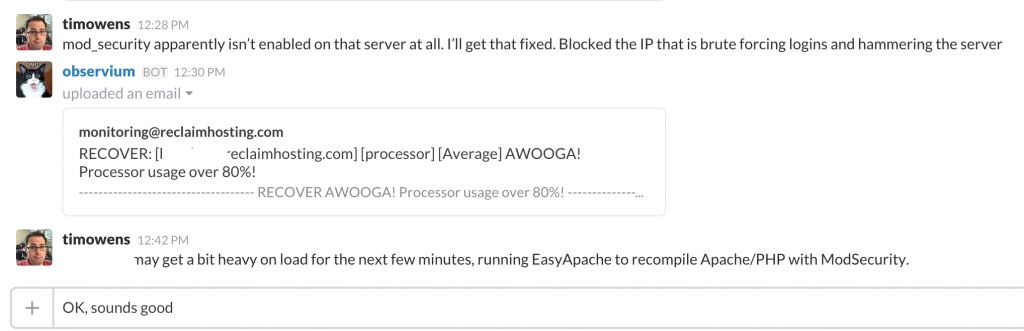
Server Monitoring channel in Reclaim Hosting’s Slack Account
What does this mean for us? Well. it means when a server is using an intense amount of its resources we’re notified in our Monitoring channel on Slack. What’s more, it let us know if a particular server is running out of space, or if it’s down all together. So now the more than 60 servers we’re currently managing are all being monitored regularly, and we’re immediately notified in Slack if anything is amiss. What’s more, we all know at the same time so anyone of us can be in the know and act on it immediately. It’s yet another brilliant use of Slack to get keep us all notified and our email inboxes empty. This is a good example of continually fine-tuning our infrastructure, and it’s what I really appreciate about how Tim thinks—and one of the many reasons why he is so good. He’s constantly working to make things more stream-lined and efficient when it comes to our infrastructure, and he and Joe are already proving a formidable team.
On a more personal note, my last post was about spending time with Shannon Hauser during her current trip to Italy to deliver some animal cargo. And this post is about the work Joe McMahon is doing building a monitoring system for Reclaim. What do these nutballs folks have in common? They were our first two student aides at UMW’s DTLT! I love the fact we are still playing and working together, even if I am a pain-in-the-ass. Long after the institution fades into memory, the good people will remain.
______________________
*Joe noted it will remain 90% for the remainder of it’s life because it is a constant work-in-progress.
This week we’ve been hosting our first guest to casa bava in Italy: Shannon Hauser. She delivered our wayward cat Clyde to us in one piece, so we’re once again a whole family. “No cat left behind!” is the Groom/Dalla Torre family motto. Shannon is the first of what we hope will be many visitors from abroad, and we spent much of this week showing her around the beautiful Mountain city of Trento. Wednesday we spent the day exploring the Buonconsiglio Castle (more on that in another post), the city center, as well as a cable car (funivia) that takes people from the center of town up to the small suburb of Trento called Sardagna.
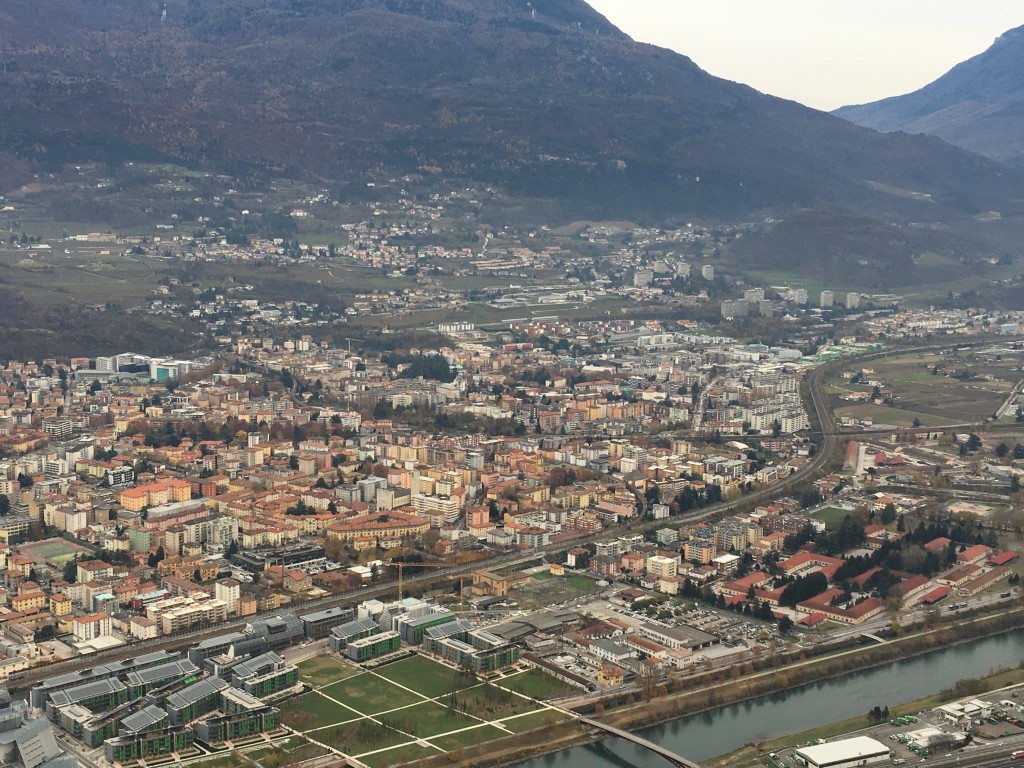
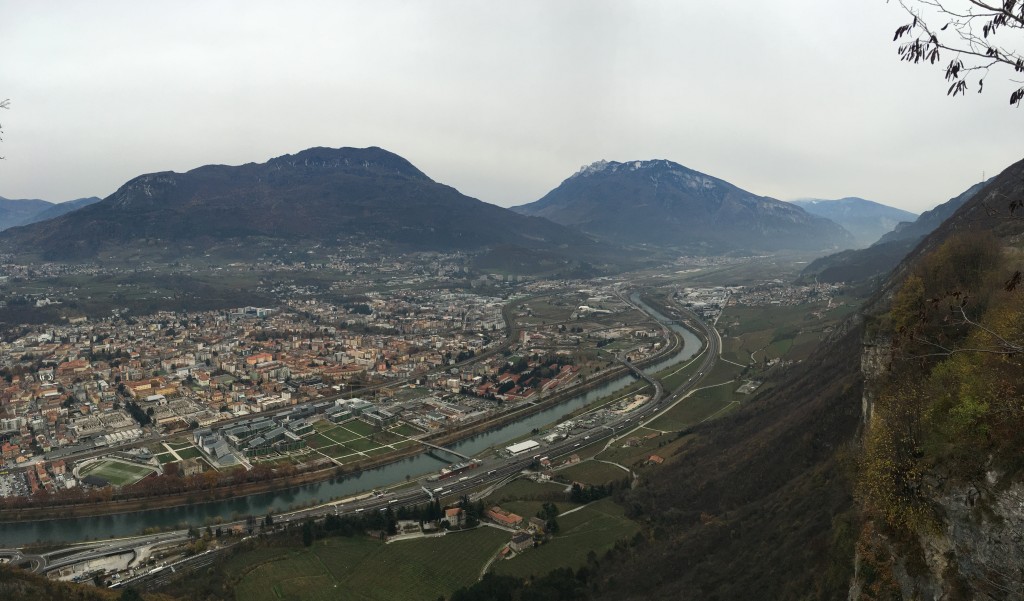
Trento as seen from the suburb of Sardagna
While riding up to Sardagna you get a stunning view of the city, and it is even better once your off the cable car overlooking Trento. It’s kinda like Trento’s Staten Island Ferry because it’s public transportation that anyone can use for the price of a bus ticket, yet it provides a truly breathtaking panorama of the city. The time-lapse video below captures our descent from Sardagna to Trento’s city center in just 16 seconds. We recommend you put on your seatbelt when watching! You’ll notice the Adige river which hugs the city, it’s Italy’s second longest behind the Po.
is an ongoing conversation about media of all kinds ...
Testimonials:
Generations from now, they won't call it the Internet anymore. They'll just say, "I logged on to the Jim Groom this morning.
-Joe McMahon
Everything Jim Groom touches is gold. He's like King Midas, but with the Internet.
-Serena Epstein
My understanding is that an essential requirement of the internet is to do whatever Jim Groom asks of you while you're online.
-James D. Calder
@jimgroom is the Billy Martin of edtech.
-Luke Waltzer
My 3yr old son is VERY intrigued by @jimgroom's avatar. "Is he a superhero?" "Well, yes, son, to many he is."
-Clint Lalonde
Jim Groom is a fiery man.
-Antonella Dalla Torre
“Reverend” Jim “The Bava” Groom, alias “Snake Pliskin” is a charlatan and a fraud, a self-confessed “used car salesman” clawing his way into the glamour of the education technology keynote circuit via the efforts of his oppressed minions at the University of Mary Washington’s DTLT and beyond. The monster behind educational time-sink ds106 and still recovering from his bid for hipster stardom with “Edupunk”, Jim spends his days using his dwindling credibility to sell cheap webhosting to gullible undergraduates and getting banned from YouTube for gross piracy.




 Ultimately resulting in an Air Force air-lift to the Arctic for who knows what’s next 🙂



 It was about that time (January/February of 2005) when I began my long, illustrious career peddling WordPress in higher ed. I had been playing with WordPress for a few months by then fine-tuning Planet Miles, and I figured it was time to try see if we couldn’t use something similar for classes that would provide a much simpler, customizable experience than BlackBoard (the LMS of choice at CUNY). I was struck by the idea that you could customize both the header image and sidebar of a WordPress blog with fairly little HTML and PHP hacking knowledge (this was the early days of the Kubrick theme, long before widgets and upload-able/resize-able header images). I learned a ton about how the “new web” worked. I learned how PHP makes calls to a database for specific information that can then be dynamically rendered in HTML. I learned how CSS was used to cascade styles across potentially thousands of dynamically created HTML pages that effectively separate function and form. These were two of the earlier revolutionary concepts that I was exposed to as an instructional technologist that helped me conceptualization how the web was changing in the early 2000s.