Moving to a new country comes with all sorts of negotiations, as I’m finding out. The most painful ones are those that interfere with my media consumption. After we moved to Italy earlier this fall we needed to pick up a bunch of things. On the shortlist was a gaming/entertainment system—the WiiU is just not cutting it anymore. I traveled most of October for work so we didn’t get anything until later that month, which conveniently coincided with my oldest’s birthday. We got the PS4 and Arkham Knight to explore the dark world of the recent spate of Arkham-themed Batman video games—which I have more or less enjoyed. But the real motivation behind getting the PS4 was the imminent release of Star Wars Battlefront.
The speeder bikes on Endor are totally sick.
As much as I try and convince myself otherwise, I can’t quit Star Wars. So, one late night two weeks ago I started trying to figure out how I could pre-order Battlefront for download on the PS4. I created a new Playstation Network (PSN) account on the new system for my son. And that’s when the issues started. The Cliff’s Notes of this post is that if you already have an account in your country of origin (mine being the U.S.) you can sign-up with your existing account and simply make the PS4 your primary device for that account and you can use it as if you were in the U.S. with no restrictions.
Turns out you don’t have to create a new account for a new system in a new country. I had no idea, and after connecting my credit card, PayPal, etc. to my Italian account to download Battlefront continually failed miserably, I got “smart.” I decided to buy a $50 Playstation Store Gift Card on Amazon, only to find out they’re country specific. Nothing would work through my Italian account, and now I was $50 in the hole! But, that also gave me the motivation to search out a solution (nothing like having financial skin in the game) and I came across this extremely informative posting in the Expat Forum:
Accounts are region locked, but there’s no restrictions in where you use them, and you can have multiple region accounts on each Playstation. I bought my PS4 in the UAE, set it up with a UK PSN account and then also set up a PSN US account after realising that most games are a fair bit cheaper on the US PS Store than the UK one (I use US Paypal connected to an Entropay virtual pre-pay credit card as I don’t have a US card or address).
It’s pretty simple and you just add each country account as a user on the console. The important thing is to set your PS4 as the primary device for both accounts.
After reading this I added my U.S. region account to my Playstation and made sure the PS4 was the primary device. I could then sign-in to my U.S. PSN account and shop the U.S. Playstation store which had Battlefront available for download two days earlier and $10 cheaper than Italy. Winning. It felt good to have that downloaded and ready for my kids earlier than promised! Just another “thank you for sharing your knowledge” moment on the web.
But anyone who has a Xbox 1 or PS4 knows it is much more than a gaming system. They have become veritable media shopping malls, along with all the crap that comes with that. But one of the issues we’ve run into is Italy’s Netflix (which just arrived this October) provides a pretty weak selection (as does the U.S., frankly) and Anto and I grew to depend more and more on Amazon’s Instant Video for impulse movie rentals. My Macbook Pro has an HDMI output, so we can run series and movies that we find elsewhere off my computer through the TV. But when it comes to in-the-moment movie choices, we had become used to Amazon. Turns out Amazon Instant Video is available for the PS4 through the U.S. Playstation store, so we got access to that as well thanks to this setup. A media twofer.
Sometimes it’s the little things when you’re abroad that make media consumption just a little bit easier. My next challenge is to find a way to get English language books cheaper. And don’t talk to me about any kind of e-reader because I refuse them altogether. My particular challenge, how can I get an English version of William T. Vollman’s Europe Central delivered to my door in Italy for less than 35 euros?
One of my favorite quotes from the classic 1987 b-movie horror Stepfather is when Jerry Blake (played brilliantly by Terry O’Quinn) picks up the phone, only to stop himself to ask that age-old question: “Who am I here?”
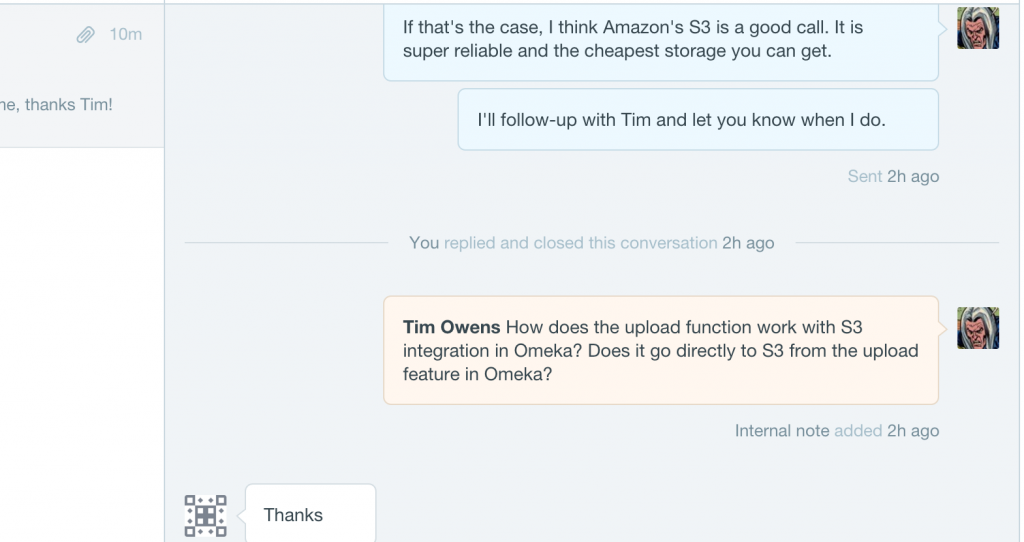
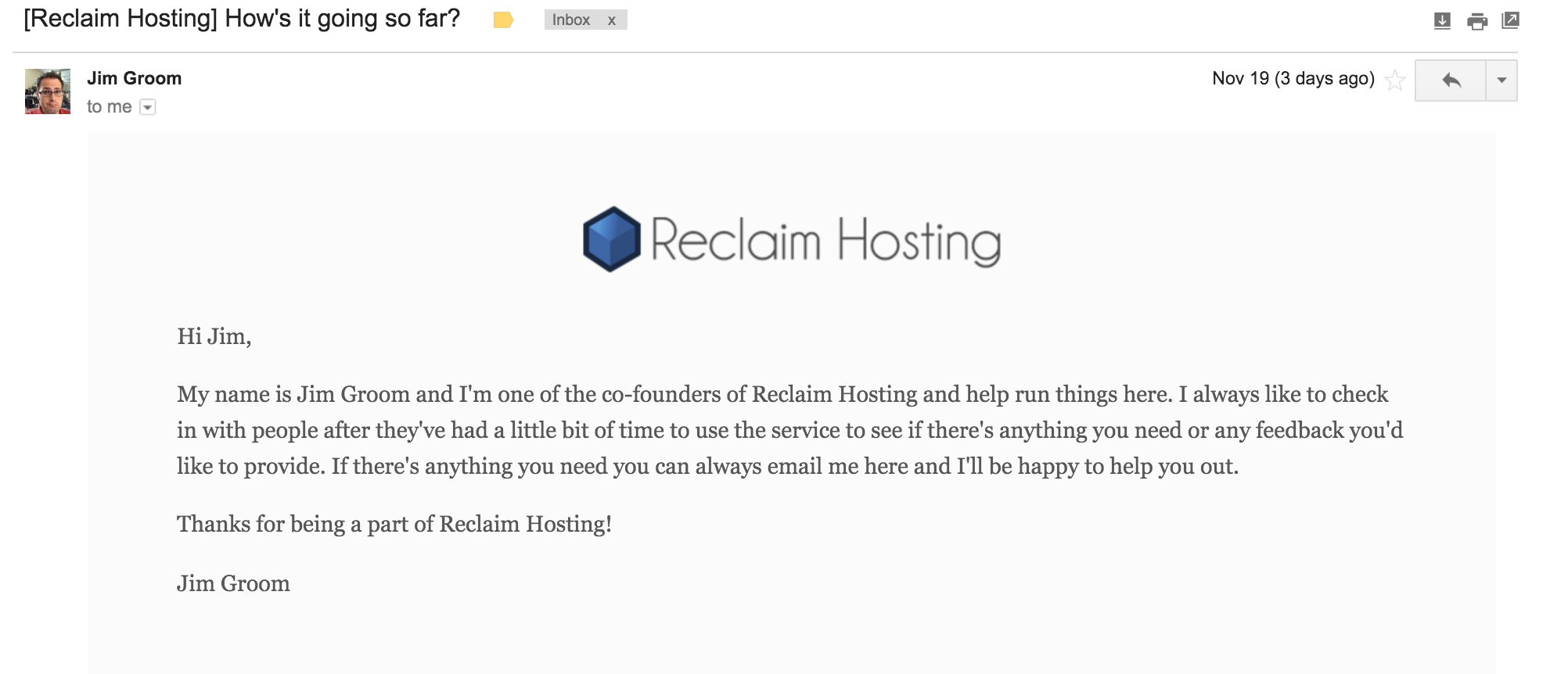
This is exactly how I felt when I got the following email:
I received an email signed by me, sent by Tim Owens, and from a company I co-founded. Who am I here?! In addition to setting up Middlebury Create and getting Whittier’s DigLibArts site up and running on their Domains server on Friday, I’ve been on a steady diet of moving various sites that were hosted on UMW Domains to Reclaim Hosting. I like this kind of work because it keeps me sharp with migrations using the restore a full backup in CPanel (a very useful tool!) as well as managing permissions after transfer, any database snafus, and more. It also provides the opportunity to go through the same sign-up experience as anyone using Reclaim. I have to say it is pretty elegant.
I got the above email after setting up a new hosting account for jimgroom.com and migrating over the domains murderinc.biz, jimgroom.me, wire106.com, noir106.us, and theinternetcourse.net. It’s an email I know well because many folks who signup for Reclaim respond to it to say thanks or ask for some help. And they get a response in short order. But this time I was sending it to myself, a bit of selfdoogfooding on Reclaim Hosting. And remember, “I’m not just the Reclaim Hosting President, but I’m also a client!”
….writing this I realise how much of this new digital language I have learned!
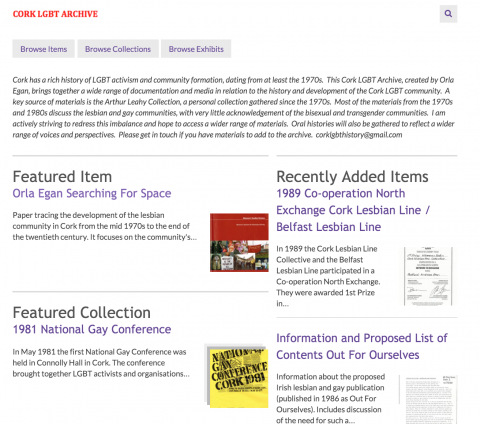
Despite the fear of the previously unknown, I have journeyed in this new-to-me digital land and have created a new Cork LGBT Digital Archive. There is much work to be done, but already there is more than there was before. Already there is a huge amount of previously unavailable documents freely and widely available to anyone with an interest in the rich history of the Cork LGBT community.
This is the ultimate affirmation of the work we’re doing at Reclaim. We do offer world-class support, and I’m very proud of that fact—and Tim Owens has set a standard for Reclaim I try and live up to every day. He is incredible! But what even cooler is what that support is for: we help students, staff, and faculty across higher ed wrap their heads around these digital environments so that they can bring “previously unavailable” resources and knowledge to a broader intellectual community. That’s a effectively our mission statement, and it is intricately tied up with learning the ins and outs of the web.
Back in 2003 I started playing with commodity web hosting thanks to Zach Davis. He turned me onto a Hosting Co-op that cost $2 a month, and I when I was teaching high school in Brooklyn. But more than that, it helped me start wrapping my head around things like DNS, databases, web server file structure, etc. All things that over the next 12 years would become the foundation of my job, but even more remarkably the world I would inhabit both professionally and personally. Zach took some of his time back in 2003 to help me reframe my entire future, and that, to quote Robert Frost, “has made all the difference.”
That is what Reclaim means to me, a indy web hosting movement that wants to help students, emerging scholars, or accomplished academics get comfortable enough to start sharing their resources and knowledge as far and wide as possible. We really didn’t do that much for Orla beyond providing advice when asked and a bit of help when needed. But, I also remember how huge that sense of support was for me when starting down this path 12 year ago. It is still very much with me. Hell, just last week I was trying to figure out how to integrate Omeka and S3. An ethos of selfdogfooding rather than saying no out of hand. Learning how to do this stuff right alongside Orla.
I’ve benefited tremendously over the years from the tutelage and modeling of friends and colleagues like Zach, Tim Owens, Martha Burtis, D’Arcy Norman, Alan Levine, and many others that I not only gained enough confidence to try, but also learned when and where to ask for help. That’s a crucial part of engaging the digital world, to learn this stuff you need to feel supported. Or at least that is what worked for me, so that’s what drives me to provide that support to others getting started. There’s a cosmic karma at work in Reclaim Hosting, and it’s pretty much come full circle back to 12 years ago when Zach Davis got me hooked on web hosting—not to mention the intervening years for many of us at DTLT who imagined these tools as a means of empowering others to navigate the digital world. I like what I do a lot, and it really hasn’t changed that much these last years—just seems the net is being cast further and further.
We’ve been really lucky at Reclaim Hosting over the last year two years to have had the good fortune of working with the good folks at Emory University, University of Oklahoma, CSU Channel Islands, and Davidson College. These four schools have believed in what we’re trying to do from the start, and they’ve been as much partners and collaborators as clients. What’s so cool is that it has not stopped with them. The work we have been doing with Brigham Young University’s IT department over the last 6 months represents an exciting continuation of Reclaim’s partnership with universities to help co-create and implement a vision of what’s possible. What’s more, Reclaim’s not working alone on this one, we have finally been able to get serious and work hand-in-hand with Ben Werdmuller and Erin Jo Richey at Known to make these visions a reality. But I’m getting ahead of myself here, let me back up a bit…
Last Winter BYU’s CIO Kelly Flanagan and Enterprise Architect Phil Windley came to UMW to find out more about Domain of One’s Own. They have been working on a broader project to define a University API across their campus, and they saw personal domains and web hosting as a way of providing students spaces to manage and control their data in a space of their own. Kelly Flanagan has recently written a post, “Personal Domains, APIs, and Portfolios,” that captures the spirit of their project, and pushes to the very limits of decentralized data ownership viz-a-viz a personal API:
Imagine a world where other sites on the web don’t hold your personal data, but instead request access to the data they need through your Personal API. Perhaps you grant them access to only the portions they actually need and restrict them from others. They use the resources they’ve been authorized to access, perform the business functions you desire, return results, and their access is revoked.
This is a perfect marriage with BYU’s University API project, and represents about as vast and ambitious a vision for fundamentally rethinking Higher Ed IT I’ve yet to come across in my 10 years of instructional technology. But actually creating such a vision starts in small, concrete ways. When we were showing Kelly and Phil Domain of One’s Own community site, that became a focus for BYU. They were very interested in building that for their pilot, and they signed on for it over the summer. The issue was the community site Martha Burtis and Tim built almost two years ago is beginning to show its age and neglect (less is not always more). Trying to reproduce what was created as a prototype at UMW for schools working with Reclaim didn’t make much sense. It wasn’t easily abstracted out; Martha has been promoted up to grander things, and we needed to come to terms with the fact that we aren’t software developers. We can help imagine and create the infrastructure, but we need to start brining folks into the equation who specialize in developing specific applications like this—particularly if BYU’s community hub is going to support the Personal API vision.
So, in late September Tim and I traveled out to BYU to have just this conversation around the Personal API, and how a re-imagined community hub might be the first piece of that puzzle. The trip was a great success for Tim and I because we made some real headway on the initial vision of an API-driven community site. What we came away with was not only BYU’s continued support on this project—they rule!—, but also the go-ahead to bring in Ben and Erin of Known to start building BYU’s community hub on top of Known.
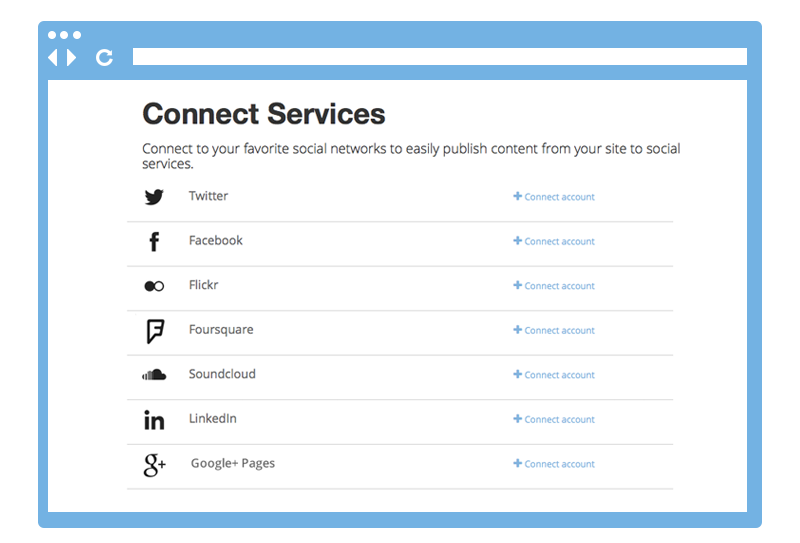
What does this mean exactly? Well, that’s the fun part. Known already has an API built-in, so if Domains at BYU “beings with the Known” (to quote the great Adam Croom) the entire experience changes. For example, what would it mean if when you signed up for BYU Domains the first thing you saw was not CPanel, but an on-boarding process that begins with the option of integrating your various social media services through Known.
Connect your Social Media through Known’s Convoy
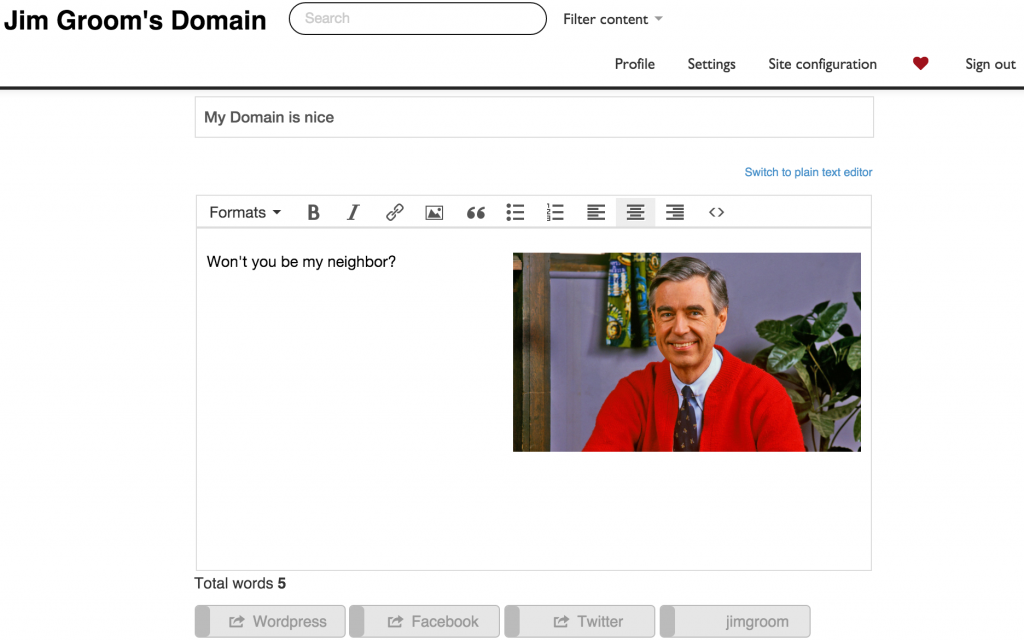
What’s more, once you have done that, you default to a page that is a quick and easy publishing space to send your various work to your social media accounts (the personal API at work already).
The Known Dashboard in BYU Domains
So, as you can see this post in the default page for my BYU Domain becomes a means of pushing to my WordPress blog, Facebook, Twitter, Tumblr, etc. All this being handled by Known’s Convoy, which does the work of connecting your domain with these various social media sites automatically. Now, by extension, there is no reason this can’t integrate with BYU’s University API. There could be buttons underneath the various post types that allow students to send their work to a particular class using something like Canvas’s API.
Privacy matters
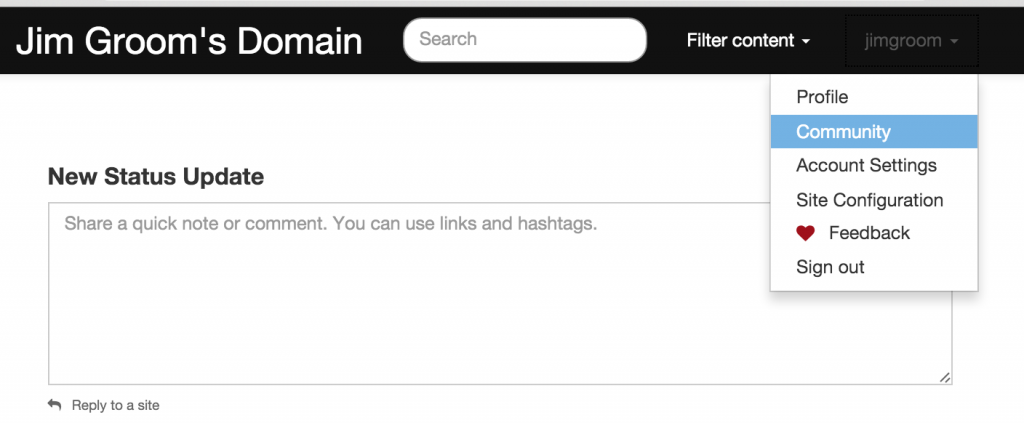
What’s more, built into each post are various privacy settings: Public, Members only (limited to the BYU community), and Private. [When talking to Tony Hirst about this, he recommended a fourth type called “off-campus” which allows students to post to their social media sites from Known, but not have it aggregated to the community site. I like that idea.] But where is this community site you speak of? Well, built into every students dashboard is a Community link.
Toggle to view community posts
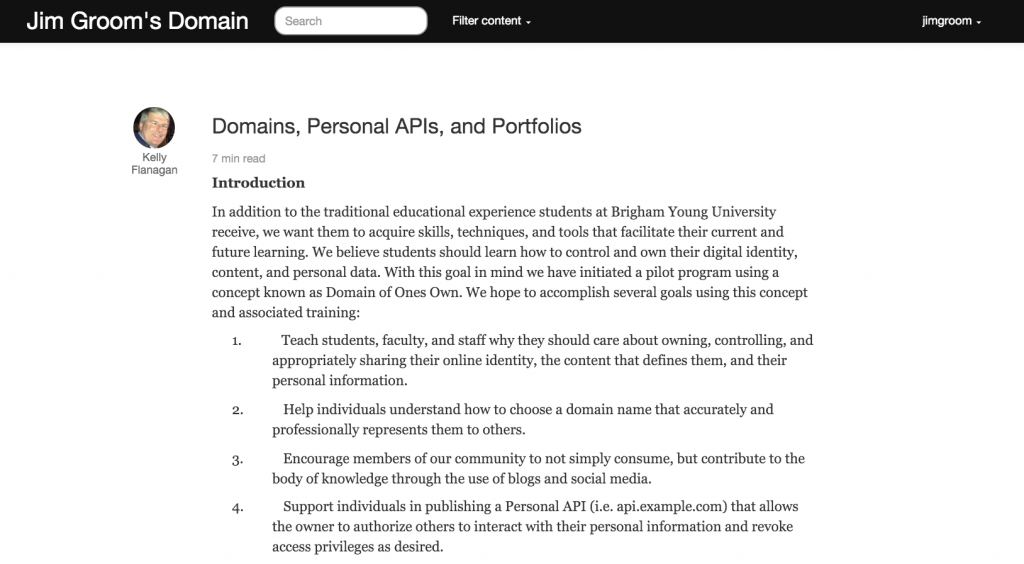
And when I click on that I can see what is happening around the BYU Community within your stream. Not unlike Tumblr. You’ll notice my domain is now showing me Kelly’s post about Domains.
Posts from community read in my Domain
The reader is a view of the community, but ultimately much more once we get targeted data via APIs. it can be a view of all the posts from one course, all the post from your Facebook community, all the public posts to Facebook from the BYU domains community, same goes for Instagram, Twitter, Tumblr, etc. (hence why the “off campus” feature in privacy setting could be OUseful). A targeted, community based reader of sorts that integrates course and distributed social media based on tags and data. A vision of aggregation heretofore only dreamed of in our edtech philosophy.
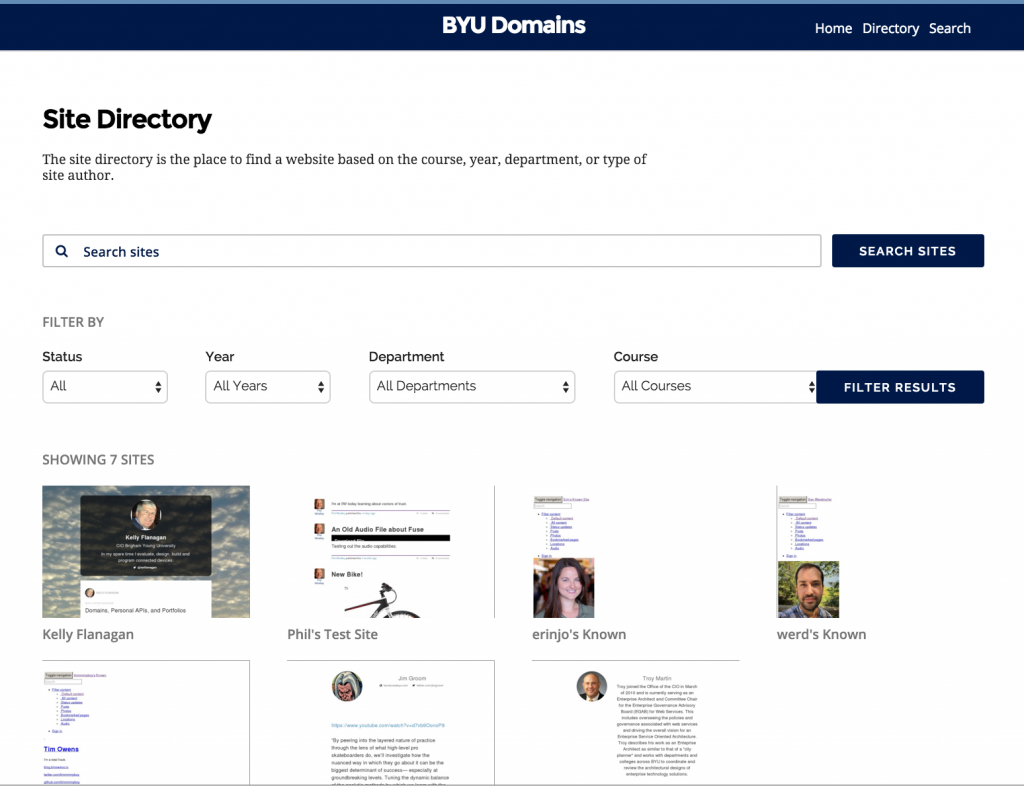
BYU Community Site Directory
What some of those tags and features might be is loosely framed in the site directory feature of the BYU Community site Ben and Erin have built, but that is only limited by how BYU wants to use their University API to integrate with the Personal API.
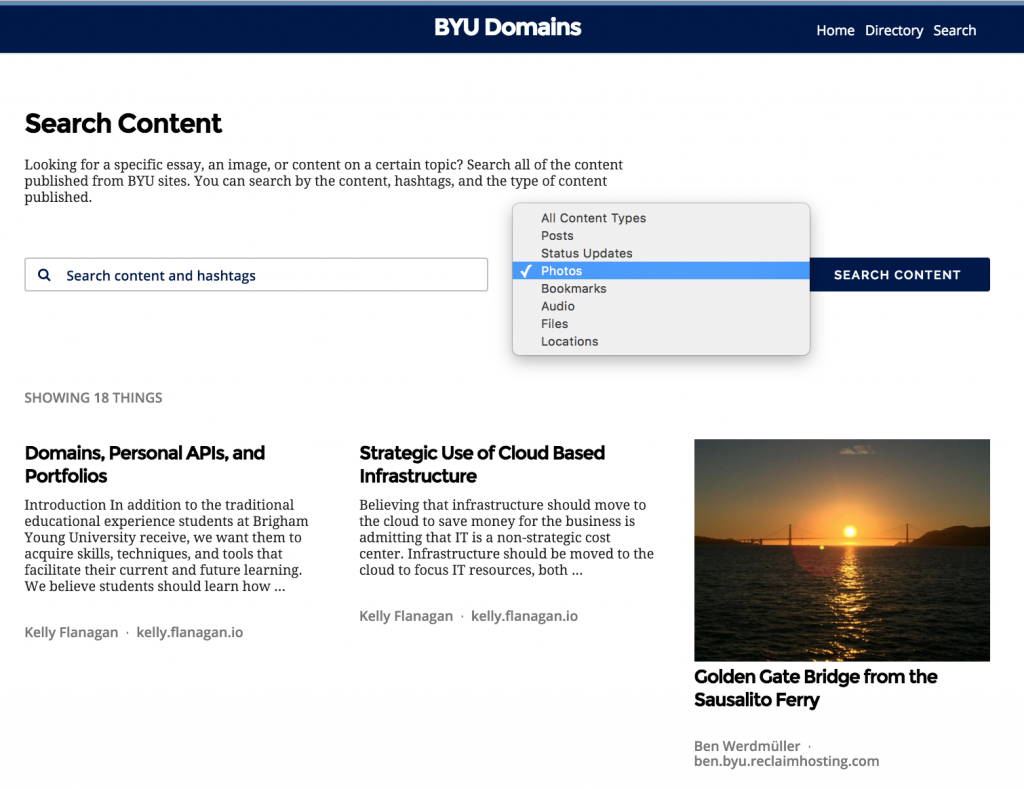
Elastic search in BYU’s community hub.
You can also search across specific content types, but this could easily be extended to search across social media sites, departments, courses, etc.
The work Erin and Ben have done on the Community Hub for BYU is phenomenal, and this is just the beginning. BYU’s community hub provides a model that we can now abstract and provide to other interested schools, and partnering with Known on this may very well changed the way we imagine Domains not only as personal empowerment online, but also community engagement.
Now, having Known as the default interface for BYU Domains in no way rules out the ability for users to install other applications, subdomains, etc. We are currently thinking through what’s the best way to provide a quick and easy way to create subdomains or install WordPress, as well as a simple means of toggle to CPanel to work from there. That said, the switch could be a major one for communities used to working in CPanel, so we to think intently about what this means for the community at large, and what works and what doesn’t. But thanks to BYU’s willingness to experiment, we have a partner that is helping us work through these questions currently, and we may have answers to some of these questions as soon as January.
These are very exciting times for Reclaim Hosting. It cool to see the visions we’ve been courting as a community for years and years start to take shape in an actual application built upon the values of an open and independent web.
Omeka continues to be a huge draw for a variety of students, faculty, and librarians using Reclaim Hosting. And the good folks at the Roy Rosenzweig Center for History and New Media have been champions of our service from the beginning, and that has made a huge difference for us. One of the issues that has come up regularly is storage for Omeka sites, which by design usually have large archives of documents, images, etc. We tend to keep our storage space for our Student and Faculty plans fairly low (2 GBs and 10 Gbs respectively) because we are trying to keep costs low, and the sales line of “unlimited” storage space for shared hosting is impractical for us. We recently introduced an Organization plan that has 100 GBs for just these instances because the need is there. That said, if you have a lot of resources you might be better off with a service like Amazon’s S3—the backup redundancy is insane and you can’t beat the price.
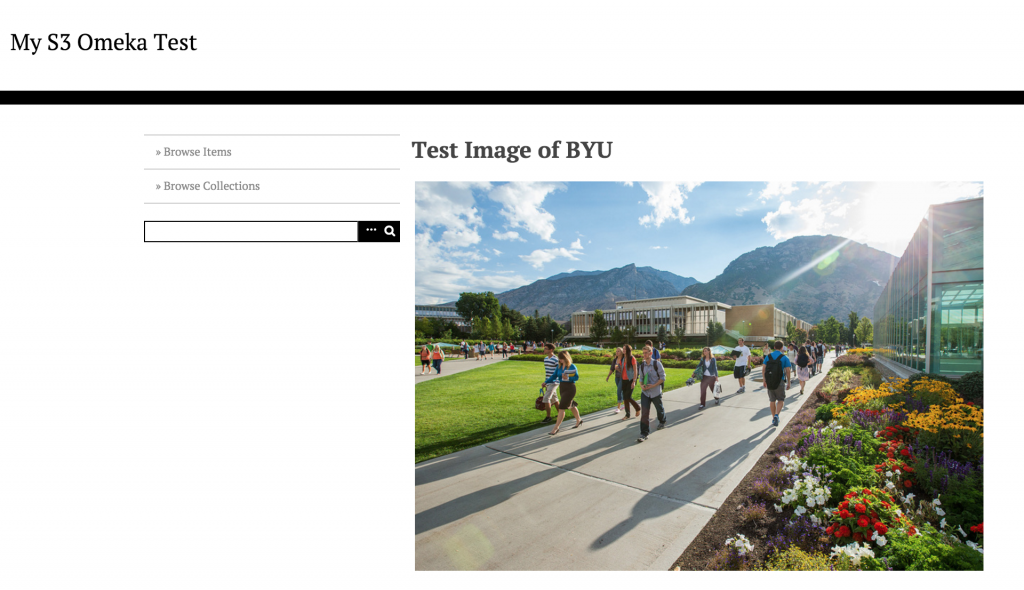
Over 8 months ago Tim Owens figured out Omeka has the option for pushing all uploaded files to S3 built into their code. It’s just a matter of setting up an Amazon S3 bucket with the right permissions and adding the credentials to your Omeka’s config.ini file to get it running. I was intrigued by the process, but Tim had taken care of it so I knew it was theoretically possible—but never tried it. Yesterday, however, I had the opportunity to help a Reclaimer get this up and running for their Omeka install. With some help from Tim on a couple of details I missed, I got it figured out. The rest of this post will be a step-by-step for setting up S3 storage with a self-hosted Omeka site. Continue reading →
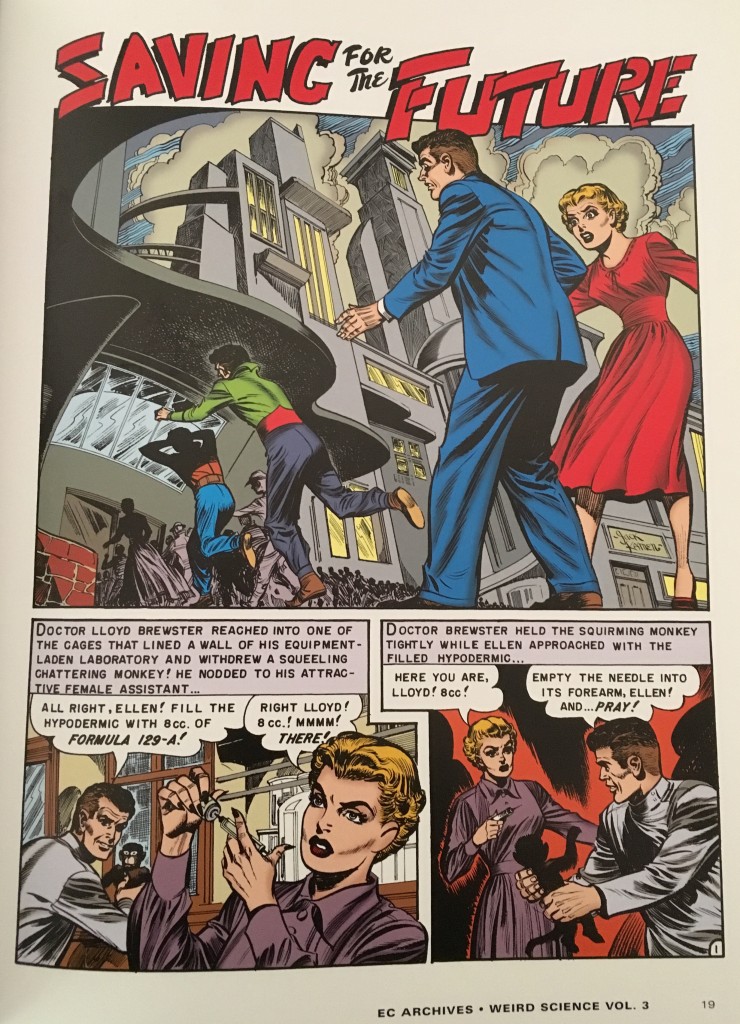
When I was in L.A. a couple of weeks ago I took advantage of a couple of awesome book and comic shops (in particular Meltdown and Wacko) to pickup some goodies for the family (as well as a few for myself). I already blogged about my Tales from the Crypt score in L.A. eight months ago, and this time I kept with the EC Comics theme, but picked up a new title: Weird Science. According to Wikipedia, this title was nowhere near as successful as Tales from The Crypt, but was a labor of love financed by the success of latter. I picked up Volume 3 of the EC Archives project, and I hope to get my hands on volumes 1 and 2 soon.
Anyway, I basically get these for myself with the excuse they are for my kids. That said, Miles and Tess have started to get into them. Weird Science was still in the wrapper until Miles asked if he could open it and read it. Absolutely! He devours them pretty quick, and he’s actually a bit more of a deciphering reader than me. I love them all, he’s more particular—but also he’s usually right. So last night as he was going to bed he told me I should avoid the first story (“A Weighty Decision”) which “was boring” and jump right to second one, “the plague story.” I was intrigued, so I headed downstairs and read the plague story, which was officially titled “Saving for the Future.” He was right, it was pretty awesome.
In fact, it’s a story that once you’ve read it, you realize you’ve heard it before in one way or another. Kind of like a collective narrative we all share in some form post-1492. Interestingly enough, it is written roughly 500 years after the discovery of the new world, and projects 500 years into the future. Anyway, here is a quick summary:
A scientist discovers a serum that can suspend and preserve life indefinitely. At the same time, he and his assistant are madly in love but his wife won’t give him a divorce. So, they decide to suspend themselves for 500 years so they can start over in the future. What’s more, they figure out that if they invest $10 with compound interest, they will be rich when they wake up. [There is a fun aside encouraging kids to figure out compound interest works.]
They wake up 500 years later, and they retrieve their money from the bank and are rich! [There should probably be another financial lesson here about inflation and the cost of living increases.] But, all of a sudden a plague begins devastating the future, and our two heroes use their wealth to constantly move to avoid it. Nonetheless it continues to follow them. Turns out the plague is the common cold—which was eradicated 300 years earlier—that they reintroduced to a population that no longer had immunity to.
So good! A solid ending with a great twist. And I love the final panel of the comic which has our two heroes, the last people on earth, turning on each other. I tend to read this as a colonizing narrative of greed and exploitation wherein the colonizers get their due. The idea of common illnesses becoming devastating plagues harkens back to the European pox brought to the “New World” and its devastating effects. Some deep stuff in this one, good work Miles!
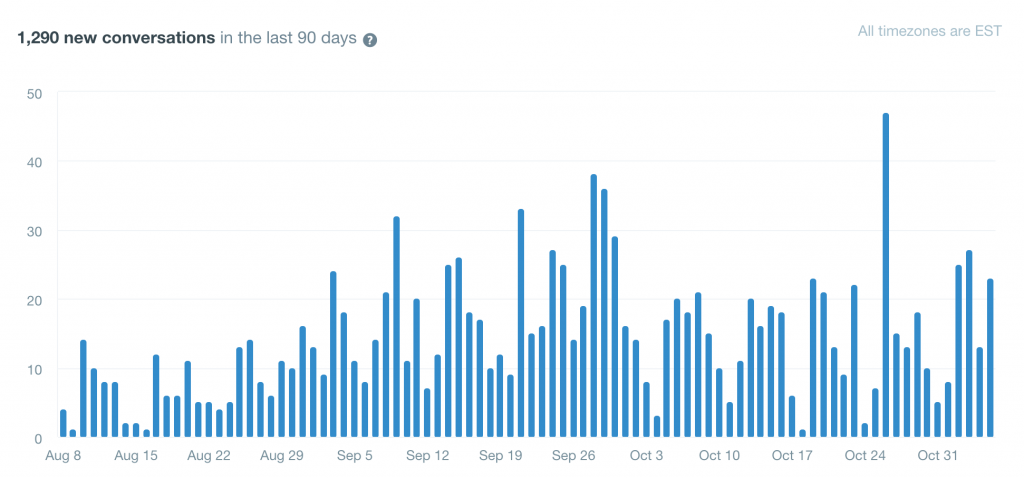
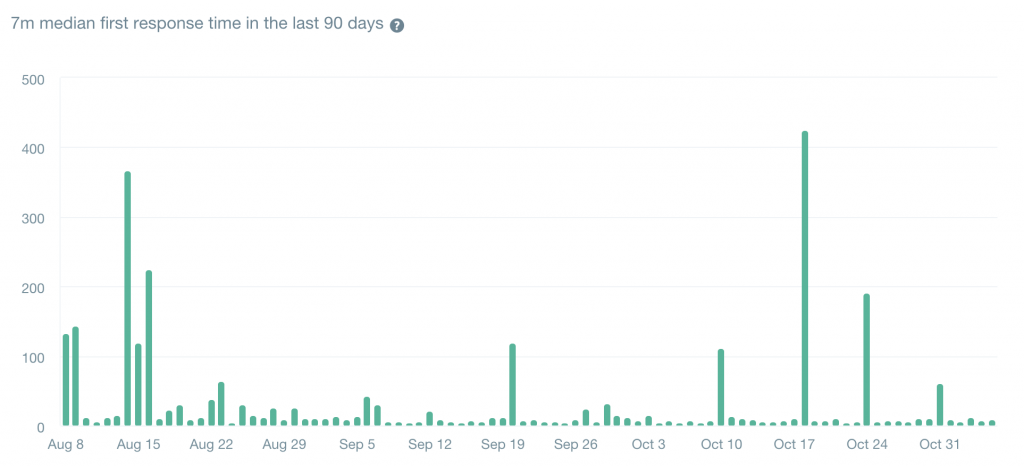
Last month I wrote about Reclaim Hosting support, highlighting the fact in August and September we had an average of 8 minute response time to ticket. I also joked we needed to make it even quicker. Well, looking at our stats, over the last 90 days we responded to 1290 tickets with a media response time of 7 minutes! #NOBODIES
So It’s been more than a month that I’ve been working completely remotely for Reclaim Hosting. I’m still in the incredulous stages of the transition, and having moved to Italy makes it a bit more surreal. I feel like both a tourist and a resident at once, given how new the idea of living here feels (my recent Tweets provide a play-by-play), but also how embedded I am in Antonella’s community of friends and family. It hasn’t sucked just yet, but the fact that I have been constantly traveling for the last two months means I also haven’t had the opportunity to settle in. But given I have a clean slate for the foreseeable future, that is beginning to change.
One thing that has gone pretty smoothly is running Reclaim Hosting remotely. We have a pretty solid distributed workflow. There are four of us now, Tim and I are full time and Lauren Brumfield and Joe McMahon (O.G. UMW at Reclaim) are part time. I think we have done a pretty phenomenal job staying ahead of our growth this semester. We went from 6 institutions as of spring to 25 this fall, and I don’t think our service, response time, or presence has hiccuped a bit. We’ve been scaling our growth gracefully, and that’s a relief given that was one of the worries Tim and I had coming into the fall. But having hired Lauren mid-summer, who has been on point 20 hours a week, has been a huge part of that success. She has been killing it for us. And just a few weeks ago Joe has been brought on for more focused server administration and support. That said, everyone at Reclaim answers tickets as they come in. We are first and foremost premised on helping people (predominantly faculty and students) wrap their head around web hosting and solving issues. So this remains our priority. And you’d be amazed how thankful folks are that we actually respond helpfully so quickly.
I swear Tim @ReclaimHosting must never sleep! Any questions or issues always answered lightening fast! ?? — Kate H. Moore (@HistoricallyUs) November 3, 2015
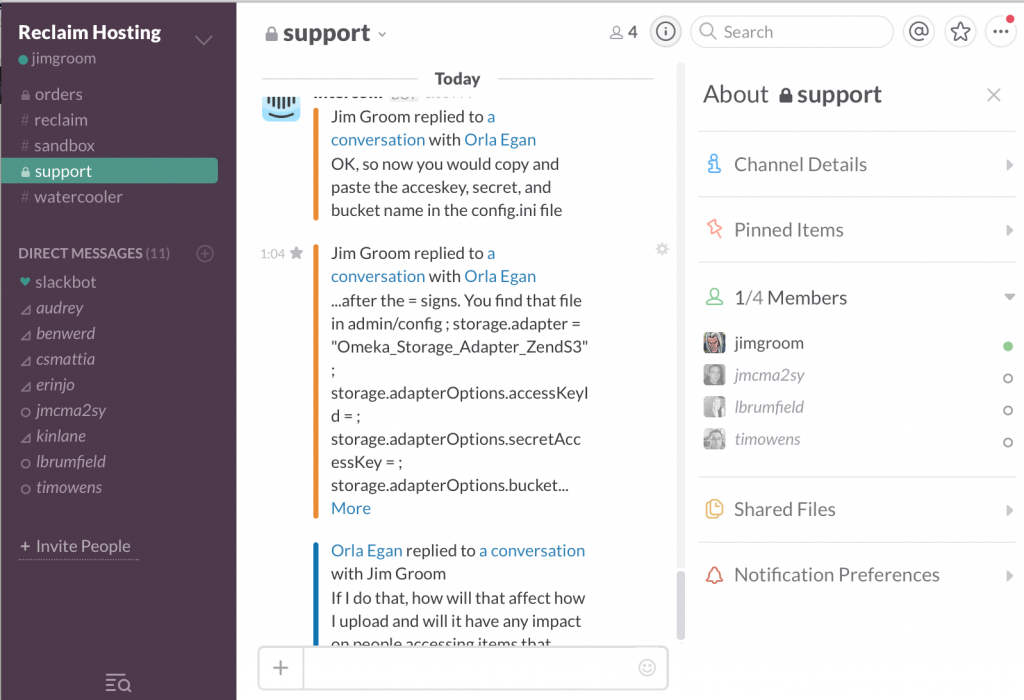
As for the specifics, Slack acts as our internal catch-all for direct messages, support, check-ins, ideas, help, etc. (those are all channels). We also use Slack as an aggregator of our other systems like WHMCS (client management for our shared hosting servers), Intercom (our support ticketing system), blogs we follow, Asana (for project management), and Giphy (purely for entertainment). Slack has become the glue, and it’s working quite well. What’s more, it is a model of an API driven architecture of syndication. Tim told me the other day he turned off all email notifications from Intercom (our support/ticket system) and is only using Slack. I tried it out as well, and it is absolutely liberating. My email inbox feels lighter (no UMW or Reclaim emails!), while then Slack support channel has become the goto for tickets.
Give Reclaim Hosting some Slack
Speaking of support, Intercom continues to be the workhorse for our day-to-day. This application allows us to respond to tickets inline for folks in their CPanel dashboard, as well as via email. We can have an ongoing conversations, and they are viewable by all of us at Reclaim. So unlike email, we have a centralized space to search these users and conversations for necessary contexts.Intercom has proven an indispensable tool for the distributed work we are doing. We can also share comments, questions, and thoughts with each other within a ticket using the notes field. So, if I have a question for Lauren or Tim, I can tag them in a note, and get their feedback and help inline. Another feature to help stay the steady diet of email.
The other nice feature is schedule. I have a pretty wide open schedule, and I am untethered to an office. Finally locking in on a cellphone was the last piece of this. I can be anywhere in the city and still respond to tickets and tether to my laptop if need be. While I was traveling back from Spain and we were having server issues I was responding to tickets on the train leaving Bologna. The new working situation feels futuristic to me. I know there are many folks who have been working like this for years, even decades, but this is pretty new for me. I’ve been embedded in office culture for 20 years, and the break away from it is pretty radical and liberating. I’m sure there will be some things I’ll miss (the lunches, banter, focused time, etc.), but I have a feeling there are so many more I won’t—and the quality of life in terms of family here in Italy has been awesome.
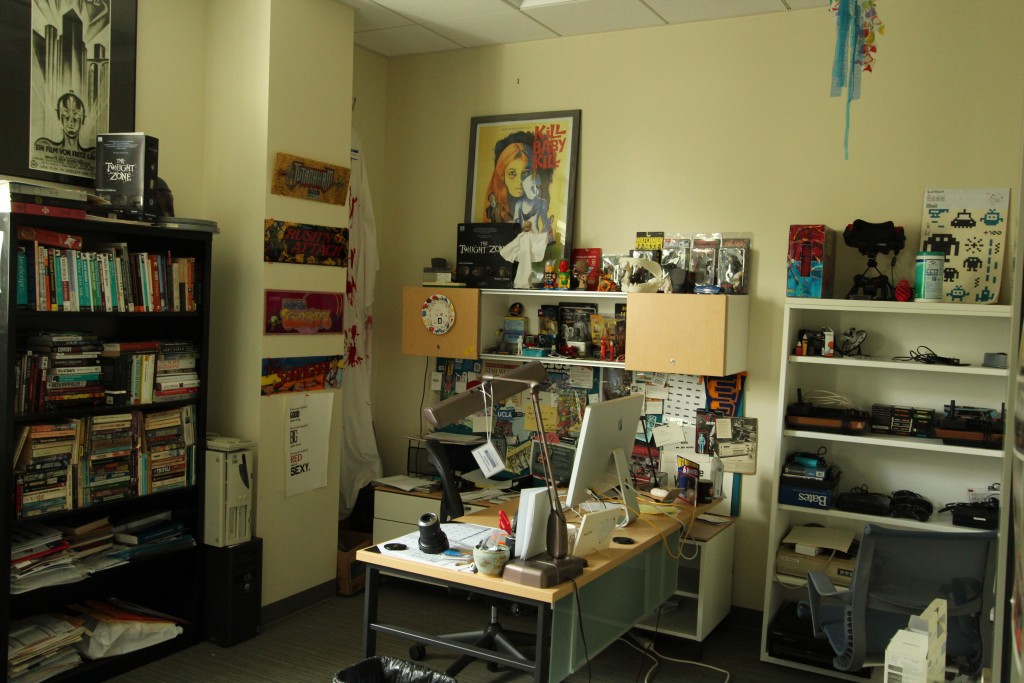
I do still want those focused, communal work gatherings wherein we lock-in around a project, and I think that will still be possible. Like the folks at WordPress, we can try and arrange a couple of Reclaim trips during the year to a destination we agree upon so we can lock-in together for both play and work. No more than a week, and no more than once or twice a year. I’m starting to get used to the idea of a distributed workplace, and I’m really starting to dig it. Life is just too short to be stuck in an office, no matter how awesome you decorate it!
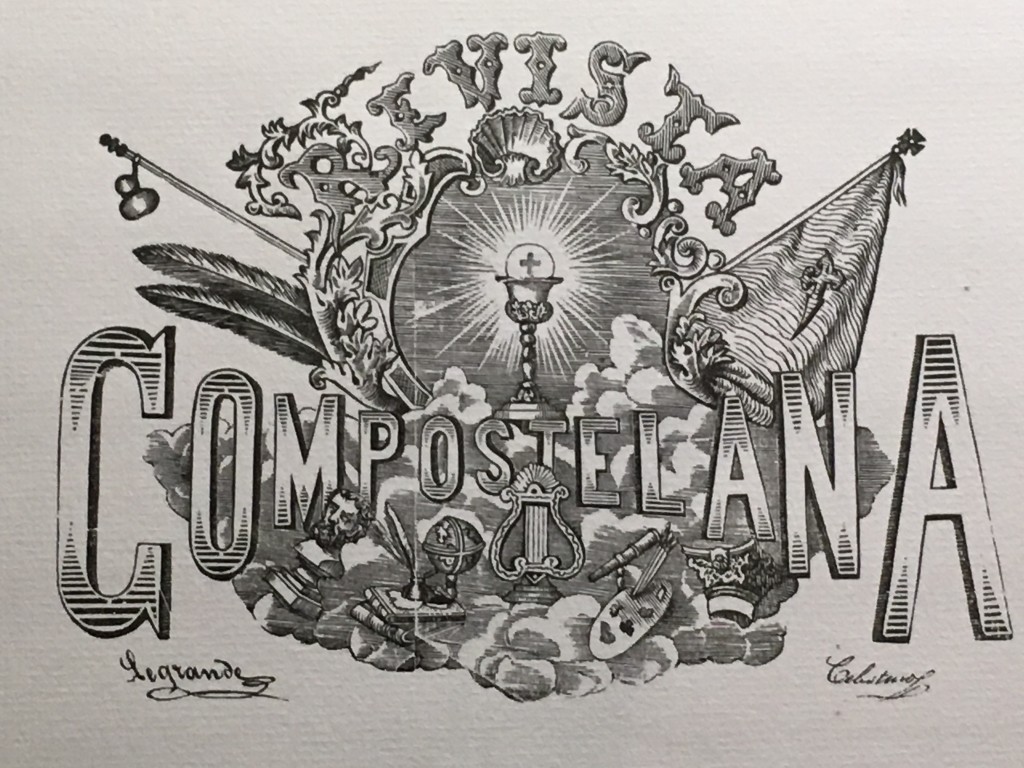
“Revista Compostelana” Late 19th century lithographic
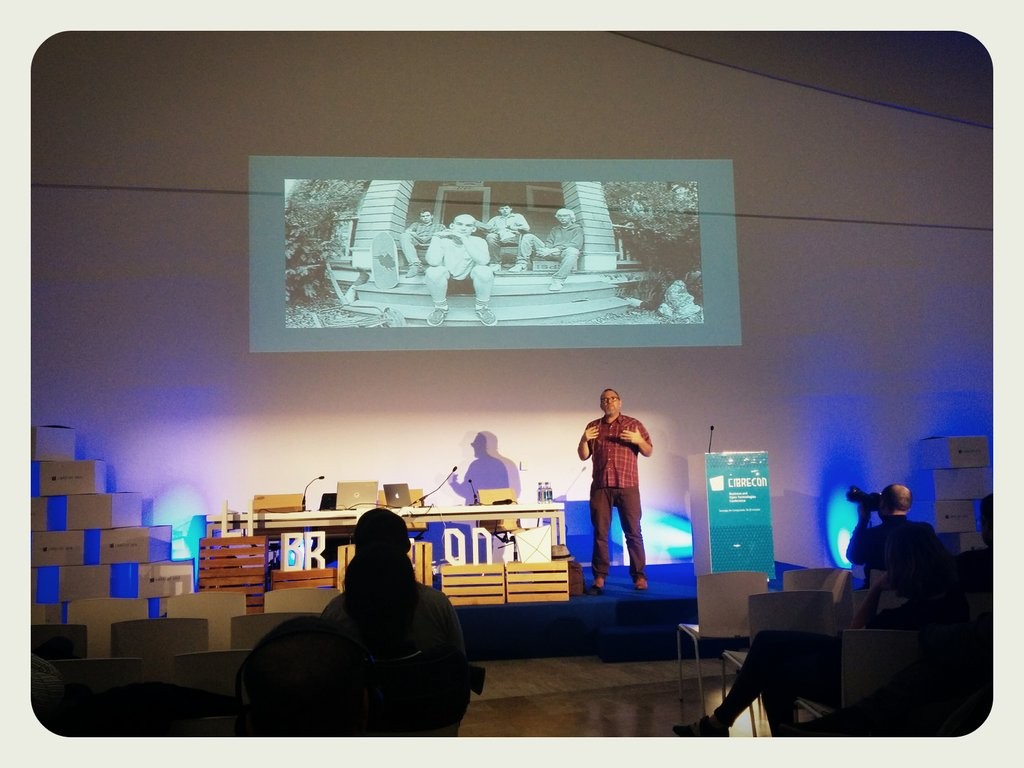
I’m currently traveling back from Librecon, a conference that aims to bring together the applications of free software in both business and education. The conference was held in the gorgeous and quite historic city of Santiago de Compostela in Galicia, Spain, and I think it is a strong frontrunner for the best experience I have had as an invited speaker to date. There were quite a few factors playing into that claim, so let me try and articulate them.
First and foremost, it was the first time I travelled to a conference with my special lady friend Antonella. In fact, it is the first time in 11 years—since the birth of our oldest child—that we’ve traveled together sans bambini anywhere (at least overnight). We had a total blast.
#artsyselfies were had
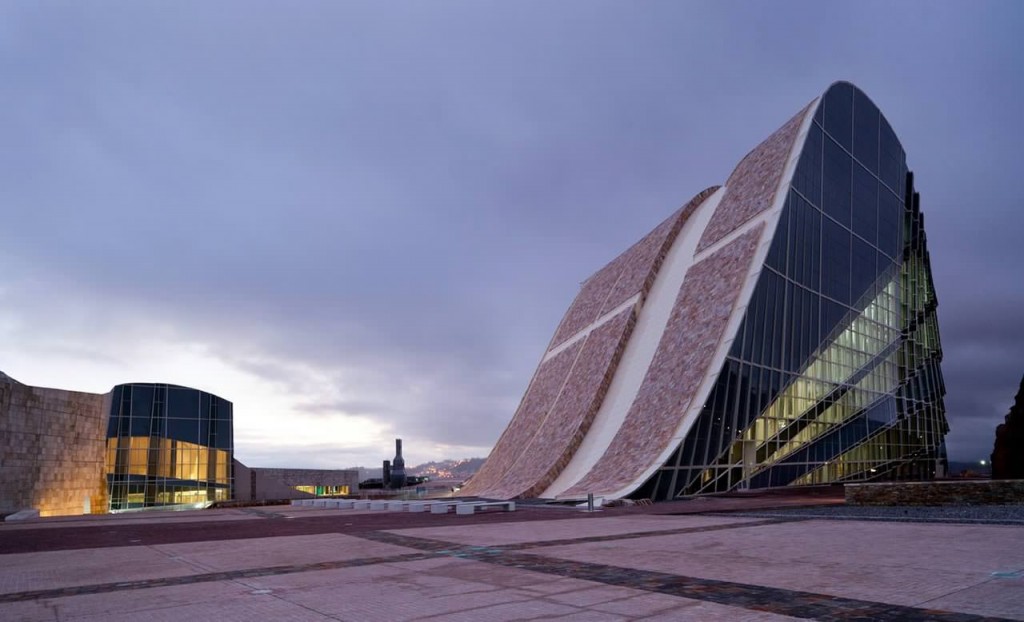
The other thing that ruled about Librecon was that the conference organizers really took care of you. They had cabs from the airport and to the conference; a cool hotel right smack in the center of the city; and a breathtaking venue in Galicia’s City of Culture designed by the U.S. architect Peter Eisenman. The project is rather controversial given how much in ended up costing, but seeing it first hand was truly spectacular; I’ve never seen anything like it. Not to mention holding a conference in it!
The City of Culture of Galicia
Another element of Librecon I loved was that it wasn’t only about education. The organizing principle of the conference was open source software rather than one particular field. So you had folks from car manufacturers, local government municipalities, policy makers, entrepreneurs, and educators all sharing how they use open source technologies in their particular fields. That was really powerful. I spent much of the morning of the second day hearing Roberto Zompi talk about GENIVI‘s attempt to build open source standards for car infotainment systems—fascinating stuff. After that, Tin Hang Liu presented his open source car project OSVehicle. Crazy. The idea of an entirely open source car is wild, and Tin has gotten manufacturers in China to agree to start producing them, so we could be looking at cars as cheap as a few thousands dollars in the near future—Ikea cars!
In the afternoon things turned to a more education-based focus. It got started with Mikel Arbiza impassioned talk about how we have been beating any sense of exploration and curiosity out of the children with our current models. He provided a sustained critique, and his talk led to the most colorful Q&A of the conference. He also linked folks to a wonderful video by legendary street skater Rodney Mullen about open source skateboarding and the “Art of Good Practice.”
We then got to hear a new, powerful voice in edtech—new to me at least for me—Beka Iglesias. I found her thinking and framing of the working she is doing really brilliant. She was focusing in on the tensions between prototyping and products, and subtly teasing out the differences, and why education needs to focus on the former not the latter. She also shared the work she’s been doing around interdisciplinary design projects using the hacker space approach (which seemed similar in spirit to the Porto Design Factory). I really hope to run into Beka again and hear more about the work she is doing because how can you not be when her bio reads like this:
…my work focuses on biointerfaces, posthuman concepts, the dissolution of gender and telepresence as connective-magical device, always using free technologies, particularly creative code and arduino electronics.
After Beka’s talk I got a third chance at my Indie EdTech presentation I had given previously at dLRN and Whittier College. I think this one kinda nailed it, all the pieces and the bands came together narratively, and I was even able to start off with a demo of Reclaim Hosting’s State U and work backwards. Over the last couple of years I have actually given the same talk 3 or 4 times over the course of a couple of months and found I could continue to hone and fine tune my thinking.
I think of my presentations as a kind of gigging, playing to an audience and feeding off their response and energy while being very much within the moment. It works well with my music metaphor, and I’ve kind of enjoyed remaining within a presentation for a a couple of months, but I’m mindful to avoid playing it out for too long. I think after Libercon I can put away the Indie EdTech presentation and be pretty happy with it. My next presentation will be at OER16 and focus around open infrastructure as an open educational resource of sorts (or something like that), playing off stuff folks like the great Tony Hirst are thinking through presently (I’m even trying to get him to co-present with me—but he is being very British about it 🙂 ).
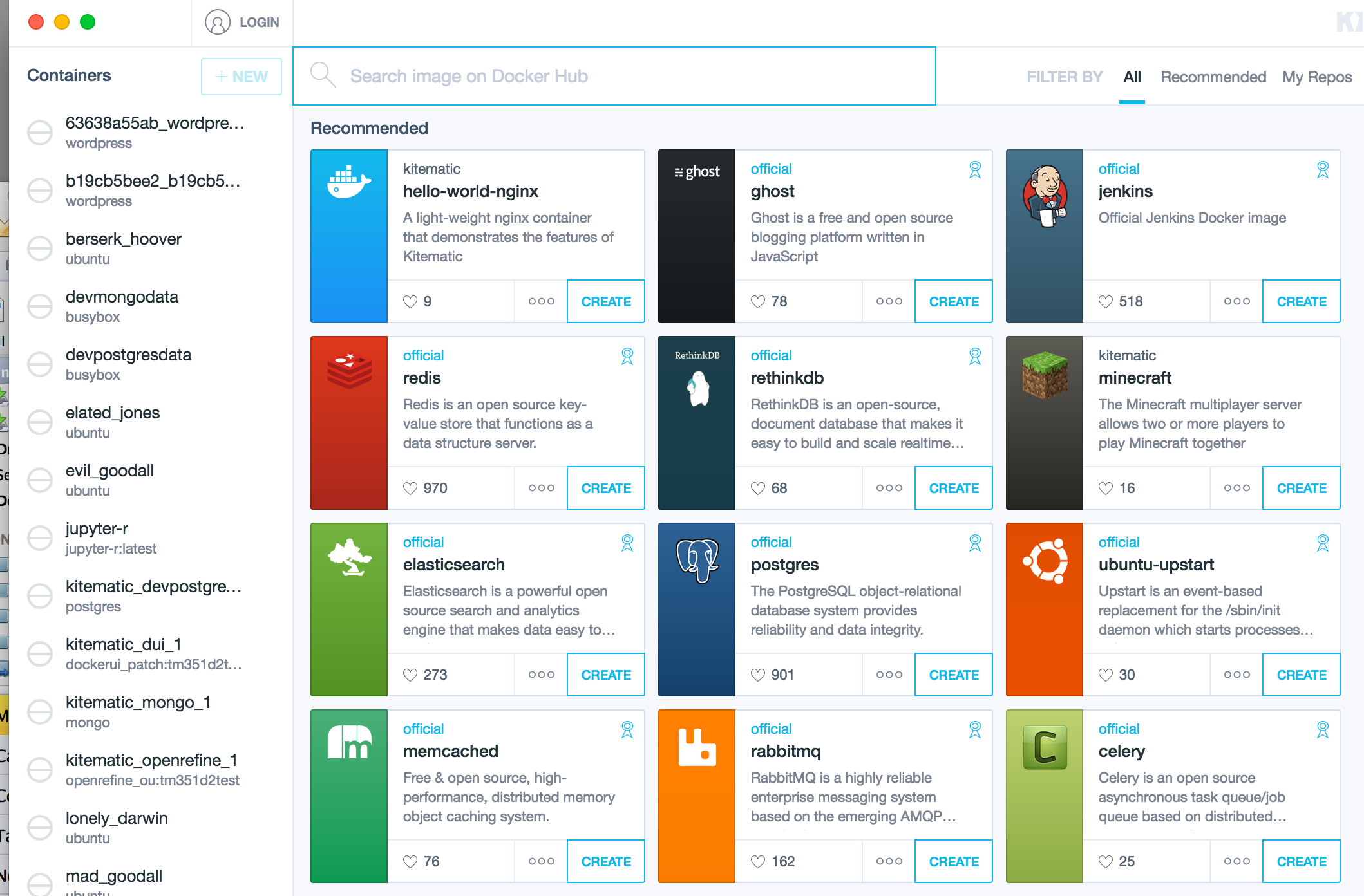
Speaking of DevOps and virtualized infrastructure, I had the pleasure of briefly meeting David Lareo at Librecon, and he is very much a fellow traveller. He has been digging in on Docker, Sandstorm, and other decentralized hosting approaches to re-thinking the web. I really hope to reconnect with him while in Europe and start sharing plans and ideas for experimenting more robustly with this stuff. But I have some work to do of my own before then—I’m committed to playing more intensely with these platforms before year’s end.
I also got to meet Juan Freire—the person responsible for getting me invited to Librecon–and someone I have been reading and following since the days of EDUPUNK. In fact, he is still very much excited by the idea—which is awesome!—but that might be because he heard the less commercial version from Brian Lamb in 2009. It’s cool to see these ideas have taken a bit of root for folks and that I still feel like we are following similar paths. it was cool to hear Juan had left higher ed a couple of years back and is running his own edtech business, something I can deeply relate to these days.
I guess the last bit I’ll say here is that they couldn’t have picked a better place to do the conference in. Galicia is a gorgeous part of Spain, I loved the rain swept streets and you can feel the sea in Santiago de Compostela, but not see it—which creates an interesting feel to the city. What’s more, Spain has to be the greatest country in the world for nightlife. Nothing gets started until after 10 PM, and it goes into the wee hours of the night. The restaurants are awesome, and we got to spend a most enjoyable evening with folks from the conference, particularly Roberto Brenlla who took us to an awesome bar and turned u on to the early 80s Galician punk band Siniestro Total.
On top of all that, Antonella and I spent all day Saturday checking out the crazy cathedrals that are everywhere Santiago de Compsotela. The main cathedral is a UNESCO World Heritage Site and it has got some serious medieval Catholic history going for it. It’s the resting place of the apostle St James, and over the centuries his image has been fashioned to be a great defender of the faith and killer of infidels, namely the Moors—which coincides historically with the Crusades. From the 10th or 11th century it has been framed as a space for holy pilgrimage, and so much of Santiago’s identity as a city is still defined by this centuries long tradition. Luis Buñuel even had fun with the pilgrimage history in his irreverent The Discreet Charm of the Bourgeoisie. I always feel so small and insignificant when i come into contact with these sweeping, historical spaces in Europe. It is a welcome dose of sobriety, if not piety.
An appropriately Gothic image of Santiago de Compostela’s Cathedral
And those are just a few reasons why Librecon was awesome. It’s a young conference, and I think it’s got a promising future.
And with that I put the last of my conference obligations behind me for 2015. The last two or three months have been intense in terms of travel and presenting, but I have had a blast. And there could be no better way to end it than with Librecon. Now it’s time to lock into Italy, the family, and the bava—the unholy trinity of my new life. Oh wait, there’s also this little thing call Reclaim Hosting…#4life!
I’m just returning from a deeply energizing trip to California. I spent the bulk of my time in Los Angeles, but also spent two days at Stanford University for the dLRN conference. This post was inspired by the presentation I did with Adam Croom at dLRN. But since starting this post I gave a follow-up presentation on Indie EdTech at Whittier College, and I’m currently preparing a third version to present at Librecon later today. So, what started as a reflection about my presentation with Adam has transformed into a far ranging exploration of this idea of Indie EdTech—so please forgive the inconsistencies and omissions.
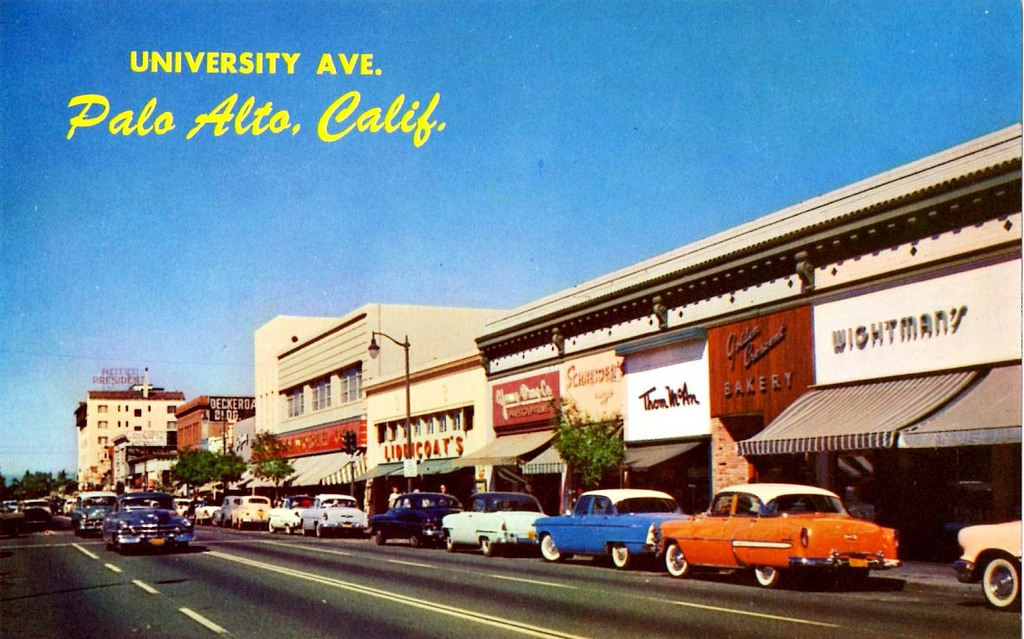
Palo Alto was an interesting spot for the presentation Adam Croom and I came up with for this conference because it’s ground zero for mainstream visions of tech culture more generally (Google anyone?). What’s more, the same can be said for edtech after the Fall 2011 AI course at Stanford taught by Sebastian Thrun and Peter Norvig got called a MOOC. This was the course that launched 1000 MOOCs, effectively mainstreaming edtech (the year that edtech broke—in both senses of that word). The context was not lost on us, and we decided to use the occasion to introduce something Adam has coined “Indie EdTech” —which I love!
Before the talk, Adam and I got the opportunity to warm up for our presentation a bit when we were invited by Maha Bali to do a Virtually Connecting chat a couple of hours before our talk. The session included Autumm Caines, Apostolos K, Patrice Torcivia Prusko (onsite Buddy), resident punk expert GZ, Kelsey Schmitz, and Jack Norton, and Christian from Hamburg (didn’t get his last name). You can watch/listen to the session in the video below.
Our chat ran long at 30 minutes, but we found it an great way to try out our ideas, warm up the conversation, and connect with folks beyond the conference. The Virtually Connecting phenomenon is very cool, and after this experience I am sold on it—at least from the vantage point of a presenter. On the other side, major kudos to all those who both organized and participated in the session. Coordinating stuff like this is a ton of work, but provides an invaluable, interactive portal into a conference like dLRN. Not to mention an alternative archive of the event.
But back to the actual talk. The first part of our 30 minute talk (which was supposed to be 15) was delivered brilliantly by Adam, who discussed the history digital music to examine the impact of the web on the changing nature of that industry, its consumers, and the artist. It’s a really sharp, paleoconnectivist analysis of the real impacts behind the claims at the turn of the millennium that the web and file sharing was killing the music industry. Turns out it was transforming the distribution of wealth and access for artists, but the industry is alive and well. A powerful statement that flies in the face of claims like those of Metallica’s Lars Ulrich about digital music destroying an industry. I highly recommend you visit Adam’s site for his entire talk. [As a quick aside, is their anyone doing the level of work Adam is right now to galvanize an entire University community to take control of their online world? I have been blown away but what he has accomplished at Oklahoma over the last year. amazing.]
The long history of music and culture that Adam explored in relationship to tech and music since the 1960s opened up a ton of possibilities for analyzing specific examples of artists’ challenging the established culture in order to try and fashion their own. I’ve been looking for every opportunity to incorporate Michael Azerrad’s fascinating book Our Band Could be Your Life (a chronicle of U.S. Independent punk bands during the 1980s) into a presentation—and thiswas my chance!
My idea behind the presentation was pretty simple, and I think it worked out decently (though it still needs a lot of work). Take specific indie bands from the 80s that Azerrad talks about in his book and juxtapose them with the development of an independent movement in edtech over the last decade. I’ll acknowledge right away that the limits of this presentation were that I focused a bit too specifically on stuff I was a part of at UMW (UMW Blogs, EDUPUNK, ds106, Domains, etc.). I tried to rectify this issue when I presented a second version of this talk the following week at Whittier College, but need to build this out.
Below is an edited version of my slides, and I went through them fast with some cursory discussion about the bands and the correlating Punk scene (we only had 15 minutes total, which we stretched into 15 minutes each). So, my commentary below is not the presentation I gave as much as the presentation I would have loved to have given if I had the time and had prepared.I guess my blog posts aren’t the only anarchic works-in-progress I’m responsible for:)
Why 1980s indie punk? First and foremost because I dig it. But secondly it provides an interesting parallel for what we might consider Indie Edtech. Indie punk represents a staunchly independent, iconoclastic, and DIY approach to music which encompasses many of the principles we aspired to when creating open, accessible networks for teaching and learning at UMW. Make it open source, cheap, and true alternatives to the pre-packaged learning management systems that had hijacked innovation. The rise of the venture capital xMOOCs only reinforced that value of such an ethos.
Black Flag
Writing about the cultural conditions that gave birth to the hardcore movement, Azerrad focuses on Souther California and the L.A. band Black Flag which represents the beginning of a whole new generation of punk:
It’s not surprising that the indie movement largely started in Southern California—after all, it had the infrastructure: Slash and Flipside fanzines started in 1977, and indie labels like Frontier and Posh Boy and Dangerhouse started soon afterward. KROQ DJ Rodney Bingenheimer played the region’s punk music on his show; listeners could buy what they heard thanks to various area distributors and record shops and see the bands at places like the Masque, the Starwood, the Whisky, the Fleetwood, and various impromptu venues. And there were great bands like the Germs, Fear, the Dickies, the Dils, X, and countless others. No other region in the country had quite as good a setup. But by 1979 the original punk scene had almost completely died out. Hipsters had moved on to arty post-punk bands like the Fall, Gang of Four, and Joy Division. They were replaced by a bunch of toughs coming in from outlying suburbs who were only beginning to discover punk’s speed, power, and aggression. They didn’t care that punk rock was already being dismissed as a spent force, kid bands playing at being the Ramones a few years too late.
And what was unique about Black Flag, according to Azerrad, is that: “Black Flag was among the first bands to suggest that if you didn’t like ‘the system,’ you should simply create one of your own.” And Black Flag guitarist Greg Ginn did just that when he founded and ran SST Records.] The band itself was “required listening for anyone who was interested in underground music.” More from Azerrad:
By virtue of their [Black Flag’s] relentless touring, the band did more than any other to blaze a trail through America that all kinds of bands could follow. Not only did they establish punk rock beachheads in literally every corner of the country; they inspired countless other bands to form and start doing it for themselves. The band’s selfless work ethic was a model for the decade ahead, overcoming indifference, lack of venues, poverty, even police harassment.
I’m fascinated by the idea here that Black Flag could forge an independent punk movement on sheer will and hard work. Not sure if that’s the whole story, but I love the narrative regardless. And it provides a nice transition to what was UMW’s DTLT. Below is the image/slide I used that captures four core group members that are in many ways the Black Flag of Indie EdTech 😉 Early on DTLT decided that rather than existing within the confines of the learning management systems that defined main stream edtech, we would build a system of their own. And that is exactly what we did for the following decade. In fact, we built a few 🙂 We weren’t in metropolitan Los Angeles, however, but rather in Civilwarland, VA. A regional public liberal arts school few people had heard of outside of Virginia. All it took was punk rock denier Gardner Campbell to unleash the Bluehost experiment as well as hooking us up with various edtech punks around the country such as Bryan Alexander, Alan Levine, D’Arcy Norman, and the great Brian Lamb.
DTLT (Edtech’s Black Flag!)
The initial push for experimentation and exploration at DTLT in 2004 and 2005 pre-dates my time at UMW, and would prove foundational for everything that would follow. And, to be clear, and this is a point Azerrad makes repeatedly in his book, punk is not necessarily a pre-defined look, political stance, or reaction, but a fervent independence from the established approach to making music in the 80s that defined the industry. And this was certainly one of the things that drew me to this analogy.
Mission of Burma
Case in point, rather than the aggressive, antisocial, and paranoid themes of Black Flag, Boston’s Mission of Burma took “elements of free jazz, psychedelia, and experimental music and injected them into often anthemic punk rock.” It was avant-garde meets punk rock—a vision bands like Sonic Youth would build upon a few short years later. The were experimental all the way, so much so that one of their band members, Martin Swope, worked as the group’s tape-effects artist incorporating tape work to most of the group’s songs, and was regarded as an integral part of the group, appearing in group photographs and receiving equal credit on recordings although he was never on stage.
The Blue Host Experiment
That kind of experimentation with various forms and technologies was what the Bluehost experiment was all about. Experiment with fledgling (at the time) open source tools like WordPress, MediaWiki, Drupal, etc. and try and create a new system all our own by building course environments for faculty and students that put them on the web, and asked them to take a hand in designing the experience.All at the low cost of $6 a month—the going rate for consumer-level commodity hosting in 2005.
Minor Threat
Washington D.C.’s Minor Threat (taking inspiration from the great Bad Brains) came on the scene, and they gave birth to a movement within the movement: straight edge. Minor Threat repudiated the idea of drugs, alcohol, tobacco, and promiscuous sex in reaction to the 70s punk rockers, as well as the burnt out threat that was the hippie movement. Founding band member Ian Mackaye also started Dischord Records which had a strong influence on the hardcore punk scene by reinforcing a “do it yourself” (DIY) ethic for music distribution and concert promotion. What’s more, there was more than just SST now. Different regions could have their own labels and build their own, unique culture for their local scene.
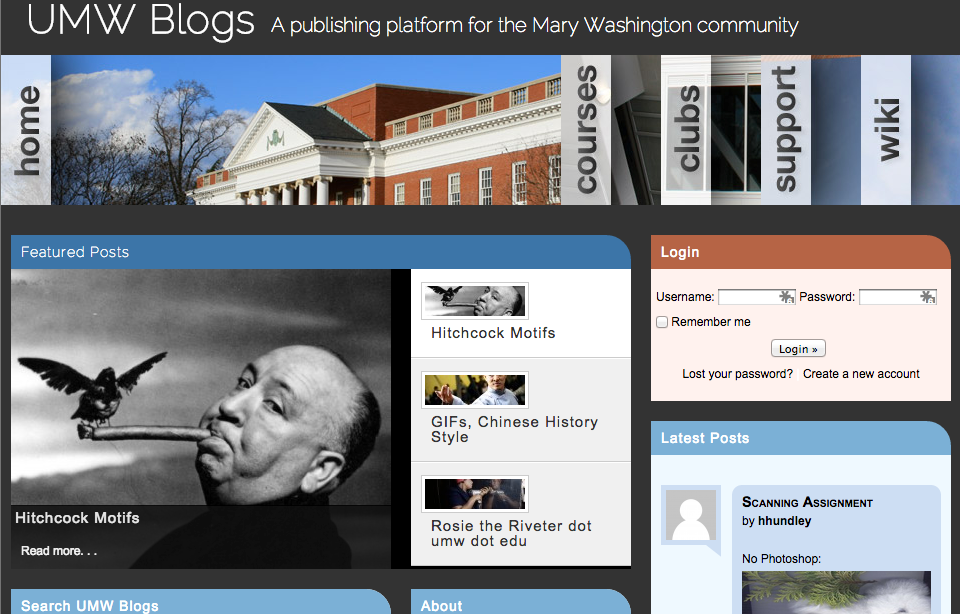
UMW Blogs
In many ways building this idea of local culture for UMW was the spirit behind UMW Blogs. The first major result of consistent experimentation was a campus-wide publishing platform on top of the open source blogging software WordPress. This might be understood as a label of sorts for the great work coming out of UMW, and we weren’t alone. There were already blogging platforms at UBC and Penn State that were doing something similar, and this became a link for a broader community of indie edtech folks experimenting outside the blackbox that was the LMS.
EDUPUNK: DIY EDTECH
As some of you may know, this isn’t the first time I’ve played with the idea of punk in relationship to edtech. And it’s not a coincidence I’m returning to it now. Much of the spirit of the work happening in UMW up and until 2008 seemed to be fairly radical for the field. Learning management Systems were the rule, and edtech was often framed in service to that system. EDUPUNK refused that paradigm, and UMW’s DTLT became an example of how to do it differently. In 2008 you could count the number of schools who were running and supporting WordPress for their campus community on two hands, in 2015 it would probably take 200 hands. Not only was WordPress open source, but it wasn’t even Moodle. It was blogging software! While EDUPUNK went underground as it became a rationale for gutting public spending for higher ed, and disrupting education more generally, it spirit lived on.
The Minutemen
Much like that of D. Boone and the inimitable Minutemen, the spirit of The Minutemen was a staunchly left politic buttressed by an intense work ethic and a parsimonious rock and roll lifestyle captured brilliantly in their calling card: “we jam econo.” Their musical style was as bluesy as it was punk, and they represent yet another node in broad vision of what punk was in the 80s. They were their own roadies, toured tirelessly, and were considered my many the exemplars of the DIY ethos of the early indie punk scene, not to mention its moral compass—but without all the overt preaching and doctrine of the straight edge scene.
ds106 #4life
So when ds106 (the Digital Storytelling course at UMW), went open and online in the Spring of 2011, a variety of folks came together to design a participatory, open, online course that would try and distill the ethos of indie edtech, while at the same time capturing its community. All the while doing just about everything on open, freely available (or at least dirt cheap) infrastructure. Grant Potter gave the course the tagline “we jam econo” —and it stuck. He also built a radio station for the course—truly exemplifying the best of open and ongoing experimentation in edtech. ds106 marks a kinda of distributed crystallization of the indie edtech scene post-EDUPUNK. A couple of letters followed by a few numbers that have become the calling card for ongoing, free-flowing creativity, experimentation, and fun.
Sonic Youth
The free-flowing creativity and experimentation that characterized the independent punk scene in the 1980s took on new levels of musical sophistication with bands like NYC’s Sonic Youth. During their early career members of Sonic Youth were associated with the no wave art and music scene in New York City. Lee Ranaldo a talented avante garde guitarist. Kim Gordon a fine artist-cum- bassist and vocalist. They were as much a noise band as a punk band, and they did a lot of work in terms of marrying the idea of avante-garde music to punk rock. They also combined the two traditions by championing thehardcore punk ethos and theDIY ethic as a genre rather than a specific sound. Why couldn’t punk also be avante-garde noise? Again, another instance of punk as a social category more than a musical one, providing creative freedom for bands like Sonic Youth to roam. What’s more, it enabled Sonic Youth to make the transition from indie to major labels with very little blowback from the community in terms of their commitment to the indy cause.
UMW’s Domain of One’s Own
And much like Sonic Youth, Domain of One’s Own represented avante-garde design thinking (build the network around the individual not the course) with trailing-edge tech and a DIY ethic. This came together so brilliantly when Tim Owens (DTLT’s Lee Renaldo) and Martha Burtis (Kim Gordon) sat down in 2012 and 2013 and built out the basics that had already been prototyped with Hippie Hosting (I hated that name 🙂 ). The vision around the Bluehost experiment that started the whole thing was taken to a whole new level of elegance and usability. It was the culmination of all the explorations that fueled the Bluehost experiment, UMW Blogs, EDUPUNK, and ds106 rolled into user innovation toolkit known as Domain of One’s Own. The fruit of years of focused work towards a common goal of empowering a community created and controlled web at UMW. It’s punk rock to the core. And like Sonic Youth, it could abstract out its value to appeal more broadly to other schools who were keen on doing something similar for themselves.
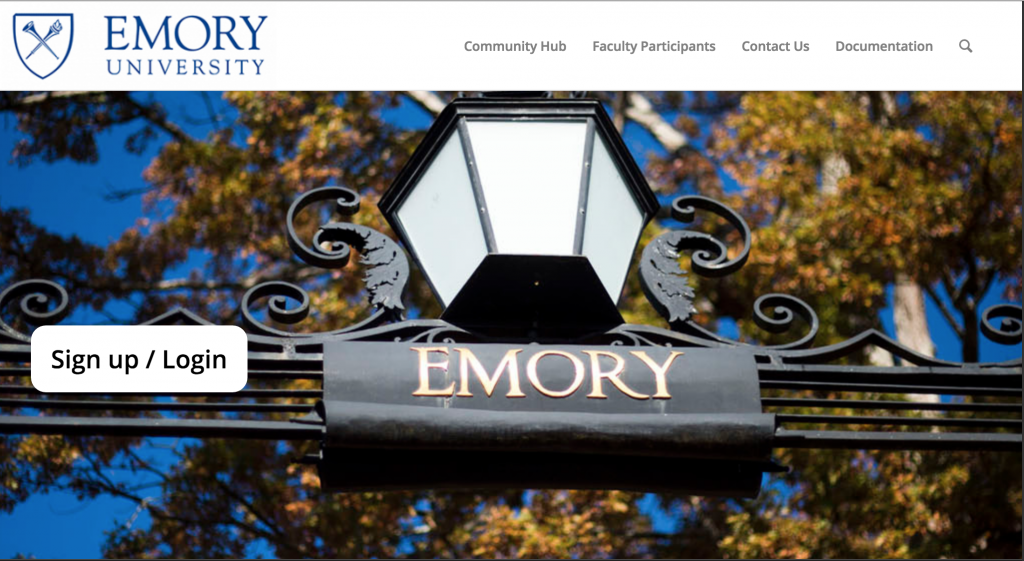
Emory Domains
For example, very early on in 2013 Emory was planning on on running a pilot for their writing classes. A vision where writing across the curriculum meets writing for the web. New idea of audience, literacy, and a broader vision of the writing portfolio. David Morgen has led this charge adroitly, and has been steadily building a culture of domains at Emory for more than two years.
From the Spring of 2013 through the Summer of 2014 the broader Indie EdTech domains movement started to congeal. We became heavily influenced by the thinking of Audrey Watters and Kin Lane, and around this time (thanks to Audrey and Kin) became familiar with and inspired by the parallel work happening in the IndieWeb movement. Audrey and Kin in many ways helped shape the direction and momentum of domains, as well as our philosophy of the IndieWeb more generally (kinda like a John Doe and Exene Cervenka—a heavily dosed, duet of O.G. LA EdTech that never gets old).
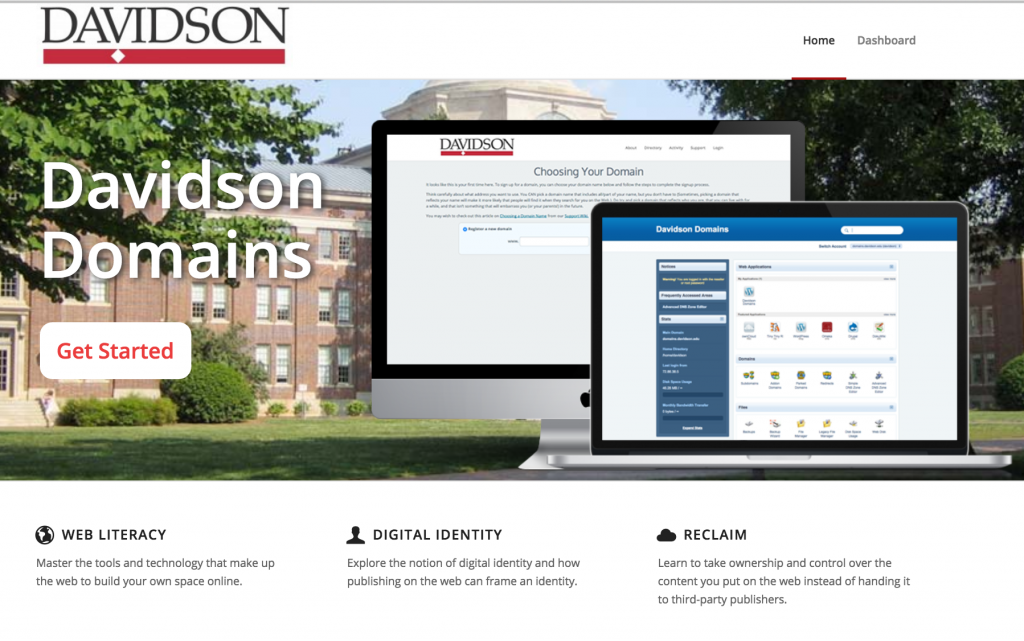
The Summer of 2014 also saw the signing on of schools like University of Oklahoma, Davidson College, and Cal State University-Channel Islands. The idea of a Domain of One’s Own was spreading across the country. And each of these schools had their own idea of what it might look like, and just like punk music, the idea of domains was not an orthodox approach, but a DIY ethos and “we jam econo” vision of edtech. Like the various bands throughout the 1980s independent music scene, they would ultimately create their own sound based on their local scene. And the universities making this possible are akin to indie edtech labels across the country in the 1980s (SST Records, Dischord Records, Touch & Go,K Records, Twin/Tone, Sub Pop, etc.) fostering a new approach to teaching and learning with technology that flies in the face of mainstream edtech—and all on the cheap.
Initially you might not think of a band like The Flaming Lips as part the 1980s indie music scene, but they are very much part and parcel of that movement. Founded in Norman, Oklahoma in 1983, they recorded their first full-length album, Hear It Is, in 1986 on Enigma Records. Far from what you think of us as punk, The Flaming Lips were a tripped out, psychedelic rock band. What’s interesting is they hailed from Oklahoma, and essentially forged a scene in Oklahoma City around their unique stye.
The Flaming Lips
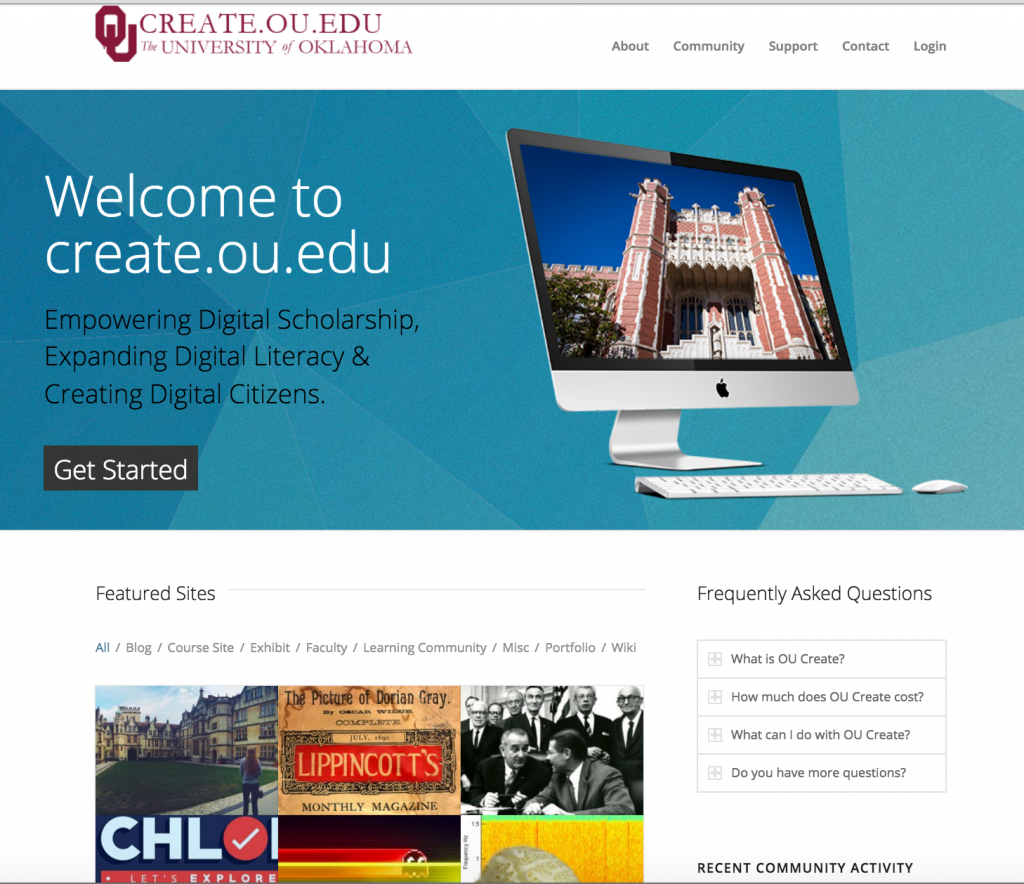
Much like The Flaming Lips, Mark Morvant and Adam Croom from University of Oklahoma immediately dug into the idea of domains, and quickly built a scene around this project at Oklahoma. The work they have done with their domains project, OU Create, is as lush and multi-layered as the Flaming Lips sounds. After a year of piloting their project, it has become something their IT department is not only supporting, but providing to anyone interested in lieu of the tilde spaces, which are soon-to-be retired. Within a year
University of Oklahoma’s OU Create
Possibly my favorite chapter in Micahel Azerrad’s Our Band Could be Your Life was the final one on the little know Olympia, Washington band Beat Happening. The chapter outlines how by the end of the 1980s and early 90s the idea of the independent music scene in the US had come a long way from Black Flag. Rather than a muscle-bound maniacs barking lyrics and insults at the crowd, you had a coy, 50s throwback group of lo-fi musicians focusing on teenage love. As Azerrad notes, “Beat Happening were a major force in widening the idea of a punk rocker from a mohawked guy in a motorcycle jacket to a nerdy girl in a cardigan sweater.” What’s more, Calvin Johnson, Heather Lewis, and Brent Lunsford, were the force behind the scene. Johnson started the label K Records which would be the inspiration for so many of the bands that would come out of Olympia, and the Northwest more generally: Bratmobile, Bikini Kill, Sleater-Kinney, Seaweed, Unwound, and Nirvana.
And that’s just the tip of the iceberg. Cal State University, Channel Islands was the third school to follow suit, and I’ve already written about their questioning of the conformity curve, and they brought a unique dimension to domains early on: A Subdomain of One’s Own. The idea that a student or university doesn’t have to pay for a domain just yet to play with the affordances of web hosting. it makes the whole thing that much cheaper for an institution to do without the domain. While certain elements get lost with a subdomain, students and faculty still have the option to buy and map their own if they would like. This was a big moment for our ability to provide domains infrastructure to schools at prices so low they almost couldn’t say no 🙂
But this is all the beginning, the last year we have witnessed so real momentum in regards to various schools running their own domains initiative. Charles Sturt University in Australia was our very first international school, and thanks to the great Tim Klapdor, we were able to run it on Australian based servers through AWS, which was a first for us. What’s more, the platform is the playground for thinking about what could be possible at Charles Sturt University more broadly for the future. Blue sky meets R&D.
Charles Sturt University’s uImagine
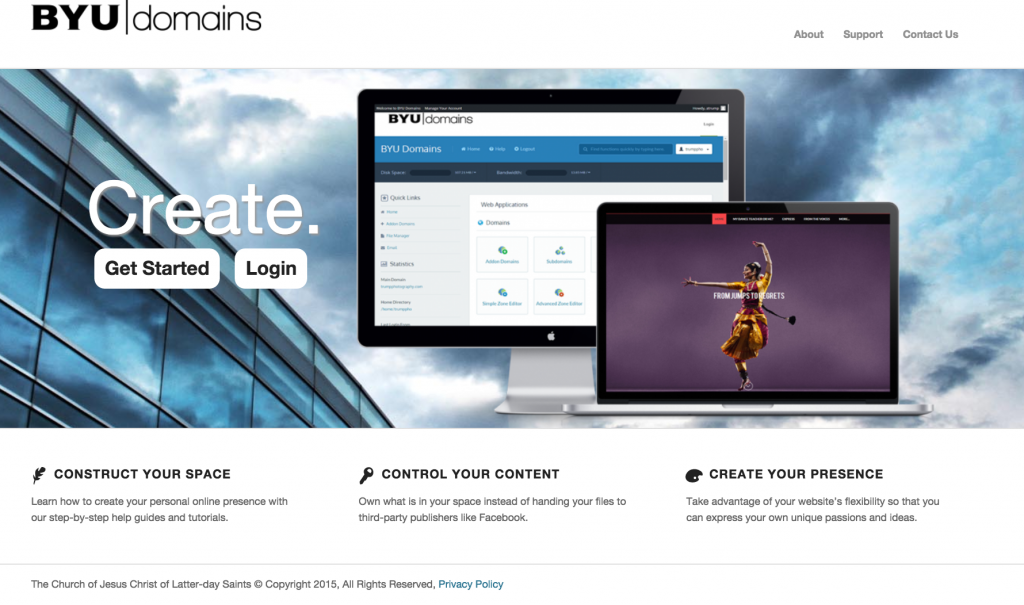
The work BYU has been doing with their domain project is truly cutting edge. They are working with Reclaim Hosting and Ben and Erin of Known fame to create personal APIs for their entire community. It may be the most ambitious project we have seen yet, and the thinking of folks like Kelly Flanagan, Phil Windley, and Troy Martin is IT punk through and through! We are close to showing off how Reclaim and Known will be the piece that feeds the personal API, and also starts connecting the broader API plumbing BYU has architecting on their campus for well over a year. This is crazy exciting work, and a whole new genre where indie edtech meets indie web apps and APIs!
BYU Domains
And after all of this the Indie Edtech scene is just getting started. What are you doing about it on your campus? I have much, much more to write and many other campuses to feature, but this post has been two weeks in the making already, and represents a look at everything I wanted to say at dLRN15 and Whittier, but wasn’t yet fully baked. So take this as a more focused attempt at trying to frame what I think is a broader movement afoot in edtech. The underground innovation that I firmly believe will prove to be the ideas and architecture that influences and frames the shape of teaching and learning ecosystems in the not so distant future.
is an ongoing conversation about media of all kinds ...
Testimonials:
Generations from now, they won't call it the Internet anymore. They'll just say, "I logged on to the Jim Groom this morning.
-Joe McMahon
Everything Jim Groom touches is gold. He's like King Midas, but with the Internet.
-Serena Epstein
My understanding is that an essential requirement of the internet is to do whatever Jim Groom asks of you while you're online.
-James D. Calder
@jimgroom is the Billy Martin of edtech.
-Luke Waltzer
My 3yr old son is VERY intrigued by @jimgroom's avatar. "Is he a superhero?" "Well, yes, son, to many he is."
-Clint Lalonde
Jim Groom is a fiery man.
-Antonella Dalla Torre
“Reverend” Jim “The Bava” Groom, alias “Snake Pliskin” is a charlatan and a fraud, a self-confessed “used car salesman” clawing his way into the glamour of the education technology keynote circuit via the efforts of his oppressed minions at the University of Mary Washington’s DTLT and beyond. The monster behind educational time-sink ds106 and still recovering from his bid for hipster stardom with “Edupunk”, Jim spends his days using his dwindling credibility to sell cheap webhosting to gullible undergraduates and getting banned from YouTube for gross piracy.


 I’ve benefited tremendously over the years from the tutelage and modeling of friends and colleagues like Zach, Tim Owens,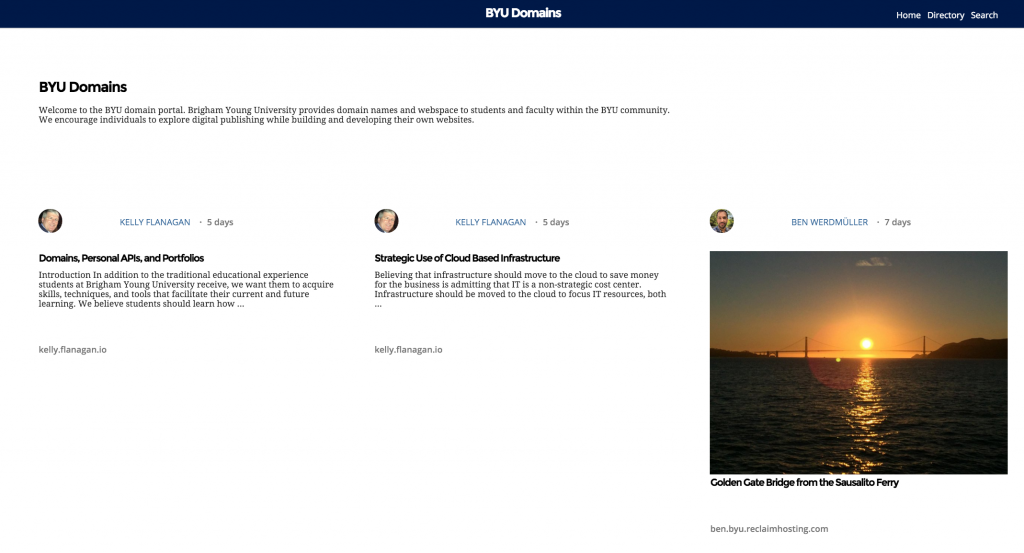

 When I was in L.A. a couple of weeks ago I took advantage of a couple of awesome book and comic shops (in particular