The Next Evolution of Reclaim

6a00d8341c630a53ef015391422b9f970b

Yesterday Tim Owens announced that he’ll be going full time with Reclaim Hosting in the new year, and that is pretty awesome. His post delineates all the amazing work he’s accomplished at UMW over the past three years—it’s a truly impressive resume. And if you worked with him you’d realize that he moves fast and furious —and it seems to me that Reclaim Hosting is the next evolution of his work. What he’s doing currently with virtualized, container-based server environments is a likely future for how university IT will start re-imagining their infrastructure—and he’s digging in to make the new web affordable and accessible to as many faculty and students as possible.

tumblr_le9ae6klus1qe0eclo1_r5_500

As I blogged about yesterday, the technologies on the fringes of conceptual understanding for a majority of faculty and students may very well be the not too distant future of the web more generally. I got my first glimpse of this back in January of 2013 thanks to Brian Lamb’s “Squamous Mind,” which pointed me to Boris Mann’s discussion of the “New Hack Stack.”  He argues the shared LAMP stack is laborious and outdated, noting the new hosting stack will be amenable to new ways of versioning/collaborating (a la GitHub), will support the prevalence of Rails and Node applications, and provide server environments for self-contained apps. It’s a post that made very little sense to me when I first read it almost two years ago. In fact, I was immediately put off by it given we were piloting giving everyone at UMW their own domain and LAMP web hosting. But long after I first read the post it stayed with me. In fact, just about everything of interest to me since (Node apps like Ghost, Ruby apps like Jeykll, versioning platforms like GitHub, and container-based virtualized server platforms like Docker) was right there in that post. I don’t claim to understand it all just yet, but I do see it as the next evolution of what’s possible when it comes to building cheaper, more flexible and ultimately accessible infrastructure in higher ed. And Tim Owens is going full time with Reclaim Hosting to try and build out some version of what that might look like. And I have no doubt he’ll do it. Hell, if all goes well, I might even join him at some point 🙂

tumblr_loa8s68rcy1qe0eclo1_r1_500

Posted in reclaim | Tagged , , , | 11 Comments

Reclaim and the Translation of EdTech


Jim Groom on Reclaim and the translation of edtech from UCalgary Taylor Institute on Vimeo.

D’Arcy Norman posted this one video that parts of a larger documentary project he started while at UMW for the Reclaim Your Domain Hackathon. I don’t get to see D’Arcy nearly enough, and unfortunately I was running around like the proverbial chicken all weekend trying to organize the hackathon which meant any focused time together was limited. I consider D’Arcy one of my oldest and dearest “edtech” friends, and sitting down with him for 15 minutes allowed me to try and articulate what’s important about the Reclaim movement for me.

This is my fourth Reclaim Your Domain event, the others being the MIT Hackathon March 2013, Atlanta Domain Incubator April 2014, and LA Reclaim Hackathon July 2014. These events have been by far the best professional development I’ve had over the last two years, and much of that is owed to the vision Audrey Watters and Kin Lane turned me onto near on two years ago. I’ve effectively been spending my copious spare time trying to wrap my head around things like Amazon Web Services, GitHub, and APIs. And as I suggest in the video, these are the platforms and technologies I’ve trying to understand so I can translate how they reflect some of the more seismic shifts in how the web works over the last few years. Kin and Audrey are a brilliant one-two punch in this regard, framing the technical, social, political, economic and more. Add to all this the IndieWeb movement, and Reclaim really feels vibrant and full of possibility. So, I want to thank D’Arcy, Andy Rush, David Kernohan, and Grant Potter for taking the time last weekend to try and capture some of it. Big Fan!

Posted in reclaim | Tagged , , , , | 1 Comment

Paleoconnectivism: The Long History of Edtech

bits_and_bytes_1One of the three presentations I was part of at Open Ed this year was “Towards a Paleoconnectivist Reader” with David Kernohan, unfortunately our third co-presenter Brian Lamb couldn’t make the conference—and we missed him dearly. I’m sure David will have a far more insightful and comprehensive post about the presentation, so let me share a few of the videos I used to frame my idea of Paleoconnectivism, which, in short, is that everything new, shiny, and revolutionary when it comes to educational technology has a much longer history. The trends that get promoted as “disruptive” for this field are often packaged as ahistorical concepts, despite the fact they have a long, rich history that you can unearth which just some surface digging. For me, Paleconnectivism is a response to a cultural trend that divorces the current developments in educational technology more broadly from their deeply political, economic, and historical conditions of their existence. This work is probably best demonstrated in recent months by folks like Audrey Watters, Mike Caulfield, and David Kernohan—although there are many, many more.
The one warning I would venture here is that, as David Kernohan suggested during this presentation, if such a theoretical and political approach to the field is undertaken, much of the marginal and liminal possibilities of the work happening in the field becomes part of the academic enclosure. I’m not totally certain whether or not this is a good thing. Which makes the push for publishing books as just this kind of artefact something I’m left to wonder about. Books often seem to be more about having written them, than anything else. And one of the things I loved about this blog is the liberation from that institutional logic of credit, credential, and the fetishization of the book as authority—not to mention the continued privileging of text in higher ed—where’s the diversity?

Anyway, here are my videos, which are all taken from episode twelve of the 1983 Canadian kids show Bits and Bytes.*

Videodiscs: Personalized Learning and the Flipped Classroom as understood the cutting edge digital video technology of 1983.

Telidon: Another example of Paleconnectivism is this videotext/teletext system that provides two-way communication and interactive instruction. A sense of a proto-web that isn’t centralized in a single database. What’s striking is the vocabulary and conceptual space is already there, the technologies often inhabit that vision post-facto.

Browsing: In possibly the most eloquent framing of the bunch, Adele Goldberg describes the vision behind windows and browsing in Smalltalk-80. Interestingly enough, Goldberg’s Wikipedia page tracks the history of this vision of browsing embedded within a corporate context of products.

According to Goldberg, Steve Jobs demanded a demonstration of the Smalltalk System, which she refused to give him. Her superiors eventually ordered her to, at which point she complied, satisfied that the decision to “give away the kitchen sink” to Jobs and his team was then their responsibility.[4] Apple eventually used many of the ideas in the Alto and their implementations as the basis for their Macintosh desktop.

Goldberg also has an amazing bit about why people are afraid of the machine because it’s far too precise and exact. The idea that windows and browsing helps our culture turn the corner when it comes to user-friendly computing.

Finally, I am including the unedited 4 minute montage at the end of this episode that reads like a litany of issues that are unique to our moment, but of course they aren’t. Back in 1983 they were facing almost identical cultural, social, and political challenges we are today in edtech. It drives home the point that 30 years later the basic questions and approaches are anything but new, we are part of a much longer narrative about technologies impact on our culture more broadly.


* I chose this show because it coincided brilliantly with the 1984 book David unearthed which was edited by Tony Bates titled The Role of Technology in Distance Education. Hell, the long history of Tony Bates in edtech is yet another topic of inquiry for Paleconnectivism.

Posted in Instructional Technology, Paleconnectivism | Tagged , , , , , | 3 Comments

Wire106: Weeks 13 and14 – Re-ups & Mix-mas

B2rUy2vIIAAdayF

Imran Ahmed Rules!

Wire Episodes
Season 4, episodes 5, 6 & 7 (week 13)
Season 4, episodes 8, 9 & 10 (week 14)

Video Discussions
Week 13
Season 4, Episode 5: Wednesday, 2:00 PM
Season 4, Episode 6: Thursday, 7:45 PM
Season 4, Episode 7: Friday, 10:30 AM

Week 14 TBD

Sign-up for video discussion here.

Assignments

For the next two weeks we will be focusing on Mashups & Remixes as well as the final project.

Mashups and Remixes
Mashups – 8 stars (make at least one of your mashup assignment The Wire related)

1 Remix – See Remixing a ds106 Assignment on http://ds106.us/open-course/unit-11-remix-mashup/ for directions on the Remix Generator, or choose any assignment and use the Remix It button.

From the ds106 open course:
For this unit you’ll be exploring the culminating ideas of ds106, remixes and mashups, the recasting of existing media into new forms by creative combination and editing. This will build off of your previous work in all media forms. And we will even remix our own assignments.

Some will split hairs over the differences/definitions of remix and mashup. Let’s try to say that remix is usually a creative edit of one form of media, such as the recut movie trailer below or the musical remixes of Girl Talk; mashups refer to the mixing of media/content of from disparate places. Both involve the creative act of making something new from previous works. We ask you to try and sort it out and tell us if the difference really matters.

Mashups and remixes come in many forms and there are a bunch of ways to approach them, some of the best examples are from students of ds106 past. Below are some excellent video mashups and remixes from the Fall 2010 ds106 internauts. Get inspired!

Some mashup examples from last semester’s ds106 course:

Lindsay Walker’s “Louis & Marie Meet B.I.G.”

Kevin Cherniawski’s “The Expendable Rangers- Recut”

Morrgan’s “Shutter Island and Harry Potter 4/5”

Garrett Bush’s Andrew Disney/Walt Ryan Mash-up

The Car: a ds106 mashedup production

The Car Mashup from Jim Groom on Vimeo.

Final Project
To keep you moving on you final projects, do 6 stars worth of assignments from any media category from the P.O.V. of your Wire character. In other words, if your character is Major Rawls, you would create a design assignment, audio assignments, visual assignment, etc. from his perspective—as if he were doing the assignment. What’s more, you share out these various assignments across the social media platforms you have created for them—and link to them on your own blog so we can find them.

In other words, walk a mile in your characters shoes.

Daily Creates  -2 per week

All of this is due Monday, December 1st, at 11:59 PM.  Good luck!

Posted in digital storytelling | Tagged , | Leave a comment

Wire 106: S04E04 – “Refugees”

In this Wire 106 video discussion, Paul Bond and I were joined by Brittany Scites to look at season 4, episode 4 of the The Wire“Refugees.”  Brittany came very prepared with four clips she wanted to talk about, all of which are included below. Paul also came ready with some great clips and shots. Me, not so much.

I’ve been really enjoying the small, focused discussions with students about the various episodes over the course of the semester. The video discussions have made the class at once online and expansive—something ds106 is very good at, as well as focused and personable—something at the heart of UMW’s mission. This semester has been a cool experiment along those lines, I just hope to do it again soon without Google Hangouts.

What’s more, with this being video discussions number 42, that means between watching the episode and discussing it Paul and I have already invested 84 hours alone. And that the tip of the iceberg. #loveonanadjunctswages

Video Clips

The mayor calls a poker game to reinforce his political war chest.

Bunk and Freamon in a bar. Bunk misses Jimmy; Freamon misses the bodies.

Bunny Colvin tours the school. As Paul noted, might as well have been a tour of Hamsterdam.

Cutty getting schooled on school.


Posted in digital storytelling | Tagged , , , | 1 Comment

Wire 106: S04E03 – “Home Rooms”

In this Wire 106 video discussion, Paul Bond and I were joined by Nick Randall to look at season 4, episode 3 of the The Wire“Home Rooms.”  This is yet another opening sequence for the ages—there are so many amazing beginnings in this series. Numerous opening sequences could be masterpieces in and of themselves. This one finds Omar heading to the local bodega to get cereal without a gun and in his pajamas. What’s more, this scene is so memorable that it was recently sweded by wire106 internauts Brittany Scites and Samantha Reutter:

http://www.youtube.com/watch?v=Db6zAgZiSxM

The discussion was pretty far-ranging, and we covered a lot of ground. We focused pretty intently on the state of public education in the US, and a sense of the dispossession and disinvestment that’s being underscored this season. We also cover McNulty’s domestic bliss, the struggling co-op, Dukie as outlier, and just how far removed from reality higher education is envisioned.

One of the real gems of this discussion was something Paul Bond shared at the very end. Bunny Colvin is trying to convince the academic researcher to focus his study on 13-14, rather than 18-19, year olds given the older kids are too far gone already. To make his point, Colvin interviews an older kids which turns out to be an insanely tense and uncomfortable scene to watch given how insanely aggressive and hostile the kid is. Here is the original:

And now look at that same clip with a laugh track from Married with Children:

Crazy how much sound dictates your reactions and emotions. Audio is some powerful shit, not to be played around with lightly 😉 Below are a couple of screenshots we discussed, and that’s just the beginning!

Posted in digital storytelling | Tagged , , , | 1 Comment

Wire 106: S04E02 – “Soft Eyes”

In this Wire 106 video discussion, Paul Bond and I were joined by Syd Bauman and Travis Peed to look at season 4, episode 2 of the The Wire“Soft Eyes.” The episode title references a discussion when the teachers are giving Prez advice, and one of them cryptically notes, “You need soft eyes.” This saying is explained more fully two episodes later by Bunk. I shared a bunch of shorter clips from this episode, as well as a few screenshots. I’ll include them below with a bit of context, watch the discussion if you want it all!

I loved the scene featuring Prez preparing his classroom. The colors are great, and as Paul pointed out the chess board is on the bulletin board. The game is still in play. I also like his diligent chipping of gum away from the bottom of the desks. He best not miss the forest for the trees.


Weebay is Namond’s dad?! How crazy is this. Weebay a dad giving his son advice about cutting his hair so cops can’t recognize him? If Weebay wasn’t a complex enough character, frame him as doting father beyond the fish.

This quick shot captures the absent, crushed expression of Lex’s mom as Bunk interviews her about her son’s whereabouts given he’s wanted for murder.

Bunk then describes that very look on Lex’s mom’s face to his colleagues. His ability to capture that expression in such a way you recognize what was bothering you about it is pretty powerful. Writing matters.

In a similar vein, the cast of characters is so established in this series that you can have Daniels doing Freamon impressions, and once again it hits home. Also, is Daniels laughing and smiling?!

Marlo challenges Michael for not taking his money. Damned if you do, damned if you don’t.

The first of many drawnout “Shiiiiiiiiiiiiiiits” by senator Davis.

Below are a few screenshots I grabbed as well.

Posted in digital storytelling | Tagged , , , | 1 Comment

Wire 106: S04E01 – Boys of Summer

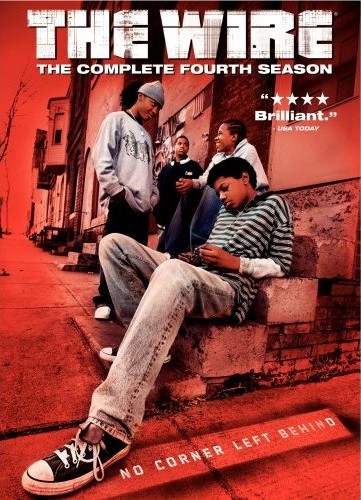
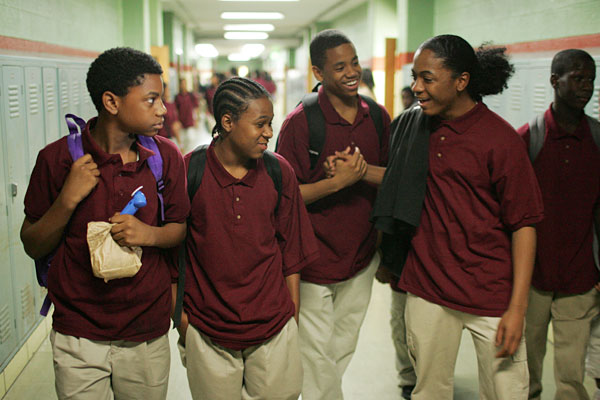
thewireseason4In this Wire 106 video discussion, Paul Bond and I to look at season 4, episode 1 of the The Wire“Boys of Summer.” This episode introduces the season about education, or as is noted on the DVD set: “No Corner Left Behind.” We get introduced to four of the most memorable characters in this episode: Randy Wagstaff, Duquan “Dukie” Weems, Namon Brice, and Michael Lee. The boys of summer. The idea of innocence lost is at the heart of the season, and one of the themes that comes up in our discussion, and an idea that will be revisited repeatedly over the next 12 episodes.

I was really taken with David Simon’s and Ed Burns’s commentary on the DVD for this episode. Turns out after serving as a police officer in Baltimore for twenty years, Burns worked as a middle school teacher in the city for seven more. His experience working in the school system is the premise for the season and, as Simon notes, this is Burns’s season.

060914_BI_theWireEX

This season also has an amazing opening sequence featuring Snoop getting schooled on the Hilti DX460 powdered-actuated, .27 caliber Lexus of nail guns. And the opening sequence of the first episode is, according to Simon, an allegory for the season at large. Wonder where this is headed:

There is so much to talk about with this episode, and Paul and I spend an hour trying to scratch the surface. Below are some screenshots of a few scenes we discussed during this discussion:

Posted in digital storytelling | Tagged , , , | 2 Comments

Scaling UMW Blogs in the Cloud

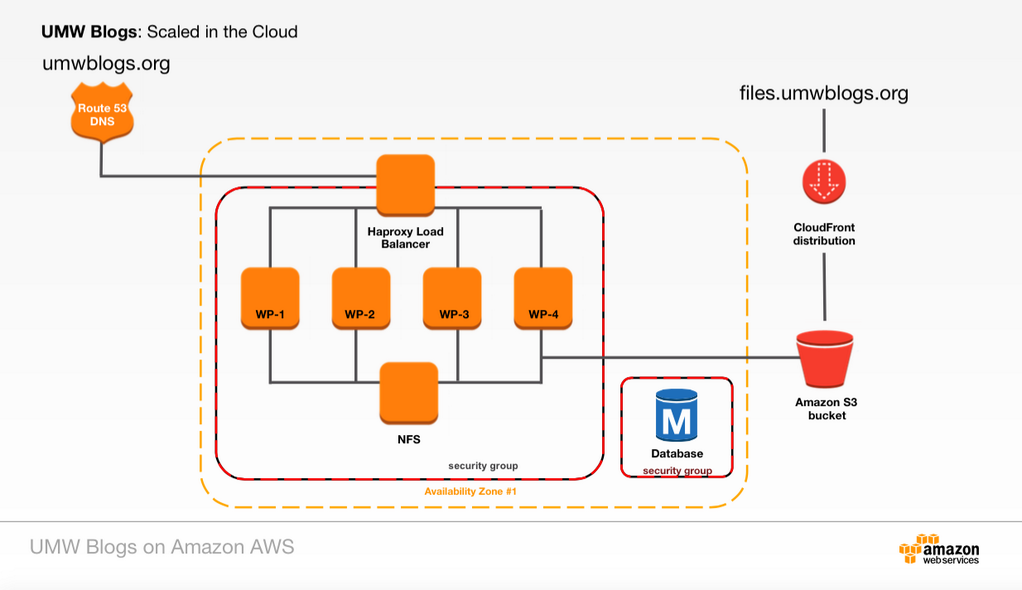
UMW Blogs AWS Diagram

Stolen from Tim Owens

UMW Blogs is in it’s eighth year, which is like 56 years old in web time. And like all us aging technologies, middle age can be a bitch when it comes to performance. But thanks to Tim Owens and the magic of load balancing, the golden years of the very best university publishing platform are proving as active and fulfilling as those heady days of wasted youth.

Above is a diagram of the six EC2 instances Tim setup to make this happen. He installed the open source Haproxy load balancer  on one instance  (the upper most in the above diagram) to route traffic to any one of four servers running the core WordPress files (wp-1 – wp-4 are all cloned and dynamically replicated). This way if one instance has too many sessions open it is automatically directs the next session to one of the other three instances with the least open sessions. The final EC2 instance at the bottom of the diagram, NFS,  is network file storage which has the themes and plugins.

The coolest thing is all of these servers are relatively small, roughly $16-18 a month each, but have made UMW Blogs lightening fast. The database is a huge mass of thousands of tables that’s being pulled from. Tim is thinking through how we replicate that for failover purposes, which may mean moving from a SharDB setup to HyperDB, but I am getting outside my element here.

Finally, all of the uploaded media for UMW Blogs goes to Amazon’s S3 and is served through their content delivery network CloudFront. In effect, all of UMW Blogs is now officially in the cloud, and it could end up cutting our server costs by as much as half. It’s really cool to think an old gold, ragtag project like UMW Blogs is the first homegrown tech project we’ve transitioned to the cloud.

Now let me be clear, at this point there are numerous services at UMW that are in the cloud. In fact, given the pervasive “buy over build” mentality of most IT departments it would be a red flag if that wasn’t the case. But in typical DTLT fashion, we launched UMW Blogs into the cloud through experimenting, tinkering, abusing the definition of “pilot,” and encouraging people to build expertise.

The only reason I can blog about any of this right now is because Tim sat me down and schooled me on what he’s doing, why, and how it works. That’s an environment I want to work in. I want to be in a position where people are showing me things I can only dream of.

There’s More in heaven and earth, Horatio, than you can dream of in your LMS.

Posted in AWS, UMW Blogs | Tagged , | 2 Comments

Wire 106: S03E12 – Mission Accomplished

In this Wire 106 video discussion, Paul Bond and I were joined by Brittany Scites to look at season 3, episode 12 of the The Wire“Mission Accomplished.” This episode pushes home the season-long allegory that parallels the politics behind the War on Drugs with those propelling the War on Terror. This theme had been around since season 1, but season 3 is when The Wire defines twelve episode narrative that follows the arc of the falling towers in episode 1 (in this case the Terrace Towers stand in for the WTC), the emergence of Marlo’s rival gang (the insurgents in Iraq), and Barksdale’s crew going to war on a lie in this final episode (the weapons of mass destruction lie). Now that’s television!
20060627-bush_mission_accomplished

The highlight of this discussion for me was Brittany’s weaving back in some of the audio details Jen Ralston discussed back in week 4.  It’s awesome, take a couple of minutes and watch the clip and her explanation starting at minute 20, you won’t be disappointed. Im including the clip below as well so you can get the full effect in the event the Google Hangout version is as poor quality as I imagine.

The following images were various scenes we discussed, included the aftermath of Stringer’s demise, the lie we fight on, Stringer’s apartment, Colvin’s right, Mohammed Ali, mixed media, Eunetta Perkins, and the final scene.


Posted in digital storytelling | Tagged , , , | Leave a comment