Wire 106: S03E04 – “Hamsterdam”

In this video discussion of episode 4 of Season 3 of the The Wire, “Hamsterdam,”  Paul and I were joined by Kris Hooks—who always brings her A-game! This episode, as well as a good part of the discussion, focuses on Hamsterdam: Major Colvin’s social experiment to legalize drugs in West Baltimore. One of the themes Kris noted how much is in flux in this episode: the street technology is changing to burners; Stringer’s trying to become a legitimate real estate developer; Cutty’s battling the street demons; Colvin is entertaining an offer from Johns Hopkins, at the same time legalizing drugs. That said, McNulty remains a pain in the ass, and Fruit laments the fact that Herc and Carver are messing with the program.

There’s a lot in motion in season 3, and we might take for granted just how tight it is given we become used to such a high standard from this series—but to keep knocking out episodes of this quality one after another without jumping the shark is phenomenal. We are at the height of The Wire‘s narrative powers, enjoy it.

Below are some screenshots from this episode that we focused on in the video discussion.

Posted in digital storytelling | Tagged , , , | 1 Comment

Wire 106: S03E03 “Dead Soldiers”

In this video discussion of episode 3 of Season 3 of the The Wire, “Dead Soldiers,”  Paul and I were joined by Meredith Fierro, Amy Wallace, and Alison Thoet. The conversation covers a lot of ground, and this episode has a bunch of memorable moments, including the ramping up of the Compstat narrative, the western style shootout between Omar’s gang and the Barksdale crew, Fruit’s crew makes their violent play to defend their territory, and the Irish wake for Jay Cole (in honor of the real life death of the show’s executive producer Robert Colesberry in the off season).

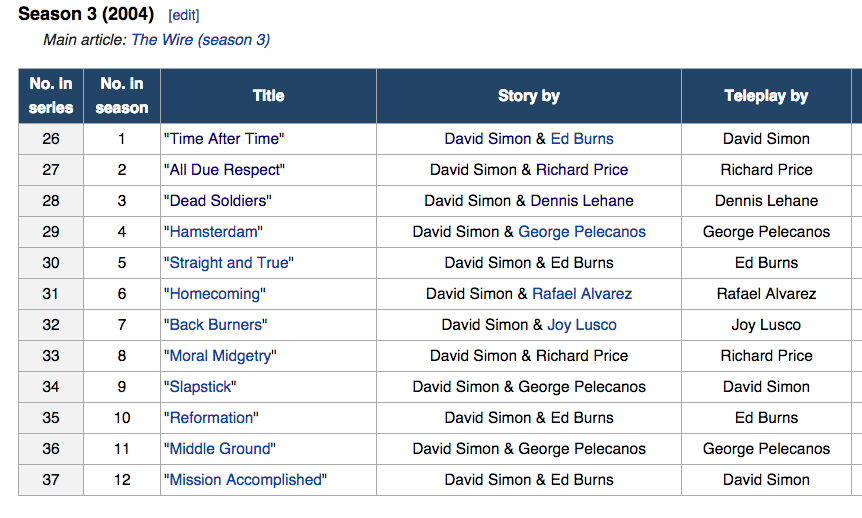
This episode was written by Boston crime fiction writer Dennis Lahane, probably best known for his novel Mystic River. This highlights something I discussed in my post for the last episode, season 3 of The Wire is written by some of the best crime fiction writers in the business. Take a look at the lineup of writers for these twelve episodes:

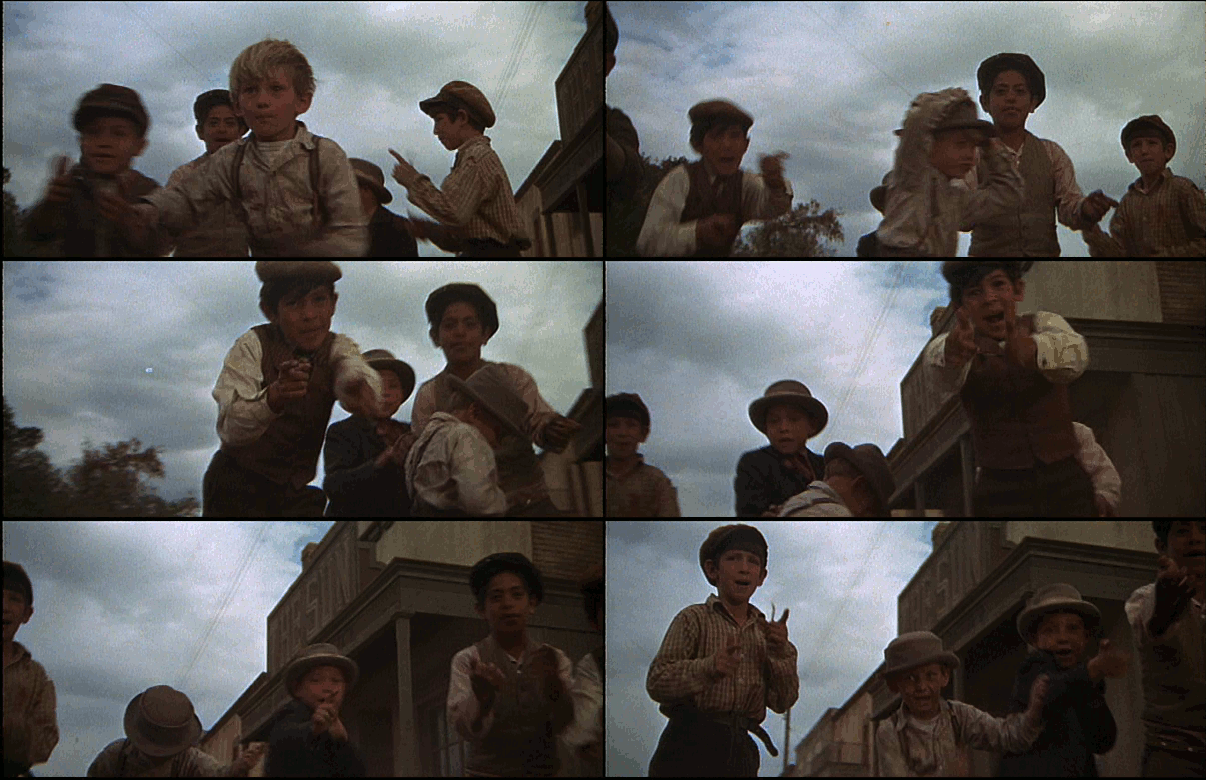
Screen Shot 2014-10-17 at 6.53.14 PM I listened to David Simon’s commentary for this episode, and I really enjoy his commentary when he is doing it solo like this one. One of the moments he talks about, that I bring up in this discussion is the influence of the Western film genre of the series. In particular, he talks about how the shoot-out between Omar’s gang and the Barksdale crew was based on the ambush scene at the beginning of Sam Peckinpah’s The Wild Bunch (1968). This film is a personal favorite, and it was awesome to hear Simon establishing the influence noting that both he and George Pelecanos took a film class on Westerns at the University of Maryland (I love details like that). I also came to understand the broader culture impact of Western movies thanks to a film class at UCLA. One of the deeply haunting moments in The Wild Bunch comes after the opening ambush scene when the children of the town are emulating the preceding carnage. It’s a scene I made a GIF of a few years ago on the bava.

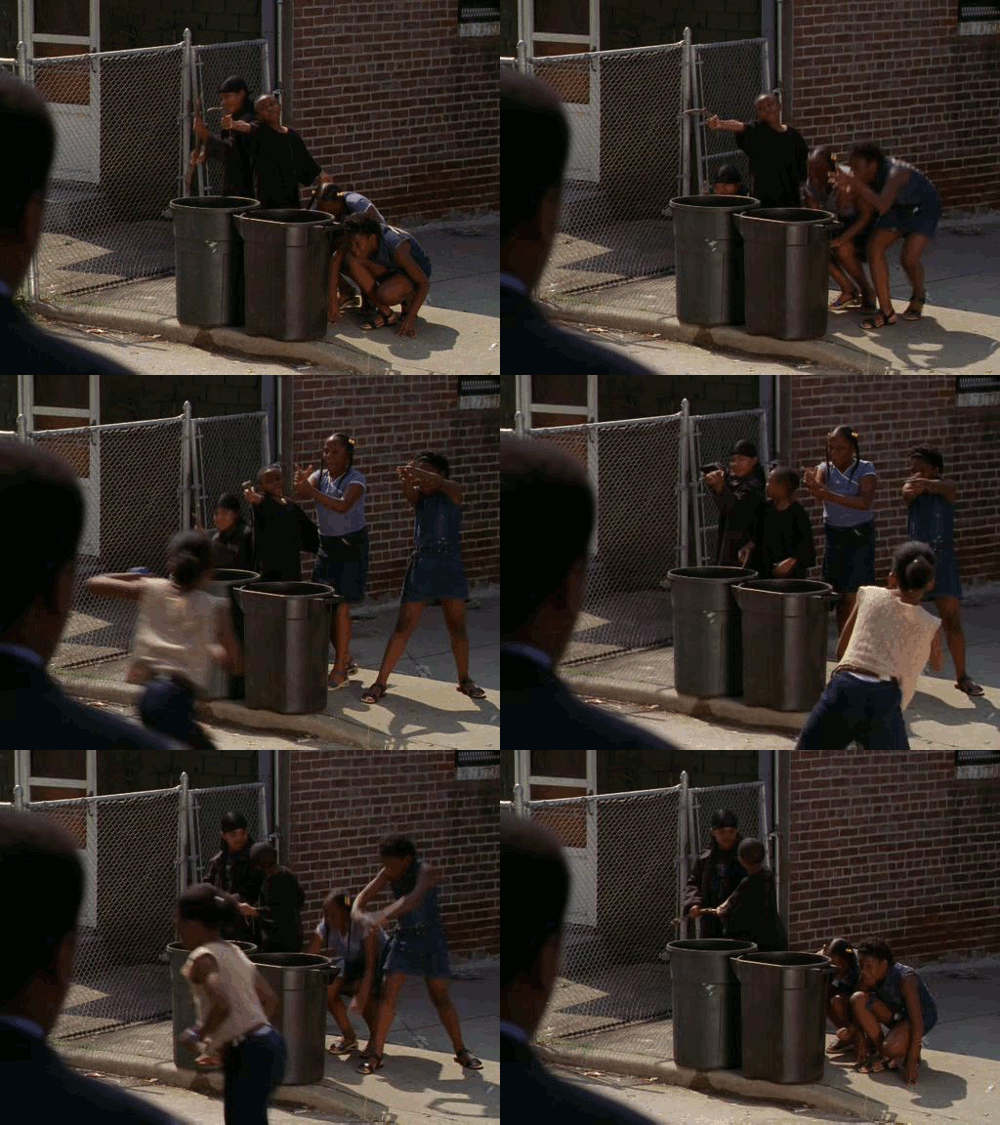
In the aftermath of the shootout scene during this episode of The Wire, you have an almost identical moment with the kids from the neighborhood mimicking the violence, and arguing over whose turn it is to play at being Omar.

omar_kids_s03e03 01

Moments like this make The Wire magical for me, and to hear Simon note the influence Western films have on his series by tracing the lineage of urban crime fiction and films back to the Western is powerful and important. Allusions like this are a series of references that charts the course of a culture, and it’s our job to dig in and explore those relationships and recognize the evolution of themes like violence, class, and power through popular culture. This idea reinforces a lot of the work Paul and I have been doing over the last two years exploring connections between Hardboiled crime fiction, true crime, and now Wire 106 in the classes we’ve taught. It’s as if we’ve been drilling deeper and deeper into these themes that have found their contemporary apotheosis in The Wire. I guess Simon’s commentary and this discussion was really meaningful to me because all these different cultural allusions, critiques, and broader themes are starting to come together in my mind.

Below is a gallery with some of the screenshots and video clips from the discussion.

Posted in digital storytelling, films, movies | Tagged , , , , , , | 1 Comment

Wire 106: S03E02 “All Due Respect”

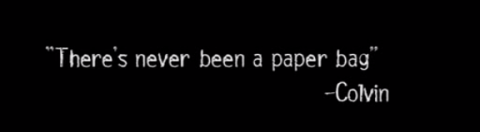
In this video discussion of episode 2 of Season 3 of the The Wire, “All Due Respect,”  Paul and I were joined by Jessica Reingold who provided a clinic in close reading and thoughtful commentary. In my opinion, this is one of the all time great episodes of  The Wire for a number of reasons, but foremost amongst them is the “paper bag for drugs” monologue by Bunny Colvin.

Screen Shot 2014-10-16 at 9.56.18 AM
The episode is written by crime fiction writer Richard Price, and his commentary on this episode is excellent. It provide a look into the challenges of writing as part of a much longer series that has been created by various voices and visions. He notes that he felt like “Helen Keller on a snowboard in the Alps” when writing the back room dealings between politicians. He relied so heavily on the political beat reporter at the Baltimore-Sun he said he felt those scenes were written by someone else. He also noted that he “plagiarized” his own work 1992 novel Clockers for a couple of the scenes in this episode, namely the brilliant moment when Bodie and Poot run into Herc and Carver at the movies when they’re “off the clock.”

If you have the time, check out the DVD commentary on this episode with price, he talks about the brain trust of urban crime writers such as David Simon, George Pelecanos, and Dennis Lahane, amongst others, that came together to help make the writing of The Wire what it is.

Posted in digital storytelling | Tagged , , , | 2 Comments

Starting at the Beginning

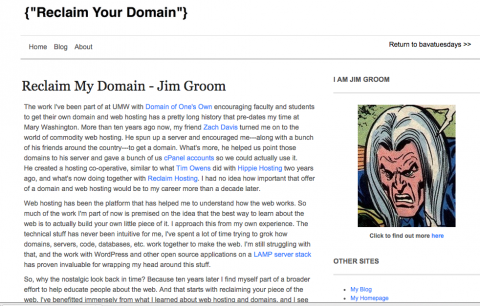
Cross-posted on my Reclaim Your Domain blog.

For over four years I’ve been daydreaming about taking stock of all my digital work out there and starting to organize and archive it. Unfortunately that’s an increasingly bigger and more complex task four years later, and I’m still nowhere closer to starting. That said, this post is an attempt to correct that. I recently got a new computer for work, and that’s always a time when you consider doing just this kind of archiving project. I’ve actually backed up my old computer but moved little to nothing to the new one in hopes that I can start archiving all my files.

But beyond the physical computer comes the broader universe of my online life. My posts, photos, videos, links, bookmarks, etc. I’ve been in a mindset that I need to start getting all of this work organized so that I can have a clearer idea of what I have and what I’ve lost—and I know I’ve lost a lot. That’s not necessarily the end of the world, but I also want to make a strategy for moving forward with my digital work. It’s an exercise in preserving all the work Ive done over the last ten years, as well as an exercise in starting to reclaim parts of my online self that have gotten fragmented, distributed, or otherwise lost.

So, taking Kin Lane’s lead, I’m starting at the beginning. Over the next few weeks I’ll be doing an inventory of every site I’ve ever gotten an account on in an attempt to start collecting my various usernames, passwords, and ultimately data. I’ve already got 1Password setup, so this should be a laborious but extremely useful task.

In addition to this, I’ll also be doing a systematic inventory of broken links and embedded media on my personal blog to start cleaning up the kipple that accumulates from almost 9 years of blogging and more than 2500 posts. I’ll be using this space to update my reclaim process, which in many ways is simply the archival and organizational work we all promise ourselves we are going to do, but never get around to. Today that all changes 🙂

Image credit: Backup designed by Francesco Terzini from the Noun Project

Posted in reclaim | Tagged , , | Leave a comment

Reclaiming Jekyll on GitHub

Jekyll is your page and blog template framework…
—Kin Lane

Screen Shot 2014-10-14 at 10.07.47 PMI actually got my Reclaim Your Domain blog up and running on Jekyll through GitHub. I’ve been experimenting with mapping a domain on GitHub and getting a basic Jekyll site up ad running. So, for my next trick I decided to push myself a bit and fork Kin Lane’s Reclaim Your Domain site and figure out how the code of Jekyll is working so that I can make the template my own.

After a fair amount of trial and error it worked, and I now have my own reclaim your domain site up and running. I outright stole Kin’s template, but turns out he’s giving it away already. I guess you can’t steal what’s being freely shared. Regardless, I’ll only be using it until I’m on my feet again 😉 I even blogged about my Reclaim process, which I’ll be cross-posting here shortly.

So, the Jekyll experiments are moving right along, and I even got another Ghost blog to play with because Tim Owens has set up a virtual server for Reclaim Hosting that we will be using to provide folks with the next level of services beyond the LAMP stack.

All of which brings me back to the epigraph by Kin Lane at the beginning of this post. More and more the distinction between what you write and the framework you publish it through is blurring. To publish on Jekyll I am locally editing a text file and committing the changes  to those files online using GitHub. The page you are writing on is actually your blog engine, it’s kind of old school, and genuinely simple at once, and it provides a sense of your work as more accessible. It’s always already in files rather than pieced together across thousands of tables in an increasingly bloated and fragile database.

Posted in Jekyll | Tagged , , , | Leave a comment

Wire 106: Week 8 – Radio Days

Image credit: Sarah Kountz’s “Sing along with me — DS106 Radio”

This week will be dedicated almost entirely to working on and finishing the radio shows.  To this end…

Blogging Radio Show Progress
Each member of the group will be required to blog about their progress on the radio show before Wednesday, October 15th. This is to clarify what your role has been and what you have contributed thus far. Be specific, discuss what you have done in terms of the conception, planning, audio creation, and editing has been. Also, this is the space where you can highlight any issues or problems. Paul and I don’t want any surprises when in comes to the show—if there are concerns we want to hear them sooner rather than later.

Tag this post “radioblog” (no quotes).

Radio Group Call
Each group needs to set up a meeting with us sometime before Saturday, October 18th, so we can talk on Google Hangouts or Skype about the radio show project as a group. You need to organize a few times your group can make it, no more than three, and we will meet to discuss where you are, listen to some pieces of the show, and generally make sure your groups is working together and on track.

Wire Episodes
Season 3, Episodes 2, 3 & 4.

Video Discussions of Episodes
Wednesday 3:00 PM Episode 2
Thursday 8:00 PM Episode 3
Friday 3:00 PM Episode 4

Sign-up for the video discussions here.

Daily Creates
Just to keep you in the habit, do one daily create this week.

Posted in digital storytelling | Tagged , | 1 Comment

I’m No Doctor of Jekyll

Image credit: onepinkhippo’s “Strange Case of Dr Jekyll and Mr Hyde”

While sick during the week I decided to explore how I could map a domain on GitHub and get up and running with Jekyll, the static-file blog application that runs on GitHub. It took me most of the day, but as I already discussed a bit on the Jekyll blog I set up, it went a long way towards helping me wrap my had around GitHub. I’ve been meaning to do this since spending time with Audrey Watters and Kin Lane over the past two years. They continue to inspire.

It’s a pretty different blogging experience. You write your post as a text file, and the layout looks something like what you’ll find at the bottom of this post. You then commit and synch the locally written post to the GitHub repository through a GitHub client and the post is updated. I actually haven’t written a new post yet, I just edited the existing post template post.

In order to get Jekyll working I had to install RubyGems packager locally, and then I was playing in command line to preview my post locally before committing it. Publishing with Jekyll makes you feel pretty techie, and that can give someone like me much needed confidence. My next projects are as follows:

  • Figure out how to write a full post in Jekyll from scratch and update my About page
  • Fork Kin’s Reclaim Your Domain site (already done) and use that as the template to build my own
  • To that end, get a jimgroom.reclaimyourdomain.org page up and running (can you setup the subdomain Kin ? ; )

Actually, the above three items are probably pretty doable, so I think I’m off to a good start trying to catch up on a lot of the ideas that have been swirling around my head for the last two years. Next up after GitHub is Docker, and I also have to catchup with the great Tim Owens on his experience at IndieWebCamp this weekend. Things are moving, and I love that feeling. I’ll be ready to start preaching again soon, I just need to wrap my head around a few more things.


layout: post
title: “Welcome to Dr. Jekyll and Mr. Bava!”
date: 2014-10-09 23:38:32
categories: testing

Welcome to my first experiment with posting using Jekyll. I’ve been playing with GitHub all day between getting jimgroom.me mapped on GitHub and wrapping my head around Jekyll. I have to say the process has given me a far better sense of how GitHub works, something I’ve be trying to push myself to learn for over a year now.

I wish I could explain what GitHub and Jekyll are exactly, but I have to admit I am still fuzzy. But if you asked me I would say GitHub is a versioning control application that folks figured out can do a whole lot more. Namely, it can run the Ruby application Jekyll which is a simple, static file-based blog application. You install Jekyll locally on your computer, and through the GitHub client can edit, preview locally, and commit edits and the like.

It’s a bit overkill for a blog, but I’m also very new to it all. I imagine there is much more that can be done that I have no concept of.

Here are some useful sites I used in the process of mapping a domain to GitHub and getting Jekyll up and running as the GitHub blog/CMS:

This page takes you through setting up a custom domain with GitHub pages:
[https://help.github.com/articles/setting-up-a-custom-domain-with-github-pages/](https://help.github.com/articles/setting-up-a-custom-domain-with-github-pages/)

This page helped me troubleshoot my custom domain issues when mapping to Github.
[https://help.github.com/articles/my-custom-domain-isn-t-working/](https://help.github.com/articles/my-custom-domain-isn-t-working/)

This blog post helped me actually see the DNS settings I needed to map my domain to GitHub cleanly.
[http://davidensinger.com/2013/03/setting-the-dns-for-github-pages-on-namecheap/](http://davidensinger.com/2013/03/setting-the-dns-for-github-pages-on-namecheap/)

This page helped me get up and running with Jekyll.
[https://help.github.com/articles/using-jekyll-with-pages/](https://help.github.com/articles/using-jekyll-with-pages/)

Stackoverflow helped me find an answer to the permissions issue I was having when trying to install RubyGems (the Ruby packager that installs Jekyll):
[http://stackoverflow.com/questions/14607193/installing-gem-or-updating-rubygems-fails-with-permissions-error](http://stackoverflow.com/questions/14607193/installing-gem-or-updating-rubygems-fails-with-permissions-error)

Jekyll’s quickstart (because I am impatient) helped me get installed and running (although not that quick):
[http://jekyllrb.com/docs/quickstart/](http://jekyllrb.com/docs/quickstart/)

Posted in reclaim, reclaimopen | Tagged , , , | 2 Comments

NYC and the Visual Design of Season 2 of The Wire

I fell behind a bit on last week’s design work for Wire 106, and I know folks are already onto audio assignments and radio shows. But while I was in NYC I took along my camera and decided to do my design blitz based on the aesthetic of The Wire. What’s interesting is that based on the commentary by producer Karen Thorson on Season 2, Episode 12 (as well as the commentary by David Simon on Season 3, episode 1) it became clear that the late Robert Colesberry was hugely influential on the visual aesthetic of The Wire.

What’s also interesting is how much Simon seems to hate NYC. It came out a bit in his commentary for S03E01 when discussing how bummed he was to have missed the opportunity for a Yankee joke when filming at the Orioles game, and he was sure to note  that he hates the Yankees. For many, NYC has become the epitome of the gentrified, wealthy metropolis that cities like Baltimore live in the shadows of.

The Freedom Tower

At the same time, Colesberry came up in the film industry in the mid 1980s and 1990s working on NYC films such as Andy Warhol’s Bad, Martin Scorcese’s King of Comedy and After Hours (a personal favorite), and more recently HBO’s 61* —the story of the NY Yankees’ storied 1961 season. So, Colesberry’s aesthetic was very much grounded in NYC cinema, making for an interesting infusion of the NYC aesthetic in this Baltimore-centric universe. I admit this might be a bit overwrought thesis, but I couldn’t help thinking about it while taking photos of the tip of Manhattan where the two planes struck the Twin Towers and subsequently shaped the development of our national agenda for the last 13 years, which was in many ways the target of The Wire‘s staunch critique of post-9/11 America.

Take a look at the following images, and tell me they don’t invoke the aesthetic of Season 2. Admittedly they are likely to have some similarities given they’re port cities, but the omnipresence of 9/11 in these images is exactly the aesthetic/visual that is becoming apparent to me about The Wire more generally.

Homeland Security at One South Street

This could be just about any cut scene from the Terrace projects to downtown Baltimore from season 1

The Brooklyn Port–the colors and cranes are familiar

Reminds me of Nick and Frank Sobotka having an early morning discussion about thieving at the port

NYC is more beautiful than Baltimore, this must be remembered

Containers, trucks, tug boats. Season 2’s aesthetic captured in NY’s harbor—although this is the Port of NJ

Garbage Barge

This could be the boat Bodie threw his guns onto.

Downtown Manhattan with a couple of alterations

I couldn’t find McNulty on his police boat, but I did catch NY’s Bravest
Posted in design, digital storytelling | Tagged , , , , | Leave a comment

Wire 106: S03E01 “Time After Time”

This week Wire 106 has been a bit hectic between my being away in NYC and then getting sick on my return. Which was further complicated by the fact we are now starting a two week odyssey into radio shows straddled across Fall Break. So, Paul and I decided to do the episode conversations this week by ourselves. This week we assigned Season 3, Episode 1 of The Wire, “Time After Time.” You can find our commentary for Episode 12 of Season 2 here.

David Simon and executive producer Nina Kostroff Noble provide commentary on episode 1 of season 3, and they raise a number of interesting points that we discuss. For example, Simon notes Marlo Stanfield’s drug war with Barksdale’s crew in season 3 parallels the insurgencies going on in Iraq asa result of the 2003 invasion. They also discuss the brilliant opening scene for season 3 which frames the theme of reform that will undergird the entire season. What’s more, it encapsulates a powerful indictment of reform, which is not only apparent in Bodie’s upbraiding of Poot’s constant visits to the clinic for the clap—but the 9/11esque smoke destruction in the streets of Baltimore. The episode’s title refers to a constant repetition of the same broken methods on the personal, local, national, and international scales. Season 3 is gonna be awesome.

Posted in digital storytelling, television, TV | Tagged , , , | 1 Comment

Wire 106: S02E12 “Port in a Storm”

This week Wire 106 has been a bit hectic between my being away in NYC and then getting sick on my return. Which was further complicated by the fact we are now starting a two week odyssey into radio shows straddled across Fall Break. So, Paul and I decided to do the episode conversations this week by ourselves. This week we assigned Season 2, Episode 12 of The Wire, “Port in a Storm,” as well as the DVD commentary on this episode with producer Karen Thorson and editor Thom Zimny. So in this conversation we discuss both the final episode of Season 2 and their commentary.

What’s interesting about their discussion is how it turns out to be a eulogy for the executive producer, actor, and visual director of the series Robert Colesberry. He tragically died shortly after Season 2 ended due to complications during surgery. “Port in a Storm” was his directorial debut, on top of all the other work he did for the series up to that point. Both Thorson and Zimny laud his achievements, which include providing the series with its filmic vision. What I just discovered after quickly researching Thorson is that she was married to Colesberry, making her commentary on this episode that much more intense.

I’ll be sad to see season 2 go, but I still owe myself a post on the technology in Season 2. Wait for it…..

Posted in digital storytelling, TV | Tagged , , , | 2 Comments