
While doing research for resources on Slave housing in the South, I serendipitously came across an interesting project at the National Institute of American History and Democracy. NIAHD is a joint venture between the College of William and Mary and the Colonial Williamsburg Foundation. this program is focused on the examination of American’s past, with a particular concentration on material culture and museums. I mention this program because while doing my search I came across a journal post titled “Honor or Slavery?” by Martha Crockett (a student in the pre-collegiate program offered by NIAHD) that offers an interesting discussion of what she terms “Southern Honor and Slave Housing” using Chippokes Mansion and Bacon’s Castle as examples.
Not only was the journal entry very thoughtful and intelligent, but the frame for technology that the pre-collegiate Summer seminar at NIADH is using piqued my interest. When I initially found Martha’s journal entry I was a bit disorientated as to its relationship to a larger course – but I was soon able to find my way based on a couple of details I will illustrate below.
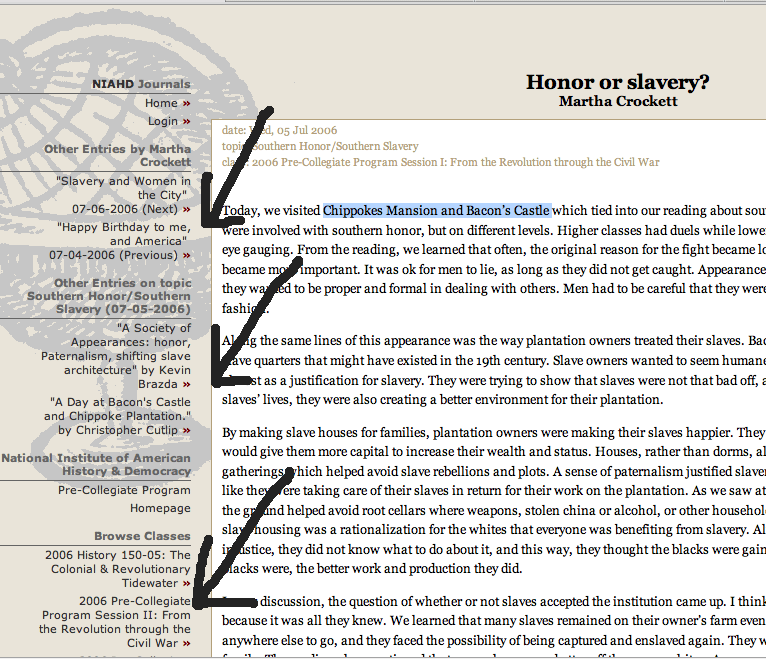
Figure 1: this is a single journal entry, notice the links on the left-hand sidebar
If you follow the link to the journal entry, you will notice that on the left-hand sidebar there are a series of categories that I point to in the illustration above. They are “Other entries by Martha Crockett,” “Other entries on topic,” and “Browse classes.” These three links on the sidebar offered me, as a user, an immediate way to place this journal entry within a larger context of a specific course. This design offers a relatively intuitive framework to help users navigate the online course work quite easily.
Below are images of the site which, when clicked on, will take you to the actual pages within the NIAHD Journals so that you can get a sense of the look and feel:
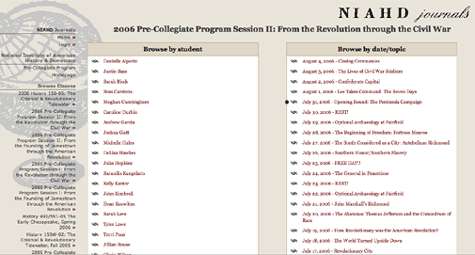
Figure 2: the default class homepage that allows you to browse by student and topic
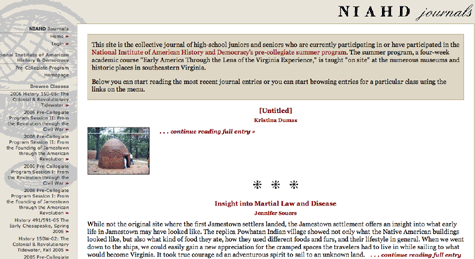
Figure 3: the Journal homepage that features the latest posts
One concern I had with this site was that there was no place for me to leave a comment on Martha’s journal to tell her what an excellent job she was doing, or even to ask her about some particular points she made about Southern honor and slave housing. The interactive element of comments seems like it would offer something important, if not essential, to such a format. Additionally, the students could include images on the right-hand sidebar of their journals, which is a bonus, but I did not see any images included in the space of the journal entries.
I am not sure what program NIAHD used to develop this site, but I am going to have to call them and find out. Looks to me like it is a homegrown php design – many elements of which might be really exciting if we could build them into a wordpress installation that would allow us to track posts easily by student, topic, and course. Very cool.

Pingback: Creating Custom Categories in K2 for WordPress at bavatuesdays
See http://www.resnet.wm.edu/~rknels/?include=niahd
I’m the developer of the NIAHD journals site. Yes, it is “homegrown php,” developed from scratch in 2004.
Thanks for the kind words about the navigation on the site. As I was designing it, I wanted it to allow someone interested in a particular topic to move along a topical axis. (One way the site differs from a conventional blog is that it’s much more structured. Instructors create any number of assignments on particular topics for particular days which the students are responsible to write about. They don’t have the option of posting as often as they want–they can only post for specific assignments.) I also wanted visitors who might find a student’s work interesting to be able to navigate along an authorial axis. Building something like this into WordPress is a great idea. I’ve only glanced at your hack, but am looking forward to trying it out. And perhaps the WordPress Courseware plugin (http://chnm.gmu.edu/tools/labs.php) forthcoming from the Center for History and New Media will have something like this.
Thanks too for the criticism/suggestion about comments. I have this niggling regret about the absences of that, especially when I see someone like you who found something engaging and wanted to start a back and forth. There are a couple reasons commenting functionality is not there. First and foremost, given that this was developed from scratch I had to pick a point where I said good enough–particularly when the time that the classes that were going to use it were about to start. Second, given that most of the contributors to this are high school students (talented, but high school students nonetheless–it’s now used for Jim Whittenburg’s undergraduate courses too) we weren’t anticipating and almost certainly do not have much of an audience beyond the instructors and other students in the course.