I love Vanessa Genneralli, let me get that out of the way up front. Her laugh can sail a thousand ships, and her infectious, joyful energy makes talking to her akin to waterskiing on Skittles. But enough about her, let’s talk about me! 🙂 I was actually interviewed by Vanessa yesterday for a P2PU course she is creating, and we talked about designing for open. This is something I have some experience with as a result of ds106, and explored that craziness for the first eighteen minutes.
At about 18:36 vanessa asked a question about the role of content in an open, online social experience like ds106. What follows was for me the best part of the twenty minute discussion. One of the ideas I was riffing off was David Wiley’s assertion back at the 2007 Open Education 2007 that “content is infrastructure.” Read the linked article because his argument around this claim is solid, and I don’t want to discount that. However, more and more I am finding with my own teaching content is not so much infrastructure as the residue of the learning happening as a result of the course.
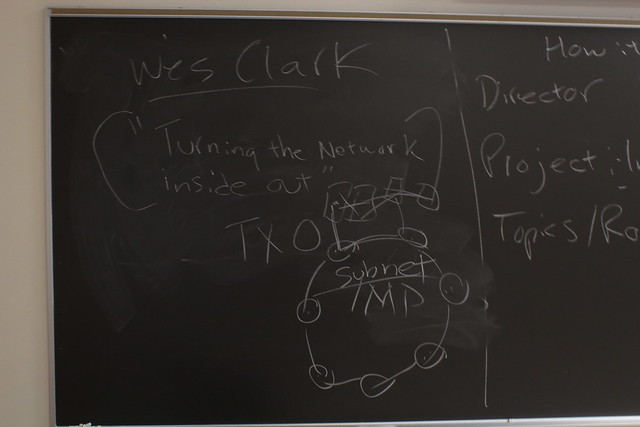
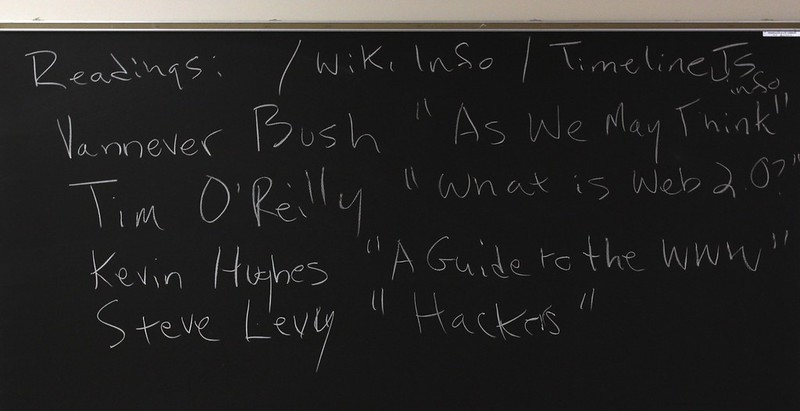
In other words, the Internet Course, and ds106 before it, were not designed around pre-determined content, often packaged as textbooks (so much of the open education movement is still premised on this idea of the authoritative text), but rather on an open educational experience. For example, in ds106 students could choose from a series of assignments, create their own, and navigate a series of resources other shared, etc. But that wasn’t a text in any strict sense, content as a concept was far more elastic and slippery that this hulking, unmoveable metaphor of insfrastrucutre. It was constantly negotiable, remixable, and fluid in its relevance. In the Internet Course there is no pre-exisiting syllabus or readings, rather the students in the course immediately start brainstorming a set of topics and then start researching and reinforcing what was what. Content plays a crucial role, no doubt, but it’s not predetermined or pre-existing in it’s layout like this idea of infrastructure. It’s malleable and part of the larger negotiation of the course. And, I would argue, once that course works through the content, digests it, and comes to terms with it, it becomes a by-product of the learning that happened.
I guess the point I am exploring here is that the infrastructure, when it comes to content for teaching and learning specifically, might better be imagined as a product of the interactive experience of learning than the foundation on which it’s all built upon. It seems counterintuitive, but more and more the oral and narrative forms Wiley discounts undergird a sense of what makes the classroom experience so powerful for learning (more on thsi in my next post). Whether or not all the infrastructure we are creating in the form of open content as textbooks is even being used remains one of the biggest questions of the whole movement, and I wonder if the focus was on experience and relationships as a negotiation of the pre-exiting content as an exploration rather than a deleiverable challenges some of these assumptions around content as infrastructure. I write this, because seven years on I am still struggling with that idea.