
….given my long love affair with the Smurfs.
Christmas greeting 2011 from trent correy on Vimeo.
Video credit to Trent Corey and discovered via the Cartoon Brew blog.
….given my long love affair with the Smurfs.
Christmas greeting 2011 from trent correy on Vimeo.
Video credit to Trent Corey and discovered via the Cartoon Brew blog.
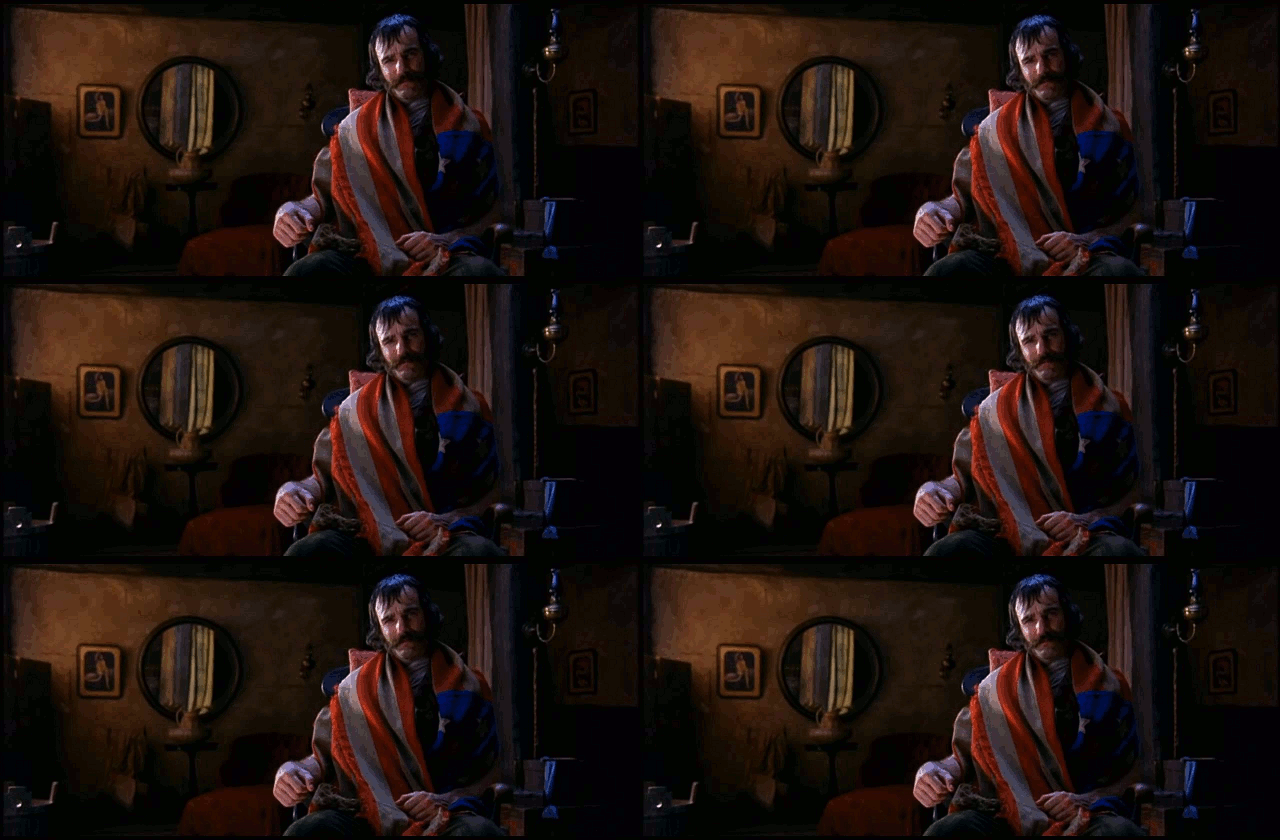
I spent too much time on this not to post it here. I used the beta version of MPEG Streamclip for the Mac which seems to be working beautifully still in terms of allowing you to pull in YouTube videos and select the piece you want and work from there. I got an HD clip from Gangs of New York scene on YouTube and pulled it into MPEG Streamclip from File –> URL. But every time I tried “export to other format”–>”Image Sequence” the images get pixelated whether I export them as PNG or JPG. And you can see the pixelation all too clear in the animation—as I am sure you can see in this one. Not pleased with this one entirely, especially given Bill the Butcher on a rocking chair draped in the American flag is animated GIF gold—I brought my b-game 🙁 That said, the slow moving rocking is kinda hypnotizing once you realize he is animated. Consider it a work in progress. I might have to get my hands on the actual DVD to see if a straight rip is cleaner.
In an otherwise vapid film, Bill the Butcher was one of the most memorable film characters in the last 10 years. Daniel Day Lewis was simply amazing, it gets me excited for him as Abraham Lincoln in Spielberg’s Lincoln.
Given my last post, I couldn’t resist sharing Gavin J. Rothery post featuring a series of photos of the Nostromo crew from Alien (1979). I found this post via the brundlefly blog, an as a sidenote that blog also has another great post about John Ford’s Stagecoach as lens on bankers an the #occupy movement.
Anyway, the photos of the Nostromo crew reinforce how awesome this film is on so many levels, I’ll share a few of my favorite below, but check them all out here.

Who is better than Harry Dean Stanton?
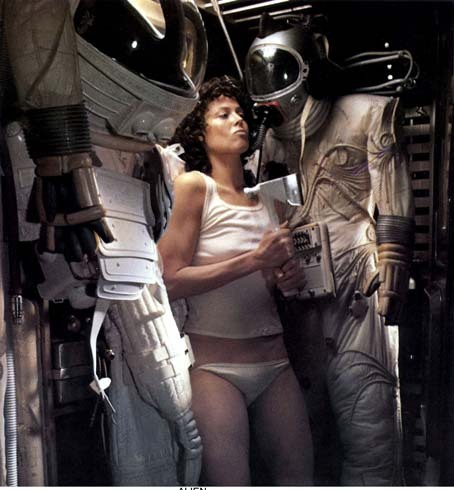
An iconic image from Alien, and one that made plain white underwear sexy to a whole generation.
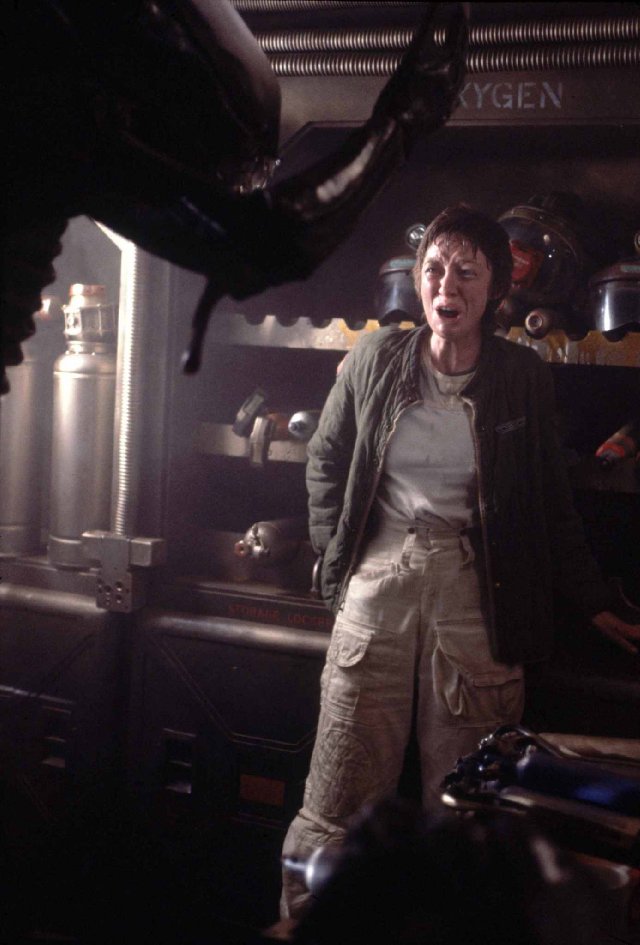
I have had a crush on Veronica Cartwell for decades, and it pains me to see her so upset

The great John Hurt dressed for a medieval joust or space walking?

A rare moment, the Alien at rest. Never realized how human skull-like the face was

Bodaji Badejo played the Alien, doesn't this kinda rank up there with the dude who wore the Darth Vader suit?

One of the assignments I have been dying to do for over a year, but have never been brave enough to try is the I Can Read Movies design assignment. My first attempt at this assignment is rather derivative, I stole the design idea from Spacesick, the orginator of this awesome series. I took the basic design for his Gremlins book cover, and applied it to one of my all-time favorite films Alien (1979).
 So basically I imagined a series of rows of alien incubator pods that end in a fullblown face hugging alien. What’s always been interesting to me is that in the original movie poster the alien pod serves as the dominant image. It is a rather minimalistic poster in its own right, and the fact that the pod in all subsequent sequels is relegated to insignificance, when for me it was one of the most powerful images of the first, and best, film is interesting. I understand the original movie poster didn’t want to give the alien’s form away, a form that would thereafter become iconic. But as much as James Cameron tried in Aliens, the feel and aesthetic of the first half an hour of the first film has never been reproduced convincingly. It’s as masterful as set design has ever gotten.
Anyway, this book cover is certainly not that masterful either but it does pay homage to the pod garden, what’s more it gives the facehugger some love. I also built in at least one easter egg wherein the film’s original tagline “In space, no one can hear you scream” is re-worked for the novel. I also made it a bavabooks production with the same year the film was released. Simple, I know, but this is my first go around with actually trying to do much more than map some text on an image, so gimme a break.
I am gonna do a fullblown tutorial for my work on this, but I have to give a shout-out to MOME, his tutroial on using brushes allowed me to begin adding some texture and making this look a bit more convincing. It was cool to learn a bit more about textures, and I am getting more and more familiar with GIMP, which is nice.
 We’re hard at work on a number of elements with regards to the ds106 site, and this post will take you through some of the upgrades we’ve done, possible new features, and even a wish or two. A lot of people have asked me to blog about the building of ds106 over the last year, but truth be told I’ve done very little of the work. Martha Burtis has been the brains behind the assignment repository, syncing comments, and the theming of ds106. And now Alan Levine is dreaming up some way to make a ds106-inspired version of the now defunct DailyShoot and Tim Owens has been hard at work integrating a new theme to ds106.us so that we can feature more work and create a more communal space that respects the distributed nature of the class but still allows people to find things easily and navigate the space intelligently. My part in all this has been the manual labor that makes certain the aggregation isn’t borking and that everyone’s work is attributed to them properly and pulling in cleanly. This is a process I would love to automate more, but I’ll get to that towards the end of what promises to be a long post.
The Assignment Repository
 Speaking of Martha Burtis, her brilliant “Rube Goldberg experiment” that has come to be known as the ds106 assignment repository has proven to be one of the most innovative elements of the course. The idea that anyone can submit an assignment for anyone else in the class to do has truly revolutionized the idea of assignments in ds106 all told, so much so that we won’t be assigning specific assignments this semester, but rather asking students to do X amount assignments from the repository. I don’t think I would be alone in saying the class has become infinitely richer as a result of this addition.
What’s more, Martha has been hard at work for the last few weeks upgrading the assignment submissions as well as the display and rating systems. This part of the site has been entirely overhauled, so I’m gonna take a moment to explain the new features and a few new ideas we have in this regard (most of the following language is Martha’s, just to be clear).
One thing that ISN’T working right now is the selector that allows people to choose another assignment from the same group. Martha is still working on this, what’s more, we are still working on the styling, all that said, assignments are up and ready to go.
A quick note on the technical side of this, Martha’s previous assignment repository was feeding in from the form submissions off a Google Spreadsheet. This new version of the repository is working in conjunction with the premium plugin Gravity Forms. For more details than that you’ll have to ask Martha, or maybe at some point she will blog the details. It is really a site to behold. I love the assignment submission and repository magic.
The dailyCreate
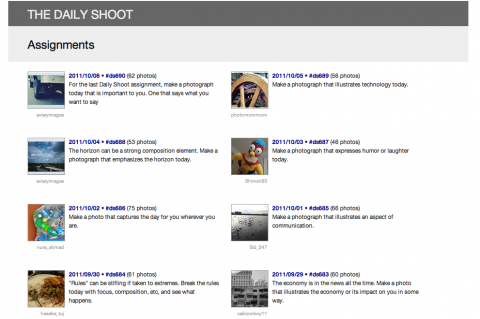 A few months back when the Fall 2011 ds106 course was in full swing the site DailyShoot announced that they were closing shop. This hit the course kinda hard because ds106 has been using the dailyshoot site for a good two to three week chunk of the course since Spring 2010. It was consistently the students’ favorite assignment, and the freedom and regularity of the daily shoots prompts really captured the spirit of the course. So when we heard it was going away we decided to try and make our own, and given there are only a very few of us who have the chops to even imagine something like this, CogDog has taken the lead and I know he has some feelers out to some code geniuses to see if we can get some help on this.
The ability to have something like this up and running as a regular, creative prompt that anyone and everyone can do as part of the class, or even as drive-by exercises, with little or no overhead to sharing it would be the key. What’s more, we don’t want to necessarily limit it to photography—why not audio, video, writing, etc.? Ambitious, but with someone as awesome as Alan Levine as the lead, I have very little question this will happen. In many ways it is very much inline with the digital storytelling programming work he has be doing with Flickr 5 Card and Flickr PetchaKucha, it just steps it all up a notch—which is what ds106 is all about:)
This is still all in the imagining stages, but I have a feeling it will come together quickly, but that might just be me being an eternal optimist. Either way, stay tuned.
New ds106 theme, BuddyPress, and a bit more community
 As you may or may not have noticed ds106.us is sporting a new look. And when Tim Owens floated the idea of changing up the entire site with a theme that hooks into the broader possibilities of BuddyPress, I couldn’t resist. Last December, right about this time, while I was enjoying a holiday in Italy I was dreaming of finally using some of the features available through BuddyPress to build in ways to feature the work being syndicated by so many people, as well as building tributaries of community where people could go to see a particular set of assignments, etc. Well, it never happened, and while we could have rested on the idea that the site has worked so far so let’s stick with it, it would very much be to the detriment of the very idea of ds106 which seems to me all about experimenting wildly and keeping what works.
To that end, Timmmmyboy has been hard at work with the premium theme Salutation to see what we can do. And while using a premium theme for ds106 does kill me a bit, it seems that there are very few good free Buddypress themes. As with plugins like Gravity Forms, more and more with WordPress if you want to do stuff with full blown application plugins like Buddypress that fully hook into its possibilities you either need a hardcore, awesome BP coder like Boone Gorges or a pre-packaged theme that we can hack around the edges of—right now we have the latter, though I believe Martha is ever closer to pushing past the hacker boundary.
I love what I am seeing so far, and for over a year I let the directory, profile, and other minimum BuddyPress features that were built-in go fallow. I didn’t even have those pages themed right, and the whole thing was a lot of duct tape and broken stylesheets. Already the profiles, activity stream, and directories look better, and we might even find a way to thoughtfully integrate Groups. Tim Owens has never let me down yet, and I have no doubt he will bring the ds106 site design to the next level, as he has done with so many things at DTLT already. I mean look at the new header, how sick is that? Much more to say on these developments, but hopefully Tim will talk to it in his own words given he actually knows what he is doing.
Automating the Aggregation Hub: my wish upon a WordPress star
 Another key element of ds106 has been the fact that the syndication of over 250+ sites at any given time has worked pretty seamlessly over the past year. We can syndicate posts from Posterous, Blogger, WordPress, Tumblr, Drupal, and we will soon be testing PivotX. So, in short, we are aggregating from a wide range of platforms, and as Tom Woodward suggests in his awesome “My Take on ds106” post we are rubbing shoulders with the mythical eduglu.
But there are a few problems in paradise, so I want to spell them out here quickly to see if there may not be an easier way. Last year I had people add their blog URLs using the Add Link widget which used to pull feeds directly into FeedWordPress—the plugin that runs all the syndication on ds106. But the latest version of Add Link puts those URLs into the Links area that then have to be categorized as “Contributor” for them to show up in FeedWordPress. This is an extra step or two, what’s more in order to synch a user with a syndicating feed in FeedWordPress they still have to sign up for an account on ds106.us and I still need to be sure the right user is attached to the right blog URL, all of which takes a bit of time as you might imagine.
I have been doing this manually as of now, and given there aren’t that many people I can still manage the work, and even contact people directly and find out how they are doing, what they need, etc. That is the part of this process I actually enjoy, and I think it makes a ton of difference when you actually have someone greeting you when you submit your URL and info to ds106, it makes it immediately personal, which is how it should be. That said, I would love a way to have people submit their blog URL somewhere in their ds106 profile through BuddyPress and have that run through FeedWordPress. This would seem to solve the relationship that I manually create between user and syndicating feed, ideally it would be something each person could mange and update themselves, and I could monitor the process and focus on the welcome and the communication. What’s more, if people select where they are taking ds106, namely at UMW, York College, Temple University, Japan, or as an open online student, we could tag each of those syndicating posts accordingly so that we can filter posts by each institution or open online students.
Simple fact is that there’s so much we could do to make the syndication bus for ds106 so much smoother, but I don’t have the coding expertise. So, all this to say I would love to hear ideas from people who do, or even get an idea of what a solid programmer who knows BuddyPress and WordPress would charge for something like this (hint, hint).
Finally, the other nightmare on this end was the fact that whenever anyone signed up on the ds106 site they weren’t immediately added to the main ds106 blog site. It was a royal pain in the ass to go back and add them to the ds106 main blog site in order to synch them as users with their syndicating feed, that alone took forever. But thanks to the great, awesome, amazing Boone Gorges that is done automatically now. Thanks Boone. Everytime someone registers on the ds106 site they are immediately added as subscribers to the main ds106.us blog so that I can add them as users to their syndicating blog. Boone kindly shared the code, so I will share it again here should anyone need this functionality (I might even make it a separate post as well so others might have a chance of finding it).I added the following code to a bp-custom.php file and added it to the plugins folder and wrapped in a PHP tags.
function bbg_add_user_to_root_blog( $user_id ) {

	add_user_to_blog( bp_get_root_blog_id(), $user_id, 'subscriber' );

}

add_action( 'bp_core_activated_user', 'bbg_add_user_to_root_blog' );
OK, I think that is it for now, but this is a pretty good breakdown of where we are at and where we might be going. I’m sure the only part that won’t come to fruition is the part I am working on….god damn it!!
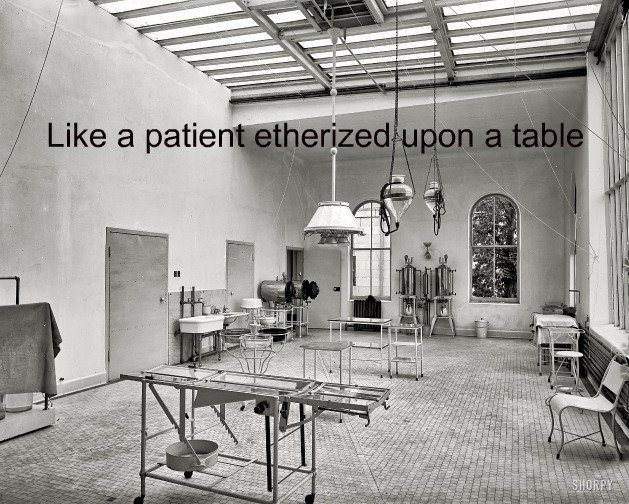
Giving Serena’s “Picturing Prufrock” assignment another go, I decided to hit up the awesome archival image site Shorpy for some shots of old school surgery rooms, and this gem titled “The Cutting Room” from The Brooklyn Navy Yard circa 1900 captures the aesthetic of the line for me to a T.
Process was the same, find image, pull it into picnik and add text. Dead simple.
Update: here is another version taken from an old school illustration I originally found here.

Serena Epstein has a fun new assignment for ds106 that asks you to illustrate an image from T.S. Eliot’s poem “The Lovesong of J. Alfred Prufrock” through the medium of your choice. As soon as I saw the assignment a few images jumped out at me such as “Like a patient etherized upon a table” or “Of restless nights in one-night cheap hotels.” But, I couldn’t get Frank Darabont’s film version of The Mist out of my head (maybe because I just finished Season 1 of The Walking Dead) when thinking about one of the greatest images in that poem that likens the London fog to a cat. So, I took part of that poetic image and tacked it onto this artistic rendering from the film. I love the opportunity to marry a high modernist like Eliot with one of the world’s most popular novelists.
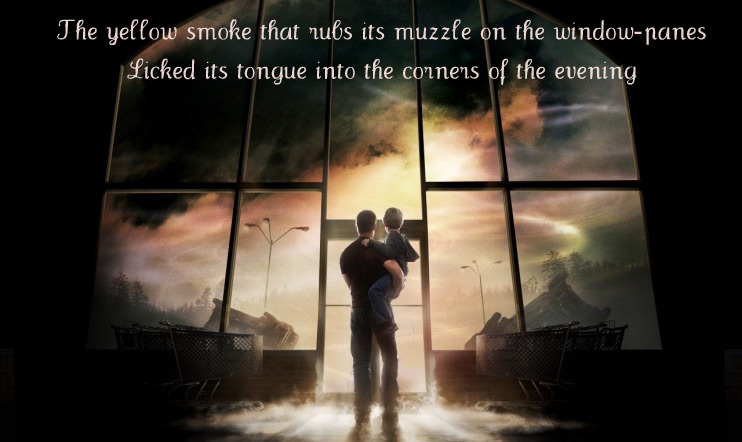
The Mist meets Prufrock
The process on this was dead simple. Found the image I wanted on the net, brought it into Picnik and added the text.
 Image credit: CogDog’s “Open is Welcoming”
That’s right, ds106 is running again in the Spring of 2012. If you have no idea what ds106 is, read more about it here. We’re still ironing out the syllabus for the Spring 2012 run, but you can see the Syllabus from last Spring here, and the course calendar here. One major change for this semester is there will be no predefined assignments, everyone will simply pick the assignments they want to do based on a rating system. I will explain in more detail how the rating system for assignments will work in another post coming soon.
Also, there will be a daily ds106 assignment generator in which students can do an assignment everyday—or whenever they want—and share it with everyone in the course. These assignments will be very low overhead in terms of time, and will hopefully satisfy the drive-by assignment folks while at the same time providing a space to share and comment on each other’s work. More on this element of the class coming soon as well.
The assignments submission form and repository got an overhaul thanks to the great Martha Burtis, and we are stepping that part of the class up a notch with the rated assignments I mentioned earlier, as well as a space for submitting tutorials and viewing and doing assignments. You can have a sneak peak at the new assignments space here, and you can submit assignments here. Keep in mind we still have some styling to do and everything isn’t moved over yet. I’ll be sure to post about that when it is all done, thank you Martha, the best instructional technologist in the world! —even though she hates that label.
I’ll be teaching a section at UMW starting January 17th, as will the great Alan Levine—but I’ll let him elaborate on that some more on his not-as-great-as-the-bava-blog. What’s more, I believe both Michael Branson Smith and Scott Lockman will be teaching this course at York College and Temple University, Japan respectively, as they did while carrying the ds106 torch this semester. Additionally, I’d like to invite anyone else who might be interested in teaching something like this course—or just parts of it—this Spring semester to simply let me know and we’ll be sure to make it happen.
It’s been a year since the first ds106 open course launched, and the Spring 2010 version was pretty amazing, what made it amazing was that anyone can do as much or as little as they wanted as part of the open, online section and leave the rest. We don’t accept apologies and we don;t believe in guilt, there is no sorry in ds106. Simply come prepared to make some art, have some fun, give some feedback, and leave when you want. That’s it, the for-credit students at each of the respective institutions don’t have the same luxury, but that’s why they are both paying and getting credit for this course and you aren’t.
I think the real power of ds106 from what I have seen so far is the amazing community of feedback, encouragement, and network effects that happen as a result of sharing your work within this community. Give what you wanna get, and come ready to have some fun.
If you are interested do two things:
Let’s get it on!
Yesterday was the last day of the Fall semester so I took a quick screenshot of traffic on UMW Blogs in Google Analytics over the last four months, which looks like this:
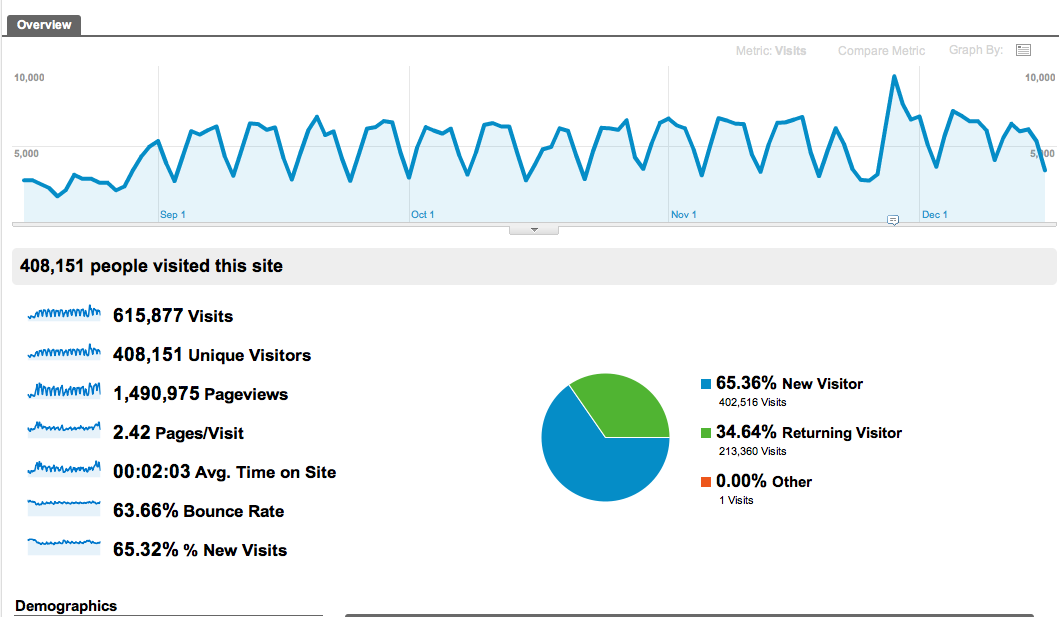
Traffic for Fall 2011 Semester on UMW Blogs
Which made me think, how does this compare to traffic from the Fall semester last year? So I did a quick filtering for traffic from 8/16/10 through 12/16/11 and what was interesting was how consistent the traffic was between the two time periods in terms of frequency throughout the week, over the weekends, etc.

Traffic for Fall 2010 Semester on UMW Blogs
What’s more, we had almost exactly 100,000 more visits and unique visitors this Fall than last–with almost 200,000 more pageviews. All of which seems to suggest traffic is settling in given that from Fall 2009 to Fall 2010 trafic almost doubled across the board in terms of visits, unique visitors, and pageviews.
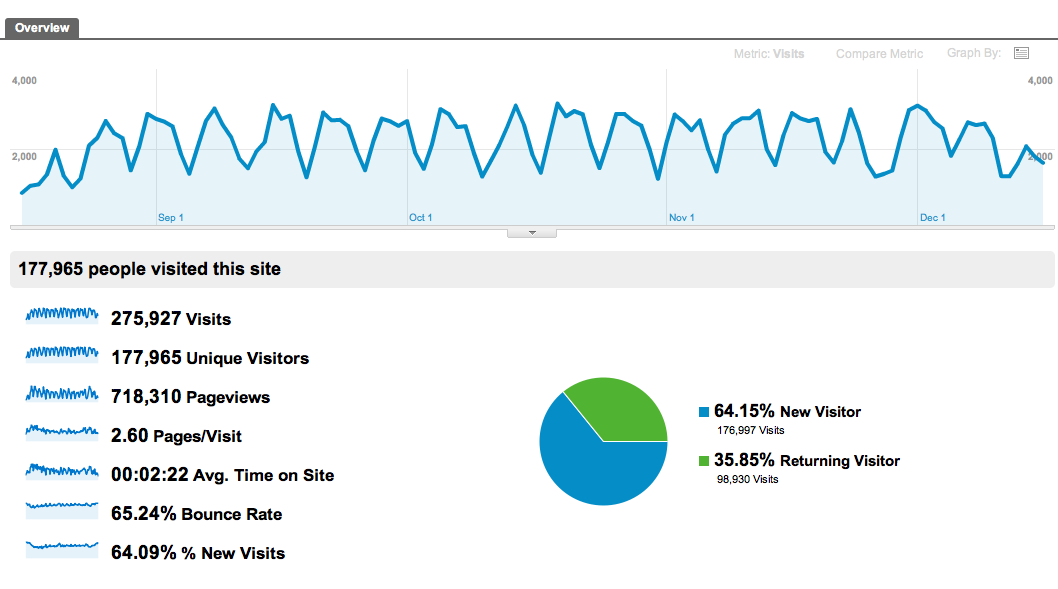
Traffic for Fall 2009 Semester on UMW Blogs
The change in traffic this Fall in comparison to Fall 2010 was a more modest 20% growth in visits, 25% growth in visitors, and a little less than 15% in pageviews. I’m not sure what any of this suggest other than the growth in traffic on UMW Blogs seems to have stabilized a bit over the last year. And I think this has a lot to do with how much UMW Blogs has saturated UMW more generally. I think we would need significantly more students to see significantly more growth at this point. I think we are at a very sustainable moment in terms of hardware, software, and support. What’s more, UMW Blogs has also stabilized considerably given we have had next to no downtime all semester long, which is a first for us and a very proud day indeed.
We’re gonna update to WordPress 3.3 this Wednesday, and I’m pretty confient that will go as smoothly as all the other upgrades on UMW Blogs have been over the last two years. One more thing, we are back on Akismet after trying our hand with TypePad’s Antispam solution for a NY minute. We survived most of the semester with the Cookies or Comments spam solution, which worked surprisingly well, but we were starting to get spam complaints from faculty and students alike so we went back to Akismet. The reason we were resisting Akismet to begin with over the last year was because the quote us a ridiculous $900 a month for the service last December, but that has since come own to about $45 a month for the service ($550 a year) which is both afforable for us and well worth the peace of mind.
Three students in Jeff McClurken’s #infoage course, Ashley Lightburn, Joe Calpin, and Caitlyn Murphy, put together a ten minute documentary about ds106. I am obviously excited by the idea that students think this course is interesting enough to make a documentary about, and what they have put together has some amazing moments. But given this is a history class and the record of ds106 is being reflected in this documentary, I want to add my feedback to the work. You can see the post with both the documentary and the bibliography/notes on Ashley Lightburn’s blog here.
First, Ashley writes that Alan Dean started ds106 and I took over the additional sections of the class, which is not actually the case. The class was dreamed up by Jennifer Pollock-Wahl, and I believe she taught it once as a Summer class in 2009—and possibly again as a class in Fall 2009. After that it was taught by both Alan Dean and myself in the 2009/2010 academic year. I first taught the class in the Spring 2010, and I believe that was either Alan Dean’s first or second time teaching the class.
Also, Alan Dean gets a lot of screentime in regards to what ds106 might mean, but in effect Alan Dean never taught ds106, he taught CPSC 106. His coursework was all handled in BlackBoard and none of it is apparent for anyone else to see, what’s more he did not teach an open course—which is very much at the heart of ds106. So including him in this documentary without making any of this clear makes it seem as if he was part of the evolution of ds106 which is actually not the case at all.
What’s more, before the Spring 2011 semester Martha Burtis and I approached Alan to let him know how we would be teaching ds106 that semester as a means to both let him know our plan as well as to invite him to play along, to which he respectfully declined. In essence, whether or not Alan Dean believes our approach “focuses too much on the technology” misses the larger point that his voice would have been best played as one that didn’t necessarily agree with the whole open course, transmedia exploration approach of storytelling in ds106—which is not to be confused with CPSC 106. Given this I think a narration or some kind of clarification of where Alan Dean fits in the narrative of ds106 is necessary.
What’s more, the very life blood of the course, the open, online part where anyone can play along was only alluded to in this documentary. I understand the limits of time, but I can think of about 2 minutes that could have been edited out to talk about what is probably the most essential element of ds106.
Finally, what exactly is the story of this documentary? What does it say about ds106? It seems like a lot of interesting vignettes, and it certainly works well as a 10 minute trailer but the problem with ds106 is that it is open, online and complex. And research and attention to so many details would need to be paid to it to do it justice. Why not talk to me or Martha or anyone else involved from the beginning to get a clear sense of the class so that some of the obvious points of confusion could have been cleared up easily? Seems to be a little research and question asking up front would have made this a far better representation of the open, online experience that is ds106.
Apart from this, I really did love it 🙂

Find out more about me here.
