Momentum for WP as LMS building

EDUPUNKIN you LMS Image by Tom Woodward
Image credit: bionicteaching’s “Edupunking your CMS”

Maybe it’s just cause I live in a particular bubble on the internet, but over the past six months or a year there has been what seems to me like some serious momentum towards thinking through WordPress (and/or WPMu) as a serious alternative to Learning Management Systems. And posts like this interview with Kyle Jones as well as Joe Ugoretz’s tour-de-force two part series on how he is putting the idea of WordPress as a LMS into action are pretty badass. This is some amazing stuff, and I really think Kyle Jones nails what the appeal of WP as an LMS is for many with this quote from his interview at wpmu.org:

But [offering faculty and students a hands-on approach to designing their learning] is what makes using WordPress MU wonderful as a LMS: We’ve modified and tweaked it at the students’ request, making their learning space what they need it to be – not what some company says it should be.

And, on top of that, Kyle captures the engine that is driving this emerging cooperation amongst and between a distributed group of faculty, students, and technologist all over the world:

We learn from each other, we steal from each other, in the end we try to give back to those who have helped us.

That really sums up what this vision of openness is as we work through our issues, tinker with the tools, think through the implications, and share back what we’ve learned. I might be crazy, but I still have faith that through this kind of process we can take back the means of imagining our own spaces for teaching and learning from the expedients of institutional efficiency, cause it’s exactly the imagination of these spaces that is a necessary and integral part of the teaching and learning process as Joe Ugoretz’s posts make all too clear. I may be biased, but I can;t help but think what we are seeing in the educational community working with WordPress, is just one part of a larger momentum of people using a variety of tools to escape the prison house of learning that is the LMS. And that brings me to a bigger point, I really don’t think we are simply using WordPress to ape the LMS, but rather to re-imagine the ideas that under gird this design: give students ownership of their work, control over the design, and the ability to seamlessly integrate a wide variety of other tools they already use to network online. More than that, the bigger push is to put students in a pace they own and share back what they choose, an expectation that they take ownership of their work and identities online.

Paternity leave is over, and the bava is back!!!

Posted in WordPress, wordpress multi-user, wpmu | Tagged , , , | 7 Comments

Humility

Humility. Humility. Humility. Humility. Humility. Humility. Humility. Humility. Humility. Humility. Humility. Humility. Humility. Humility. Humility. Humility. Humility. Humility. Humility. Humility. Humility. Humility. Humility. Humility. Humility. Humility. Humility. Humility. Humility. Humility. Humility. Humility. Humility. Humility. Humility. Humility. Humility. Humility. Humility. Humility. Humility. Humility. Humility. Humility. Humility. Humility. Humility. Humility. Humility. Humility. Humility. Humility. Humility. Humility. Humility. Humility. Humility. Humility. Humility. Humility. Humility. Humility. Humility. Humility. Humility. Humility. Humility. Humility. Humility. Humility. Humility. Humility. Humility. Humility. Humility. Humility. Humility. Humility. Humility. Humility. Humility. Humility. Humility. Humility. Humility. Humility. Humility. Humility. Humility.

That should do ‘er.

Posted in humility | Tagged | 8 Comments

iProp

Fill in the the gap: iPropaganda, iProprietary, iPropofol, whatever.

Unlike most technologists I’m really not a device guy, I don’t have an iPhone (not because I don’t want one, but I just can’t afford it) and I don’t have three 22″ cinema displays. Why would I? I’m an International Web Worker of the World, I labor for an ideal of openness and sharing. I believe that at its core technology can be used to help us enable people to cooperate and share on a scale never before seen, and I think when this becomes an issue of higher and higher costs, and more and more proprietary lock-in, the further away we are from the power and promise of technology to augment human intellect. And to be honest, I know very little about both the iPhone and even less about the iPad, so this post isn’t really about either of them, though Andy Rush nails the idea of these devices in this post: they are devices geared towards consumption and the design of which make creation that much more difficult. That’s a very interesting statement, when you think about what that means for the web. And Mike Caulfield does an excellent job in this post talking about how the hype around the iPad for Newspapers and Journals might be grafted on education:

I think it’s quite likely the reason that mobile learning is consistently overhyped, despite its obvious defects, is that implicit in the image of a student watching a lecture on his phone in a bus is the idea of higher education as a distributor of content, rather than as a community hub. It’s a way of going forward technically while doubling down on the old paradigm.

I agree with this, and the idea of distribution of content for consumers who have that much less stake in the creation is the old paradigm we are talking about more specifically.

But it’s Brian Lamb’s brief, but evocative, mention of the future threats to open education in this post that have me continually questioning devices like the iPhone and iPad:

I see a number of other trends that strike me as far more threatening to the shared values of self-described open educators (and diverse as the movement is, I do think there are shared values, however broad) than what open really means. Over the next week or so, I intend to write about a few of these threats… Like the profoundly undemocratic process that is working to establish a shockingly awful global copyright scheme… I’ve also been brooding about the diminishment of the qualities that made Web 2.0 so genuinely interesting and innovative (I’m thinking of what Jonathan Zittrain describes as the generative web), endangered by the return of corporate-driven platform-based computing (hello mobile web) and a disturbingly passive and self-absorbed online culture. [My emphasis, which may just as well have been everything]

What we are seeing right now is “the return of the corporate-driven-platform-based computing” that is essentially killing the web, and endangering the open URL. And we all love it or hate it for what seems like all the wrong reasons: the device, not the under girding ideas of openness, freedom, and affordability.

I’ve been following Josh Kim’s blog for a while now, and I like much of what he says on there, but I don’t know what to do with quotes like this from his most recent post:

Nothing about a tool as wonderful as the iPad will lower the cost of constructing or delivering education. We will need to invest in buying iPads, developing apps for iPads, and experimenting with new pedagogies and training around iPads.

Are we really there yet? Have we decided to abdicate our Kingdom to the Gonerils and Regans of the commercial world for these “wonderful” devices we’ve never used? We must be careful to give away the kingdom of innovation too easily and quickly, for nothing comes of nothing, and lest we want to remain in the hovel of corporate-driven-platforms we need to realize and promote the open source solutions that allow us all to imagine the web as a “community hub” (to quote Mike Caulfield) for sharing and creating rather than a subscription to consume.

Posted in Uncategorized | 12 Comments

Los Angeles, Jabberjaw, Unwound

Pretty trippy, I just found the following video of Unwound (the 1990s noise band) playing at LA’s post-punk mecca Jabberjaw. And, I’m pretty sure I was at this show. Must have been 1994 or 1995, and seeing this brings on a wave of nostalgia for one of my favorite city’s in the world: Los Angeles. The World Wide Nostalgia Machine sends me right back to my undergraduate years at UCLA. Amazing times—filled with both a deep despair and a boundless sense of possibility that time continually reels in. Well, who am I to fight nostalgia? I think it might be high time to start digging up Jim Groom’s spotted past, and this particular chapter is what I will be referring to as “the potent years” 🙂

Posted in LA: The Potent Years | Tagged , , , , | 6 Comments

Deleting old MySQL tables across blogs and databases in WPMu

OK, so this will probably be the final installment of my “pimp your WPMu databases” series 🙂 Part one was moving from WPMuDEV’s Multi-DB package to SharDB; part two dealt with optimizing tables across a number of databases in MySQL, and the final installation will share some SQL code, once again thanks to Gowtham, for deleting specific tables across various blogs and databases.

Ok, so here is the setup, when we started UMW Blogs we used the spam filter Spam Karma 2. It was a personal favorite of mine, and while a lot more work than Akismet, it did a pretty good job of shutting out spam. Spam karma 2 has since died, and we moved to Akismet well over a year ago now. However, for at least the first 500 or 600 blogs (maybe more) we had Spam karma 2 installed, which inserted two tables into each blog kinda like this:
wp_21_sk2_logs
wp_21_sk2_spams

Where 21 was the blog ID, so across numerous blogs and databases there are a number of blogs with two fields like those above (just a different blog ID number, say wp_581_sk2_logs) filled with spam. It would make sense to drop these tables out as part of an optimization of our databases, but the only question I had was how?

Well I went to Gowtham, the oracle, once again (I hope this well of riches doesn’t go dry for overuse 🙂 ) and he sent me the following script for deleting all tables with _sk2_ in the name. Now I imagine very few folks have this specific issue with Spam Karma 2, so the details of this script may seem irrelevant. But if you think about it, if there is a plugin that inserts tables on numerous blogs spread across various databases, and an uninstall of that plugin doesn’t delete the tables, then such a script would be quite useful to you. Just change the list of databases from my specific setup to yours and instead of the following bit of code:

$sql_q = "SHOW TABLES LIKE '%_sk2_%'";

Put a unique series of characters between the ‘%_uniquecharacters_%’ to delete a series of tables across blogs and databases.

How freaking cool is this? I tested the script on UMW Blogs, and it worked beautifully, UMW Blogs databases just lost another half a gig of spam fat, and I’m am happy to say it’s never been healthier. No heart disease in the future of this WPMu install—though we can never rule out plugin cancer 🙂

Here is a text version of the script.

And here it is sans the opening and closing PHP calls:

# PHP script to find all tables, whose name contains
# the string '_sk2', in a given set of MySQL databases
# and delete them. This is a 2-step process.
# Run this script as
#
# php mysql_skarma.php > mysql_skarma.sql
#
# Then, run the following command in a terminal
#
# mysql -u USERNAME -p < mysql_skarma.sql # # and enter PASSWORD when prompted. # # First written: Gowtham, Mon, 25 Jan 2010 08:01:48 -0500 # Last modified: Gowtham, Mon, 25 Jan 2010 09:20:22 -0500 # Connect to the database # It is expected that you will be able to connect # to all your databases [listed below] with this # set of credentials $host = 'localhost'; $dbuser = 'username'; $dbpasswd = 'password'; # The act of connecting to the MySQL server $connect = mysql_connect($host, $dbuser, $dbpasswd) or die('MySQL Connection Error: ' .
mysql_errno() . ': ' .
mysql_error());

# List of databases
$databases = array(
"umwblogs_wpmu_0",
"umwblogs_wpmu_1",
"umwblogs_wpmu_2",
"umwblogs_wpmu_3",
"umwblogs_wpmu_4",
"umwblogs_wpmu_5",
"umwblogs_wpmu_6",
"umwblogs_wpmu_7",
"umwblogs_wpmu_8",
"umwblogs_wpmu_9",
"umwblogs_wpmu_a",
"umwblogs_wpmu_b",
"umwblogs_wpmu_c",
"umwblogs_wpmu_d",
"umwblogs_wpmu_e",
"umwblogs_wpmu_f",
"umwblogs_wpmu_global",
"umwblogs_wpmu_vip1"
);

# FOREACH_LOOP_DATABASES BEGINS
# Loop through the array, 'databases'
# Each array element will be stored in the variable 'database'
foreach ($databases as $database) {

# Connect to the database using details specified
# above - it expects that there is one username-password
# combination that can connect to all your databases
mysql_select_db($database, $connect) or
die('Database Connection Error: ' .
mysql_errno() . ': ' .
mysql_error());

# Select all tables from 'database' that have '_sk2_'
# in their name
$sql_q = "SHOW TABLES LIKE '%_sk2_%'";
$result = mysql_query($sql_q) or
die('Invalid Query: ' .
mysql_errno() . ': ' .
mysql_error());

# WHILE_LOOP BEGINS
# Loop through the list of tables from 'database'
while ($table_details = mysql_fetch_row($result)) {
$table_name = $table_details[0];

# SQL query to DROP the table
# This will be written out to a flat text [SQL] file
# to be imported into MySQL. This is necessary because
# tables with an underscore in their names cannot be
# directly deleted from PHP [to my limited knowledge]
print "DROP TABLE `$database`.`$table_name`; \n";
}
# WHILE_LOOP ENDS

}
# FOREACH_LOOP_DATABASES ENDS

# Close the connection
mysql_close($connect);

Posted in UMW Blogs, wordpress multi-user, wpmu | Tagged , , , , | 3 Comments

Changing the Oil on a Multi-Database WPMu Install

And to build on my last post about Moving from Multi-DB to SharDB on WPMu, here is a rundown on some of the work done to further optimize the multiple-databases for our WPMu at UMW Blogs.

First off, we have a plugin install called WordPress MU Sitewide Tag Pages that basically republishes every public post from around UMW Blogs into one blog, the tags blog, which is located at http://tags.umwblogs.org. This plugin has a ton of uses for us, not least of which is sitewide tags and categories, as well as feeds off those sitewide tags and categories for syndication and republishing into course sites. Another function of this blog could be a searchable archive of all the public work done. So, needless to say, this blog is important enough that we have let it run now for almost two years without pruning. And when I checked the wp_posts table of this blog in the database there was what seemed to be 99,066 posts.

And that one table was weighing in at a hefty 425 MBs, which mean it was out-of-control, and I imagine some of our recent performance and down time issues might be related, so I decided to cull this table. So after backing it up, I tweeted looking for advice on how I might delete all posts from the tags blog before a certain day, say August 15, 2009—the week before the Fall semester started this year.

And in no time at all, Michigan’s finest, Gowtham (and sgowtham on Twitter) sent me the following bit of code:

DELETE FROM wp_posts WHERE post_date < "2009-08-15";

Along with the note, "please be sure to replace the right table name in place of wp_posts though." Which would like like this for the tags blog with the ID 1291:

DELETE FROM wp_1291_posts WHERE post_date < "2009-08-15";

So I just copy that bit of SQL code into the PHPMyAdmin editor that lets you run SQL queries for a specific database like so...
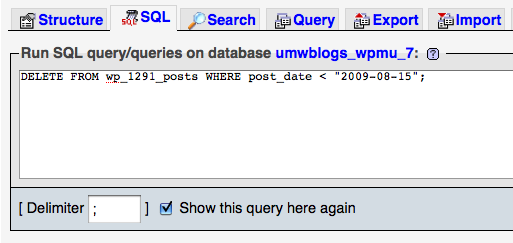
And within a minute 66,000 posts were removed, and the table was now 142 MBs.

Now, let's stop here for a second. How sick is that? Within minutes I got a solution to my issue and deleted 66,000 posts and potentially saved UMW Blogs a couple of more crashes this coming week, from a friend on twitter who just knew what to do. How much richer am I because of this relationship? How much richer is all of UMW? It's kinda wild to think about that. And more than that, it doesn't stop there....

When I removed those 66,000 posts the size of the table was still showing 425 MBs, but there was now a value in overhead column of the table that had a value of 140 MBs. I had o idea how to get rd of this, so asked again in Twitter, and D'Arcy Norman tweeted me back this:
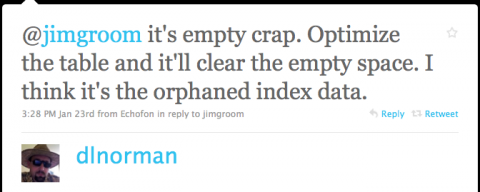
He was right, optimizing the table brought the 425 Mbs down to a slender 140 MBs, and the overhead value was flushed clean. So this got me thinking, hmmmm, what if I could run a script and optimize every table in every database? I mean this site has been running non-stop for almost three years, and has been a work horse. How about giving UMW Blogs an "oil change"---to use Gowtham's analogy which works beautifully. So, when I tweeted about that optimization question, Gowtham once again sent me a message, and after I gave him the naming conventions of my 18 databases on UWM Blogs, wham, I had a PHP script to optimize every table in UMW Blogs.

People, are you getting the point here? Gowtham is an Engineering Physics grad, a hell of a photographer too, but he knows his shit. And he was willing to share that will me in all of about a few minutes the first time. But for the optimization script, he actually wrote it up and sent it to me via email. I don;t know how long that took him, but it would have taken me hours and hours of research and learning to figure out I could do it. And hours more to beg someone who knew at UMW to write it for me (if that person existed). Well, this process was a matter of minutes.

And, Gowtham not only sent me the SQL Optimization script, but was more than cool with me sharing it, so here is the code to the script as a txt file.

And here it is copied below sans opening and closing PHP calls.


# PHP script to optimize each table in a given set
# of MySQL databases and improve the overall performance.
# First written: Gowtham, Mon Feb 27 09:33:01 EST 2006
# Last modified: Gowtham, Sun, 24 Jan 2010 13:01:58 -0500

# Connect to the database
# It is expected that you will be able to connect
# to all your databases [listed below] with this
# set of credentials
$host = 'localhost';
$dbuser = 'USERNAME';
$dbpasswd = 'PASSWORD';

# The act of connecting to the MySQL server
$connect = mysql_connect($host, $dbuser, $dbpasswd) or
die('MySQL Connection Error: ' .
mysql_errno() . ': ' .
mysql_error());

# List of databases
$databases = array(
"umwblogs_wpmu_0",
"umwblogs_wpmu_1",
"umwblogs_wpmu_2",
"umwblogs_wpmu_3",
"umwblogs_wpmu_4",
"umwblogs_wpmu_5",
"umwblogs_wpmu_6",
"umwblogs_wpmu_7",
"umwblogs_wpmu_8",
"umwblogs_wpmu_9",
"umwblogs_wpmu_a",
"umwblogs_wpmu_b",
"umwblogs_wpmu_c",
"umwblogs_wpmu_d",
"umwblogs_wpmu_e",
"umwblogs_wpmu_f",
"umwblogs_wpmu_global",
"umwblogs_wpmu_vip1"
);

# FOREACH_LOOP_DATABASES BEGINS
# Loop through the array, 'databases'
# Each array element will be stored in the variable 'database'
foreach ($databases as $database) {

# Connect to the database using details specified
# above - it expects that there is one username-password
# combination that can connect to all your databases
mysql_select_db($database, $connect) or
die('Database Connection Error: ' .
mysql_errno() . ': ' .
mysql_error());

# Select all tables from 'database'
$sql_q = "SHOW TABLES FROM $database";
$result = mysql_query($sql_q) or
die('Invalid Query: ' .
mysql_errno() . ': ' .
mysql_error());

# WHILE_LOOP_OPTIMIZE BEGINS
# Loop through the list of tables from 'database'
while ($table_details = mysql_fetch_row($result)) {
$table_name = $table_details[0];

# Print a message to the screen - helps in debugging
echo "$database :: $table_name \n";

# SQL query to optimize the table
$sql_o = "OPTIMIZE TABLE `$database`.`$table_name`";
$optimize = mysql_query($sql_o) or
die('Invalid Query: ' .
mysql_errno() . ': ' .
mysql_error());
}
# WHILE_LOOP_OPTIMIZE ENDS

}
# FOREACH_LOOP_DATABASES BEGINS

# Close the connection
mysql_close($connect);

I put in the drop database sign-in information, uploaded it to UMW Blogs via FTP, and went to the script at http://umwblogs.org/mysql_optimize.php, and a few minutes later all of the tables in all 18 of the databases were optimized.

Is this not awesome, UMW Blogs has gotten the oil change it has been in desparate need of---and I don't recommend waiting every 4,000 users and blogs, every 2,000 may be wiser. So, thanks to Gowtham, UMW Blogs is purring like a cat, and I really hope it stays that way.

And just to show you I have no shame, something else I saw when the databases were optimizing is that random blogs still have the Spam Karma tables in them, I would think about 500 or 600 blog tables filled with old spam. The tables are labeled wp_blogid#_sk2_logs and wp_blogid#_sk2_spams. For example: wp_21_sk2_logs and wp_21_sk2_spams. So riddle be this Batman of Gowtham, how would you find and drop all tables with _sk2_ in them across 18 databases?

I love the internet, and I can't thank you enough Gowtham for your selfless support, people like you make this space both fun and wonder-filled.


Posted in UMW Blogs, wordpress multi-user, wpmu | Tagged , , , , , , | 5 Comments

Moving from Multi-DB to SharDB on WPMu

In the early morning hours yesterday we moved UMW Blogs from multi-db (which is a multi-database setup provided through WPMuDev Premium at a cost) to the ever so free SharDB multi-db setup, and I’m happy to say it worked. We’ve had some “unscheduled downtime” recently at UMW Blogs, and between the ever-growing traffic and a syndication/tags blog that’s all too full with 99,000 posts—it was high time to start cleaning database house. This post will take you through the switch from multi-db to SharDB, which is surprisingly simple. And the following post will be about optimizing a multiple database setup that depends heavily on syndication like UMW Blogs does.

Multi-DB –> SharDB
So, our first step was to move to Ron Rennick’s (of wpmututotials and @wpmuguru fame) SharDB setup because UMW is no longer a subscriber of WPMuDEV Premium, and given upgrades to multi-db are no longer available to us—-we were eager to be rid of it. What’s more, I’m hoping this move to SharDB (accompanied by the database optimization and tags blog clean up) will bring UMW Blogs back to a snappiness we haven’t known for a couple of months now. So here’s to hoping….

When I downloaded SharDB I expected a lot more work than there actually was. The move is rather simple, and save a hiccup or two on my end, it went smooth as silk. The first thing to do is configure the db-settings.php file. UMW Blogs is running on 16 databases (well actually 18, but that is besides the point) on one dedicated server, we don’t have several servers or multiple data centers so I think our setup was rather simple. And while we probably should consider getting another server or two some time soon, as Joss Winn suggested, for right now we’re easy.

[What follows is pretty ugly :)]
Continue reading

Posted in UMW Blogs, WordPress, wordpress multi-user, wpmu | Tagged , , , , , , , | 6 Comments

Digital Storytelling: the Course

OK, so I’ve been on paternity leave enjoying some quiet time with my ever growing family, and as a result the bava as well as my general annoying presence online has been limited as a result. But, despite that, I’ve been developing (while at the same time teaching) a course titled Digital Storytelling for the Computer Science department here at UMW, and we are now in our second week. I’m pretty excited about this course because I’m actually shaping it as an experiment that focuses upon cultivating one’s online presence, or digital identity if you will, as a mode and means of storytelling.

So, rather than focusing specifically on the art of storytelling with digital media from the outset, I’ve started off with a slightly different approach that each student should start of with a space of their own to manage and consider the implications of becoming the owner of their own story. Of take some responsibility and possession of the work they will do for the next 15 weeks, and to this end each student has signed-up for their own web hosting service and domain as a means to create their own storytelling/experimental platform. A domain of their own, or to quote Gardner Campbell’s essay on the topic, “A Personal Cyber Infrastructure.” No that can not be all for a digital storytelling class, but from the outset it actually frames their work in getting familiar with a digital environment like a LAMP server and various open source applications as a means to understand through experimentation and tinkering how the process of publishing as well as the to manage their online lives for themselves is very much within their control.

I really don’t know if this is the right approach, and I’m actually basing this experiment as much on our work at UMW’s DTLT as on my own development with open source applications and web hosting back in 2004/2005—thanks to Zach Davis and his very innovative Hosting Co-Operative—in which I got a LAMP account with CPanel for 3 bucks a month and was able to experiment with basic code, open source apps as well as get my head around DNS settings, FTPing files, server management, and everything else that comes with managing one’s own little piece of the web. There is no question in my mind that Zach’s work with Hosting Cooperative (as well as his introducing me to WordPress as well as tutoring me on what XML, PHP, and Apache actually meant) got me my job at UMW, and I’m wondering if learning some of this stuff with a simultaneously technical, practical, and conceptual approach might help everyone in the class get a sense of the power and possibility that lays at the heart of a domain of one’s own. So not only is it an experiment, but it’s one that extrapolates its value from my own experience which may make it doubly flawed and problematic, nonetheless I think it may have some value in the end. At the same time, it doesn’t hurt to read posts like this that suggests learning a bit of code and how the web works both generally and specifically may not only be useful, but increasingly essential to a sense of cultural and personal literacy as we move forward (via Joss Winn).

I have much more to say about the idea behind the class, but this will come out over time given that my process throughout the class will be a focus on narrating what we are doing, how and why I’m approaching certain topics in certain ways, as well as sharing the resources we create as both individuals and a class. In many ways my own digital story got started around the process of figuring how to actually manage my online hosting space, as well as hacking and experimenting with open source applications like WordPress. My narrative is very much one of becoming in relationship to a series of applications and processes I had to learn in relation to and with others, and I really hope this class follow a similar pattern for everyone involved. And that is not to say the process has to be one of technical detail and explanation, but rather a way for everyone to capture their thinking and reflection as they approach a series of topics, issues, and challenges—all of which has the added benefit of a pre-fabricated community of classmates to provide feedback, support, and share their own successes and failures—not to mention the world wide web which looms larger in this class than probably any of us really understand just yet. That’s what my education online has looked like, and I wonder if we can capture some small part of the power of such a process over the next 15 weeks. I’m not sure, but one can dream.

Posted in digital identity, digital storytelling | Tagged , , , | 5 Comments

We are expendable

“We’re not computers, Sebastian, we’re physical” Audio Sample from Blade Runner

I’m not sure I would call Blade Runner one of my favorite movies, because I really don’t think of it in that way. In fact, I don’t really even think of it as a movie at all, it’s more like a magnificent building that you marvel over the conception and construction of and recognize it’s beauty and genius and move on, albeit forever changed. Blade Runner is like an aesthetic institution in my mind, and when you pair it with Ridley’s other masterwork, Alien, I find it simply amazing how a single director could do something that oppressively beautiful twice in three years. Say what you will about Kubrick and the rest of the aesthetic filmmakers, but no other director has created two wholly unique visions of futuristic/alien worlds like Ridley Scott did in such a short time—not to mention with very much a popular audience in mind.

And in fact, the ideas of time and expendability at the heart of Blade Runner, are very much what this post is about. In fact, it’s a post where I finally connect the dots in order to let all of the self-proclaimed “futurists,” or worse yet “instructional technologists,” know that, just like Roy Batty, we are expendable. We have a very definite lifespan, and let their be no question that we’ll be turned off soon. You see, because like replicants in Blade Runner, we are working towards our own demise, we are providing knowledge labor that will pave the road to the demise of our occupation and livelihood. We are expendable!!!

“What the hell is he talking about?”, you might ask, perturbed. Well, I’m talking about this little email I got from a professor just two days ago, from a colleague I’ve “groomed” for years. I shared my knowledge openly, gave freely of my vast expertise, and bared my web serving soul, and in response I get this:

You are SO without a job. I have set up two colleagues’ blogs, trained colleagues on four or five different blog actions, and trained [my own class]. But I miss you anyway.

That’s right, I give everything and I end up without a job. The professors are coming of age in a big way here at UMW, adroitly using these “easy and open” tools to write instructional technologists out of existence. And what’s our oh-so-small send off, “I’ll miss you.” And like Roy Batty notes in Blade Runner, replicants like us are “not computers, Sebastian, we’re physical.” And it’s our very physical realities that we are witnessing being taken right out from under us by the ever dwindling tenured professoriate. They’re like landed gentry in 19th century Russia, dealing in dead souls to pave their way to wealth and job security. And this is the very reason why I have warned against sites like Prof Hacker again and again, that empower professors to pretend they invented the internet (when, in fact, I did). Such sordid spaces provide these social capital hoarders the means of production, and by extension their corrupted message that they’ll push and publish widely while hiding away the fact that we made them! WHO MADE WHO?! WE MADE YOU! And it’s time for instructional technologists around the world to rise up and put a stop to this. How? Well, it’s fairly easy…

If you’re an instructional technologist and you want to keep your job right now, shut it down. Stop communicating with faculty, don’t return their calls, avoid them. And if you’re forced to consult with them, do not, I repeat DO NOT mention any new and useful tools or sites you are using. More than anything, don’t offer ideas or think through design and pedagogical possibilities with these back stabbing profligates, because if and when you do, it will most assuredly be held against you. Think of it as one less month of employment for every faculty member that you helped to “just get it.”

Point is, we’ve had it all wrong, once the faculty become as facile in these web platforms as instructional technologists, we’ll become deprecated. Our only hope for survival is centralized, proprietary applications that are confusing, poorly conceived and insanely expensive. Our eight hour work day might suck as a result, but at least we’ll have a job, and isn’t that what really matters in this day and age? And while our services could always be subcontracted to some outsider vendor as we travel the proprietary road, I think it’s a far better fate than the saccharine “we miss you” you’ll get from your well-protected faculty as you’re handed your pink slip.

So, the instructional technologists of the world need to rise up, and rise up now, and stop this flood of professors taking credit for stuff they not only didn’t do, but couldn’t ape for their peers if it hadn’t been for the true workers of the academic world right now, the transitional team that serves humanity: the ever-great INSTRUCTIONAL TECHNOLOGISTS. But let’s be clear, our way of life is now in jeopardy within this new landscape and we have to fight for what’s rightfully ours. We need to keep the faculty uneducated, and mystify the web with expensive content and learning management system so that we can ultimately lead them by the nose to the next thing when the time comes. Protect yourselves now, while you still have a job to fret about.

Posted in Uncategorized | Tagged | 18 Comments

In New York…

Been feeling homesick for NY these days, especially after putting Jay-Z’s “Empire State of Mind” on an infinite loop. I mean how sick must it be to write an anthem for the city you grew up in. You have to admit it, Jay-Z is the true “King of New York,” and in this case 16 million views can’t be wrong.

Linktribution: Jay-Z’s latest anthem to NY via Shauser.

Posted in Uncategorized | Tagged , | 3 Comments