An inbox full of new UMW Blogs registrations. And while all the Canadian hippies wonder whether they should be rolling their own or not, this red-blooded American knows why we’ve built and installed our own pacemaker—cause we wanna live free or die!
Spider-Man’s latest caper takes the wall crawler far away from the familiar skyscrapers of New York City and into a dark realm of horrible monsters and menacing overlords. After picking up a disturbing distress call through his “Spider-sense” Spider-Man eagerly takes a state of the art jet-plane for a test drive over the ocean. It is here that Spidey finds the source of the mysterious message and decides to take on the evil “Dr. Manta,” and his army of robotic insects to save a lost civilization from destruction.
Quick note to anyone who has been following the simple re-publishing of the 1967 Spider-Man series on this blog, right around episode 21, which is the beginning of Season 2, there is an entirely new look and feel to the series. It seems like the psychedelic visions of the 60s all of a sudden exploded upon Spidey, and the person behind this psychedelic invasion is none other than the animation legend Ralph Bakshi (pre-Fritz the Cat). In the King Pinned episode you can really see a lot of what will be the aesthetic for the groundbreaking animated film Fritz the Cat. What’s trippy about the Bakshi episodes is the music and trippy colored backgrounds, also the episodes seem obsessed with going into the underground world of freaks and mole people. It’s really great stuff, and simply wild to see the explosion of 60s culture on the Spider-man cartoon so suddenly.
It’s a race against time for Spider-Man as the classic villain “The Mole” returns with a vengeance. With the buildings of New York disappearing one by one it’s up to Spidey to save the day. Relying on his “Spider-hearing,” to decipher a cryptic message, Peter Parker swings into action. This time it’s an adventure below ground as Spider-Man must outrun a race of elves, outwit a subterranean rock giant and of course overcome the underground Kingdom of “The Mole People” before it’s too late. Check out the classic Spider-man episode from 1967 and see what happens as “Spiderman Battles The Molemen”
”Diamond Dust”: Museum robbers disguised as gorillas create a diversion by unlocking a zoo cage and stealing valuable items while the wild animals occupy the security. Spider-Man discovers the devious plan and corrals the freed animals in time to get to the bottom of the heist.
”Menace From The Bottom Of The World”: A criminal takes charge of subterranean molemen and uses them create sinkholes under bank buildings to steal all the money inside.
”Criminals In The Clouds”: Peter plans to use his super powers to become a star athlete for his high school’s football team. He becomes a waterboy in hopes that it will lead to a spot on the team. But Peter’s plans are disrupted when The Skymaster kidnaps the school’s star quarterback and Spider-Man must take matters into his own hands.
”Swing City”: A mad scientist takes control of a power station and uses it to energize his anti-gravity device. Meanwhile, Peter Parker finally lands a date and must decide whether or not to break it to save the city. Suffice to say, Spider-Man understands that ”with great power, comes great responsibility.”
It’s been a while, but the kids are enjoying a snow day today, so we need something to do!
“The Origin of Spider-Man”: Peter Parker is bitten by a radioactive spider and soon finds that he has gained the arachnid’s amazing abilities. He learns that “with great power there must also always be great responsibility” after his Uncle Ben, husband of Aunt May, is murdered by a thief who he allowed to get away during a heist.
A word from the artist… While viewing and sourcing content from the Great North Run film archive, it occurred to me that the huge crowds that come to spectate this event are as important as the participator.
I arranged film frame layers across the screen so that they strayed outwards in the direction of the natural panning of the original shots – much more in accordance with the natural gaze of the spectator, revealing a unique panoramic view of the content. The irregular angles and shifting perspectives bring to mind Cubist photomontage and Cubist/Vorticist painting/collage, with the added dimension of the moving image naturally taking this to another level.
Given that this is a celebration of human achievement, and as a nod of appreciation to the Cubist influence within this work, it seemed appropriate to use “Parade” by Erik Satie as the musical backdrop.”
And you can see a video of Vicki Bennett talking about this production here.
Catchig up on my RSS reader is always a joy, and one of the most consistent and indisposable YouTube filters in my reader is the Media Funhouse blog, without fail there are at least 5 or ten posts that lead me into the rabbit hole that is YouTube. I love Ed Grant’s stuff, and he is absolutely an encyclopedia of all kinds of schlock and camp culture, but more than that has been running Media Funhouse as a cable access television series for over 13 years in Manhattan. He freely shares all his insane media addictions and endless riffs on the forgotten character actors, artists, and directors that represent the truly talented working class of our celebrity culture.
Anyway, here are a few of his recent gems, dating back to Thanksgiving wherein he links to a pretty poignant clip of from 1986 that captures the circus that is American popular culture: “What is America to me?” This post has stuck with me, and I keep coming back to how Ed Grant reads a seemingly throw away moment in yet another spectacle like the Macy’s Thanksgiving Day Parade to frame the state of our fragile experiment:
I can think of no better way to sum up what American means to me than to offer up Robert Vaughn being mocked by Macy’s employees dressed as clowns (watch them flock!) as he reads the Constitution to a befuddled and bored TV audience. The fact that host Pat Sajak tries to save his bacon by doing an impromptu intro to the segment (after Vaughn says on-mic, “you have the cards?”), and the fact that the director then tries to save Napoleon Solo once again by putting him in a little circle (in which you can still the bobbing clown heads) only makes this moment more of a patriotic godsend. I can offer no better treasure from my coffer of weird VHS moments to celebrate the “discovery” of this wonderful land.
Brilliant, that’s what reading culture is all about!
Next up is his post on Spanish actor/screenwriter/director Paul Naschy “The Lon Chaney of Spain,” and I admittedly have a lot to catch up with in terms of Naschy’s career. Of all the films pointed out in this brief retrospective of a wild career I have only seen clips from Werewolf Shadow (1970), so there is a lot of viewing to do, but it all looks like a ton of fun. But isn’t that why we subscribe to blogs?
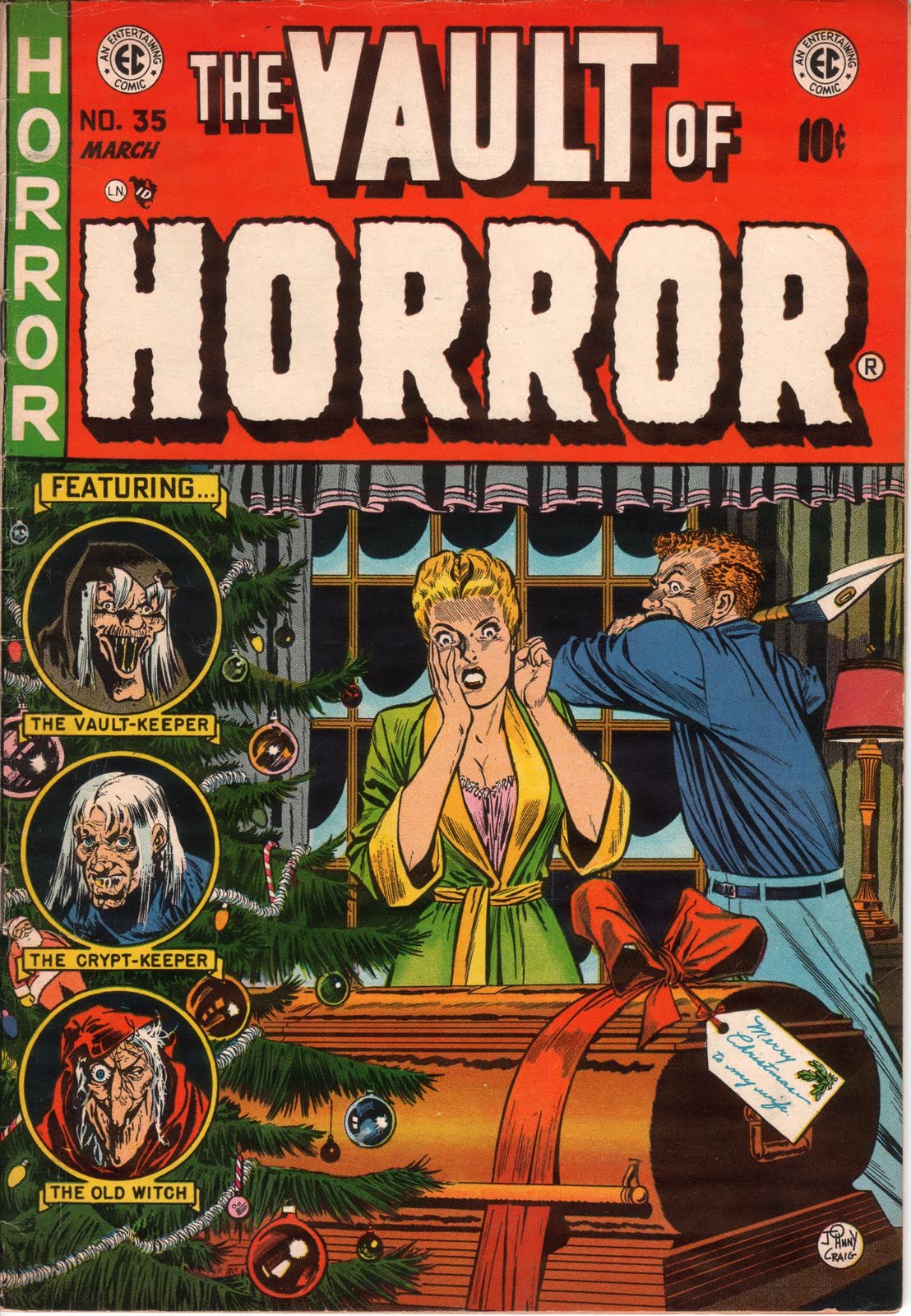
And then there is this tribute to the noir art of Johnny Craig, and the features from E.C. Comics’ The Vault of Horror, highlights some of the most impressive aesthetics from the golden age of comics.
I love this quote:
Craig’s work is probably the single best comic book corollary to the film noir cycle, because he went from being an artist who perfectly captured the mid to late-1940s guys-with-guns and sexy-gals style of illustration (a style also possessed by E.C. stalwart Jack Kamen), and then, much like the noir cycle, he went crazy stylistically and storywise as the 1950s came to stay.
And don’t miss the download link to some scanned reproductions of Johnny Craig’s The Vault of Horror issues, great stuff.
Finally, there is this post about the recently passed character actor Val Avery, which as an added bonus includes his film stealing scene from Cassavete’s Minnie and Moskowitz (1972):
is an ongoing conversation about media of all kinds ...
Testimonials:
Generations from now, they won't call it the Internet anymore. They'll just say, "I logged on to the Jim Groom this morning.
-Joe McMahon
Everything Jim Groom touches is gold. He's like King Midas, but with the Internet.
-Serena Epstein
My understanding is that an essential requirement of the internet is to do whatever Jim Groom asks of you while you're online.
-James D. Calder
@jimgroom is the Billy Martin of edtech.
-Luke Waltzer
My 3yr old son is VERY intrigued by @jimgroom's avatar. "Is he a superhero?" "Well, yes, son, to many he is."
-Clint Lalonde
Jim Groom is a fiery man.
-Antonella Dalla Torre
“Reverend” Jim “The Bava” Groom, alias “Snake Pliskin” is a charlatan and a fraud, a self-confessed “used car salesman” clawing his way into the glamour of the education technology keynote circuit via the efforts of his oppressed minions at the University of Mary Washington’s DTLT and beyond. The monster behind educational time-sink ds106 and still recovering from his bid for hipster stardom with “Edupunk”, Jim spends his days using his dwindling credibility to sell cheap webhosting to gullible undergraduates and getting banned from YouTube for gross piracy.