Ten Years Online @ The Washington Post

This article looks back at the Washington Post’s ten year relationship to the online publishing world, arguing that not until quite recently has the MSM started imagining the full potential of online publishing -with a little help from the blogosphere no doubt.

Big guns such as the Associated Press’s chief executive, Tom Curley, have admitted that the industry seriously fumbled its new media strategy for years by opting to re-purpose material produced to serve print and broadcast audiences.

Read more here.

Tagged | Leave a comment

WSJ on Craigslist Refusal to Advertise

Soviet Union FlagInteresting article in WSJ about Craigslist turning its nose up at half a billion dollars in advertising revenue.

Craigslist’s obstinate insistence on giving away what newspapers have made their bread and butter has gotten the company a lot of media attention. Many newspaper executives see something sinister in Craigslist’s near-total lack of avariciousness — Are those guys communists? Do they hate newspapers?

Read more here.

Posted in Uncategorized | Tagged | Leave a comment

Setting up a MySQL Database for Lyceum

I had mentioned that I would further detail the steps of setting up a MySQL database for Lyceum for those of you that may be unfamiliar with the process. Keep in mind, however, that the following steps assume that you have a web hosting service with CPanel.

The part of the config file where you fill in your database information in Lyceum is as follows:


define('DB_NAME', 'jimgroom_lyceum'); // The name of the database
define('DB_USER', 'jimgroom_jimgroo'); // Your MySQL username
define('DB_PASSWORD', 'password); // ...and password
define('DB_HOST', 'localhost'); // hostname or IP of database server (possibly 'localhost')

The four fields above (DB_NAME, DB_USER, DB_PASSWORD, & DB_HOST) are all settings that you have to fill in with information relevant to the particular database tables you set in your CPanel. Where does one get this information you ask? Well, let’s do a play-by-play to find out …
Continue reading

Posted in Uncategorized | 6 Comments

DAMS: thinking the future of scholarship digitally

Update: For a nice overview of Digital Asset Management Systems on college campuses check out the recent article in Campus Technology. Thanks Andy!

DAMS Well, I have been away from bavatuesdays for a while now, and I have been beating myself up for not blogging regularly. At least until I remembered that I have, indeed, been blogging regularly with Lyceum form my English 375 class blog, so I promptly made up with myself and will now proceed with a regularly scheduled bavatuesdays article.

I must say that UMW has been the epicenter of some extremely interesting discussions as of late, and while the echoes of Faculty Academy 2006 are still audible given the recent podcasts on facultyacademy.org, DTLT was fortunate enough to have Andrew Treloar on campus today who brought into sharp focus the relationship between digital asset management systems (DAMS) and “the future of scholarship” for higher education institutions around the globe, to paraphrase Andrew himself.

Andrew is the director of Information Management and Strategic Planning at Monash University, and he spent much of the day laying out the strategic questions higher educational institutions must engage when considering the implementation of a DAMS. Andrew’s generosity in sharing best practices culled from his own experiences designing projects such as ARROW and DART was only surpassed by the quick-witted flare with which he presented the numerous lessons learned throughout the course of his own work.

And what are these lessons learned? Below are just a few, and I am sure Gardner and the other ITS’s will fill in any and all of the gaps I have overlooked, ignored, or just simply failed to grasp.

  • First, Andrew immediately made it clear that when designing a DAMS the greatest challenge is not necessarily technical, but rather the process of navigating the particularities of the institutional culture. A very interesting point which certainly means different things to different institutions, nonetheless negotiating the needs and concerns of the academic and administrative departments at UMW has been a large part of strategizing such an initiative, even before we began to explore the numerous technical options.
  • Second, in thinking through the formats we would use to capture metadata for the digital resources, questions emerged around how we would use a SQL database structure in conjunction with the Resource Description Framework when serving the digital objects. Turns out that Fedora (the DAMS Monash University has chosen) is moving towards an indexed RDF file that in many ways combines these two processes in ways I haven’t entirely conceptualized as of yet (Patrick, Cathy – any help here?). Point being that specifications for recording and eventually serving metadata such as Dublin Core and RDF in a DAMS are becoming standardized as projects such as the semantic web become more established.
  • Thirdly, do not reinvent the DAMS wheel! While a few of us in DTLT had been kicking around the possibility of designing elements of a management system from scratch with PHP, I think we all were a bit relieved when Andrew directed us to open source DAMS systems out there like Fedora and DSpace. And, while the fact that Fedora is programmed in JAVA may scare some universities away with limited resources (like, for example, UMW), open source projects such as Fez , a highly flexible web interface to Fedora designed at the University of Queensland, is a ready-made frontend for interfacing with Fedora programmed in PHP. Additionally, DSpace is another alternative for UMW, given that it is an out-of-the-box open source DAMS solution -yet another avenue we will be exploring in the near future.
  • Finally, in the words of the great Keith Jackson, sports announcer par excellence, “this analyzing is paralyzing … just play this dang thing!” In other words, Andrew suggested that we start the pilot, begin the iteration, make the necessary mistakes, and learn a ton. For while we are experimenting with these options we always know that exporting/migrating less than 5,000 digital objects and their metadata to another system will not prove too painful. But, more importantly, we at UMW will be much, much wiser than when we started!

So, as you can see we all have some work to do in DTLT, but the kind of work this group was made for!

Posted in Uncategorized | Leave a comment

Second Life Ecosystem

image of 2nd Life EcosystemZach just pointed me to a recent boingboing article about a game programmer who took time off to be with her child and, as a diversion, create an ecosystem in Second Life!

Posted in Uncategorized | Tagged | Leave a comment

Good, Old Freddy …

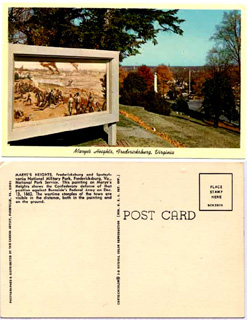
Postcard of old Fredericksburg, VAGardner Campbell just tipped me off on a veritable gold-mine of old postcard images of Fredericksburg, VA offered through the Central Rappahannock Library. Why might this be of interest to a native New Yorker and Yankee through and through, you ask? Well, because my middle name is “Stonewall”! Well, actually, it’s not for I never got a middle name (sniffle, sniffle). A bit more seriously, my interest has emerged from a project I was (and still am) working on with professor John Pearce’s Historic Preservation Museum Interpretation class. We designed a virtual exhibit which features many old images of Mary Washington over the last 100 years, and a site like the one Gardner discovered really starts to suggest just how many great resources there are to work with out there … exciting stuff!

Speaking of which, another thought crossed my mind while the lines above – at Faculty Academy I was on a panel with Carolyn Parsons, Jami Bryant and Patrick Gosetti-MurrayJohn in which we discussed the finer points of metadata, digital asset management systems, and the centrality of libraries and librarians with the new emphasis on cataloging, organizing, and serving the immense amount of digital resources that are beginning to become available. This panel discussed the process we are working out at UMW for gathering and organizing metadata, while at the same time allowed us project about the future possibilities of online resources. After the panel, we had a brief conversation with a librarian at the Central Rappahannock Library, Chris Glover, who was very interested in exploring new ways of tagging metadata and as well as experimenting with open source options for serving and distributing this information. One of the things he mentioned which really struck me while we were talking was that he has numerous groups from all over the region interested in trying to digitize and catalogue their archives (one example was the parks services), and while it is clear that such a job would be best suited for the local public library system -how much of the labor and time necessary is well above and beyond the scope of the all too often understaffed and over-extended public libraries and librarians. In fact, I may be speaking out of turn, the Central Rappahannock Library system may very well have the staff and resources they need to digitize and catalogue thousands of images and documents from numerous groups, although if their budget is anything like UMW’s I highly doubt it.

In NYC when their was a budget crisis of any magnitude the first thing to be cut were public services, and the first public services to go were library services such as extended library hours (which meant for many branched over 20 hours/week), librarians, new books, etc. And while this has always been a crime against the residents of NYC, particularly for residents of the neighborhoods effected, I wonder if and when city and/or municipal officials are going to realize that the greatest investment they could make in organizing for the future, while simultaneously preserving the past is going to be an investment in their library systems. And while librarians themselves still have many questions to ask and answer about best management practices for digital media, it seems their experience and expertise goes a long way towards getting at the root of many issues at stake at this moment – that certainly has been my experience with Carolyn and Jami at Simpson Library. For what other profession is better positioned to start integrating these digital resources into a publicly accessible database that offers knowledge to its constituents as a public service? Gosh, what a great mission a public librarian has! Sounds kinda like that of the public university, no? Don’t get me started … for I have recently heard a certain individual discussing this very topic with GREAT ENTHUSIASM, I wonder who it could have been? (Hint, he provided the fodder for this post!!!)


Posted in Uncategorized | 9 Comments

Second Life: So Cool it is Spooky!!!

Me in Second Life

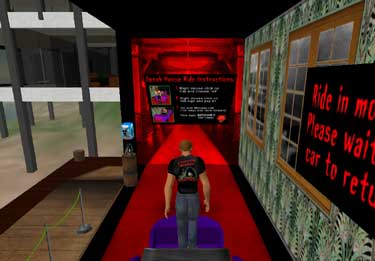
A screenshot of me getting ready to ride through the Haunted House for the Second time in Second Life. I can’t even begin to describe how cool this place is, but I will say this much, a friend of mine just bought a 1932 Indian motorcycle for $1.06, and it is in mint condition.

That should give you some idea …

Posted in Uncategorized | 2 Comments

Cac.ophony: or, the mellifluous sounds of inter-campus collaboration

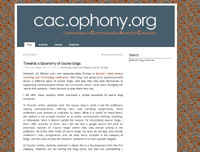
Cac.ophony.orgMikhail Gershovich, the director of the Bernard L. Shwartz Communication Institute at Baruch College (CUNY), has been engaging many of the questions about technology and learning that we are dealing with here at UMW. Like us, he has been integrating an external web-hosting service into the exploration of enterprise wide tools such as wikis, blogs, podcasts, etc. Moreover, we have just recently discussed the possibilities of a multi-user blogging program, such as Lyceum, that could offer a scalable option for a college of over 15,000 students, counting undergrads and grads.
In fact, the Institute’s blog, cac.ophony.org, is tracing many of the questions about the intersection of technology and learning that we have been grappling with lately. Kate Moss, who I worked with as an Instructional Technology Fellow at the CUNY Honors College, has recently posted an informative taxonomy of the different ways blogs can be used in the classroom setting for teaching an learning.

Recently, Mikhail and I have been speaking about hosting alternatives to that allow him and his staff to start playing with tools, such as Lyceum, in a more robust way -allowing experimentation and play to develop alongside research and adoption of new tools. So, i just wanted to draw your attention to the ways in which the conversation we are having is really important for many schools out there that want to pushing the envelope for communications possibilities. And cac.ophony.org is one of those places we need to keep a close eye on …

Posted in Uncategorized | 5 Comments

Doing things with Lyceum

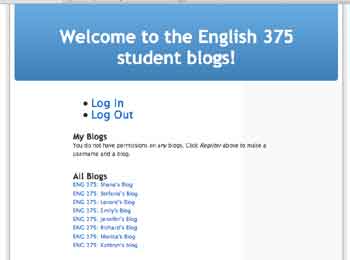
Image of ENG 375 Portal Well, I am back in the teaching saddle and it feels good, but I do feel sorry for the students in my class who have become subject to a whole lot of technologies. And while I think they’re enjoying it, I am also realizing that blogs and a wiki can really change the way one can do business in a class – which is an adjustment for every one involved. So heeding Jerry’s latest mantra, its is not all or nothing, it can be something in between -or even abandoned if need be (wow, this notion is really difficult for someone like me to accept!). Ok, but enough about the King, how about this thing called “Lyceum.”

Lyceum is a multi-user blog solution based on the WordPress blog engine (you can read more Lyceum in an earlier post of mine here). I have been tinkering with it for a few months and the developer at UNC Chapel Hill, John Joseph Bachir, has been an unbelievable help it getting me up and running along the way -as have several other folks in the lyceum irc forum like whatup. One of the most impressive aspects of this project, besides the solid program, is the number of online venues they have made available for support. My experimentation was ultimately preparation for a live run, which has just recently started. So, now I am trying to give a little direction to anyone who might want to see how this program is installed, as well as a quick overview of the maintenance and administration involved.
Continue reading

Posted in Uncategorized | 47 Comments

Faculty Academy 2006

Coming late to the UMW Faculty Academy experience, I have heard on several occasions during this year’s event that I was spoiled. Why, you ask? I am sure there are many reasons, but one certainty is that this year’s conference did an exceptional job of framing the space where scholarship, technology and camaraderie intersect through a philosophical lens. It is truly an exceptional thing to have a supervisor and colleagues who refuse to succumb to criticism and constantly raise the bar for excellence to an ever-higher level. The group of ITSs I have joined seems to have the uncanny ability to bring out the best in one another, and this represents a unique form of chemistry that more often than not defines success. It also helps to have people like Rachel Smith, Jon Udell and Cyprien Lomas encouraging and shaping the work we are doing here -as they all superbly did during this year’s Faculty Academy. A little recognition from a cool guy who brings generosity, wit, and a hyper-analytical mind to IT concerns never hurts either. Yet, all these elements would be irrelevant without the unbelievably dedicated faculty at UMW that made this event both possible and meaningful.

Upon reflection, Faculty Academy 2006 (at least for me) was about the future of now, and how the members of DTLT at the the Unviersity of Mary Washington are trying to define this concept as well as continually push it forward. I had no idea on a rainy day last October (when I interviewed for this job) of how quickly and how forcefully the people I was speaking to were going to push the boundaries of their discipline. Serendipity sublimated … thanks y’all.

Posted in Uncategorized | 4 Comments