The Return of a Redbaiter

“Well, Lloyd, I’ve been away but now I’m back. So, you line ’em up and I’ll knock ’em back, one by one.”

Here's Jimmy
That’s right the best damn ITS from Timbuktu to Portland, Maine (or Portland, Oregon for that matter) is back in the blogosphere. It has been one of those months, as they say, where I have been all work and no play, making Jackie here a dull boy. So much to say with so little time to frame it means that I have been battling a bit of my own writer’s block – but this silly post is just a way to warm up … so stay tuned I am getting ready to tackle a number of topics such as:

  • Faculty Academy
  • Teaching with Lyceum
  • And using wikis as developmental syllabi

So stay tuned …

Posted in Uncategorized | Leave a comment

Multimedia and the incoming freshmen over the next ten years …

I have been thinking a lot about the space of multimedia authoring in higher education lately, and it just seems to me that most universities I have been at are grossly under-prepared for the challenges that freshmen over the next ten years are going to represent in terms of “non-traditional” authoring. In fact, Gardner’s Donne Seminar podcasts are one example of incorporating a “non-traditional” (whatever the hell that means) media authoring tool into a 16th and 17th century Brit Lit college classroom. As it has been recently claimed, if technology is understood as a heuristic then we must consider how such techniques for learning and discovering shape the context in which we learn and, hence, the content that we learn.

I have been particularly interested in these questions because over a year and a half ago I turned my then 14 year old nephew on to Sorenson Squeeze, he has since discovered how to edit films quite impressively – moreover, he has just started publishing them on his very own blog! Wow, here’s a kid who is developing a filmic vocabulary that is allowing him to communicate ideas, emotions, and his own life experience quite effectively through numerous mediums to a potential audience of millions.

There is no question that universities privilege the written word over all other media, yet there is a question as to how long this can and will remain the case. We are, indeed, embarking on a brave new world characterized, at least for the moment, by a popular digital-authoring movement (just go check out youtube.com if you don’t believe me)- but are we at all prepared here in higher-ed? Not by a long-shot!

Posted in Uncategorized | 1 Comment

“Like Gold to airy thinness beat …”

That is how I would describe the student readings of Donne being published on Gardner Campbell’s blog. Where was this guy when I was an undergraduate in English literature?

Wow! The sound quality is impeccable, but, more importantly, the interpretive and analytical nuances of such a student generated project are truly amazing. This is Web 2.0 in the academy at its finest … Bravo to all involved!

Posted in Uncategorized | Leave a comment

UMW at ACCS: A Motley Crue (insert umlaut …twice)

As a proud member of DTLT I think it is safe to say that we had a relatively successful run of our “Bluehost: A Fantastico Expedition” presentation at the ACCS conference today. It was really a pleasure to talk about all the fantastic”o” things we are doing here at UMW, and framing it through our experiment with bluehost web hosting gave me a fresh and important perspective on all the great things we do on a daily basis. Additionally, it makes me really excited about the next steps we take. I know Gardner always talks about the ‘Dream Team’ – and today I think I saw what he was talking about when I watched my colleagues share their knowledge so articulately with the audience … bully for DTLT!!! Below is a picture of the group (I actually took the picture so, unfortunately, I am absent from the photo) right after the rock concert:

Motely Crue

Oh, yeah, did I mention Jon Udell is coming to Mary Washington? More info here …

Posted in Uncategorized | 2 Comments

Did somebody say Slide Show Pro has a Coppermine Plugin?!

I love Slide Show Pro I have been taking a little slack here at DTLT (which, by the way, will be hosting none other than Jon Udell at this year’s Faculty Academy on May 17th – wow!!) for pointing out the delicate subtleties of a slide show extension for flash called Slide Show Pro. So much so, that my new initials have been designated S.S.P. Often times, folks try and focus on what Slide Show Pro -that beautiful image presentation panacea- cannot do. Like, for a random example, interface and work with a photo gallery such as coppermine (which, happens to be where the theater and historic preservation classes we are working with here in DTLT are storing their digital images). Well, my jaded PowerPoint lovers, Web XS 24(like me) has recognized (in all our infinite wisdom) the shifting paradigms of web image communication as we know them, and coded accordingly.

In sum, comments on blogs can be a space for conversation, dialogue, and a general community of sharing and learning. But they can also be a place to pay homage to your Slide Show Pro master! So, I will be expecting at least two, if not three, comments on this blog very soon – if dignity is still a value in this forsaken land of scrap bookers!!

Posted in Uncategorized | 7 Comments

Felix the Cat – a socialist?

Felix the Cat Who knew Felix the cat was such a pinko? Here he is doling out money to the poor of the depression-era (a majority of whom would make up the the audience in a theatre for this short) with his gold brickin’ goose – this is yet another fascinating cartoon in this Vintage Tooncast series – I have included the cartoon below for your perusal. More on this soon, but I did want to get it up for your consideration and comment …

[MEDIA=12]

Posted in video | Tagged , , , , | 12 Comments

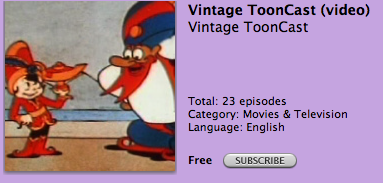
Vintage Tooncast

Vintage Image It is truly amazing what gets unveiled when the copyright laws lapse, the public domain kicks in, and an unbelievable online digital resource like archive.org broadens its library and allows us to access the past in new and exciting ways, but also, at times, in challenging and problematic ways. I was on iTunes recently seeing what’s new and exciting with the videocasts when I came across the Vintage Tooncast. I downloaded about 18 short cartoons (each with red-font type labeled “explicit”) expecting to see new, mashed-up episodes of our familiar animated favorites like Mighty Mouse, Woody Woodpecker, Herman the Mouse, Casper the friendly Ghost and the like.

However, after watching a few episodes I was struck by the fact that these cartoons were neither edited nor re-dubbed at all – so much for my mash-up theory! In fact, they were the originals in all their integrity. “That’s odd,” I wondered, “why the warning then?” After viewing a few more cartoons the explicit tags pasted on these videos became more than clear. The Vintage Tooncasts description in iTunes ( which, by the way, I failed to read in my frenzied search for more things to obsessively collect online) reads as follows:
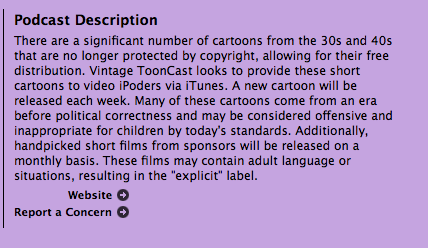
Vintage Tooncast Description

Wow, and then it struck me that this label of “explicit” to define the cartoons that were once like candy during the 1930s and 1940s seems to me to be a very different kind of warning. More than an indicator of foul language, violence (which these cartoons do indeed have), or nudity – these warnings are premised on a shift in our own historical understanding and definition of cultural identities now and then, capturing the powerful (and potentially volatile) impact of visual representations of race at different moments throughout the twentieth century. One cartoon that struck me along these lines in particular was Merrie Melodies’ “The Early Bird Gets the Worm.” This cartoon is very much in the vein of one of Disney’s greatest kept secrets Song of the South (1946), which represents in an “explicit” manner the deep-seated racial stereotypes at work in the media of the early twentieth-century.
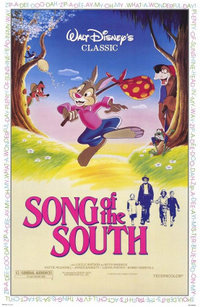
Song of the SouthA few years back I took a seminar with Professor Heather Hendershot from Queens College who did a wonderful job examining this medium and relating it to the ways through which the history of animation during the twentieth century traces a complex trajectory of race, class, and gender -framing sharply the role of media in both their codification as well as their subversion. Herein lies the rub, how do we understand the potential uses for the availability of these cartoons which are potentially offensive, yet, at the same time are historically and culturally significant for numerous reasons? This, in my mind, is all primary research material for an important paper or class or seminar or book on the framing of a visual rhetoric of culture during the 1930s and 40s – or an examination of the animated war effort during the 1940s, or a framing of animating race, gender, class, or … well go to vintage tooncast, watch a few movies, and tell me what you think!


Posted in movies, video | Tagged , , | 5 Comments

Now that’s a fire

campireBasecamp has done it again recently with their free IM messaging service. Here is how they describe it:

Campfire lets you set up password-protected web-based chat rooms in just seconds. Invite a client, colleague, or vendor to chat, collaborate, and make decisions. Set up a room on your intranet for internal communications.

You can find out more here … Campfire.

Thanks for the tip Zach!

Posted in Uncategorized | 1 Comment

The Louverture project

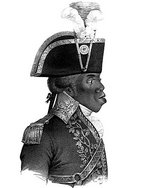
Image of ToussaintI have been been looking for resources on the relationship between Americas’ first war (the Tripolitan War from 1801-1805) in North Africa and the Haitian revolution. While I am still searching for the historical connection, I found a very interesting ‘academic’ project using a wiki and blog to open up the historical narrative of the Haitian revolution to a larger online community. The Louverture Project understands its marriage of the narrative of this important revolution for liberation with technology as follows:

One proposed feature of The Louverture Project is the development of a historical narrative to provide context for the encyclopedic collection of facts on the site. The Revolution Will Be Forgotten is a work in progress, a popular history of the events of 1791-1804 and their effects on the world at large. Readers of the online narrative will have the freedom to read the text on its own, or to explore the ideas, concepts, and facts referenced in the text in varying levels of detail. Of course, TLP will also function as a fully-searchable online resource for a wide range of Haiti-related historical material.

Though we’re starting out with a focus on the Revolutionary Period of Haitian history, it’s not easy to tell exactly when, or if, the effects of that revolution ended. Therefore, the scope of the site is bound to expand as more contributors come online. Be bold in adding to and editing the site. Let it be l’ouverture “the opening” to knowledge and understanding of a fascinating, important, and too-long ignored piece of world history.

The intersection of popular histories and social networking technologies seems to be a truly important academic and cultural development that takes the wikipedia model and focuses it upon an in-depth examination of specific moments of, in this case, history (but why not music, literature, art, biology, chemistry, etc.?). The use of the wiki, and other social networking applications, as a repository for the inscription of a public memory that is neither unilateral or complete suggests an ongoing dialogue that depends upon community involvement and a willingness to explore and engage the intellectual and cultural moments that shape our worldview. Such a project, while it is certainly exposing itself to potential “errors”, opens up the composition of cultural memories to the diverse authorship of communities. The Louverture Project envisions the possibilities of technology to expand the horizons of understanding of cultural moments, practices, etc. both within and outside of institutional models.

Posted in Uncategorized | 11 Comments

Gaming Libraries?

AD&D Video gameThe Shifted Librarian has a fascinating post about exploring the place of video games in libraries. The post links to a webpage dedicated to Gaming Libraries. There is also a newly created section of Meredith’s wiki that allows a space for libraries that are integrating gaming into their services to describe them in their own words. So, my question is: when are we going to be running the new Dungeons & Dragons game at Simpson Library?

Posted in video games | Tagged | Leave a comment