A Bit Blue with Bluehost

This afternoon I have been a bit blue with bluehost. I have been ramping up for a project I will be working on over the next month, and I finally got motivated to install the Content Management Systems Drupal and Typo3 (I am going to try working through both to see which one is best for the project). When I opened the script installer Fantastico, to my great surprise, neither were available. I knew they had been previously available because I had installed both programs using Fantastico on Bluehost to play with these different systems a few months ago. So I called Bluehost and found out, with a bit of uncertainty on the tech’s part, that Drupal v.4.7.2 and Typo3 v.3.8 are for the moment -this is where the uncertainty manifested itself- unavailable through Fantastico because they have recently had problems with both applications. Hmmmm … problems? How do you call these problems?! (Excuse the Strong Badian moment.) I asked if they planned to resolve the issues and have these applications back up and running through Fantastico anytime soon? To that question I was told that the person who found the bugs with Typo3 was on break and that as of right now they could not support Drupal 4.7.2. Not very reassuring for those of us interersted in using CMSs through Bluehost.

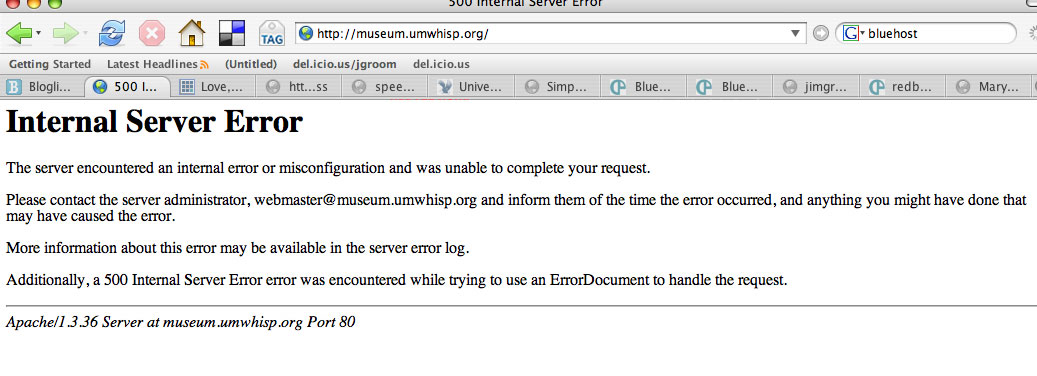
After this I decided to use a Typo3 installation I had installed (using bluehost, mind you) for an entirely different set of sites I worked on previously as a temporary development space. And at this moment my surprise became something closer to concern. I was uploading some images when I began getting a 500 Internal Server Error message (see image below) that basically disabled all of the installs, i.e. blogs, wikis, lyceum, etc., on my web-hosting space. However, the various sites on my account were back up and running in a matter of a couple of minutes.
error_500.jpg

Click on image to see a larger copy of the error message

I had gotten the Internal Server Error message previously when working with Typo3 on Bluehost back in April. At that time I was told that I probably had bad javascript in my templates that was causing the crashes. The tech was right. I did, indeed, have an errant javascript in the template so I removed it promptly and had fewer errors, but they were not entirely fixed. But today the problem seemed worse, anytime I try and upload an image file from my desktop to Typo3 I get an Internal Server Error -to avoid this I have been uploading my images via FTP, but this only circumvents the problem. Additionally, during the last half hour I have been getting these errors when trying to add an image as a content element which I uploaded via FTP. At this point I am not entirely certain if these issues will be resolved, but I would think that two pretty popular php driven applications like Drupal and Typo3 would be a pretty high priority for Bluehost to get working correctly, don’t you?

Posted in Uncategorized | Tagged | 11 Comments

Doing Things with Digital Video on a MAC

Over the last couple of months I have been putting together some resources for ripping DVDs, editing the extracting files, and converting/compressing them into more globally readable formats. Negotiating the minefield of video codecs and file extensions is a complex process, and I certainly do not claim to be an expert. Yet, I think such a resource could be extremely useful for enriching the ways we integrate multimedia into the teaching and learning process in higher education. I hope to come up with a series of relatively straightforward guides for accomplishing this on the MAC, at least at first. Having recently been the benefactor of a new MacBook Pro :), I plan on working through a similar list of resources for Windows once I get more and more familiar with the possibilities for XP.

Some of the topics that might prove helpful are as follows (feel free to add suggestions or requests to this list):

  1. The process of extracting digital video from a DVD.
  2. Editing down and entire DVD, or individual chapters, to clips.
  3. Reformatiting these clips into gloablly readable digital video formats.
  4. Extracting, editing and reformatting digital video for in-class instruction (mainly using Windows Media Player of Quicktime on the desktops).
  5. Reformatting digital video clips for the video iPod.

Below is an annotated list of some applications that I have found useful when working with digital video on MAC OS X. I will be working on a more detailed, step-by-step set of guides using these applications to accomplish the above listed tasks in the not too distant future.

  • Mac the Ripper: this application is freeware that enables you to quickly and easily extract an entire DVD ,or particular chapters of a DVD, on to your machine as a video object file(s) (extension *.VOB). Click here for the manual as a pdf file. As the name implies, this application is only for MACs.
  • Handbrake: this application, like Mac the Ripper, extracts an entire DVD as well as individual and consecutive groups of chapters from a DVD. There is an upside as well as a downside to using this app, in my opinion. The upside is that when using Handbrake you will not have to shell out $20 for the mpeg2 encoder if editing VOB files with MPEG Streamclip (see below). That said, the downside is, as Phill Ryu’s post on Handbrake points out, if you do not have a MacBook Pro duo-core (or a similarly fast machine) extracting and converting DVDs takes significantly longer with Handbrake. This is also a MAC specific app.
  • VLC Player: a cross-platform multimedia player that plays a wide range of audio and video formats that players such as Windows Media Player and Quicktime cannot read. Great for viewing and testing recently extracted video object files (as well as a host of other codecs that will not work with these players) before you edit them into clips.
  • MPEG Streamclip: This is freeware that streams digital video you have extracted so that you can edit the digital video into clips and save it as an easily readable format, unlike VOB. Keep in mind, however, that in order to playback and/or convert the VOB file format you need to buy the QuickTime Mpeg2 Playback Component from apple for $19.99. Click here for more info about this. They have versions of Streamclip for Mac OS X and Windows XP.
  • ffmpegX: quoting their site:

    ffmpegX is a Mac OS X graphic user interface designed to easily operate more than 20 powerful Unix open-source video and audio processing tools including ffmpeg the “hyper fast video and audio encoder.

    In other words, ffmpegX cannot edit digital video files, like MPEG Streamclip can, but it can compress and convert these files into a variety of video formats such as Mov, AVI, DV, MP4, etc. And, unlike MPEG Streamclip, you do not need to purchase the Mpeg 2 Encoder from Apple for this program to convert VOB files. Once again, this software is only compatible with MAC OS X.

  • Sorenson Squeeze: For those of you who are willing to part with some dough, Sorenson Squeeze is an application that costs about $100 and they make versions for both Windows XP and Mac OS X. One of the greatest advantages of this program is that it allows you convert and compress Real Media files (RM), MP4s and MOVs into the flash formats SWF and FLV, which otherwise you can only do with Flash MX Pro or Flash 8. The FLV format is particularly nice because it runs quite smoothly on the web and WordPress has some sweet plugins for playing this format on your blog. Additional features of Sorensen Squeeze are that you can control the compression size of your videos, make them progressive playback for the web, crop the frame of the video, and a whole lot more.
  • digitalFAQ.com on editing DVDs on a Mac: this is a fairly useful guide for using MPEG Streamclip to edit digital video. Go directly to the part where they discuss Streamclip, for they mention another DVD extraction program called yadeX that is a level editor for the classic video game Doom, but, as far as I know, does the same thing as Mac the Ripper or Handbrake. Link
Posted in video | Tagged , , | 5 Comments

Beyond Self-Interest, or, Some Initial Thoughts on Re-imagining the Possibilities of the Open Source Movement

Beyond Self InterestIn a recent article on ZDNetUK, Sun’s Simon Phipps argued that the open source movement is premised on the capitalist ethic of self-interest. Below is an excerpt from the article quoting Phipps’ discussion of open source within a capitalist framework:

Speaking at the Open Source Business Conference, Sun Microsystems’ chief open-source officer, Simon Phipps, said that open source had been focused for too long on sharing code instead of what he called “the enrichment of the commons” …

… Phipps said that the message of open source was that “creating and maintaining a completely independent code base was ultimately self-defeating”.

Instead, the future was in co-operation and in organisations preserving what was ultimately of value to them. “This is not volunteerism,” said Phipps. “It is directed self-interest, synchronised self-interest and there is nothing wrong with self-interest.”

And Phipps took time out to take a swipe at some of the exhibitors at the conference who were selling professional advice on negotiating the open source “legal minefield”.

“I disagree with those who say who say open source is a legal minefield,” he said as he threw from the stage a brochure from one firm of lawyers. “If you think open source is a minefield you’re doing it wrong.”

In fact, this intellectual property minefield is the legal mechanism for preserving capitalist self-interest to turn a profit. I think many would agree these days that the litigious spirit of US capitalism has gotten just a wee bit out of control as this idea of sharing and cooperation has been construed as being at odds with self-interest and profit. Given this, I think Phipps call for a re-evaluation of how we understand the open source movement as a necessary and beneficial element of the innovative engine that drives capital is both strategic and astute.

And while I agree with what much of Phipps is arguing here, I think channeling the possibilities of the open-source movement through the human nature argument of capitalism is an attempt to sell this idea to a group of people who can profit from it, using the appropriate buzzwords like “self-interest” and “connected capitalism.”

Such loaded and vague economic terms, such as ‘self-interest,’ seem inadequate to define the potential power of the open source movement. This movement is not premised on the individual as much as it is upon his/her space within a larger collaborative network of groups and communities that by working together are redefining the idea of the economic self, as well as the social self, creative self, etc. -bearing in mind that the term self here becomes increasingly more meaningless for it quickly becomes impossible to rein in or determine.

Open source is premised on using technology as a tool to share intellectual labor in new and potentially profound ways. The driving logic behind the open source movement is at odds with the mythical biopic of the self-interested individual entrepreneur, a bootstrapping capitalist who labors alone in the sole pursuit of his/her benefit, often translated as financial wealth. Edison’s biography can be understood as an example of the paucity of such myths. His patenting of Tesla’s inventions is a fine example of the problematic history of the legal minefield of capitalist self-interest. How different would our ideas of energy be if these two had collaborated rather than competed?

That some are desperately trying to monetize this wellspring of creativity and innovation is not unimaginable or even undesirable, but it does need to be put in perspective. The late 1990s showed that investors (corporate and otherwise) were willing to throw money at just about anything related to Internet technology. This speculative value is, in fact, the predominant method through which we have come to create value in our society. Yet, might we not be able to generate value through collaborative efforts that are premised on more than a speculative faith system that pays homage to the idol of unbounded profit?

An idea that would be interesting to persue in more depth would be how open source may differ from the over-determined figure of capitalist self-interest. How might the open source movement refigure some of our assumptions about capitalism? -many of which are still premised upon industrialized labor? The possibilities and challenges posed by an organized and robust open source community may provide an moment to start re-examining some of our pre-conceptions about concepts like self-interest, speculation and value rather than a moment to routinely reinforce them.

Posted in Uncategorized | Tagged , , | 2 Comments

“THE HORROR, THE HORROR!” movie

Night of the Living DeadThis post started out as a comment on my favorite blog these days, The Tattered Coat. Matt, the proprietor of said blog, has one of the most intelligent, entertaining, and interactive blogs going. After a long hiatus to finish his dissertation, Tattered Matt is back at it and as good as ever. Lately he has been posting some movie thoughts on his blog that have had me commenting, and now blogging, with a new found energy. His most recent post on movies calls for suggestions of horror films for those who do not like the genre. The post below is both a response to his question as well as a perambulation through my own ideas of the genre and its uses and generative abuses.

A few years back IFC did an excellent documentary, The American Nightmare, with the masters of recent horror (i.e. Wes Craven, David Cronenberg, John Carpenter, Tobe Hooper, & George Romero) in which they talked about their films in relationship to the violence of the Civil Rights and Vietnam War era. These directors (and special effects guru Tom Savini) represent a particular group of film folk that can actually talk intelligently about their work -for 99% of the actors, filmmakers, and producers who talk about their films are completely inane. In particular, Romero, Craven, and Cronenberg articulate how they understood their films as allegories of a particular moment in America when violence, terror, and horror were undermining the dreams and ideals of a generation.

Possibly the greatest horror movie of this moment is Romero’s The Night of the Living Dead (1968). This film was made on a shoestring budget, but quite effectivly turns the entire nation into a battle zone against zombies (a rich figure that he gets a lot of mileage from, especially in Dawn of the Dead (1978)) by simply integrating the TV and Radio as narrators of the cataclysmic event. The lead character, Duane Jones, is a resourceful no-nonsense black man who slaps up an hysterical white woman -most definitely a radical moment in film. His ultimate demise after surviving an intense evening of fighting off the flesh-eating humanoids comes not at the hands of the undead, but by a posse of rednecks who mistake him for a lifeless savage. Click on the video below to view these two clips from the film.

[MEDIA=15]

Romero mentions in the documentary that when he was bringing the recently finished film up to NYC for distribution, the news that Martin Luther King Jr. had been assassinated was announced on his car radio; a powerful fact once you watch this in terms of the conflicts and social unrest of the 1960s. As an added bonus you can watch this film for free given that it is part of the public domain, just click on the following link to be redirected to archive.org.

Horror might be understood as the ideal vehicle for social commentary because its message can often be embedded within such malleable and generative figures as vampires, zombies, werewolves, aliens, freaks and maniacs. And unlike drama, comedy, and the documentary, most viewers are not expecting sophisticated critiques from what at first appear to be relatively straight-forward genre scare tactics. Some other movies from the IFC documentary that are a must see are Shivers by Cronenberg, Last House on the Left by Craven, and Maniac by William Lustig.

Most of these films, however, are pretty painful to watch, and if you are already unlikely to watch horror films these may not help the cause. So I have another suggestion (well, more like a crusade): Mario Bava!!!

“Who the hell is Mario Bava?” you ask. Bava is an early pioneer of my favorite type of horror movie: the 1980s b horror movie. There is no substitute for camp. I just got finished watching an early film by Bava, Hercules in the Haunted World (1961), which is probably one of the few horror movies with Hercules as the hero- which quite bizarrely, and hysterically, plays the whole Greek Mythology thing pretty straight -how can you go wrong? But more seriously, Bava’s brilliance, and I don’t mean to use this word lightly for I am not about to argue that he is a genius or master, for unlike the documentary on Bava that attempts to argue this very fact, I find it both irresponsible and antithetical to the value of the films Bava made. Bava’s aesthetic is uneven throughout his work but at moments transcendent in films such as Black Sunday (1960), Black Sabbath (1963), The Girl Who Knew Too Much, (1963) and (my personal favorite) Planet of the Vampires (1965). Bava’s ability to work through more genres than even Kubrick with overtly campy themes (see Roy Colt and Winchester Jack (1970) for an over-the-top Western—the other spaghetti Western) marks his uncanny ability to make a compelling variety of worlds with little or no budget, a trademark that would jump-start the power of the b-movie which comes to a kind of oxymoronic golden age with the advent of VHS during the 1980s.

In fact, many critics, fans, and Bava devotees link his films to some of the most important horror films of the 80s. And while Alien is anything but a b-movie, many link Ridley Scott’s marriage of horror and SciFi and the mist-filled atmospheric aesthetic with Planet of the Vampires. But one of the most persistent and interesting legacies of Bava comes with his film Twitch of the Death Nerve (1971) (a.k.a The Bay of Blood). This film is set on a wooded bay and methodically works through 13 brutal murders by an unknown maniac. An earlier prototype for horror/slasher/gore franchise films such as Friday the 13th (1980), Halloween (1978), and Slumber Party Massacre (1982). Twitch of the Death Nerve has it all: p.o.v slasher perspective, over-sexed camping teenagers, and an ending that will leave you wondering what the hell you just watched.

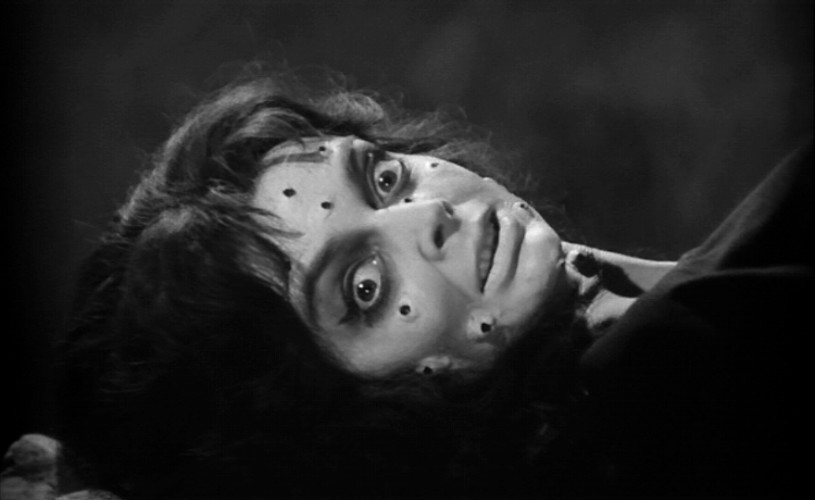
If you are not overly impressed by the moralistic slasher movies of the 80s then Black Sunday may be a perfect Bava alternative for the weak-stomached horror film hater. Starring the queen of 60s horror, Barbara Steele, this film is often cited as the pinnacle of Bava’s aesthetic, and after seeing a couple of his shots in glorious black and white it may be difficult to argue otherwise. What strikes me about Black Sunday is that its film aesthetic comes right out of the stage-sets of the classic period of horror films during the 1930s. It is really a pleasure to watch Bava’s ability to conflate the camp world of Barbara Steele with the aesthetic brilliance of James Whale.
Black Sunday
Barbara Steele fresh out of the Iron Maiden in Black SundayTwo more Bava films of note before I try and wrap-up this seemingly endless comment cum post cum book prospectus. As I mentioned earlier, Bava was constantly working though genres and in the case of Twitch of the Death Nerve fashioning new ones. Perhaps the best example of an acknowledgment of his place as an Italian b-movie filmmaker is found in The Girl Who Knew Too Much-a gorgeous attempt to put the Giallo on film. Professor Hieronymos-Grost from Ireland does a nice job of summarizing this film in a comment on IMDb:

Nora Davis (Letícia Román) is an American tourist in Rome who witnesses the brutal murder of a woman on her first night in the city, however circumstances prevail that no body is found and the police and pretty much every one else believe she is a little crazy, except that is for a young Dr. Marcello Bassi (John Saxon) that she has befriended who plays along and helps her investigate. Nora’s investigations brings up three earlier killings in the same place on the Spanish Steps in Rome, that at the time were called the Alphabet Murders, due to the killer’s preponderance for killing women that had the respective letter in their surname, but the killer was caught and imprisoned for life, so who is it doing the killings? Soon Nora realizes that the letter “D” is next on the killers list and that she is to be his next victim.
Well, I’ve searched high and low for this granddaddy of the Gialli Genre for over two years now and finally got myself a copy, and was it worth it? It’s Mario Bava of course it was! Filmed in stunning black & white the film boasts some fine performances from the leads, it is also regarded as the film that started the ball rolling for the Giallo on film. The Girl Who Knew Too Much also gives a very firm nod to the work of Hitchcock whose Man Who Knew Too Much the title is borrowed from. The film is full of suspense with some very nice scenes and keeps you guessing until the end, as all fine Gialli should — it is quite low on the bloodletting though, a trait the Giallo would ignore more and more as it entered the 1970’s, but this is still an excellent film and well worth checking out.

Well said, Hieronymos! Bava fashions yet another sub-set of the thriller with this film version of the Giallo. And as the comments above suggest, the film Giallo’s increasing dependence on bloodletting may begin to suggest a transition from this pulp genre to the more overtly gore driven films of Dario Argento and Lucio Fulci – admittedly a fast and loose genealogy of the 80s slasher viz-a-viz Bava.
The GirlWho Knew Too Much

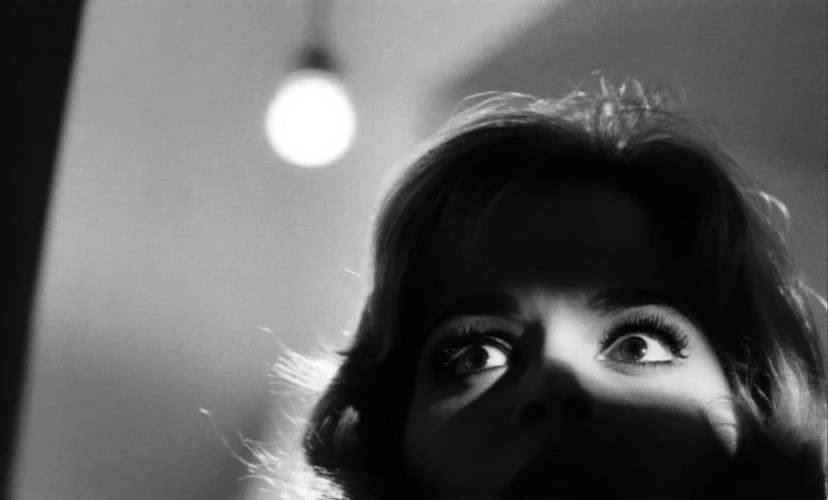
Letì­cia Romàin in The Girl Who Knew Too Much.

Finally, Rapid Dogs (1974) adds yet another layer to the influence of the films of Mario Bava on the B-movie horror films of the 1980s and beyond. The plot, as told on IMDb, is as follows:

A gang of thieves hijack a man’s car after botching their getaway from a robbery. They take a woman prisoner and command the man to drive them to safety. The man must try to cope with the bad situation he is in as well as trying to get help for a sick child that he is caring for.

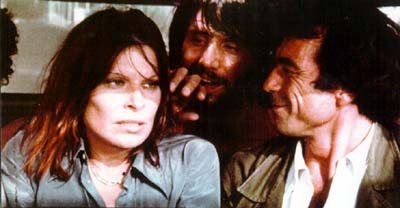
What is striking about this film is how radically it departs from any of Bava’s previous films. It is shot in a hyper-realistic style, especially by Bava’s standards, and smacks of a documentary-like examination of the horror of everyday violence. The film is gritty and at times very hard to watch and as one commenter suggest on IMDb quite similar to Wes Craven’s Last House on the Left -given its relentless and realistic portrayal of people’s potential for horrific acts of brutality towards one another. This film seems inspired by Sam Peckinpah’s Straw Dogs, and may be understood as a model for films like Henry: Portrait of a Serial Killer and Man Bites Dog.
Rabid Dogs
Kidnap victim (Lea Lander) being molested by her abducters in Rabid Dogs.
Anyway, this post is becoming unruly and I will have to save my thoughts about the relationship between Bava and the b-movies of the 1980s for another post on the subject. I imagine it will pick-up where I left off in order to explore (or rather indulge in) some of my favorite bad films of the 1980s such as Stepfather (1987), Terrovision (1986), Silent Night, Deadly Night (1984) and The Toxic-Avenger (1985), Saturday the 14th (1981) and Attack of the Killer Tomatoes (1978) -the first movie I ever saw on HBO which was technically made in the 70s, but made available to kids like me in the 80s.

Finally, below is a collection of taglines for the films I listed above, absolutely genius:

  • Stepfather: “Daddy’s Home and He’s Not Very Happy”
  • Saturday the 14th: “Just when you thought it was safe to look at the calendar again.”
  • Silent Night, Deadly Night: “You’ve made it through Halloween, now try and survive Christmas!”
  • TerrorVision: “People of Earth, your planet is about to be destroyed… We’re terribly sorry for the inconvenience.”
  • The Toxic Avenger: “Melvin was a 90lb. weakling until nuclear waste transformed him into…” [The Toxic Avenger]

This post was made possible by a film retrospective titled “Mario Bava: the Baron of Blood” that was scheduled at the BAM a few years ago. Thank you BAM programmers, you’re doing fine work.

Posted in film, films, movies | Tagged , , , , , , , , , , , , , , , , , , , , , , , , | 7 Comments

Quick-fix for Headphones Bug for XP on MacBook Pro

headphones.jpg As Mikhail pointed out to me, when you have the headphones plugged in on the the MAcBook Pro in XP the built-in speakers still play sound. For a quick-fix to this problem intel has released a program that re-routes all the sound to the headphone jack. The only trade off is no built-in speaker functionality. I figured this works well as a temporary solution until bootcamp fixes this bug. If interested, here is the link to the fix.

Update: Mikhail just found a fix on the apple discusssion board that gets both the headphones and built-in speakers to work. Click here.

Posted in Uncategorized | 2 Comments

Senator Stevens on Net Neutrality

Redefining the term “bumbling idiot”! It is amazing how this politician completely butchers the whole concept of what the internet is, no less what net neutrality is. How can someone so inarticulate and ill-informed be a spokesperson for something so vital to the process of democracy? John Dvorak does a nice summary of this train wreck of a speech in his article on PCMAG.com. You can hear the entire 10-minute speech on publicknowledge.org. At first this misguided tirade against the “two-tier” system that net neutrality will create (I have no idea what he means by this) seems somewhat comical, but when you realize this man is in a postition of tremendous power and is backed by extremely wealthy corporations -it quickly becomes very scary!

Posted in Uncategorized | 1 Comment

My Blue Screen Heaven (or my MacBook Pro Windows XP Install)

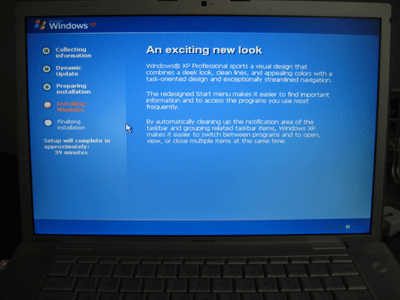
Well, installing Windows just got a little easier, primarily because you can now do it on a MAC! The Bootcamp setup assistant makes installing Windows on your MacBook Pro as easy as finding an external disk drive on OS X.4. I was prepared for a long, drawn out battle with the install of Windows XP on my new MacBook Pro, but it was a cinch with Bootcamp. So while this setup assistant is still in Beta (and I will try and report any bugs I run into), the setup is a breeze. Being a good Lukacsian, as a rule I try not to fetishize commodities, but MAC is making this a harder and harder for me to live up to. Below are pictures of my brand new baby – the veritable the Maserati of the computer world!

macbookpro_1.gif

macbookpro_2.gif

macbookpro_3.gif

macbookpro_3-5.gif

macbookpro_4.gif

macbookpro_5.gif

macbookpro_6.gif

Update: If you are like me and you don’t read directions all the way through, here is a tip that may save you some time on the discussion boards. After installing XP with Bootcamp, be sure to load the Macintosh drivers that you made a CD/DVD copy of when using the Bootcamp Installation Assistant. Impatience is NOT a virtue.

Posted in Uncategorized | 4 Comments

LibraryThing.com

the_thing.jpg Boing Boing linked to a WSJ article about a new social networking service called LibraryThing.com. Below is the excerpt from boingboing:
WSJ has an interesting article about LibraryThing.com, a site that lets you create a database of your books, rate them, review them, and look at the catalogs of other users. The social information compiled by LibraryThing lets you find recommended books, the top-rated authors (and the lowest rated authors — poor Jessica Cutler), the top-rated books, and lots more.

Interesting stuff with many possibilities, I wonder if we can include digital resources like the ones Brian Lamb has recently pointed to in his post on the unbelievable literary resource ubuweb. I guess I am gonna have to play with it to find out …

Tagged , | Leave a comment

Freaks, Monsters, & Prodigies: an Image Database for Literary Studies

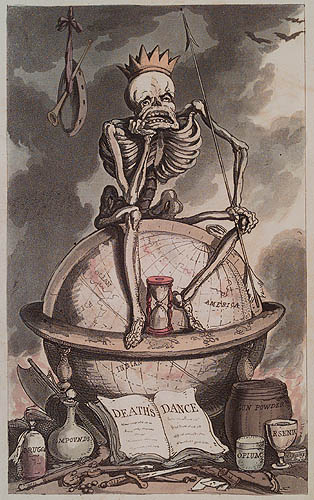
Death's DanceBy way of boingboing, as usual, I discovered an unbelievable example of how image repositories and the study of literature are made for one another. John Anzalone, professor of French at Skidmore College, in collaboration with the Tom Hickerson and Katherine Regan (from Special Collections in the Cornell University Library) have created an unbelievable resource of over 300 images dealing with the fantastic in literature. While the subject matter is unbelievably cool to begin with, I am even more fascinated by the ways these folks are thinking through the connections between literature, art, and technology in truly exciting and persistent ways for everyone interested in such resources – scholars or otherwise. Below is a quote from the about page which gives an overview of the project and its rationale:

Sponsored by Cornell University’s Institute for Digital Collections (CIDC) this image-bank provides a visual resource for the study of the Fantastic or of the supernatural in fiction and in art. While the site emerges from a comparative literature course on the topic at Skidmore College, it is also intended to open the door to consideration of some of the constant structures and patterns of fantastic literature, and the problems they raise. In this sense, the materials presented here may find a use among students in a variety of disciplines.

To explore the collection follow this link.

Posted in Uncategorized | 6 Comments

Social Networking and Global Nationalisms

Image of Cyworld banner Fred Stutzman, manager of the Lyceum project and co-founder of claimID.com, has an excellent post about five huge social networking sites. Despite frequent assumptions that Web 2.0’s social networking is always already a global phenomenon, the five sites listed in this article suggest how such sites align themselves along national lines. For example, Cyworld is South Korea’s largest social networking service with 20 million daily users (or 25% of the population) according to the article -simply staggering numbers! “Well, this is obvious Jim,” you say, “for how many people outside of Korea can speak Korean?”

All right, smart guy, how about this then -how many of us in the U.S. (or even North America) are aware of British social networking sites like Faceparty (with over 6 million users), or a post-colonial social networking space such as India’s Hi5 (with over 40 million users, published in English – that most ubiquitous of online languages -but that is another story about language, colonialism and the traces of empire).

More broadly, how do linguistic, national and cultural differences make some of our claims about the international nature of the web fall flat? I say this knowing full well that DTLT has been forging unbelievably fruitful international relationships with Instructional Technologists in Canada. But does this beg the question -why not Mexico? Or Liberia? Or Jamaica? While not trying to be overly polemical, I think our frame for Web 2.0 as a necessarily “global” movement may, at times, ring true, yet how do we explain the nationalized boundaries that social networking like MySpace or Hi5, or Faceparty rearticulate and reinforce?

Posted in Uncategorized | 4 Comments