AI Maddeness: How (Not) to Blog with AI

In the spirit of the talk at Reclaim Open, I fed the details of the video summary provided by YouTube’s AI into the game preview GPT I created for AI Maddeness. It wrote a post in the “spirit” of how it breaks down a weekly match-up between two teams, it adjusted fairly well for the subject matter. I love the insistence ChatGPT makes on the “creative” possibilities of AI. While I think there’s something there, to be honest, it’s trying a bit too hard here 🙂

In fact, I’m not sure the following AI-generated post about the session is all that creative, but it does do a fairly good job capturing the talk’s highlights while revealing its own biases. There’s a sensation of floating outside yourself—kinda like Rusty James in Rumble Fish (1982)—when you having ChatGPT create a blog post like this. Anyway, here’s a breakdown of the talk Tom Woodward and I gave at Reclaim Open on AI Maddeness according to the machine

____________________________.

Exploring the Wild Intersection of Artificial Intelligence, Creativity, and Madden NFL 2001

In their presentation “AI Maddeness: How (not) to blog with AI,” Tom Woodward and Jim Groom take audiences on a fascinating tour of their experimental journey — one that blends nostalgia, technology, and creative curiosity. Using Madden NFL 2001 as their playground, the duo reimagines what it means to create, play, and narrate through the lens of artificial intelligence.


The Birth of AI Maddeness

The session opens with the origins of the term “AI Maddeness” (1:22–1:36), coined by Tom Woodward to capture both the enthusiasm and chaos of experimenting with AI — and to pay playful homage to Madden NFL 2001. For Jim Groom, once an AI novice, this project marked his first true dive into generative technology — a blend of excitement, learning, and humor that would shape the entire talk.

His early experiments with ChatGPT (1:50–2:05), prompted by Tom, began with something deceptively simple: feeding the AI screenshots from Madden NFL 2001 and seeing what it could make of them.


Image Recognition and the “Wow” Moment

From 4:39–6:20, Groom and Woodward showcase what would become a breakthrough: the AI’s ability to extract structured data from screenshots — recognizing stats, names, and scores, and organizing them into usable formats like tables and CSV files.

Jim describes this as a genuine “wow” moment — the realization that AI could act not just as a creative partner but also as a kind of digital archivist, transforming static images into dynamic, reusable information.


When AI Hits Its Limits

Of course, AI Maddeness wasn’t all smooth sailing. Between 6:20–7:20, they encountered clear limitations: while the AI could handle player stats, it stumbled over more complex data like standings and schedules. Ironically, when it couldn’t solve the problem directly, the AI generated Python code to help them get there — revealing both its ingenuity and its dependency on human refinement.


Building Custom GPTs and AI “Agents”

By 7:53–8:30, Woodward introduces the concept of Custom GPTs, referencing terms like “Gems” and “Agents” used in other AI platforms. These specialized configurations allow users to define parameters and roles for the AI, ensuring more consistent outputs for tasks like generating game previews or creating visual assets. It’s a glimpse into how AI can be sculpted for specific creative workflows.


WordPress Integration and AI Personas

Perhaps the most entertaining segment arrives between 10:20–13:50, when they demonstrate their WordPress integration with AI to automate blog comments. By assigning distinct voices and personalities to each AI commenter — some witty, others argumentative or analytical — they transformed the blog’s comment section into a lively cast of digital personas.

This experiment blurred the line between human community and machine imagination, showcasing how AI can simulate engagement, satire, and even social dynamics.


Balancing Efficiency and Emotion

Despite the power of automation, Groom underscores an essential truth in 15:20–16:50 — the human element still matters. He chose to continue writing his own post-game summaries, driven not by efficiency but by emotional connection. AI could document the play-by-play, but it couldn’t capture the feeling of playing.

The duo also used AI to create GIFs from gameplay moments, adding another layer of personality and humor to their multimedia storytelling.


Simulated Games and AI Narration

In one of the project’s most thought-provoking experiments (17:19–18:46), they tested AI’s storytelling power by simulating games that never happened, then prompting the AI to “hallucinate” full recaps as if it had actually watched them unfold.

The results were surprisingly convincing — complete with player stats, dramatic moments, and post-game reflections. It raised playful but serious questions about reality, simulation, and the creative potential of machine-generated fiction.


Cultural Sensitivity and Responsibility

Around 18:48–19:58, Groom recounts including a reference to Washington DC’s now defunct team name far too casually in one of his AI-assisted posts. That moment, he reflects, was a reminder that intent doesn’t erase impact. Even in nostalgic or experimental contexts, creators have to balance historical authenticity with cultural awareness.

This led to a broader conversation about ethical use of AI — who’s responsible for what the machine produces, how to correct its oversights, and what it means to remix the past through automated storytelling.


Imagining the Future of AI in Gaming Media

The presentation concludes (25:24–29:10) with a forward-looking vision of AI-powered gaming media: autonomous systems that could instantly produce post-game recaps, podcast commentary, and even fantasy sports analysis — all dynamically generated as soon as a game ends.

While acknowledging this potential, Woodward and Groom also caution against the seductive ease of automation. AI can amplify creativity, but it can just as easily accelerate detachment or misinformation if used uncritically.


The Takeaway

AI Maddeness is far more than a quirky tech experiment — it’s a creative inquiry into the boundaries between human imagination and machine collaboration. With humor, reflection, and a healthy dose of self-awareness, Tom Woodward and Jim Groom reveal how AI can both inspire and unsettle our understanding of authorship.

Ultimately, AI Maddeness isn’t about teaching machines to think like humans — it’s about rediscovering what it means to create like one.

Posted in AI, AI Maddenness, Reclaim Open | Tagged , | 2 Comments

‘Some caveats / things to note’ or, the bava according to ChatGPT

  • The blog is quite wide-ranging. If you are looking for very focused, academic writing, you may need to dig into specific posts.
  • The author has a casual, personal tone—so the writing is less formal than peer-reviewed work.
  • While the blog is influential in certain communities (edtech/open web), its reach may be more niche compared to large-scale academic journals or publications.
Posted in bavatuesdays | Tagged , | 4 Comments

Family Pictures Podcast at Reclaim Open

As part of Reclaim Hosting’s blogathon during day 1 of Reclaim Open Michael Branson Smith (MBS) and I presented about the “Joy of Podcasting” live on ds106radio. The audio below includes our half-hour discussion around how and why we started the Family Pictures Podcast, as well as sharing our process. What’s more, it ends with ideas and potential spin-off projects for the future. The remaining hour and change of the audio is us recording episode 41 of the podcast on Alfonso CuarĂłn‘s Children of Men (2006) —part of our 6-film theme focused on “Families on the Run.”

Family Pictures Podcast on ds106radio and Episode 41: “The Human Project Lives”

In the actual podcast episode we explore the dystopian chaos of Children of Men (2006), a movie that somehow feels more real now than it did twenty years ago. We talk about the film’s relentless world-building with details like the graffiti, the cages, the Pink Floyd pig floating over the “Ark of the Arts” and how every frame feels like a visual essay on decline. We don’t spend nearly enough time on the jaw-dropping long takes (the car ambush and the Bexhill uprising), but there’s a deep dive into memory, loss, pets, and why the idea of family hits so hard when the future’s gone missing.

IWDRM GIF from Children of Men

I even try and sneak in some of Frederic Jameson’s The Geopolitical Aesthetic to talk about conspiracy theories and urban uprising, but I never could explain his theory well enough to be cogent. Anyway, it was a fun ride for episode 41 that marks yet another brick in the Family Pictures Podcast wall

Posted in ds106radio, Family Pictures Podcast, Reclaim Open | Tagged | 5 Comments

We’re not computers, Sebastian, we’re physical

I guess it makes sense to start a conference about blogging with a blog post about blogging—hello you beautiful Reclaim Open 25 folks! Let’s face it, blogging is a blogger’s favorite topic, right? And these days I’ve been thinking about what it means for blogging to transmogrify (it’s Halloween season, after all) into something else. Most often a blog is the fodder for a book, which makes total sense given the textual base and the general sense that blogging is always a work-in-progress—in my case always becoming something legible 🙂 But I never was all that interested in writing books because it seems like a lot of work, and I’m already holding on for dear life with keeping up with this here blog.

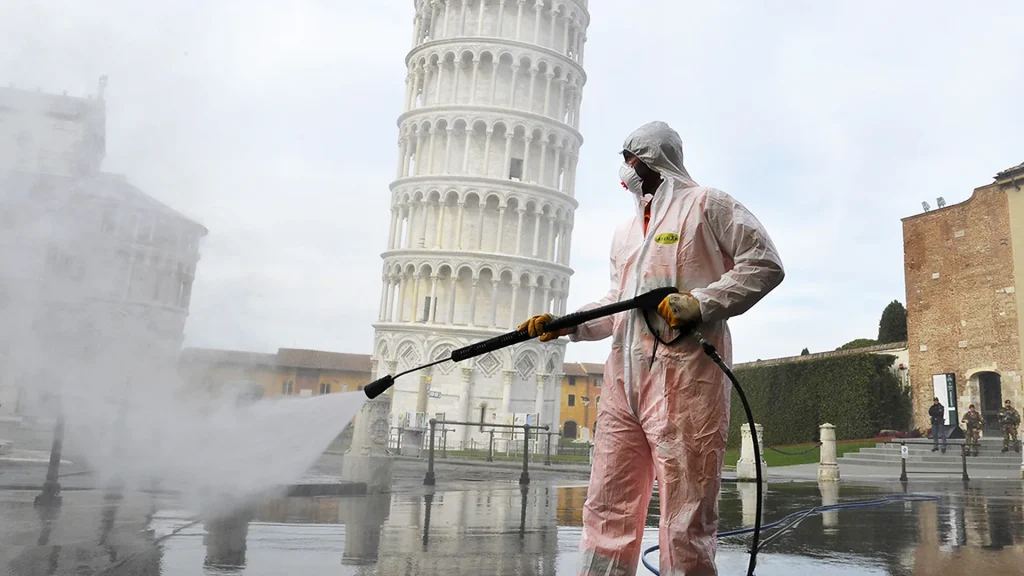
But after a breakdown a couple of years ago (they come every so often for the bava) I was looking for something to hold off the black dog hounding my psyche. To put this in some context, it was late 2023 in Italy and we were still slowly emerging from COVID. The prospect of re-integrating into anything resembling a sociable society took significant effort. Here in Trento numerous shops in the city went bust leaving many available for let. The cultural center was even more of a ghost town than usual, add to that my own extended darkness from working alone for years in a light-challenged basement and it’s no wonder things came to a head.

Image credit: Laura Lezza/Getty Images as seen on BBC article “Covid 2020: Italy’s much-loved landmarks fall into silence” (article linked)

While struggling through this moment, one of the hopeful ideas that emerged in conversation with folks like Maren Deepwell, Bryan Mathers, and Tim Owens was getting out of the basement and into the world. Knowing there were plenty of spaces available in downtown I started looking for a studio to work from as a means to separate home and work a bit more. But more than that, I needed something akin to what Tim and I had in Fredericksburg with what was first CoWork and then Reclaim Arcade to channel some creative energy. You have no idea how rewarding it can be to build a 1980s video store.  And while this blog has been the best creative outlet for me over the last 20 years, in the wake of COVID and a tentative release from the grips of a deep depression I felt the need to build something physical.

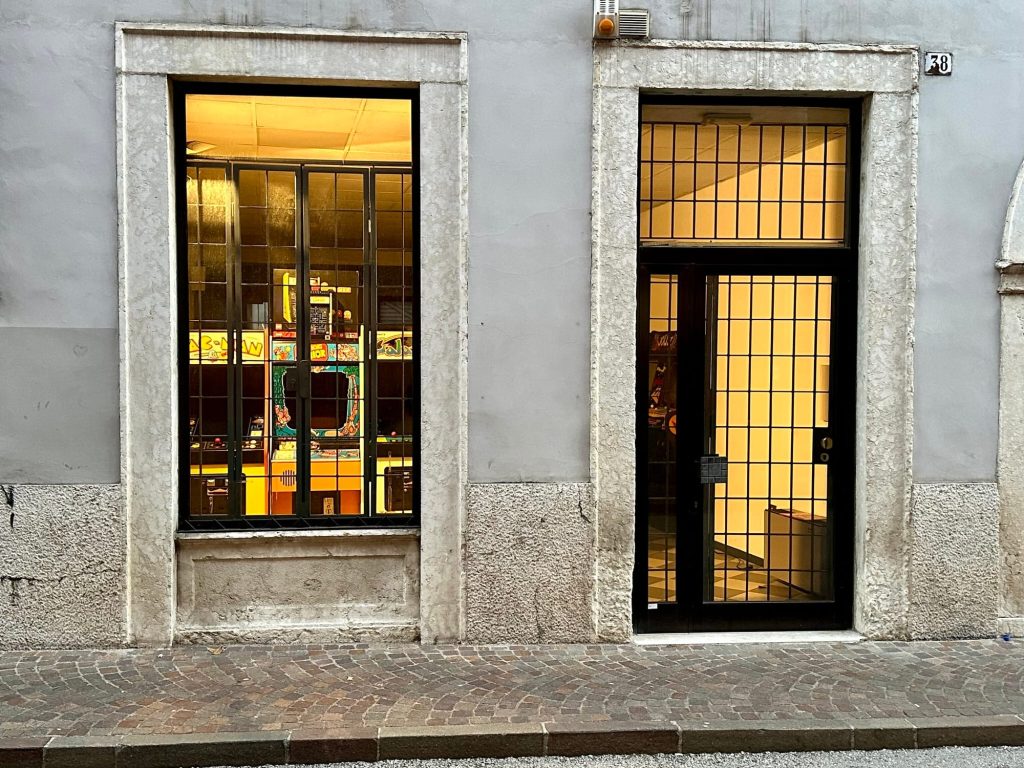
Image of the bava.studio storefront from early days when there were still bars on the windows 🙂

That is the how and why bava.studio came to life. In December of 2023 I signed a lease for a small space with the idea of ultimately making it self-sustaining (this is still a work-in-progress, like the blog 🙂 ). But the idea, as it took shape in my head, was not so much to have an office, but to transform the bava blog into a physical space. Not one unbounded by the internet, but something very much bounded by the definite geographic and cultural context in which it exists. I wanted bavatuesdays to become an actual space people can enter in Trento that allows for wonder and  conversation around media and culture of all kinds (at least all kinds of bad American pop culture on hand).

RGB: a bava.studio production

Most importantly, like this weblog, I wanted there to be no cost associated with the experience—at least for them. This is where my favorite part of the space emerged: creating a window display/diorama that bucks the traditional approach of showing off the goods to be bought and sold. With each diorama we’re creating a “post,” if you will, that tries to capture the magic of certain moments in a film that folks might connect with. It’s a message in a bottle for any passerby to potentially discover and, hopefully, engage with. I understand the real limits of the diorama being scenes from 70s and 80s US horror films, but the experiment is young yet and the ultimate dream is to have folks from the community build displays that move beyond any specific interests. This would be an act of cross pollination and “true” sharing that we’ve not yet achieved, but hope springs eternal in the bava breast.

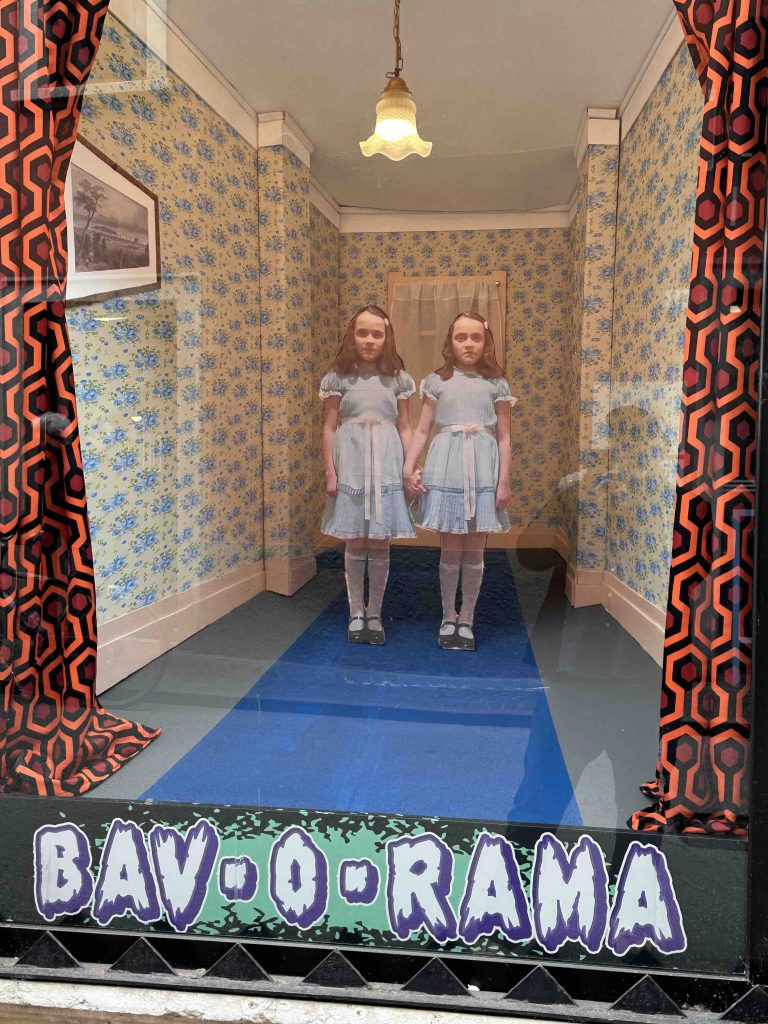
Bav-o-rama

The build-out for the bav-o-rama

Looked at from one point of view bava.studio is simply an office where I go to work somewhat regularly, but from another it’s an attempt to try and make material connections with a community I’m still very much an outsider to—like any new blogger jumping in the web water for the first time. The joy of this blog has been all the connections and real-life friends it’s provided over the years as we commune over ideas—and certainly not always agreeing in that communion. The bava has made me rich as kings when I think about the people it’s brought into my life. The move to Italy ten years ago has resulted in linguistic and cultural challenges that were far greater than I originally foresaw. So rather than continuing to rest on those blogging “laurels” or basking in the glory days of “Web 2.0,” the studio is an attempt to port the sense of community this blog has provided into a different format for a very different context.

Something to Tide Me Over

I am not sure how successful it will prove in the long run, but since last October/November, when we finally got the space built out and the first diorama up and running, we’ve been on a bit of a roll. We started with the “Something to Tide You Over” scene from George Romero’s Creepshow and about six months later re-created the hallway in which the Grady sisters greet Danny.

The Making of The Shining Diorama

Just this past week we debuted the most recent diorama, a scene of Michael Meyers emerging from behind a bush and then quickly disappearing. It’s one of the early, creepy moments from the original 1978 Halloween and it’s so fresh I haven’t even blogged it yet, but you can get a sense of its workings from the short video below.


View on Mastodon


In fact, the diorama was just one part of the equation. After a year of trying to navigate the grey zone that is Italian bureaucracy we finally held our first event: the Halloween Haunted Arcade. You can read more about the specifics of that amazing event, but the idea was to convert the space into an escape room/arcade for the evening and invite folks to enjoy the experience free of charge. It was a blast, and I’ll have much more to write about that anon, but for now you can see a live walk-through of both the diorama and the haunted arcade as part of the Reclaim team’s Halloween stream. 

Anyway, I guess the whole point of this post might simply be a reminder, at least for myself, that as replicant Roy Batty tells Sebastian in Blade Runner while struggling with his own synthetic place in a near future dystopia: “we’re not computers, Sebastian, we’re physical.” Not only does his distinction between being a computer and physical make him somehow more “human,”  but this sense of the product of computing crossing over into the world in human form highlights another brand of struggle emerging in our moment between what’s even human anymore. That said, we all live in the world until we don’t.

The various events over the last years (amongst which the consolidation of the web into a few for-profit platforms) can make many of us feel lost and alone—less than human? But I believe the desire for real connection and the need to carve out a space, if only for a moment, to try and exist outside the demands of capital is not only important, but dare I say essential and life-affirming. There has been a long history on this blog of proclaiming we should “Make art, dammit!” -but what happens when the blog itself transforms into the art you make and becomes a physical instantiation of and in the world you want to exist? Who made who?! Is that some kind of blog apotheosis? We’re not computers, people, we’re physical. Make art, dammit!

Posted in bav-o-rama, bavacade, Reclaim Open, Uncategorized | Tagged , , , , | 2 Comments

Halloween Haunted Arcade

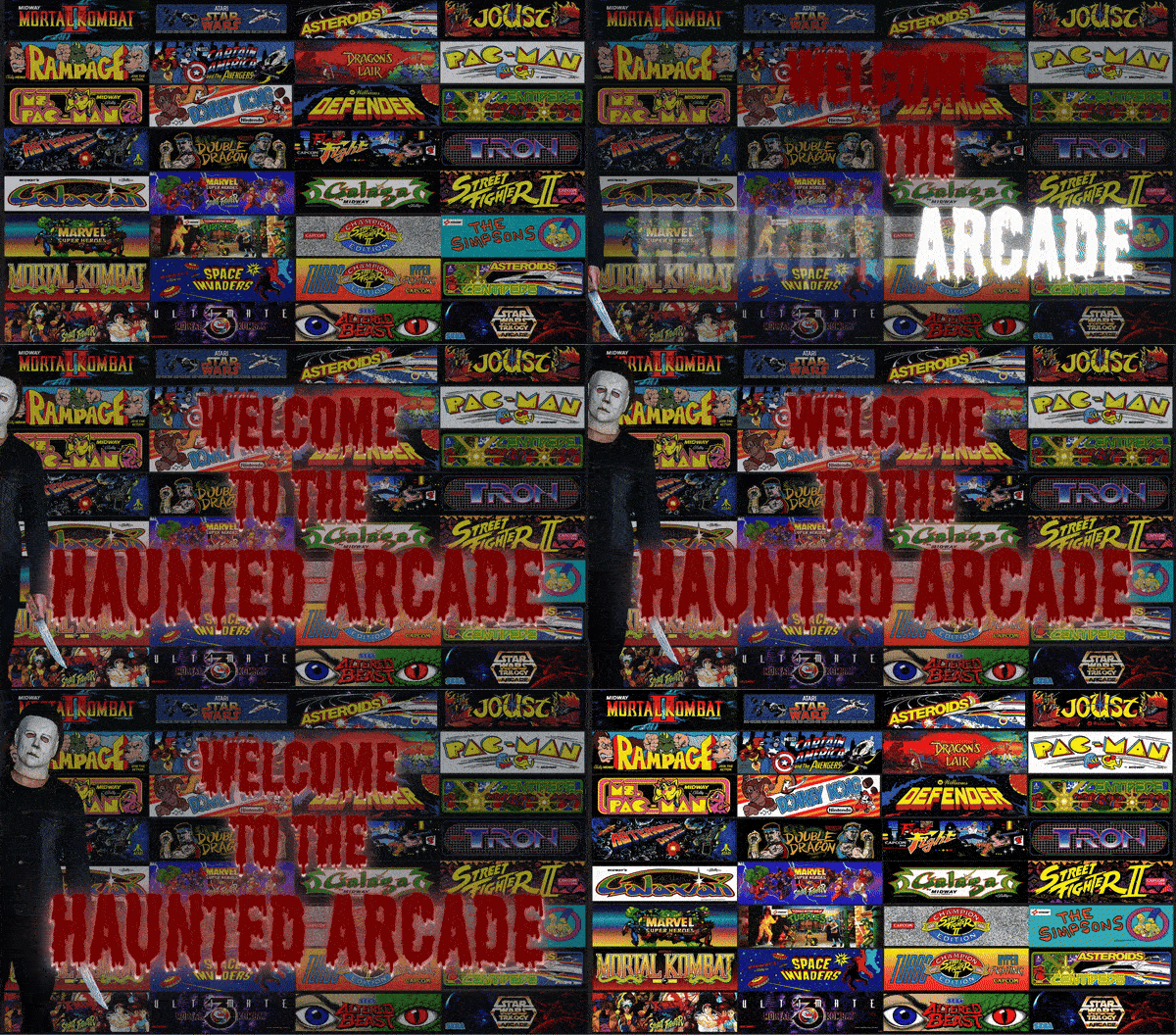
It’s been a crazy month, and now it’s time to race to the finish line trying to get the bava.studio’s Halloween Haunted Arcade up and running by Friday the 31st, just in time for Halloween. The diorama has come in fits and starts, but now it’s time to lock-it-in. In fact, the following video (as well as the GIF poster above) were made by Riccardo Sarraco, who has done a brilliant job helping to both create and promote this small event.

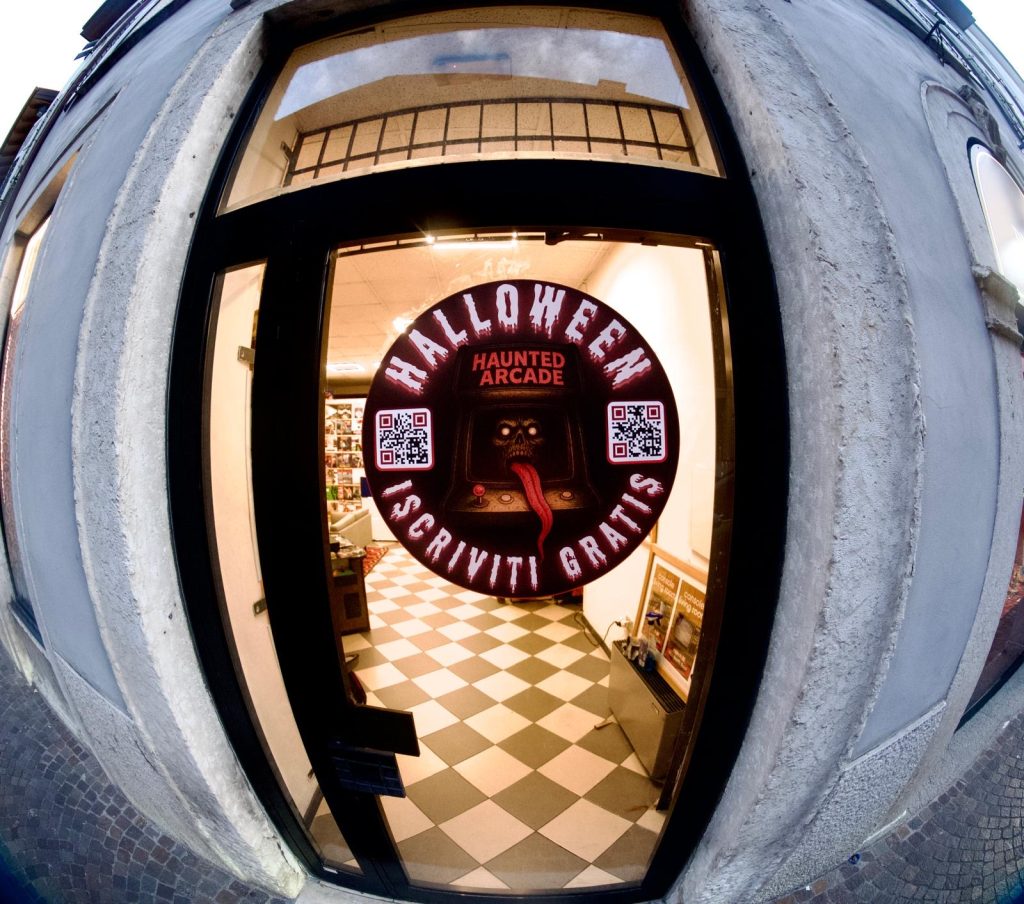
Folks will see a poster on the front door of the bava.studio that will have a QR code for them to scan.

Promotional poster for the bava.stuidio Halloween Haunted Arcade

That code brings potential guests to this post on the bava.studio site which provides an overview of the event (in Italian and English) as well as a sign-up form. The video is followed by the following text:

The bava.studio invites you to its very first private members’ event — The Haunted Arcade!

On this most cursed of nights, Halloween, the doors of Via Calepina 38, Trento, shall creak open to welcome only the bravest souls.

Sign up using the form below, and you and your chosen companions will be summoned at your appointed hour — arriving in groups of ten to fifteen — to embark upon a chilling journey through a maze of haunted visions, sinister sounds, and spectral surprises.

When the darkness lifts, you will find yourselves amidst the glowing relics of the 1980s — authentic arcade cabinets — where the spirits of the past dare you to play… perhaps for your very soul.

Enter… if you dare.

If you watched the video, you’ll notice that Dr. Oblivion plays a role in this new adventure, which is aways fun. Essentially we’ll be turning the front part of the arcade into an escape room that once they figure out will lead to a maze of arcade games with a scare around every corner. After that it’s time to play some games. Each group of 10-12 people will have roughly 45 minutes in the space to prevent too many folks all at once. The form allows people to sign-up for a specific time slot, something that worked well in Reclaim Arcade during COVID. While I’m not sure folks will actually be interested enough to sign-up, I’m thrilled that least something is finally happening!

Halloween Diorama

Things to do are finish the Halloween diorama, plan the escape room, and design the arcade maze. It will be tight with just under two weeks to make it all happen, but I also think it’s time to give myself a kick in the ass to make things happen.

Posted in bav-o-rama, bavacade, bavastudio | Tagged , , , | Leave a comment

Coming off the AI Maddeness Bye Week

I gave myself a few things to do during the bye week and I’m happy to report I got more than half of them done.

The most pressing issue to address was getting the emulated version of Madden 2001 running on Batocera to stop freezing mid-game. It’s been happening consistently and the best case scenario led to a delay of game penalty, the worst would mean a hard restart of the game all together (which meant losing data). This was not viable so I tried replacing the game rom (the cue and bin files), changing the emulation system (switching between Duck Station, Swan Station, ePSXe, etc.), re-configuring video settings, and more. After everything failed I decided to take the season’s save file and move it over to a RetroPie. So far that seems to have solved the issue, but it also means there’s still an issue with PS1 emulation on the Batocera.

Playstation bezel used for my Ai Maddeness game streams

After switching to RetroPie I was concerned about losing the Playstation bezel on the sides of the video, but I figured that out in OBS and thankfully the bezel images are freely available here. I’m currently using the night time PSX image. With that done, I’m now running my AI Maddeness weekly games though RetroPie, which will hopefully fix those annoying freeze issues.

Another thing I did this week, speaking of Playstation save files, is try to figure out if there’s a way to tap into the save data for Madden 2001 a bit more programmatically than taking tons of screenshots every week. According to Google’s AI overview, the Playstation save files (.SRM) are proprietary and encrypted, so it would have to be a bit of reverse engineering to decipher the code with a hex editor. The only person I know who talked about using a hex editor was Reclaim Hosting’s badass sysadmin Chris Blankenship, so I will be consulting the mighty oracle. Long story short, it may be possible (albeit Herculean and not worth it) to decipher the code and then write a script to pull the weekly stats off the SRM file directly. This is purely the realm of theoretical right now, but I do love the idea of cracking the Madden 2001 code 25 years later to release the Kraken!

That’s two things on the list I can cross off. In fact, I even squeezed in a third, namely playing some of the Week 5 games while my Jets rest up. I played against the Colts as the Bills to see if I could deliver Indianapolis there first loss—didn’t happen. It was a heart breaker that was lost in the last 14 seconds, you can read all about it on AI Sport Zone. In better news, I also played as the Jaguars against the Steelers and won 17-10, giving the Steelers their first loss while also doing a bit of recon in preparation for week 6’s match-up against the Jets.

The fourth and final task I got to was creating a couple of videos where I had ChatGPT take my game recap blog posts and turn them into a 90 second script that I had Dr. Oblivion read via the voice MBS trained more than a year ago in Elevenlabs. So Dr. Oblivion is now dabbling in sportscasting. I did two different takes, the first was Steelers vs Jaguars with a bit more serious tone using the royalty free track  “Epic Sport Trap” for background music—recommended by ChatGPT.

For the second video featuring the Colts vs. Bills, I had Dr. Oblivion coming off as a bit more humorous. It uses the royalty free song “Scheming Weasel” to underscores the almost comical nature of this mistake ridden game (once again recommended by ChatGPT). I was pretty impressed with the new Enhance feature in Elevenlabs that adds tags to help guide delivery. For example, in the script you can see the guided delivery in square brackets that tell the machine when to change emphasis and how:

Rob Johnson threw a pick on his second play, and Peyton Manning said, “[chuckles] hold my Gatorade” — tossing his own in the end zone. We were off to a hot mess of a start.

Then outta nowhere — 4th and 19, Johnson hits Moulds for 61 yards. [excited] Buffalo wakes up! Steve Christie boots a field goal to tie it at 10 with just 19 seconds left.

I found these audio deliveries pretty impressive, and I have to say it sounds less like Dr. Oblivion and more like a younger me, which I’ll take today 🙂

As for the things I didn’t do:

  • Style the AI Maddeness, AI Sports Zone, and Gangus Green sites. I’ve been promising this for weeks, but is this the weekend I’ll truly lock-in? Nope.
  • Create a separate official Jets site for team news, injury reports, comprehensive stats, etc. This will be a model for having a site for every team (aspirational I know), but if I come up with a solid template it would be easy enough with WPMS.
  • Finally, testing out what it would be like to make an AI-generated podcast reflecting on previous week’s game and getting ready for the next week’s, the bye week may provide the perfect occasion to reflect on the Jets vs Steelers going into week 6.

I got to 4 of 7 tasks, so I’ll take that as a win given I was a busy Reclaimer this week. What’s more, I’m happy to report that AI Maddeness is the time suck that keeps on giving! I would write more, but I still need to knock out a post for Gangus Green and get out a couple of preview posts beyond the Jets vs Steelers given I plan on playing at least 3 games this week.

Posted in AI Maddenness | Tagged , , , , | 2 Comments

Commodore 64C

A strange thing happened on the way to trying to open a Haunted Arcade at bavastudio, someone gave me an original Commodore 64C.* I’ve never seen the re-design of the classic breadbox version of the C64, so it was definitely a novelty.

Commodore 64C

The Commodore 64C revision of the breadbox made it look more “computery”

I was essentially tasked with seeing if this old machine still works, and for that I needed a few things: a disk drive, power source with a 7-DIN connector, 8-DIN video convertor, monitor, and joystick. I was pretty sure I had accumulated most of those components over the years, so I took the machine home to test it.

Commodore 64C Peripheral Ports

RF, Video, and Serial ports on the back of the Commodore 64C

Commodore 64C Side Ports

Side ports include two joystick ports, the on/off switch and the 7-DIN power output

Turns out I had everything but the power supply. A 7-DIN power supply is not something I used with my C128 machine, that has the more traditional three-pronged grounded power cable. So I bought a C64 reproduction power supply from Keelog in Poland and they were awesome. The product came within a few days, and I love the way the C64 marquee lights up. These retro computing outfits are the best, the lion’s share of which are small businesses run by aficionados—what’s not to love!

Commodore 64C PSU

A reproduction power supply unit for the Commodore 64 

7-Din Power Output for C54c

The 7-DIN power cable output for the C64 power supply

The other piece that also came from a retro computing outfit that I picked up back in 2016 is the uEIC/SD disk drive. This thing was a revelation for me when I started playing with it, and I now have it in my box of retro computing wonders. It was essential for this project, and as usual it took me some time to remember how to use it, but luckily I document everything on this blog.

Commodore uIEC/SD Drive

The uIEC/SD disk drive

The uIEC/SD drive plugs into the cassette port (for power) and uses the serial port for transferring files on the C64c given it’s much faster.

Commodore 64C Cassette Port

Cassette port on the Commodore 64C powers the uIEC/SD drive

The other piece that I had bought years ago when figuring out how to stream the C128 was an 8-DIN video convertor to RCA component and S-Video. This is a handy little convertor that works really well to bring the computer into the 19″ Sony CRT I have in my office.

Commodore 64C 8 Din Video to RCA/S-Video Convertor

Video convertor from an 8-DIN output cable to S-video and RCA component

Commodore 64C 8-pin Din Video Connector

The 8-DIN video/monitor output cable (there is also an RF, but I have no time foe that!)

Once I had everything hooked up I was able to confirm this C64 was working perfectly. These 40+ year-old machines are total beasts. The few I’ve dealt with seem to last forever, and the simplicity of the C64s design is something to marvel at in retrospect. Strip a computer down to its very basic keyboard/CPU and let everything else be a peripheral, including the home TV as monitor. People have told me the Commodore monitors compatible with the C64, namely the 1702, are some of the best mass-produced monitors of the era. I never had one and they don’t come cheap, but I can believe it given the quality of everything else Commodore made around this time.

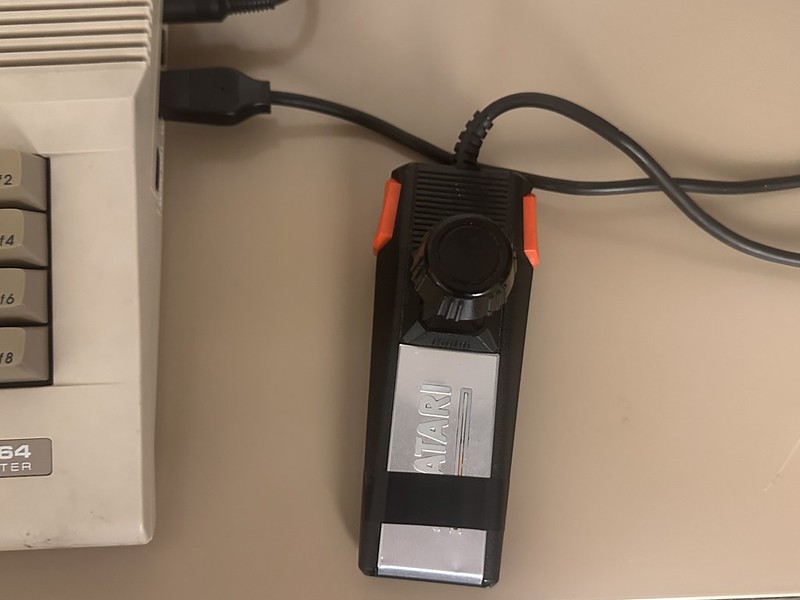
Atari 7800 joystick works well with the Commodore 64C

The final piece for the setup is getting a joystick so I can play the games. Turns out the Atari 7800 joystick works well with the Commodore 64C. And with that, I am ready to start loading and running games:

Commodore 64C Setup

The blue screen of life from the C64

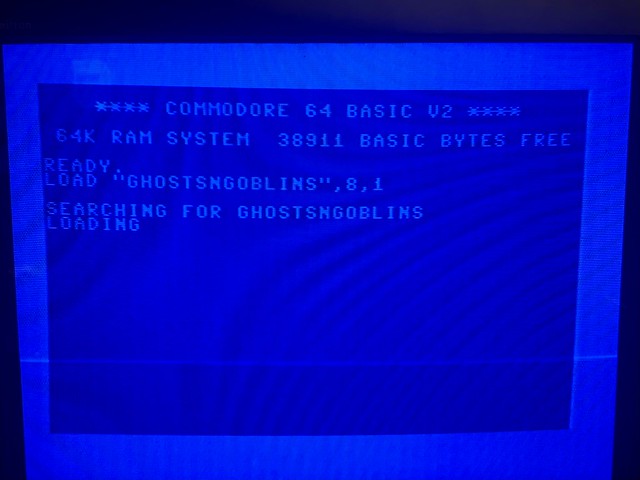
And for the cherry on top, loading a little Ghosts ‘n Goblins on the C64 would be nice, no?

Commodore 64C Blue Screen

Loading Ghosts n Goblins–hardest part about re-visiting the C64 is re-learning the commands

It’s worth noting here, if for no one but myself, a few of the commands used to get things running.

First, to assign the uIEC/SD drive the traditional number of 8 (it’s 10 by default) you need to run these two commands (thanks to the Good Old Days blog for documenting it):
OPEN 15,10,15,"U0>"+CHR$(8):CLOSE15
OPEN 15,8,15,"XW":CLOSE15

After that all commands can run with the uIEC/SD card as drive 8. I might need to change this back to 10 for the C128 given that has a disk drive built in that is already claiming the ID 8.

Also, when trying to switch to a .d64 disk image (which is essentially a floppy disk) you need to do the following:

OPEN 1,8,15,"CD:RANDOMNAME.d64":CLOSE1

After that, to see what is on the disk type the following command:

LOAD"$",8

Then

LIST

That will list the program files on the d64 disk that you can then load and run, such as the following:

LOAD"GHOSTSNGOBLINS",8,1

Once it is ready the type

RUN

While diving into the Lemon64 forums (which are invaluable) I found a tip about using FB1K V1.1 as a file manager for the SD drive, so I’m excited to play with that.

Anyway, that is my quick start tutorial to remind me how to negotiate the .d64 images that I always mistake as files and try and load. Future Jim, remember to first open the .d64 directory then load and run files.

__________________________________________

*Long story short, I am try to build a mini-haunted house at the arcade that folks can enjoy then play the games for a bit. In this effort I am reaching out to other folks who have cultural associations here in Italy and this guy Max came on my radar. He runs a space called Babarum which is an amazing, multi-level walled Italian garden that he opens up to the community once a week. It has live music, theatre, DJs, and is pretty much the sickest home bar I’ve ever seen. It’s more like a home club. He’s been both kind and generous with his time and knowledge for which I’m most grateful. Beyond that he had a Commodore 64 hanging around and gave it to me to see if it works.

Posted in retrocomputing, Retrogaming | Tagged , , , | 4 Comments

Zombie Malls

This post started as a comment on Martin Weller’s post “Meet me by the Blogroll,”  but it felt like something I might want to also have on the bava proper, so here we are.

Martin’s post draws a parallel between the life and death of the mall (a space near and dear to my 70s and 80s childhood) and the blogosphere. As with all of his metaphors, they are provocative in some really creative ways that I deeply appreciate.

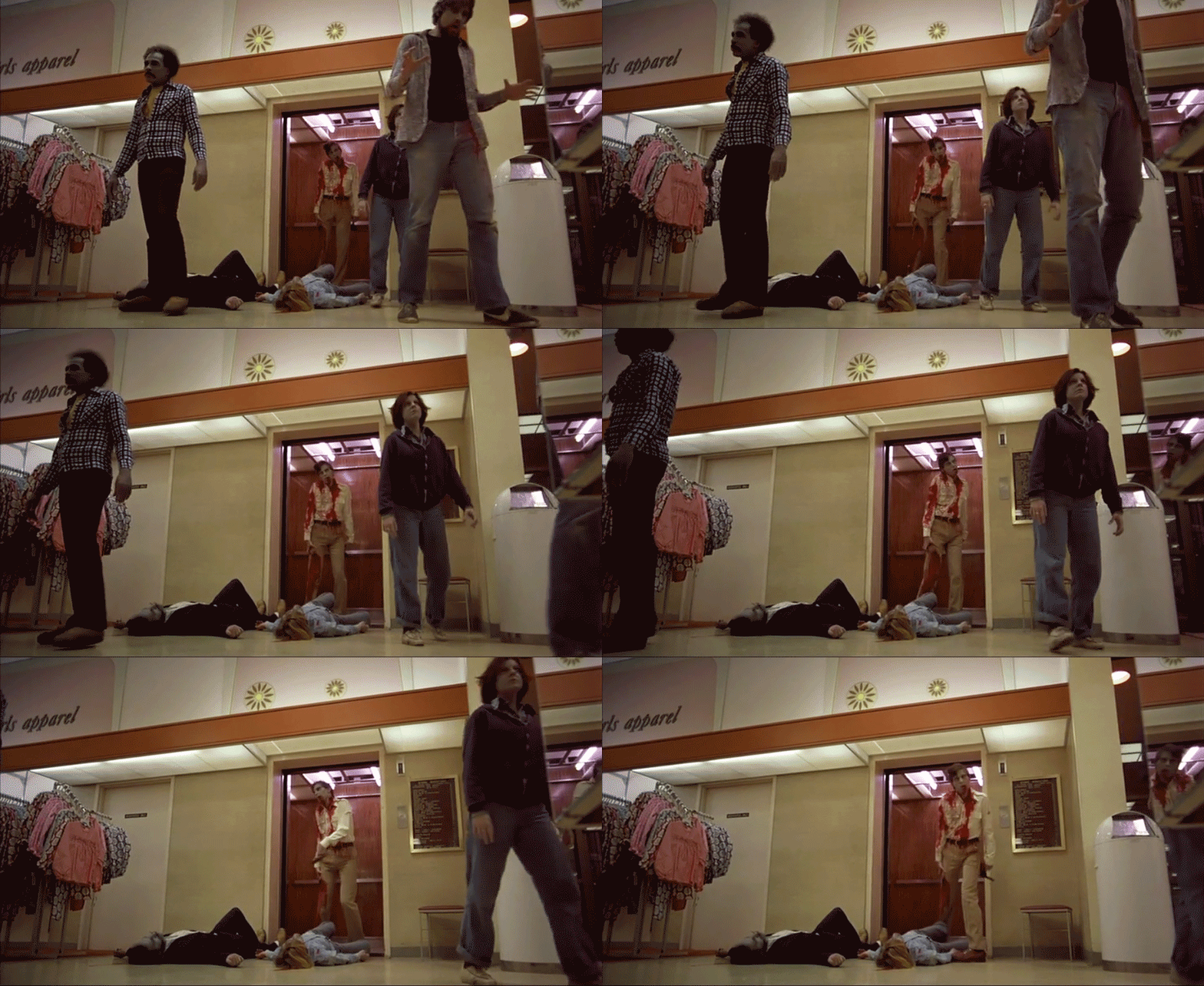
Dawn of the Dead zombies roaming the mall, as they did in life 🙂

Immediately upon reading the post I thought about George Romero’s second installment of his Dead series: the amazing Dawn of the Dead (1978). This film takes place almost exclusively in and around a shopping mall. It’s also the film that notes the dead that walk the earth are returning to what they knew in life: THE MALL! So good!

Zombies from Dawn of the Dead clamoring to get into the mall

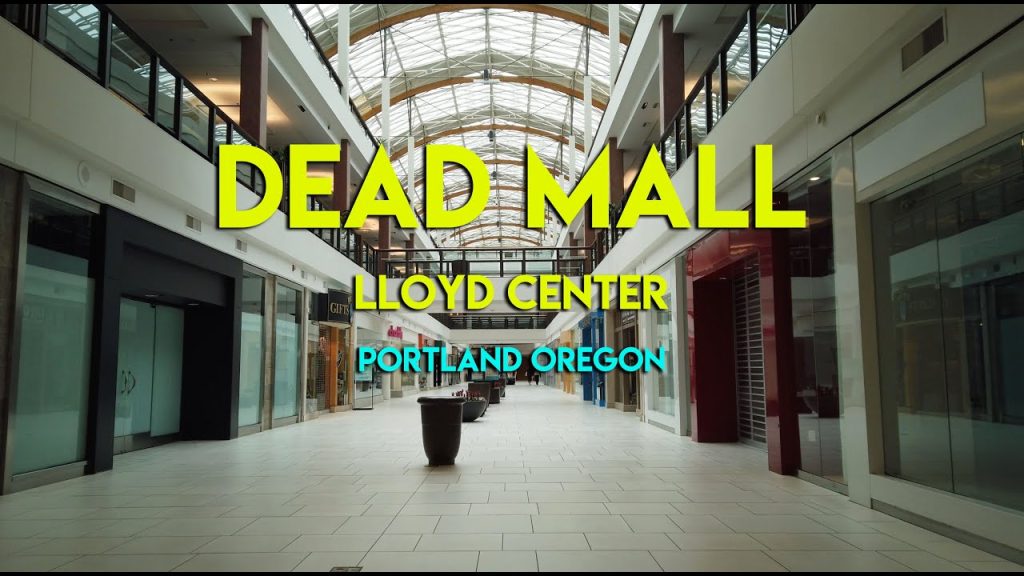
Recently my family and I went to the West Coast for a vacation. A large part of the stay was in Portland, Oregon cause we love that city. To the point of Martin’s post about the rise and fall of malls (and the blogosphere), a huge mall in the center of Portland—the Lloyd Center—lost almost all of its anchor stores and was essentially abandoned circa 2021. But something funny happened, a number of local, independent businesses saw the advantage of this moribund mall’s now super low rents. This was in many ways fueled by the fact that commercial rent in Portland has gone sky-high. So now this huge mall built in 1960 was the home to small, experimental start-up shops.

Portland’s Dead Mall: Lloyd Center – check out the Reddit thread about it

When we went there we found comic shops, record shops, Pokemon game shops, a working ice skating rink, and a crazy build-your-own-lightsaber shop—brilliantly playing off that “build-a-bear” concept. There were all kinds of other very Portland ideas percolating in the space that made this “dead mall” feel more alive than it probably has since the Fast Times at Ridgemont High 80s. The spirit of Portland is so awesome, and I have to think that’s really why that city is under attack with the recent blustering about deploying the National Guard—what a colossal fool.

I just love that the mall’s afterlife in Portland is an actually relevant and cool space again. It’s really powerful for me because if I go with Martin’s metaphor it might mean that the blogosphere is not dead yet 🙂 And while I’m not sure how much longer the Lloyd Center will exist (or the blogosphere for that matter) given both are built on prime real estate that some huge developer will build a combination Pizza Hut and Taco Bell sooner than later. But until that day comes it’s a model for what the blogosphere (and web) can become again—a welcoming, low-rent space that offers an escape from the platforms that everywhere box us in!

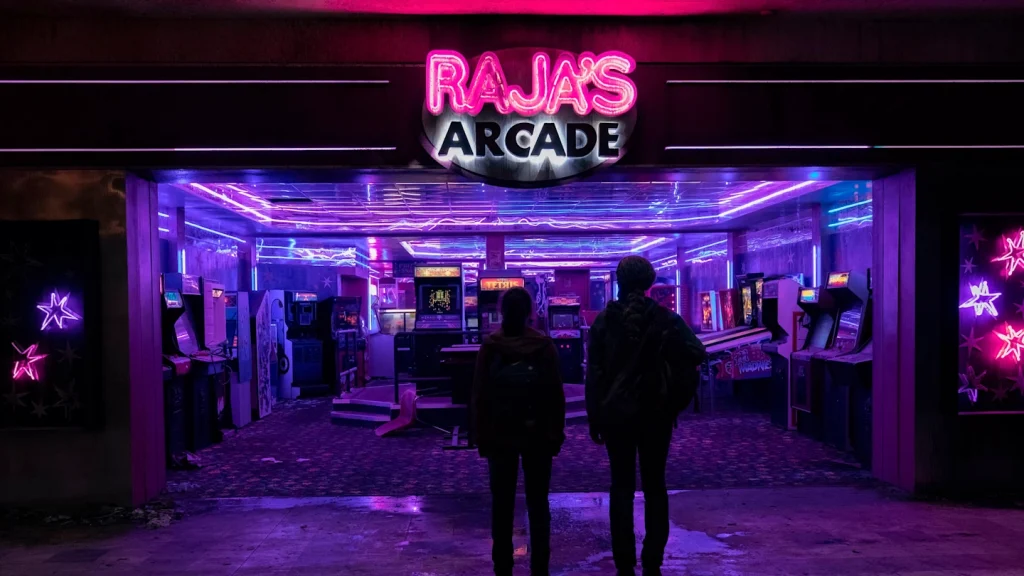
Scene of an abandoned mall from The Last of Us on HBO with a surprising amount of working games

Fun story, my family and I visited what appeared to be the last box store standing in Lloyd’s Center: a Barnes & Noble book store. Turns out it wasn’t your average Barnes & Noble. Not only was everything half off (it had become a wholesale store), but also the lights would turn off every few minutes. We thought it was a signal the store was closing, but the employees assured us that it’s an intermittent electrical issue they’ve been dealing with for months and that we can safely ignore it. So strange.

All of this led us to the conclusion that this Barnes & Noble was actually cool. Cheaper than Powell’s and potentially haunted! When we were joking with the cashier about our assessment, he was sure to remind us that Powell’s is a far better book store. While true, his admonishments reminded us we were still in Portland after all.

Anyway, thanks to Martin for an excuse to post about my summer trip while blogging about the half-life of blogging 🙂

Posted in Bloggers Anonymous, blogging | Tagged | 9 Comments

10 Years a Stranger

It’s hard to believe I just passed the 10 year mark in Italy.* At this point all my kids have spent more of their lives as residents of Italy than the US. When we take our family trips back to the States, as we did this summer, it’s like their visiting a foreign country—but one that they are intricately familiar with the language and culture. It’s that in-betweenness while occupying either of the cultures that I hope will serve them well in the future. The value of a critical eye towards the nationalist impulses that become part and parcel of being enveloped in your own private Idaho has never been more important. We’ll see, but the other side of that in-betweenness is a sense of restlessness that comes with being a stranger in both places, at least for me.

To be clear, I’m not nearly as acculturated to Italy as my kids. They’re fluent in the language; they attend the schools (a huge part of the assimilation process, and very much where they feel the most outside the US); and they actually have Italian friends. I have no claims to any of these features, but I still blame moving here when I was 43. I was already a bible-thumping nationalist by the time I set foot in Italy, so anything the European socialists might say or do to me could have no real impact 🙂

I’ve also been on the run most of my life. When I was 17 I left Long Island for college in Virginia for just a year and then on to California for another 7 years to finish undergrad and live life on the best coast. After that, back to New York City and grad school for 8 years. Then a practical move for a new family to Fredericksburg, VA where I “stepped in shit,” as they say, when joining the Division of Teaching and Learning Technologies (DTLT). After Reclaim Hosting became a viable plan A it was off to Antonella’s motherland: Trento, Italy.

This sense of being grounded is strange, the first 4-5 years here, up and until COVID, I was mountain boy. I was hiking regularly (probably in the best shape of my life since my early 20s) and essentially living Italy as a tourist. During and post-COVID things got a little more quotidian and despite being here for half a decade my language and acculturation was not getting much better (still true!). Irregardless of my head-shaking disgust with the trajectory of America, my sense of attachment to that identity remains ferocious, and arguably even more so the last five years as the Italian language feels like an impregnable fortress.

I often think about the Italian grandparents of friends I knew on Long Island who never spoke English. Whenever you saw them they would look at you with equal parts suspicion and wonder. They were truly strangers in a strange land—you could see it in their eyes, this was not their home. But like me, they probably learned that home is only where your family is. Those solitary visits back to Fredericksburg in 2016 and 2017 for work re-enforced how empty my life was in the US without my family—that house was no longer a home, just a house. This is still true, I have a good life in Italy despite my resistance to “becoming” Italian—which my wife is convinced is a mental complex on my part, for which I’m currently seeking help.

I’m also at the stage of life where in the next few years all my kids could be out of the house. Talk about losing a huge part of my stay-at-home (while working) dad identity. I’ve already started thinking about what’s next. I have a studio in the center of Trento where I started to work outside the house (a big step for me) and building dioramas based on movie scenes from the 70s and 80s. This has kept me somewhat placated and attached for the moment, and it has the added bonus of making me practice my terrible Italian with the random passer-by. But when you get to my age you also start thinking what what the hell you would do if you get sick and are holed up in a hospital where you can’t really communicate—that’s already created issues for me recently.

This year my dad died, that started my exploring the possibility of what a return home might look like. Turns out my love/hate relationship with Long Island runs deep—despite and because of so many people that I love so dearly on that island. I then imagine, 25th Hour style, what might a new life for the family out west in Portland, Oregon be like at this later stage of life/career.  As soon as I start entertaining that thought I’m reminded that Portland could very well be an occupied city by the time I’m ready to move 🙂 <– that’s an uncomfortable smile emoji, to be clear

Perhaps being a stranger is something I’ve grown accustomed to over the years, I may even relish it. Ten years into the Italian experiment there’s still much to explore and learn. And while the US government continues to do everything in its power to push others away it becomes an easy decision to stay put for the moment. But one of the things that haunts me is this sense of a final resting place, what and where does that look like? Have I arrived? I still feel restless enough to wonder if that’s even possible. The geo-political situation just reinforces any sense of “arriving” at a sense of peace or happiness divorced from one’s political and social context is primarily a myth.

What will the next ten years bring for this stranger?

_____________________________________

*Maybe even harder to believe that Reclaim Hosting turned 12 this past July.

Posted in bavatuesdays, family | 2 Comments

Halloween Diorama

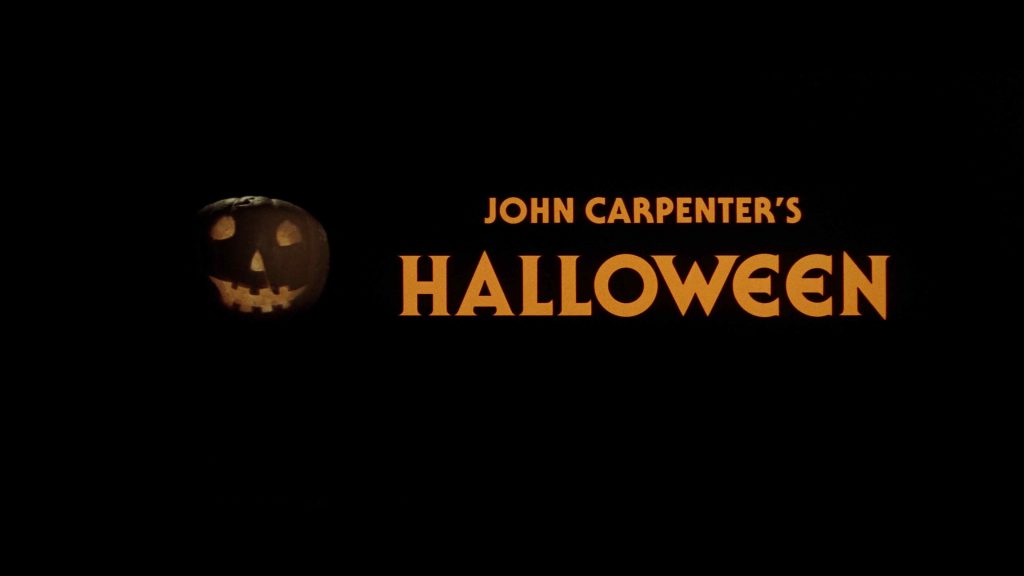
Joe Carpenter's Halloween title screen shot

John Carpenter’s Halloween title screen shot

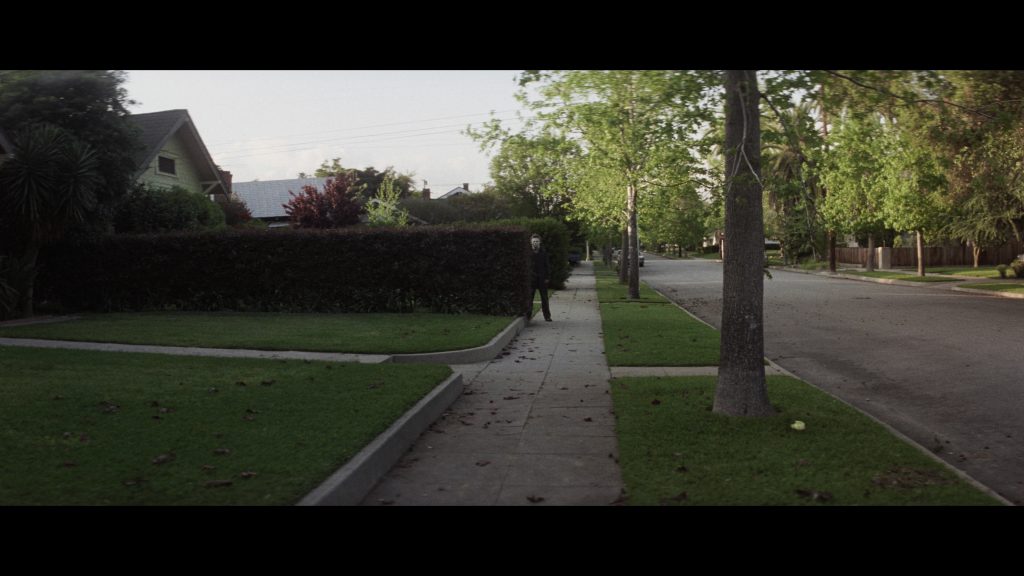
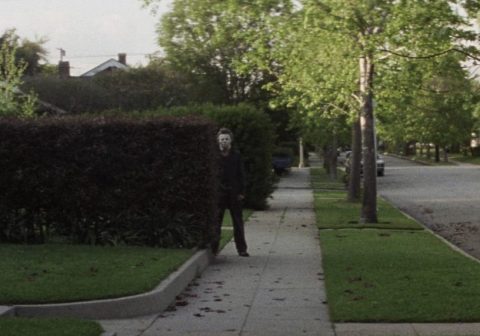
It’s literally gonna be a Halloween (1978) diorama, in particular the scene when Michael Meyers briefly appears from behind the hedge.

Shot from Halloween when Michael Meyers appears from behind the hedge

The bav-o-rama has had the Grady sisters of The Shining fame gracing its presence for the last 4 months, but they tell me its time to move on.

Sadly, The Shining diorama has run its course after four months

Not gonna lie, it was hard to say goodbye to the sisters given I think that diorama represents a potential high-water mark for the space, but Tommy assures me the best is yet to come, so avanti!

Apart from taking apart The Shining diorama we mapped out the Halloween diorama, figuring we would be able to recreate a piece of the shot physically in three-dimensions and then Tommy will paint the background and side-view around the centerpiece. Below is a cropped image of what we are planning to build:

Cropped shot from Halloween when Michael Meyers appears behind the hedge

This shot will essentially be what you see when you walk by the window. A bit more subtle than the twins, but for me it’s iconic not only because it’s the first time you get a good look at Michael Meyers as an adult in the film, but also given how well it captures the ambience of Halloween (the holiday) in a suburban town with fall in full swing. That’s what we’re shooting for with this diorama: communicating to our Italian audience a sense of the magic of that moment when Halloween arrives in a Midwestern suburban America town.*

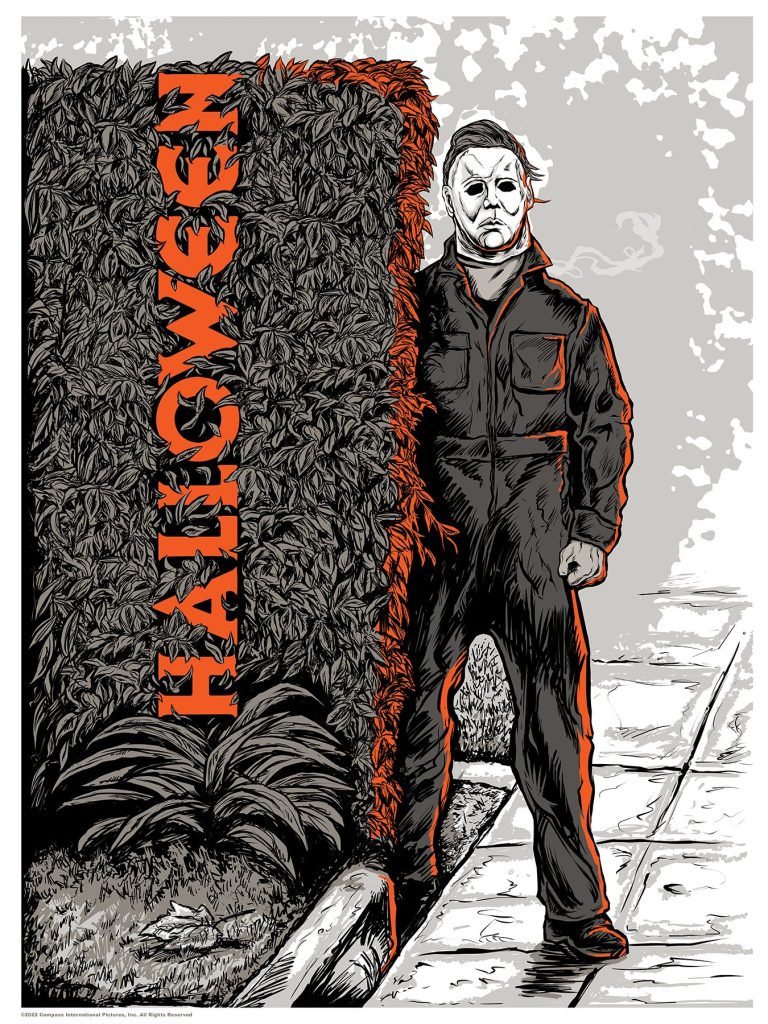
Highlighting this moment is also iconic for others, here’s a silkscreen of the moment created by an artist (link from image for more)

It’s also pretty magical because Tommy is fully partnering up on this one with me, so I’m turning this into a family business. We’ll soon be making dioramas all over the world together 🙂

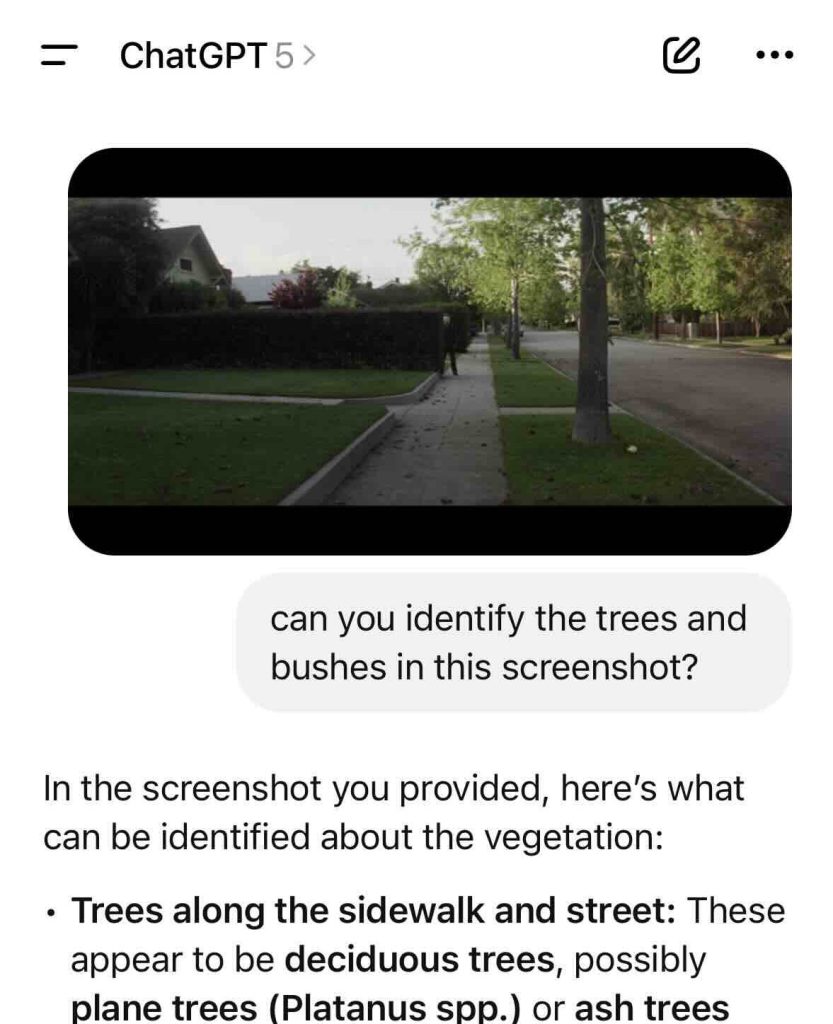
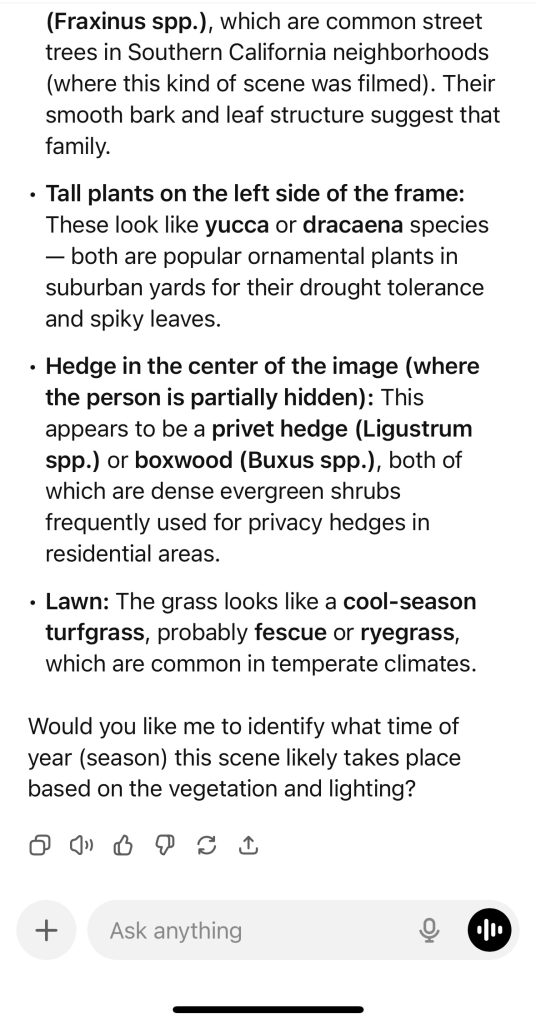
Having mapped out the floor and its incline for this piece, I’m now investigating reproducing the hedge, tree and sidewalk (I already have the grass figured out). To get a little help on the hedge identification I threw the image in ChatGPT and got the following:

I obviously fell down the rabbit hole of what time of year, what time of day, is that dog poop or a leaf? etc. It seemed accurate enough claiming it was shot in early to mid autumn (that’s what the director wants you to think at least) and in the later afternoon/evening (that’s when the girls are walking home from school). ChatGPT was also able to quickly ascertain this shot was in Southern California (something the director was trying to hide) rather than the Midwest.

In fact, this hedge is one of the more famous in Hollywood, or South Pasadena to be precise. It not only still exists, but it has become a popular destination for fans, which is a blast and further re-enforces the iconic nature of the scene.

That said, the imagined world of Halloween is the fictional town of Haddonfield, Illinois. For me as a Long Island kid the way Carpenter captured that sense of anywhere suburbia America during the 70s was a huge part of the power of this film.

And while the scene was shot in the spring, lighting and the placement of some fallen leaves and toned plants quickly belies that fact for creative effect. In fact, we’ll be trying to do the same in our diorama with much less to go on. Hopefully knowing those are ash trees and the hedge is a boxwood (something I kinda knew) will help a bit with some modicum of verisimilitude.

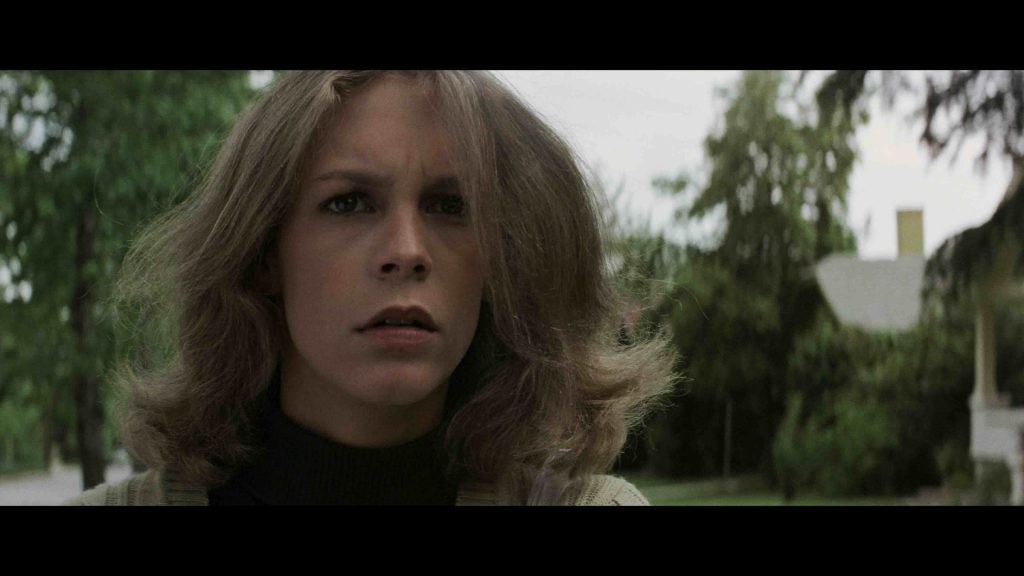
Image a of a deeply concerened Jamie Lee Curtis after seeing Michael Meyer disappear behind the hedge

If we can get at least one passer-by with the same reaction that Jamie Lee Curtis has in the screenshot above, I would call it a success.

_________________________________________

*As an added bonus, the Halloween in the film land on a Friday as it does this year, so I love that chronological symmetry.

Posted in bav-o-rama | Tagged , , | 4 Comments