Reclaim the Web with Reclaim Hosting

Image credit: "No Dash for Gas" http://www.nodashforgas.org.uk/

Image credit: “No Dash for Gas” http://www.nodashforgas.org.uk/

Yesterday Tim Owens finished up the “10 Reasons to Reclaim” series on the Reclaim Hosting blog. Granted I’m biased, but I think what he’s laying down in that series—especially the #1 reason to Reclaim—is arguably the most innovative infrastructural work happening in edtech. Why? Well, he’s taken what we’ve learned helping schools get up and running with their Domain of One’s Own projects and made it dead simple and dirt cheap for any school—no matter how big or small, rich or poor—to get up and running.

For $199 a month a department, school, or university can start exploring what it would mean to give faculty, staff, and students a domain of their own with web hosting. While this price doesn’t include a unique domain like mysite.com (though that could be easily arranged), it does provide a subdomain on any given top level domain, such as jimgroom.reclaim.host, that has access to a cPanel interface with the ability to install applications, map a domain, create an email, etc. You can get a trial account to see exactly what I’m talking about here: http://reclaim.host/

How could schools not afford to experiment with this? I think the innovation here is four-fold:

  • It’s an excellent platform for controlling one’s own data and identity
  • It meets a growing need for digital projects, courses, and portfolios
  • It’s eminently affordable
  • It can be seamlessly integrated into a school’s authentication system making it dead simple to rollout

Don’t believe me? Try get up and running with your own subdomain here, and tell me you can’t see faculty, staff, and students doing this?

What excites me most about this whole thing is that Tim has formalized and scaled a vision we’ve had for a while at UMW. Finding ways to share the innovation we’ve been working on with as many people as possible. We did it with UMW Blogs back in 2008, but that was a one-off approach that we couldn’t support and sustain beyond one school. Reclaim Hosting is for real, with the recent ten reasons series we’re doubling down on just how serious we are about making the work we do accessible to just about anyone.

This marks a highpoint for the edtech work I’ve been part of over the last decade. Rather than just bemoaning existing possibilities or pointing out the limits of the existing infrastructure (something I’m certainly guilty of), Reclaim marks an intervention into technical reality behind it. We’re offering something we believe in, we can scale, and we want to support. We’re making it easier and cheaper for colleges and universities to enable their communities to invest in the open web again.  It’s time to reclaim the power of the web with (or without) Reclaim Hosting. We’ve just made it easier. Can you dig it?

I knew that you could.
Posted in reclaim, reclaimopen | Tagged , , | Leave a comment

iPod Liberalism

This week we had an interesting series of panel discussion about the political, social and economic implications of the web in the Internet Course. The way Paul and I run this course, almost all of the content is researched and shared by the students presenting any given day. So this past week it was cool to see that Dalina Beckham started us off with an RSA Animate video of a talk by Evgeny Morozov to talk about the problems with cyber-utopianism. It was a great discussion starter around the limits and possibilities of the web as a vehicle for political change.

It’s been interesting just how much of this class has been driven by moments like these where the presenters will share a particular video that speaks to an issue and the conversation proceeds from there. It’s a pretty compelling way to run a discussion course, and I am enjoying it immensely.

Posted in The Internet Course | Tagged , | Leave a comment

A funny thing happened on the way to preschool

I’ve taken this week off to work on my upstairs bathroom and generally get ready for Halloween. Historically this has been the busiest week in our house with three young kids, as many costumes and parties, and a ton of others things to be done. I decided to take off some time to be home given I’m not traveling much this semester, which has increased my quality of life 1000 fold.

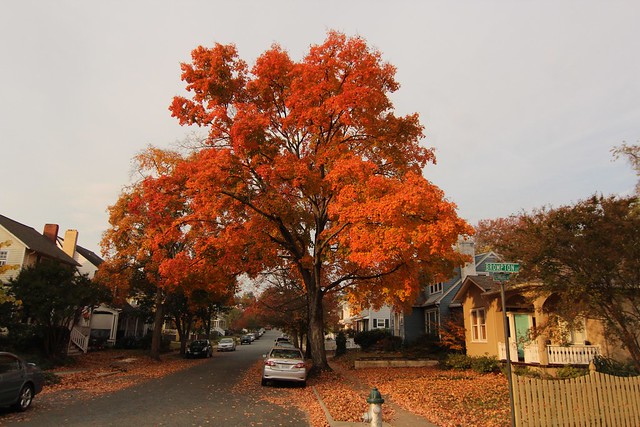
Anyway, on Wednesday morning I got up with the two older kids and got them off to school, and then took some time to walk Tommaso to his preschool downtown. He has gotten into the habit of scootering to school with the requisite stop at the local cafe for his favorite pastry (as Dr Garcia would say, “Eurobaby!”). I figured I would take a camera given Fall is pretty decadent in Fredericksburg this week. Less than a block from my house is a big old beautiful tree that is basic on fire. I see it from my front door on a regular basis, but I decided to try and capture the image, so I did.

“Fall in Fredericksburg”

When I got done with the walk I uploaded it to Flickr via my Known site, and went on with gutting my bathroom. A day and a half later I was looking through my photos and saw that a couple of my recent images got as many as 250 views, which is a ton for photos I take. And that’s not surprising, I take photos of my family, my house, and some fairly Norman Rockwell shots of the perfect small town. I can’t help it, I’m genetically nostalgic. My photography is middling at best, and when I look at photos from folks like Tom Woodward I am blown away by the quiet complexity of a great photo. So, when I got to the “Fall in Fredericksburg” shot and realized there was over 28,000 views I thought it was an error. But then I realized there were more than 40 comments and 700 favorites, so I knew something was up. I put up a tweet expressing my confusion, and Brian Bennett immediately figured out what happened:

Screen Shot 2014-10-30 at 9.47.37 PM

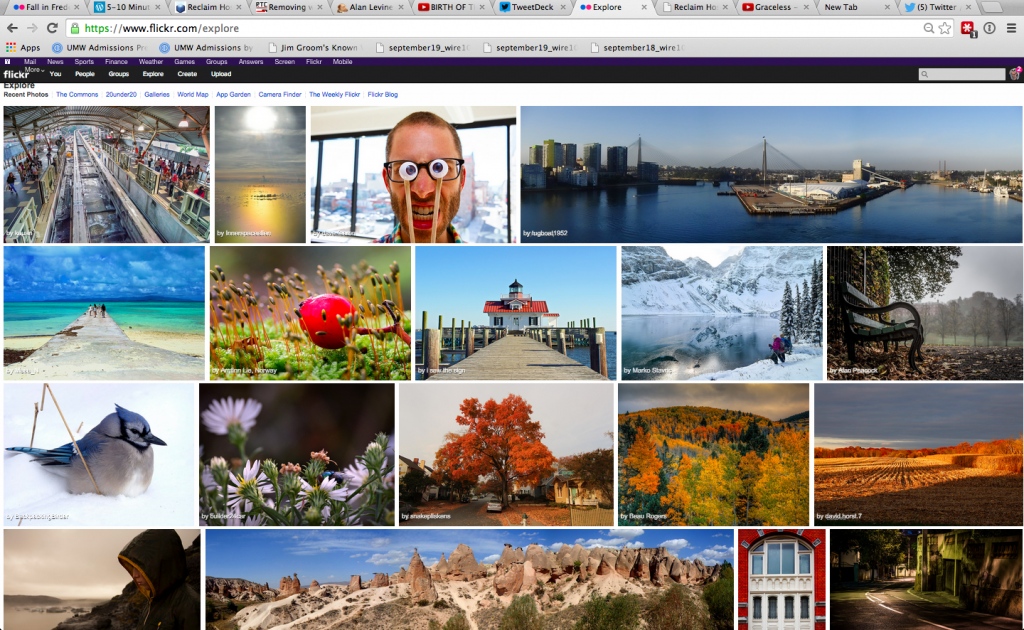
And there it was, this humble photo of a tree in Fredericksburg featured on Flickr’s Explore. Which made me think, how the hell does Flickr’s explore work? I mean i’m not one to denigrate my own work, frankly quite the opposite, but I would be the first to say this isn;t necessarily a great shot. So what about it? Turns out, no one really knows how Flickr Explore works beyond “there is an algorithm”:

Patrick Costello says:

There is an algorithm. It probably started off measuring all the obvious things but certain groups got really good at gaming the system so Eric built in some less obvious criteria.
The objective is not to find the best pictures on Flickr (impossible for anyone to agree what they might be) or even the most popular (though the algorithm takes note of popularity as some indication of something), but simply to highlight interesting content that you might not otherwise see.

It’s not a competition.

I just love the idea that the algorithim is trying to resist the idea of the best or most popular photo, and focusing on this idea of interest–whatever that means. It’s not a competition, but getting featured like this does make me feel kinda good. Being featured can easily be seen as a competition, and I understand why, but if it’s framed around one’s interest it can become a far more interesting and generative process of building community.

I’m particularly taken by this because just last week we ramped up the presence of ds106 inspire, a site where students feature the work other have done in the community that has inspired them. And that’s not necessarily about the best work, in fact ds106 has never been about the best work per se, but about finding ways to express and articulate your interests across various media. The students that frame, develop and more fully articulate their specific interests  usually have the most fun. There’s something to that, and I kinda like that my tree photo found an audience on Flickr not so much that is was masterful composition or technically brilliant, but that some folks found it interesting. It spoke to their own sense of nostalgia for a moment. That simple connection beyond competition. It’s a fine line, but one worth exploring to build community.

Posted in digital storytelling, pictures | Tagged , , , | 1 Comment

Set UMW Blogs to Phase Diagram

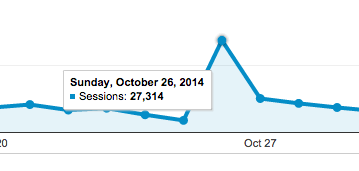
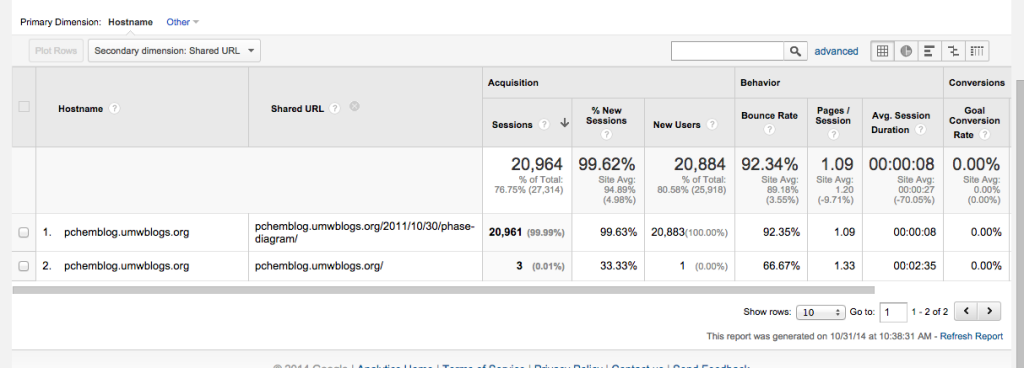
Screen Shot 2014-10-31 at 10.46.48 AMI was looking at the traffic on UMW Blogs on this beautiful Fall morning during my day off—I can’t help myself. Looks like last Sunday we had a traffic anomaly of epic proportions. On average we get 8 to 10 thousand page views a day, but this past Sunday we got a whopping 27,000 hits. What in the wide, wide world of web sports went down? With a little digging in Google Analytics I discovered (under Audience–>Technology–>Network and switched Primary Dimension by Hostname)  that 20,000 page views were hitting a three year old physical chemistry post featuring the phase diagram.

Screen Shot 2014-10-31 at 10.38.47 AM

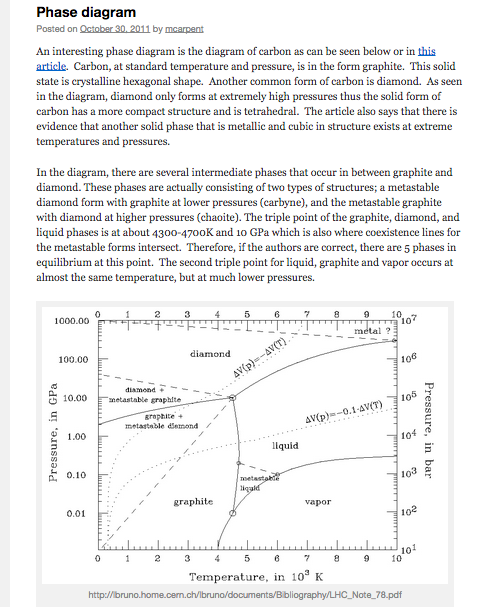
Here is a look at the post:

Screen Shot 2014-10-31 at 10.46.21 AM

Phase Diagram post on UMW Blogs

Which begged the questions, what site sent 20,000 people to a diagram on UMW Blogs about chemical properties of carbon? I discovered (under Audience–>Technology–>Network–>Hostname and filtered by the secondary dimension Social Network) that it was Reddit of course 🙂

Screen Shot 2014-10-31 at 10.38.47 AM

In particular, the traffic came from the AskScience Discussion thread posing the question “Does every material have a solid, liquid, and gas state?” One of the comments links people to the post/diagram on UMW Blogs as a way to demonstrate Carbon has a liquid phase (which we all know thanks to Hans Solo’s being frozen in liquid carbon in Empire Strikes Back).

Moral of the story? I’ve been saying it for years, but educational institutions publishing to an open web makes the commons greater and open resources ubiquitous. I can;t get enough of these stories, and with a work horse like UMW Blogs that is well into it’s seventh year, it should be no surprise anymore. But it’s always worth repeating lest we forget how powerful these open publishing platforms can be to share information at a scale far beyond our wildest imaginations.

Posted in UMW Blogs | Tagged | 2 Comments

Diverse Literacies and Thinking Like the Web

I caught Friday’s Connected Courses webinar with Gardner Campbell, Howard Rheingold, and Jon Udell discussing the idea of Thinking Like the Web. This was a must-see for me because so much of the work I’ve been part of over the last five years (ds106, UMW Domains, and Reclaim Hosting) is inspired by a more robust and engaging approach to web literacy at UMW and beyond. The idea that there are certain key concepts like tags, syndication, aggregation, etc. that both faculty and students meed to wrap their head around to get a sense of the power and possibility of the greatest of all communication revolutions.

This vision inspired the thinking behind ds106 which helped demonstrate Domain of One’s Own was scalable for the entire institution. Whereas, for clarification purposes, Reclaim Hosting is the vehicle by which we’ll scale it for the rest of higher ed 🙂 So, needless to say, I have a lot invested in the idea that thinking like the web needs to be a fundamental element of higher ed moving forward, and thanks to Tim Owens I can and will back it up with servers and domains for all my friends!

But that’s not exactly, precisely what I was planning on writing about. What I wanted to note was at 34:50 of the video archive of this webinar discussion Udell talks about the fact that writing is not the primary mode of expression on the web. Rather, it’s a platform of the diverse literacies including video, audio, visual, design thinking and more. TO make his point, he used the example of a manufacturer of furniture repair parts sending him a video to demonstrate how much pressure to apply when hammering a particular piece, something that might be far harder to communicate via text. This idea being that sharing videos provides a fairly new (in terms of ease, access, and immediacy) and rather powerful medium for showing and demonstrating a physical action.

At the same time, video, like writing, is a form that has conventions, grammar, syntax, etc. And to what degree are are we helping students interpolate these other modes of literacy. We’ve just begun the video section of ds106, and one of the clips we are asking the students to reflect on the visual rhetoric employed in the opening sequence of Fritz Lang’s M (1931).

I know art, film and communication departments have been teaching this for decades, but when listening to Udell and Rheingold talk it became apparent this needs to be a more fundamental way of seeing and thinking at universities, much like writing essays became the primary currency for near on a century. I think it’s painfully clear we should be cultivating multi-modal literacies across disciplines and departments. And they should be focused on the ways in which these various media are playing out on the most remarkable and fairly complex expression engine to date: the web. But few, if any universities, are taking this on as a core part of their mission, which seems insane 25 years after the web claimed half the world’s population as its own.

The many of us who came together to build ds106 had no idea what we were doing, but part of me wants to believe we were trying to imagine what such a curriculum might look like and how we would get at it in a fun and engaging way. I’m not sure we failed entirely 😉

Posted in Uncategorized | Tagged , , , , | 2 Comments

Wire 106: Week 10 – “Let’s Go to the Videotape”

TV-color-bars-2

Actually, it’s not really tape, it’s all digital these days.

So now it’s time to start putting all the different digital media we’ve been exploring this semester—photography, design, and audio—into motion. Video is a magical medium in that it combines so many powerful elements into one, but that’s also why it can be difficult to do well. We’ll be working on just that these next two weeks.

Reading Movies
Take a look at the Reading Movies unit for the open ds106 course, there are a ton of great resources there. And while we’ve been reading The Wire closely all semester, this week serves as reinforcement. It’s high time we start formalizing the things we’ve been talking about. This should raise the quality bar going forward. But also since we’ve been analyzing all along, this week’s concepts should be easy for everyone.

For a quick overview and some inspiration watch the short Ken Burns clip on storytelling with video:

Read the late movie critic Roger Ebert’s article “How to Read a Movie,” you’ll be coming back to this for the “Look, Listen, Analyze” assignment explained below.

Finally, watch the first seven minute’s of Fritz Lang’s masterpiece M and reflect on how he is providing exposition and creating narrative tension cinematically in this opening sequence. How does he get across such a huge amount of information, simply, subtly and naturally?

Look, Listen, Analyze

This week you need to do the “Look, Listen, Analyze” exercise outlined here, the only difference is you should use a scene of your choice from this week’s episodes of The Wire.

Tag: readingmovies

Tools of the Trade

For the work over the next few weeks, you will need to be using software that allows you to combine, edit, augment, re-sequence video, as well as being able to add or even replace the soundtrack within a video.

Reference the Tools for the Trade for links to software you might want to use as well as our new Video Guide for video resources and tutorials.

We most strongly recommend you use the applications that come with your computer- either Windows Movie Maker or Apple’s iMovie, these are generally the easiest to get started with and should be available on your computer.

Note that students often face challenges in Movie Maker and importing MP4 type videos (the most common format you will download videos in), you may have to install extra video codec software or find converters that will translate MP4 videos into AVI or WMV formats (try http://www.online-convert.com/ or http://zamzar.com).

But for this unit’s work, you will only do basic editing. If you don’t have a machine that can handle editing videos, the Media Editing Lab on the first floor of the Convergence Center is open and available, as are the Macs on the first floor of the library.

For making small clips from downloaded videos, get a copy of the free MPEG StreamClip, an application for Mac OSX and Windows that makes it easy to mark and export the exact portion of a video – see our tutorial that shows you how this is done.

Basic Editing

We recommend using video editing software that allows you to cut and re-arrange clips on a timeline, and to add, and layer audio tracks. Most typically this is the software that came with your operating system- iMovie on Macs and MovieMaker on Windows PCs (but feel free to look at some of the other options in the ds106 Handbook).

Many of the assignments will require downloading of clips form YouTube (we have a tutorial if you need it). PC users may have challenges in importing the downloaded mp4 video files into MovieMaker (We have been told that the Windows Movie Maker Live can import MP4)- you will either have to install codecs to read mp4 videos, or use a converter to change mp4 into AVI or WMV file formats. See the ds106 Handbook for some video converter options.

Other resources that may help include:

Digital Knowledge Center

The Digital Knowledge Center (on the 4th floor of the ITCC) is open for business between 10 Am and 6 PM Monday through Thursday, and from 10 Am to 3 PM on Fridays. They are awesome, schedule an appointment to get focused help with using these video tools—you might even meet a fellow classmate 🙂

Video Assignments

Do ten stars, involve The Wire in at least one assignment.

Episodes:
Season 3, episodes 8, 9 & 10

Video Discussions

  • Episode 8 on Tuesday, 10/28 at 7:30 PM
  • Episode 9 on Thursday, 10/30 at 7:30 PM
  • Episode 10 on Friday, 10/31 at 1:30 PM

Sign-up here.

Daily Creates: 2

Inspires: 2 Building on last week, keep inspiring one another.

Posted in digital storytelling | Tagged , , | 1 Comment

Four Flies on Grey Velvet (1971)

I try not to be, but whenever I see a Dario Argento film it’s hard not to compare his work to the master, Mario Bava. And with such a pairing, Argento always seems to come up short. But this could be a personal issue, and perhaps I’ll outgrow it and become a healthier moviegoer—or maybe I’ll become a sadistic psycho-killer like the one in Four Flies on Grey Velvet (1971).

Last night I saw a 35 MM print of what is one of the rarest of Argento’s films (though you can find the entire film on DailyMotion these days) at the Library of Congress, Packard Campus. They had an uncut version in English, but the print was pretty bad quality with lines all over the place. What’s more, the colors were faded leaving a red tinge throughout. The film is the third installment in Argento’s “Animal Trilogy” and it’s not nearly as gory or scary as some of his better know films like Profunda Rossa (1975) and Suspiria (1977).  In fact, it’s actually more comedic than anything else.

There were various scenes when the small film audience I was watching it with burst out in laughter. And for most of them that seemed to be the desired effect. The plot was thinner than the various women’s blouses in the film, and the lead actor was almost impossible to relate too. That said there were some scenes that were pretty awesome. In particular the opening scene and the closing scene.

The opening features the protagonists band rocking out and then cuts to a human heart beating in empty space. In many ways it’s a perfect metaphor for the incongruence of much of the plot, but the rockin’ drumming which seamlessly compresses a week’s worth of time into a few minutes was pretty awesome.

On the other hand, the final scene does that opposite, taking one moment and stretching it out over three minutes. It’s a bit gory (although not by Lucio Fulchi’s standards), but marks one of the first times a feature film uses “high-speed camera (capable of producing 1000 frames a second)” to slow down the action so you can see crazy details of the collision. It’s a beautiful scene, and the music makes it. Also, it’s not really too gory but you should take heed that heads will roll.

I didn’t really think about it until writing this post, but the compression of the opening scene and the expansion in the closing moment is an interesting meditation on time in both film, life and death. But I’m not sure all that came between those two points of the film reinforced that intelligibly in any way—but it does make me admire Argento a bit more. Who knows, maybe it’s a sign I’m turning.

Finally, the music is by Ennio Morricone, and he rules. Although apparently Argento and Morricone had a major falling out over the exclusion of certain tracks, so they wouldn’t work together again until his 1996 film The Stendahl Syndrome. You could argue this made way for Argento’s work with Italian progrock, soundtrack band Goblin, which is significant given how connected their sound is to Argento films like Suspiria and Tenebrae—not to mention Romero’s Dawn of the Dead.

Posted in film, films, movies | Tagged , , , | Leave a comment

Jack-O’-Lanterns in StereoGIF

IMG_5175

It was my oldest son’s birthday weekend, and we had a good one. Bowling party, Minecraft mods, 8-bit jack-o’-lanterns, and much more. With him turning 10 comes the closing of the first decade of my own blogging. I didn’t start the bava blog until December 13, 2005, when I arrived at UMW. But I started my first experiments with blogging about this time in October 2004 with planetmiles.net. Crazy, time goes fast, and the web has helped me chronicle a remarkable amount of my post-independent life with kids.

Also, I was pretty impressed with my creeper pumpkin, if I must say so myself. I can do 8-bit art quite well 🙂

IMG_5165


Posted in Uncategorized | Tagged , , , , , , , | Leave a comment

Inspired by Un-Cropped Signs

One of the nicest surprises of ds106 this Fall has been the Daily Creates. I am consistently blown away by the awesome work people are doing for these creative exercises. The community owes a huge amount of thanks to the impeccable work of Mariana Funes who has taken over the gardening of this branch of ds106 from Alan Levine—who kept it alive for the last two years.

Many of the daily creates have been just as inspiring—if not more so—than fullblown assignment posts, so I figured I would share a double-feature for the un-cropped sign prompt back on September 23rd.

I loved Jessica Reingold‘s “Falling” Rocks:

https://www.flickr.com/photos/67490503@N05/15335249175/

And Nicky Memita’s Popper Scooper or, “construction” will never be the same again.

Pooper Scooper

Posted in digital storytelling | Tagged , , , , | 4 Comments

Inspired: The Game Supercut

This video is a supercut of all the mentions of “the game” from season 1 of The Wire. It’s pretty amazing what John Johnston is doing with the software he found that automatically creates supercuts from video files based on the subtitle time stamps of dialogue. Brilliant stuff. I’ve already blogged about this awesomeness, but I how couldn’t this be an inspired post?

Posted in digital storytelling | Tagged , , , , | Leave a comment