6x6x6: In Our Time as told through T-Shirts

Week two of Hardboiled was dedicated to Ernest Hemingway’s collection of short stories In Our Time (1925). It’s a series of stories loosely connected around the themes of war, loss, death, and some larger, figurative “end of something.” It’s the third or fourth time I have read this book, and I have to say it has gotten better for me each time. I always considered myself part of the Faulkner camp when it came to U.S. modernism, especially during undergraduate, but I’ve starting to really come around to both the style and themes of Hemingway’s fiction since.

It’s amazing just how much Hemingway can pack into so few words and such short, taut sentences. The genre/style of Flash fiction that has become increasingly more popular as of late and I am realizing it has many of its early, genre-defining masterpieces within In Our Time. Stories like “The Revolutionist” and “A Very Short Story” are little more than a page but so rich with narrative that every line could be the plot of a novel (more on “The Revolutionist” in particular in a minute). The majority of these stories are five to six pages—but feel as fleshed out and dense as any novel. The ways in which Hemingway’s minimalist style congeals so beautifully with the way he in which the aesthetic of minamlism has defined the web for the last 5-10 years is fascinating to me. It’s as if the web were the perfect medium to analogize and engage such a format given our own technological transformations. Paul Bond, who has been playing along with hardboiled and is awesome, says it best in his reflection about Hemingway’s style:

I wonder if Hemingway’s style was in part a reaction to his time. The beginning of the twentieth century saw life quickly going from a gas-lit, horse and buggy world to cars and planes and electricity and radio. In those circumstances, lives would have gotten busier, the pace faster, and Hemingway’s sparse style would have been a natural fit. In our own time, life is even busier, and we’re sending messages in 140 characters and telling stories in six words.

There some important parallels and they underscore my rationale for starting with Hemingway. His style, which is almost invisible to most given how common it’s become, was a radical departure from the extensive verbiage of Victorian tomes that defined a century of fiction before figures like Ezra Pound, Virginia Woolf, Gertrude Stein, and James Joyce started experimenting wildly. Hemingway’s prose in many ways became the vernacular of that experimentation that is still in use today. And while he is not alone in this, we’ll talk about Dashiell Hammett’s simultaneous experimentation with form and the detective genre, the focus on minimalism, violence, and the end of a way of understanding the world outside of the technological modernism that defines the early 20th century is beautifully and succinctly embodied in In Our Time.

But that’s all fine and good to say, now let’s anchor the argument in that actual text and its contexts. The approach I am taking in this post is to use short, six word quotes from the various stories, alongside an iconic image, and putting them on a shirt to try encapsulate an element of a story and its themes. I talked about the idea in some detail here, and once again Paul Bond has already done a brilliant example from “The Battler.” Paul notes that “People would get that there’s a cryptic meaning to it, but most wouldn’t place the quotes.” It’s kinda like Hemingway’s style, an allusion to things, ideas, and meanings that you have to work for—an issue that was foregrounded during class this week. Few, if any, students in the class dug deeply into those allusions, or ruminated on what exactly is going on just beneath the surfaced tip of the proverbial iceberg. That must change!

Anyway, as an attempt to model the 6wordsx6iconsx6shirts (6x6x6) assignment I did a number of them last night that are tied together by the recurring theme of loss, the ravages of war, death, and a world in radical foment—a theme I only just touched on Thursday with my favorite story from this time around “The Revolutionist.” But let’s start with the ruins! When I first read In Our Time in undergraduate with professor James Goodwin at UCLA he returned again and again to simple quotes through the story that were constantly referring to a concrete, physical reality as well as a psychic state. The realism in Hemingway always finding its symbols and icons realistically weaved inside the story so that disaggregating the two became increasingly more difficult. This works nicely in “The End of Something” wherein Nick and Marjorie breakup because Nick can’t feel anything anymore. It’s the end of something, but the figure they keep referring to as over is not the relationship but rather an old mill that has abandoned. All that is left is the ruins, and its the ruins of a time gone by as well as the ruins of Nick’s emotions and his relationship with Marjorie—all happening at once, all sparsely described, and all competing levels of genius that start to hit you if you just slow down a bit and look for them. “The End of Something” could have just as well been the title of the collection of stories. Here is my shirt for this quote, a theme of loss and a relationship, life, and world in a kind of psychic ruin is all here in this simple 6 words with the right context 🙂


Image credit: http://thenounproject.com/noun/ruins/#icon-No3849

Playing on this theme the following story sequentially, “The Three-Day Blow,” picks up his theme and uses the storms of Fall that blow all the leaves off the trees and rip through the lanscape (a figure returned to at the end of the stories with the grasshoppers and scorched earth) becomes the controlling metaphor for Nick’s sense of emotions and attachment being blown away. He gets excited at the idea that it is theoretically possible he could love Marjorie, but as the stories ends it is apparent that that possibility to that the “wind blew everything  like that away.” Again the naturalistic metaphors seamlessly integrated into the story could be completely missed if you don’t have a sense of the context and the psychic wounds Nick is carrying around—the vignettes about the war, bullfighting, etc., seem to frame that context for the reader, but the refusal to spell it out is jarring and the approach from some many different perspectives, none of which are necessarily grounded suggests the influence of Pablo Picasso and Gertrude Stein’s experimentation with cubism on Hemingway’s early masterpiece—and arguably his greatest book as a result.

Image credit: Wind http://thenounproject.com/noun/wind/#icon-No2636

“I don’t love anyone!” is a Belle and Sebastian song, but it’s also a major recurring theme throughout the stories, the inability for the characters in “The End of Something,” “The Three-Day Blow,” and “Soldier’s Home” to be able to connect or talk about their experiences in the war becomes the unspoken reality. This is not a book about the physical atrocities fo the war as much as it is a book about the psychic atrocities of warfare more generally—and he tells it all indirectly—an approach that is so much more subtle, haunting, and painfully beautiful in the end. The following quote is from the back and forth between Krebs and his mother in “Soldier’s Home,” a story many scholars point to as the obvious war story from the collection, but you could argue they almost all are.

Image credit: http://thenounproject.com/noun/broken-heart/#icon-No821

The real discovery for me this time around was “The Revolutionist,” a very short story about a Hungarian communist fleeing the “White Terror” through Italy. Little over a page long, I was blown away by how much Hemingway could pack in there, and how dense the story was. In just three paragraphs he references the White Terror in Hungary, the early masters of Italian painting, the revolutionary state of the world, and the ethnic atrocities committed by Horthy as a reaction to the short-lived communist-driven Red Terror in Hungary. All this happening in such little space, and what struck me is none of my students stopped to dig here. What does Hemingway mean by “Whites in Budapest” or “Mantegna he did not like” or “Horthy’s men has done some bad things to him” or “he believed alltogether in the world revolution”? I stopped at each of these points and asked the class again and again. No one knew. No one simply did a search, that’s all you would have to do to get a wealth of historical context that turns a one page story into a book-long adventure into the political aftermath of World War I with Hungary as the stage for a ethnic cleansing of the Jews that would be scaled to horrific levels just 15 to twenty years later. Who is Mantegna (Andrea Mantegna the great 15th century Italian artist)? And why doesn’t this Hungarian revolutionist like his art? What world revolution is he referring to? What’s happening here? Who the hell is Horthy? A good student is gonna wanna know, and that has never been easier in this day and age thanks to our own technological revolutions. But it doesn’t happen, it is still not a habit for most students to connect the dots. What I really love is how easy Hemingway makes it apparent who is doing the work and who isn;t, because he makes you work to truly understand what he’s doing. Minimalism comes with the price of putting the work back on the reader, and I like that. So here are my two designs for this chapter, and ideas about why the revolutionary might not like Mantegna, especially when the story ends like this: “The last I heard of him the Swiss had him in jail near Sion.”

Image credit: “Communism” http://thenounproject.com/noun/communism/#icon-No350

And finally (I’m not the textual minimalist that Hemingway is 🙂 ) the quote in the first part of “Big Two-Hearted River” (find it online here) in which the scorched earth, and soot covered grasshoppers become the metaphor for the post-war generation of lost souls tainted by their experiences. Here is the passage, and after that comes the shirt. This approach of Hemingway to anchor the themes in the descriptions of the natural environment in the most simple, and unassuming of symbols marks his ability to reduce the themes and figures to the most fundamental, unassuming examples he could find—and they are that much more powerful as a result:

As he smoked his legs stretched out in front of him, he noticed a grasshopper walk along the ground and up onto his woolen sock. The grasshopper was black. As he had walked along the road, climbing, he had started grasshoppers from with dust. They were all black. They were not the big grasshoppers with yellow and black or red and black wings whirring out from their black wing sheathing as they fly up. These were just ordinary hoppers, but all a sooty black in color. Nick had wondered about them as he walked without really thinking about them. Now, as he watched the black hopper that was nibbling at the wool of his sock with its fourway lip he realized that they had all turned black from living in the burned-over land. He realized that the fire must have come the year before, but the grasshoppers were all black now. He wondered how long they would stay that way.

Image credit: http://www.clker.com/clipart-11603.html

How long would a lost generation stay that way? the grasshoppers were all black now

Shirt Icon Credits:

“There’s our old ruin, Nick”
-The End of Something, pg 32
http://thenounproject.com/noun/ruins/#icon-No3849 Ruins Icon
http://www.cafepress.com/cp/customize/product2.aspx?from=CustomDesigner&number=694645823

“wind blew everything like that away”
-The Three-Day Blow, Pg 49
http://thenounproject.com/noun/wind/#icon-No2636 Wind
http://www.cafepress.com/cp/customize/product2.aspx?from=CustomDesigner&number=694643997

“I don’t love anybody” Krebs said.
-Soldier’s Home, Pg 76
http://thenounproject.com/noun/broken-heart/#icon-No821 Broken Heart

“Mantegna he did not like.”
The Revolutionist, Pg 81
Image from Wikipedia article
http://www.cafepress.com/cp/customize/product2.aspx?from=CustomDesigner&number=694642928

“believed alltogether in the world revolution”
The Revolutionist, Pg 81
http://thenounproject.com/noun/communism/#icon-No350 Communism
http://www.cafepress.com/cp/customize/product2.aspx?from=CustomDesigner&number=694642013

“The grasshoppers were all black now”
Big Two-Hearted River Part 1 pg 136
http://www.clker.com/clipart-11603.html Grasshopper
http://www.cafepress.com/cp/customize/product2.aspx?from=CustomDesigner&number=694641212
Posted in detective fiction, Hardboiled | Tagged , , , | 3 Comments

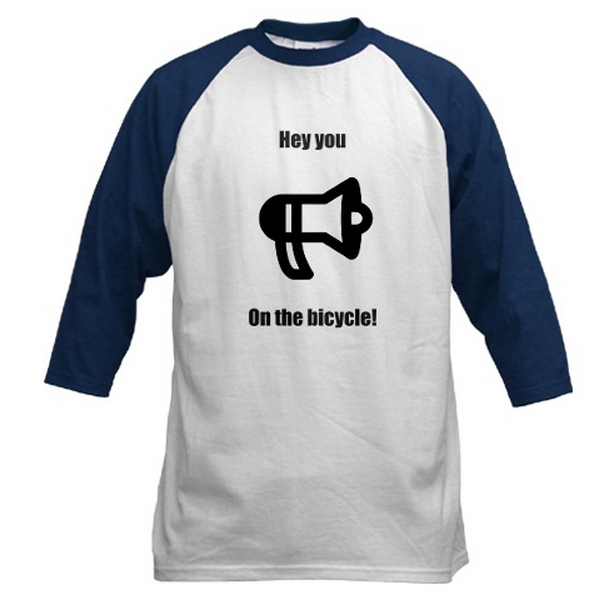
Random Movie Quote T-shirt #1

This is pretty easy, right?

Posted in fun | Tagged , | 4 Comments

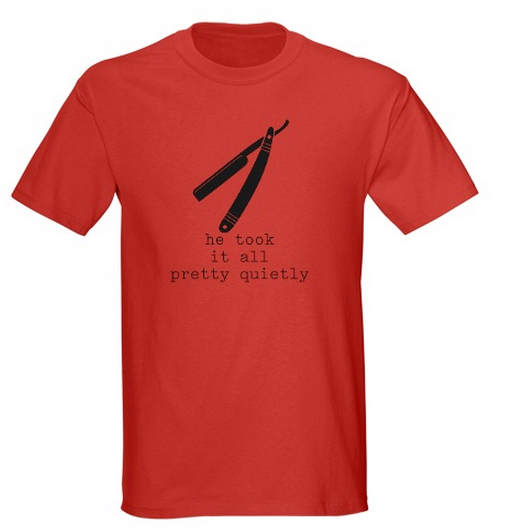
He Took It All Pretty Quietly

We’ve been playing around with the #6wordstory in the Hardboiled course, and this post by Sarah Clay gave me the idea to further build on Michael Branson Smith’s idea to have students summarize each story with a 6wordstory. Here is what Sarah wrote:

In the field of Physics, there is a collective theory that in order to prove you really understand something, or that an aspect of our world is fully explained, the formula created must be able to fit cleanly on a t-shirt. If this were applied to English, Hemmingway [sic] would be like the Haynes-man or something, because he is so direct in his stories. I have no doubt that he would be able to fit the meaning of each of his stories on a t-shirt.

Take that, and lay that on top of Michael Branson Smith’s suggestion to have student use the 6wordstory concept to summarize each of the stories we read this semester, which I re-focused towards In Our Time, and you have an awesome assignment. My small contribution is to add an iconic image to the mix. So, what we have is 6x6x6: 6words, 6stories, 6shirts.

That’s right, students will be required to create six shirts for six stories from In Our Time, with six words and an iconic image that can be associated, however loosely, with the words. I did the above t-shirt on CafePress (which means there is no image editing overhead except getting the transparent icon from The Noun Project—I discuss this in the quick tutorial below). I chose the black text and black icon on a blood red shirt for added effect! How cool is this, using CafePress for an assignment in the Hardboiled course? Martha Burtis was wondering how I would begin to integrate ds106 into this lit seminar, and last night really felt like I was getting there. What’s cool is it really was Sarah And Michael that laid the groundwork (which is always the case when you open your ideas up to others), and I’m just wrapping it up and assigning it! Did I mention how awesome it was to talk about Hemingway’s In Our Time in a classroom setting? I’ve missed great literature! Here is the context for the above shirt from one of Hemingway’s greatest short stories “Indian Camp”:

“Ought to have a look at the proud father. They’re usually the worst sufferers in these little affairs,” the doctor said. “I must say he took it all pretty quietly.”

He pulled back the blanket from the Indian’s head. His hand came away wet. He mounted on the edge of the lower bunk with the lamp in one hand and looked in. The ndian lay with his face toward the wall. His throat had been cut from ear to ear. The blood had flowed down into a pool where his body sagged the bunk. His head rested on his left arm. The open razor lay, edge up, in the blankets.

You can read the entire story here.

So, late last night while trying to go to bed but still too excited about this assignment I got to thinking of another design for a t-shirt, this time for William Faulkner.

In Sanctuary there is a famous scene of a rape with a corncob. There is a story in Faulkner lure that someone asked him, “I hear that writers always insert themselves in their books through one of the characters. Which character from Sanctuary are you?” To which Faulkner replied, “I was the corncob.”

A Quick Tutorial
Using CafePress and The Noun Project to do this assignment. For the Hemingway-inspired straight razoe quote from “Indian Camp” I found this straight razor icon on The Noun Project thanks to Proletkult Graphik. This icons are highly recommended because they are vector graphic files and scale up seamlessly and have a transparent background (which makes the shirts look awesome). What you need to do is download the svg file from Noun Project, open in the the free image editing program GIMP, and resize it—probably to about 1500 x 1500 pixels) then save it as a PNG file with a transparent background.

After that, go to the CafePress site and click design a t-shirt. Pick your style and color, and then upload the icon image file and add some text. That’s it, you’re done. The only real work is converting the SVG file to the PNG format, but it is pretty simple, if you have an issue let  me know. Now go make some literary art, dammit!


Posted in Hardboiled | Tagged , , , , , , , | 4 Comments

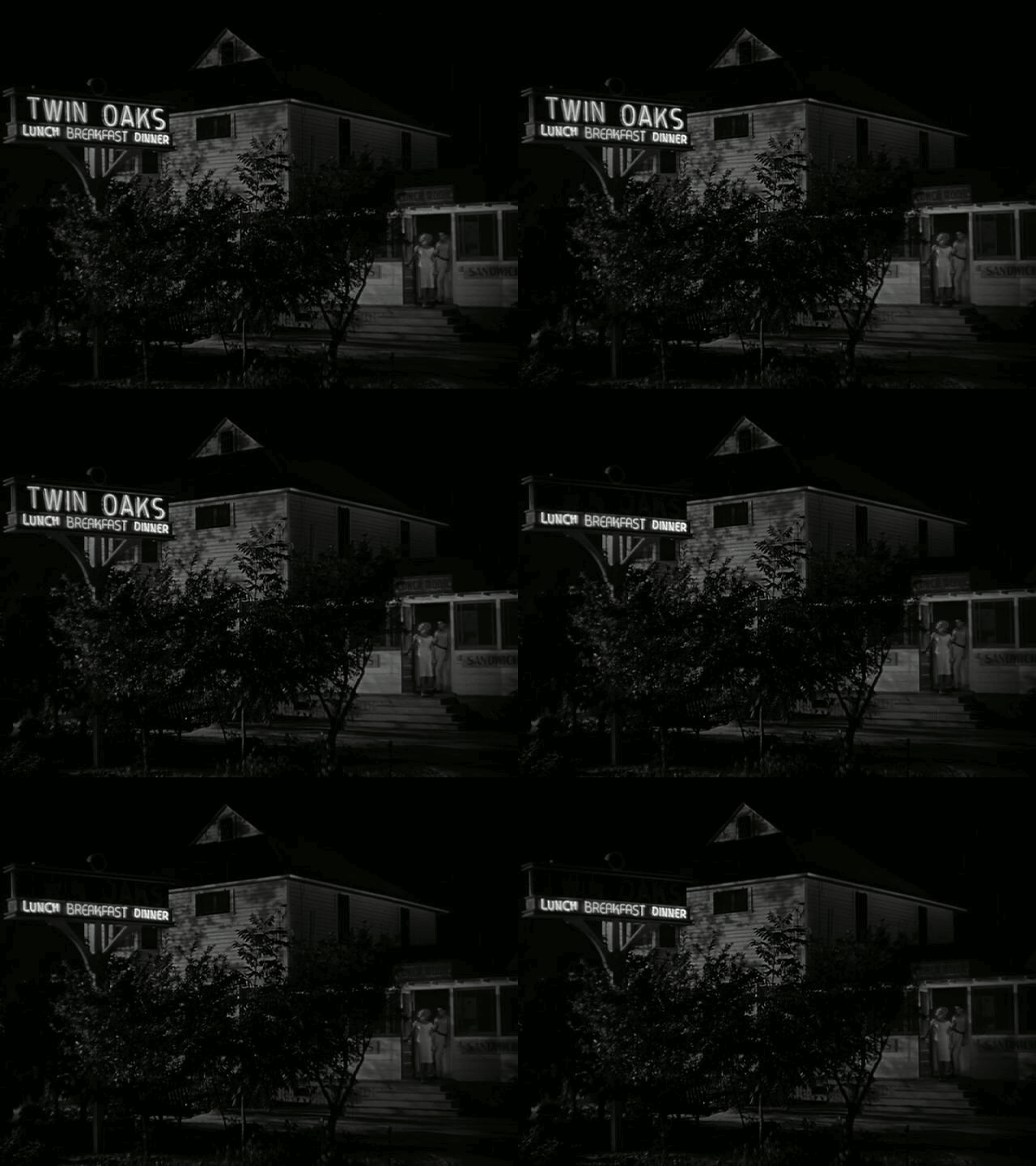
Twin Oaks

That was when I hit this Twin Oaks Tavern. It was nothing but a roadside sandwich joint, like a million others in California. There was a lunchroom part, and over that the house part, where they lived, and off to one side a filling station, and out back a half dozen shacks that they called an auto court. I blew in there in a hurry and began looking down the road. When the Greek showed, I asked if a guy had been by in a Cadillac. He was to pick me up here, I said, and we were to have lunch. Not today, said the Greek. He layed a place at one of the tables and asked me what I was going to have. I said orange juice, corn flakes, fried eggs and bacon, enchilada, flapjacks, and coffee. Pretty soon he came out with the orange juice and the corn flakes.

James Caine’s The Postman Always Rings Twice

Posted in Hardboiled | Tagged , , , | 2 Comments

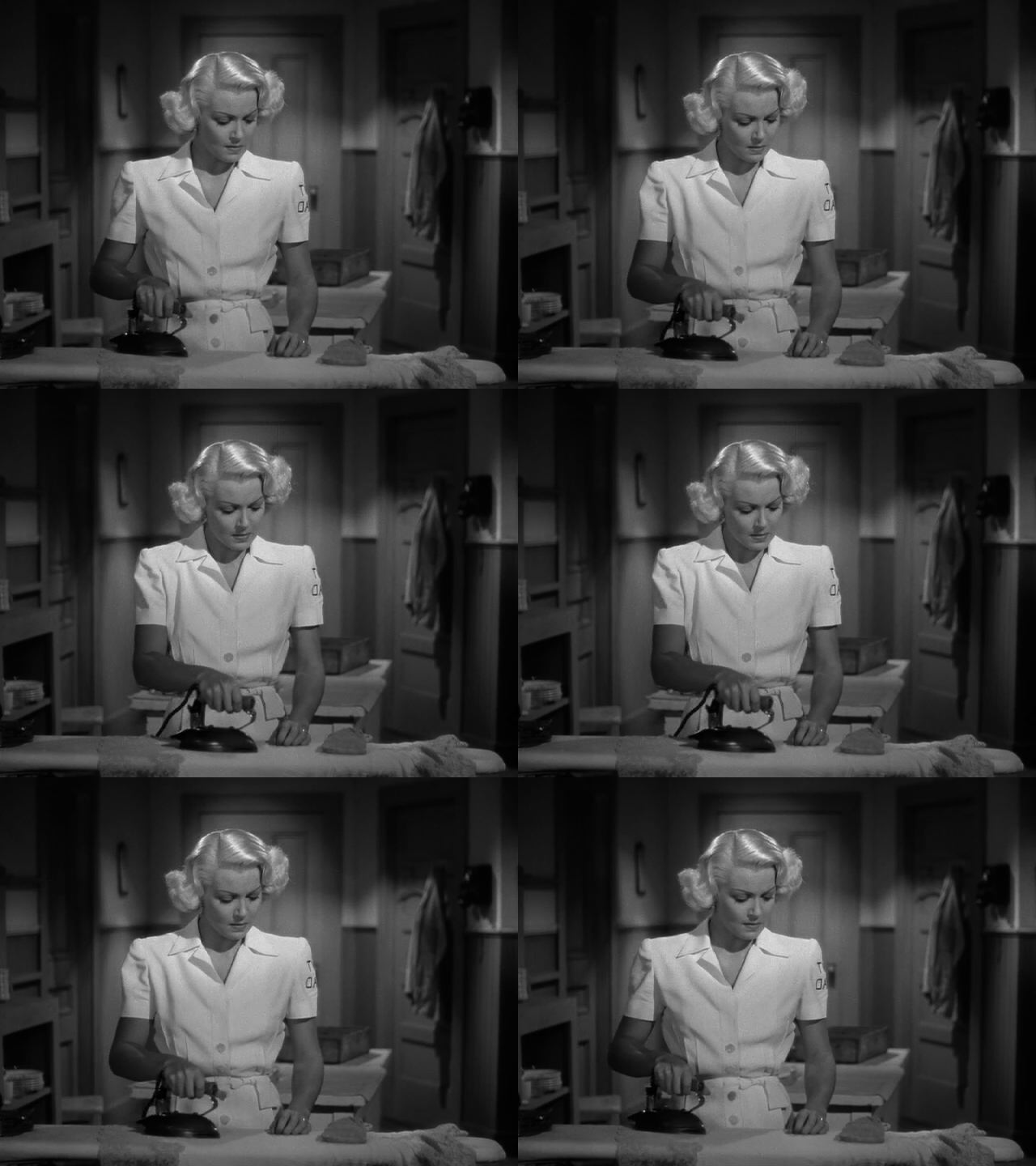
Lana Turner

Lana Turner is always hardboiled! I wanted to title this one Johnny Stompanato —if you don’t know the story of Turner’s turbid relationship with the LA Underworld you should (James Ellroy writes them both as characters in L.A. Confidential). This one is from The Postman Always Rings Twice (1946) and if you know the film, you might also know in this scene she is planning to knock off her husband upstairs. NO MORE IRON!

Posted in Hardboiled | Tagged , , , , , , | Leave a comment

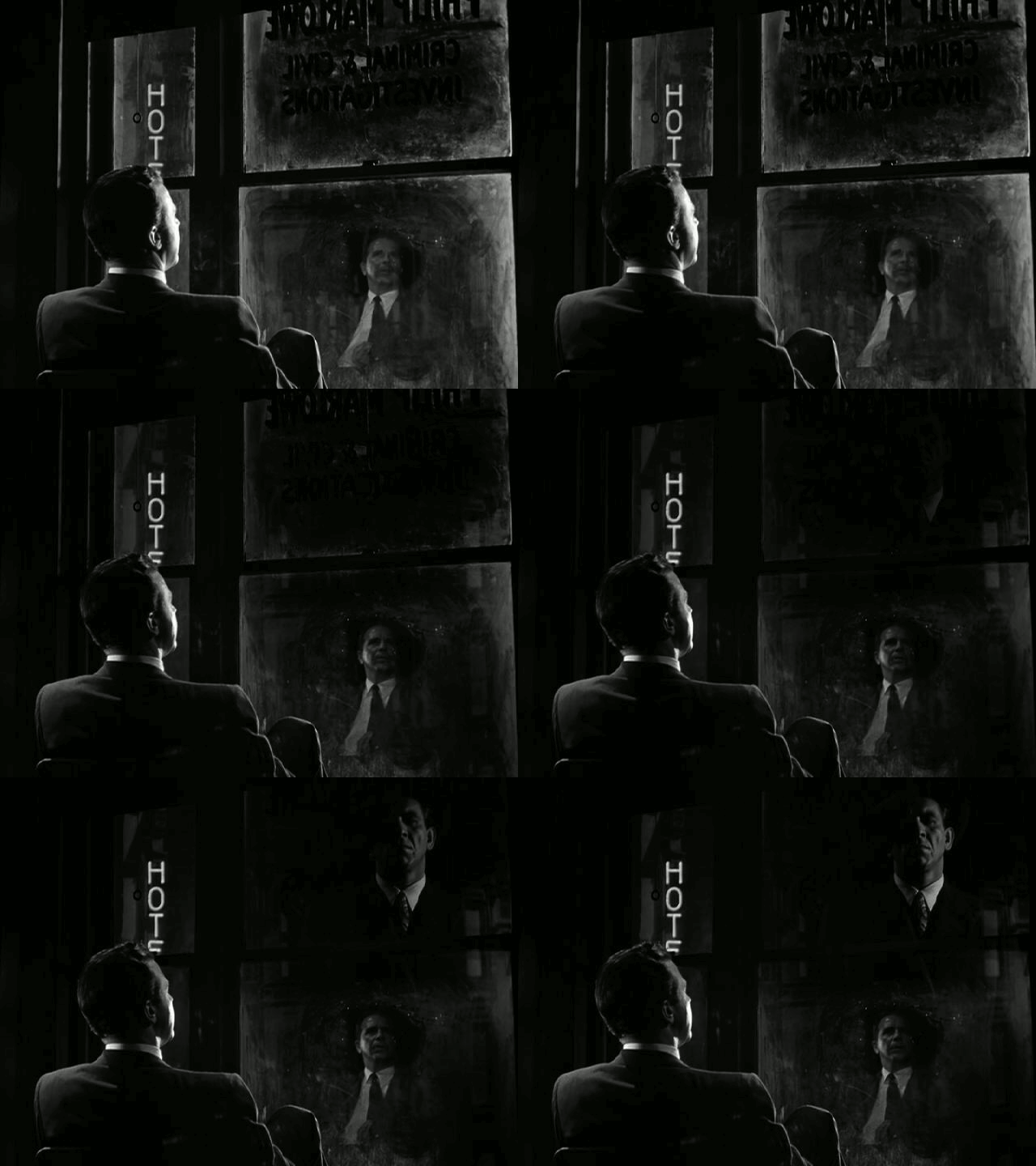
Reflections of Noir

Dick Powell plays an awesome Philip Marlowe in the 1944 noir Murder, My Sweet which is based on Raymond Chandler’s 1940 novel Farewell, My Lovely. I love this particular scene because the flashing lights and sinister reflections capture the aesthetic beautifully. What’s more, watching the thug Moose Malloy (played brilliantly by Mike Mazurki) appear in the reflection on the window was truly creepy while watching the film. I felt scared for Marlowe—brilliant stuff.

Posted in Hardboiled | Tagged , , , , , , , | 6 Comments

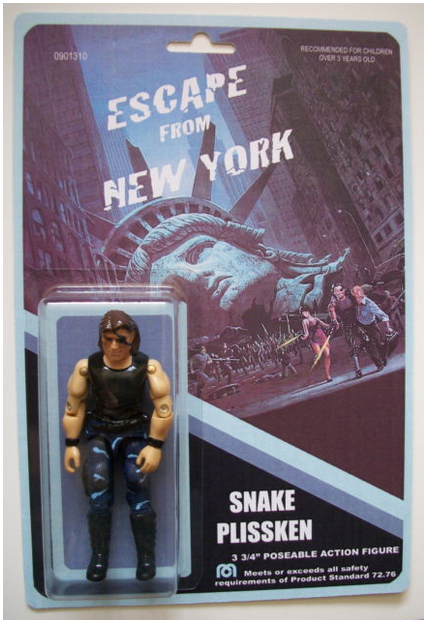
John Carpenter’s The Thing Action Figures

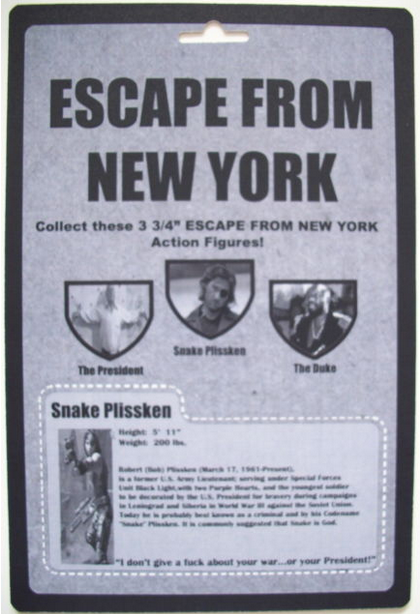
I’m increasingly loving Tumblr these days, especially when a gem comes my way like the video above featuring a promo for action figures based on John Carpenter’s The Thing (1982). Seeing these I immediately thought, “Were there ever Escape From New York Snake Plissken action figures made?” [I refuse formally acknowledge that the abortion known as Escape from LA was ever made.] And, of course, there were—actually there is one available on ebay for $60. What’s trippy about that one is that it seems to be a custom made doll not released by any major toy producer—how cool. Indie toys #4life!

Also I would be remiss if I didn’t mention that The Thing toy promo came my way via Sarkos’ tumblr, far and away the best one I follow there—it’s a constant stream of awesome.

Posted in movies | Tagged , , , , , | 2 Comments

September Cinema: This Month at the Packard

This month’s programming for the Library of Congress, Packard Campus Theater is particularly strong this month so I figured I would blog the original page on their site, what’s more I marked it up with links to all relevant Wikipedia articles and movie posters where available. Now, if I were the Packard Campus I would work out a way to be sure you could pull all relevant links and movie posters from a public site like Wikipedia automatically as a first referent for their readers. I did it here, and a half-way decent programmer could actually automate the links and visuals. The pages have no links, and if there is an issue with the Wikipedia page, have a reference resource of your own that you build with each month’s program. The work the Library of Congress, Packard Campus is doing with their programming is amazing, starting to figure out that the web is their best friend for promoting what they are doing, and it just might be the thing that builds their theater space into a cultural epicenter.

Thursday, Sept. 6 (7:30 p.m.)
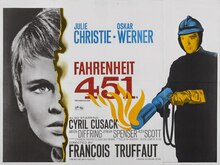
Fahrenheit 451 (Universal, 1966)

Oskar Werner and Julie Christie star in this futuristic drama based on the science-fiction novel by Ray Bradbury. François Truffaut directed the story about a fireman who begins to question his duty to destroy all books.


Friday, Sept. 7 (7:30 p.m.)
Paris, Texas (20th Century-Fox, 1984)

German director Wim Wenders’ atmospheric story of a man who tries to put his life back together after being lost for four years won the Palme d’Or at the 1984 Cannes Film Festival. Harry Dean Stanton, Nastassja Kinski and Dean Stockwell star in the film. Ry Cooder composed the musical score.


Saturday, Sept. 8 (7:30 p.m.)
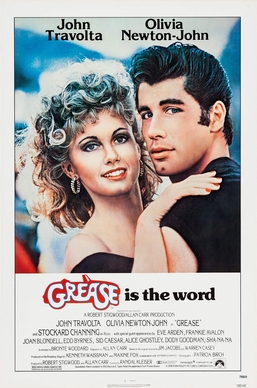
Grease Sing-A-Long (Paramount, 1978)

The original high-school musical is back in a sing-along version with animated subtitles. John Travolta, Olivia Newton-John and Stockard Channing star in this rocking musical-romance directed by Randal Kleiser.


Thursday, Sept. 13 (7:30 p.m.)
Glory (Tri-Star, 1989)

Matthew Broderick portrays Colonel Robert Gould Shaw, commanding officer of the 54th Massachusetts Volunteer Infantry, the first formal unit of the U.S. Army to be made up entirely of African-American men. Denzel Washington won an Academy Award for Best Supporting Actor in this Civil War drama, which was directed by Edward Zwick. Glory is R-rated.


Friday, Sept. 14 (7:30 p.m.)

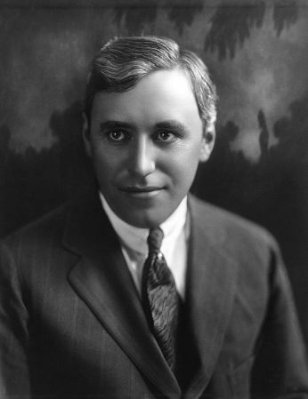
Mack Sennett

“Cruel and Unusual Comedy” (Various studios, 1913-1929)

The evening features a sampling of the film series “Cruel and Unusual Comedy: Social Commentary in the American Slapstick Film,” which has been presented annually at the Museum of Modern Art (MoMA) in New York City since 2009. Curated by Steve Massa and Ben Model, the program will include Mack Sennett’s “Their First Execution” (1913), starring Ford Sterling; legendary vaudeville comedian Bert Williams in “A Natural Born Gambler” (1916); and “Goodnight Nurse” (1929), directed by and starring British comedian Lupino Lane. The silent comedy shorts, courtesy of MoMA, will have live musical accompaniment by Ben Model.


Saturday, Sept. 15 (7:30 p.m.)
The Wedding March (Paramount, 1928)

Erich von Stroheim directed and stars in this silent drama about a roguish Viennese prince who agrees to marry for money and position to help his family. He then falls in love with a beautiful but poor girl. Ben Model will provide live musical accompaniment for this 2003 selection to the National Film Registry.


Thursday, Sept. 20 (7:30 p.m.)
Midnight (Paramount, 1939)

Claudette Colbert stars as a penniless chorus girl stranded in Paris who masquerades as a Hungarian countess to help a millionaire break up his wife’s affair with another man. Mitchell Leisen directed this sparkling romantic comedy that also features Don Ameche, John Barrymore and Mary Astor.


Friday, Sept. 21 (7:30 p.m.)
Thief (United Artists, 1981)

An expert jewel thief, who is also a hard-boiled ex-convict, agrees to take one last job before he goes straight—with dire consequences. Michael Mann directed this crime thriller starring James Caan, Tuesday Weld and Willie Nelson. The film is rated R.


Saturday, Sept. 22 (7:30 p.m.)
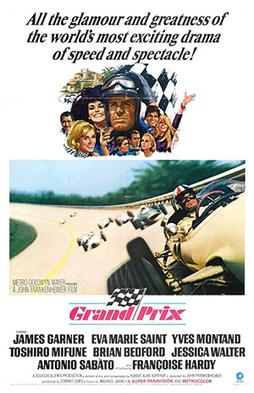
Grand Prix (MGM, 1966)

Outstanding racing cinematography in European locations is the star of this story that follows four Formula One drivers throughout a racing season. Directed by John Frankenheimer, the Technicolor sports drama features James Garner, Yves Montand, Antonia Sabato, Brian Bedford and Eva Marie Saint.


Thursday, Sept. 27 (7:30 p.m.)
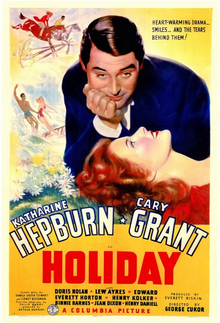
Holiday (Columbia, 1938)

George Cukor directed Cary Grant and Katharine Hepburn in this romantic-comedy classic about a rebellious young heiress who finds a kindred spirit in her stodgy sister’s freethinking fiancé.


Friday, Sept. 28 (7:30 p.m.)
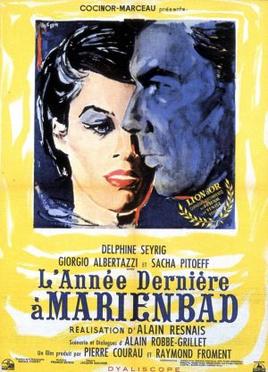
 Last Year at Marienbad (Astor, 1961)

This surrealist psychological drama is famous for its enigmatic narrative structure where it is difficult to distinguish between truth and fiction. Produced in French with English subtitles, the film was directed by Alain Resnais and stars Giorgio Albertazzi and Delphine Seyrig.


Saturday, Sept. 29 (10 a.m.)
“Saturday Morning Cartoons” (Various studios, 1933-1956)

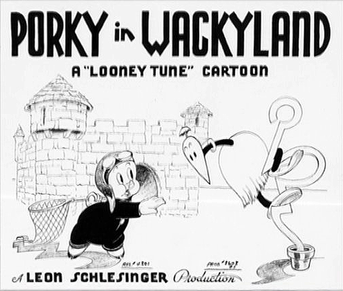
This Saturday morning funfest features Bugs Bunny, Yosemite Sam, Porky Pig, Pepe Le Pew, Tweety & Sylvester, Mighty Mouse, Popeye and many more. The program will include three titles from the National Film Registry—”Gerald McBoing Boing,” “Porky in Wackyland,” and “One Froggy Evening.”

Posted in Movie Lists, movies | 2 Comments

EdStartUp Intro: Innovating Around Syndication

Jim Groom’s EdStartup Intro Video from Jim Groom on Vimeo.

I finally did my introductory video for EdStartup 101, an online MOOC that is brilliant model of a distributed, syndication-based architecture that drives participation in the course. What’s more, the great Martha Burtis worked with David Wiley to figure out how to seamlessly get the sign-up process (which integrates with BuddyPress) to immediately populate and integrate feeds from the get go. So, without any extra labor on the part of the instructor, each person’s feed immediately pulls in, associates with the proper user, and starts syndicating their work. It’s such a beautiful thing, and you can see it working seamlessly on EdStartup here. In my mind this is a proto-type for an open, easily managed framework based on WordPress that any course could use. As of now it’s dependent on the premium plugin Gravity Forms, but hopefully there will be a completely free and open option soon. So, what I’ll try and be doing over the course of this semester is frame-out such an approach on an institutional scale that a university could embrace and pilot as a way to give its community members the ability to manage and control its own data, while at the same time building the technical infrastructure to make syndication and aggregation easier, more attractive, and architecturally sound.

Posted in edstartup | Tagged , , , | 2 Comments

California Community Colleges Waitlist 470,000 Students

One of Sean Hartter’s many awesome designs for Murder University

Due to funding cuts, 470,000 community college students are beginning the fall semester on waiting lists, unable to get into the courses they need. Enrollments are down 17% from 2008, representing almost exactly the shortfall of 470,000 places. California’s community college system, the nation’s largest, has suffered about $809 million in state funding cuts since 2008. It faces another $338-million hit midyear if voters reject a tax measure on the November ballot supported by Gov. Jerry Brown.

Via Tony Bates, half a million students can’t get community college courses in California due to budget cuts. Jesus Christ! That’s an educational epidemic right there. I’ve told this story before here, I’m sure, but in 1991 I headed out to Long Beach, California to put myself through undergraduate. I attended Long Beach Community College for a year and a half at the total tuition cost of $105. That breaks down to $35 a semester. I remember this because I could pay my community college tuition after one night of bussing tables at Parker’s Lighthouse. This, in turn, enabled me to then apply and get guaranteed admission to places like UC Santa Cruz, UC Berkley, and UCLA—at the much more inflated price (at least at the time) of $500 a quarter, but I could still pay that with my job at Audio Visual Services in a semester. In our moment, you can’t even get into a class, it’s not an option, years of your life towards any idea of educational advancement are basically stonewalled. If there are any questions about the disinvestment of public higher education you really don’t have to look any further than California right now. It is a horror movie, and the tuition isnt the only thing that will kill you anymore.

Posted in edtech survivalist | Tagged , , , , | 3 Comments