I was sad to read over on Mark Guzdial’s Computing Education Blog that potential FERPA violations were being invoked in order to close down a wiki experiment at Georgia Tech that’s older than Wikipedia. Here is Mark’s rough reading of Georgia Tech’s interpretation of FERPA:
Georgia Tech’s interpretation of FERPA is that protected information includes the fact that a student is enrolled at all. The folks at GT responsible for oversight of FERPA realized that a student’s name in a website that references a course is evidence of enrollment. Yesterday, in one stroke, every Swiki ever used for a course was removed. None of those uses I described can continue. For example, you can’t have cross-semester discussions or public galleries, because students in one semester of a course can’t know the identities of other students who had taken the course previously.
I obviously can’t speak for the particulars of Georgia Tech’s situation, but from the outside looking in this reading of FERPA seems to be the most rigid and draconian imaginable. In many ways, a worst case scenario for openly teaching and learning online at an institution. What’s more, it speaks to a culture of fear, uncertainty, and doubt (FUD) in higher ed when it comes to social media. And it is such a reactionary response that has imbued this act, which was originally intended to give students more control over their personal data, with a deep sense of institutional dread over lawsuits. Here is a bit from Georgia Tech’s FERPA policy:
The Family Educational Rights and Privacy Act (FERPA) is a set of regulations written specifically for students guaranteeing them the right to inspect and review their education records; the right to seek to amend education record; and the right to have some control over the disclosure of information from those education records.
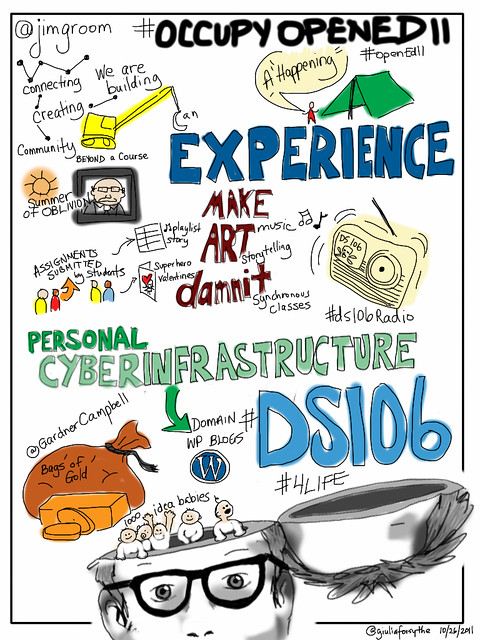
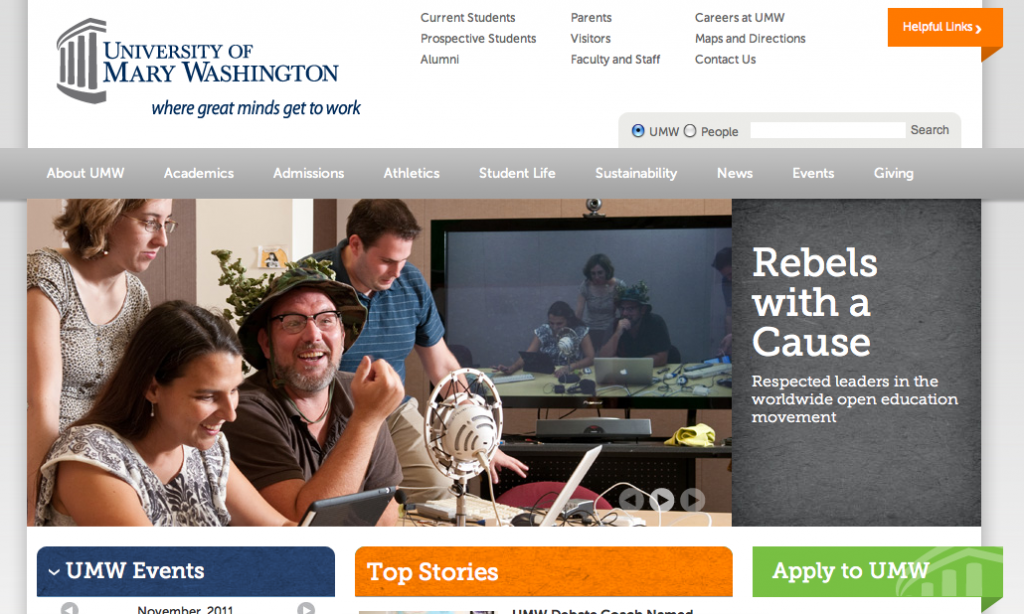
The right to have “some control over the disclosure of information from those education records” is an argument as to why we should have a technical architecture on campus that gives students more control over their own educational experience. We have created an architecture of centralized control and then used FERPA to cultivate fears of moving to distributed, open architecture for sharing. So much so, that just about any time I present about UMW Blogs or ds106 the first question I get is—what about FERPA? It’s a kind of zombie question at this point, something people are almost programmed to ask even if they don’t know what FERPA is or what UMW Blogs provides students. People immediately assume social media and FERPA are necessarily exclusive and frame the question in such a way that immediately puts a publishing platform like UMW Blogs on the defensive.
But thanks to a tweet by Mike Caulfield almost two years ago, I finally had a way to think UMW Blogs’ relationship to FERPA differently. Mike basically noted that by giving students their own spaces online wherein they control their online identities, decide what they will share and won’t, and take control over the disclosure of their own data we are more FERPA compliant than any other system on campus. In fact, that’s exactly right, UMW Blogs is focused on giving students control over their own learning process, reflections, and take back ownership of their data. What could be more FERPA compliant? I think it is time to reclaim the FUD around FERPA and reinterpret it as it was intended: an act that encourages universities to give students more control over their own data, and by extension their own teaching and learning. Fact is, FERPA is in many ways a parallel to Gardner Campbell‘s idea of “student as sysadmin of their own education” —that is what we should be actively pursuing as a community dedicated to teaching and learning in the open rather than heading down a road of prohibition further alienating higher education from its mission.
At UMW we are FERPA compliant because we are actively making students sysadmins of their education. What’s more, we are encouraging them to interrogate the questions around privacy, digital identity, and the data landscape that will frame their future rather than precluding this conversation all together—what could be more anathema to higher education?






 Sarah Cunnane, writer for the Times Higher Education blog