Writing New York: Posts from the Boroughs and Beyond

This morning a friend and former colleague of mine, Luke Waltzer, turned me on to a wonderful class project that he has been working on with two professors at Baruch College. Professors Bridgett Davis and Roz Bernstein’s students have been working together to create a distributed publication of their journalistic writings throughout the five boroughs of NYC titled Writing New York: Posts from the Boroughs and Beyond. The raison d’être of this blog is as follows:

Neighborhood news has never had its fair share of coverage in the mainstream press. Local papers do their best to report local stories-both news and features-but much is missed. Beyond the sensational stories, little is written about everyday folk who provide the energy, chaos, rhythm and texture of community life.

A major reason for this oversight is that coverage seldom comes from reporters with intimate knowledge of these communities. Thanks to the internet, that glaring omission can be eliminated. What if there was a place in cyberspace where journalists could post ideas and observations before they became full-fledged stories? What if they could join into a dialogue with other journalists about these posts, honing and expanding their original ideas? What if citizens could weigh in as the stories evolved? And what if stories developed from this shared process ultimately appeared on the site?

Writing New York: Posts from the Boroughs and Beyond is an experiment in achieving this type of social and community media. Written by two Baruch College, CUNY journalism classes as a blog, the site is a shared space where students can record impressions and observations and share information as they report stories on their neighborhoods. Organized into ten community teams based on the boroughs and beyond, the groups each post weekly, creating a site that serves multiple purposes: as a resource for both classes, a vehicle for conversation between classmates and the larger blogisphere community, and as a hotbed of fresh ideas that will naturally lead to original neighborhood stories.

This site acknowledges that bloggers are an important part of the media landscape.

Wow, I think this mission statement for the class and the the use of the blog to accomplish this is quite powerful. Doing this as part of a “real school” classroom that involves an apprenticeship for aspiring journalism students makes it that much more impressive. I love it when smart people wrap their heads around these tools and put them to work in unbelievably intelligent ways -particularly when it is in relationship to the classroom. Great stuff coming out of the Bernard L. Schwartz Communication Institute (BLSCI) up there in the greatest city on Earth (period!). See the BLSCI blog cac.ophony to follow their work more closely.

As an afterthought: I will point out to all you Drupal nerds that WordPress made it that much more attractive and easier for everyone involved, according to a few credible sources! 🙂 In fact, there is a plugin for WordPress by Alex King titled Articles that would make this site more extensible in terms of indexing the articles and separating them out by theme, category tags, etc. Just another way to start re-defining the possibilities of thinking both within and beyond the generic boundaries of the blog with all this cool stuff people are doing.

Posted in drupal, plugins, WordPress | Tagged , | 1 Comment

Speaking of students at UMW…

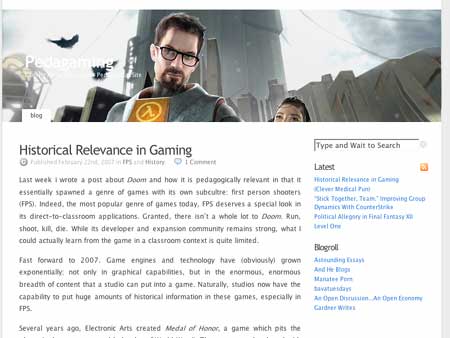
…I can’t begin to tell you how impressed I am with our student-aide’s blog titled Pedagaming. Joe McMahon is quickly becoming one of my favorite bloggers. He is new to the form, but not the medium. Additionally, I really like the images he has in his blog header -he’s a natural! For some good reading, check out his post on gaming and historical relevance here.

Pedagaming

Posted in video games | Tagged , | 1 Comment

M*A*S*H U*P*S

My class and I have been talking a bit about mashups in our Museum Interpretation and Design class as we try an figure out all the possibilities we have when approaching a virtual exhibit. One student, on her own initiative, came up with a great new logo for Mashups. She titled her post with the image she created as follows: “A Little Fun with Photo Shop (ie I was bored.)” I am never that creative when I am bored. In fact, the intersection of boredom and creativity might need to be re-examined after this little gem!

Mashup Preview

Tagged | 3 Comments

StumbleUpon, the video

Mikhail Gershovich forwarded me a great video via del.icio.us, I immediately realized he found the cartoon through Stumble Upon’s relatively new video referral feature (it was released in early December 2006 was discussed on Tech Crunch here). I have been doing some thinking about video on the web recently for some upcoming projects, and this has been a fun tool to play with. Below is the feed of the latest videos I have stumbled upon.

Posted in video | Tagged , , | 6 Comments

Northern Voice Postscript

I got home about eight hours ago from a two-day traveling saga. While I am glad to be back, things are not the same for me on many levels. Ideas of commitment, integrity, and the political nature of the work many of us do was brought into sharp focus over the last four days and I was not prepared for the powerful and important education I received. I was acutely reminded that I need to constantly re-examine some basic assumptions about space, place, nation and identity more closely. Something in me seems amiss after Northern Voice, despite the facts that the conference was excellent, the people I saw were top caliber, and the organizers did a bang-up job of putting together an outstanding breadth and depth of expertise in a relaxed and inviting environment.

In fact my own uneasiness has very little to do with the NV conference per se, but rather with the life-sustaining human contact, conversations, and out-and-out education I received after hours. Some conversations I had jarred me on some fundamental intellectual, physical and emotional levels as very few things have over the past couple of years. Dr. Glu started me upon my education in Ed Tech, but in Vancouver I kinda felt like Luke in the Degoba Dagobah system: lost, scared, and out of my depth. This could be the ravings of exhaustion after almost two days of travel, but I think the travel problems were the easiest part of the trip in some ways. Much more profound was that I was forced by the people around me to think about the pressing political and social questions that under gird the logic of social learning -it was like being in a four-day seminar with the most committed thinker on the topic I have yet to meet. Numerous discussions traced and chased some of my comfortable assumptions out of their foxholes. Social learning is not about RSS or blogs or Wikis or Drupal or WordPress -it’s about defining and maintaining a vision of commitment of social justice in the face of all the other bullshit. I met a few people who taught me more than a thing or two about this over the last few days, and for that I am greatly indebted to all of you.

Tagged , | 19 Comments

Building Rich Communities with Wikis

Stewart Mader and John Willinsky separately discussed how we imagine the wiki in new and powerful ways. Stewart Mader did an excellent job of giving an overview of re-conceptualizing the wiki space as a collaborative, distributed publishing platform, while John Willinsky gave a pointed example of how wikis are informing the way his classes create, organize, and share their experience as student teachers. His classes have created an on-going repository of lesson plans for K-12 teachers using this wiki -a brilliantly conceived framework for the knowledge management that a well-organized wiki is so good at. Moreover, the community is centered around building professional and personal resource for thinking, learning, and teaching. Willinksy is also a part of the Public Knowledge Project that highlights open access -so much here in relationship to the vision of open source and an intelligent use of the tools.

Tagged , , , , , | 3 Comments

Social Software for Learning Environments

D’Arcy Norman, Chris Lott, Sylvia Currie, and Jon Beasley-Murray combined forces examining a wide array of issues facing the integration of social software into the learning environment. At the core of these various discussions was the enigma of community -what makes an effective online community? How do we foster the process of allowing these spaces to be individual’s space as well as a self-organizing community? How do we think this in education? Does institutionalizing blogs, or any one blogging-platform, within a university necessarily allow for a space of contest, discussion and dissent? Should this space be part of the institutional logic, or a place to critique and question the locus of power of existing communities? This last question was a point John Beasley-Murray posed quite eloquently, making the enterprise question of scaling eduglu that much more rich and complex.

Additionally, Brian Lamb is quite a moderator: he managed to seamlessly work in a slam on Hummers and those who driver them!

Tagged , , , , | 2 Comments

Chris Lott’s Brain -a great place to be!

Chris Lott‘s has been gracious enough to let us into his brain. Here are three questions he is working through now:

1. radically increasing bandwidth, processing, and storage capacity
2. changing student demographics because of access to that technology and their increasingly technologically mediated lives
3. advances in learning theory taking into practical account the social aspects of learning in a networked, distributed environment

Following is the link to the rest of his thoughts. Link.

Tagged , , | Leave a comment

The wiki has been made a blog… story at 11!

All I am gonna say right now is that John Maxwell, presenter of “designing a smarter wiki” (see his notes in the Northern Voice wiki) has effectively married the wiki and the blog. Amazing stuff, check this out: is it a blog or is it a wiki? It is a wiki, and I am blown away! More details to follow…

Tagged , , , , , , | Leave a comment

So close, but so far?: Mashups, RSS, and chasing the eduglu dream

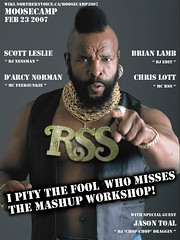
Mr T does RSSBeware Sucka: this is a collection of notes, ideas, and brief reflections -so sense and cohesion is not the common denominator here (I guess kinda par for the course)

First session at Northern Voice 2007 I attended was Mashup for Non-Programmers. You can follow the link to the wikified workshop outline on the NV wiki here.

Scott Leslie’s introduction made the case that mashups for non-programmers is not necessarily for coders, but it also is not for those who aren’t afraid to get their feet wet a bit. The art of the tinkerer in many ways.

Darcy Norman
From there D’Arcy Norman (in a very cool, calm, and collected style) gave us a tour through the Yahoo! Pipes (what he terms a visual procedural programming environment) that does a majority of the programming for free! here is a link to his demo page of Yahoo Pipes examples. One example he showed us takes the RSS feed from Twitter and mashs it up with a keyword from the twitter conversation and matches it up with that same tag from flickr (take a look at it here). He also spoke about the possibility of cloning other pipes that you liked (for examples the NYT headlines mashed up with flickr -see this here). All of this before Pipes took a dive on us and became an absent presence throughout the discussion.

Additional points D’Arcy made I need to pursue:

  • Joining RSS feeds -joining all the edubloggers into one photostream
  • Also, talked about using the Pipes to create custom search engine using pipes to search content by zip codes

Scott Leslie:
These notes are skeletal for Scott’s talk for he had so much cool stuff to say…

  • Using your del.icio.us tags to search other things. Some examples of this are Open Kapow create a service you can query off of -google search results driven by Scott’s del.icio.us tags.
  • You can also get your del.ico.us tags and use this to run a search through Amazon. Go to your del.icio.us account, click on help and then find “json” tags: Something like this for your account: http://del.icio.us/help/json/tags -I will fill in the details on this once I play with it more.
  • He also played with Dappit which you can find here,
    Dappit
    , more research to be done here.

Brian Lamb
Brian’s pursuit of the Holy Grail for eduglu continues…
It was really amazing to hear Brian eloquently and precisely define the struggles we all face in the pursuit of mashing up learning process via RSS. how do we allow students to bring their own blogs and other social services into a feeding services we provide, endorse, or create takes these disparate resources and delivers them in a coherent, and targeted fashion that somehow reflects the complex process of teaching and learning. His talk is here, and it really sparked my imagination, gave me a clearer idea of the struggle as well as re-doubled my efforts to work collaboratively to see this emerge in some way, shape or form. Eduglu -we love you!

Why can’t anything with an RSS feed provide a legitimate way to feed the students’s own tools into some larger, uber feeder throughout a campus, or series of learnig institutions? WHen are we gonna create this? -or demand it? -or hack it?

Chris Lott:

Unfortunately, in Chris’s experience, non-programmers can’t do a lot… and programmers can only get just a bit further. What is the promise of the mash-up? Is it possible to push it further for the non-programmer? Re-mixing and mashing up is still elusive in the class-room.

Some tools Chris mentioned, Grazr – a service that, to quote the site, “…lets you view as many feeds as you want without the hassle of subscribing. Grazr users can freely jump from feed to feed. It’s like surfing on a river of feeds.”

He also mentioned Google co-op as a way to search group spaces in a more targeted manner.

Create a del.icio.us site allows a more faceted classification search – as well as domain specific searches (must figure this one out -any help out there?)

And once agian, the promise of Ning for creating a great social sharing site -problems with mixing and matching at a granular level is still diffiuclt and the dream we are in pursuit of continues…

Awesome session with more than I can think about in a m onth, no less than a 45 minute span. The Moose promises, and the Moose delivers!

We re so close, yet so far to the edu glu dream…

Great, great stuff

Tagged , , , | 4 Comments