More on Mojiti

I really like Mojiti! Did I already say this?

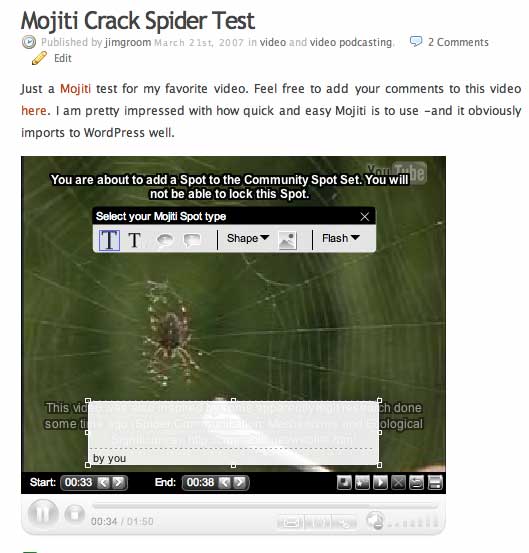
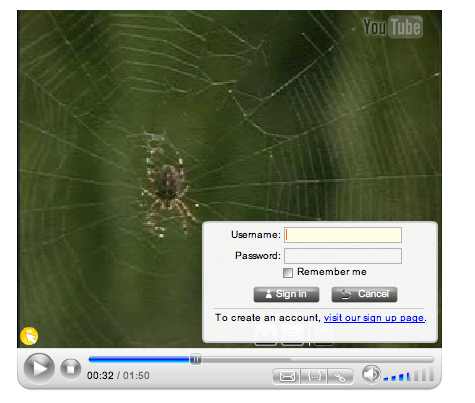
I just realized -it was rather self-evident- that you can add spots to a ‘Mojitied’ video right within a blog post. And while you have to be logged on to Mojiti’s service to do this, they are so smart that they allow you to login right through the video on your blog -never having to leave the page.

So, there is really no more than three very simple steps to integrate Mojiti into the classroom:
1) students have to sign-up for a Mojiti account,
2) Add a video and make it public,
and 3) embed the video on your class blog/site.

Once this is done, the class can easily sign-in and annotate a video clip at any given point they want to make a comment, observation, argument, etc. The possibilities are extremely interesting here, especially in the wake of the NMC’s Web Video Convergence conference. One drawback is that you can’t create specific groups you can restrict commenting to (if you’re into that sort of thing), so you could potentially have some drive-by commentary -all of which can be easily flagged right from the blog.

Here are some screen shots of the in-blog login and commentary possibilities.


Mojiti_login

mojoto_in_blog.jpg

Posted in video | Tagged , , , , | 2 Comments

Why do I love online participatory culture?

Because of gems like the Ron Turner Cover Collection:

Tagged , | 2 Comments

Francis Ford Coppola Predicts YouTube

Riffing on the NMC Web Convergence Conference themes and cross-currents -check out this forty second interview with Francis Ford Coppola from Hearts of Darkness. In this clip he might be seen as “predicting” the creative power of social sites like YouTube.

Posted in movies, video | Tagged , , | 6 Comments

Web 2.0 Online Learning Festival

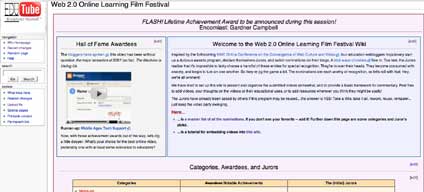
T -48 minutes to the Web 2.0 Online Learning Festival for the NMC Online Conference on the Convergence of Web Culture and Video. I am all fired up, and here is the link to the wiki, half fully-baked, but an unbelievable resource for all those viral online videos. Be sure to check out the nominations page here.

NMC Video Party

Posted in video | Tagged , | 4 Comments

Mojiti Crack Spider Test

Just a Mojiti test for my favorite video. Feel free to add your comments to this video here. I am pretty impressed with how quick and easy Mojiti is to use -and it obviously imports to WordPress well.

[youtube]http://www.youtube.com/watch?v=sHzdsFiBbFc[/youtube]

Posted in video | Tagged | 3 Comments

Spam can be entertaining

bavawiki (a MediaWiki install) gets the occasional spam. Here is one I got recently that made me laugh:

Hi Boss,

People who do lots of work…
make lots of mistakes

People who do less work…
make less mistakes

People who do no work…
make no mistakes

People who make no mistakes…
gets promoted

That’s why I spend most of my time
sending e-mails & playing games at work
I need a promotion.

Not sure what this is selling, or why someone took the time to enlighten me with this sage advice. As a tangent, has anyone found a good spam plugin for MediaWiki?

Tagged , | Leave a comment

I love John Locke

Well, the other John Locke.

Jon Locke

He’s a great spirit, a Shaman. I just had to get that off my chest.

During a recent conference in Vancouver many contracted the dreaded Moose Fever, whereas I picked up the arguably more contagious Lost fever. As for you folks who are saying, “Well, look at the Johnny-come-lately raving about Lost” – fair enough, I know I’ve come late to the party. Sure, three years after its inception and almost 30 some-odd episodes behind, I am way out of touch. Sue me!

But if you look deep inside, you’ll realize that I am where all you die-hard Lost fans want to be: at the beginning of the relationship when excitement, expectation and possibility frames everything. I have been using the wee hours of the night this week to work my way through the first 16 episodes of Season 1. I’m as hooked as Charlie sans Locke! In fact, beyond hooked -I can’t wait to go home and watch four more episodes tonight! Perfect weather, it is torrential in Virginia, 80 degree weather has turned to almost freezing, and it’s Friday in Freddy -and like Chris Tucker and Ice Cube -I ain’t got “anything” to do! I love it!

Tagged | 3 Comments

Now soliciting submissions for an online video dance learning party

Shama lama ding dong! That’s right folks, teaching and learning technologies have never been so much fun. Brian Lamb, D’Arcy Norman, Gardner Campbell, and I have joined forces to offer a little “twist” on the standard presentation for the NMC’s Online Conference on the Convergence of Web Culture and Video. Brian Lamb’s recent post has already nicely framed the occasion as follows:

The Web 2.0 Online Learning Film Festival! My colleagues and I have designated ourselves as Festival Jurors. From what we hope will be an avalanche of nominations we intend to select a 45 minute program, adding bits of commentary, analysis, trash talk and awards. (All legitimate nominations will be included on a supplementary program.) We intend to use Mojiti (which allows for annotation of online videos) to facilitate the communication of juror and audience input. We will argue about discuss our respective choices during our NMC online presentation on Wednesday, March 21, and when the conference wraps up we’ll open up the discussion to the wider web world.

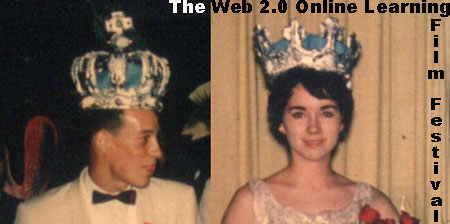
Now, here’s where you come in: I need you to add links to your favorite online videos (multiple nominations are encouraged) with a brief context for how they can be understood as “educational” in the comments of this post. I am leaving the idea of educational intentionally vague, for any definition depends entirely on the context -so have fun and make me laugh, cry, feel, think, and scream out for more! Who knows -you could become the prom king or queen at the NMC Web Video Homecoming!

Online Film Festival

Posted in video | Tagged , , | 11 Comments

Read, Think, Remix

The blogosphere I inhabit has been quite active as of late with some really thoughtful examinations of the ways we understand such large and powerful ideas as the nature of the university, teaching and learning, technology, and our own sense of obligation and commitment. Here’s a tour of my own rummaging through these ideas, all of these thinkers offering me a nuanced conceptualization of a very complex series of inter-related issues –thank you one and all.

Brian Lamb’s doubts about his own path-breaking struggles to realize a vision of the connected university (in Brian’s case mashups and RSS) with a more sobering institutional reality started me thinking about some of the issues we are up against:

It seems like a painfully familiar dynamic, expecting that just ahead things will fall into place and something utterly revolutionary will be upon us. But can we assume that things will come together the way we envision? Perhaps our fate is eternally mucking through a messy and promising set of possibilities, with enough useful bits spinning out of the maw to keep us from giving up altogether. Small victories providing a few passionate educators with the means to make big things happen inside a few people’s heads.

I respect Brian’s writings and his vision immensely and just can’t help but think he is on to some big things both with his questions and with his own shaping of the “revolutionary” that he constantly under emphasizes. His work may in fact be key to bringing together these random, arbitrary pieces we all find on a daily basis into some kind of recognizable, coherent, and accessible framework, that is at the same time loose and extensible.

From Brian’s comment discussion I found my way to Jon Beasley-Murray’s Post-Hegemony, one of Jon’s posts about the evolving (no Social Darwinian notion of progress implied) institutional logic that is playing itself out in higher education. This post is interesting to me in the way it frames the larger conceptions of the changing mission of today’s universities. Jon discusses a book called The University in Ruins by Bill Readings and frames his argument as follows:

Readings argues that the operative principle of the University is now “excellence,” a concept that replaces the previous guiding concept of “culture,” which itself succeeded the Kantian vision of “reason.”

But the characteristic of the University of Excellence is that it lacks any concrete referent: “excellence has no concept to call its own” (24); “excellence is clearly a purely internal unit of value that effectively brackets all questions of reference or function” (27).

Whereas the University of Culture was tied to the nation state and to national culture as its object and the national subject as its product, the University of Excellence is contextless and its students merely “consumers” (53); the university’s goal is now that “of producing a subject who is no longer tied to the nation-state, who can readily move to meet the demands of the global market” (49).

Such a framework is quite useful for understanding the very obstacles Brian is struggling with in relationship to social networks and the different forms of collective collaboration they may offer. At the point when these networks become institutionalized, are they then, by extension, part and parcel of this mission critical -are they in the business of producing a consuming subject for the global market? For I think many of us have been interpreting these tools as an alternative to such a pragmatic logic.

Gardner’s series of posts on Steiner (here and here) are eloquent examinations of the transcendent experiences born of the student/teacher relationship. His framing of this bond as a generative, life-affirming force is a necessary reminder that as we move towards thinking through transforming education institutionally the human connections this structure can make possible must not be forsaken.

These posts by Gardner then lead me to Stephen Downes’s exacting post wherein he closely examines and re-writes a series of marketable slogans on what the future of education is and is not. This, in turn, leads me to re-visit his vision on the OL Daily homepage which further frames the problematics of the master/student relationship in higher education Gardner was working through:

I want and visualize and aspire toward a system of society and learning where each person is able to rise to his or her fullest potential without social or financial encumberance, where they may express themselves fully and without reservation through art, writing, athletics, invention, or even through their avocations or lifestyle.

Here is a vision of education one can imagine without necessarily dressing it up as an institution of masters in pursuit of “excellence.” More pointedly, Downes’s notion of moving away from the social and financial encumbrance of current educational enterprises is of no small concern. Throughout the states the price tag of an average education (no guarantee of transformative, mind you) seems to be climbing to ludicrous levels almost as fast as real estate. The $10,000 – $20,000 cost of most 4-year public institutions (including room & board, etc.) only seems less insane when compared to the $30,000-$50,000 a year nut of most private colleges and universities -note that those figures are for ONE YEAR!!!! Does this fail to shock and greatly distress any other financially struggling Americans with young children?

The biggest question for me is increasingly becoming- how do we reproduce a learning environment that is not dependent upon and so deeply rooted in the financial, social, and political vision of the constantly expanding and ever-voracious system of global capital? Gardner’s idea of the relationships that define learning experiences is integral to growth and intellectual development, yet how do we reproduce these connections without a corporate-like drive towards an institutional definition of “excellence” that is accompanied by financial burden and a re-entrenchment of social hierarchies?

Now, that is a Learning Management System I want to build –anyone want to help? I’m not so sure it will be so difficult once Brian finally figures out eduglu (hasn’t Stephen Downes already done this?)! We’re all closer than we think –and that is by no means simply about the tools themselves but rather the ideas they empower!

Tagged | Leave a comment

RefWorks vs. Zotero

Recently a librarian at UMW recently asked a few of us at DTLT to take RefWorks for a spin to see how we liked it. I was pretty happy to see that the library valued our opinion enough to ask for our input, so I started playing with RefWorks for the last day or two. According to their website, RefWorks might be quickly defined as follows:

RefWorks — an online research management, writing and collaboration tool — is designed to help researchers easily gather, manage, store and share all types of information, as well as generate citations and bibliographies.

I have to admit that at first I had a hard time managing the interface. And while RefWorks has good documentation, I didn’t use it with the logic (however misguided) that an intuitive and well-designed application should be easy to get up and running without it. After signing up for a 30-day trial I hit an immediate wall. The interface is web-based, and gives you all sorts of options for searching university catalogs, formatting bibliographical styles, exporting & importing resources, etc. But you don’t actually use this tool to search databases, in fact you search the online databases as usual, and after you save your sources in the respective databases you can then export them to RefWorks by simply clicking on a link. Simple enough once you are told as much (thank you Martha), but a bit confusing for me.

Also, it is important to note that not all databases are RefWorks friendly. So after finding sources in various online databases you may have to export some of these references to a text file locally and manually import them to your RefWorks database. One feature that may appeal to hardcore researchers and scholars is that RefWorks allows you to output your sources into a tremendous number of quite specific bibliographic styles. For example, if you are writing an article for a particular journal that has its own, unique formatting requirements for references, you can have RefWorks “style” your sources for that journal (if they have it as an option in their database, and they do have a ton!). For an undergraduate liberal arts college, however, this may be a bit of overkill for what is required of students in terms of research and formatting. Nonetheless, I can see where large research institutions may find such a powerful tool quite useful.
Continue reading

Posted in Uncategorized | Tagged | 3 Comments