Radio Scan from night John Lennon was shot

John Lennon A post on WFMU (published back in December 2005) features a radio dial scan recorded shortly after John Lennon’s murder. This file captures the public air waves response to his death, enframing the cultural/media history of such an event in a truly amazing manner. Link. Discovered via digg.com.
Posted in Uncategorized | 2 Comments

We are not digitizing in a vacuum but, rather, a cylinder!

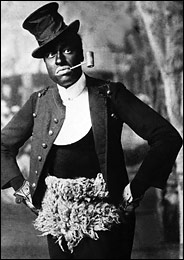
Image of Turn-of-century Black face MinstrelAn article in yesterday’s New York Times titled “How Pop Sounded before it Popped” discusses the unbelievable collection of cylinder recordings that have been digitized and made available on the web thanks to the Donald C. Davidson Library’s Cylinder Digitization and Preservation Project at UCSB. While I can’t pretend to know much about American musical history, I won’t have too many more excuses not to given such an unbelievable resource as this. Enjoy this amazing collection!

Thanks Gary and Mikhail!

Posted in Uncategorized | 1 Comment

Tracking Web 2.0 at techcrunch.com

An image of the DabbleDB logoI was reading an article on edugadget posted back in October, and it had a great link to a site called techcrunch which is keeping track of all the new and cool software being distributed under the Web 2.0 banner. After following the link, the site did not disappoint. They are featuring a new software, yet to be released, called DabbleDB – which allows you to do the following, to quote an earlier techcrunch review of this forthcoming web 2.0 application:

DabbleDB is a platform that allows you to create applications online using a web interface. The sort of applications you would create and then use are what most of us normally hack together in a spreadsheet or using some other database application that is often complex. Example applications that I created in DabbleDB are a contacts list, where I can store, share and categorise my contacts, and also an issue tracking system where I can track bugs and change requests. Other examples on the DabbleDB website are a expense report application, a conference organising app, a scheduling app and a client invoicing application.

A Web 2.0 Meta-application – I love it! You can see the demo video of the application here. Man, I hope they release this soon, it looks groovy …

Tagged | 4 Comments

Lyceum – a multi-user blog solution?

A couple of weeks back (March 1st, to be exact) boingboing posted about a new multi-user blogging service called Lyceum (developed by ibiblio.org).  I just got around to downloading the nightly build and reading the FAQ, and I have to say if it delivers on what it promises this could be a welcome alternative to the WordPress Multi-User nightly build nightmare.

Seems that Lyceum uses the wordpress code, design, themes, and plugins, but has redesigned the database table structure.  And while users that are not sysadmins cannot upload files or install themes and/or plugins, this multi-user blogging software promises to scale easily from 2 to 200,000+ blogs – now that is enterprise level!

You can see their demo site to try a test installation here.

Posted in Uncategorized | 3 Comments

Riddle me this Batman …

Why should you buy a PC? Having read the late-breaking news that the MAC intels can, indeed, run Windows XP flawlessly – I can’t think of one …

The Riddler from Batman

Posted in Uncategorized | 1 Comment

Universities not ready for open source?

Insidehighered.com quotes a recent study (conducted by the Alliance for Higher Education Competitiveness) that finds Universities are not ready for open source! Interesting read for thinking about precisely why this might be the case …

Tagged , | Leave a comment

Slide Show Pro

Image of Slide Show pro logoIn my efforts to find an easy, versatile, and professional looking solution for presenting images as a slideshow online, I came across SlideShowPro – an extension for Macromedia’s newer Flash authoring programs, such as Flash MX Professional or Flash 8. And while this solution is not a freebie (the cost of the Flash software plus 20 bucks for the extension), you get a whole lot more than you pay for with this extension.
Here are a couple of examples that feature this extension:

The basic logic behind this plugin is that it allows you to create a flash movie that acts as a container for information about your slide show images. However, to improve the speed and versatility of the movie, the flash file is simply a receptacle for a XML document that organizes the albums of photos that live outside the flash movie. In other words, the flash movie (SWF file) is reading a XML file that organizes the images and can be easily updated and changed – so you don’t have to recreate the swf file to add images, albums, etc. Moreover, the extension also allows you to fetch your flickr albums with an OPML file, play music with your slideshow, and insert FLV movie files …

This is perfect for some of the projects I am currently involved in, and I will be playing with this a lot more in the days to come. In fact, I already have an example that works with typo3 – check out this page for a test run with slideshowpro …

Posted in Uncategorized | Tagged , | 2 Comments

Laptop University

The following article on Slashdot is from an IT person (I assume) at an Art College who is asking for advice about dealing with his colleges pending move to an entirely laptop campus … interesting concept!

Tagged , , | 1 Comment

If you build it, they will come …

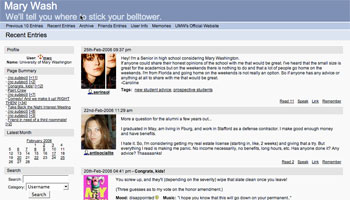
While I hated the film Field of Dreams (almost as much as I hate the acting persona of Kevin Costner), I will shamelessly utilize an oft abused quote from that film. After speaking with Amanda McCuskey (a sophomore at UMW, and one of the University’s finest), I was made aware of some online communities that UMW students partake in outside of the ubiquitous facebook. There is a community of UMWers on livejournal called Mary Wash that have been using this social software to communicate amongst themselves and, quite interestingly, with those high school students that are considering coming to the university.

In fact, the this year’s incoming class of freshman (2009) used the bulletin board feature on livejournal to post musings, schedules, proposals, advice and support as they embark on their new life in college. (Please note: that this is a student run site and you may not always be excited about the content!) Moreover, the lists are moderated by the students themselves which implies that these communities are self-sustaining, designed to vent about the college experience as well as foster a space to both find and provide help for one another. Now, here is a public social software tool that allows studnts to create communities before they even step foot on campus, pretty cool, no?

And while I am not a particular fan of livejournal’s software, it seems highly effective at creating a space where students can create effective social networks. For example, the Mary Wash community has well over 200 members, and while you have to be a member to post and keep a journal (their term for blogging), anyone can coment on the post or signup as readers (there are another 215 of them). Students also have the option to control who views their journals, building in a layer of privacy and protection. While in the back of my mind I knew these networks existed for many purposes outside of the mission of DTLT, there are also many uses that fall well within the realm of the academic community.

Image of a livejournal Site created by UMW students

Yet, I think knowing that the students are putting this social software to good use by cultivating a community of information sharing suggests the ways in which these tools are shaping many students social experience at UMW. Such a fact parallels the mission of DTLT, making a strong case for bringing similar tools into a more specific context for their academic experience at UMW. And while I am not suggesting this as an opportunity for coopting these pre-exisitng communities (for they serve a unique purpose outside of DTLT’s purview), I do believe that these elements of online social networks can be easily framed and adopted for many students into a more rigorous, academic online experience which, in my mind, is ripe for development and exploration. In fact, that is what we’re all doing here at DTLT, but I find it really exciting to know/remember that we are by no means alone in this! The students are not only the reason we are here, but, moreover, our most useful resource for understanding what these communities offer and why they keep them alive. So, as a revsion of my original title I offer up: “They’re all ready here! We just have to build it …”

Posted in experimenting | Tagged , , , | 1 Comment

The MoAD’s Virtual Museums

Image from the Museum of the African DiasporaThe Museum of the African Diaspora (MoAD) in San Francisco has one of the most elegant and important exhibits I have yet to see online. The “Photographs from the African Diaspora” virtual exhibit is truly visionary, be sure to take a look.

Posted in Uncategorized | Tagged , , , , | Leave a comment