
Image credit: Amy Burvall
For more than a decade I’ve been circling around one pretty basic idea: the open web kicks learning management systems (LMS) asses when it comes to teaching and learning in higher ed. I’ve said it far less succinctly than that on numerous occasions, but my point has always pretty much the same. And Audrey Watter’s nails it with her usual exactitude in a recent talk in Newcastle about the LMS:
The learning management system has shaped a generation’s view of education technology, and I’d contend, shaped it for the worst. It has shaped what many people think ed-tech looks like, how it works, whose needs it suits, what it can do, and why it would do so. The learning management system reflects the technological desires of administrators — it’s right there in the phrase. “Management.” It does not reflect the needs of teachers and learners.
If that’s the case, what are the needs of teachers and learners? Is it presumptuous for a few edtech folks to argue everyone should be using the open web? Probably, but that’s not going to stop us. And I will turn again to Audrey’s recent talk for an excellent reason why:
If we think about new technologies like the Web as facilitating learning networks and as learners and learning communities as nodes on those networks, we can see a very different “shape,” if you will, to education technology than what the learning management system enables.
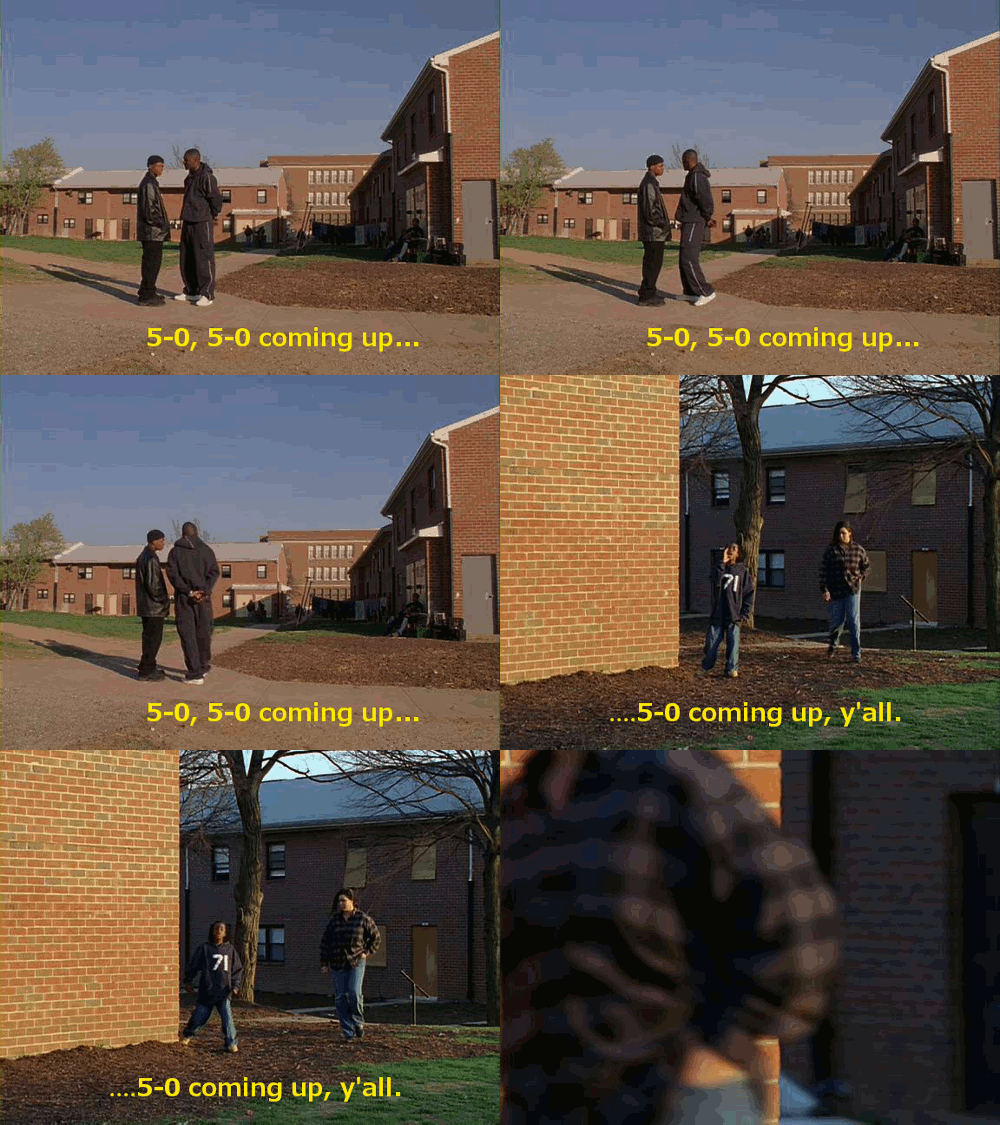
The web as learning network that isn’t an insulated, hierarchical reproduction of a managed system is a reality higher ed seems to be hell bent on resisting. Why can’t we imagine, for even a moment, the idea of user as developer that was prevalent in the early days of the web. Once upon a time we explored HTML and used FTP to upload files. Since then, creation on and through the web has gotten much more user-friendly. And, as Gardner Campbell notes in his essay on The Personal Cyberinfrastructure, we have arrived at a moment where a student can and should be the sysadmin of their education. The same holds true for faculty. What’s more, with extensive experience over the last two years helping more than 1000 faculty, staff and students get their own domain and web hosting through UMW’s Domain of One’s Own project, I can confidently say it’s easier than ever. And, to visually quote Amy Burvall, it moves us towards a technical infrastructure that privileges “self over system.”
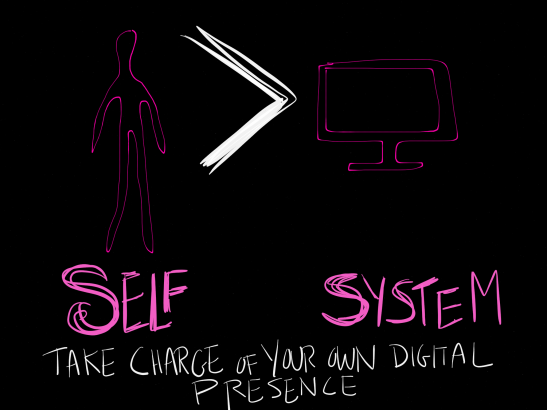
Image credit: Amy Burvall
And while ease and convenience can’t be underestimated for faculty, it’s the personal and professional opportunities available that are truly compelling: building your online identity, networking within your discipline, and designing curriculum centered around digital fluency. It seems to be a foregone conclusion that online learning, hybrid courses, and digitally rich classrooms are the future, yet the systems we provide to support this inevitable reality do little to nothing to reinforce any of the most basic rights of students, faculty, and staff.
- Do you have control over your data? (Domains is about as FERPA compliant as you can get!)
- Is the work you do in any given system easily exportable and ultimately affordable beyond your university experience?
- Do you have the freedom to customize your online learning environment?
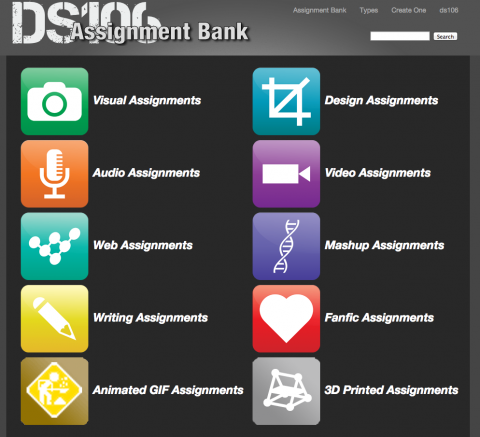
We have been working hard at UMW to start answering these questions. And having worked with more than 75 faculty over the last two years, and almost 1000 students, we’ve been able to answer yes to all three. This is the “singleness of purpose” driving the work we’re doing at UMW. We see open sources publishing platforms like UMW Blogs, courses like ds106, and campus-wide initiatives like UMW Domains as compelling examples of resistance to higher ed’s fifteen year addiction to the LMS.
And the shift starts pretty simply. The path to empowerment is through acknowledging and reclaiming ownership of your world online. Over the course of the next 12 weeks I’m committed to help any and all faculty playing along with Connected Courses get up and running with their own domain and web hosting. This was the impetus behind the original vision of the course: create resources for faculty who wanted to build a course-hub on their own domain like the one Howard Rheingold and I worked through in this three part video series. Those videos were the beginning of a larger idea of creating resources that would support faculty interested in setting up their own domain and web hosting.
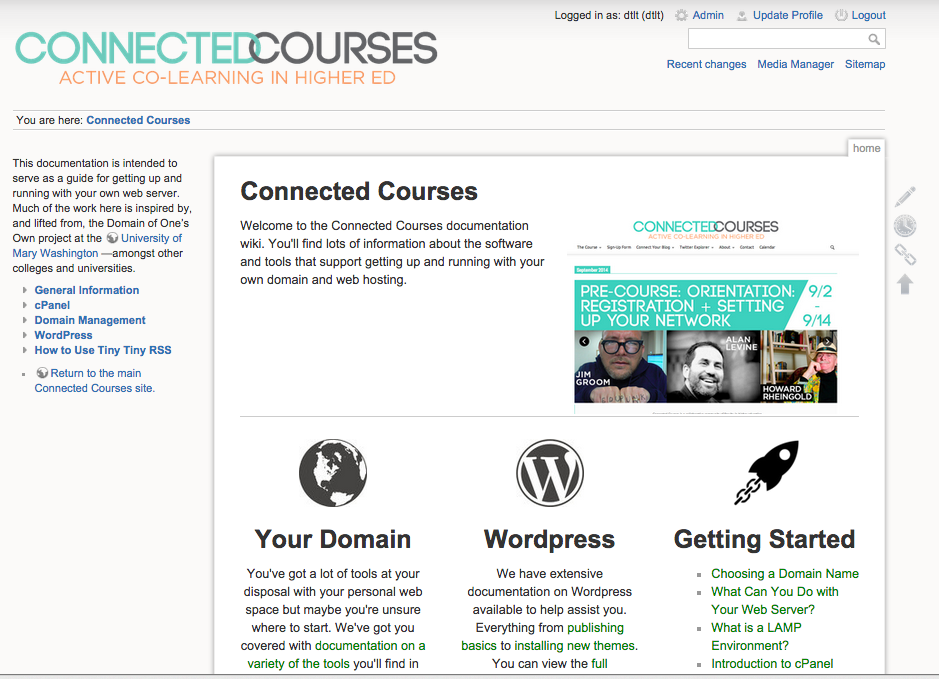
To that end, we created the Connected Courses documentation that provides an overview of web hosting, domains, as well as ton of specifics about CPanel, WordPress, and more. If you ever wanted to dig into managing your digital life online but never felt comfortable based on time investment and support, this is your lucky semester! Use any web hosting service you like, but the documentation above is specific to the CPanel GUI interface for managing your slice of a server. Also, if you want targeted support for your web space, I recommend starting out with Reclaim Hosting. Full disclosure: this is hosting service Tim Owens and I run, and I recommend it because it means we can help you in very targeted ways.
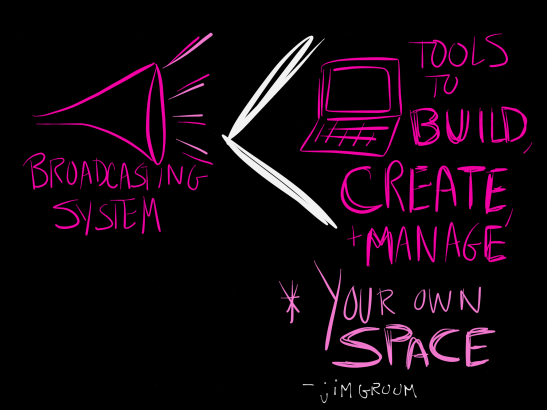
Image credit: Amy Burvall
So, as you follow along for the next twelve weeks consider this an opportunity to fully explore the tools available to create and manage your own space online.