Here is a quick screencast showing you how to add text to GIFs in GIMP. And keep in mind, GIFs don’t necessarily need text for the summary assignment.
And here’s a GIF with text 😉
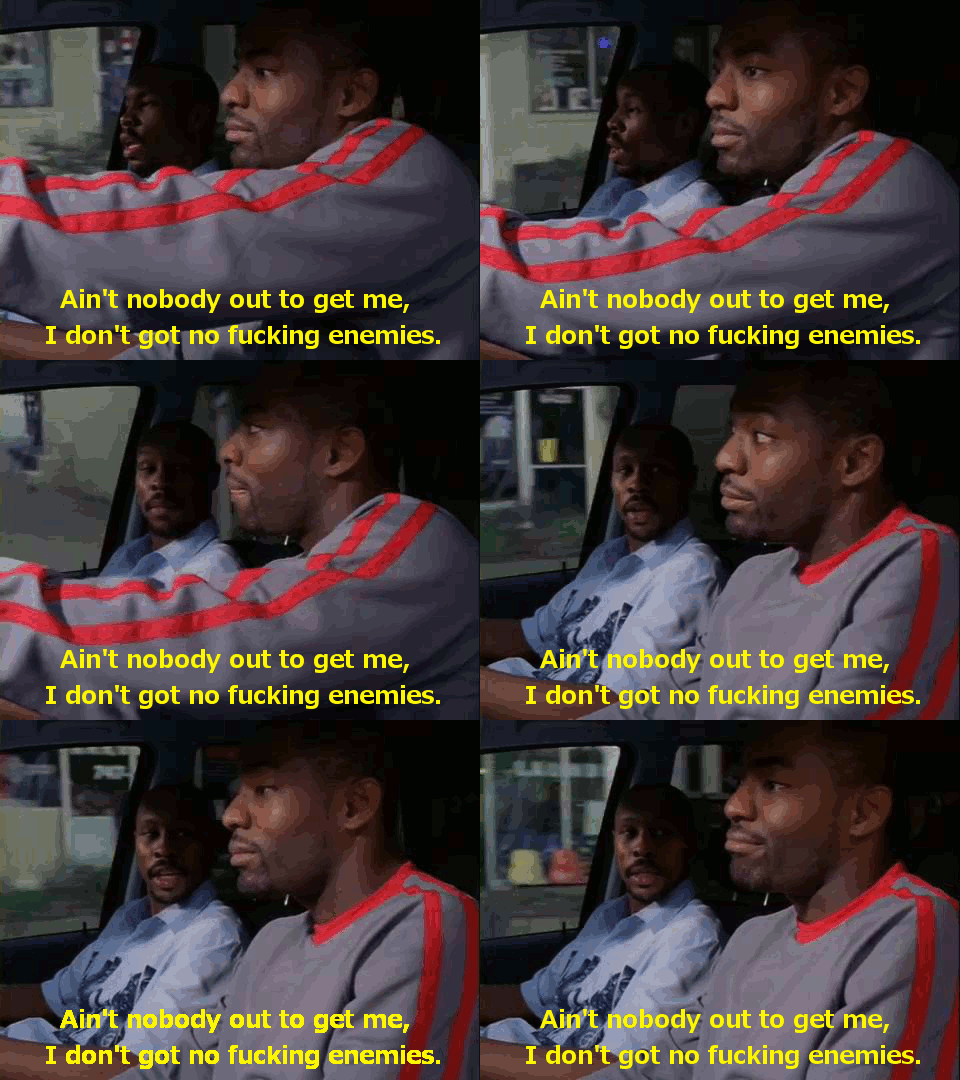
Here is a quick screencast showing you how to add text to GIFs in GIMP. And keep in mind, GIFs don’t necessarily need text for the summary assignment.
And here’s a GIF with text 😉
Paul Bond and I discuss Episode 10 of Season 1 of The Wire: “The Cost.” And as you may have guessed, this episode is all about, well, the cost of it all. Also, Wire 106 internaut Maggie Stough provides and awesome look at light and color in this episode, and Paul Bond is up to his usual flights of fancy analysis. We’re are all getting pulled into the inescapable narrative gravity of this “Russian novel” of a series.

Image credit: I think Audrey Watters took the shot but I grabbed it from Kin’s blog
A year and a half ago now, I caught up with Audrey Watters and Kin Lane at the Reclaim Open Hackathon at MIT. I’m still working off the fumes of that weekend, and to be fair a few subsequent meetings 🙂 The image above is a shot of what Kin was sketching out the architecture of Reclaim Your Domain, basically a domain-based hub that enables you to integrate and push all your various content to the appropriate sites, while maintaining the “authoritative” (probably the wrong term, but work with me here) copy in your own space.
The top of the diagram in the above image lists the various resources based on media, rather than services. Under that you have the technologies to push/pull content to the various sites. It will depend on either RSS (OG) or APIs to get that done, and the former will pull, the latter, utilizing JSON, will push the data where it needs to go. [It took me a year and a half to start wrapping my head around this.] Now, if we premise this on an individual’s domain within a network (this was one of the coolest realizations for me during the hackathon) any site could be both a spoke or a hub. A faculty or student’s domain could be a hub for syndicating content—leveling some of the hierarchical biases baked into the course-driven learning management systems. Hubs created and managed by faculty may still be the norm with domains, but that is not an assumption built into the technical infrastructure.
And I wrote all that, to say this. Looking at the way Tim Owens created the custom Installatron package for Known in UMW Domains, the idea that every individual’s domain at UMW has the ability of being both a spoke and a hub for content was realized.
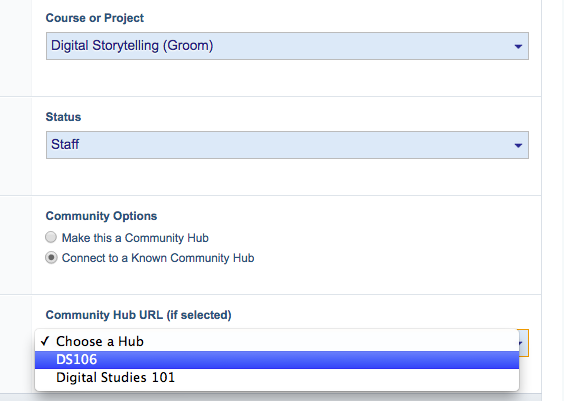
Above you see fields of options you are offered when you create a Known site on UMW Domains. The radio buttons to choose between making this site a community hub, or connecting it to one is powerful choice. The learning system infrastructure is not necessarily unilateral. There was a lot of talk during the MOOC days—remember them?—about students creating their own communities in the forums, on Facebook, MeetUp, or some other abysmal platform. And why? Because it wasn’t an option native to the systems, most of the VC-funded revolutionary MOOC platforms where LMSs that scaled big.
The platform that let’s you keep control of your data, decide where to send your content, while refusing to distinguish your technical infrastructure from the course you are subscribed to is the outline that I am currently watching get colored in with Known. Kin had the idea that when you sign-up for your domain you would decide where you want to import and store your photos, tweets, videos, check-ins, etc. All the while you would get educated contextually, much like the video games do. With the Known hub Ben Werdmuller has made available to us at UMW, we are having students in a couple of experimental classes do just that.
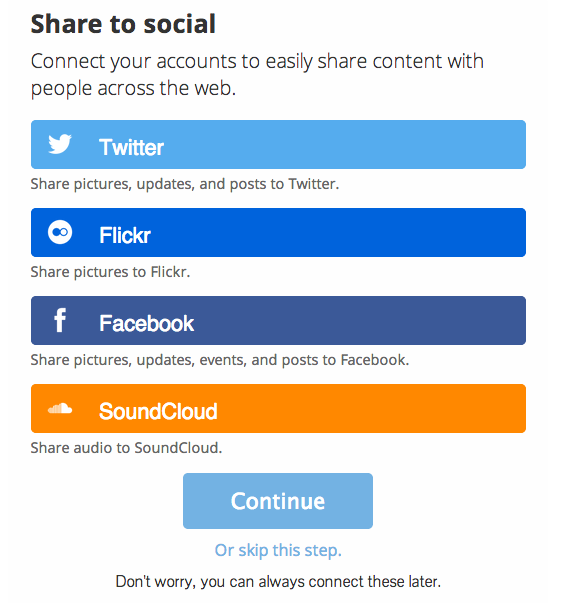
They’re authenticating into Twitter, Flickr, Facebook, SoundCloud, etc. and they’re now posting through Known, keeping the “authoritative” copy. It’s remarkable that a year and a half later one of the former developers of Elgg, along with Known co-founder Erin Jo Richey (designer from the IndieWebCamp school of thought) had already imagined something that fit this vision so well. At the same time, maybe it’s not all that remarkable. Maybe a certain swath of web culture is starting to wake up to alternative means of publishing on the web, one in which we manage our online selves more assiduously. That’s exactly what Domain of One’s Own has been all about for years, and I think we’re starting to see open source applications like Known begin to reflect those values.
At this point I am fairly certain Tim Owens and Ben Werdmuller could come up with a model that would make on-boarding new users for Domain of One’s Own an exercise in getting everyone up and running with a Known site. But not simply to replace Known with WordPress, but to provide a seamless, yet contextualized, experience of what ownership on the web looks like. How push publishing works, and what the principles of a new, indieweb are. Make the on-boarding an experience akin to the first ten minutes of Half-Life 2, an introduction that attempts to scare you into how to play the game, or in this case the web 😉
Below is a breakdown of what will be expected for week 2, but be sure to watch the video in its entirety for context, details, and personality 
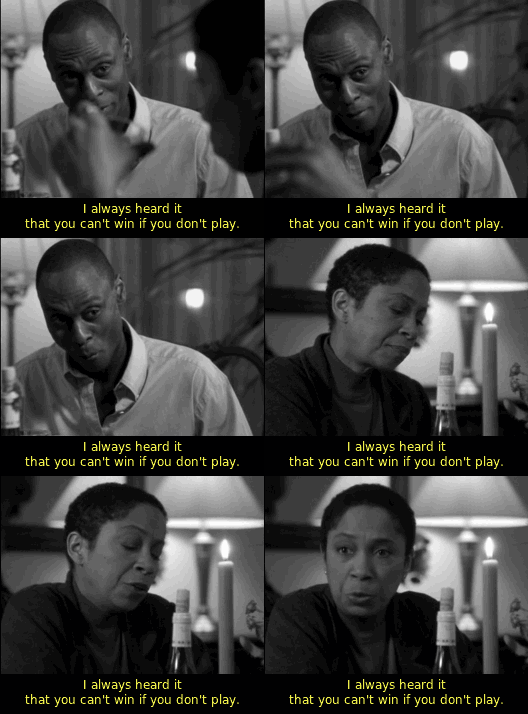 Summarize a Wire Episode in GIFs: You will each be asked to create a GIF Summary of your choice of one of the first nine episodes. The trick is you have to do it in no more than 6 GIFs Here is the assignment, and be sure to tag the post you write for this assignment with the proper two tags, i.e., AnimatedGIFAssignments, AnimatedGIFAssignments1352. Also, here’s a good tutorial for creating animated GIFs with free and open source tools. Don’t wait on this one, it will be a time suck if you’ve never done it before.
Scott Punkett’s “We Can Blog”
Blog Post Titles: We’ve noticed a lot of your post titles were quite boring. Something like “Week 1 Summary,” etc. This is not the most inviting entry point for your work. It is up to you to make your posts, like all your work, creative and enticing. Which birngs me to the second bullet point….
For a more in-depth overview of WordPress check out the documentation we have provided at http://docs.umwdomains.com/wordpress/wordpress
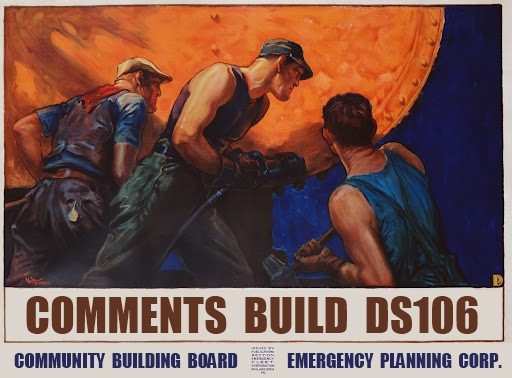
Jack Mulrey’s “Comments Build ds106?
Commenting: Commenting is the life’s blood of this class, and it is a large part of your overall work in this course. Read widely and comment freely, Commenting builds community, and from here on out we will take Desa’s lead and link to all the comments we left over the course of any given week in our Weekly Summary posts. You can find all the course posts on our ds016/wire106 page. We will also setup a hub this week (see Known install below) for aggregating all the work happening in the various sites in one place.
This week we will be watching episodes 10-12 of Season 1 of The Wire. You should know where to find them.
The application we will be installing this week, Known, is what we will be using to create a syndication hub for all the various media: Tweets, SoundClouds, Daily Creates, Flickr images, etc. Below is a screencast video that will take you through installing this application. I will be sending out specific details for how we expect you to use Known mid-week, for now jsut get it installed and test it out. Also, I recommend each of you installing it in a subdomain called wire106 (here’s how you create subdomains).
Brittany pointed out, quite rightly, that Google search is your friend in this course:
I did a little troubleshooting on google and found out that uploading it in an incognito window would work and when I did that it uploaded without any issues.
This is our discussion about the 9th episode of Season 1 of The Wire: “Game Day.” And that’s nine episodes of The Wire by the first week of class—that’s pretty awesome. And if you have kept up with them so far, then you are too! Next week we’ll be dialing back the pace considerably, only doing 3 episodes a week. That should bring us into Season 2 by week 3. It’s our plan to get through 4 seasons of The Wire this semester, and then have fun with Season 5 over winter break for any and all who might be interested 
Also, be sure to check out Paul Bond’s notes on episode 9. Paul has done a tremendous amount of work with the sound editing of the more recent episodes, and we’ll be having a special radio discussion dedicated to sound some time this week, we’ll be sure to announce it for anyone interested in participating. What’s more, looks like we will be bringing in the sound editor for the series, Jen Ralston, to talk about her work on the show. This should prove amazing! We’re still working on a time and day, so I’ll keep everyone posted.
This is our discussion about the 8th episode of Season 1 of The Wire: “Lessons.” As I mentioned in the last discussion post, in the coming weeks we will be live streaming these discussions for anyone to join from the wire106 course and beyond. And given the reflective work I am starting to see from the UMW students I can’t wait!
Once again, I’ll keep the post for this one brief because given I have a longer post I will be writing that integrates all three episodes, but in many ways focuses on this one—which is all about lessons. It starts with Jimmy McNulty giving his kids a lesson in police work in A Baltimore market as they tail Stringer Bell. A scene, as Maggie Stough notes acutely in her post on the episodes, that parallels the lesson Wallace gives to one of the many kids he is raising in the abandoned rowhouse:
This scene with McNulty and his kids seems to parallel the scene between Wallace and one of his kids. The kids struggles with a math problem and figuring out how to do it in his head, but the minute Wallace phrases it as a drug dealing problem instead of passengers on a bus, the kid can solve it in his head. When Wallace asks why that is, the kid explains that the consequences for getting the drug dealing math wrong are much more serious than getting a math problem wrong. Just as McNulty’s kids enjoy playing the spy game, Wallace’s kid has an understanding of drug dealing and takes the matter seriously.
The parallel between these two lessons is an excellent read, and it suggests how much we are defined by our context. We can also see the theme of lessons repeat throughout the episodes in relationship to education. Stringer Bell attends a local community college to learn about macro-economics, while Herc and Carver are preparing for the sergeant’s exam. The following two screenshots mark the transition from Stringer Bell in class to Carver and Herc taking their exam, reinforcing the parallels between these two worlds.
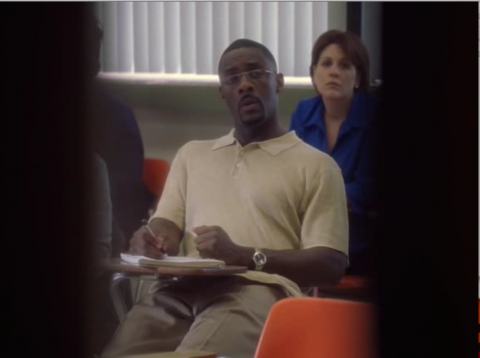
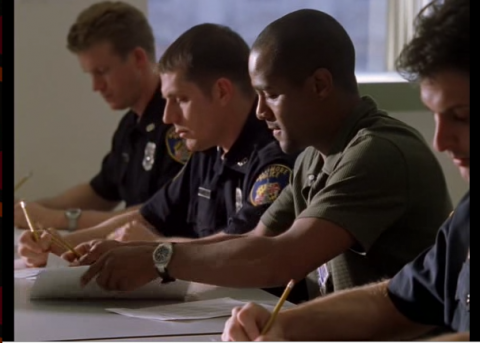
I was also struck by the constant, subtle reinforcement of how similar the cops and robbers are in this series. For seven episodes now we have been trained to see the Barksdale crew with a pager by a pay phone reporting to their bosses. In this episode I was struck to see Jimmy McNulty doing the very same thing, it’s like he went to work in the pit:
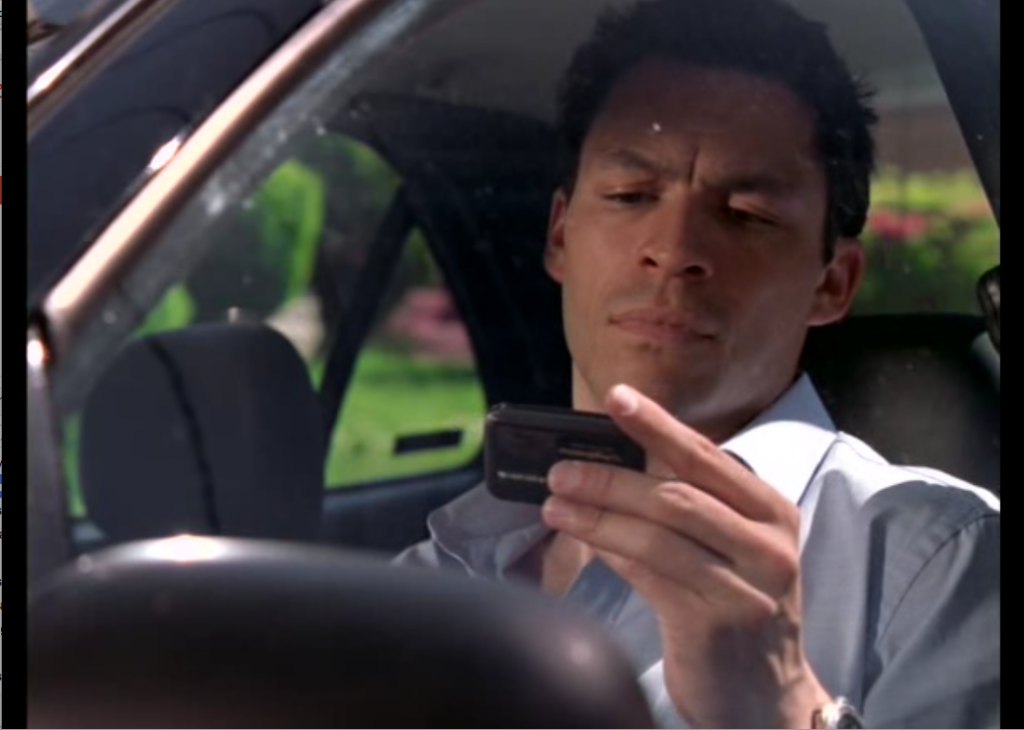
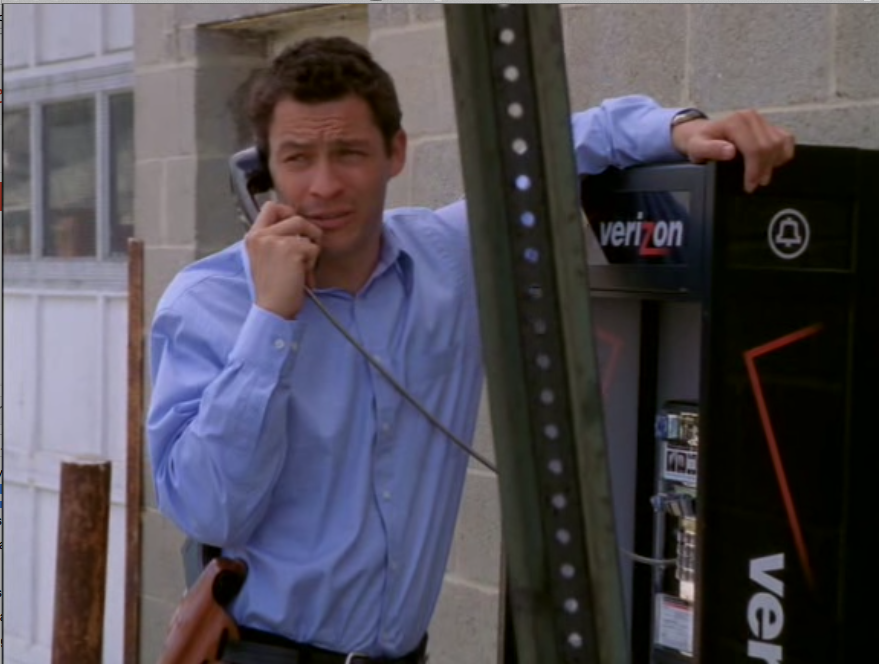
Paul Bond offers more visual and aural readings of this episode, so don’t miss that either. Also, as Brittany notes in her week 1 summary blog post, this is the episode wherein Omar and the Barksdale are in full-on Sergio Leone mode.
Omar says, “You come at the king, you best not miss.” Interesting because Avon was the king but now Omar is saying he is the king. He said this after he injured one and killed one of Avon’s men.
Interestingly enough, this epigraph foreshadows how episode nine is going to end for Omar. Man, this show is good!
This is our discussion about the 7th episode of Season 1 of The Wire: “One Arrest.” In the coming weeks we will be live streaming these discussions for anyone to join from the wire106 course and beyond. Also, we will be asking various UMW students to sign-up to lead the discussions of certain episodes, and we will schedule around their availability. So stay tuned for that announcement in week two.
I’ll keep the post for this one brief because I have a longer post I will be writing that integrates all three of the episodes we discussed this week. But be sure to check out Paul Bond’s discussion of parallels in this episode (not his awesome use of GIFs 😉 ).
Also, I really enjoyed Kristine’s reflections on the discussions in her weekly summary post wherein she remarks….
….there are things I’m seeing in my second trip through Season 1 that I missed in the first viewing. Stuff in the background of scenes, things on computer screens that I missed the first time around, and bits of dialogue that have more meaning to me now, having seen the entire thing all the way through. I like the explanations that Freamon gives, and how after he at first seems skeptical of the group and remains on the fringes, he jumps in when it becomes a puzzle that needs to be solved. I like how Prez “finds himself” as a puzzle-solver too, and the two of them end up being the brain trust of the law enforcement side of the story.
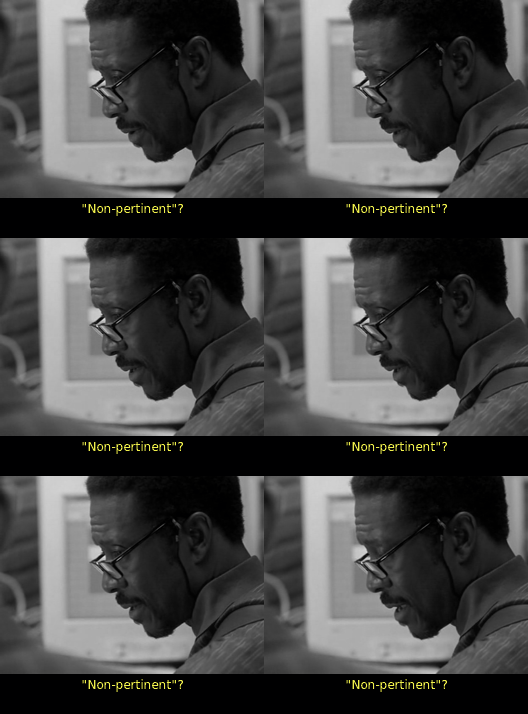 She sums episode 7 up better than I can. This entire series will be all about the close reading, and watching each of the episodes more than once to fully get a sense of what’s going on—Lester Freamon gives us just that in the beginning of this one.
Next month at Library of Congress, Packard Campus, three of the most iconic films of the last 35 years will be showing:
Saturday, Sept. 13 (7:30 p.m.)
STAR WARS: EPISODE IV – A NEW HOPE (20th Century Fox, 1977)
This first film in the epic American space opera created by George Lucas continues to be one of the most popular movies of all time. Film critic Leonard Maltin called it an “elaborate imaginative update of Flash Gordon” and “a hip homage to B-movie ethics and heroism in the space age.” Young Luke Skywalker is aided by a Jedi Knight, a cocky pilot, a wookiee and two droids to save the universe from the Empire’s world-destroying battle-station, while also attempting to rescue Princess Leia from the evil Darth Vader. Starring Mark Hamill, Harrison Ford, Carrie Fisher and Alec Guiness, the film received 10 Academy Award nominations including Best Picture, winning six. The original release version of “Star Wars” was added to the National Film Registry in its inaugural year of 1989. We will be screening the special edition released in 1997.
Color, 125 minutes
Saturday, Sept. 20 (7:30 p.m.)
STAR WARS: EPISODE V – THE EMPIRE STRIKES BACK (20th Century Fox, 1980)
After the rebels have been brutally overpowered by the Empire on their newly established base, Luke Skywalker takes advanced Jedi training with Master Yoda, while his friends are pursued by Darth Vader. The much anticipated continuation of the “Star Wars” saga, Irvin Kershner’s 1980 sequel sustained the action-adventure and storytelling success of its predecessor and helped lay the foundation for one of the most commercially successful film series in American cinematic history. It was nominated for three Academy Awards and won a Special Achievement Award for visual effects. Stars Mark Hamill, Harrison Ford, Carrie Fisher are joined by Billy Dee Williams and Frank Oz as the voice of Yoda. The original version of “The Empire Strikes Back” was added to the National Film Registry in 2010. We will be screening the special edition released in 1997.
Color, 124 minutes
Saturday, Sept. 27 (7:30 p.m.)
STAR WARS: EPISODE VI – RETURN OF THE JEDI (20th Century Fox, 1983)
Set one year after “The Empire Strikes Back,” “Return of the Jedi” deals with the rebel forces’ last stand against the Empire and Luke Skywalker’s fateful confrontation with his archrival, Darth Vader. Skywalker tries to rescue Han Solo and Princess Leia from Jabba the Hutt, while the rebel army and the small, furry Ewoks battle the enormity of the rebuilt Death Star. This finale of the original epic space trilogy was directed by Richard Marquand and stars Mark Hamill, Harrison Ford, Carrie Fisher, Billy Dee Williams and Frank Oz as the voice of Yoda. We will be screening the special edition released in 1997.
Color, 134 minutes
When I first browsed the schedule I thought they might be presenting the original 1977, 1980, and 1983 films respectively, which got me very excited. Turns out that’s not the case, in fact it’s near on an impossibility. They will be showing the 1997 versions which, as some would argue, are very different films. I tend to agree, and I yearn to see the original, unaltered versions in 35 MM again because those mark the moment my cultural imagination changed.
That said, I would jump at the chance to take my kids to see the 1997 versions if they are being shown in 35 MM for many reasons. Not least of which is how rare public showings of these films in 35 MM are. I’m not sure the LOC has gotten approval to do so, but I will be calling first thing next week to try and find out.
These films, particularly A New Hope, still produce a tractor-beam like grip on my imagination, and it might be argued that this film is the single most enduring pop culture artifact of the last four decades. Just this evening my kids were watching Star Wars: the Clone Wars series. More than 35 years later the 125 minutes I spent in a single screen movie theater in Baldwin, NY has played an almost daily role in my life over the last two decades. Between bad prequels, lego sets, video games, internet memes, DVD sets, posters, toys, and and on and on. In some ways the franchise is more akin to MacDonald’s than cinema these days, but at the same time I was born at a moment were the original magic that engulfed a generation was pure and transformative. Or at least I still need to believe that, and my kids experience of A New Hope probably won’t be one of mind blowing wonder like mine was in the late 1970s, but if it’s in 35 MM I don’t care. We’re going!
 Almost two weeks ago Ryan Brazell and Tim Owens moved both the core files and the databases of UMW Blogs onto Amazon Web Services (AWS). What does that mean exactly? It means UMW Blogs is now in a virtualized server environment that can dynamically expand and contract based on usage demands. It also means our pilot experimentation with AWS ramped up pretty quickly 🙂 But it did so because UMW Blogs was having some serious performance issues over the summer, and we had to act fast to make sure it was ready to go for the start of classes this week.
That couldn’t have happened without the time and energy Ryan and Tim put in over the course of a weekend to make sure it went off smoothly. They shut down the site for a day and a half, and moved both the database and the core files to Amazon instances. What this will mean for us going forward is pretty awesome. We can decide to adjust the CPU resources to the Elastic Computer Cloud (EC2) instance the first week of classes so the server isn’t overrun. We can clone the entire server setup within seconds and do testing and seamlessly integrate new features throughout the semester: latest versions, plugin and theme updates, etc. We can downsize the server toward the end of the semester and over the summer to save some money.
The server is now a utility, and we pay for what we use. This is all the more relevant given some of the usage we previously saw on UMW Blogs has moved to UMW Domains. The cloud enables agility when it comes to a system like UMW Blogs, and it breathes new life into its performance. As we approach the end of the first week of classes we haven’t had any issues (jinx), and if and when we do we can adjust the allocation of resources temporarily to address potential problems.
UMW Blogs is entering it’s seventh academic year of service to the UMW community, and it’s a point of pride that under the stewardship of Ryan and Tim it’s better than ever. I would write up all the technical details and dig into the nitty gritty of the process, but I was on the outside of this one. Tim and Ryan owned this project and made it happen, because lord knows I was out of my depth. It’s a real honor to work with consummate professionals. They worked damn hard to bring this platform into the future, and I really appreciate it. Now if they’d only blog it 🙂

Find out more about me here.