Digital Agency in the 21st Century

I was just asked to submit an abstract for a presentation I may or may not give this Spring. I’m kind of enjoying being on hiatus from presenting, but I still get the itch 🙂  I jammed it out first thing this morning, and kind liked the marriage of agency, the Indieweb, and domains. I just need to work bot storytelling in there and it would be perfect 🙂

This presentation will explore the importance of providing students, faculty, and staff with an innovative, web-based platform for owning, managing and migrating the digital work they create over the course of their academic career. What’s more, this platform is not a proprietary, vendor-driven product, but an ecosystem of open source applications that are central to the critique and creation of their digital world. It’s the backbone for a broader, curricular-wide push for cross-disciplinary digital fluency. In essence, the platform undergirding the pioneering work of Domain of One’s Own at Mary Washington—and several other campuses across the U.S at this point—is, wait for it….the open web. More than a learning system or publishing platform, UMW Domains recognizes and codifies the importance of each and every learner on campus managing their own piece of the web. What’s more, through trailing edge technologies like commodity web hosting we can enable this for each individual at scale. The impact of the global information network on our campus community is not imagined or inferred, it is intentionally designed and cultivated. Welcome to the digital liberal arts, and the emergence of the Indieweb in higher ed. Can you grok the future?

Posted in presentations | Tagged , , , | 2 Comments

The Game Supercut

John Johnston, hearing my call, created an automated supercut video of all the mentions of “the game” in Season 1 of The Wire. The VideoGrep script provides a quick, easy, and exacting way to analyze a show like The Wire around very specific themes in the script. It’s not comprehensive, but seeing John create this video moments after my blog request is mind blowing.

What an amazing resource for students to be able to search and be immediately presented with the clips across 60 episodes of The Wire as a starting point for their analysis. What’s more, playing the above video back is mesmerizing. It’s like the show is speaking back to the me through the filtered lens of a coded theme deeply embedded in a masterpiece of television. This technology provides a pretty compelling example of how quickly we can extract these themes/patterns across a TV series like The Wire to open up new and powerful ways of reading. We provide variables that fuel a formula to represent our interpretive assumptions, as well as challenges them. Can machines tell stories? I think they can if we provide interesting search terms and damn good metadata 🙂

Posted in digital storytelling | Tagged , , , , , | 2 Comments

Wiring Supercuts

John Johnston’s post yesterday about Videogrep really piqued my imagination.

Videogrep is a python script that searches through dialog in videos and then cuts together a new video based on what it finds. Basically, it’s a command-line “supercut” generator.

In other words, if I can get this thing wired up, I can create a supercut video of every mention of “the game” throughout all of season 1. How sick is that? This is my new goal in life. The script will search through the subtitles (.srt files) and link them with timestamps of the video to immediately cut the scene and link it with every other scene that has a mention of “the game.” John included some examples to give you an idea of how this might work.

A good one is every mention of “know” in Blade Runner—I love this:

And here’s an example of every time “jungle” is mentioned in Apocalypse Now:

And John even threw in an example from episode 1 of season 1 of The Wire featuring every mention of “Barsksdale.”

It begs the question, apropos of this week’s focus, are such automated, script-based videos an example of digital storytelling? On top of that, what term would you search across a single episode, or even the entire first season?

Posted in digital storytelling | Tagged , , , | 7 Comments

Week 3: Putting the Digital in Storytelling

Important: If you haven’t gotten and verified an email from ICANN confirming your domain, login into umw.domains and there should  be a message asking you to resend the email for confirmation—if there isn;t you did it already. Do that ASAP or else your domain will be suspended.

Below is a breakdown of what will be expected for week 3, but be sure to watch the video in itsz entirety for context, details, and new and improved personality this week :)
z
The Shapes of Stories

Watch this 4 minute video by Kurt Vonnegut on the shapes of stories.

What is the “digital” in Digital Storytelling?
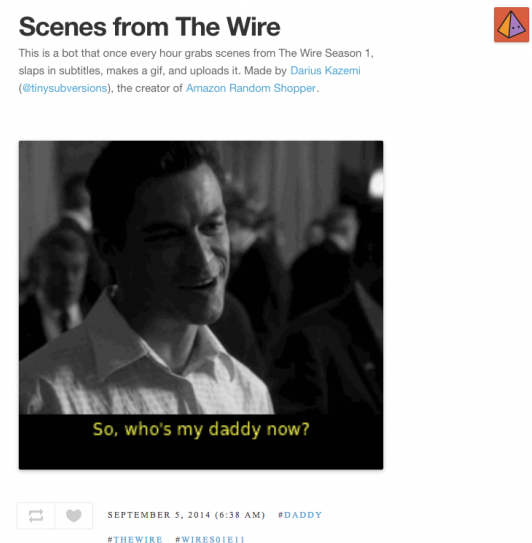
For this week read and reflect in a blog post on Bryan Alexander‘s “Web 2.0 Storytelling” chapter from his book The New Digital Storytelling. Also, based on Alexander’s discussion of digital storytelling, explain if the tumblr bot site Scenes from The Wire and Facebook’s TheWire constitute digital storytelling? Explain your rationale in your reflection to Alexander’s chapter, and tag the post “web20story” (no quotes).

Watching:

This week we will be watching episode 13 of Season 1, and episodes 1 and 2 of Season 2 of The Wire.

Creative Assignments

  • 3 Daily Creates: This week you all went to town with the Daily Creates, we were deeply impressed. Keep it up this week. Get into the daily habit of creating. Remember, if you spent 10 minutes on the Daily Create, you spent too long. That said, if you are inspired go with it. You can choose from any 3 TDCs during the week, but you have to do it on the day it comes out. Doing all 3 on Sunday will not be accepted for credit. Also, your Daily Creates shouldn’t be old photos, writings, videos, or audio you created previously, unless you add something significant to it that effectively makes it new. 

    Image Credit: Jessica Reingold’s “Paperman Transit”

  • Screen Shot 2014-09-08 at 7.59.41 AM

    ds106 Assignment Bank

    Exploring the Assignment Bank: You need to do three assignments from the ds106 assignment bank from three different categories of your choice, i.e.,  visual, design, audio, etc. that need to reflect each of the 3 episodes of The Wire we watch this week. Make sure your completed assignments show up in the assignment bank by using the proper two tags, for example, VisualAssignments, VisualAssignments5694.  Also, it’s your job to narrate the process, explain your thinking, and tell the story of your creation. To wit,  Alan Levine‘s awesome resources for writing up ds106 assignments is required reading for this week before writing up assignments.

Organizing Your Blog

You need to set up a framework on your blog to organize all of the work you will do in the coming weeks. By creating and using categories as your start, by the end of ds106 your blog is going to be like a well-oiled machine of creativity. Here is a suggested structure, but feel free to come up with your own.

  • Assignments
  • Daily Create
  • Thoughts and Ideas
  • Weekly Summaries
  • Best Work
  • Radio Show
  • Final Project

Now create the additional sub-categories and set the Parent to be Assignments:

  • Visual
  • Design
  • Audio
  • Video
  • Web
  • Mashup/Remix

You may end up with a category structure like this example.

Once you have created these categories, you will need to create an an organized menu to reflect the framework. Find out more about creating and customizing menus in WordPress here.

Engaging the Class

  • Commenting:  Did I mention commenting is the life’s blood of this class? Read widely and comment freely. And this is not limited to blog comments, this can happen on Twitter, Flickr, SoundCloud YouTube, etc. And remember to link to all the comments you left over the course of any given week in the Weekly Summary post. You can find all the course posts on our ds016/wire106 page.
  • Moderating Comments and Jetpack: Some folks still haven’t moderated comments other have left on their site. Also, a number of you still haven’t installed Jetpack. How do we know this? Because if you had we would be able to subscribe to your blog and get all your posts via email. Take care of this.
  • Twitter: At this point in the semester you will have realized Twitter is essential to your active engagement and regular feedback in this course. If you are not there, you are missing much of the community emerging around wire106. Given this, it will be difficult for you to get the full experience, an by extension full credit. Once again, follow the hashtags #ds106 and/or #wire106 and try using Tweetdeck for searching on these specific hashtags it there own columns.
  • Known: We setup Known last week, but now it is time to start kicking the tires on this application. The value of Known is it integrates your various social media in one place that you push out to those sites. From here on out, you will need to post the links to your assignments. Daily Creates, and weekly summaries to through Known to Twitter/Flickr/SoundCloud, etc. Get in the habit of using this space to share stuff you want the rest of the class to see on the hub.wire106.com. Also, share you thoughts about Known, and speak freely, this is an experimental application we are testing out this semester.
  • The Wire Video Discussion: This week we will start asking students to join us in the weekly video discussions of episode 13 of Season 1, and Episode 1 and 2 of Season 2. Right now the times are Tuesday 4 PM, Thursday 5 PM, and Friday 3 PM. We can change these times based on your availability in coming weeks, but if you can make those times this week sign-up and be ready to talk! I’ll be sending out discussion questions to folks that sign-up. Each of you will be required to do this at least 3 times over the course of the semester. But the more the merrier :)
  • Wire 106 Lunch (sign-up): Also, the Wire 106 lunch will continue this week for interested students. We’ll be getting Pizza off-campus at Brothers this week, we’ll get lunch to talk ds106, The Wire, storytelling, and more. This is optional, and we can find other options for those of you who can’t make it. Consider it a free lunch. Sign-up for this Thursday or Friday.

Quotes of the week:

Netflix gives me 15 seconds to decide whether I am doing anything with my day. -Stefanie Reutter

I am self conscious of my 17 inch laptop. -Sythekid

Posted in digital storytelling | Tagged , , | 2 Comments

Wire106 Week 2: My Kingdom for a Comment

Image Credit: “The Green Canoe”

Getting locked into the warp speed that is ds106 quickly reminded me why this the best class in the world. Ever 😉 We are starting to ramp up the course by getting more familiar with we post and connect across various social media spaces, such as the personal blog, Twitter, Flickr, and Known. This week also saw the introduction to the Daily Create, which UMW internauts have taken to like moths to the flame. I really love the work folks did so far for just about prompt, such as the logo create, the well-known story as transit map, drawing your internet, and Calvin Ball. There is no shortage of creativity in this crew. And despite the fact I said if you took 10 minutes to do the assignment you took too long, most folks invested themselves in what they were making.  I can’t thank Mariana Funes enough for keep things rolling so smoothly on this front.

I only did three out of four of the Daily Creates this week, so I stumbled a bit.  I did the Calvin Ball, Protest Blocker Book, and today’s Techfession. They’re all embedded below:

TDC #1 Calvin Ball:
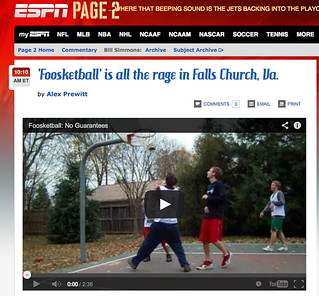
Foosketball is a sport that has ds106 roots

Foosketball:
A sport created by and for the Gods, combining football, basketball, and ultimate frisbee. Like in ultimate frisbee, a player cannot move with the ball. However, instead of a frisbee, foosketball is played with a football and instead of crossing an endline, a team must shoot the football into a basketball hoop in order to score a point.

It must be noted that in foosketball there are no guarantees. This refers to the difficulty of the game, most notably that even the easiest of shots can rim out due to the sport’s epic and intense nature. – www.UrbanDictionary.com definition

Actually, Fooseketball is an interesting mashup because it was actually dreamed up by Wesley Clark, a student who took ds106 back in the Fall of 2010. He did a video on the game his friends created in Falls Church for ds106, and it got picked up by ESPN that semester. Crazy of the implications of creating and sharing. Here is the full video:
www.youtube.com/watch?v=gSAkXJgvBk4

And here is Wes Clark’s original post on the sport from his 2010 blog post: ds106.umwblogs.org/2010/12/03/foosketball-there-are-no-gu…

TDC #2: What book would protect you in a protest?

Bomb Book

I went to Noun Project for this one, because I needed quick and easy, and I also want to start getting this site out there for folks because it is so awesome, and starts to get at the idea of using other people’s work but attributing in kind. So here is my bomb book, bang on that fascists!

This is my quick creation for today’s Daily Create: “What book would protect you in a protest?” I took this assignment literally. I dare you to hit the bomb book 🙂

I did this in GIMP, it was pretty easy. Opened up the book as one layer, the bomb as another, and invert the color on the bomb and voila!

I used the Noun Project, which rules, and the two icons in this image to be credit are as follows: Book designed by Charles Riccardi from the Noun Project. Bomb designed by Thomas Hirter from the Noun Project

TDC #3: My #Techfession

Y U NO SMARTPHONE
I guess my techfession would be the fact I have no owned a cell phone or smartphone outside a burner I use on occasion when I travel. My partner and I have had three kids and lived in NYC and Freddy and have never had a ,mobile device besides a laptop—if that even qualifies. It was mainly for lack of money throughout grad school, but recently has become a defining personal characteristic. People can;t fathom I don;t have one, and I find that equally as unfathomable. I amy get one at some point, I have flirted with it recently, but for now I find it’s the new black not to have a smartphone. I am free, at least when I am not teaching #ds106 #4life 🙂

Summarize an episode of The Wire using GIFs
My six seven GIFs below, and here is my write-up.

This is my attempt at the “Summarize A Wire Episode In GIFs.” I chose to pull six (actually seven) animated GIFs from episode 5 of Season 1 of The Wire: “The Pager.” It’s one of my favorite episodes because the theme of being watched and a more generalized sense of paranoia creeps into the episode constantly. The cops are finally up on the wire, and Avon Barksdale seems to have a sixth sense about it. In the opening scene he reminds Wee-Bay of their reality given they control the drug trade in West Baltimore.
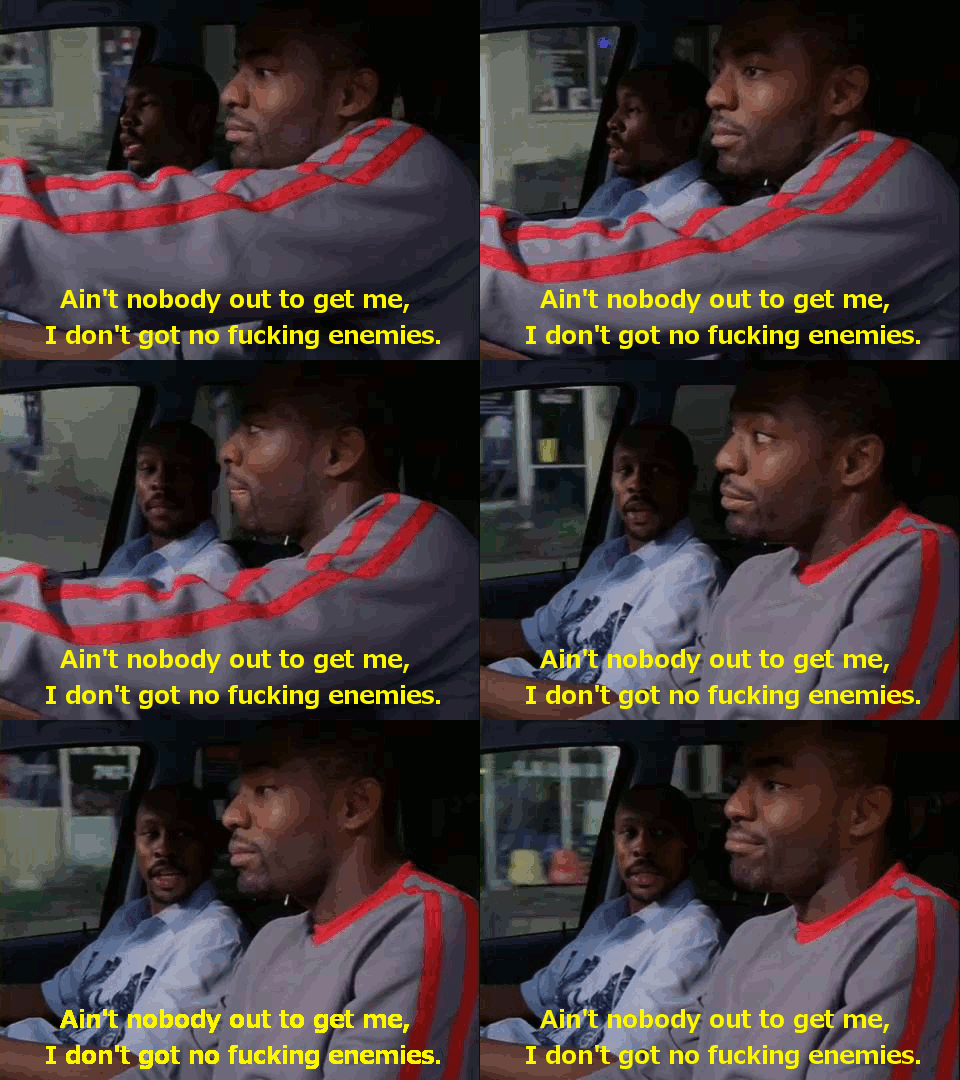
wires01e05_1 01

And the cops aren’t the only reason they should be paranoid. This is one of the earlier, if not earliest, episode where we hear the refrain: “Omar’s coming!” As we all know, “the cheese stands alone!” —and he’ll be coming for Avon soon.
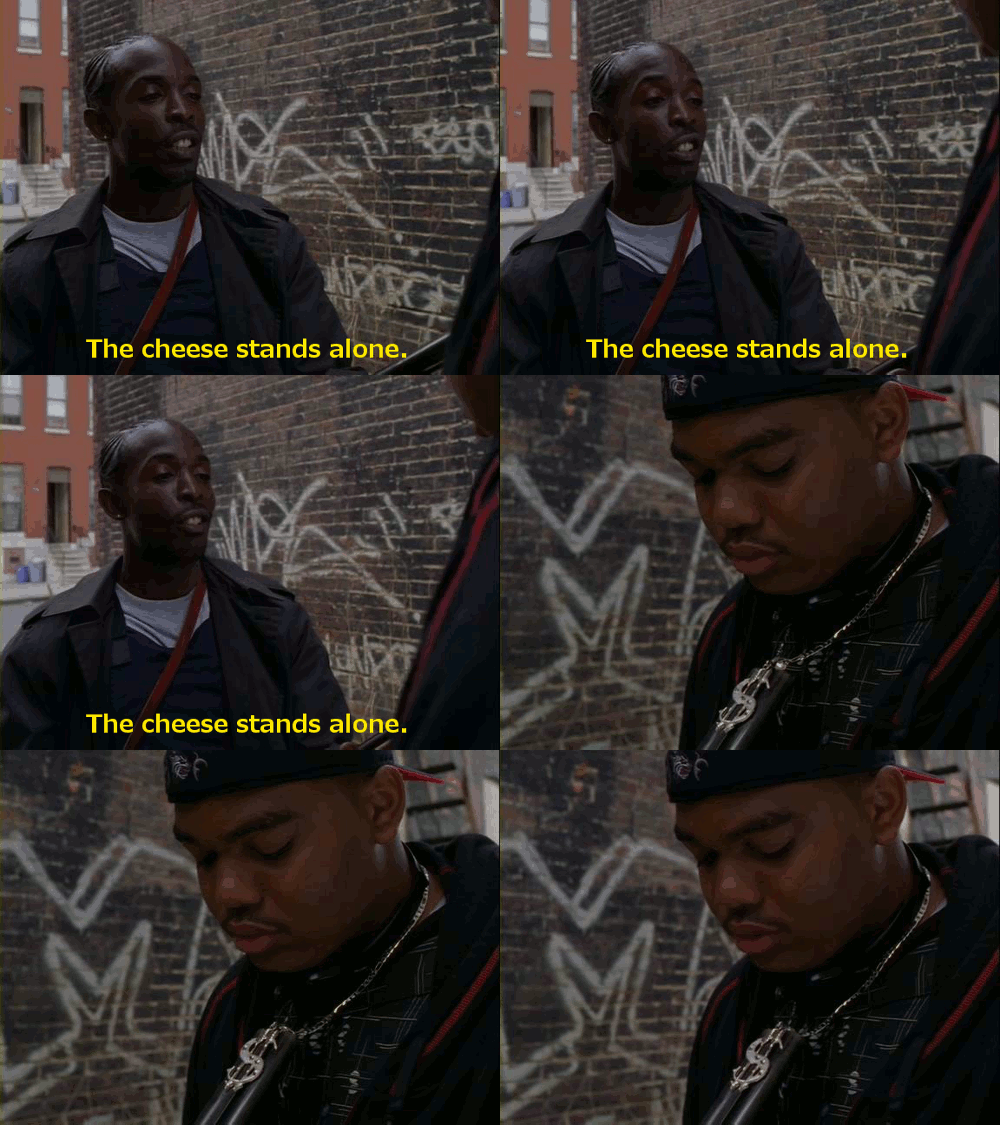
cheese_stands_alone 01

There’s a lot of warnings in this episode, and I found an interesting parallel between Omar’s raid on the East Side stash, and the young hopper’s in the pit calling the warning for “5-0” that Stringer Bell and D’Angelo hear while talking about there being a snitch in D’s ranks. Again, this constant sense of being watched, betrayed, and generally under someone else’s control.
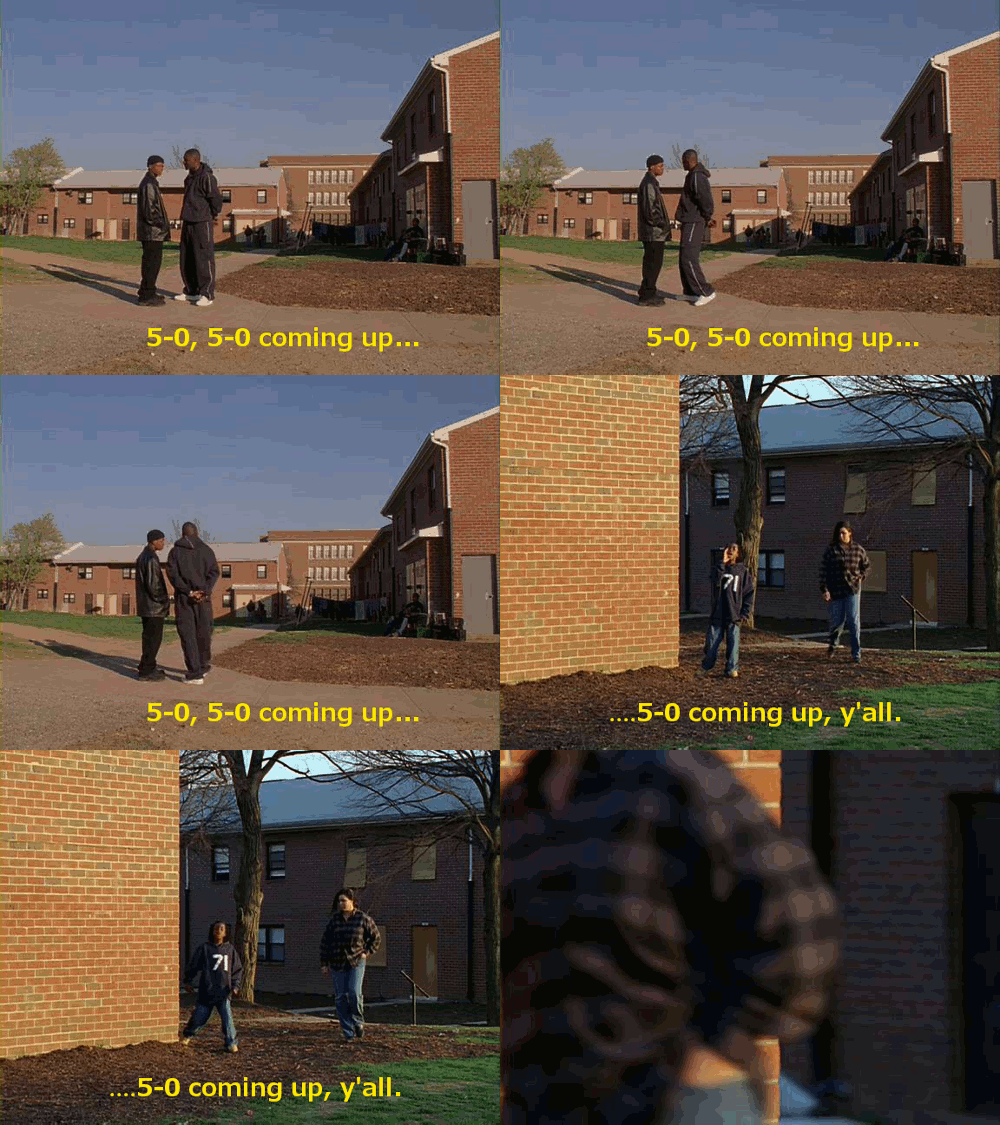
5-0-5-0_coming_up 01

I love this seemingly throw away scene when McNulty says “School’s out” as he sees the kids heading home while staking out Omar’s pad. He then remembers to call his ex-wife about his kids’ weekend visitation, while one of the neighborhood kids picks up on the cops presence and reports back to Omar. So many small, perfect details to reinforce the theme of being watched without driving them down your throat.
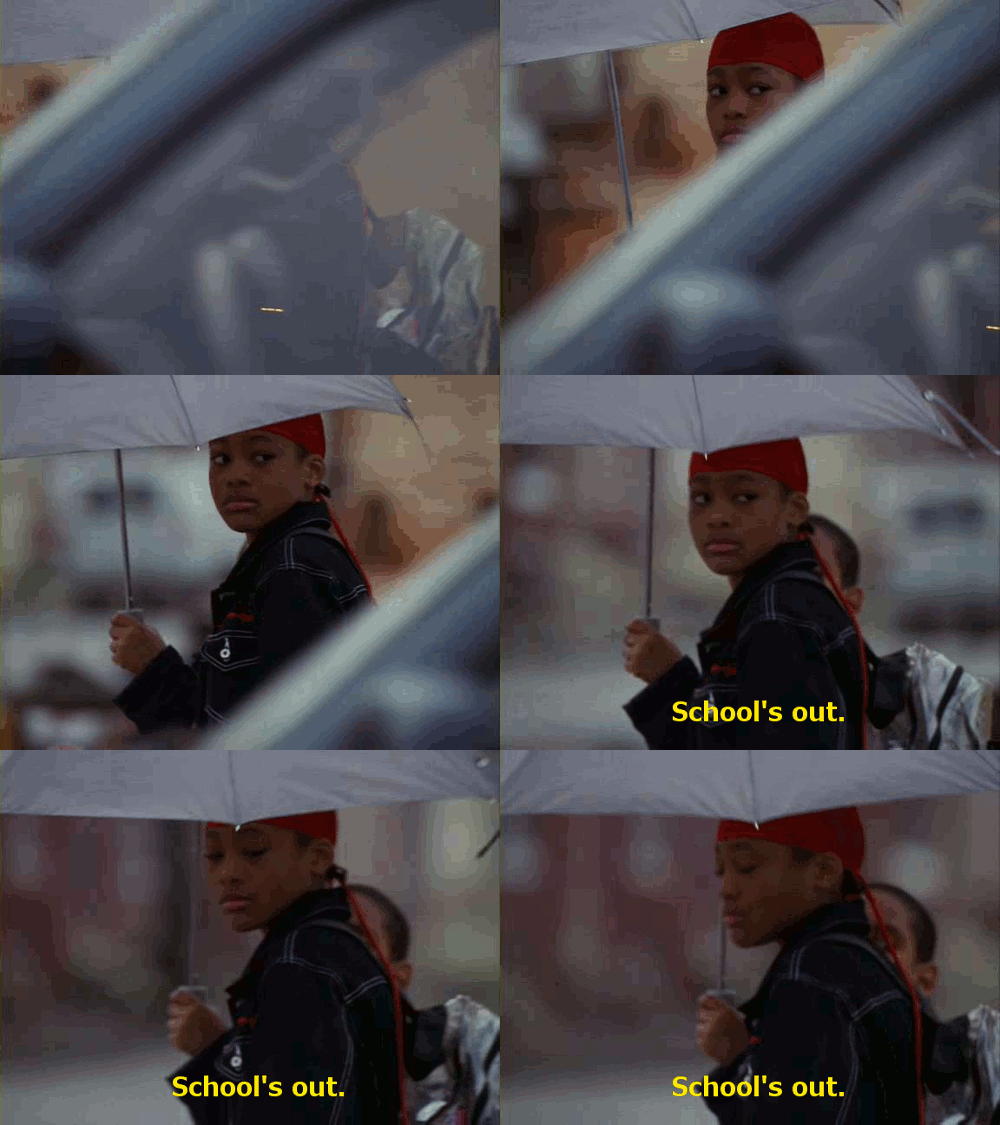
schools_out 01

Possibly one of my favorite scenes in The Wire is when D’Angelo goes out to dinner with his baby’s momma, to use the parlance of our times. She notes he didn’t push hard enough to get a better table away from the kitchen door, and as she finishes he’s spooked by the waiter behind him. Not only demonstrating D’Angelo’s “soft,” but also suggesting his discomfort, bordering on paranoia (although not seemingly misplaced), with the race/class-driven logic of the system.
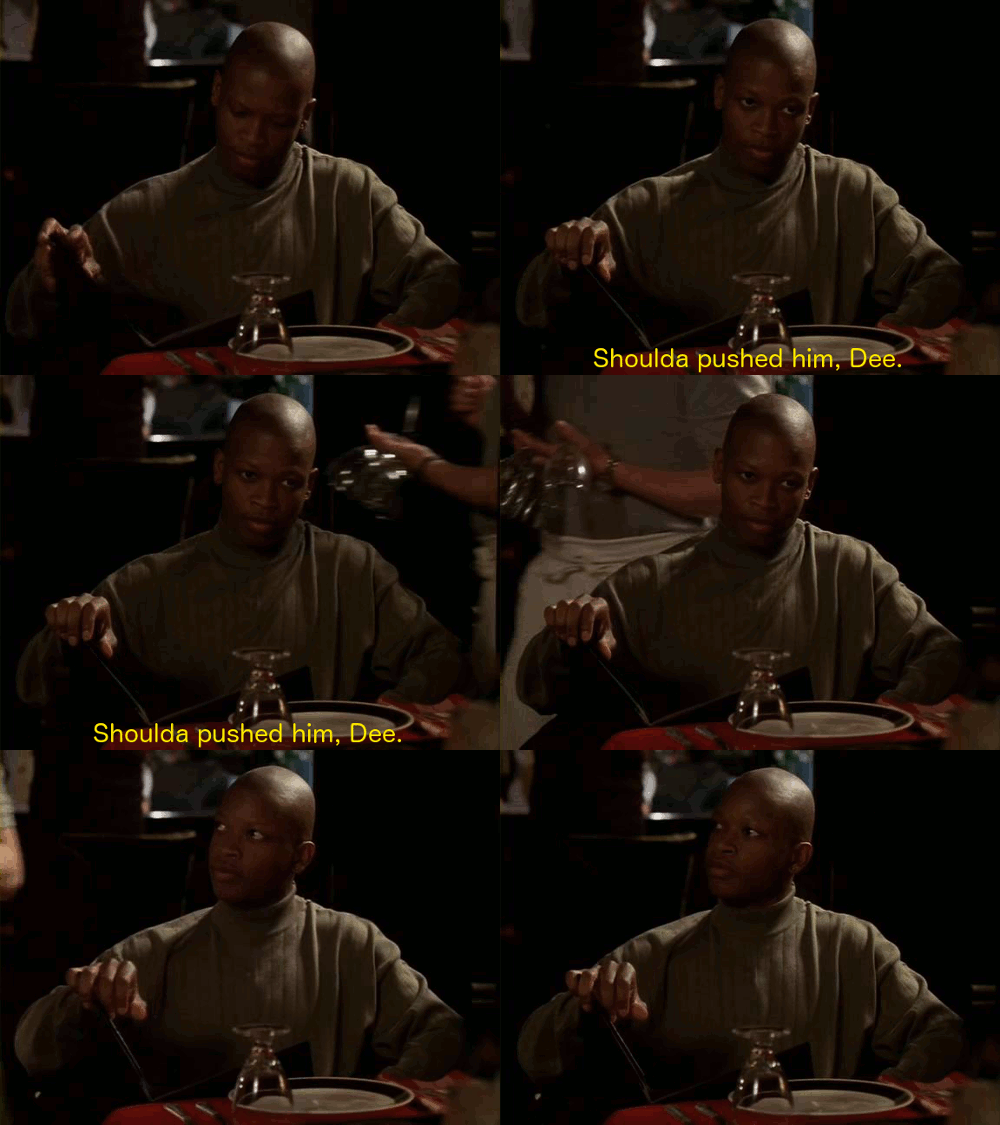
shoulda_pushed_him_d 01

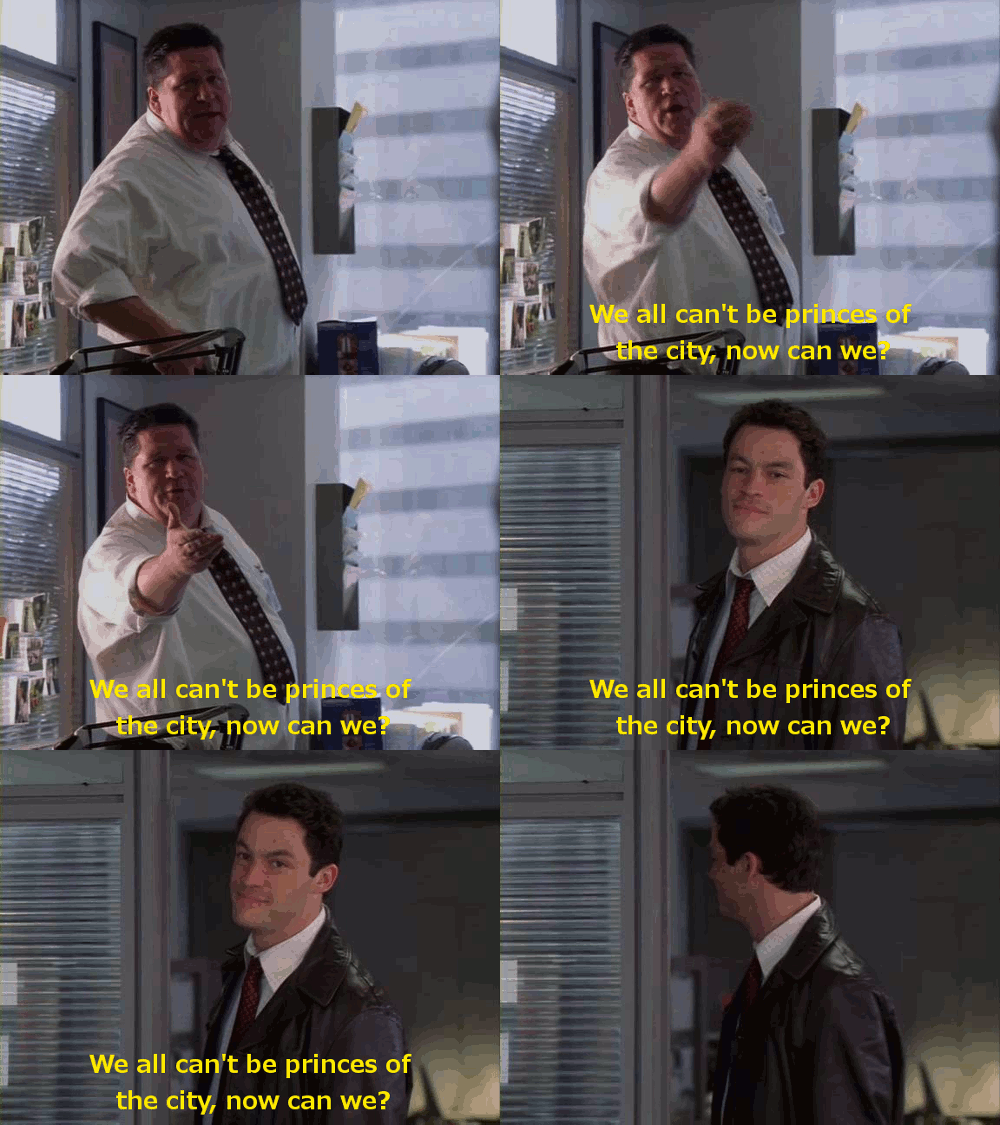
I love this one between Sergeant Jay Landsman and McNulty because it’s an allusion to Sidney Lumet’s 1981 NYC cop film Prince of the City. Interestingly enough, the “protagonist” of that film, Danny Ciello, turns state’s evidence on his fellow cops because of his guilt over the institutional corruption. Ultimately he’s torn apart by his choices and can’t trust anyone—in effect becoming paranoid. The tagline of the film: “A cop is turning. Nobody’s safe.” Also, it was Lumet’s attempt to make up for his two-dimensional portrayal of cop corruption in his 1973 film Serpico—so much potentially layered into a throw away line.
princes_of_the_city 01

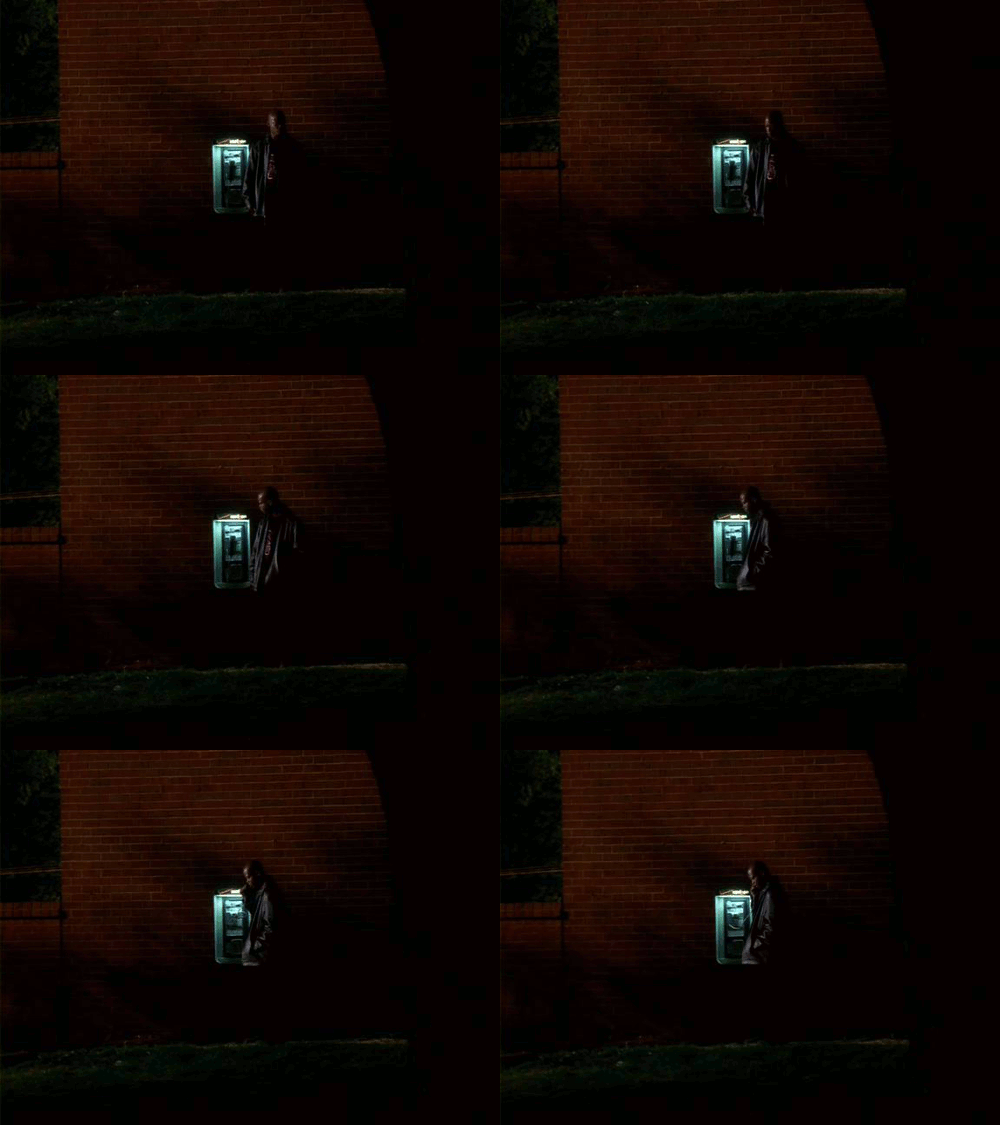
Finally, as a bonus GIF, D’Angelo relays the whereabouts of Omar’s partner Brandon to Stringer Bell. This is a moment that leads to a whole series of events that reverberate throughout Season 1.
d_payphone 01

Known
I’ve been playing a bit with my Known this week, trying to get feedback from people how they are liking it thus far. There is some duplicated effort given we are so WordPress-centric, but I have a more extended post I’ll be writing about Known shortly, as well as more specific directions of how we can use it this week. I appreciate Lauren’s candid feedback about the application in the comments on her Known, and I’m looking forward to more from the rest of the wire106ers. This is early days for this application, and we need to figure out how it might work more seamlessly in the workflow of this course.

WordPress
Got all my plugins set and Jetpack fine-tuned. I am actually going to work on getting folks to install their own feedreader this week too. More on that soon. I want the dipping into the open source applications to be a regular thing in #ds106 this semester.

Commenting/Community
“This is the job,” to quote Lester Freamon. Reading and feeding back on other people’s work is what makes this class worth anything. If you’re reading and commenting on posts, engaging on Twitter, and generally present across the various spaces—then you’re doing your job. If you aren’t, well, then you aren’t. I spent much of this weekend reading and commenting on just about everything in wire106, as well as some of the other section’s work taught by professor Jen Polack.

Also, I’m moderating my comments, replying to folks who were kind enough to comment on my work, and generally being a good citizen in this course on the web. You need to be doing this too. That’s the job, and all the details matter. If you’re present in this class across the web then you’re bringing your A-game. What’s great about #ds106, at least for me, is that your contributions are everywhere present online. On the other hand, your absence is equally present. There is no hiding in ds106, your kingdom for a comment.
Posted in digital storytelling | Tagged , , | 3 Comments

Pager Paranoia on the GIF Wire

This is my attempt at the “Summarize A Wire Episode In GIFs.” I chose to pull six (actually seven) animated GIFs from episode 5 of Season 1 of The Wire: “The Pager.” It’s one of my favorite episodes because the theme of being watched and a more generalized sense of paranoia creeps into the episode constantly. The cops are finally up on the wire, and Avon Barksdale seems to have a sixth sense about it. In the opening scene he reminds Wee-Bay of their reality given they control the drug trade in West Baltimore.

wires01e05_1 01

And the cops aren’t the only reason they should be paranoid. This is one of the earlier, if not earliest, episode where we hear the refrain: “Omar’s coming!” As we all know, “the cheese stands alone!” —and he’ll be coming for Avon soon.

cheese_stands_alone 01

There’s a lot of warnings in this episode, and I found an interesting parallel between Omar’s raid on the East Side stash, and the young hopper’s in the pit calling the warning for “5-0” that Stringer Bell and D’Angelo hear while talking about there being a snitch in D’s ranks. Again, this constant sense of being watched, betrayed, and generally under someone else’s control.

5-0-5-0_coming_up 01

I love this seemingly throw away scene when McNulty says “School’s out” as he sees the kids heading home while staking out Omar’s pad. He then remembers to call his ex-wife about his kids’ weekend visitation, while one of the neighborhood kids picks up on the cops presence and reports back to Omar. So many small, perfect details to reinforce the theme of being watched without driving them down your throat.

schools_out 01

Possibly one of my favorite scenes in The Wire is when D’Angelo goes out to dinner with his baby’s momma, to use the parlance of our times. She notes he didn’t push hard enough to get a better table away from the kitchen door, and as she finishes he’s spooked by the waiter behind him. Not only demonstrating D’Angelo’s “soft,” but also suggesting his discomfort, bordering on paranoia (although not seemingly misplaced), with the race/class-driven logic of the system.

shoulda_pushed_him_d 01

I love this one between Sergeant Jay Landsman and McNulty because it’s an allusion to Sidney Lumet’s 1981 NYC cop film Prince of the City. Interestingly enough, the “protagonist” of that film, Danny Ciello, turns state’s evidence on his fellow cops because of his guilt over the institutional corruption. Ultimately he’s torn apart by his choices and can’t trust anyone—in effect becoming paranoid. The tagline of the film: “A cop is turning. Nobody’s safe.” Also, it was Lumet’s attempt to make up for his two-dimensional portrayal of cop corruption in his 1973 film Serpico—so much potentially layered into a throw away line.

princes_of_the_city 01

Finally, as a bonus GIF, D’Angelo relays the whereabouts of Omar’s partner Brandon to Stringer Bell. This is a moment that leads to a whole series of events that reverberate throughout Season 1.

d_payphone 01

That was fun, I love GIFs.

Posted in digital storytelling | Tagged , , , , | 7 Comments

Wire 106: S01E12 “Cleaning Up”

For this video discussion of Season 1 Episode 12 of The Wire, “Cleaning Up,” Paul Bond and I were joined by UMW #wire106 internauts Maggie Stough and Imran Ahmed. This discussion was generative because I realized it might be useful to coordinate discussion details with students before we go live. I tend to fly by the seat of my pants in all things, but a bit of structure for these discussions makes sense. I’ll be working on sharing an ongoing video discussions document wherein folks can share the particular things they want to talk about for each episode. Iteration 4life!

Another thing about this discussion, and why I am learning to hate Google more and more, is that they threatened to stop the discussion midstream if we shared another clip from the show. We were sharing a couple of minute long clips from The Wire to contextualize the discussion we were having and they threatened to shut us down. Total bullshit. This is an excellent example of how out of control the media lockdown on our culture has become, and how our convenience-driven dependence on third party services reinforces that reality. I have to get our own video setup together for these wire106 discussions soon, because I am so tired of having advertising companies dictate how we interact with the media culture defines us.

Also, I keep calling this episode “The Clean-Up,” but it’s Cleaning Up.” So much for exactitude.

Posted in digital storytelling | Tagged , , , | 2 Comments

Scenes from the Wire

Scenes from the Wire screenshot

Last week Zach Whalen reminded me of a tumblr site Ryan Brazell turned me onto last year: “Scenes from the Wire”. The tumblr is run by a bot—an art form Zach turned me onto yesterday—that automatically creates GIFs with subtitles numerous times a day until it has giffed every moment of dialogue from the entire first season. I’m actually finding it a great resource for refreshing my memory about particular episodes. I wonder how much more dialogue it has to GIF before it’s done?

It got me thinking, while talking with Zach about bots yesterday, what a wire106 bot might look like. So I think I might have bigger project for this class—above and beyond the assignments—figured out. I want to create a wire106-inspired bot through something like Tumblr, Twitter, or some other application—although Twitter seems like popular choice. Here’s to ds106 for making me feel creative again. I love this course!

Posted in digital storytelling, Uncategorized | Tagged , , , , | 3 Comments

First Wire 106 Lunch

After returning to teach ds106 as an online course at UMW for the first time in over a year, I decided to experiment with an idea Mike Wesch mentioned while in Irvine this summer preparing for Connected Courses. He noted that he goes out to lunch with a different student of his every day. I loved this idea. And given that most of the students taking the wire106 version of ds106 this Fall are residential students, I decided to organize group lunches for anyone interested. Today was the first one, and it was pretty awesome.

Maggie, John, Ien, and Meredith joined me at a local eating establishment to get to know each other over lunch. After working through the expected initial awkwardness, we sat down, ordered food and started talking about The Wire. And, interestingly enough, we all got into it. They confessed to binge watching, admitted using ds106 to procrastinate doing other class work (a badge of honor), and generally acknowledged they were hooked on the series. Needless to say, I was fired up. We talked about Wee-Bey’s exotic fish fetish, the tragedy of Wallace, the existential angst of D’Angelo, Greggs as natural police and much more. It was fun.

On top of that, we came away with some ideas for class activities, assignments, and projects that Meredith was kind enough to capture at lunch before they slipped away.

Live Tweeting Episodes
It even produced some ideas for both wire106-themed assignments and possibilities for coordinating activities for the class to come together. For example, watching episode 1 of Season 2 together by starting it at a predetermined time and live tweeting out our reactions. This is something we need to make happen.

Opening Scene Episode
Take all the opening scenes from the 13 episodes of season 1 and edit them into a video wherein they play one after the other chronologically to see how it would flow as it’s own episode.

Beginnings and Endings
Juxtapose the opening and closing scenes of each episode in season 1, noting how much they play off each other in a number of episodes. One good example to start with is episode 10, “The Cost.”

Wire Colors
Another assignment that came up was doing an analysis of the use of color in the series. And we’re still thinking about how we would frame that as a compelling visual assignment. Ideas?

Wire 106: Messing with the Macguffin
John suggested an assignment that would have a character saying something that changed the nature of the episode, if not the series, all together. Like, for instance, Deputy of Ops suggesting a Bust and Buy on a case with a wire would be out of the question. Poor Kima. Kinda like a Wire 106-themed “Messing with the MacGuffin” assignment.

OG Technology
If you were to change the technology in a scene, how it would be different today. Could there be a season 1 Wire without pay phones?

Where are they now?
Playing off the fact many of the actors in The Wire have gone on to successful careers, do a where are they now assignment that plays with the before and after. Perhaps even creating a fiction story around the changes. This could be very interesting for Wallace, Stringer Bell, Snoop and more.

Clothing Change Ups
A design assignment that has you photoshopping one character’s set of clothing onto another character.

Putting Words In Their Mouth
Giving a quote that one character said to another character.

Wire on the Twitter
Create a twitter account for each character in an episode then tweet the dialogue of that episode. This might be a group project later in the semester, it would take some interesting coordination, and the tweets might be an awesome subtitle to a live projected episode at the end of the semester.

Audio Commentary
Provide a polished, rehearsed audio commentary to an episode. Make it a special feature anyone can download and play as part of their watching of the series.

The idea of coming up with fun assignments over lunch is a really appealing focus for these sessions, at least for me. And it could be one approach we take to these get togethers. But the real goal is to simply get to know each other. The idea of residential online learning that Mike Caulfield has written about is still very appealing to me. An hour and a half lunch with four different students twice a week, over 13 weeks, means I could spend almost 5 hours with every student for focused, relaxed, and  personalized time to get to know them, have a good meal, and get creative about what we can do with the class. That to me is what online makes available for a community like UMW. More time to get to know each other, have fun, and re-imagine how we learn together. And what better venue that #ds106!

Posted in Uncategorized | Tagged , , | 1 Comment

Creating GIFs with Text in GIMP

Here is a quick screencast showing you how to add text to GIFs in GIMP. And keep in mind, GIFs don’t necessarily need text for the summary assignment.

And here’s a GIF with text 😉

wires01e05_1 01

Posted in digital storytelling | Tagged , , , | 2 Comments