Summer Reading List (July)

Summer Reading List for July

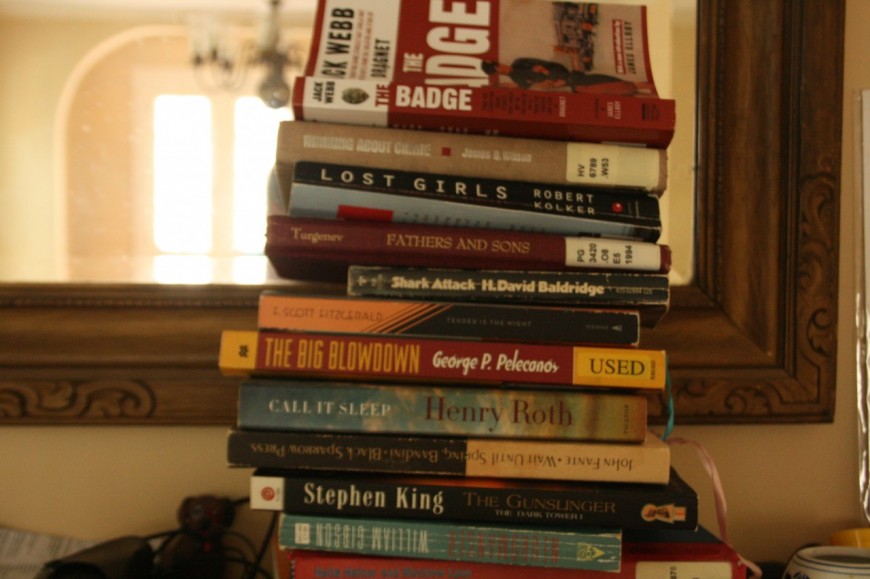
We’re almost a week into the Summer of 2014, and I’ve already polished off two books: Lost Girls (not the graphic novel) and The Badge. Now I recognize this reading spree got off to such a strong start because I’ve been at the beach for almost two weeks. But it has inspired me to try and come up with a reading list for the next month. Pictured above is my summer reading list through July. If I finish these books I’ll post another one for August, but don’t hold your breath 😉

badgeAs I already mentioned I read Jack Webb’s The Badge: True and Terrifying Crime Stories That Could Not Be Presented on TV, from the Creator and Star of Dragnet and this one was a real treat. I’ve been want to reading this since Paul Bond and I taught the True Crime class in the fall. And if we teach that class again, this book will be part of the syllabus. One could make the argument (coming in a future post) that this book is as important, if not more, than Truman Capote’s In Cold Blood for the True Crime genre.
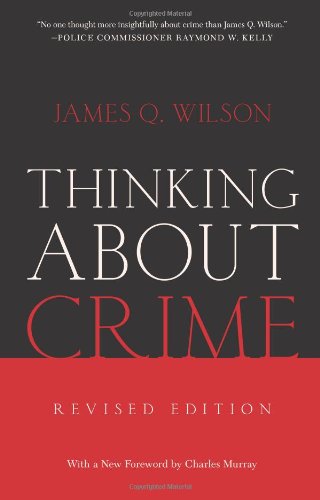
thinking_about_crimeJames Q. Wlison’s Thinking About Crime is a book I want to read as I get ready to watch the HBO series The Wire again. This amazing comment from Mike Caulfiled a while back introduced me to the broken window theory of crime, and it got me intrigued. I am returning to the book by Wilson that introduces the theory in the 1970s as a way to think about theoretical and narrative elements of The Wire for the fall instantiation of ds106, which will be based on the TV series. What’s more, it is probably another book I’ll use for True Crime if we teach it again.
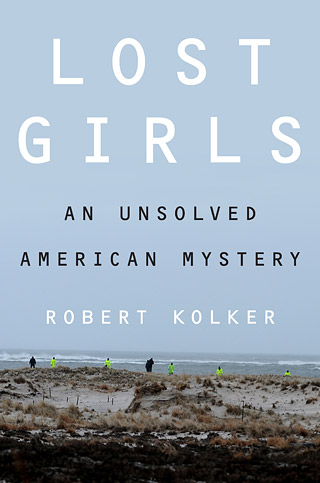
LostGirls hc c.JPGI’ve already read and blogged about Lost Girls. It’s another candidate for the True Crime class, and I am personally taken with it because it focuses on the story of a serial killer that operates on the south shore of Long Island, which is where I grew up.  I’m so intimately familiar with the places being discussed in the book that it adds an extra layer of creepy to the whole thing. What’s more, it has a whole angle on the role of the web in disrupting prostitution which gives this book a particularly 21st century spin on the nature of violent crime in a moment dominated by new media.
fathers-and-sons-1Fathers and Sons by Ivan Turgenev is a 19th century Russian classic I’ve been dying to read for two decades but never made the time. It’s relatively short, and I am half way into this one. It’s awesome, anarchists are all the rage, and it’s far more complicated than that because it’s a 19th century Russian novel. I’m really enjoying the strained relationship between the struggling aristocratic father and his loving, anarchic son. It’s the meat of the book, and through such a simple premise so much can be learned about not only a cultural moment in Russia, but life in general. There will be a bava post on this one that makes up for my inanities here.
51ureXuxwVLShark Attack by H. David Baldridge is one of the earlier books to capitalize on the exploitation of sharks that was Jaws. That said, Baldridge built the International Shark Attack File and this book narrates that process and digs deep into the data, and the gorey details, of shark attacks. This is a re-read for me, and it’s on the list because I still want to propose a freshman seminar on sharks sometime in the near future.

F. Scott Fitzgerald’s Tender is the Night is a novel Anto and I started reading while on vacation in Maine last Summer, but we never finished it. I want to return to the stories of Americans on the French Riviera living the life, and then watching it detoriate before their very eyes—and mine. How can you follow-up on The Great Gatsby? This is Fitzgerald’s attempt.

9780312242916George Pelecanos’s The Big Blowdown was on the syllabus for the Hardboiled fiction class Paul Bond and I taught in the fall of 2012. It was bumped from the syllabus given we read so many books, that said I want to actually read it now because I put it on the syllabus blindly 🙂 Luckily, Paul Bond is better than me.

Henry Roth’s Call it Sleep, like Turgenev’s Fathers and Sons, is a book I’ve been wanting to read for a very long time. Antonella raves about it, and given my roots in New York and my time spent in Brooklyn I know it will hit home. I just have to sit down and finally read it, and I’m looking forward to just that over the next few weeks.

Wait-Until-Spring-BandiniJohn Fante’s Wait Until Spring, Bandini (the book doesn’t even have its own Wikipedia page) is on the list for my trip to Los Angeles in July. No writer reminds me of the dark and the light that is LA, and I’ve written again and again how Fante should be counted amongst the LA hardboiled existentialist writers, even though his relationship to crime is cursory. Ask the Dust was on the Hardboiled syllabus, but now it’s time to dig into this novel which I have neglected for too long.

Stephen King’s The Gunslinger on the lsit because Martha and Ryan have been talking a lot about this series, and I read it so long ago that I don’t remember any of it. So, this one is an ode to memory lost. It’s kind of hard to think you spent hurs pouring over and deeply enjoying a book just to forget it. The mind is cruel.
tumblr_m56ojlGpS21qbaom0Finally, William Gibson’s Neuromancer is a re-read that I’m doing becuase I want to add it to The Internet Course as a required text, along with Bruce Sterling’s Islands in the Net. I figure the scifi space of cyberpunk during the 1980s holds a fascainting space for a time that is still trying to imagine the future of the internet. I’ll probably bring in Stewart Brand’s Whole Earth Catalog as well.


That’s roughly nine books (subtracting the two I read) in about five weeks. Two a week would be a really good pace for me. As with anything, reading gets easier the more you do it. I think it’s time to commit to a little mind exercise to draw some connections and imagining beyond what I have to take care of next on my todo list. What’s more, I’m inspired by Chris Lott’s recent Katexic Clippings project which emails you a passage from a literary work, a word of the day, and some of the things that have him fascinated on the web. The email/newsletter approach makes it more personal and private, and I’m interested in that turn.

Posted in reading | Tagged | 10 Comments

Disrupting Prostitution

By 2008, Melissa had switched almost entirely to Craigslist. She wasn’t the only one. Kritzia had another friend, Fabulous, who did it, too. In the few years since the website had caught on, Craigslist had done more to delegitimize the age-old system of pimps and escorts than a platoon of police officers could. Why sign on with a pimp when it was so easy to take a picture and let a guy call you—way easier than walking the streets and looking for a guy and then trying to convince him and then waiting forever at the ATM while he tried to sober up enough to remember his PIN? With Craigslist, johns came to you, and you didn’t have to share the money with anybody. (106)

LostGirls hc c.JPGI spent most of my vacation on the beaches of Montauk reading true crime books.* I just can’t help myself. The above quote was taken from Robert Kolker‘s Lost Girls which traces the stories of the victims of the serial killer still at large on Long Island. The murderer is also known as the Gilgo Killer or Seashore Serial Killer because the remains of  his or her numerous victims were discovered on the south shore barrier island of Jones Beach—minutes from where I grew up. So going back to Strong Island for a vacation and reading about the various haunts I grew up in on the South Shore of Long Island was the immediate draw.

Beyond that, I was struck by how Kolker took the time and energy to provide the back story of the five women who were the most recent victims of this vicious predator. All of them prostitutes; all of them had families that loved them; and all of them used Craigslist to negotiate their services. It’s that last bit, at least in this brief post, I wanted to remark on. The quote above discusses how web services like Craigslist helped disrupt prostitution by getting rid of the middlemen, i.e., pimps and escort services. The other side of that fact the author tries to demonstrate is how much more vulnerable these women became as a result. Lost Girls uses the common thread of Craigstlist across all these murders to suggest how this new wave of an age-old profession further alienates the individual worker from any sense of collective protection.

What I appreciated about Kolker’s is he didn’t demonize technology or preach about the horrors of the internet. Rather, he focused his book on a broader breakdown of community across all facets of American culture. The backstories of each of the victims tell a pretty sad, yet consistent, story about financial struggles, broken homes, and deep class-inflected motiviations for the actors in each of these stories.  The upper middle-class communtiy of Oak Beach, Long Island (where the bodies were discovered) told another story of class. Oak Beach was framed as an insular, back-biting, and far from generous community that wanted nothing more than these atrocities to be forgotten. They wanted to return to the creature comforts of their isolated beach hamlet where they could argue about more pressing issues like in-ground pools, landscaping, and security cameras. Finally, the Suffolk County Police Department did little to nothing in the early stages of the case to follow-up on the missing persons reports for each of these victims. Given their profession, the department was less than interested in wasting time and energy on the marginalized sex worker.

In this book, the internet becomes an extension of a broad marginalization of the underclass in thr U.S. The ease and simplicity of the web doesn’t change the deep structural inequalities across class lines, despite all the promises of equal access and we all can earn anything online at anytime. The context of our lives is premised on so many others things than potential and possibility, such as the everyday struggle of reality. The internet mimics and heighten the vulnerability of society’s most disenfranchised. Disruption is simply the codeword for all of this, it’s the patina of promise and possibility being sold to us that conveniently erases the ongoing economic and psychic struggles of more and more people everyday that are being denied basic socail services. And disruption works as rhetoric because it preys on the one thing the best of us share: hope for a better tomorrow. It’s anything but.

* I also read Jack Webb’s The Badge: True and Terrifying Crime Stories That Could Not Be Presented on TV, from the Creator and Star of Dragnet which was awesome. More on that in another post.

Posted in True Crime | Tagged , , | 4 Comments

#tic104: Back to the Future

I’m sad to say that the summer session of The Internet Course Paul Bond and I were teaching for the last five weeks has ended. It was a pretty amazing class, and Paul and I remained faithful to our vision of having the students effectively design and run the course. The combination of a condensed semester and small cohort meant we had them running a projet a week for the last four weeks (the first week was dedicated to research).

The course wiki was where the class collaboratively built each of the four projects, and you can find them all here. I wrote about this already on this blog, but I found this particular classes use of the wiki  for their collaborative projects was really effective. So, for the fifth and final week’s project—which we called “Back to thr Future”— each of the students were charged with collecting clips from various television shows and movies to suggest how the future of the internet (and technology more generally) has been framed for us through the culture industry. For example, how are specific topics such as The Internet of Things, Cyborgs, Wearable Technology, Artificial Intelligence, etc. been protrayed in film and television? What’s more, what might it tell us about these possible futures as well as our own moment?

As has been the case for the previous three projects, a wiki page was created, topics were delineated, and film clips were added. The wiki page offers an interesting collection of clips from a variety of films that frame future visions across the spectrum of topics. Interestingly enough, there is no real database for this kind of stuff that we could find. When talking with other folks at DTLT, there was some discussion that we might frame something like thisand open it up for anyone to contribute to.  I think this would be an interesting resource for folks to use and share. How does film and television feed us our future?

Anyway, once everyone added their various clips, each student was charged with creating a video using at least five film and/or TV clips to explain a particualr topic—an adaptation of the video essay assignment we’ve employed for years in ds106. As usual, when you charge students with something difficult, yet fun and creative, they usually rise to the challenge and then some. That’s exactly what happened here. Six video on everything from Cyborgs to Artifical Intelligence to Virtual Reality to Big Data. James Dawson, the capable director of the final week’s project, curated all the videos into one page on the course site, you can find and watch them all there.

Below I want to feature two of the video essays made by members of the class. First is Jessi Clark’s examination of big data using the films 2001: Space Odyssey (1968), 1984 (1984), Fifth Element (1997), Minority Report (2002), and Eagle Eye (2008).

Additionally, check out Steven Hartzell’s discussion of artifical intelligence using the films Blade Runner (1982), Terminator (1984), and Her (2013), as well as the TV series Battlestar Gallactica and Star Trek. 

I have much more to write about this course and how fun it was to teach over the psst five weeks, but if I try and wait until I have time to articulate it all I’m afrtiad thsi post will enver get written. So here it is, and I hope you check out some of the awesome work from this summer’s internauts!

Posted in The Internet Course | Tagged | 3 Comments

UMW Domains vs UMW Blogs

There’s a somewhat manufactured rivalry in the DTLT bullpen between the old gold blogging platform UMW Blogs and the young upstart UMW Domains. Ryan and I stand on the side of tried and true tradition, while Tim and Martha are into the new and shiny. Andy is still waiting for both to come out in HD 🙂

The rivalry is mostly imagined because we all see the value and need for both, and the fact that one developed out the other illustrates the spectrum of thought these approaches represent.   Domain of One’s Own is, as I’ve said before, the apotheosis of UMW Blogs. With UWM Domains anyone can run their own UMW Blogs system if they wanted. That’s the real push behinds domains, it enables an entire campus community to take control of their own innovation toolkit.

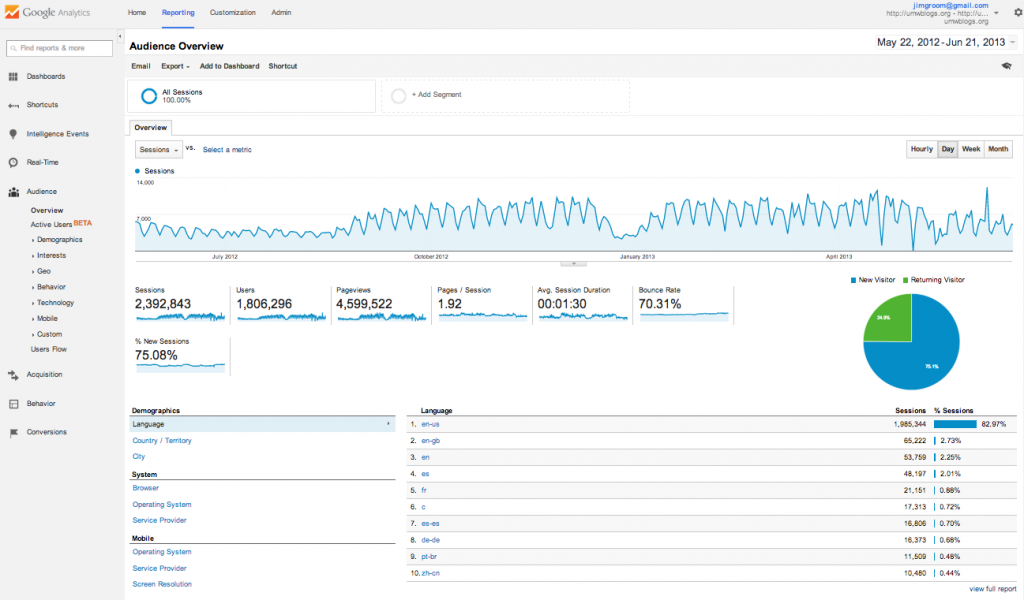
THinking through this yesterday, I wanted to see how the first year of UMW Domains might have effected the traffic on UMW Blogs. I understand this is cursory, and one day when I get smarter I’ll do more with all the data we’ve accumulated. But for now, I am just looking at aggregates such as page views, unique users and sessions (the new terminology for visitors). And looking at these numbers, I’m wondering if UMW Domains  might have had an effect on UMW Blogs’  page views.

umwblogs_6-12_6-13

Last year, from May 2012 through June 2013, UMW Blogs had 4.6 million page views, from 1.8 million uniques users spread out amongst 2.4 million sessions.

umwblogs_6-13_6-14 This year, from June 2013 through June 2014, both unique users and sessions were just a bit higher with 1.9 millions users and 2.41 million sessions. Pageviews, on the other hand, went down 500,000 to 4 million. It’s interesting that UMW Blogs traffic remained relatively steady, regardless of the fact that we had almost 800 sites running on UMW Domains this year, and moere than 20 of those were courses.

It would be interesting to try and get a sense of the traffic statistics across UMW Domains to do a comparison, but that might be impossible given how distributed Domain of One’s own is by design. While we can easily capture the number of posts and broader activity that syndicates in from the community hub, an aggregate traffic report along the lines of UMW Blogs would be almsot impossible toget  given there is no centralized site of activity. Everythign is decentralized to the level of the individual user.

That said, there are so many other things with UMW Domains we can begin to measure, and thanks to Martha you can see them on the stats page. We can measure sites by deartment, sites by software, sites by status (i.e. faculty, student, staff, etc.), and posts by date. One of the things that will be interesting as UMW Domains continues to grow is how we can start to understand how this ecosystem is about a different set of aggregates than pageviews, unique users, and sessions.

I believe that UMW Domains will begin to suggest an ecosystem that starts moving us beyond the predefined axis of the course, and starts making our entire community start to think of their spaces online as their personalized network wherein they interact online. UMW Blogs and UMW Domains are both simply steps ina  continuum along these lines, providing structure and a sense of why go about imaginign this space with the certainty that this will matter in the future. Who we are is heavily mediated, and we need to start understanding what involved in becoming a citizen in such an encirnment meeans.


Posted in UMW Blogs | Tagged , | 2 Comments

Where Reclaim’s Going

Image Credit: "Keep on Reclaimig" by Alan Levine

Image Credit: “Keep on Reclaimig” by Alan Levine

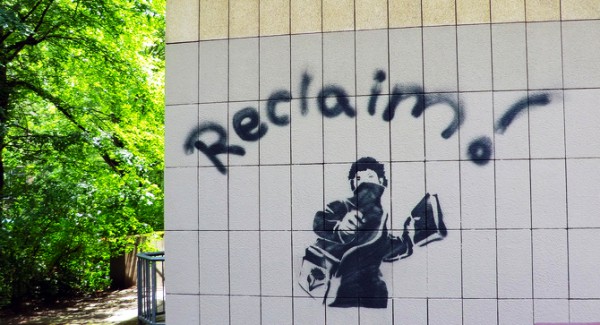
More than a year ago the idea of “reclaiming the web” started to congeal for me as a result of the MIT Hackathon I attended. It’s there where Audrey Watters and Kin Lane plugged me into the future of the web. During that two day stint we imagined a project called Reclaim Your Domain that we’ve been working on in those rare few available moments since. Professionally, reclaiming is all about trying to educate people about how the web works and empower then to take control of their small piece of it. Politically it’s about consciously resisting the increasing centralization of everything to a few online corporate conglomerates. I believe the one makes the other possible.

Reclaim has been the intellectual basis of much of the work I’ve been part of since, and even prior, it just didn’t have that title yet. UMW went live with Domain of One’s Own this past Fall, and that’s a project that has empowering students, staff, and faculty to interrogate how the web works built into its DNA. A year ago Tim Owens and I started Reclaim Hosting, and that has been a means of providing an infrastructure for folks to experiment with managing their space on the open web for a pittance with unparalled support. As Audrey so brilliantly frames it, “The Future of Ed-Tech is a Reclamation Project.” Her willed optimimism is the hallmark of generous and generative humanity and reinforces for me that this is my future as well.

reclaim-db

But the cool part of all this that I am starting to realize is that we’re not alone in the push to reclaim. Just the other day Doug Belshaw started drawing the contours of this broader movement in his post on the DML Hub titled “Reclaiming the Web for the Next Generation.” He connects the recent global realizations that  a) we’re all being surveilled online by at least the NSA, but probably many, mnay more agencies; b) our personal data is the currency for the predominant “free” online business models, and privacy is the cost; and c) we can’t solve this alone, we need to start re-thinking our relationship to the web as a connected culture. This post really starts to frame why reclaiming one’s sense of their own domain (to verbally mashup the work I’m part of) has far broader implications than an initaitive at UMW or a few hippies trying to explain web hosting.

In fact, on the same day I saw Belshaw’s post, I also read Jon Udell’s “Mapping the Decentralization Movement”, which is another articulation of the mobilization, as Udell notes, to “re-decentralize” the web. The project Udell is currently work on, Thali, is an experiment to see what a truly peer-to-peer web might look like. But he notes it is just one of many projects like this. He links to a long list of people and projects that are trying to make this alternative web a reality, and it’s a great palce to start getting sense of what may prove to be a broader cultural movement away from the centralization of the web.

In fact, UMW’s DTLT recently talked with Ben Werdmuller and Erin Jo Richey who are leading up Known—one of the projects on that list—about how their software might enable our community to publish to a variety of different services without ever having to login to them. A personal hub for pushing content to these other services, while at the same time claiming the work you are creating locally and decided where you want to share and how. Tim Owens has been experimenting with this software, and I think he may already have it as one-click install for the folks on both UMW’s Domain of One’s Own and Reclaim Hosting.

And that, for me, is where Reclaim Hosting is going. We want to support as many people as  possible explore as many of these applications that enable them to more easily manage and control their piece of the web. We’ll be working our way through the alterative web community’s applications and see if we can make them part of the Reclaim Hosting application universe. Even better, we hope to be contributing to at least one more as part of the Reclaim Your Domain project, but more on that anon.  And start addressing all those applications that can’t run in a LAMP environment, we’re currently working on helping people install and manage  applications that run on a particular set of dependencies in a virtualized environment. We’ll be making a push to explore machine images for a variety of applications and document how to get them working. But more importantly, we’re working on a rollout of the community-focused face of Reclaim Hosting that will provide a space to share the work happening by interersted parties from across the Reclaim universe.

Reclaim Hosting

To this end, as you might have surmised, Reclaim Hosting is not a pilot anymore. We’re bonafide! We plan on sticking around to support reclaimers for a long time. We just redesigned the siteintegrated CPanel into the client area, and updated our pricing model. Rolling out the next stage of Reclaim Hosting is exciting because it truly feels we are part of a broader movement to help people start thinking about the importance of re-decentralizing the web. And I remain convinced the best way at this is to start by taking control of your own little piece of it.

Posted in reclaim, reclaimopen | Tagged , , | 2 Comments

You yell ‘Barracuda’

[youtube width=”640″ height=”480″]https://www.youtube.com/watch?v=NB8m0CI4Kfg[/youtube]

I watched Jaws the other night as I’m wont to do before I go on a vacation to a North Eastern beach town where Great Whites abound. And this time around I have to say Mayor Larry Vaughn was my favorite character. I just love his anchor-ridden coat jacket and unrelenting disregard for any adult, child, or beast who gotten devoured by Jaws (is that a zuegma?). And the above scene is Vaughn at his sleaziest. Below is the full dialogue:

I don’t think you appreciate the gut reaction people have to these things…Martin, It’s all psychological. You yell ‘Barracuda,’ everybody says ‘Huh? What?’ You yell ‘Shark,’ we’ve got a panic on our hands on the Fourth of July.

And given I know this is one of Martin Weller’s favorite films too— damn he has impeccable taste—I’m gonna re-write this quote just for him:

I don’t think you appreciate the gut reaction people have to these things…Martin, It’s all psychological. You yell ‘Open Course,’ everybody says ‘Huh? What?’ You yell ‘MOOC,’ we’ve got a panic on our hands in Higher Education.

All of which reminds me of an interesting question Audrey Watters raised back in April at the Atlanta Domain Incubator event. Who yelled MOOC?

Posted in fun, movies | Tagged , , | Leave a comment

My Father’s Day Card

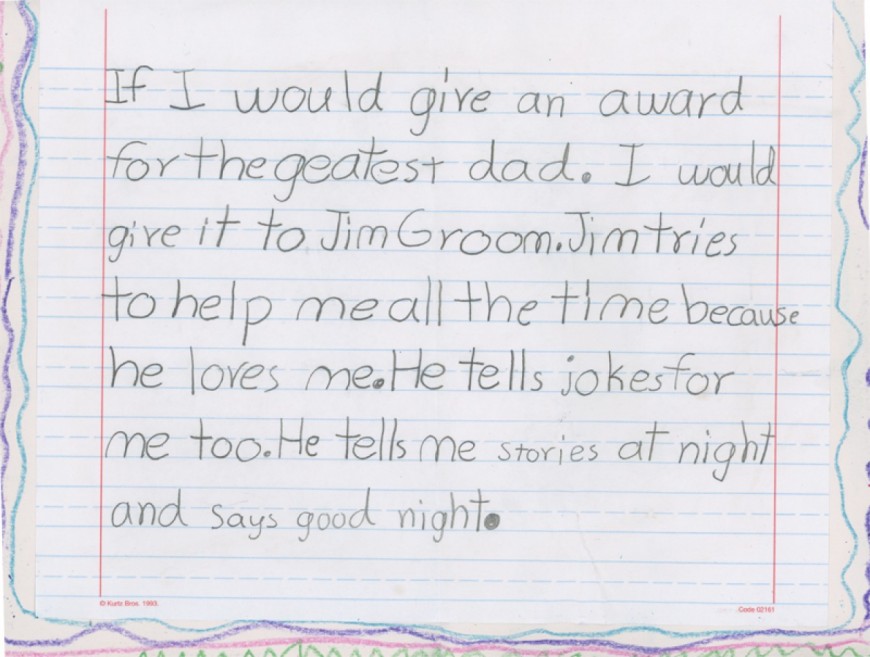
I got a pretty awesome father’s day card from Tess today.  Not only did she design the colorful cover.

But she also composed a fullblown essay about why I should be considered the greatest day.

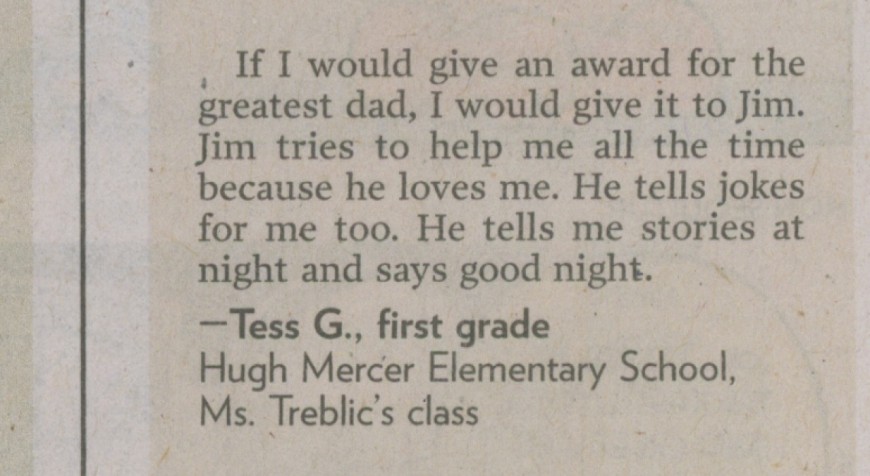
An essay so good it found it’s way into the Weekly Writer Corner of the Free Lance-Star, Fredericskburg’s local newspaper.

I’m not so sure I’m the greatest dad for about a million reasons generously omitted by Tess. But there’s no question she’s the greatest daughter a dad could have.

This whole thing really made my week, not to mention my day. This year has been all about distributing more of my time and energy back to my family. I want to recognize that was the smartest thing I’ve done in a very long time.

Posted in fun | Tagged , , , | 2 Comments

OpenVA Under Construction

I just published this post announcing the second annual OpenVA conference that will be happening October 18th, 2014 at Tidewater Community College. This announcement will be followed shortly by an email from the State Council of Higher Education for Virginia (SCHEV) to the provost (or academic equivalent) at every pulic higher education insitutiton in Virginia. That email will layout the reconsititution of this committee under the official banner of OpenVA, and frame this conference as the first step in building an infrastructure around open education in Virginia . This email will also be a call to these campuses to appoint representatives at Virginia’s various public colleges and universities to steer this newly imagined group.

It was pretty excited to hear that OpenVA got a second act, and it’s even cooler to think SCHEV intends to given this group credence, support, and a platform to operate from. But this also means we need to actually get down to brass tacks. Start building, if you will.

So when thinking about this year’s conference, we came up with a somewhat different approach. Rather than reproducing what we did last year, we decided to try and dedicate the time during the event to try and focus on what it is we want, and try and hash out how we can make it happen—hence the title “Building OpenVA.” It will be like a hackathon for pushing policy conversation towards action:

  • Open infrastructure
  • Open content/resource
  • Open pedagogy/curriculum

This event isn’t a conference, per se. It will be broken down into four sessions.  The first three will showcase open initiatives happening currently in Virginia that embody each of the three faces of  open listed above .  The final session will be a culmination of the discussions with the goal of charging participants and laying out a strategy for action at SCHEV, higher education institutions, and legislative bodies.

Each session will be 90 minutes long and formatted as a kind of call/response. The first half will be a presentation by a panel consisting of Virginia higher ed institutions and educators who are at the forefront of open innovations currently taking place in VA.  This will be followed by a directed panel discussion by a small group of stakeholders including representatives from faculty, IT, librarians, administration, and legislature.  The panel will discuss how the current initiatives might be scaled to move beyond their existing implementations and be adopted by a larger number of Virginia institutions.

It’s this call and response idea that I hope takes off. It reinforces the fact that Virginia’s colleges and universities are a distributed, but connected voice that needs to collaboratively frame the conversationcof our future. To that end, we’re asking that anyone from around the state contribute their example of an innoVAtion (forgive the cheesey camel case, I couldn’t resist) from any of Virginia’s public higher education institutions.

 ….there is an open call on the OpenVA website (http://openva.org/innovation) seeking examples of projects happening currently in Virginia’s colleges or universities that represent an innovative approach to opening up infrastructure (sharing technical resources, server space, applications, etc.), content (open educational resources, textbooks, media, etc.), and pedagogy (syllabi, innovative course practice, research, curriculum, etc). The organizing committee will use these examples to contact various presenters and create a schedule for the day that is rooted in what’s happening on the ground. The event will be about augmenting and amplifying the best of what’s already out there.

I’m pretty excited about this approch to the confernece, and all the credit goes to Andrew Feldstein and Steve Nodine who took time out of the Sloan-C Emerging Tech conference in Dallas this past April to hash this idea out in person. I should also add that as we go through a transition to the OpenVA incarnation, the committee has been pared down to a few highly motivated and dedicated people. And they make it very apparent that the vision of an open Virginia has taken hold and driving us all.

We’re running the conference at a different campus this year, thanks to the ever great Diane Ryan of Tidewater Community College, and that idea of a moveable, shared vision for which we share responsibility is why I know this group will be successful. But I shouldn’t get ahead of myself, there is much more to do over the next four months. Sountil then save the date: Saturday, October 18th in Virginia Beach. This analyzing is paralyzing, let’s build the future of open education in Virginia we want to see!


Posted in openva | Tagged | 1 Comment

8 New Things that Rule about UMW Domains

I just posted a tour de force video of an hour and 26 minute discussion about two years of development that has brought Domain of One’s Own to the brink of international greatness where we find it precariously teetering currently. This post will provide the puff of breath necessary to send it over the edge.

Below are eight new features, and I’m sure I’m missing a few more, about the overhauled Domain of One’s Own that Martha Burtis and Tim Owens have been building out over the past month that have me more excited that ever about the future of Domain of One’s Own at UMW and beyond.

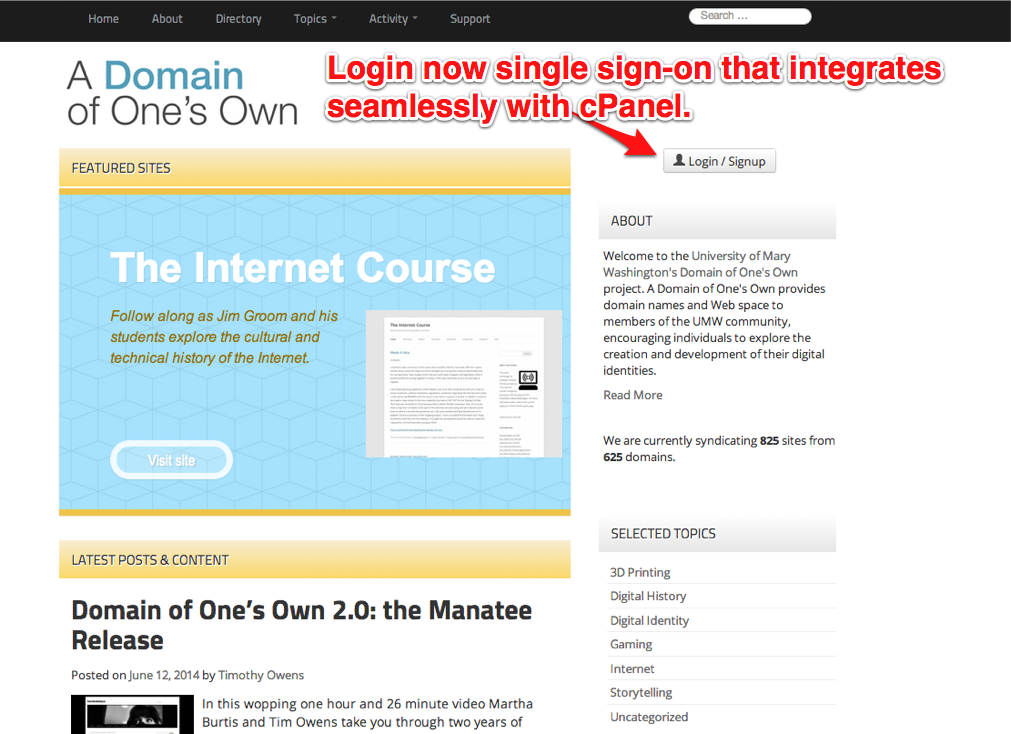
1. Single Sign-On

First and foremost, we now have UMW Domains integrated with Centralized Authentication Service (CAS) that now enables us to take the various logins for CPanel and the billing anagement software WHMCS (which our community need not see) and fold them into the main campus netid and password. This is huge, the hardest part abotu a project like this is keeping your passwords straight, and we just made this a whole lot easier.

dooo2_login

2. Integrated CPanel

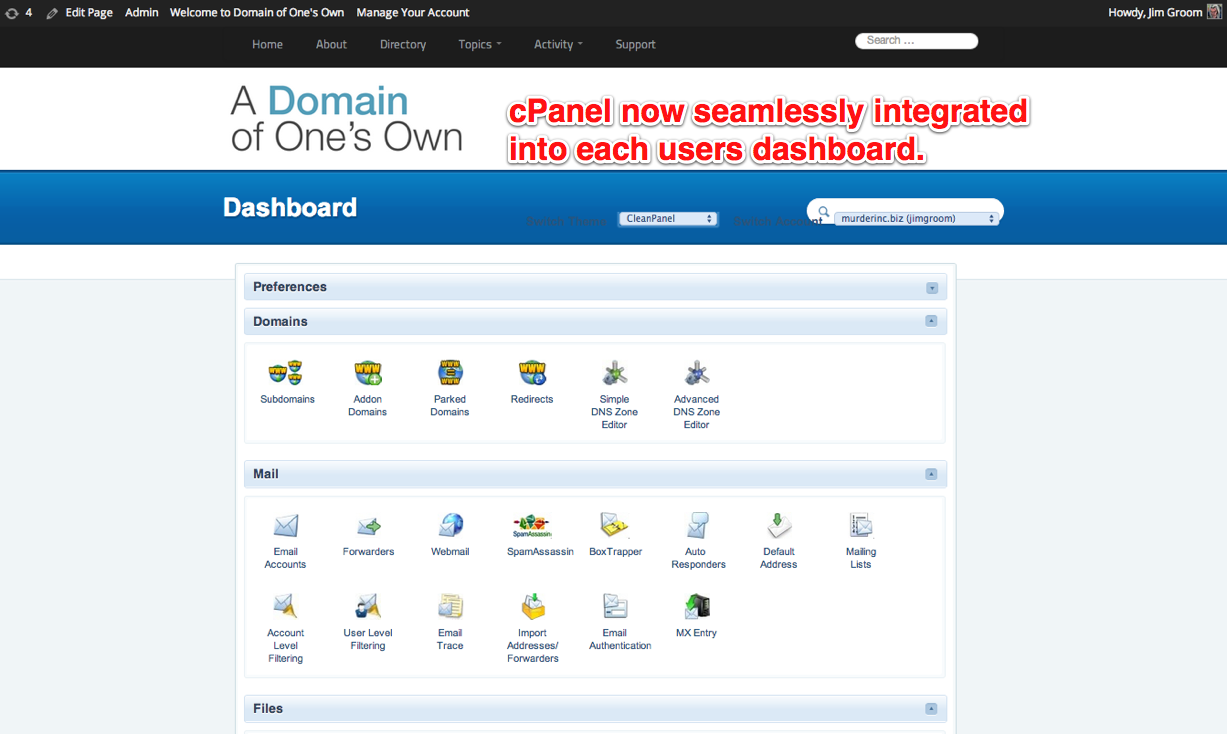
When you login to UMW Domains, the first thing someone will see is the personalized CPanel for managing  their web hosting account. BAM! This is being pulled in through and iframe based on some Tim Owens magic, and we aren’t sending users away from the UMW Domains site, they’re doing all their work from one space. The idea of coherence matters, and these first two steps are a huge boon to making our community’s experience a seamless, user-friendly one.

dooo2_cpanelTim and Martha have engineered the environment like we never have been able to do before, and it’s so cool to think we are at the stage of actually making this tightly integrated. We’ve been using duct tape for so long it almost feels strange 😉

3. Integrated Management of Domains and Backups

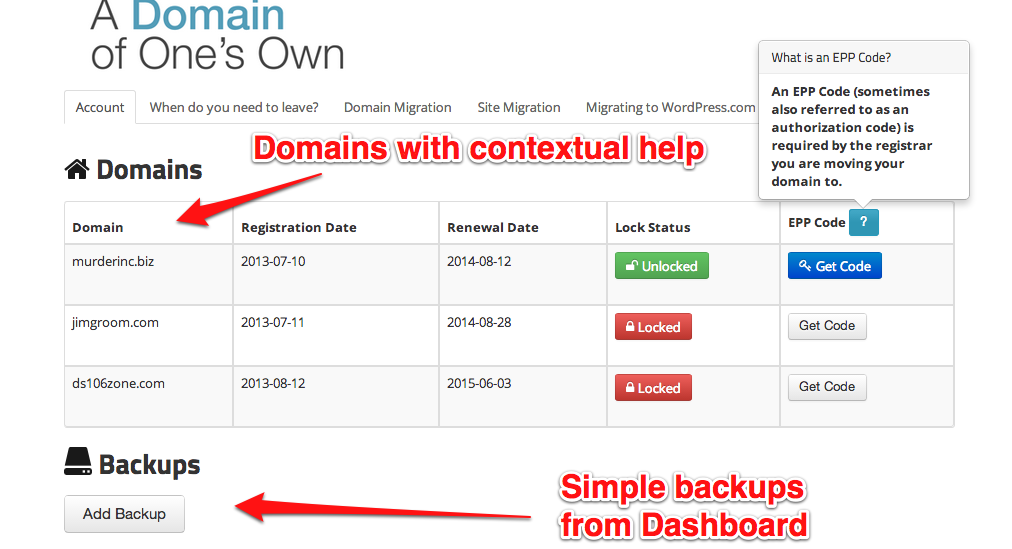
Another element that build on the tighter intergration of features in Domain fo One’s own is the ways in which your dashboard lists your domains, the relevant registration and renewal dats, as well as provided contextual support about what an EPP code is and how you use it to move your domain. In effect, Tim used the WHMCS API to pull that information into the user’s Dashboard on Domain of One’s Own.

dooo2_domains_backup


Same goes for backups, through the CPanel API Tim allows anyone to get a full-backup fo their entire account with one click. We truly want folks to own and seamlessly take their work with them. Next steps is allowing them to send it to Amazon S3, DropBox, etc.

4. Contextualized Support

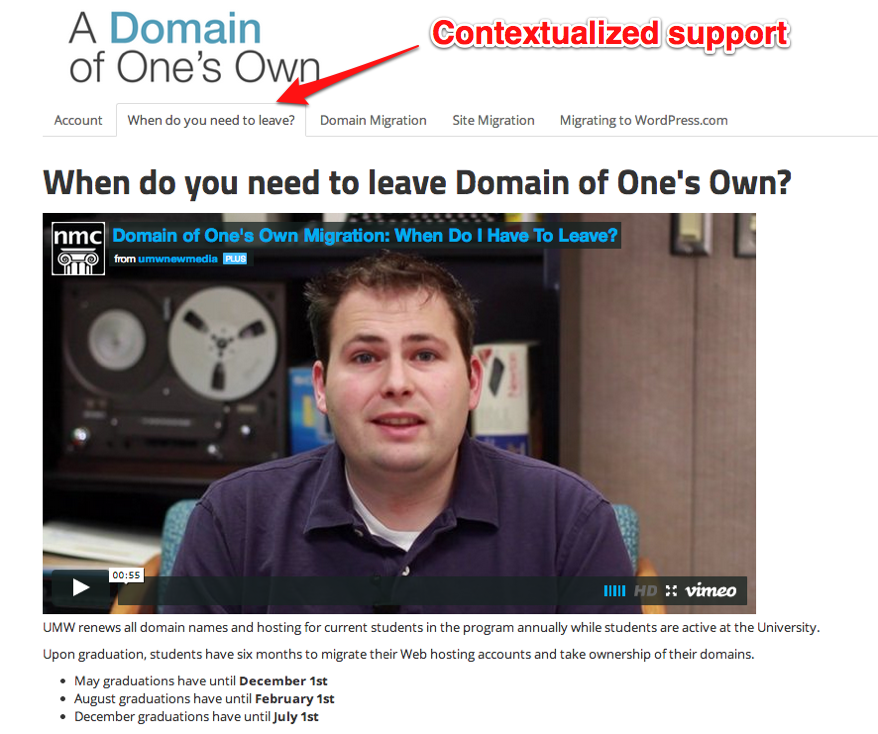
One of the things you can see in the screenshot below is a series of tabs alonside the Domains and Backups account information that contextually provide support for students, faculty, and staff that want unlock and transfer their domains.

dooo2_contextualized_support

5. Distributed Documentation

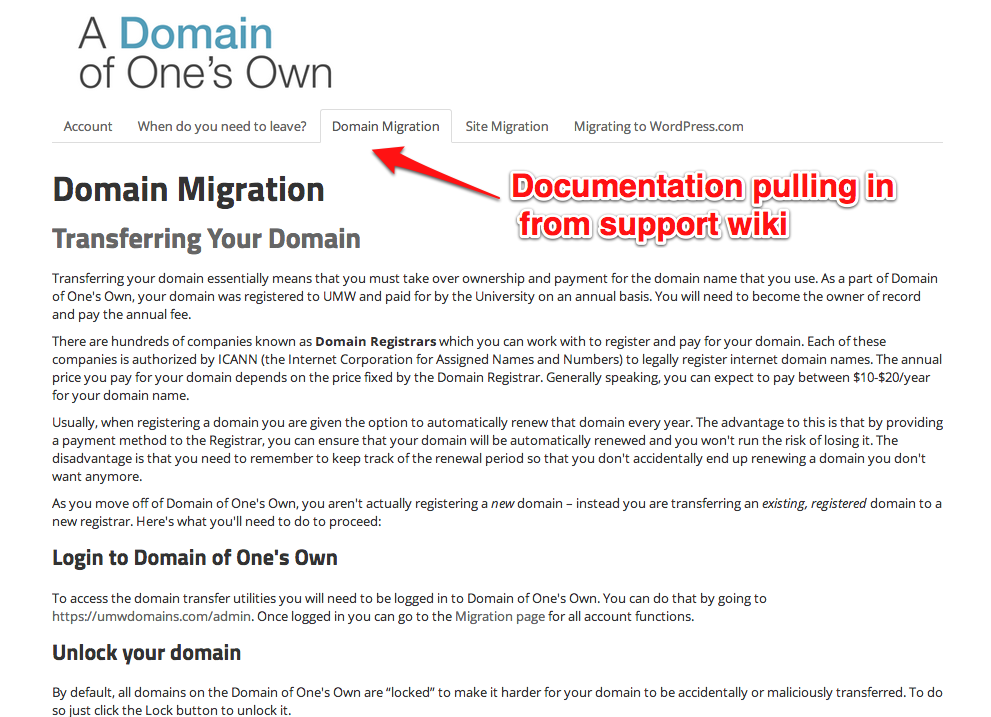
Building on the last point, we’re including that contextualized documentation through a transclusion plugin for DocuWiki developed by students in Karen Anewalt’s Software Engineering course. So, not only do we have all the docuemntation authored in a centralized wiki, but we can contextually include it whereever we want in the Domain of One’s Own dashboard.dooo2_docuwiki_support

6. Ability to View Your Content

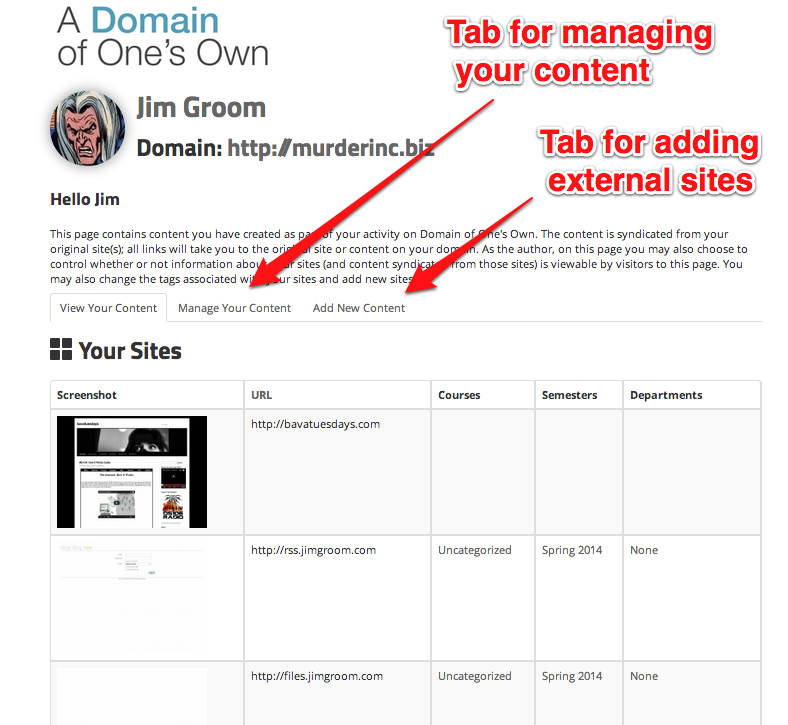
One of the rad new features Martha developed is the ability to view all of a person’s domains, sites and recent posts in one place. What’s more, if you are logged in your dashboard, you wills ee tabs for managing your content and add new sites. More on that in points 7 and 8.

dooo2_view_content


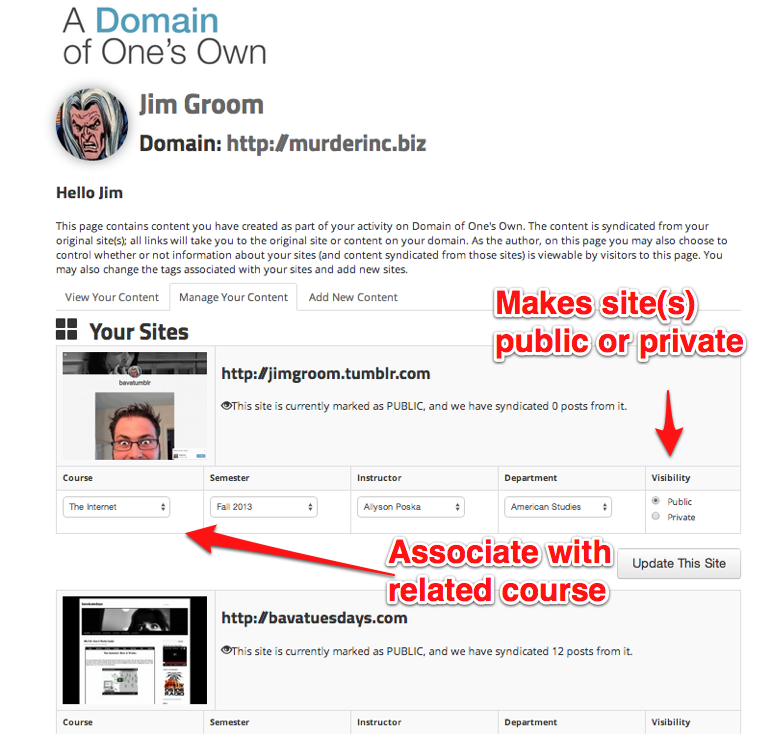
7. Ability to Manage Your Content

One of the things we struggled with during year one of UWM Domains is reconciling the rhetoric of reclaiming your work and owning it with making everything syndicate into the main site. This the latest version, our community members can decided which sites are public and which are private. What’s more, they can decide which site syndicates where in terms of courses. For example, if a student has selected The Internet Course when created a blog and now wants to use that blog for a new course, they simple head to manage content and change the course they want to associate their site with. This is so groovy!
dooo2_manae_content

8. Ability to Add New Content

But that’s not all! With the Add Content tab, people can add any site on the web with a working feed and assocaite it with a class. This includes targeted feeds off of categories or tags. I lvoe this feature because it effectively open up the Domain of One’s Own community to any site that person uses to publish  on the web, as long as it has a working RSS feed. EDUGLU anyone?dooo2_add_content


Image credit:  Thanks to Ryan Brazell for the awesome Teeter Totter GIF.

Posted in Domain of One's Own | Tagged , | 2 Comments

Domain of One’s Own 2.0: the Manatee Release

Manatee_at_Sea_World_Orlando_Mar_10

Domain of One’s Own, the distributed, web-based sea cow everyone loves!

In this wopping one hour and 26 minute video Martha Burtis and Tim Owens take you through two years of development on the UMW Domains project. It’s the most thorough record available of the work they’ve been doing since Summer 2012, and it traces the thinking, development, and deployment of how UMW is giving every student, faculty, and staff a domain and web hosting account of their own.

We understand that an hour and 26 minutes is a very long time, so we’re breaking down the conversation according to specific topics so you can watch what might be relevant for you:

00:01:26 – 00:10:30 Domain of One’s Own 0.5: The Alpha Pilot

Timeframe: Spring 2012 through Spring 2013

In the first part of the video Tim and Martha discuss the pilot of Domain of One’s Own. We start with some history. During the Fall 2012/Spring 2013 Academic year we used a dedicated server with MediaTemple (which uses the hosting control panel software Plesk) and also had them acting as our domain registry system. This method had us adding requested domains to a spreadsheet that we submitted as tickets to MediaTemple. This was how we signed up 420 domains during the pilot, but there was no question there would have to be another way.

00:10:31 -00:20:53 Domain of One’s Own 1.0: The Godaddy of EDU!

Timeframe: Late Spring 2013 through Fall 2013 (mid-October)

In this segment Tim and Martha narrate the development over the summer of 2013. Having gotten presidential funding to run a Domain of One’s Own at UMW for the next four years, the challenge of making this a manageable system that we could deploy to upwards of 1000 students, faculty and staff became a bit daunting. We moved to a dedicated server contracted through a state vendor and installed cPanel hosting control panel software as well as WHMCS, the software which enables management of the various shared hosting accounts. In effect, we were making the transition to becoming our own hosting service, and this section narrates the challenges, opportunities, and limits engineered into the process based on the software we were using.There is also mention of Installatron, a script installer that made much of the earlier work we did around the community site possible.

00:20:53 – 00:43:30 Domain of One’s Own 1.5: Red October

Timeframe: Fall 2013 (mid-October) through Winter 2014

Come Fall 2013 people are signing-up for domains, and we have all sorts of activity but no community. Martha and Tim start building out a prototype for the community site which hooks into Installatron. In turn, we are able to start adding the various sites’ feeds with specific tags and categories to FeedWordPress that would syndicate a representation of the community at large. The work during this period enabled dropdowns for selecting classes, their status, department, etc. We could effectively start adding metadata to a wide range of sites and posts across the university. It was the beginning of pushing this idea of simply being a web hosting solution to actually building a community out of the more than 820+ sites on Domain of One’s Own. This development carried over into Spring, and was really crystallized in mid January 2014 as we were all preparing to attend the Domain Incubator in Atlanta which was snowed out twice! This section features development like the D]directory of sites, the calendar of posts, statistics, and more elegant design. This generative period was also the beginning of Tim and Martha’s exploration of APIs, which changed our lives!

00:43:30 – 01:19:00 Domain of One’s Own 2.0: Manatee

Timeframe: Spring 2014 through Now

Tim and Martha fully realize the possibilities of make this project as simple, elegant and tight as possible. And the results are nothing short of amazing. In this section the discussion centers around some of the “pain points” in the workflow of Domain of One’s Own up and until now. One of the biggest was the various username/passwords for cPanel and WHMCS, not to mention all the specific applications (like WordPress, etc.) they install as part of their domain. Through enable single sign-on through Central Authentication System (CAS) and some real magic with APIs and FeedWordPress wrangling UMW Domains is truly a fine-tuned domain vending machine without the vending 😉 In effect, we are using the Domain of One’s Own main WordPress site (http://umw.domains) as dashboard where they can create a domain name, access their cPanel, export all their files, unlock their domain, and manage their various sites, make them public and/or private, add additional sites to their account. etc. It’s truly amazing how tightly designed the Domains project has become thanks to the work of Martha and Tim.

01:19:00 – 01:26:11 Domain of One’s Own 3.0?: Let Us Help You 

Timeframe: The Future

How can we start sharing the Domain of One’s own infrastructure with whomever wants it? Imagining it as a Machine Image we can share on Amazon Web Services that can be accessed and customized by anyone interested. Tim also discusses how projects like Known start providing us with applications through Domain of One’s Own that empower us to push hard on further articulating the raison d’être for doing this in the first place: reclaiming who we are on the web.

Posted in Domain of One's Own, dtlt, DTLT Today | Tagged , , , , | 2 Comments