Talking Domains at DML2014

Below is a four minute video clip for the upcoming Digital Media & Learning Conference, “Connecting Practices.” The conference is in Boston from March 6-8, and I’ll be part of a featured panel alongside the great Jonathan Worth, of Phonar fame, titled “Open Technologies for Learning.” Philip Schmidt put this panel together, and I’m looking forward to starting to frame out more specifically how “Domain of One’s Own” is the ultimate open technology for learning. In the following preview of the discussion Howard Rheingold gets me going on a bit of domains tear, and there will problably be a lot more of that in March. I have to point out that Howard did not miss the chance to push ds106. He’s #4life! Did I mention I’m all domains all the time now?


DML2014: Jim Groom Discusses ‘A Domain of One’s Own’ from DML Research Hub on Vimeo.

Posted in Domain of One's Own | Tagged , , , | Leave a comment

The Boss (1973)

No, not the Boss from Jersey, il Boss from Palermo!

I recently got a four-pack of Fernando Di Leo’s Poliziotteschi (in Blu-ray no less) and I watched the 1973 film Il Boss (or The Boss) starring Henry Silva. It was crazy. The opening scene, which also is the first scene in the trailer below, features De Silva’s character shooting a grenade launcher into a movie theater to kill a crime boss. It seems to be at least partial inspiration for Tarantino’s movie theater holocaust in Inglorious Basterds. Great stuff, if you are looking for grade A Italian b-cinema, this comes highly recommended.

The Boss(Il Boss), Fernando Di Leo/1973/Original Trailer from Rarovideousa on Vimeo.

Synopsis of the film from Rarovideo:

Based largely on real people and actual events, Fernando Di Leo’s action-packed film – the final part of his Milieu Trilogy – is his boldest commentary on corruption and the criminal underworld. A bomb attack in a cinema in Palermo kills all the members of one mafia family except for Cocchi. Realizing that the instigator of the bomb attack is Daniello from another mafia family, Cocchi is determined to revenge. Lanzetta, a hired killer employed by Daniello is told to assassinate the rival family. Following Lanzetta’s successful hit he finds himself in the midst of the ensuing gangland war, with Daniello attempting to turn him into the police, his boss’ daughter kidnapped, and the rival gang looking for revenge.

Posted in movies | Tagged , , | 5 Comments

A Study in ds106

ds106_Howard Rheingold has written an excellent case study of ds106 as an example of open and particpatory learning for the Connected Learning community. I’ve worked a bit with Howard this past year, and it’s an absolute joy to collaborate with him. He truly groks ds106, and he also deeply understand the value of a community is that it doesn’t center around any one thing or person, and this is sometimes what eludes folks when trying to either make sense of or, even more dangerously, explain ds106. It’s a distributed community that has many moving technical and corporeal parts, seasons, moods, and people. This case study does an unbelievable job of trying to do justice to as many of those complexities as possible.

I’m really greatly indebted to Howard for promoting the work so many of us have been doing with communities like ds106, Domain of One’s Own, and Reclaim Hosting. He’s a tireless creator with enough good energy to go around. He embodies one of the greatest single affordances of the web—broadcasting the honest celebration of the ideas, things and people he enjoys. Which, interestingly enough, is also at the heart of ds106, and which may explain some of the mutual attraction between that community and Howard. Anyway, this is jsut to say that I  think he’s truly groovy. And when I say groovy, I mean Bruce Campbell GROOVY!

armyofdarkness-quotes-groovy


Posted in digital storytelling | Tagged , , | 3 Comments

Domain of One’s Own is ALL BUSINESS

Unviersity Busines DoOOSomehow I missed the fact that this article about Domain of One’s Own published in University Business has already been out for a week. I’m slipping. I love that the article was published in an IT management-centered publication. IT management might not be our particular focus at DTLT—we’re all about the teaching and learning—but that’s part of the genius of Domain of One’s Own: it’s protean. And this isn’t the first time a more business-centered publication picked this initiative up, last semester Nicole Henderson wrote an article about UMW Domains on the Web Host Industry Review. The author of the article for University BusinessMatt Zalaznick,  talked with Tim “the wizard” Owens about the project, and it all sounds so good:

The tools provided by the “Domain of One’s Own” initiative make it easier for students to carve out their own space on the web, and control and customize it…

“Students want to make something their own—to personalize it and say this is my space, this is who I am, in a way to personify themselves on the web,” Owens says.

Users have complete control over the content and the design of the page. Mary Washington students can install a variety of open source software, such as the blogging platform WordPress, to help them design their sites.

Exactly, these three paragraphs really get at why someone at University Business or Web Hosting Industry Review or some other solutions-minded publication would be interested in Domain of One’s Own—because it is an amazing solution to have university communities thinking more critically about how the web works. It provides a space for students (as well as faculty and staff) to experiment with their web presence through the university, but not necessarily on it.

Enabling an academic community to experiment with a wide range of open source applciations (like WordPress, Omeka, Mahara, Moodle, MediaWIki, DokuWIki, etc.) is built into the design of UMW Domains. This isn’t a unilateral, campus-wide approach to a singe tool, an approach often taken with most content management, learning management, and e-portfolio systems, and one that often breeds mutiny in pockets. This is a platform that enables and encourages experimentation of possibilities and a diversity of options. Such an approach recognizes the university campus as a lab that can simultaneously be virtualized, de-centered, and personalized.

UMW Domains provides myriad opportunities for faculty, staff, and students to once again imagine the work they do at and for their university as part of a broader set of resources and conversations the campus community can and should be publishing on the web. The general neglect of campus provided web spaces (remember the /~space) as part of a university’s web infrastructure could very well mean that less and less personal, pedagogical, and scholarly work is freely published as part of that community despite the fact that the tools have never been easier. This isn’t to say the work won’t still be published on the web, but it’ll be all over the place providing no unified sense of a networked community with a shared sense of purpose that in many ways defines what a university community is. Why would we let the very core of our mission languish so?

And we haven’t even gotten to the points of controlling one’s data in the era of the NSA Spygate (this is not a conspiracy, we actually all know this now), interrogating how the web works, learning the inner workings of web hosting and open source tools that can make students more marketable, etc. Why isn’t everyone considering something like this? It seems to me we have a lot more to lose than to gain by not doing it. No, I guess we would rather just build or lease huge virtual auditoriums that seat tens of thousands of people and show videos because the web is just an amphitheater and ebooks are the popcorn 😉

Today I sat down with one of the many great professors at UMW. As we got started, rather than telling her to sign-up for a blog on our system—something I have been doing for eight years now—she logged into her own web hosting account  and started exploring CPanel, creating subdomains, editing files in the file manager, and installing an open source software—all before we even got to the tool. This was an awesome moment for me professionally. At UMW we have evolved with the technology and we’re bringing our community along. We’ve built several layers of what some folks might refer to as “work” into the process, but it’s work that people want to do because they want to try and understand how the web works. UMW Domains provides them a place to start from; a space to manage, archive, and explore what it means to be sysadmins of their education.

What’s more, because this professor was part of the Domain of One’s Own Faculty Initiative, we actually started talking about Vaneveer Bush’s Memex, Doug Engelbart’s “Mother of All Demoes,” and Jon Udell’s “Seven Ways to think like the Web” while doing it. That’s a professional peak for me 😉 The Domain of One’s Own Faculty Initiative kicked off this week with 19 faculty, and you can see the first week’s curriculum here. In just about a year we’ve gotten almost 70 tenure-track and administrative faculty their own domain. It’s all the rage!

In fact, instead of sitting here writing this in my den, Martha Burtis, Tim Owens, and I should have been in Atlanta tonight preparing to attend the three-day Domain Incubator that was set to start tomorrow. Unfortunately, because of the snow and ice it has been rescheduled for two weeks from now in mid-February (the 13th and 14th). This event will bring together a number of regional faculty from a variety of universities in the Atlanta region who are ready to experiment with their own domain projects. In fact, Pete Rorbaugh and David Morgen published an excellent article in Hybrid pedagogy yesterday in which they framed the theoretical context for building a cross-institutional community around web literacies at this moment.

Add to all of that a meeting DTLT had at the beginning of the week with our Provost. He asked to meet to get a better sense of the project so that he could start explaining its broader technical and conceptual possibilities to others—and he gets it. It’s truly been an awesome week for Domain of One’s Own. The press is writing about it, the academic communities are theorizing it, administration is groking it, and DTLT is rocking it. It’s a win-win, baby! I feel like I am living in the ds106zone!

Posted in Domain of One's Own, dtlt, Faculty Initiative | Tagged , , , | Leave a comment

Blue Monday: the 12″ Floppy Disk

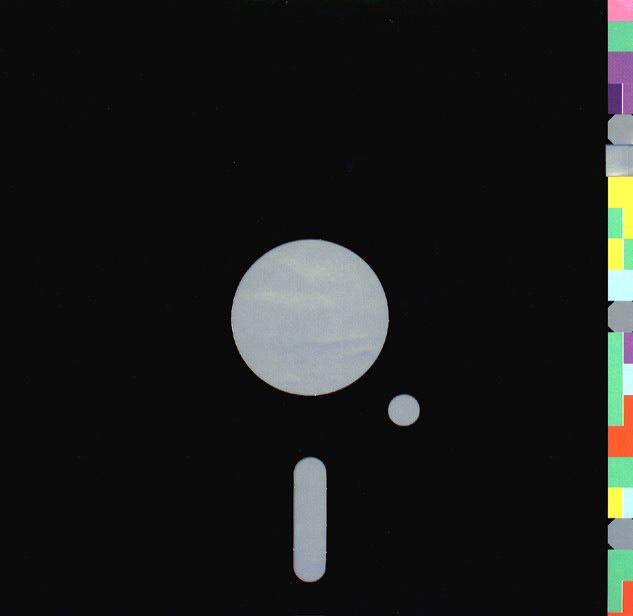
bluemonday

Peter Saville’s Floppy Disk design for the 12″ Blue Monday extended single

GNA Garcia sent me a link to this 30 minute documentary for Swedish National TV about New Order’s seminal dance classic “Blue Monday.” It’s a fascinating cultural history of the 12″ extended single in particular (the design of which is awesome), but also of the dance scene in the late 1970s, the band’s range of influences (Donna Summer, Sylvester, Kraftwerk, and Klein + M.B.O.) the mainstreaming of Techno, the birth of Madchester, and the difference between being and artist and being part of a movement: the first seems so limiting compared to the latter even if they are often intricately connected. It reinforces, despite the “bickering” as Peter Hook notes, that a community of people working together at specific time with a shared ethos for dancing can make some magic. It makes me want to watch 24 Hour Party People again. Highly recommended, and you can thank the good doctor for that!

Posted in fun, music | Tagged , , | Leave a comment

Cruising in Memory of…

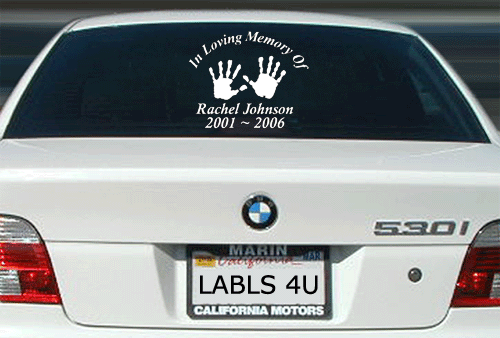
I’m not sure if this is an element of Virginia culture in particular—kinda like vanity license plates—or a broader national trend, but over the last eight years I’ve noticed a fair amount of people using their car windows as mobile memorials for dead loved ones. I find myself stopped behind one of these “in loving memory” decals fairly regularly. I’m forced to do the math, and it’s usually pretty depressing. They all seem to die so young, serving to remind of my luck so far, and how it can’t last. All I wanted to do is get through the red light in peace.

There are a ton of designs and possibilties to choose from, but I personally find the whole thing a bit less than reassuring. That’s why the only thing I put on my car is “Jesus is My Car Insurance.”

Posted in fun | 9 Comments

Digital Scholars Institute

Image by Kyle Bean: “The Future of Books.”

One of the more exciting things to grow out of the Domain of One’s Own Faculty Initiative—the second cohort starts this week!—is Mary Kayler’s beautiful brainchild the Digital Scholars Institute. The Digital Scholars Institue is a way to continue the work started in the faculty initiative for those interested in sharing out the digital projects they are working on.

It’s a way to bring a small group of faculty (5-7) together to talk about what they’re currently working on in the digital realm. The institute can provide a space for faculty to share the details of their work, get feedback from their peers, and publish their ongoing reflections at the end of the year. We’re roughly thinking of this being a series of 5-7 meetings a semester, each of which discusses one faculty member’s digital project (kind of like a dissertation group). They’ll be a cohort of faculty that continues to provide feedback, support, and critique (online and off) so we can begin to more formally codify the identity we have fashioned as a university of the digital liberal arts amongst our faculty.

Mary and I have the pleasure of working with professors Sue Fernsebner and Betsy Lewis to frame this institute out, and hopefully it will be up and running soon. These are exciting times at UMW, and what’s been crystal clear to us at DTLT is that it all starts with faculty development. Last year we had 30 people sign-up for the Domain of One’s Own faculty initiative, this year we had another 19. Add to that 5-7 faculty continuing on with the Digital Scholars Insitute, and you’ve got just about 50 faculty (out of roughly 215) that have been experimenting with what’s possible through umwdomains—that’s awesome. Onward and upward!

Posted in Digital Scholars Institute, Domain of One's Own, dtlt, featured | Tagged , , , | Leave a comment

Technical Vistas: Flat Files and APIs

It’s been an exciting time at DTLT for a bunch of reasons, not least of which is that the Domain of One’s Own project, much like the Death Star, has been fully operational for more than a semester now. We’ve learned a lot about what works and what doesn’t, and we have much more to learn this semester. We’ll be sharing out what we learned in more detail shortly, but in short: curricular integration is king.

dokuwiki-logoMoving beyond the cultural work we’re working towards with Domain on campus, there’s some technical stuff we’ve been exploring that’s pretty exciting. I’ve already wrote about the student coding projects we’re working on with professor Karen Anewalt’s Software Engineering course which should bare much fruit in the way of WordPress plugins for Domain of One’s Own and UMW Blogs. The other technical stuff we’ve been experimenting with is sharing our documentation for Domain of One’s Own. Tim Owen’s recently wrote a post about how he is using the open source application DokuWiki and Github to allow anyone interested to fork our documentation. What’s cool is that the synching between these two applications is possible because DokuWiki is using flat file storage. It very well may be that flat file CMSs will be all the rage in 2014, and far so good for us when it comes to wikis. Props to Audrey Watters for seeing the potential of Github well before the rest of us edtech hacks caught on.

The push for this setup on DokuWiki came out of our shared frustration with MediaWiki, talk about an application that wants you to hate it. And despite it’s inclination to become a spam farm within an hour of installation, I was still prepared to stay in that abusive relationship if only for the great work the UBC folks have done with WordPress plugins like Wiki Embed. But Tim and Ryan Brazell challenged my backsliding, and proved me very  wrong. I’ll happily eat crow for those two geniuses.

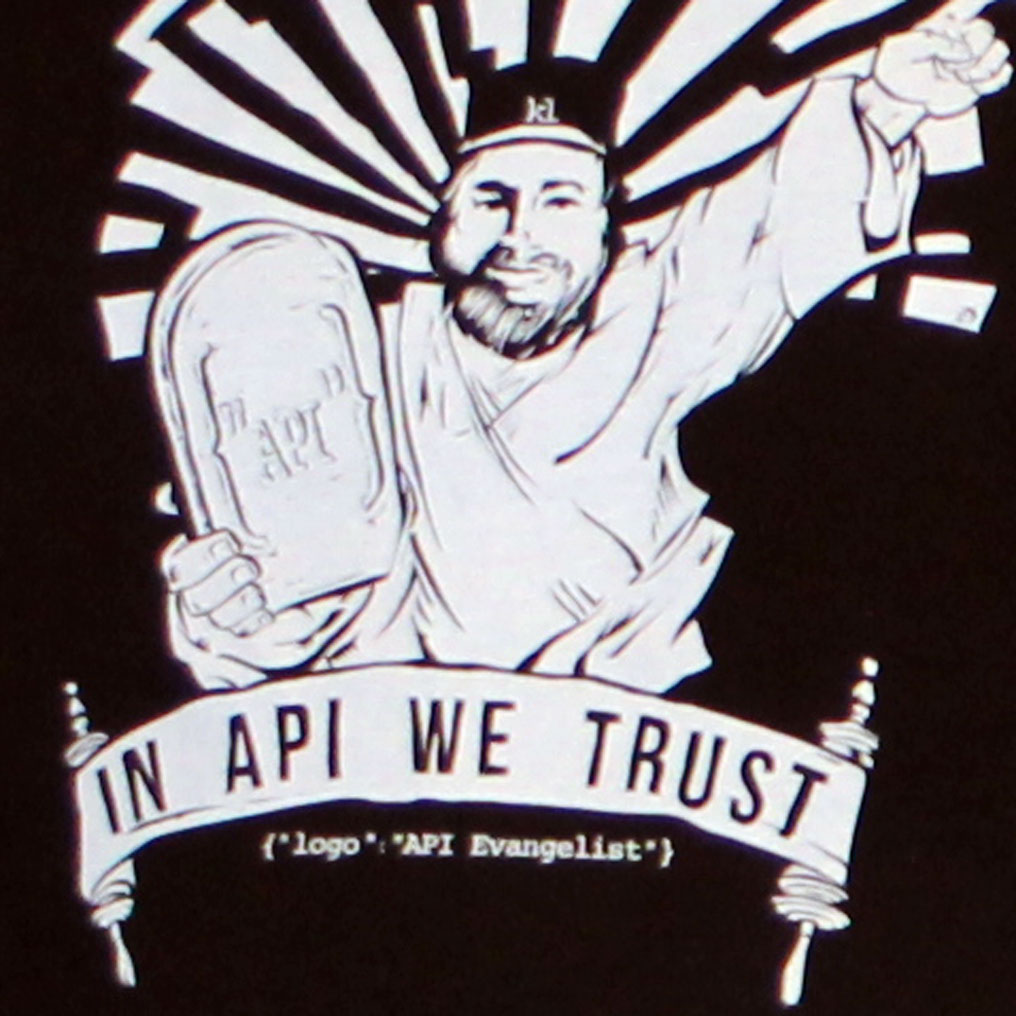
Kin Lane #4life

The other thing that’s got our attention as of late are APIs. Kin Lane is my hero in many regards, and his prosthletizing work for APIs has opened up a whole new world to us over the last year. I’ve known about APIs for a while, and had some vague idea of their value, but its Kin who framed for us their endless possibilities. Tim Owens has led the charge in the experimentation (he’s DTLT’s R&D), and he recently wrote a post “Harnessing the Power of APIs” that chronciles some of his early experiments. We are still in the early stages of this one, but as TIm eloquently notes:

There’s something magical about realizing that you can interact with almost any piece of software out there and build great things. There have been many instances where we’ve relied on RSS in our department to handle the bulk of the work of getting information from other systems. It’s “old reliable” in that regard, but riddled with its own issues (the future of it notwithstanding). More often than not services are not including RSS as a part of their core offering (and in some cases it probably doesn’t even make sense). But public APIs are commonplace and in most cases you can accomplish some really incredible stuff using them!

RSS is old gold, but might we need to invest more time and energy into APIs for making some of the work we are doing more seamlessly integrated? Tim was recently talking about providing a preliminary dashboard for all Domain of One’s Own users that enables them to get a domain, create a subdomain, and install an application without ever going to CPanel—all with APIs. Making things that much easier for our community to create and manage there own spaces is very powerful, and I’m stoked Tim is leading us in that direction.

DTLT, we’re not the best for nothing. NOBODY!

Also, I have to quickly note that meeting Kin Lane and Audrey Watters last April at M.I.T. to start imagining Reclaim Your Domain has proven to be truly inspiring for the work we’ve been doing this year. I can’t speak for anyone else in DTLT, all of whom are smarter than me and probably saw these developments on the rise, but I desparately needed a good schooling on flat-file CMSs, Github, APIs, and the future of the web.

OK, but enough of that, I’m off to read Roy Fielding’s dissertation.

Posted in dtlt | Tagged , , , , , , , | 11 Comments

Student Coded Projects for DTLT

This semester students in Karen Anewalt’s Software Engineering course (CPSC 430) will be working with DTLT to create a series of WordPress plugins/themes for UMW Blogs and Domain of One’s Own. This is pretty awesome because we could always use some development, and it gives these students experience working with clients who need particular functionality for an open source application.
Traditionally students in this course put a call out to the community for projects and built applications for any takers from scratch. This model had some success, but the issue with this approach was that there was no one to take care of the application after the students graduated. Under this new approach, DTLT will be maintaing whatever they program. Major kudos to Martha Burtis for coming up with this model as well as taking the lead on organizing it.

Below is a list of the projects we are asking the Computer Science students to develop. The descriptions are in italics and were written by Martha Burtis, I provide commentary following each description.

DokuWiki/WordPress Plugin 

umwdomains docsThis plugin will scrape content off of DokuWiki wiki pages and re-display them within WordPress. Similar plugins already exist for MediaWiki, [namely Wiki Embed],  and they may serve as models for development. Ultimately, when installed, the plugin should allow the site administrator to provide the address of DokuWiki install and then use shortcodes to embed specific DokuWiki content from that install on WordPress pages.

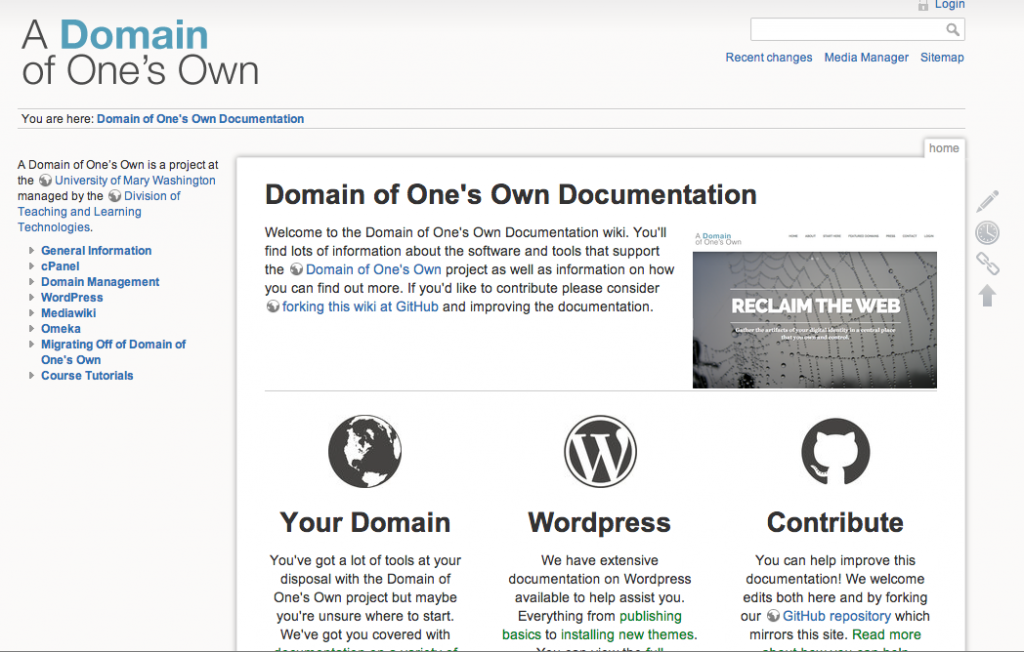
This plugin was motivated by the fact that DTLT has moved its documentation for Domain of One’s Own to DokuWiki (we are finally breaking up with MediaWiki). What’s more, the documentation is synched with GitHub so that anyone interested in using our documentation can simply fork it there. Tim Owens rocked out this whole setup over break, and I am blown away by how awesome it is. You can read his post “Please Steal Domain of One’s Own”  that breaks down his thinking and process—so good. This plugin provides us with the last piece that MediaWiki provided us that DokuWiki doesn’t, and these CS students will be contributing to at least two open source projects.

WP Install Packages 

Image Credit: wright.edu

Image Credit: wright.edu

This plugin would allow users of Domain of One’s Own to add additional packages of plugins/themes to their WordPress install. In addition to being able to select packages, they should also be able to choose plugins/themes/features a la carte, based on their specific needs. A system will also need to be created to allow us to manage the installation packages.

The work with packages for Domain of One’s Own has already been blogged about by Martha, and this plugin would actually allow us to customize packages for specific courses. So if an art course needed a specific art portfolio setup or a faculty member wanted a syndication setup or a student wanted a professional portfolio this would provide all of these. What’s more, this plugin woud allow folks to choose which features of each package they want. What’s so important about this plugin is it starts to make the various options provided by Domain of One’s Own that much easier for people to see, understand, and use.
Reddit-Style Reader for Domain of One’s Own

Reddit-iconThis project would involve create a Reddit-style interface for viewing, commenting upon, and upvoting incoming content from Domain of One’s Own. It could be built within WordPress, or in another standalone application.


This project is why I’ve been exploring Reddit in more detail recently, and it promises to help us build a sense of community around all the disparate work coming out of Domain of One’s Own. By default we have every post from every domain pulling into umwdomains.com. What’s more, we have been able to capture metadata like department, instructor, course, etc. So, theoretically, we can use tags to create a series of subreddits off the homepage of Domain of One’s Own that allows people to dig down to posts by department, course, instructor, etc.

UMW Blogs Plugin Suite 

wordpress-plugins

Image credit: http://lornali.com/concise-list-seo-plugins-wordpress/

This project involves developing several smaller plugins to enhance functionality and capabilities specific to UMW’s WordPress Multisite installation (UMW Blogs):

  • Enhanced Admin User and Site Search: Allow for searching of partial usernames and sitenames in the Network Admin backend.
  • Sitewide Comment Tracking: Allow users to keep track of their comments across multiple sites on the UMW Blogs network.
  • Enhanced Contextual Support: Provide additional contextual support and help across the network.
  • Instructor-Filtered View of Student Activity: Allow the instructor of a course to track student activity across the course/network.
  • Bulk User Import: Allow instructors to easily import a data file of a student roster to automatically add students to a site.

This is a list of plugins we would love to have for UMW Blogs. Stuff like Sitewide Comment Tracking used to exist, and might in sites like wpmudev—but we like our plugins free when possible. That said, if you know of freely accessible plugins that provide any of these feature we’d be much obliged. If not, hopefully they’ll be developed at UMW sometime soon.

__________________

I’ve already had two meetings with the students providing the specs for what we need with the Reddit-style theme, and I’m pretty psyched this is moving forward. I’ll be sure to provide detaisl and updates as the projects materialize virtually.

Posted in dtlt | Tagged , , , | 3 Comments

The Internet Course

Is it really the beginning of week 3 of the semester already? Between a rough re-entry from Italy, a couple of snow days, catching up on my day job, and a stomach flu, the new course Paul Bond and I are teaching this semester has been woefully neglected on the bava. This post will try and remedy that.

Paul and I have teamed up again to teach the entry-level Computer Science course CPSC 104, also known as THE INTERNET COURSE. The course provides students with an overview of the history, technical infrastructure, and cultural implications of the internet as a communication revolution. Here is the catalog description:

A survey of the technology and issues underlying the use of the Internet for communication, resource discovery, research, and dissemination of information in multimedia formats. Topics include an introduction to Internet protocols, Internet history and development, electronic mail, use and functions of a Web browser, accessing Internet services and resources, using the Internet for research, Website design and implementation, and social, legal, and ethical issues related to using the Internet.

We are planning on covering all these topics and more, but we’ve decided to take a different approach. Rather than a predefined syllabus with a list of our handpicked readings, we’ve decided to take the first two weeks of class and have the students select the readings. What I love about this approach is that it challenges the popular idea that a course is defined by the pre-selected readings, resources, textbooks, etc. Is that really the case? What if a course were from the very beginning about students contributing to the discussion by critically selecting the sources that make-up the experience. That’s exactly what we’ve done thanks to Paul’s vision for the course. During week 1 we had the class consider how to vett resources with the help of the UMW Library’s CRAAP test video animated by the great Giulia Forsythe and narrated by UMW English professor Gary Richards. CRAAP is an acronym that provides some guidelines for selecting good sources on a topic: currency, relevance, authority, accuracy, and purpose.

After we discussed the basics of the CRAAP test in our second class, we broke the roadmap for the class up into eight topics:

  • where it comes from
  • how it works
  • creation/consumption
  • intellectual property/fair use
  • privacy/openness
  • digital identity
  • social/economic/cultural impacts
  • where it’s going

The rest of this class was spent brainstorming subtopics for each of the eight topics. This was an invigorating session because everyone was providing a wide range of solid subtopics that would help them get started on their research. By the end of the hour and fifteen minutes each student was assigned two topics for which they would need to find six readings (3 for each of their two topics) in a weeks time.

Paul came up with a pretty cool system for the submission of these readings so that we could vett them according to the guidelines of the CRAAP test. Paul setup a Google form for students to add their sources that you can see on the course site here. Once they submitted their readings, we color-coded them green, yellow, or red in the spreadsheet based on whether they are good to go (green), questionable (yellow), not acceptable (red). The students can get the feedback on the course site, and return to the library for more and better research if necessary. They need to have at least 3 green sources, and justify anything that is yellow. Paul lays out the system in far better detail in his post “Talking CRAAP.”

The final part of this process is that the students have to summarize the articles they found and tag them with the appropriate topic before publishing them to their blog. After that they will syndicate into the course site and we’ll have 140+ articles linked and summarized as by the beginnign of week 3. What’s more, the articles can be filtered by topic. Paul was inspired by an experiment Michael Wesch did back in 2009. Whereas  it reminds me of some of the work Michael Caulfield is doing currently with his Water106 idea around crowdsourced articles fed into a hub around a specific topic.

I’m really excited by this new approach. We’ll be playing with concept maps this coming week, and after that, for the next 6-8 weeks the students will form panels accordingly to their topics and discuss the readings they found on their topics as a way of interrogating the historical, technical, and cultural elements of THE INTERNET.

Posted in The Internet Course | Tagged | 8 Comments