Master of My Domain

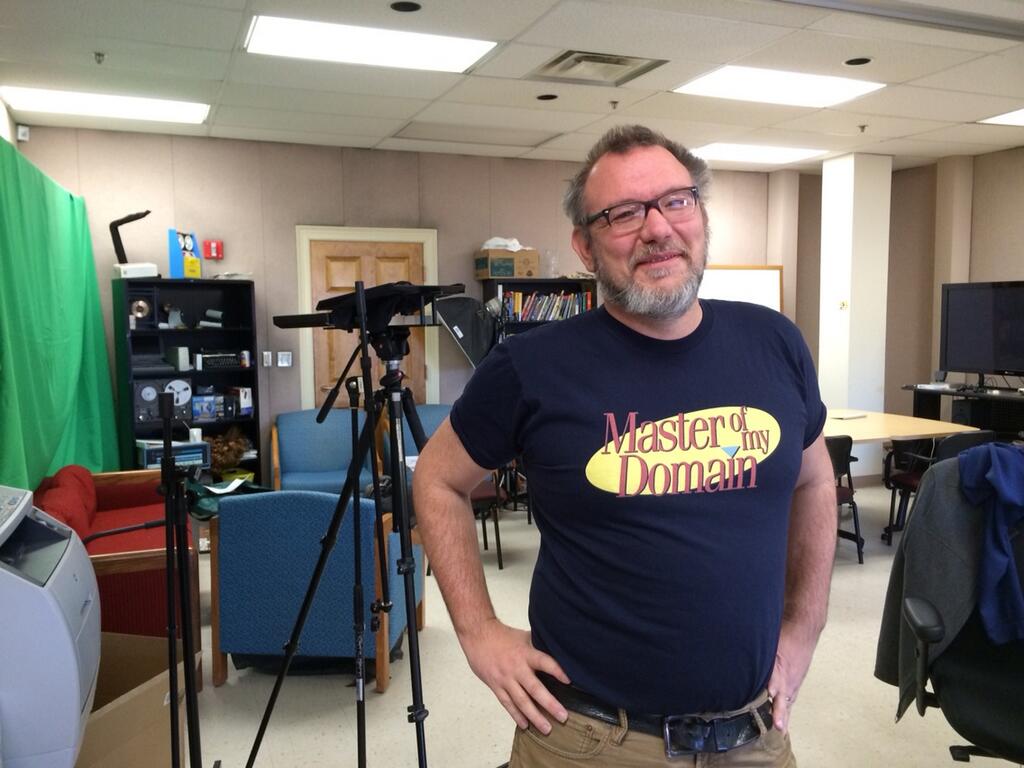
Master of My Domain T-Shirt

Image credit: Andy Rush caught me in my Walt Whitman B’Hoy stance

We are going full throttle at UMW with Domain of One’s Own, so it’s time to bust out the t-shirt! Mary Kayler got me this gem for Christmas, and I am wearing it with pride today! We have nearly 600 domains registered, Martha and Tim have built the community site for UMW Domains (read about the details on Timmmmy Wonder’s blog), that Domain of One’s Own Faculty Initiative is ruling, and this whole thing is starting to feel even more exhilarating than UMW Blogs did seven years ago. DTLT is operating in the clouds right now, and I’m really thankful to be part of it. I might be master of my domain, but I hope that doesn’t belie just how much a collective effort realizing this awesomeness has always been. I’m very happy right now. I couldn’t be prouder of the work DTLT is doing and I love UMW more every day—this place truly does rock!

Posted in Domain of One's Own | Tagged , | 6 Comments

Rainbow Dash on UMW Domains

rainbow_dash_approved_by_ambris-d4bdn33

I have another post I’ll be writing about this week in The Internet Course, but one of the gems early on has been finally getting to meet and work with Amber May given she’s in the course. I’ve known Amber’s work for a while now given how strong she showed in Alan Levine’s section of ds106 last Spring. Her voice acting is amazing, and I’m happy to hear she is exploring that across a number of courses at UMW, including Mark Snyder’s MIDI course. Here’s a recent song loop she created for that course which is hysterical.

All this to say, I was joking with her last week that we need to get together and have Rainbow Dash promote Domain of One’s Own. And given that she’s awesome and #4life the real deal was quickly delivered. If you’re a Brony like me, you’ll enjoy the latest promo for UMW Domains—the greatest thing since My Little Pony 🙂

Posted in Domain of One's Own | Tagged , , , | 3 Comments

Broadband: Make it a Commodity like…uh…a Pork Belly

enron

Click image for Simpson’s take on Enron scam

I just finished watching the 2005 documentary Enron: The Smartest Guys in the Room, and it reinforces David Simon’s theory of America as Horror Show. What’s more, it was just a small taste of things to come in 2008 with the global financial meltdown at the hands of the world’s most “trusted” financial institutions.

Anyway, I learned a bit about how Enron defrauded state’s like California out of tens of billions of dollars through loopholes in the legislation for the recently deregulated energy utility market. Through redirected energy and fabricated shortages, Enron could sell California back it’s own energy at an insane markup (kinda like academic publishers 🙂 ). Enron moved from a company that dealt in natural gas to one which manufactured several high-profile gimmicks while hiding its losses in order to trump up its stock value. The Wall Street analysts had as muc h to with the Enron scam as anyone.  It was basically one big lie cashing in on capital running amok.

One of its scams that caught my attention was Enron’s foray into the bandwidth commodity market, in particular teaming up with Blockbuster to deliver on-demand video through their network provider Enron Broadband Services.  What’s funny about that is we were talking about the history of the web tonight in The Internet Course  looking at the emergenc eof the web,  Web 1.0 and Web 2.0. One of the details omitted from that history was the Dot-Com Bubble of the late 1990s. Enron was playing on just that market hype when they made the broadband announcement, and it suggests how their fraud was all about creating a compelling narrative regardless of what was possible (true of the dot-com boom more generally). In fact, broadband was just another utility to be deregulated and you could argue that was what the 30 second commerical is really arguing for. What if broadband was a pork belly?* What if broadband was a basic right, a public utility affordable to everyone so we could avoid the pillaging of the public that was Enron?

Paul Bond and I had talked about including this documentary in the True Crime course if we teach it again, and after watching it I would say absolutely. It frames one of the most heinous premeditated crimes committed against the citizens of the U.S. and beyond in the past thirty years: corporate crime kills!

* Turns out pork bellies are no longer a commodity anyway.

Posted in The Internet Course, True Crime | Tagged , | 4 Comments

Over 1000 Reclaims

Image courtesy of Conejo Through the Lens, Thousand Oaks Library.

Today Reclaim Hosting went over the 1000 reclaimers mark. That’s right, in the last six months more than 1000 people choose to explore reclaiming their online presence through a system that Tim “the Wizard” Owens built into one hell of a hosting service. We’ve kept it as cheap as possible without running at a loss, while at the same time providing top-notch hosting and support to K-12 and higher education institutions all over North America.

Given how successful and rewarding the first six months have been, we’re committing to run the service beyond the initial year-long pilot. Over the next few weeks we’ll be introducing a set of affordable packages for both individuals and institutions so that anyone can get up and running on Reclaim Hosting in no time.

It’s been a lot of fun dreaming  alongside Tim about the possibilities of Reclaim Hosting. We’re committed to the vision of using this service to enagage and foster the discourse of personal empowerment and community development through education when in comes to all things online. That’s what Reclaim Hosting is, and that’s what it will be.

We’ve got the hosting and support parts down pretty well. So now we’re starting to develop out ideas and possibilities for incorporating a robust community presence that will help transform what is now a series of one-off sites into a “neighborhood” of educators and students exploring and interrogating their online presence together.

What’s more, we are still hoping to team up with Audrey Watters and Kin Lane to start realizing the vision behind “Reclaim Your Domain” as an extension of the Reclaim Hosting environment. Not just commodity hosting, but a space to synch, archive, and own your social presence around the web, while at the same time developing crucial web literacy skills. I’m very much looking forward to travelling to Atlanta in less than two weeks to the rescheduled Domain Incubator so that we can continue to push the reclaim education agenda forward 🙂

Posted in reclaimopen | Tagged , | 1 Comment

Fredx Coder Dojo

Yesterday, Tess, Miles, and I went to a free, three-hour event offered by the FredX Coder Dojo. The dojo seems to be born out of—or at least in the spirit of—the maker culture work George Meadows and Tim Owens have been cultivating in Fredericksburg for a couple of years now. The local, community-wide impact on libraries, local schools, and beyond this work has been visibly greater than anything else UMW has been a part of in this regard. The mentors running the dojo, at least two of whom are UMW grads, did a truly great job.

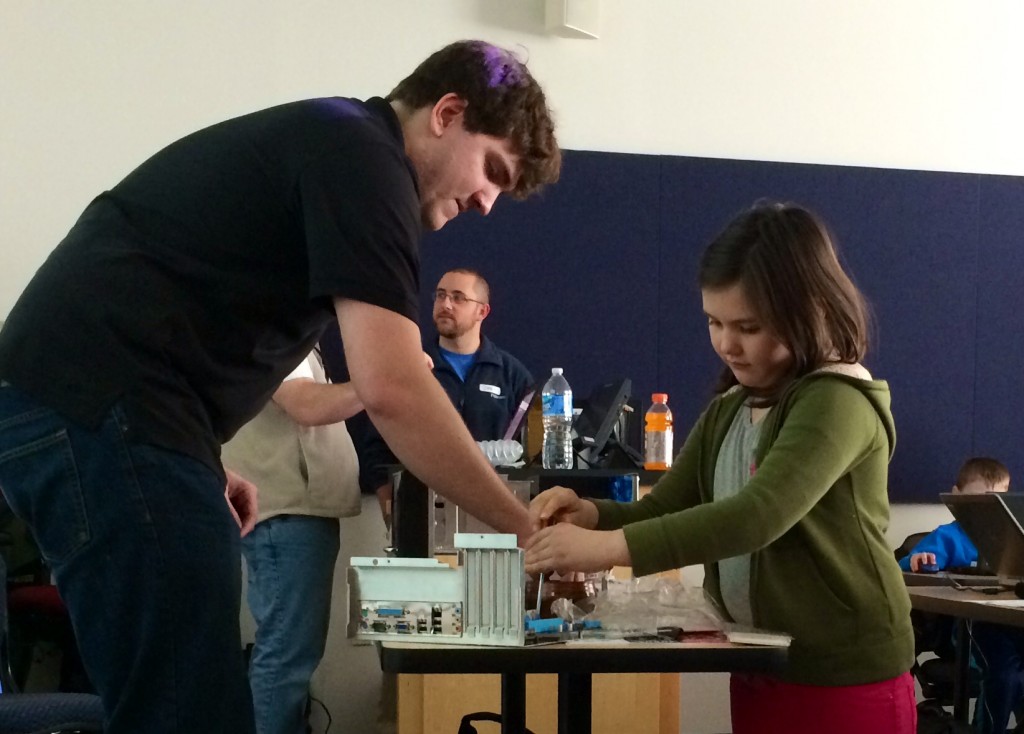
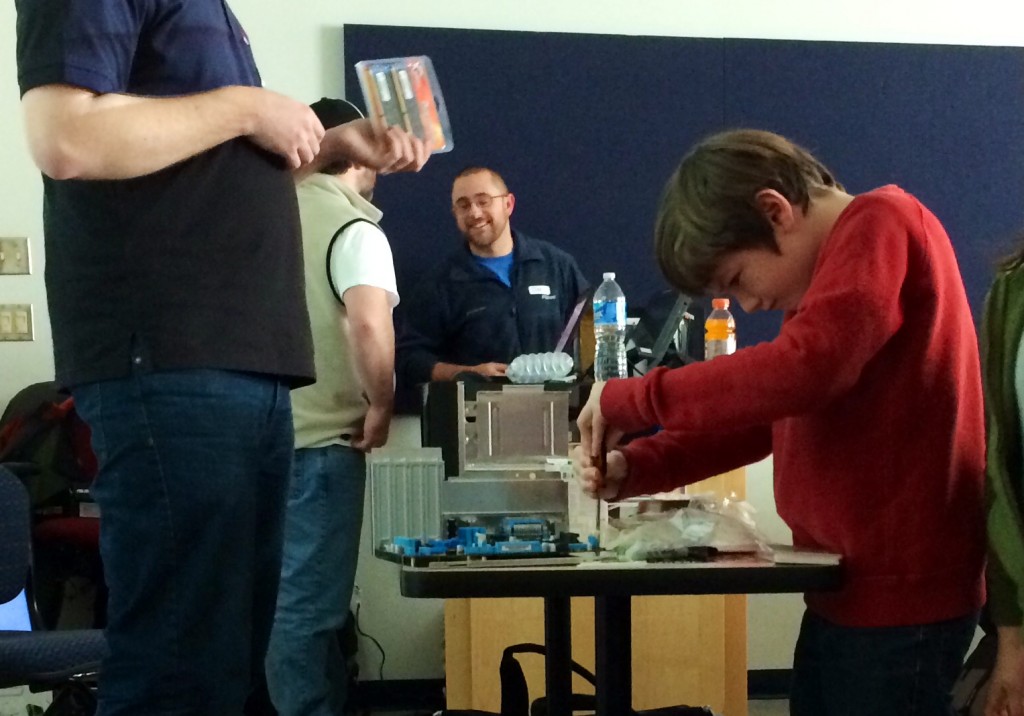
Elliott Sperlazza spent the first hour taking the room full of more than 20 kids how to build a server. Groups of kids came up to help the construction along, and talking about CPUs, harddrives, hetsinks, etc. was pretty awesome. Thanks to Tim I have images of both Tess and Miles turning a screw or two on the motherboard.

tess_building_server

miles_building_server

During the next hour Elliott took the group through creating mods for Minecraft. I though this was pretty awesome given they broke down modding for this game environment into recipes that kids could create and use to change variable, set parameters, etc. Java programming and making something simple are usually not two things that are associated, but Elliot demonstrated through the applciation Eclipse how this is possible. There were some difficulties getting all the developer tools up and running for Minecraft, so I’ll be following up on this as homework before the next meeting.

Finally, the last hour was an HTML clinic run by Devon Loffreto. What’s interesting about Devon is he’s also doing a similar program out of Stony Brook University with no funding. I imagine that would be a pretty exciting partnership for SBU’s newest and greatest CIO (paging Cole Camplese)!

Anyway, this portion of the day was awesome because I got introduced to Mozilla’s web maker HTML tool Thimble. This was perfect for Miles and Tess because they could change HTML code in the left-hand column and see those changes on the right. What’s more, we could play around with basic HTML and publish it right through the thimble tool. I’ll be using this one this coming week for an assignemnt for the Internet Course.

For example, Miles made his very first webpage and it just so happens that it is also has a predictive engine that can determine who will win the Super Bowl. Impressive stuff.

Miles Webpage

Also, there was another mentor there named Josh (featured in the middle of the pictures with Miles and Tess) who I ‘ve know for a while through Joe McMahon (I just don’t remember his last name, little help?). It felt to get out there and actually go to one of these events and expose my kids to some of this stuff. For all my rah rah rah on this blog, I can be lazy and ignore the stuff happening right in front of my own nose. So, this year I’ll be doing more cool stuff like this locally. It’s good for me, for my kids, and for building ties that help foster community. Fredx coder dojo promises to be just that, and I’m a big fan.

Posted in Uncategorized | Tagged | 1 Comment

David Simon on America as a Horror Show

If I dig myself out anytime soon I have a pretty fun web project centered around David Simon’s brilliant television series The Wire that I want to run sometime this year. In the meantime, here’s a 26-minute video featuring David Simon articulating all the points he made in both The Wire and his unfortunately abbreviated Treme about the deep failings of America along deep institutional and economic fault lines. Here’s one rough quote: “Labor’s lost the fight, Capital won.” It’s really good stuff, thanks to Alec Couros for the link on Twitter.

Posted in pop culture, TV, video | Tagged , , , | 2 Comments

Analog Futures

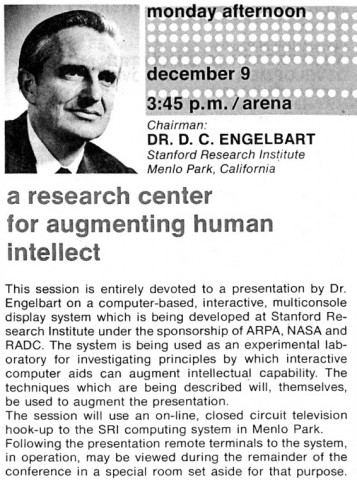
EngelbartEarlier this week I read Vannevar Bush’s seminal 1945 essay “As We May Think.” It was as remarkable as I had heard in terms of his ability to predict the future, and I was amazed at just how many kernels of current technical and communciation realities it contained. Like Doug Engelbart’s “Mother of All Demoes” which introduced the computer mouse, word processing, networked video calls, and hyperlinks all in an hour an a haf, Bush’s essay maps out everything from the future of photography, wearable computing,  credit card machine, wireless communications, Wikipedia and the web more generally, which Bush refers to as the Memex. It’s an essay with a remarkable range of registers, from technical to practical to hopeful, and its that last one that was so inspiring for me while reading.

This article is just as much a historical document as it is a roadmap for the future. Written in 1945 it breifly frames the previous five years of intesive war-time scientific research dedicated to mass destruction (in the form of the Atom Bomb) as a turning point for civilization. Rather than continuing down this path, Bush himself effectively ran the militiary industrial complex during WWII in the U.S., the post-war moment provids the opportunity to direct that collaborative research momentum to transform the way humanity communicates. Re-think how we share information, solve problems, and provide “a record of ideas….so that knowledge survives and endures throughout the life of a race rather than that of an individual.” It’s powerful because it helps to position Bush, and after him Engelbart, in a tradition of the internet (and later the web) that is first and foremost grounded in the idea of sharing as much of the world’s knowledge as widely and openly as possible.

Connecting the history of the internet and new media with Bush and Engelbart immediately frames it as a deeply humane, noble pursuit that is, paradoixically, born out of and continually developed through and/or alongside the militiary industrial complex. That immediate tension still very much exisits remains, and id one of the more fascinating elements of internet history I hope comes across this week in the Internet Course.

The other part of Bush’s essay that fascinates me to no end is how he is pushes up against the limits of what’s possibly through analog technology.  This essay provides an excellent opportunity to talk with a class of students about the difference between analog and digital technologies, and what that has meant for the future of computing and culture. When Bush talks about the Memex, he imagines it as a “sort of mechanized private file and library” storing “all his books, records, and communiations.” What’s more, it’s a system that can be fit within a desk consisting of milliosn of compressed records on microfilm that can be immediately retrieved and linked to create a web of trails that the user follows.
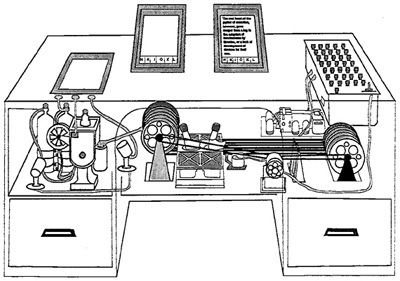
Image of Vannever Bush's imagined "Memex"

Image of Vannever Bush’s imagined “Memex”

As Bush lays down the entire vision, it’s obvious he’s describing what we would call the web at almost every point, the only difference between his vision and our reality is that it would ultimately be accomplished through digital, not analog, computers. His vision of an analog Memex of microfilm wouldn’t have been practical because it explodes at the point of seamlessly linking various resources and breaking out of the linear continuity of analog information. Therein is the magic of digital information, it’s discontinuous. The digital enables the web trails that Bush discusses that cut across any one logical and continuous system to emerge by transmuting resources into binary packets of information that can be transmitted easily.

I spoke to this point a bit last Tuesday when teaching this essay, and I wonder if it might not be just as useful for the Domain of One’s Own Faculty Initiaitve folks who read “As We May Think,” as well as watched Engelbart’s demo. What does it mean to be a “digital” scholar in this regard? The term is used pretty liberally now, but how do we start to very specificaly map it onto the work we are doing in higher ed? Both Bush and Engelbart seem to share the basic principle that the emerging communication technology that would become the internet is premised on one thing above all others: “augmenting human intellect.” How does that fit in with the way we use it?

Posted in Domain of One's Own, Faculty Initiative | Tagged , , , , , , | 1 Comment

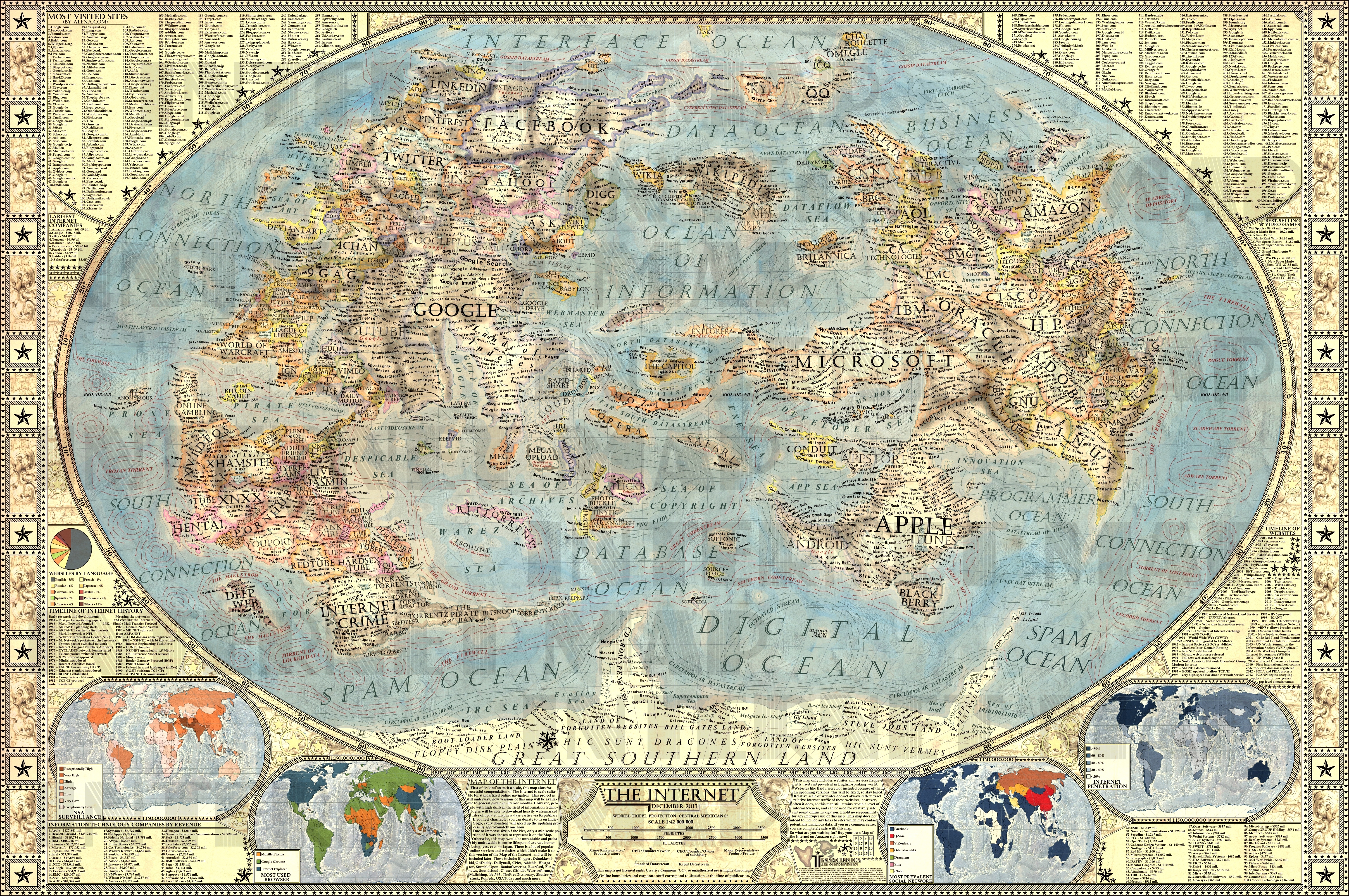
A Map of the Internet

Image credit: "Map of the Internet 1.0." by JaySimons

Image credit: “Map of the Internet 1.0.”
by JaySimons
Click for larger version.

Paul Bond and I are teaching a course on the itnernet this semester, so I couldn’t resist this beautifully wrought map of the internet designed by JaySimons. I came across it thanks to this post on the OLDaily, and Stephen Downes is right: “It’s worth exploring in some depth because of the wealth of detail. Don’t forget to look at the ocean currents.” We’ll definitely be bringing this one up in class this week as we start talking about The History of the Internet.”

Posted in images, maps, The Internet Course | Tagged , , | 2 Comments

Brewster on Bitcoin

bitcoin-logo-3dIn this four-minute video over at Forbes (forgive their ad, they know not what they do), Brewster Kahle talks about some of the experiments the Internet Archive has been doing around Bitcoin for the last couple of years. He has been paying employees in Bitcoin, and they even set up a credit union that accepts the crypto-currency.

We’ve been talking a bit about Bitcoin at DTLT over the past few months after Tim Owens and Martha Burtis decided to start play the market—it was pretty exciting to seem how quickly they got so deeply into this world. In fact, I even got $15 worth of Bitcoin as a Christmas gift from Tim, which means I’ll be a million one day 🙂 I’m still cnoceptually trying to wrap my head around Bitcoin, and the best way for me to do that is to teach a course about it, but this might be out of my league. Wouldn’t it make an interesting Freshman Seminar? In fact, when we were talking about the future of the internet topic in The Internet Course, one of the ideas students were most fascinated and garrulous around was this idea of internet-native currencies. Anyway, maybe we can pull a series of scholars from a few disciplines and have an experimental seminar on the topic—why not?

Posted in The Internet Course | Tagged , , , | 4 Comments

UMW Domains goes Back to School

Domain of One's ownKim Jaxon and Patrick Berry had a compelling conversation as part of their most recent Back to School podcast about the fact that more and more faculty and students want alternatives to the centralized, campus-supported learning management system. The larger question they get at is why aren’t universities thinking more creatively—and this goes for IT, academic departments, and individual faculty alike—about providing more options for their campus community.

This is very much inline with the thinking we’ve been doing at UMW, and I agree with them wholeheartedly that this stuff isn’t crazy. Providing faculty, staff, and students with web hosting space to explore the web, publish freely, and share resources as part of the unviersity experience should be at the core of its mission. Nevertheless, ever since universities abandoned evolving the shared web tilda spaces (~jgroom) they’ve provided little to nothing in their stead. What’s crazy about this (and this is what’s really nuts to me!), is that it’s only gotten more important to create and define a professional presence on the web. UMW Domains speaks precisely to this reality.

Kim and Pat, let us know how we can help you over at CSU Chico. Also, there’s this little thing called Reclaim Hosting we came up with to make this possibility a quick and cheap reality for any interested faculty and/or student who want something like Domain of One’s Own, but don’t have the internal support to get it for whatever reason.

Also, Patrick Berry consistently cracked me up throughout this podcast, I love his sense of humor.

Posted in Domain of One's Own | Tagged , , , | 1 Comment