Grandma Mashup -you won’t regret it!
Via WFMU’s Beware the Blog which, in turn, found it via Monkeys for Helping.
Grandma Mashup -you won’t regret it!
Via WFMU’s Beware the Blog which, in turn, found it via Monkeys for Helping.
 Ok, I’m gonna take a different tact from the RIAA’s methods of dealing with college students, rather then threatening suit and certain incrimination -I will celebrate the unbelievably cool work that has been going on here at UMW. Amanda Rutstein has been blogging an independent study on Sylvia Plath that she is doing with Professor Claudia Emerson (this prof even has her own wikipedia article for good reason!). She found the WordPress Multi-User site I created for the English, Linguistics, and Speech department (an experiment of sorts), and decided that a blog may be useful way to track the progress of her Plath research over the course of the semester. I don’t think anyone had any idea how useful it would prove!
Amanda started discussing her readings of Plath while talking about all the cool resources available to scholars on sites like YouTube. Moreover, she blogged a discussion her class had with Dr. Donovan from VCU, who is the Editor-in-Chief of the online literary journal Blackbird. During this discussion it came out that one of the students at VCU had “discovered” a poem by Sylvia Plath, “Ennui,” and Blackbird had published the piece to much acclaim. This was obviously a source of excitement for a budding Plath scholar and led Amanda to some more research -all of which she has blogged. To make a long, amazing story about undergraduate research a bit shorter -Amanda quickly realized that there are a number of Plath’s earlier poems in the Lilly Library at Indiana University that have already been indexed, including “Ennui,” but not published in the Collected Poems of Sylvia Plath. Seems like the great find by Blackbird had already been discovered, and that many of Plath’s early poems have by sequestered in the Lilly Library for scholars but remain unpublished for a broader audience. According to Amanda:
I’ve been reviewing the articles that came out around the time that “Ennui” was published in Blackbird and I am continually surprised by the quotes I find! For instance the one listed above which I found in both The Washington Post and USA Today. In an effort to remain unbiased and fair I was giving Dr. Donovan (the editor of Blackbird) and Anna Journey (the graduate student who “found” “Ennui”) the benefit of the doubt and hoping that they had just been rather vague in describing how she “found” the sonnet, rather than simply claiming it a true discovery (in every sense of the word). However, it seems that everyone I’ve spoken with, and everyone in conjunction with Sylvia Plath (ie: Linda Wagner-Martin) were all under the same assumption I was: that Anna Journey did find an undiscovered poem. It seems completely inconceivable that no one ever flipped to the end of Plath’s Collected Poems and saw the list that allowed me such easy access to Plath’s unpublished poetry! I hate to harp on this, but I’m going to! All of Sylvia Plath’s unpublished juvenilia is accounted for and catalogued and safely stored in her archive at the Lilly Library.
She follows this with a very cool point:
For a minimal fee, and a reasonable reason, any student/teacher/scholar can get a copy of these poems and a chance to try to get them published. It is criminal, in my opinion, that this is not common knowledge, and has been, in effect, further hidden from the public due to the publication of “Ennui”.
Wow, so Amanda’s process has led her to an interesting discovery about the whereabouts of Plath’s earlier, unpublished poems. She then goes on to secure a copy of an unpublished poem from the Lilly Library for herself:
Very exciting stuff!!! I just got a letter from the Lilly Library with a copy of the poem I had requested along with all the paperwork I will need to get publishing rights. I might try to get rights to reproduce the poem on this blog, because it seems like everything is running so smoothly that I might as well try. I cannot believe how quickly I was able to get a copy of this poem. The poem is titled “Words of Advice to an English Prof” it’s actually not a great poem. I mean it’s fine, it’s cute but it’s not written in any precise form although it does have a tight end rhyme. The neat thing is just that I’m reading it, that I own a copy and that it was so SO easy to get. It is also fascinating to see something so mediocre by such a fantastic poet, it really shows her progress. I would love to get the original draft with her professor’s notes on it. It’s late, and I don’t have anything specific to say right now other than to spread the news that I have the poem and hopefully soon I can share it with everyone right here on this blog!
And now she is simply waiting to get the go ahead from the Lilly Library to publish it! Imagine that, an undergraduate begins a process of studying Sylvia Plath’s poems three months ago, and is currently on the verge of presenting a heretofore unpublished poem by a literary giant to the rest of the world on her own blog. It just blows my little mind! Now you tell me undergraduate research won’t be affected by these tools! While no tool will ever be able to replace the passion and drive of student research -the possibilities of connecting, collaborating, and publishing one’s work to a larger audience is only a click away! If you’ve made it this far -do me a favor- let Amanda know that you’ve read her blog and that this is, indeed, a very cool thing!
Below is an ordered list of blog posts that take you through the quotes and details of Amanda’s discovery. Well worth following at length! Also, rather than commenting here -please save your comments for Amanda’s posts. She deserves all the meager attention I can muster for the hard work and effort she has devoted to this research over the last several months.
 I have been following some recent threads about the RIAA’s attempts to bully campuses into forcing students to comply with copyright laws. On boingboing, this article summarizes the University of Nebraska’s frustration with the RIAA’s demands to rat out students who are sharing music using peer-to-peer technologies. They were so fed up that they plan on sending this organization a bill for all the time they have wasted. You got to love it when a university finally says enough is enough.
At the other extreme, Purdue University has warned that the RIAA has requested information about thousands of students. According to Bob Caswell’s (whose post you can find here):
Last week, 40,000+ students at Purdue (including myself) received a warning email. In short, stop illegal downloads, the Recording Industry Association of America (RIAA) is coming. Purdue is advising all computer users to remove or at least partially disable any peer-to-peer file sharing software on their computers.
Moreover, he notes that while Purdue is not necessarily excited by the prospect of cooperating with the RIAA given the logistical nightmare it presents, they have taken the tact of washing their hands of any responsibility of inaccurate information being passed along. Caswell continues:
So why would the university be interested in accuracy if a) this whole process is a “significant cost” and b) it’s not Purdue’s fault if it screws up? Call me Mr. Skeptical, but I have little faith in any institution that seems forced do something while simultaneously eliminating responsibility for its actions.
Classic case of our hands are tied and we can’t do anything but cooperate with these demands. Well, from what I understand Nebraska has set a precedent Purdue might consider following. Tell them no, and charge them for wasting everyone’s time because they haven’t figured out a good way to make online music easily accessible, affordable and free of rootkit nightmares. This is obviously the last gasps of a moribund vision of business who has to resort to threatening their target audience.
Sad part about it, is that the resorting to fear and terror seems to work! Of the 400 college students from over 13 universities who received letters from the RIAA threatening suit, over 116 of them have made a settlement (link). I’m not sure about you, but wouldn’t such letters and the fact that the RIAA is sniping their own audience be enough to “Just Say No!” Looks like there will be plenty more letters sent out until we start re-imagining how we can continue to create spaces that foster the creative process free from the greed-inspired threats of a dying industry.
Update: Looks like the University of Maine system has flat out refused to play ball with the RIAA -if I were ready to be an undergrad, I’d be packing some warm clothes and heading north! Here’s a cool bit from the article:
According to Jon Ippolito, a UMaine new media professor and associate curator of media arts at the Guggenheim Museum, the university has taken a principled stance. “[The RIAA] have so many lawyers that they can afford to send frivolous subpoenas right and left, and the mere threat to do so has caused some universities to cave right away,” said Ippolito, an expert on digital media.
On Thursday, Ippolito sent a letter to the university system urging administrators not to reveal students’ identities to the RIAA. Ippolito said the practice of subpoenaing universities won’t necessarily hold water in court, and was critical of the RIAA’s newest tactics with colleges, a policy he called “mafia-like.”
“They want to bully universities into exposing students and also bully students directly into signing onto a discount,” Ippolito said. “There’s no legal process and that’s the end of the story.”
Stephen Downes, in the quote below, crystallizes the reasons why the field of instructional technology needs to be a lot more than a conversation about a range of tools.
Presumably philosophy does have an inherent interest in something other than the making of money, though you would never know these days. Certainly, anyone with a moral stance ought to be looking at how knowledge – whether military, medical or philosophical – is created, for what purpose, and who benefits.
This beautifully framed intersection of the relationships between power, control, and capital has never been more apparent to me than when I started blogging as an instructional technologist. Interestingly enough, this emerging field has uniquely positioned a number of extremely smart folks to start thinking about how discourse is framed, by whom, and to what end. These were the cornerstones of my own undergraduate and graduate work, but I have never experienced these ideas in a conversational manner on a daily basis as I currently do within the EdTech blogosphere. This social network is an extremely vital “structure of feeling” (to quote Raymond Williams) during “the interesting times we live in” -to paraphrase Jon Udell.
Because I am overloading on video these days, here’s another one for y’all! Sorry, I just can’t stop myself! Via WFMU (link).
That is what Michael Frackas, general counsel for Viacom, asserts in his opinion piece in The Washington Post. Here is a brief summary of the article via Slashdot:
Fricklas asserts that the DMCA’s ‘safe harbor’ provisions don’t apply because YouTube is knowledgeable to infringement and furthermore derives financial benefit from it. He also argues that putting the onus of spotting infringement onto the content providers represents an undue burden on them. Fricklas caps the argument by stating, ‘Google and YouTube wouldn’t be here if not for investment in software and technologies spurred by patent and copyright laws.’
And, alternatively, Viacom would not be here if we didn’t watch their content. Given this fact, might we begin to suggest that they are beginning to fear spaces like YouTube that provide an open marketplace for user generated content that will quickly overshadow their own piece of the entertainment market? At the heart of the issue is that companies like Viacom want to make it more and more difficult for the emerging participatory culture of the web to congregate around spaces that feature user-generated content. Fear and terror in relationship to copyright is one way to accomplish this. Unfortunately it is not necessarily novel in our day and age. Let’s face it, how many people use YouTube to watch TV? It is primarily a destination for connecting with other user-generated content. There are a lot of amazing videos that do not depend upon the conglomerated media companies -see the Web 2.0 Online Learning Film Festival for some impressive examples.
What universities need to do is foster and promote individuals who want to broadcast their own vision for entertaining, sharing, and educating the public outside of the overly oppressive strictures of copyright. Why don’t they start using their position as institutions of education to join the discussion more directly by encouraging their faculty and students to become a part of this conversation? We are at a moment where Public “Television” can be reinvented, let’s not leave it to the wolves to dictate the terms of this conversation!
Mikhail, a good friend of mine, just sent me this screenshot via IM, letting me know he is watching Escape from New York. Oh, if I didn’t have two kids under three…
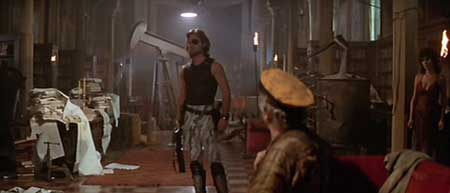
By the way, Harry Dean Stanton is my hero!
Update: If I wasn’t so self-absorbed, I would have realized much sooner that Andy Rush, our resident multi-media god, has already built UMWTube, something quite similar to a YouTube inspired Drupal site but framed out using Ning. So there is yet another angle to pursue. You can request an invitation to see this site here.
The edtech blogosphere has been pretty active as of late with discussions surrounding the role of online, user-generated videos in education. On Thursday, George Siemens posted about VideoLectures, a site that features online video-taped lectures of academics that are open to the public. On Friday, he posted “Formal and informal…control vs foster” which briefly frames some of the issues surrounding the corporate battles currently being fought over the online video distribution market. Also on Friday, The Washington Post’s Business section had an article, “For YouTube, This is a Test,” that named the media companies involved (NBC Universal, News Corp., AOL, Yahoo!, and Microsoft) in a partnership to develop a new online video service -in the spirit of iTunes- that will be a mix of free and “for a fee” content to protect their “interests” against the dominant YouTube. Copyright violation has obviously helped to frame the tenor for this clash of the corporate titans -but what is to stop us in education from building or own?
Would educational institutions building their own prove to be “just another silo?” This is a question Alan Levine asked in his recent post about TeacherTube -a site based on the YouTube model that deals specifically with educational content. That’s is a crucial question that needs to be considered, so with this potential pitfall in mind, I’ll go on. After the NMC Online Conference on the Convergence of Web Culture and Video conference, D’Arcy Norman suggested that a YouTube like framework could readily be built out using the open source CMS Drupal. If this proves to be the case, and the pieces fit together so that students and instructors can quickly and easily upload their videos (in various formats and sizes) to a campus “UTube,” why would we need to worry about the corporate battles being waged currently?
Students will continue to use services like YouTube and that’s great. But the logic and success of YouTube is not only about the large-scale social network that frames the experience for many users (although this is an essential part of it), it is also provides a simple process for uploading, compressing, converting, and storing video online. Moreover, the accompanying unique static URL for each video and embed code makes this media quickly and easily portable to a blog, wiki, website, etc. This idea of the easily portable URL (if it is possible) opens up the potential for creating a space (especially if it is relatively easy) on campus that is open and encourages students to start thinking through the ideas they are grappling with through the lens of video. What would make this endeavor even more powerful would be an online video editing suite for students. There are already services out their like jumpcut, photobucket, etc., that may do the trick, but if a university (or series of universities) wanted to go the extra mile, create a quick and easy video editor with Ruby on Rails and Flash, like this one at The American Image exhibit.
As an aside: what about an online video editing suite for college campus that plays nice with Drupal (as well as some other open source CMS, DAMS, etc.) might be a really cool idea for a MacArthur grant. Make it open source and design a system that would start linking video content between campuses via RSS -a video facebook for universities that focuses upon the academic uses of videos for universities more broadly -students sharing their video projects with other students from a host of different universities.
Introducing a social framework on campus that engages the creative and intellectual possibilities of video within a more immediate space that is open and can be freely re-framed on a blog or within a wiki marks a moment where universities might begin to acknowledge and engage the possibilities of online video for the learning experience. The idea that professors having to be “video experts” or “editing gurus” for this to be of value at a liberal arts university may be short sighted.
What needs to happen is that professors and students are encouraged to explore the educational possibilities of video both inside and outside of the classroom more seriously. Think about it, what if we find ways for institutions premised on higher learning (which if they are living up to their name are dealing with the most important questions regarding culture, ethics, law, science, etc.) to present their research, ideas, beliefs, arguments, etc to the public using video. We could very well be re-inspiring the logic of public broadcasting, using the university as the center of this intellectual exchange of ideas.
How might this begin to change the flow of content through the publishing tributaries of these major corporations. Rather than news stations like Fox and NBC calling on an “expert” to validate their nonsense, let students and professors frame their own experiences for the public, further populating the mediated space of the internet of a range of voices, ideas, viewpoints, etc. Keep in mind that this is by no means a call for video-taped lectures!!! This is a call for students and faculty to present their work to the world creatively. We already have the possibility to publish videos online for a larger audience using blogs, wikis, and more traditional websites. But we have not exposed students to quick and easy video editing tools that will allow them to bring various video resources together and edit them into an argument of some kind.
A university that fosters and encourages the more general exposure to such skills also affords the opportunity of blurring the lines that serve to reinforce a strict separation of the social and educational aspects of the college experience. Do we need to frame this discussion as a curricula shift wherein faculty are forced to teach video instead of text? Well, do we teach students how to give a PowerPoint presentation? -I’d say no, yet I see students using them all the time in the classroom. Part of the excitement of a tool like PowerPoint for me (not that long ago), was the fact that I could bring other resources like images, sound and video to an experience I want to share with others. Are we doing every thing we can to foster the same possibilities within the university for what has now become a ubiquitous medium? Additionally, can we afford to use the thinly veiled excuse of a general “lack of expertise” with the tools as a reason not to start thinking seriously about video and digital literacy for the 21st century?
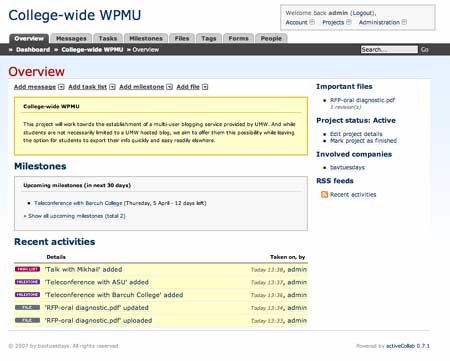
UMW’s Department of Information technology has been using Basecamp sporadically for a little while now, and DTLT has been using it lately to manage the Student Academy of Information Technologies (there are some really exciting presentations this year so there will be more to blog on this shortly). I think we all agree that this is a very useful tool for more involved projects with various players. So, when I saw activeCollab I was intrigued, when I downloaded and installed it I was quite impressed. This open source, web-based application makes no qualms about presenting itself as a no-frills Basecamp knock-off. There are no wiki-inspired Writeboards and the slick javascript is kept to a minimum, but it does just about everything Basecamp does without the monthly costs. It allows for unlimited projects, unlimited users, multiple admins, etc. So how about that- the nuts and bolts of the best of web-based project management applications for the price of a LAMP environment you are probably already paying for! Moreover, it was a cinch to set up -just keep in mind you need Apache 2.0, PHP 5.1+ and MySQL 4.1+.
I just spent some time with Joe McMahon, our student aide extraordinaire, getting an overview of an online game he is playing called Eve Online. I could try and fumble my way through a more articulate discussion of exactly what this world is, but I’m way too green as of yet and it is -from what I saw- far too complex for such a discussion at this point. Maybe Joe will offer us a more in-depth examination of this game at Student Academy. What did blow me away, however, was the 4 minute introduction that frames the narrative situation for the new user. It is a great scifi premise and really make me excited about the intersections of imagination, creativity, narrative and game play. Anyway, spend four minutes and marvel at the cinematic narrative below that beautifully frames an online world of science fiction game play.

Find out more about me here.