Hot Summer 70s Family Horror

On a recent trip back to New York I had the good fortune of meeting up with the better half of the Family Pictures Podcast and doing two episodes of our gobsmackingly amazing film podcast in person. What’s cool about this meetup is we were able to kick-off a new series within the podcast we’ve titled “Hot Summer 70s Family Horror.” MBS, being the awesome guy that he is, wants to work through his horror movie aversion so he gave me the green-light to pick five movies that work well with our family-focused theme.

At first I was going to spread them across several decades, but after listing out the family-related horror films I wanted to talk about I realized there were way too many, so I decided to start with the 70s. The one movie missing from the logic of the following list is George Romero’s Night of the Living Dead (1968), but as I discuss when we open the Texas Chainsaw Massacre episode, Romero’s low-budget gem pretty much inspires all horror films that come in its wake.

Below are the five movies we’ll be covering as part of the Hot Summer 70s Family Horror series:

While together we were able to knock-out two of those episodes that have already been published for all the world to enjoy—namely Texas Chainsaw Massacre and Jaws.

Being in a studio recording these alongside MBS was an absolute blast. It made me want to move back to New York  just to record podcasts in York College’s new studio on the regular. I think Andy Rush would have been proud of the the brilliant work York College’s  Fawwaz Allie did to convert an old school studio into a state-of-the-art, light-weight space outfitted with Blackmagic equipment at a fraction of the cost you pay for a vendor solution.  Good people = good things. I’ve played around the edges with recording studio stuff briefly, but experiencing this production studio at York College in all its glory made me want to dive deeper for sure.

Another highlight was that Tommaso took the trip into Jamaica, Queens with me, and having him as the studio audience for the live sessions was special. It’s powerful when your kid can hear you talk about things you love (I mean, this is the Family Pictures Podcast). Having just re-listened to the two episodes we recorded in New York City I do think there’s a there there. Besides the hard reality that I always need to be fact-checked, the joyful rapport, mutual respect, and shared passion MBS and I have cultivated as we work together just reinforces for me just how good the whole experience has been.

I dedicate a fair amount of time to watching and preparing for these discussions on a weekly basis, and that’s the easy part because I love to watch and talk about movies. Having someone to share that object of desire with who is also willing to put in the work on a regular basis is rare and special. Doing this podcast has been one of the greatest things to happen to me since I stopped teaching ten years ago. Having an open and public outlet to share the things I’ve read, watched, and learned with someone else in an informal manner is something I’ll never take for granted again.

While this blog is the space for my personal chronicling and recording of thoughts and ideas, the Family Pictures Podcast has become the space to push myself to learn and explore in dialogue with someone else; that is a gift. I can see why podcasts have become all the rage. It has little to do with views and followers, but everything to do with finding that person (or persons) you can take that exploratory learning journey with together, in discussion.
Posted in Family Pictures Podcast, film, films, movies | Tagged , , , , , , | 8 Comments

bava.tv Upgrade to PeerTube 7.2.3

Between vacation, travel, and AI Maddeness I’ve fallen into a bit of a hole. Sometimes disappearing down a hole is good for the soul, but it’s time to work my way back onto the blog with an old school tech update.

I’ve been running into issues on my self-hosted instance of PeerTube at bava.tv with live streaming as well as offloading videos to Digital Ocean’s S3 storage. My PeerTube instance is running in a Docker container, so sometimes I get timid when it comes to updating. Taylor and I recently brought my instance up to 7.1 (or thereabouts) and there where some change log issues with how the videos storage folder was named that meant we needed to update paths and directory names in the production.yaml file. That was all done and videos loaded, but concomitant with that update there were issues with videos offloading to Digital Ocean’s Spaces as well as live streaming through bava.tv.

Sometimes you assume things are related—especially with a recent upgrade—but that’s not always the case. Turns out the video offloading issues was a problem with the Digital Ocean API key for the S3 bucket, so after creating a new key that was fixed easily enough.

However the streaming issue on bava.tv persisted, so I used the Docker upgrade commands to update my instance and streaming works again. I do love it when Docker upgrades just work, it reminds my why that technology can be so awesome.

I have to admit that part of my digging in here was inspired by a conversation with Andy Rush about a presentation we are considering (we need to loop in Taylor) about “A Network of Your Own” or what it means to use various peer-to-peer and federated tools to decamp from soul-sucking platforms. Andy is hosting his PeerTube instance through FediHost, which saves him some of the anxiety of Docker upgrades and path re-writes that I’m able to lean on Taylor for.

Managing some of these federated tools in Reclaim Cloud is work, and while you get all the bells and whistles of PeerTube on Reclaim’s Cloud like multi-thread encoding, live streaming, cheaper storage, etc., you have to be willing to own it and pay a bit more. Tim and I have explored Cloudron in the past, and they do a good job of making those tools available at a reasonable price.

Simple fact is, self-hosting federated tools in the cloud are still not dead simple or as cheap as cPanel’s shared hosting (although I think we (Taylor) figured this out for Ghost on Reclaim Cloud), it requires a bit of work and that you pay-per-app, which is a different model than most folks are used to. I look forward to talking about all this and much more with Andy and Taylor at Reclaim Open.

Oh yeah, Reclaim open, I need to blog that gem of an online conference coming soon!

Posted in bava.tv, PeerTube, Reclaim Cloud, reclaimopen | Tagged , , , | 1 Comment

Family Pictures Podcast: Pauline at the Beach (1983)

For episode 20 — we’re obviously committed at this point, so subscribe already! — we take a long stroll through the shifting sands of Èric Rohmer’s Pauline at the Beach, a breezy yet piercingly sharp entry in his “Comedies and Proverbs” cycle. The proverb this time? “A wagging tongue bites itself” — and over the course of one summer holiday in Normandy, just about every character manages to do exactly that.*

Rohmer, the elder statesman of the French New Wave and former editor of Cahiers du Cinéma, wasn’t the enfant terrible type like Godard or Truffaut. He was more of a formalist and a moralist, quietly shaping an enduring cinematic philosophy of speech, desire, and self-deception. With Pauline at the Beach, he gave us one of his most layered and subtle explorations of love and lust, anchored by Amanda Langlet’s quietly perceptive performance as the titular Pauline.

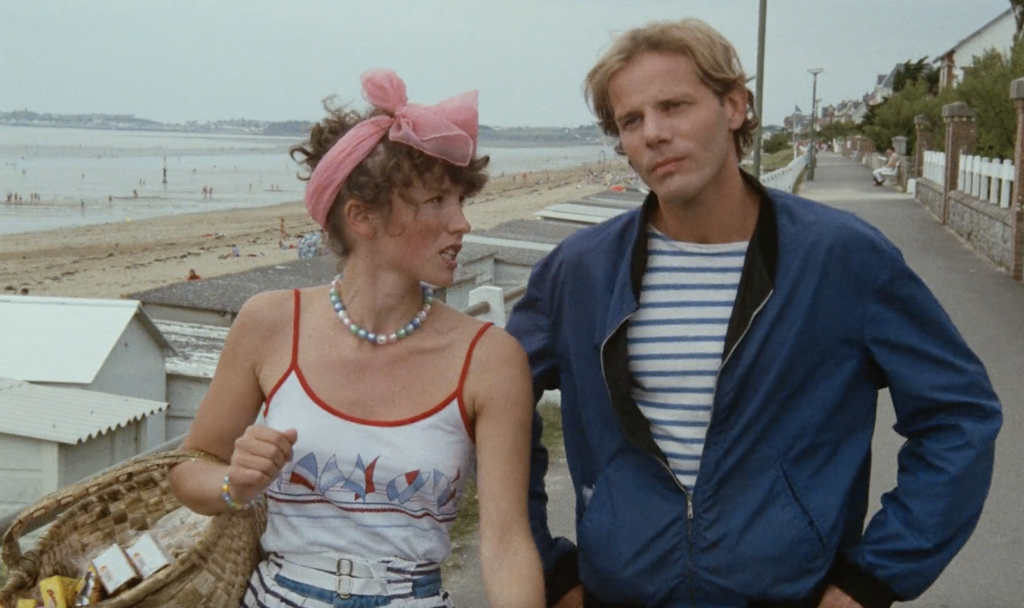
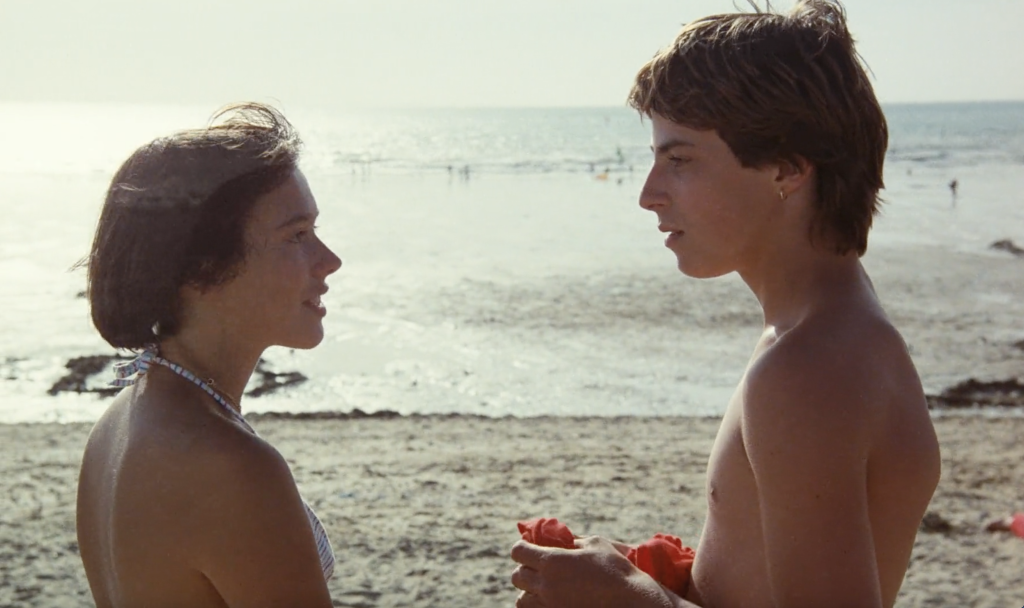
Pauline and Sylvain together at the beach

The film opens with Pauline and her older cousin Marion (Arielle Dombasle) arriving at a seaside villa. Marion is recently divorced and eager for a new start. Pauline, 15, is observant but tentative, open to experience but skeptical of the romantic myths adults seem eager to sell her.

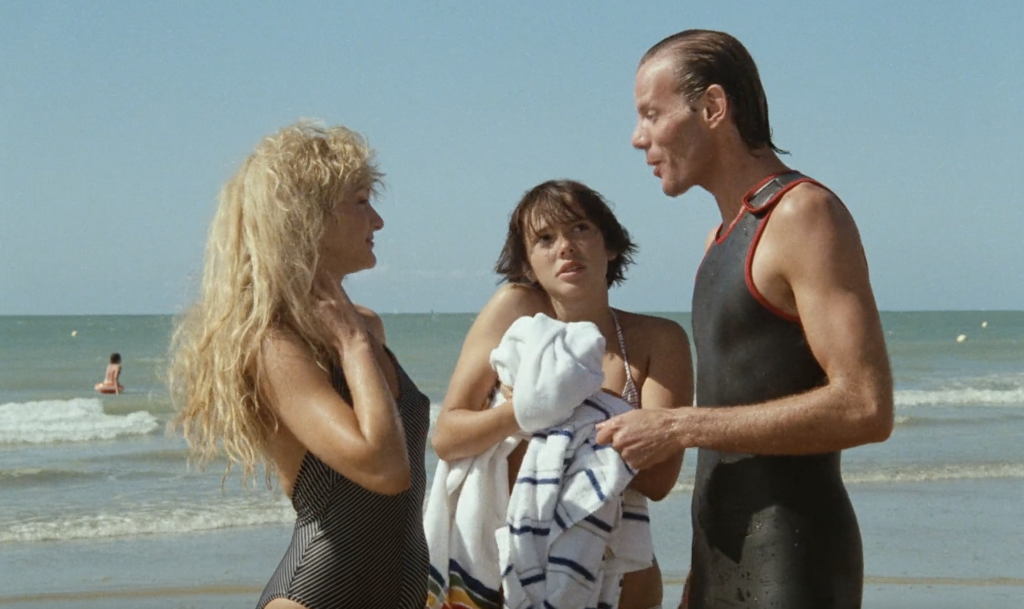
Pauline caught between the adults, this time her cousin Marion and her old flame Pierre

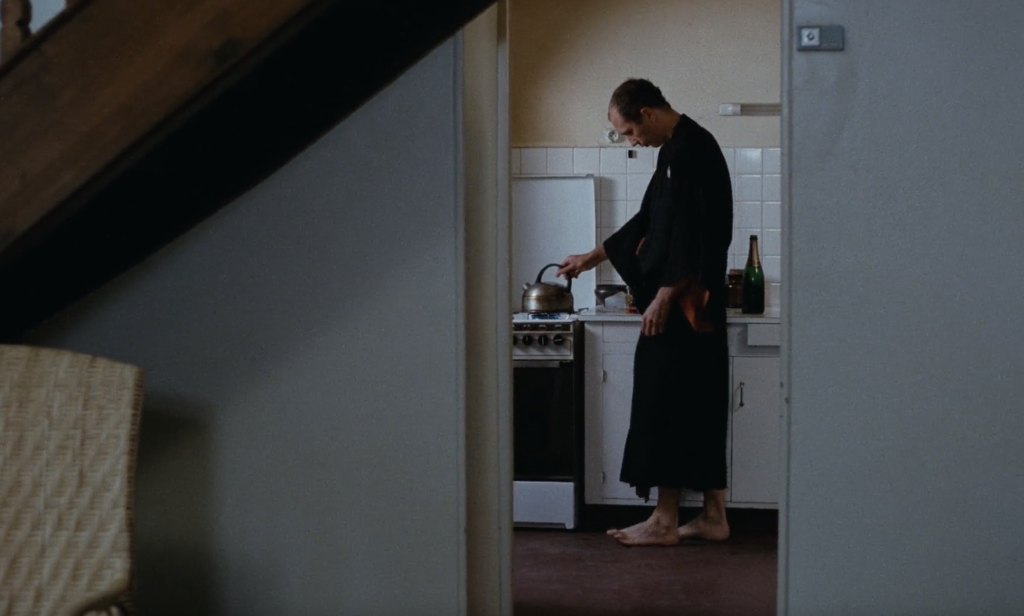
Soon, they’re joined by Pierre (Pascal Greggory), a brooding, judgmental ex of Marion’s, and Henri (Féodor Atkine), a libertine with a penchant for manipulation and a kimono robe that would make Larry Dallas jealous (more on this connection soon). Rounding out the cast is Sylvain, a local boy Pauline takes an interest in, and Louisette, a.k.a. the Candy Lady, whose casual approach to sex and relationships throws everyone into a tizzy.

Henri in is “Larry Dallas” kimono

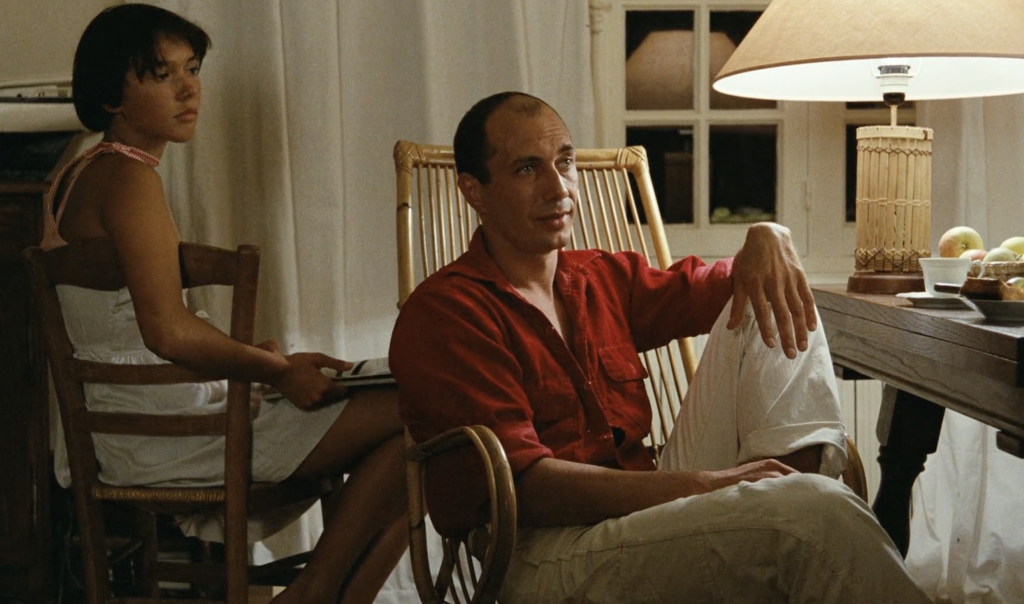
The center piece dinner early in the film lays out the central philosophies. Marion wants love to be instant and burning; Pierre seeks something slow, stable, and rational; Henri postures about freedom and honesty but lies as easily as he breathes. Meanwhile, Pauline watches and listens, less interested in asserting a theory than in quietly spotting the contradictions.

Puline watching and listening to the adults like Henri weave their web of lies

By the end, Marion begs Pauline to believe a pleasant lie—that things worked out for everyone. And Pauline does, not out of naïveté, but maybe because she knows better than to waste breath correcting grown-up fantasies.

What makes Pauline at the Beach so brilliant (and so funny) is how casually its characters drift into morally iffy territory. Marion encourages Pierre (lates 20s) to pursue Pauline (15)—yikes! Henri’s interest in young women ranges from creepy to criminal. Sylvain ends up as an accessory to a cover-up. And through it all, Rohmer lets it unfold without heavy-handedness, trusting his audience to squirm accordingly.

Pierre and the Candy Lady

The Candy Lady sees through everyone, even as she’s used as a pawn in their games. Pierre thinks he knows best for everyone and instead just makes things worse. Marion tries to play it cool but ends up tangled in romantic melodrama. And Henri… well, Henri just Henri’s.

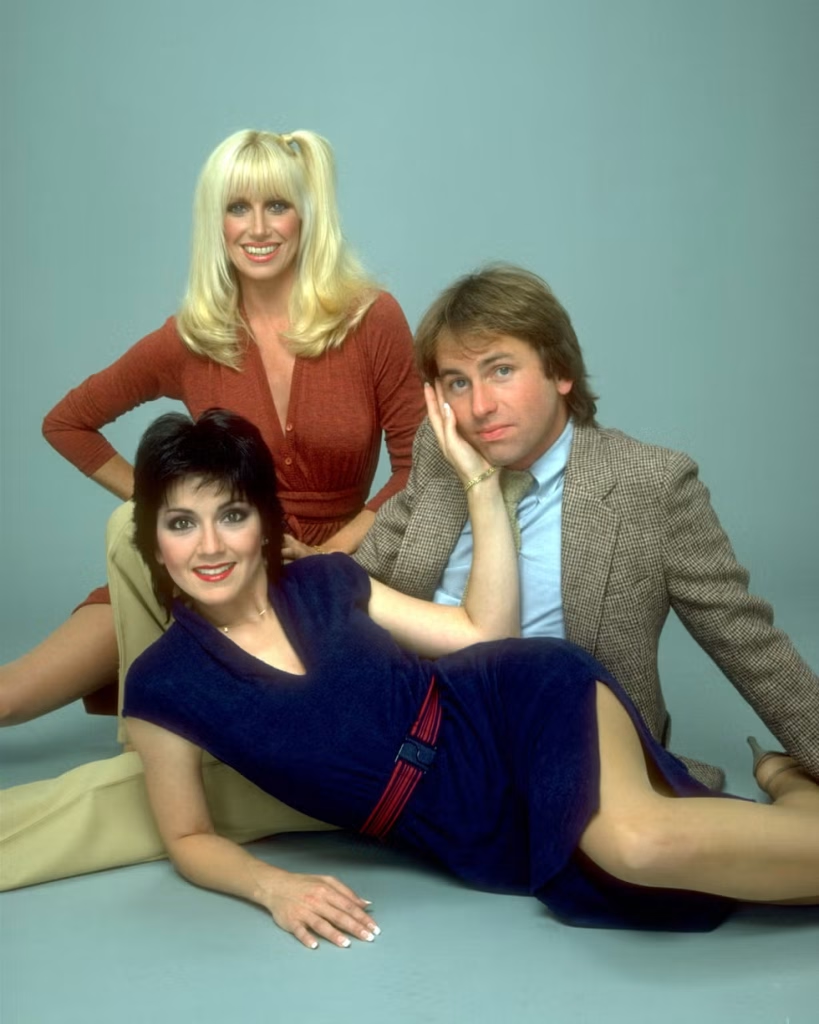
Hot take: Pauline at the Beach is a French rip-off of Three’s Company —fight MBS!

Too busy to listen, you philistine, here’s MBS’s hot take, and it’s pretty damn good: Pauline at the Beach is a French art-house remake of Three’s Company.

  • Henri is Larry Dallas in a kimono, always ready for sex, always scheming.
  • Marion is Chrissy, all romantic idealism and bizarre logic.
  • Louisette is Janet: smart, pragmatic, and constantly underestimated.
  • Pierre is Mr. Roper/Mr. Furley, the prudish interloper always barging in and misreading the situation.
  • Sylvain is Jack Tripper, always caught in the middle of the adults’ drama.
  • Pauline is either the studio audience or every kid of the ’80s forced to watch adult shows because there was nothing else on.

Seriously, just add some laugh tracks and freeze frames and it works perfectly.

Pauline at the Beach is funny, discomfiting, delicate, and precise. It’s a coming-of-age story where the teenager comes away more clear-eyed than any of the adults. It’s about people talking too much, lying to themselves, and blaming others for it. It’s about how desire tangles up with delusion. And it’s about how sometimes, the smartest person at the party is the one who says the least.

And hey, it’s also about how very French people can still be while making a complete mess of their lives.

Bonnes vacances!

______________________________________________

*The bones of this post were created by ChatGPT trained on my Family Pictures Podcast category. Post coming to explain in more detail, but just being transparent for all you machine-hating purists 🙂

Posted in AI, Family Pictures Podcast, films, movies | Tagged , , , | 2 Comments

Martin Weller “On Writing”

One of the nice things about interviewing bloggers about blogging is that there is a pretty good chance they’ll blog it, saving me some extra blogging.

Say blog again!

Anyway, the great Martin Weller has done just that by writing about our chat wherein he outlines the particular periods of his blog in terms of a geological time scale: this period was the web 2.0 epoch, then the MOOC epoch, and we are currently within the AI (post-OU) epoch. You get the drift.

He worked it all out which made for the easiest interview ever, and for that I appreciate him! He does a better job breaking it all down in his post “On Blogging (Again)” which makes a strong case for blogging #4life.

Posted in Bloggers Anonymous, blogging, On Writing | Tagged , , | 4 Comments

Family Pictures Podcast: Taken (2008)

For episode 19 we went full throttle into Taken (2008), a hyper-efficient father-daughter revenge fantasy that launched Liam Neeson into late-career action-hero orbit.* You know the line. You probably heard it quoted before, or even quoted it yourself after watching this modern-day classic: “What I do have are a very particular set of skills…”

Directed by Pierre Morel—formerly Luc Besson’s go-to cinematographer (he shot The Transporter, directed District 13)—Taken is shot like a first-person shooter game crossed with 24. This is Morel at the height of his kinetic hand-cam phase, still operating the camera himself, a la Kubrick (who couldn’t give it up either). Written by Besson and Robert Mark Kamen (Karate Kid, Fifth Element, The Transporter), the film is lean, mean, and problematic as hell—and that’s why we discussed it on the heels of Not Without My Daughter.

Liam Neeson was 54 when he made Taken. This was supposed to be a one-off European thriller. Instead, it detonated into a franchise and reinvented Neeson as an aging, grim-faced action star who drives fast, punches harder, and glowers best. And it’s not just Neeson—he’s part of a lineage: Tom Cruise, David Statham, and Denzel Washington to name just a few, all proving that sixty is the new thirty and that they’ll never cede top billing to emerging talent (fucking Boomers!).

At its emotional core, Taken is a divorced-dad fantasy. Bryan Mills (Neeson) is the classic estranged father: he missed birthdays, ruined relationships, and now has to win his daughter back by murdering half of Paris. He can’t connect with her in real life (karaoke machine vs. stepdad’s literal horse), but when she’s kidnapped by Albanian traffickers while on vacation, he becomes the perfect dad: protective, resourceful, unstoppable.

The message is pretty simple? If your kid gets abducted, all your failings are retroactively forgiven if you have combat training.

The speech over the phone is the most iconic moment in the film, and Neeson delivers it brilliantly (see full speech in video above):

“I don’t know who you are. I don’t know what you want… What I do have are a very particular set of skills… I will find you, and I will kill you.”

Not only is it iconic, but it also functions as a moral permission slip for the audience. Everything that follows is not just justified, it’s righteous. The film traffics (pun intended) in a lot of nasty tropes: shadowy immigrant criminals, morally compromised French officials, and the utter collapse of European civility in the face of American justice (boy does that seem especially quaint these days).

From the chaotic Parisian safe houses to the red-door brothel of doom, Taken is one long endorsement of the rogue American agent cleaning up the corrupt, decadent old world. And yet—it’s so tightly paced, so brutally efficient, so entertaining, that you can’t help but cheer for all of it. Because Liam Neeson isn’t just avenging a daughter, he’s avenging all absentee parents who ever missed a dance recital. This is revenge-as-redemption, and it’s hard not to eat it up.

Similarly to Not Without My Daughter, Taken is American family values propaganda dressed up as vigilante pulp. But that’s easy to overlook given it’s pure cinematic adrenaline that plays on deep fears (parental helplessness) and deeper fantasies (parental omnipotence) and in Liam Neeson, it gave us the patron saint of aging badasses.

As for personal parenting stories, Michael shares his own badass moment in which he  gives Bryan Mills a run for his (lack of) money—-shirtless no less! As for my own tale, its the antithesis of a super dad moment. It shares a similarly European feel as Taken, but my misadventures never end in redemption—and probably for good reason. I could try and describe them here, but then why would you listen to the brilliant podcast we spent all this time fashioning just for you!

__________________________________

*The experimentation with ChatGPT for these Family Pictures Podcast posts continues. I’m limiting my explorations with AI to these posts  because MBS and I have written extensive show notes for each and every episode we recorded, and the machine does a fairly good job summarizing them as a starting point. What’s more, I’m kinda having fun with playing with this and I am not too concerned given the bava has always been a space where I experiment. That said, I know using AI to write posts can be a touchy issue, so at the very least wanted to be transparent that I’m doing that here. I’ll write a longer, more in-depth post on the process, but more than anything the AI-generated post is a base that I then deconstruct and re-create. While it does not save that much time, it does provide some interesting opportunities to reflect on my writing style (if that’s what you can call it).

Posted in AI, Family Pictures Podcast, movies | Tagged , , , , , , | Leave a comment

Family Pictures Podcast: Not Without My Orientalist Captivity Narrative (1991)

N.B: Ongoing experiments with AI-enhanced posts for my Family Pictures Podcast summaries. I think this will be one of the last. Although I do really get a kick out of how ChatGPT understands how I write, and what it fashions as my voice. Anyway, I know this might be annoying for some, and my son is talking shit on me for even playing with it, so I’ll eventually be forced back into the writing grind. Also, the GIFs are all mine, made with ezgif.com  🙂

For episode 18 of the Family Pictures Podcast, we tackled a film I’ve returned to many times over the years—not because it’s a classic, but because it’s a case study in narrative propaganda done with all the force of a melodramatic slap. We’re talking about Not Without My Daughter (1991), starring Sally Field and Alfred Molina, directed by British filmmaker Brian Gilbert.

This film, released as the Gulf War kicked off, is a glossy Orientalist nightmare—a post-Midnight Express captivity drama dressed up in family trauma and American righteousness. If you’re into weaponized domestic melodrama with geopolitical subtext, well, saddle up.

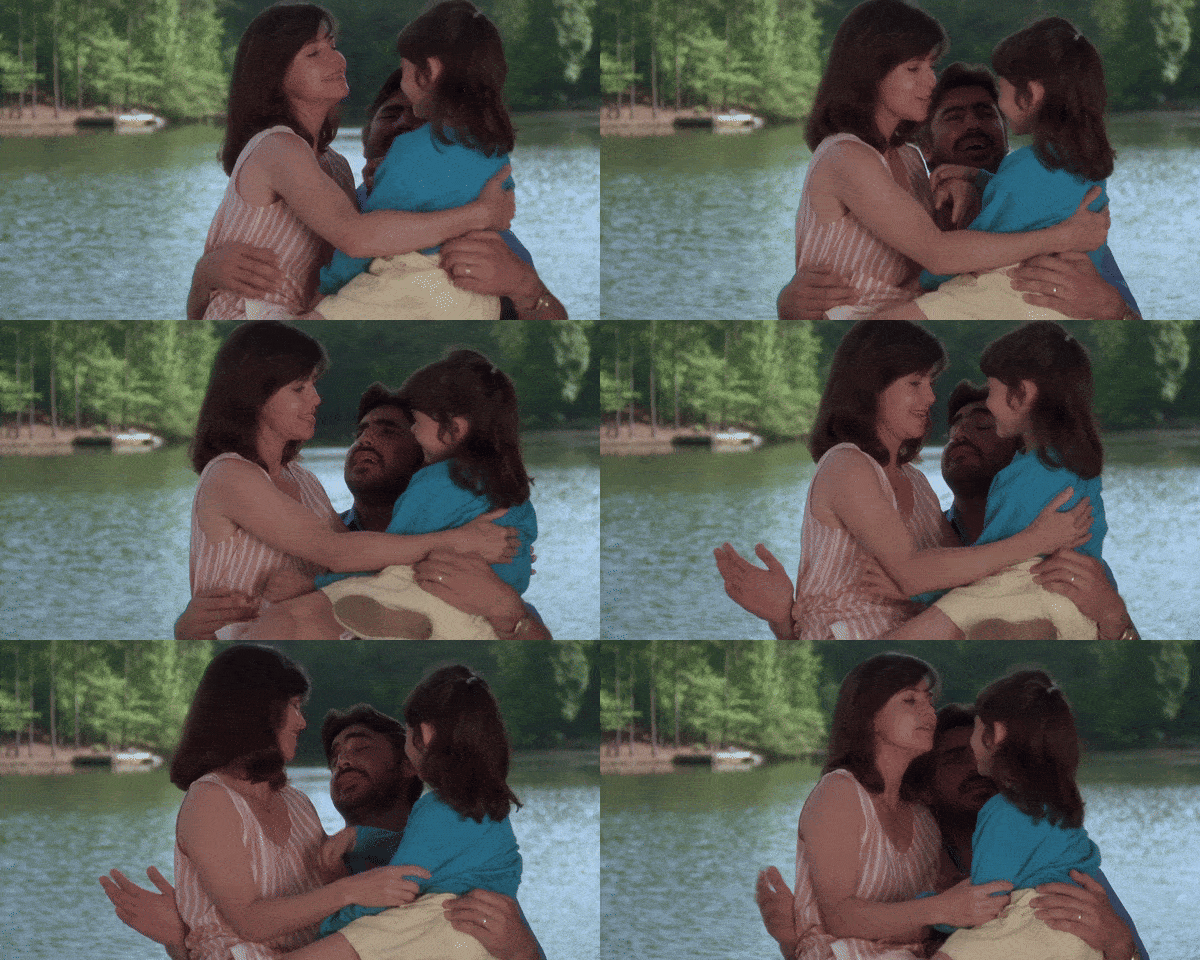
Film opens with a happy American family on the lake in Alden, Michigan

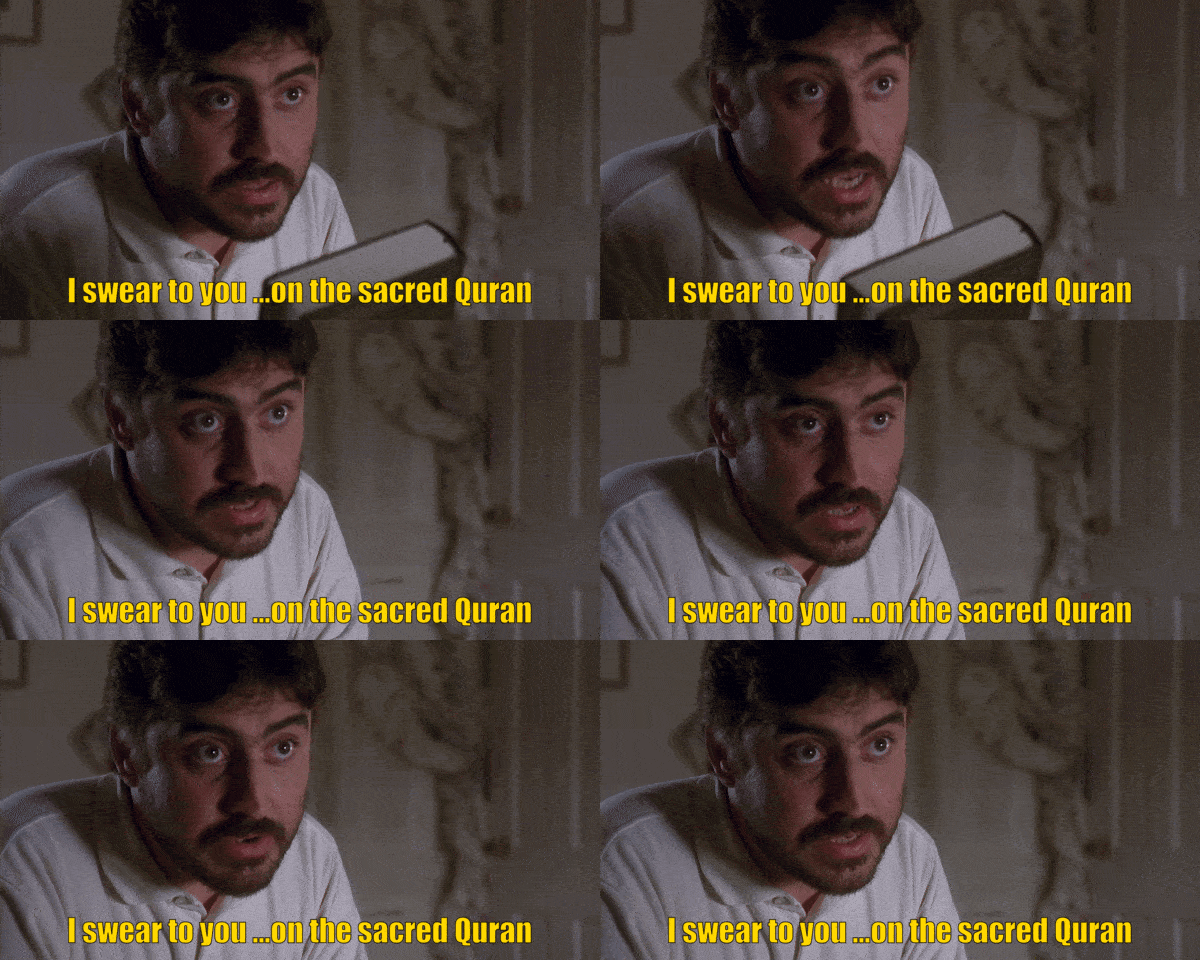
The first 13 minutes are ridiculously efficient. Betty and Moody (Field and Molina) live in idyllic Michigan. He’s a doctor, she’s devoted, their daughter Mahtob is adorable. But as Moody faces racism from his colleagues and growing nostalgia for Iran, he convinces Betty to take a “two-week” family trip to Tehran. He swears on the Qur’an they’ll come back. Spoiler alert: they won’t.

Moody swears on the Quran to convince Betty to travel to Tehran

Moody’s transformation from sensitive immigrant to eyebrow-twitching villain is all but complete by the time they land. The lighting darkens. The sound design tightens. His voice drops an octave. And just like that, we’re in captivity narrative territory.

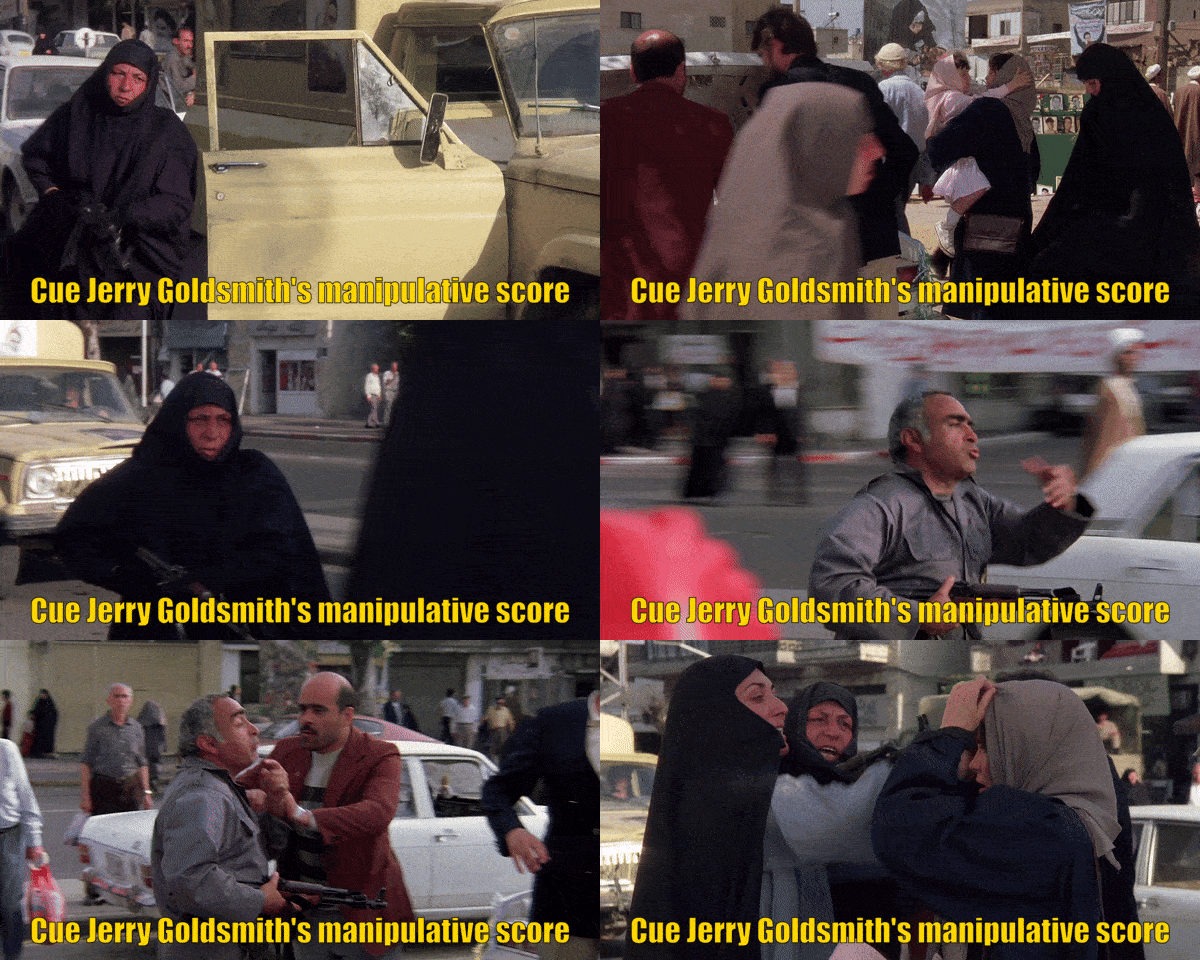
What’s more, Tehran is introduced as a place of chaos, moral extremism, and blood-soaked ritual. There’s no subtlety—just fear. Betty is stripped of agency, language (no subtitles), and even sunlight. The moment Betty is confronted on the streets for not being fully covered by the Guidance Patrol is the first time we’re introduced to Jerry Goldsmith’s manipulative soundtrack that underscores the harrowing realities of Iranian culture. As Moody’s family member immediately reminds Betty after she is accosted,  “every single hair that’s not covered is like a dagger aimed at the heart of our martyrs.”

The moment when Betty is confronted by the moral squads in Tehran

It’s not long before Moody becomes a full-blown zealot. The cultural friction is exaggerated at every turn. And with no subtitles, the viewer is put firmly on Betty’s side—suspicious, confused, and morally affirmed.

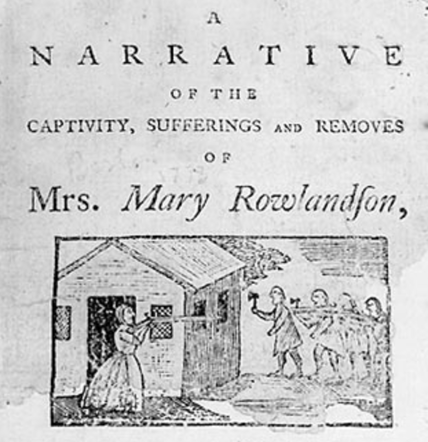
A Narrative of the Captivity and Restoration of Mrs. Mary Rowlandson is a 1682 memoir written by Mary Rowlandson

What makes this film so rich for analysis is how it fits within a deep tradition of American captivity narratives. From Mary Rowlandson’s 1682 memoir to Jessica Lynch’s 2003 media moment, the structure is the same: white Christian woman taken by the savage Other, rescued by resistance and faith.

Betty’s growing desperation becomes a stand-in for America’s moral righteousness. By the time she’s sneaking through alleys in a chador and whispering to smugglers, the film has traded realism for national myth-making. And it works—viscerally, manipulatively, masterfully.

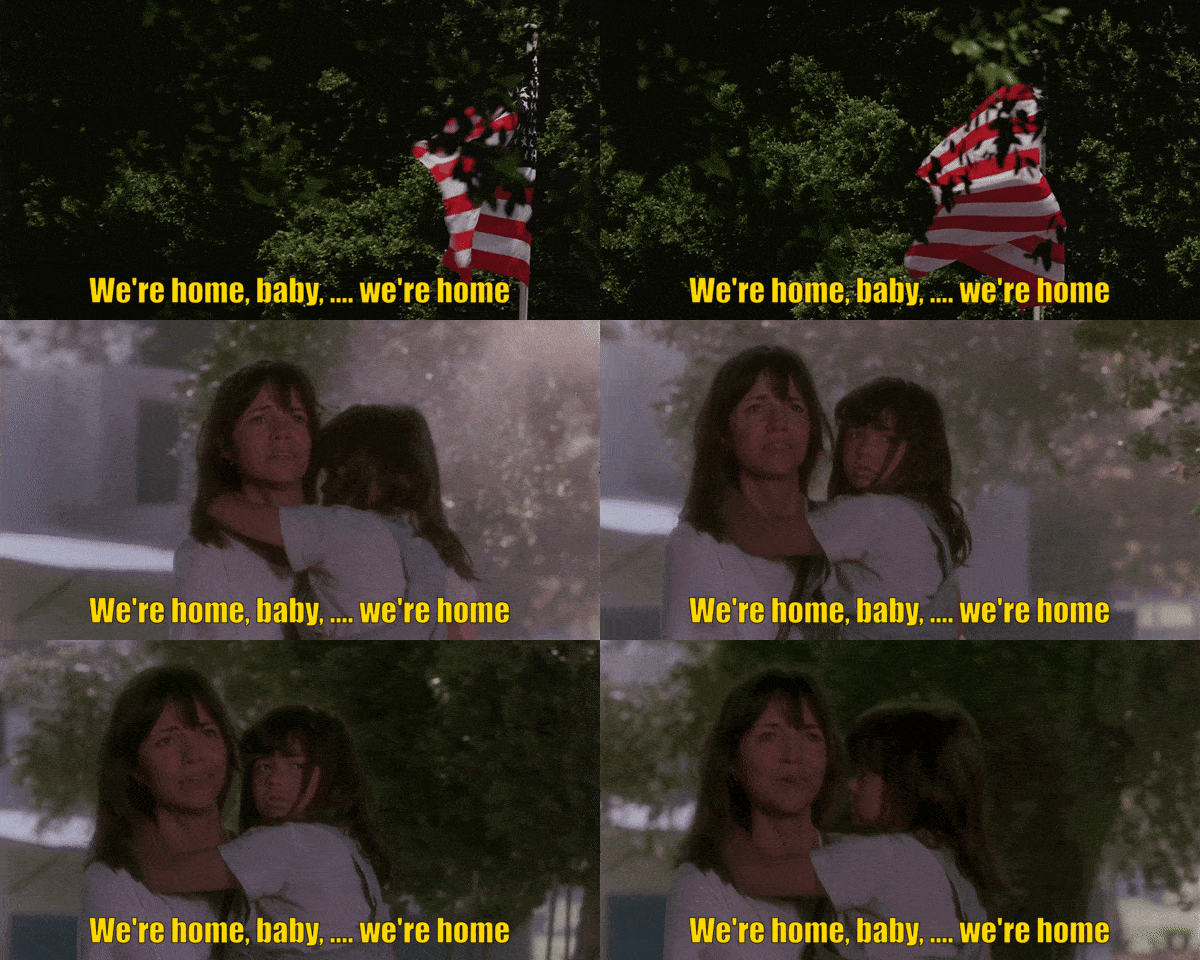
The final 20 minutes are textbook white-knuckle escape drama, culminating in Betty and Mahtob crossing into Turkey under cover of night. The music swells. The sun rises. She whispers: “We’re home, baby, … we’re home.” And the flag might as well unfurl on screen.

Betty and Mahtob arrive in Turkey, a proxy for the US complete with a gigantic Stars and Stripes to hammer home the point

This isn’t just an escape from abuse—it’s a symbolic return to the safety and superiority of America. The film doesn’t just end with triumph; it ends with affirmation of a national narrative. The West saves. The East imprisons. Faith in God (the right God) will deliver you.

Not Without My Daughter is pure 90s Middle Eastern menace, with a heavy coat of melodrama and moral clarity. And that’s why I keep watching it—it’s a cinematic time capsule of how America framed “freedom” and “otherness” right as the Gulf War began and as the seeds of post-9/11 foreign policy were being planted.

If you’ve already seen it, go watch it again (if you can stomach it), and bring your Edward Said and popcorn. If you haven’t, well it’s evergreen when it comes to propaganda.

Posted in AI, Family Pictures Podcast | Tagged , , , , , , | Leave a comment

The Shining Stage Curtains

The Shining Carpet Curtains have arrived

Quick update from bavastudio, I’ve had some custom curtains made for the diorama window, and I think they’re pretty awesome. I got the idea from the fact that the carpet in the Grady Twins hallway scene is actually not the iconic carpet, but the fairly drab grey and blue carpet in the help wing of the Overlook Hotel.

The Shining Diorama: Coming Soon

I was using a cheap area rug with the classic design to cover-up the window between the Creepshow and The Shining dioramas. I liked the effect and figured having real curtains that could open, close, and even festoon for each of the dioramas would be pretty cool, so there you have it. The bav-o-rama now has official stage curtains to finish the effect of the coolest diorama this side of the Atlantic.

The bav-o-rama with iconic The Shining rug curtains at night

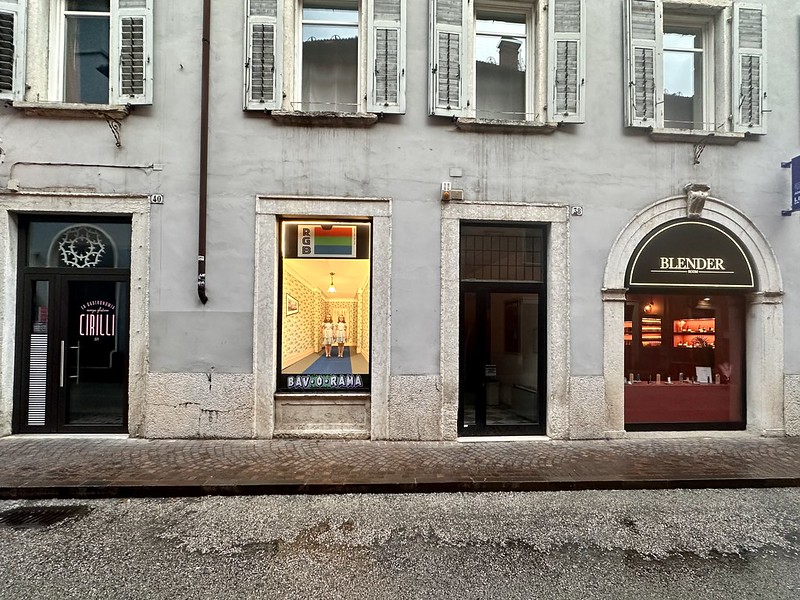
Also, one more image to provide some context of where and how the bav-o-rama sites on a little side street in Trento.

A wide-shot to give you a sense of where the bav-o-rama sits on via Calepina (this shot is pre-curtains)

Posted in bav-o-rama, bavastudio | Tagged , , | 2 Comments

Tim Klapdor “On Writing”

Before the “On Writing” series  went on a bit of a vacation for the 4th of July (Independence my ass!), I had the pleasure of chatting with Tim Klapdor about his blogging career. Tim is an Australian ed-tech blogger who’s currently the Manager of Educational Design at the University of Adelaide. What’s more, he’s writes regularly about work, life and everything in between on his blog Heart Soul Machine. If your not a big fan of Tim just yet, watch the chat above and I’m sure you soon will be!

Tim is as real as they come, he writes about not only his work, but his daily life, including the quotidian struggles most folks argue are not worth sharing, but in my mind are the most relatable and compelling bits that make blogging different—it keeps the web personal and real. I enjoyed this conversation immensely because in transported me back to a moment on the web when there was a sense of being there—and Tim captures this brilliantly as he relates his own story of discovering his blogging voice. With just about everyone I have talked with thus far, the sense of blogging as a space of authenticity has become a regular theme. The blog is a node on the web where words matter—a genuinely attempt to connect with others and that’s less and less common on the platformed wasteland the web has become.

Posted in Bloggers Anonymous, blogging, On Writing | Tagged , , , , | Leave a comment

AI Maddeness: Highlights from Bears vs Lions Week 17

This is a highlight video from recorded footage from the week 17 game of the Chicago Bears defeating the Detroit Lions I payed this past weekend. I’ve been trying to clean up things before vacation so I’ve had less time to go full bore on all the cool features Tom has come up with for bot commenters, but the season hasn’t even started yet!

This video re-enforced that I might want to avoid instant replays when doing these post-game videos. The full-speed action clips seem to work better, or maybe it’s just the inconsistency going between normal speed and slow-mo that gets annoying. I also tried to tell the story of the game with no narration, although I have the NFL Films-style script on-hand thanks to ChatGPT as well as an ESPN highlight reel redux I’ll be recording over this video. You can find it below, with timestamps and everything:

Great — switching from NFL Films-style to an ESPN-style highlight reel redux means we’re going for:

  • Faster-paced delivery

  • Punchy, energetic phrasing

  • A bit of attitude and play-by-play flavor

  • Less poetry, more “here’s what happened and why it mattered”

Tone-wise, think Stuart Scott, Boomer, or Tirico—with crisp narration that lets the action speak but frames it cleanly.


ESPN-Style Voiceover Script (2:15 Runtime)

For Highlight Reel Sync / ElevenLabs Voiceover


[00:00 – 00:06]  00_00_intro.mp3

“Week 17. Bears. Lions. One playoff spot on the line. Let’s go to the Silverdome.”


 [00:06 – 00:16]  00_06_lions_td.mp3

“Early in the first — Mike Tomczak loads up and hits Germaine Crowell in stride. That’s six for the Lions. 7–0 Detroit.”


 [00:16 – 00:30]  00_16_daniels_sacks.mp3

“But the Bears defense? Not having it. Philip Daniels — back-to-back sacks to kill the drive. Lions punt. Momentum swings.”


 [00:30 – 00:40]  00_30_fake_punt.mp3

“Next possession, Bears try a fake punt — ball’s loose — but somehow, Chicago recovers. Big break.”


 [00:40 – 00:48]  00_40_enis_td.mp3

“And Curtis Enis finishes what they started — 8-yard rumble into the end zone. Tie game.”


 [00:48 – 01:03] 00_48_robinson_int.mp3

“Now this one hurts — Marcus Robinson steps out just before a would-be touchdown. Next play? McKnown throws a pick. Detroit dodges disaster.”


 [01:03 – 01:37]  01_03_second_half_td.mp3

“Start of the second half — Bears come out firing. McKnown runs the show. Enis again — this time through the air. Touchdown. Bears take the lead, 14–7.”


 [01:37 – 01:52]  01_37_flanagan_sack.mp3

“Defense stays hot. Run stuffed. Then Urlacher crashes in for another sack. That’s four on the day for the Bears D.”


 [01:52 – 02:08]  01_52_engram_td.mp3

“Final blow — McKnown to Bobby Engram. Easy money. Bears up 21–7 and rollin’.”


 [02:08 – 02:15]  02_08_final_stats.mp3

“Final: Bears 21, Lions 7. Enis goes for 120 total yards and 2 scores. Defense smothers Detroit. Playoffs? Yep — Chicago’s in as the 6 seed.”

Would you like this turned into a downloadable .txt, or split into ready-to-upload ElevenLabs segments with pacing hints?

I can also make a subtitle .srt to match your video.

I can probably do a Boomer Esiason version of this script decently, and I’m gonna give that a try.

I love all the options the machine gives me at every step, right down to subtitles—pretty crazy. For this one, so far at least, the highlight reel was pretty much AI-free. I opened up iMovie and got consumed with trying to make the game highlights as tight and clear as possible, imagining my own commentary over the game play in highlight reel style all the while. I appreciated ChatGPT’s advice to reinforce what I was already thinking, but as much as the goal is to automate I cant help but insert my own impulse to parrot sports media. I really have to remedy that 🙂

Posted in AI Maddenness | Tagged , , , | Leave a comment

Family Pictures Podcast: “TV Made Me Do It” – The Positively True Adventures of the Alleged Texas Cheerleader-Murdering Mom (1993)

N.B.: Another cyborg post: half-bava, half-ChatGPT, and all right! I am now officially using ChatGPT to push out these Family Pictures Podcast posts, sue me! Which part is bava, which ChatGPT? Can you guess? Are you even reading, my big, beautiful bavabot-following! 

We’re still making the donuts, and for episode seventeen on the Family Pictures Podcast we serve up the unthinkable: a TV movie. Not just any TV movie, but HBO’s 1993 dark comedy The Positively True Adventures of the Alleged Texas Cheerleader-Murdering Mom that Television critic Matt Zoller Seitz in his 2016 TV (The Book) named the 2nd greatest TV-movie of all time, behind Steven Spielberg‘s Duel. High praise for a [cue deigning tone] TV movie.

Movie poster of Holly Hunter with mugshot board

Directed by Michael Ritchie (Fletch, The Bad News Bears), this one stars Holly Hunter in full Emmy-winning mode as Wanda Holloway, a Texas mom whose ambition for her daughter’s cheerleading career knows no bounds—including murder plots, sugar-filled bribes, and truly iconic hair.

Set in the refinery-shadowed town of Channelview, Texas, the film paints a portrait of a mother desperate to escape the fence-lined, dog-filled sameness of suburban life. And how does one escape? Through cheerleading, obviously. It’s Texas. That’s how social mobility works here. The film’s satire is sharp: moms with clipboards, pep rally politics, and training montages that could go toe-to-toe with Hoosiers. Except instead of boys and basketball, it’s daughters in sequins—and the stakes are murderous.

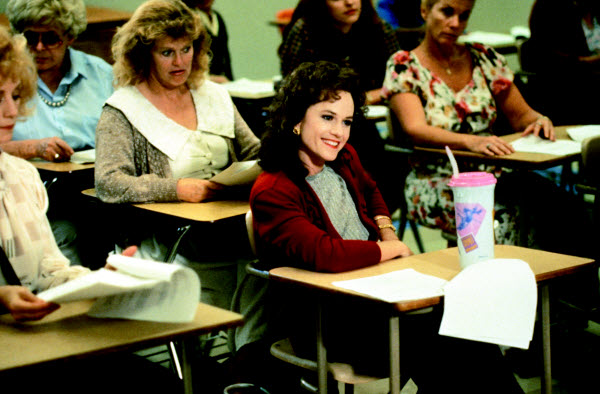
This film aired on HBO, which gives it that 90s prestige TV sheen, but let’s be honest—this is pure tabloid dynamite. Based on a true story, with a script sharp enough to cut pom-poms, the movie walks the line between camp and critique. We get fake murder contracts, late-night phone calls, courtroom dramatics, and a cheerleading constitution, all while Holly Hunter sips Diet Coke out of a gigantic sippy cup and plots her rival’s downfall with chilling precision.

Wanda (Holly Hunter) with gigantic sippy cup politely pissed the world is scheming against here and her daughter

So, why did we cover it? Primarily because it was MBS’s choice (blame this one on him 🙂 ), but also because Family Pictures isn’t just about haute taute movies with Criterion releases. Sometimes it’s about movies that mirror America’s obsession with ambition, status, and the perfect Texas ponytail. Female Trouble gave us camp via filth. Cheerleader Murdering Mom gives us satire via felony. And if that’s not family, what is?

Posted in Family Pictures Podcast, movies | Tagged , , | Leave a comment