Three Faces of Mexico’s Robin Hoods

head1

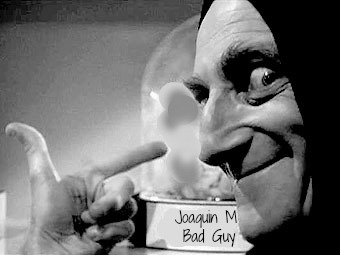
Joaquin Murrieta “Bad Guy” from Young Frankenstein

Today’s Daily Create features Robin Hood, a testament to the dearth of anything resembling a Western culture in Britain. Poor bastards! The West was definitely not won in green tights. Regardless, the whole steal from the rich give to the poor theme is one I can get behind. Turns out one of the nicknames for the Mexican legend Joaquin Murrieta I wrote about for yesterday’s Daily Create was the “Mexican Robin Hood.” I went digging around the web a bit and found this 1949 comic book Western True Crime (marrying two interests of mine and Paul Bond’s) on the awesome Comic Book + site which includes a comic book version of Joaquin Murrieta’s tale:
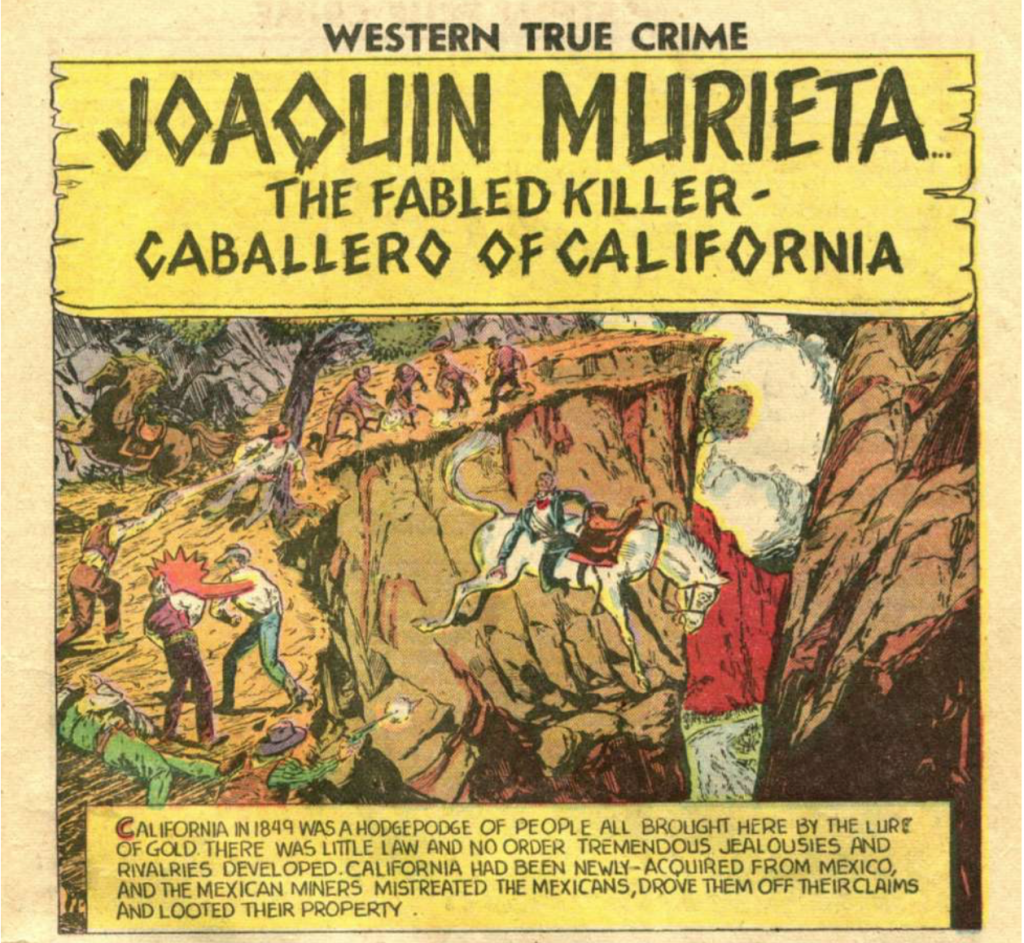
Screenshot 2016-01-07 14.16.14You can find the entire 10 pages of the comic here. It is pretty badly drawn and not all that compelling, but it does have a couple of moments. Like when he discovers gold and plans on sending money home. It picks up exactly where I left off in yesterday’s Daily Create.
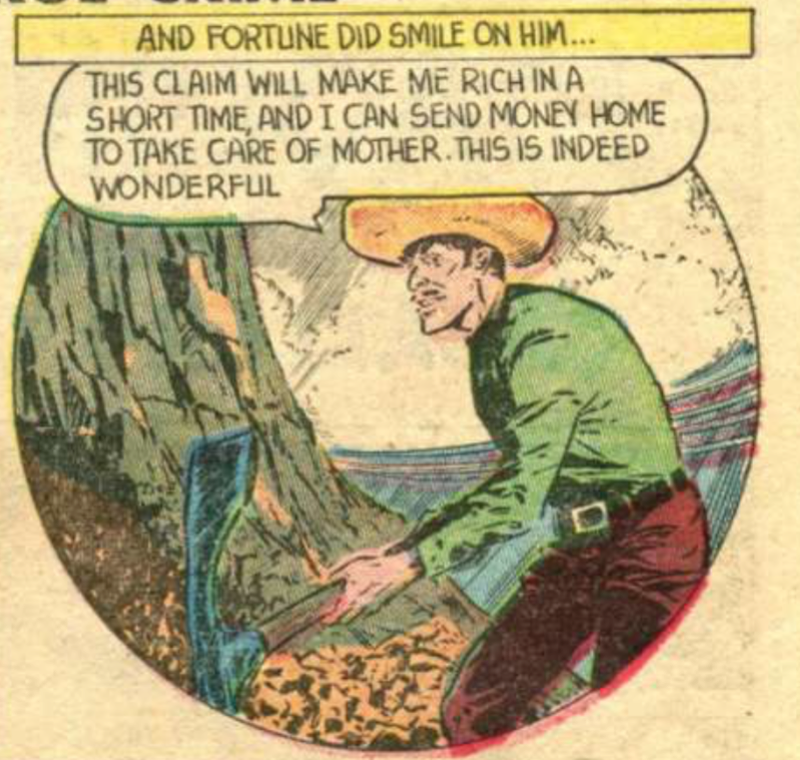
Screenshot 2016-01-07 14.15.31

There is also the panel where he is getting horse-whipped after his brother is lynched. The idea of using Murrieta as a lesson to all Mexicans is telling, as well as the avarice for gold that undergirds the crime is pretty in-your-face, and not all that sympathetic towards the miners. Also, Murrieta is even whiter than the European-American lashing him, which is interesting.
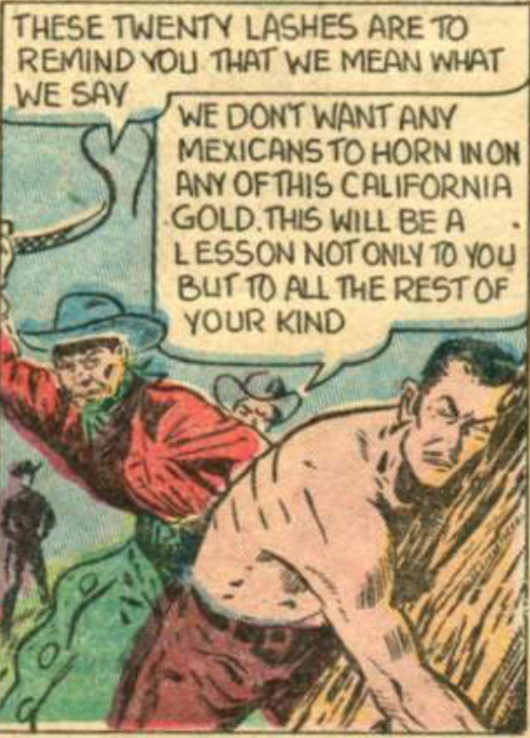
Screenshot 2016-01-07 14.10.34

When Murrieta goes on his revenge spree, he sounds a bit like Inigo Montoyo. Take the panel below when he is preparing to get his revenge on the miner-cum-sheriff who killed his brother” “Therefore you must die…”
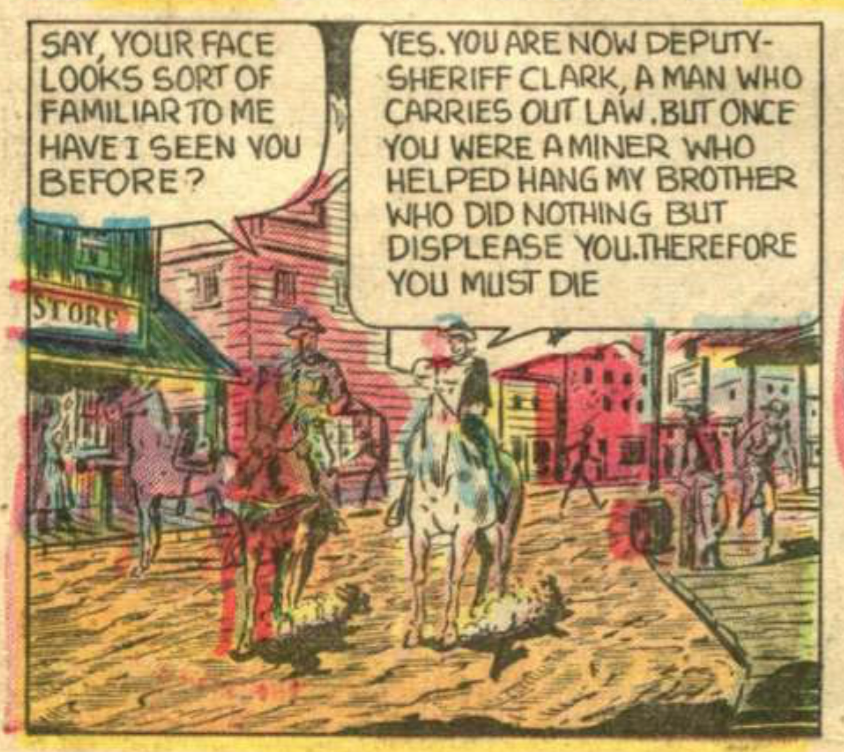
Screenshot 2016-01-07 14.12.40

Can’t you here it: “My name is Joaquin Murrieta, you killed my brother, prepare to die!” And then there is the perplexing panel wherein Murrieta pretends to throw himself from a cliff rather than being taken by the Rangers. What’s strange is the text, or what I can make out of it.
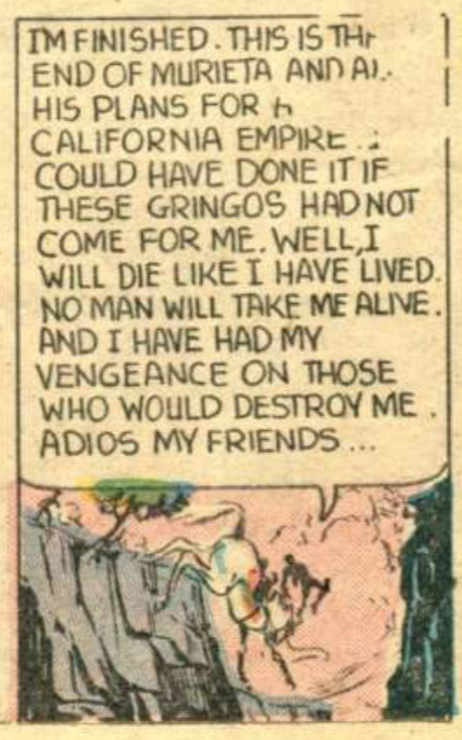
Screenshot 2016-01-07 14.14.53The whole idea that Murrieta was actually planning to reclaim a California empire that was taken from Mexico after the Treaty of Guadalupe Hildago is quite aspirational? Certainly makes him more than just a vengeful fugitive, he also becomes a great patriot and defender of the people. Maybe this is more appropriate: “My name is Joaquin Murrieta, you stole my homeland, prepare to die!” I can’t get enough of Murrieta, and if you feel the same read Sandy Brown Jensen’s amazing take on yesterday’s Daily Create.

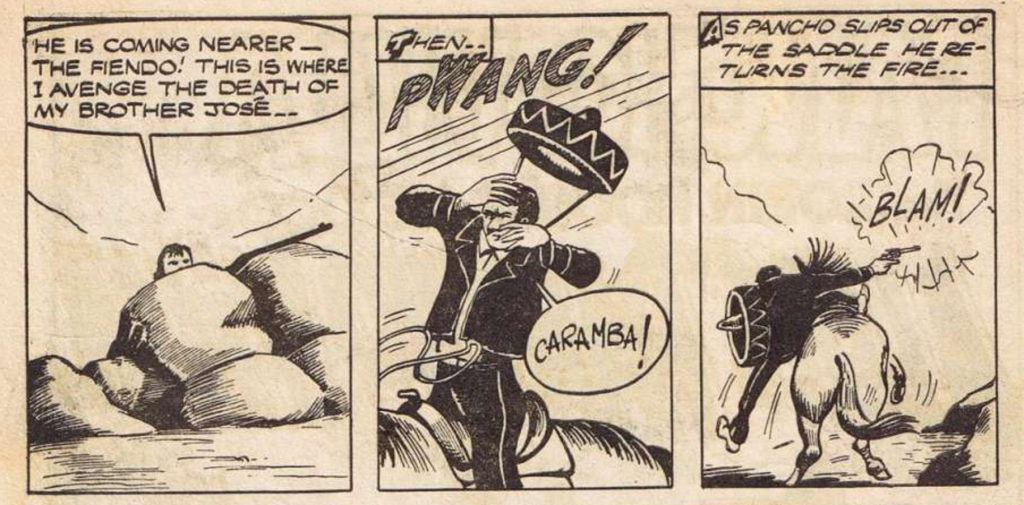
But as I searched for sites and images using the term “Robin Hood of Mexico” I found another version of the Mexican Robin Hood, and this one also came in the form of a comic: Pancho Villa. This is a pretty beautifully drawn comic, and the style reminds me a bit of some of Robert Crumb’s stuff.
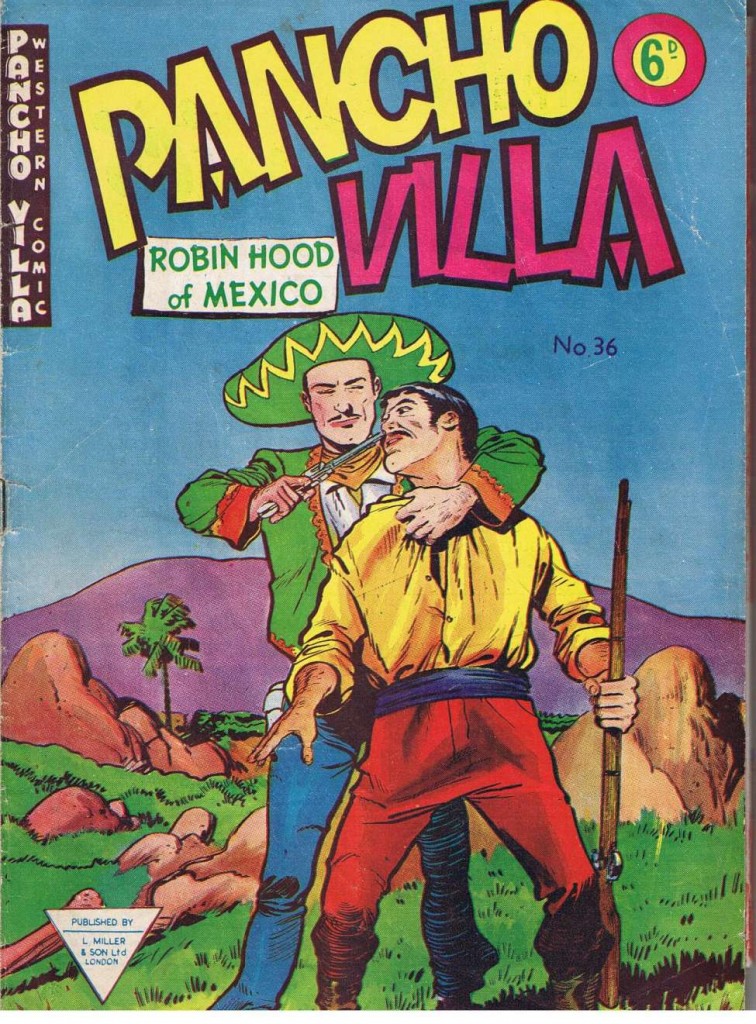
pancho_villa

The first story in the comic is excellent, it features Pancho Villa and and his amigo Luiz facing off with a marauding, fake Pancho Villa that is traveling from town to town pretending to be the bandit, and plundering along the way. I guess Villa was a victim of his own fame 🙂 Coolest part of the comic is that they face-off with and then befriend/enlist a local goat herder named Maria to help fight the fake Villa. What’s cool about Maria is she may be a nod to the Adelitas of the Mexican Revolution, or the women soldiers (Soldaderas) who represented a significant force in the revolution. It’s not only a man’s revolution!
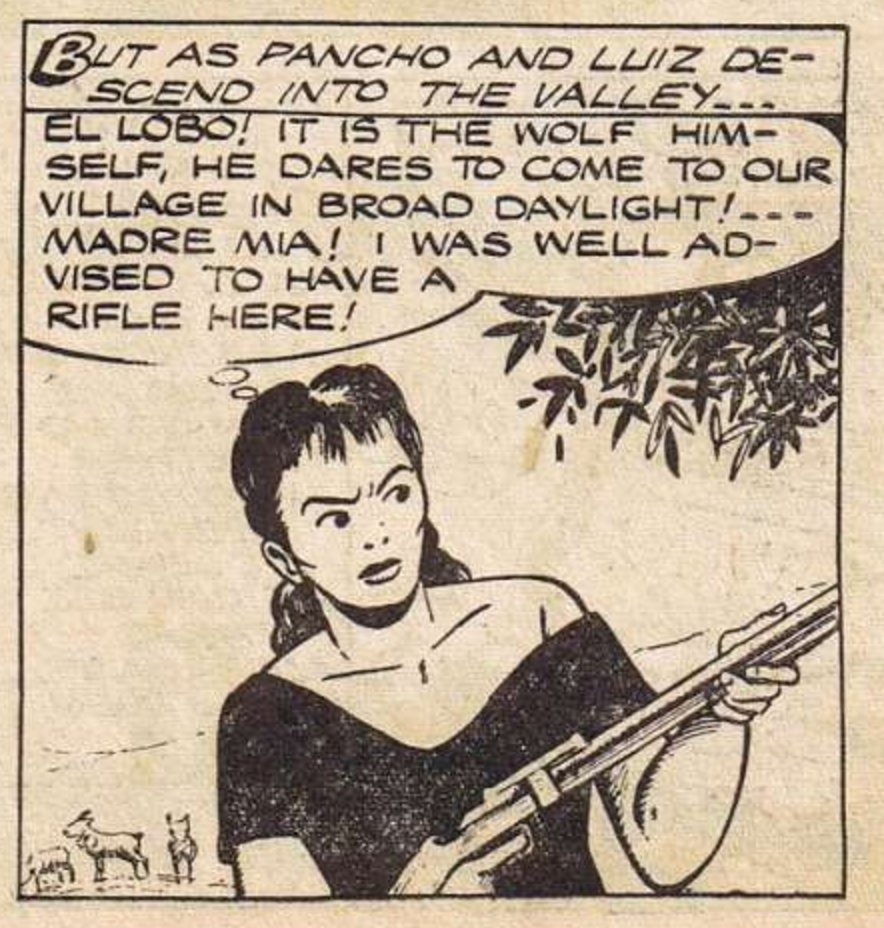
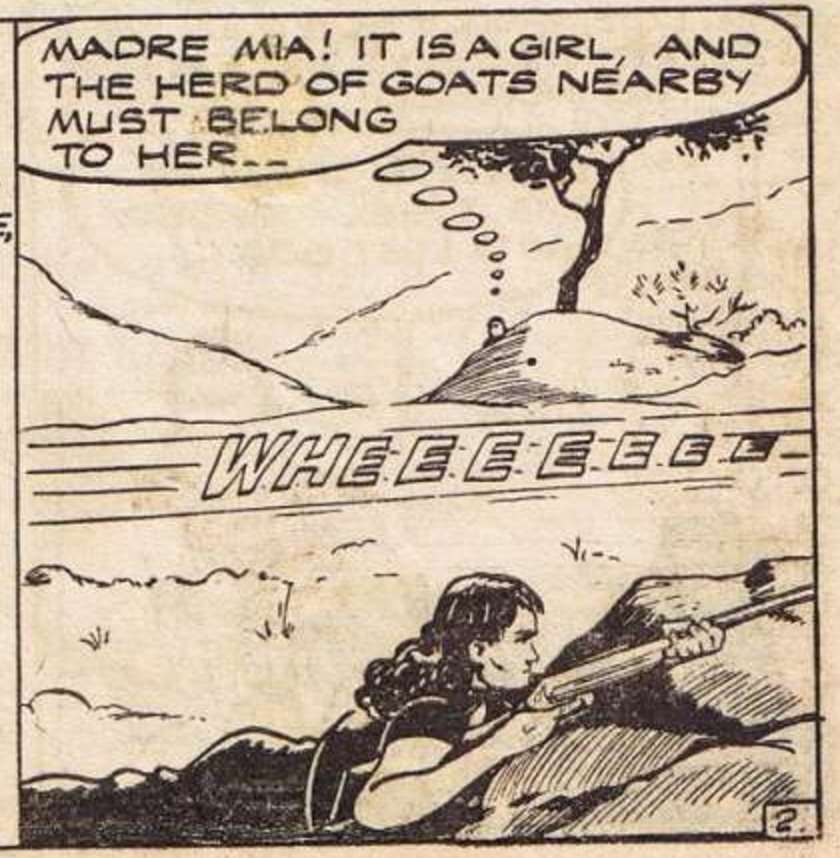
Screenshot 2016-01-07 15.05.51

Screenshot 2016-01-07 15.07.07 Screenshot 2016-01-07 15.06.30

This comic was a gem of a find, and it’s interesting how the idea of Robin Hood in Mexico is reframed in the early 20th century through a military figure who, along with Emiliano Zapata, opens up a whole new historical context for the legend. That said, Villa’s early life overlaps interestingly with Murrieta’s, and so many other Western legends:

Villa spent much of his youth helping out on his parents’ farm. After his father’s death when Villa was only 15 years old, he became head of the household. With his new role as protector of his houshold, he shot a man who was harassing one of his sisters in 1894. He fled, spending six years on the run in the mountains. While there, he joined a group of fugitives and became a bandit.

And his role as a revolutionary general during the Mexican Revolution is legendary, as was his ability to drum up international publicity for himself and his cause through U.S. journalists like John Reed (particularly his essay “The Rise of Pancho Villa”), Hollywood newsreel films, and more. Robin Hood with an early understanding of the power of new media!
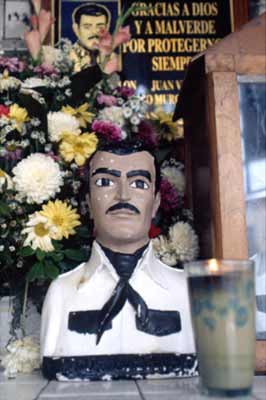
Angel of the Poor, Generous Bandit, The Narco Saint

Angel of the Poor, Generous Bandit, The Narco Saint

The third Mexican Robin Hood I came across on my way to what I promised myself would be a quick and easy Daily Create is Jesús Malverde. According to his Wikipedia article:

The existence of Malverde a.k.a. ‘El Rey de Sinaloa’ is not historically verified.[4] According to Patricia L. Price, he is said to have been born Jesús Juarez Mazo, growing up under the rule of Mexican dictator Porfirio Diaz, whose local supporter Francisco Cañedo ran Sinaloa. He is supposed to have become a bandit after the death of his parents, which he attributed to their poverty. His nickname Malverde (bad-green) was given by his wealthy victims, deriving from an association between green and misfortune.[2] According to the mythology of Malverde’s life, Cañedo derisively offered Malverde a pardon if he could steal the governor’s sword (or in some versions his daughter). The bandit succeeded, but this only pushed Cañedo into hunting him down. He is supposed to have died in Sinaloa on May 3, 1909. Accounts of his death vary. In some versions he was betrayed and killed by a friend. In some he was shot or hung by local police.[2] His body was supposed to have been denied proper burial, being left to rot in public as an example.

In some ways Malverde shares many of the more iconic traits with Robin Hood myth: stealing from the rich and giving to the poor, as well as the association with the color green. The equating of green with misfortune is an interesting cultural take on that color, not sure if that’s the case with Robin Hood as well.  In a U.S. context, the green would be associated with money to the contemporary mind, but there is also another context during the Mexican American War wherein the uniforms of the U.S. forces were green. Which gave us the term Gringo, believed by some to have been born from what the Mexicans chanted when demanding the invading  U.S. Army leave their country: “Green Go Home.”*

One of the interesting details about Malverde is he has become a patron saint for Mexican drug traffickers, or “the narcosaint.” You just can’t make this stuff up, right? And drug dealers have…

“…strategically used Malverde’s image as a ‘generous bandit’ to spin their own images as Robin Hoods of sorts, merely stealing from rich drug-addicted gringos and giving some of their wealth back to their Sinaloa hometowns, in the form of schools, road improvements, community celebrations.”[2]

So, what to do, what to do. Well, given I spent all my time searching around for info about the Mexican Robin Hoods I have no more time for this daily create. So i am going to go simple:
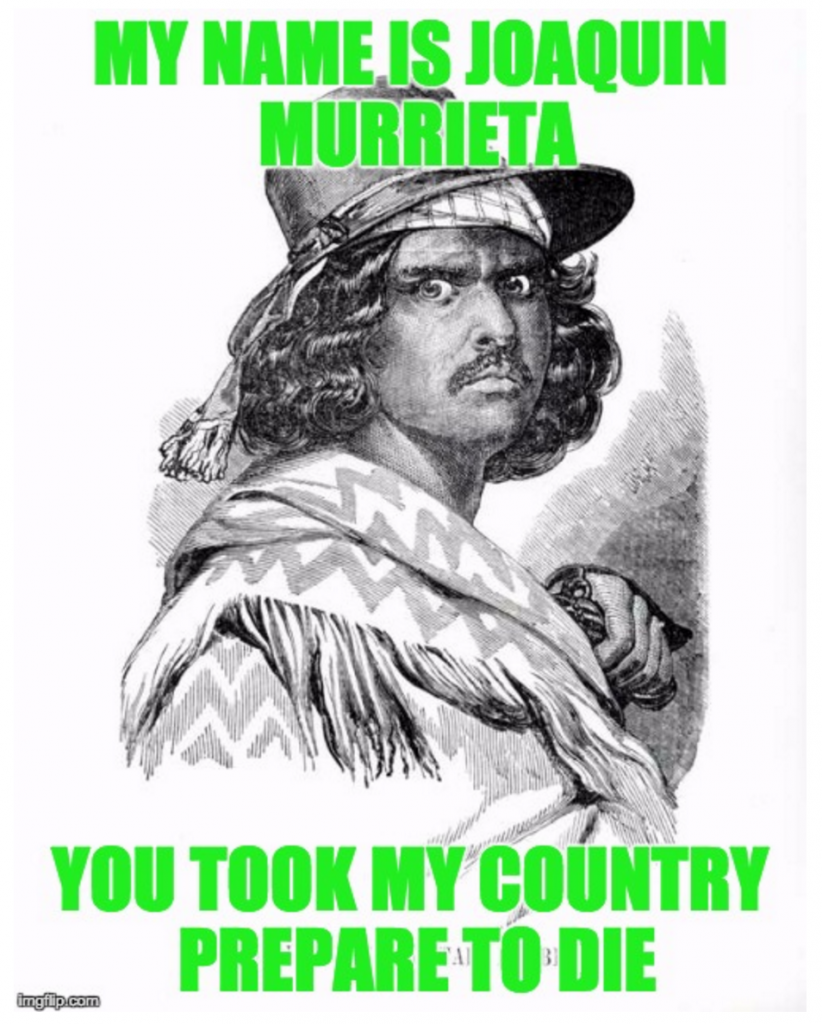
Screenshot 2016-01-07 22.39.33

_______________________

*Pretty sure this definition is apocryphal, but I like it much better than the more legitimate etymologies. Not to mention it fits nicely with the whole imperial subtext that is everywhere apparent.
Posted in digital storytelling, Western 106 | Tagged , , , , , | 4 Comments

Bring me the Head of Joaquín Murieta

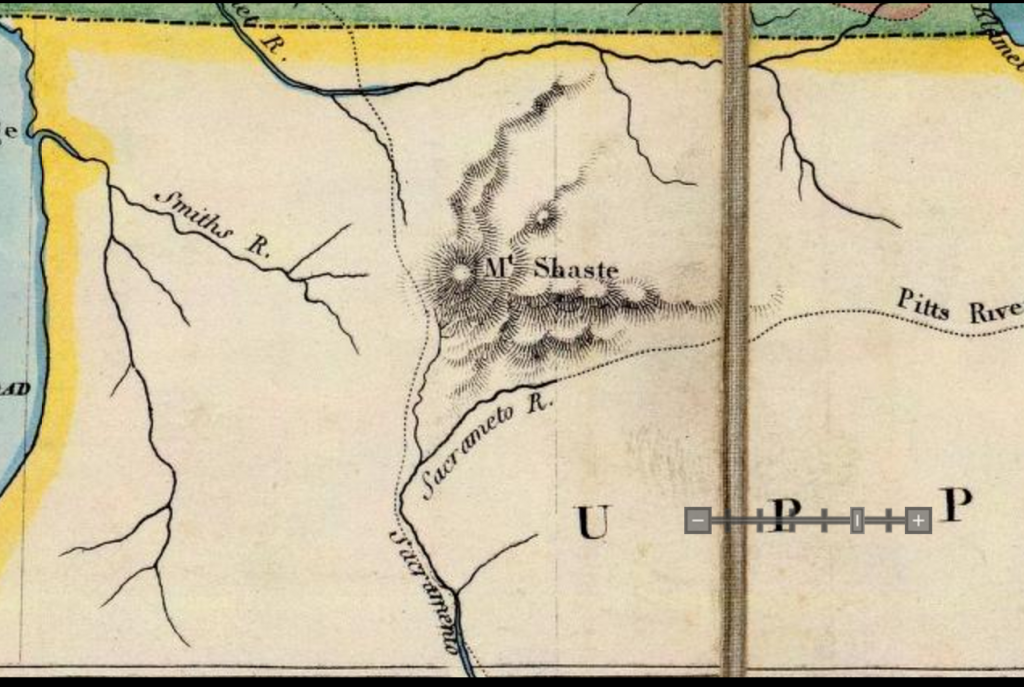
map-1024x705
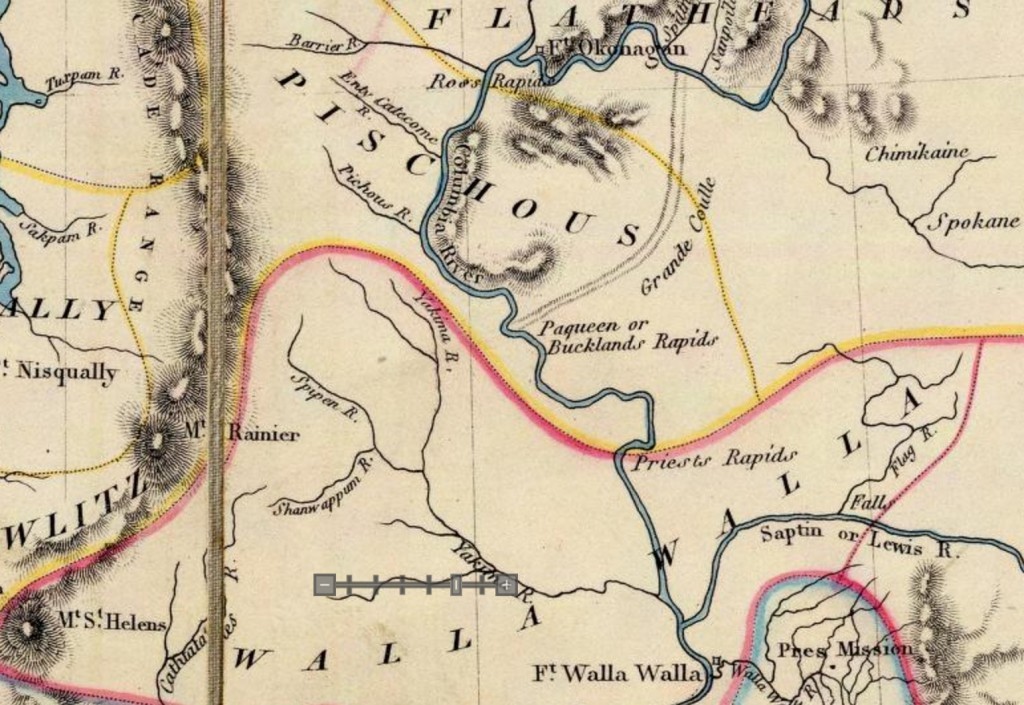
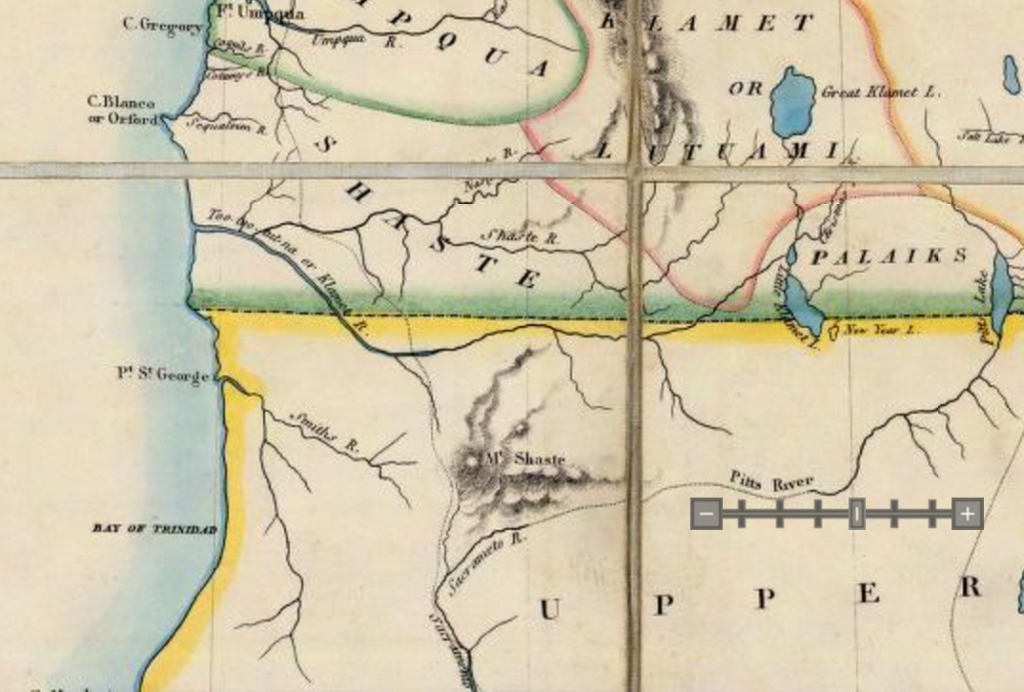
Today’s Daily Create is pretty awesome. It provides an old gold map of the Oregon Territory published in 1844  via the David Rumsey Map Collection, and asks you to pick a spot on the map that would provide the setting of a story. Our job is “to write the opening to a a story that might take place there.” The spot that I immediately gravitated towards was the “Shaste” region.

Screenshot 2016-01-06 08.56.38

The Shaste region in the Oregon Territory

Screenshot 2016-01-06 08.56.04

Mt. Shasta in Upper California

Or more specifically, Mt. Shaste in Upper California, or what is now know as Mount Shasta in Northern California 🙂 “Why Mt. Shasta?” you ask. Well, my brother lives in Red Bluff, California, not far from Mt Shasta, and I spent a fair amount of time up there in the 90s. It’s a gorgeous spot at the southern tip of the Cascade Mountain range that runs all the way up to British Columbia. What’s more, that “Upper California” region stills has remnants of the California Gold Rush which brought the first Euro-American settlements into the area. And that provides a beautiful segue way for both the time period, setting, conflict and action of my humble Western tale: “Bring me the Head of Joaquín Murieta.”

Wpdms_mexican_cession

The Mexican Cession, shown in red, and the later Gadsden Purchase, shown in yellow.

But before I write the opening, a little historical context is in order because the other reason I chose Mt. Shasta is because it was one of the settings referred to in a dime novel I read while in grad school by John Rollin Ridge titled The Life and Adventures of Joaquín Murieta (you can find a PDF of the novel here).¹ In fact, this is a novel that has a couple of pretty impressive firsts: first novel written in California and the first novel written by a Native American. The novel frames a pretty interesting moment in U.S. history right after the Mexican American War. This conflict is seldom talked about, and while it only lasted a year and half it resulted in Mexico losing more than half of its national territory, including  Arizona, Utah, Nevada, California, and parts New Mexico, Colorado, and Texas. Talk about a land grab! It’s in many ways the final realization of Manifest Destiny, but one piece of a much longer history that had been written in blood for more than three centuries by that point. I think that might be one reason the Western continues to speak to (or is it haunt?) the U.S. psyche—it can provide a bloody reminder of how we got where we are. What’s more, the Mexican American War opens up broader questions about impulses towards imperialism in the early U.S. that often aren’t suggested until the 20th century.

So, in the late 1840s, early 1850s (just a few years after the map prompting this post was drawn) you have California as a newly annexed territory of the U.S., which means you have an intense, shifting border zone with increased conflicts between the European-American speculators and the existing Mexican and Native American communities (who are increasingly seen as subjects of the U.S.). What better setting than the Gold Rush in Northern California to underscore the violence and greed undergirding this expansion! You can start to see it unfolding, right?

But wait, there’s more. The figure of Joaquin Murrieta (sometimes spelled with one r) is one of legend and lore. Murrieta, once a dignified citizen of Mexico, becomes a legendary bandit after his gold mining claim is violently taken from him. He then takes his revenge on his tormentors. To quote U.S. historian Susan Lee Johnson from Murrieta’s Wikipedia page:

So many tales have grown up around Murrieta that it is hard to disentangle the fabulous from the factual. There seems to be a consensus that Anglos drove him from a rich mining claim, and that, in rapid succession, his wife was raped, his half-brother lynched, and Murrieta himself horse-whipped. He may have worked as a monte dealer for a time; then, according to whichever version one accepts, he became either a horse trader and occasional horse thief, or a bandit

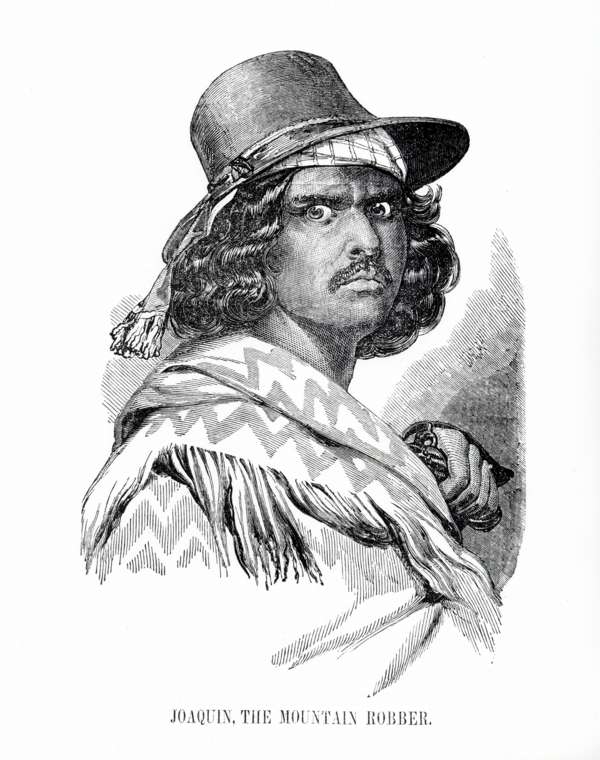
JoaquinTheMountainRobber-1

A Portrait of Joaquin Murrieta, “The Mountain Robber”

His wife raped, brother-in-law lynched, and him horse-whipped to within an inch of his life provides an almost textbook example of some of the most horrific violence apparent in a number of contemporary re-tellings of Western tales. And this violence is something Sandy Brown Jensen reacted to in her recent post about the Male Revenge Fantasy specific to this genre of films. And she is right, it’s a story told again and again. After reading Ridge’s novel, I wondered if Clint Eastwood was using it as inspiration for the beginning of one of the most visceral Western revenge fantasies ever:  The Outlaw Josey Wales (1974). A film that starts out with the protagonist watching on helplessly as his wife and son are murdered, the blind revenge for which becomes the driving logic of the entire film. Murrieta’s legend provides a very similar case. He went to Northern California in 1849 to find his fortune in the Gold Rush. He encountered racism from the white prospectors, and when the fins out he has struck gold, the miners turned on him and lynched his brother, raped his wife, and nearly beat him to death. After that, he and a band of fellow Mexicans become outlaws and fight the existing power structure, killing numerous European and Chinese-Americans in retaliation.²

A narrative of male revenge fantasy? Yes. But also an allegory for the land grabbing exploits of the Mexican American War, the racism at the heart of Manifest Destiny, and a broader look at the violence that has made our refusal and outrage at it now even possible. Fact is, to tell a tale like Murrieta’s is to be constantly reminded how integral violence was (and is?) to the formation of the U.S. Take, for example, the fact that in 1853 the California legislature hired 20 Texas Rangers to kill the “Five Joaquins“:

The legislature authorized hiring for three months a company of 20 California Rangers, veterans of the Mexican-American War, to hunt down “Joaquin Botellier, Joaquin Carrillo, Joaquin Muriata [sic], Joaquin Ocomorenia, and Joaquin Valenzuela,” and their banded associates. On May 11, 1853, the governorJohn Bigler signed an act to create the “California State Rangers“, to be led by Captain Harry Love (a former Texas Ranger and Mexican War veteran).

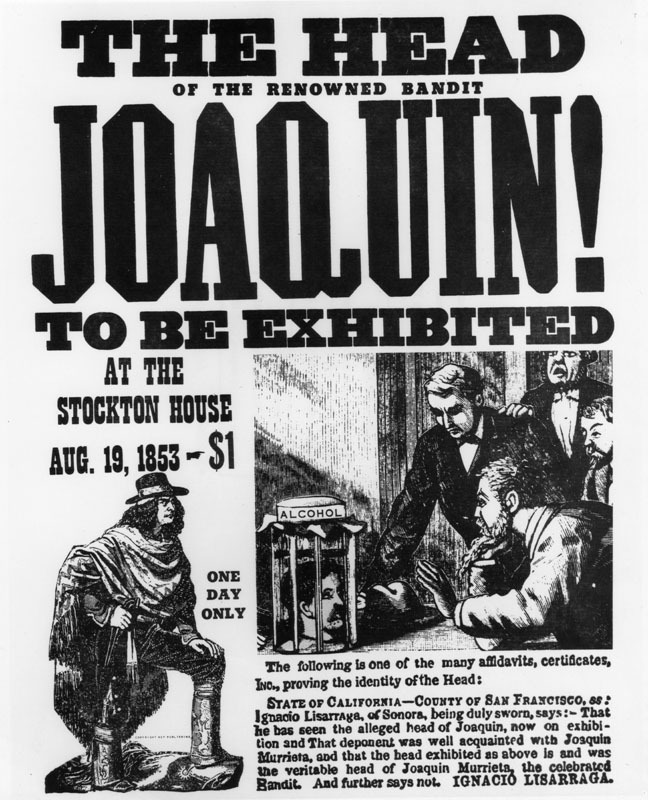
The Five Joaquins could be the subject of a movie in and of itself, add to that the formation of California State Rangers and the manhunt for Murrieta that would, according to legend, ultimately end with his head—preserved in alcohol—being shown for $1 a viewing. It doesn’t get much more violent, and I am just referencing history here.³ The title of this post is inspired by the detail of Murrieta’s head in the Wikipedia article, which makes me wonder if Sam Peckinpah might have been playing on this tradition in another 1974 Western Bring me the Head of Alfredo Garcia (which plays more like a noir than a Western).  And whether or not all the facts in legend around Murrieta are true, I don’t think any of us find the details hard to believe if they were, am I right?

JoaquinMurrieta-headflyer-02

A poster advertising the display of the supposed head of Murrieta in Stockton, CA. 1853

As a follow-up to the tale of Murrieta’s demise, the Rangers received the $1000 reward for bringing back his head, but questions about whether the Rangers murdered an innocent and bribed people to swear out affidavits emerged—who needs an imagination when you have Wikipedia? The whole thing is simply crazy, and its hard not to see the violence as part and parcel of this genre given the history it interrogates.

That said, the narrative implications of Murrieta’s story have seemingly endless possibilities for a a revisionist Western, but it also points to the fact that the violence of our past is so easily forgotten in time. I can’t help but think that’s what Cormac McCarthy’s is talking about in his ultra-violent Western novel Blood Meridian when ruminating about the carnage all around one of his characters in the novel:

All about her the dead lay with their peeled skulls like polyps bluely wet or luminescent melons cooling on some mesa of the moon. In the days to come the frail black rebuses of blood in those sands would crack and break and drift away so that in the circuit of a few suns all trace of the destruction of these people would be erased.

All that said, I digress. All I had to do for today’s daily create was pick a point on a map and write the introduction to a story, so here you go:

The scene opens with a shot of Mt. Shasta and the camera pulls out to show a well-built cabin alongside a running stream. It’s an idyllic scene with lush swaths of green and yellow against a striking blue sky embroidered with the Cascade Mountain range in the distance.

Cut to two attractive Mexican men (brother-in-laws, in fact) knee-deep in a stream panning for gold while laughing and telling stories of their exploits in Sonora before heading to “Upper California” to try their luck in the California Gold Rush. They got a jump on the the rush of ’49 that followed later that year, and were able to stake an impressive claim in an out-of-the-way spot on a tributary of the Sacramento River. They have had no luck yet, but that was all about to change, in more ways than one….

Now I want to write the rest of this film. Thank you Daily Create!

______________________________

  1. Although, truth be told, most of the novel takes place further south in Marysville, San Jose, etc.
  2. Murrieta’s supposed targeting of Chinese-American immigrants adds another layer of racial and ethnic complexity to the narrative.
  3. Although, to be fair, history quickly melds with myth in the stories around Murrieta. Turns out his narrative has been attributed, at least partially, to the creation of the figure of Zorro. It’s a rich legend, and I am genuinely surprised more hasn’t been done with it in contemporary explorations of the Western.


Posted in digital storytelling, Western 106 | Tagged , , , , , , , , , | 5 Comments

Reclaim Support for December 2015

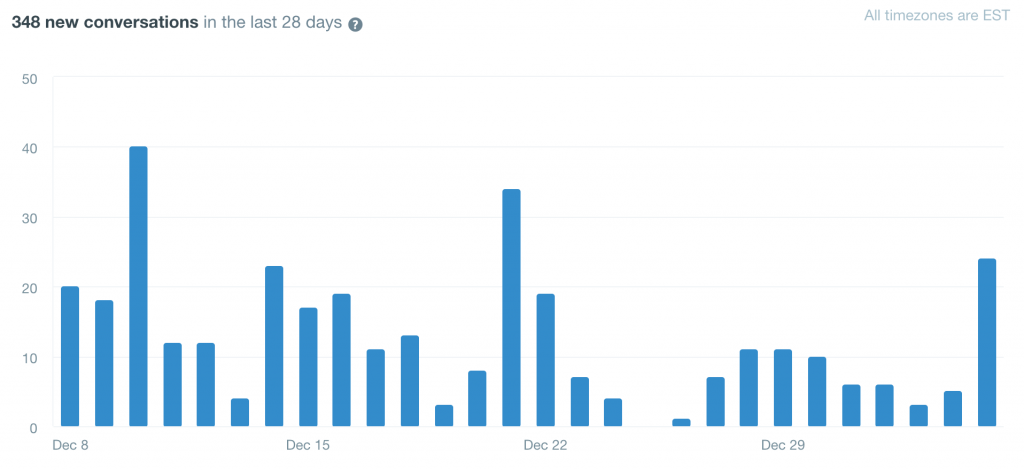
I’ve written about Reclaim Hosting‘s stellar support a couple of times already, and out of curiosity I took a quick look at our support statistics for December. Our average response time to new tickets during August, September, and October was 7 minutes, and there were 1290 support tickets, which averages out to 430 tickets a month. At the very beginning of the Fall 2015 semester (mid-August to mid-September) we had an 8 minute response rate for 365 tickets. In December we had 348 tickets with an average response rate of 6 minutes.

Screenshot 2016-01-05 14.49.22

348 new conversations, or tickets wherein someone is asking for support

Screenshot 2016-01-05 14.49.10

6 media median first response time to new tickets

I was surprised that we had almost as many tickets at the beginning of the semester as we did at the end. We really didn’t slow down that much in December until the holidays hit. I think the fact that I start my working day at roughly 2 or 3 AM for the Eastern Seaboard of the U.S. might be making a difference in how long overnight tickets go unattended. It also provides early morning support for the European Reclaimers. I am guessing this might have something to do with the improved response time because I want to take credit, but Tim “The Machine” Owens responded to half of all the tickets in December. So, I think I know what my New Year’s resolution will be: rule the Reclaim support leaderboard 🙂

But even if I fail, which I very well may given the competition, one thing remains certain: we live and die by our support of faculty, students and staff. What’s more, we have no intention of letting that slip in 2016.

Posted in reclaim | Tagged , | Leave a comment

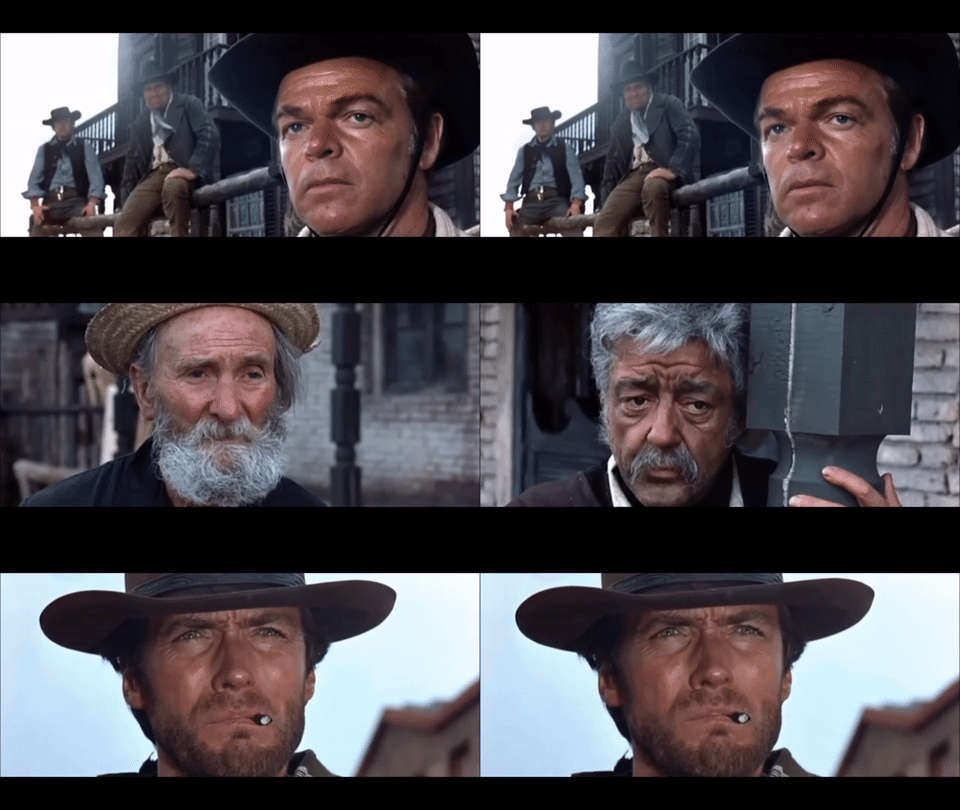
A Fistful of GIFs

The Western 106 force is strong with me these days. I even watched John Ford’s Stagecoach (1939) last night, but more on that in another post. For now I’ll be talking about today’s Daily Create which asks us to make GIFs from the “Get three coffins ready” scene in Sergio Leone’s A Fistful of Dollars (1964). I used Giffy because I am starting to dig the SPLOT-like GIF services like Giffy and Imgur’s Video to GIF. In fact, I probably wouldn’t have made half as many GIFs if I was using my old gold technique of MPEG Streamclip and GIMP.

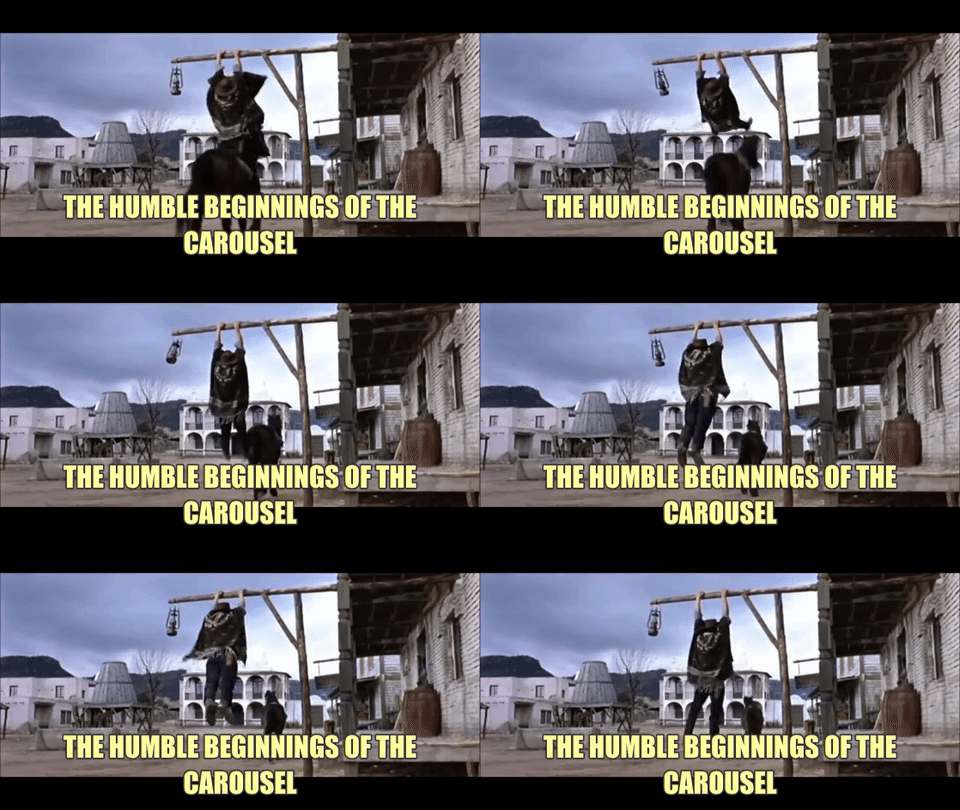
I had no plan going in, I just wanted to make some GIFs and have some fun. It’s amazing what a good ds106 course can do for your blog. I watched the scene through once, and decided I would try and isolate Clint Eastwood swinging on the lamp post. Once I did it, I realized I could actually play with the horse eternally coming underneath him making it like a primitive carousel of sorts. Hence, my first GIF of the series was born.

carousel

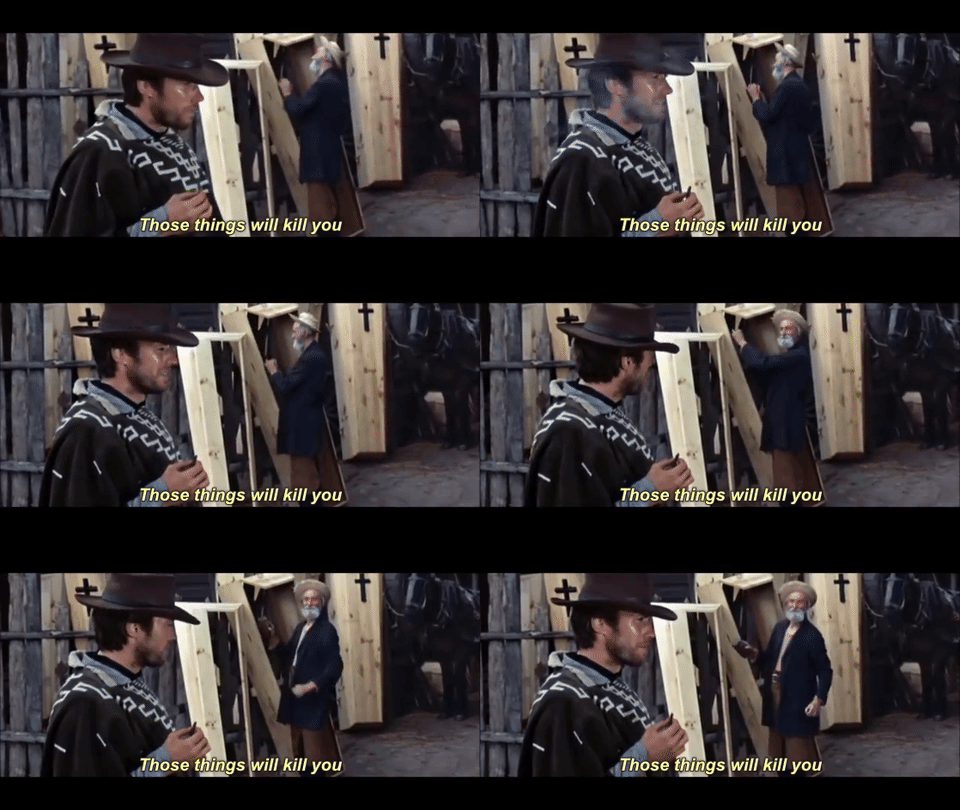
In the next GIF I wanted to isolate the old man planing the coffin, but it wasn’t smooth. I did, however, isolate Clint Eastwood blowing out smoke from his cigar, which then made me think, “What if this GIF was a play on the Marlboro Man and anti-smoking ads?” I added fake dialogue, trying to keep who is saying it somewhat vague. Weird how the mind works, even if the GIF doesn’t 🙂

t.gifhose_things_will_kill_you

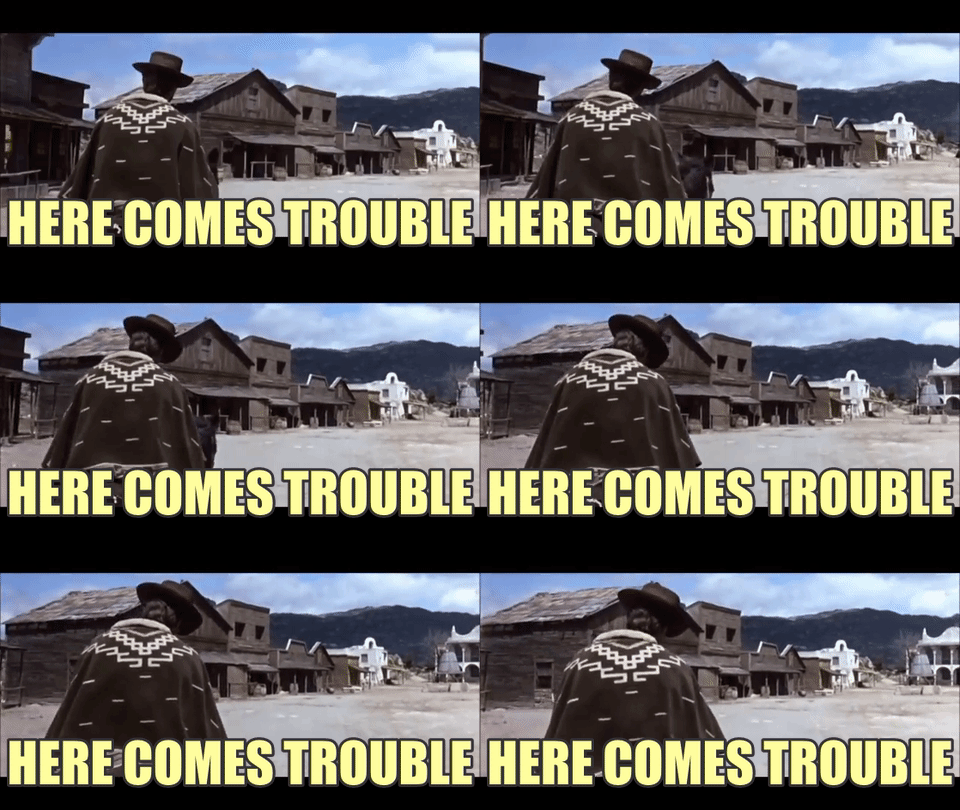
The third GIF I made was simply the default GIF Giffy gave me. I like it. It epitomizes the lone gunmen figure of Leone’s Westerns beautifully. What’s more, you know a shootout will soon follow, hence the cheesy MEME text “Here Comes Trouble.”

here_comes_trouble

But the deeper I got into making the GIFs, the more I could see the artistry of the scene. And the following GIF wherein Leone communicates everything you need to know about the moment before a gunfight through a series of close-up facial shots. It’s a clinic on creating tension in film, and provides a brilliant example of Leone’s signature genius.

fistful_of_faces

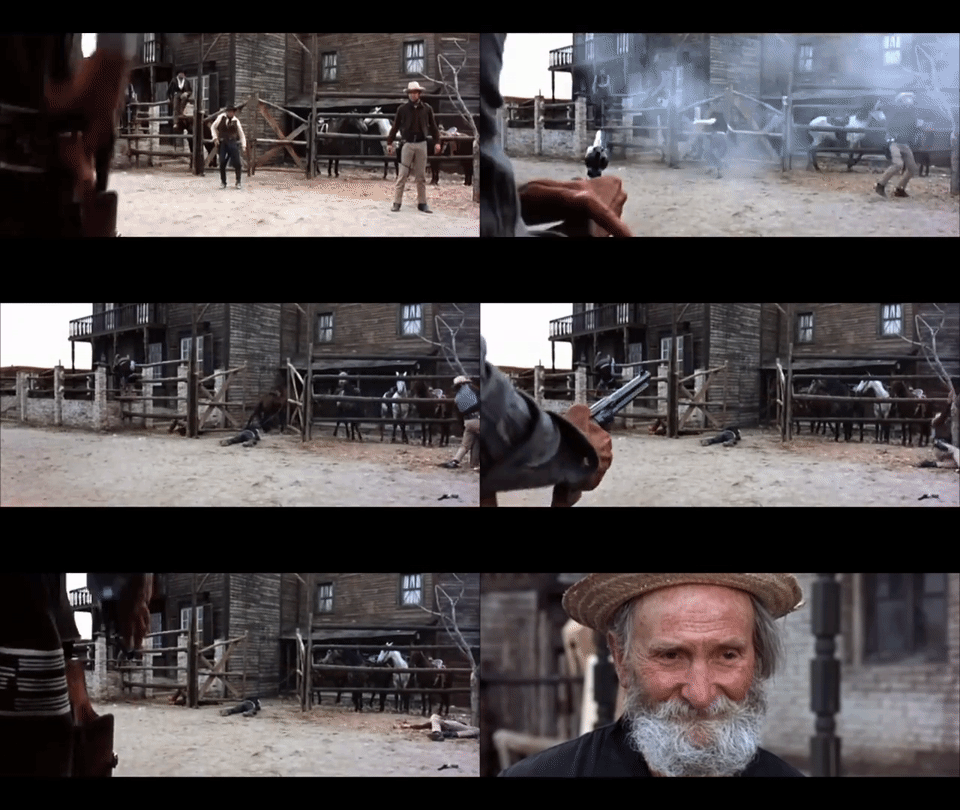
And then putting the actual gunfight (can you even call it that?) on constant repeat is just plain fun, it slows down a really quick scene (so different then the shot of the faces above) and allows you to analyze a scene that would be impossible in a movie theater, and laborious on a DVD, etc.

gun_fight

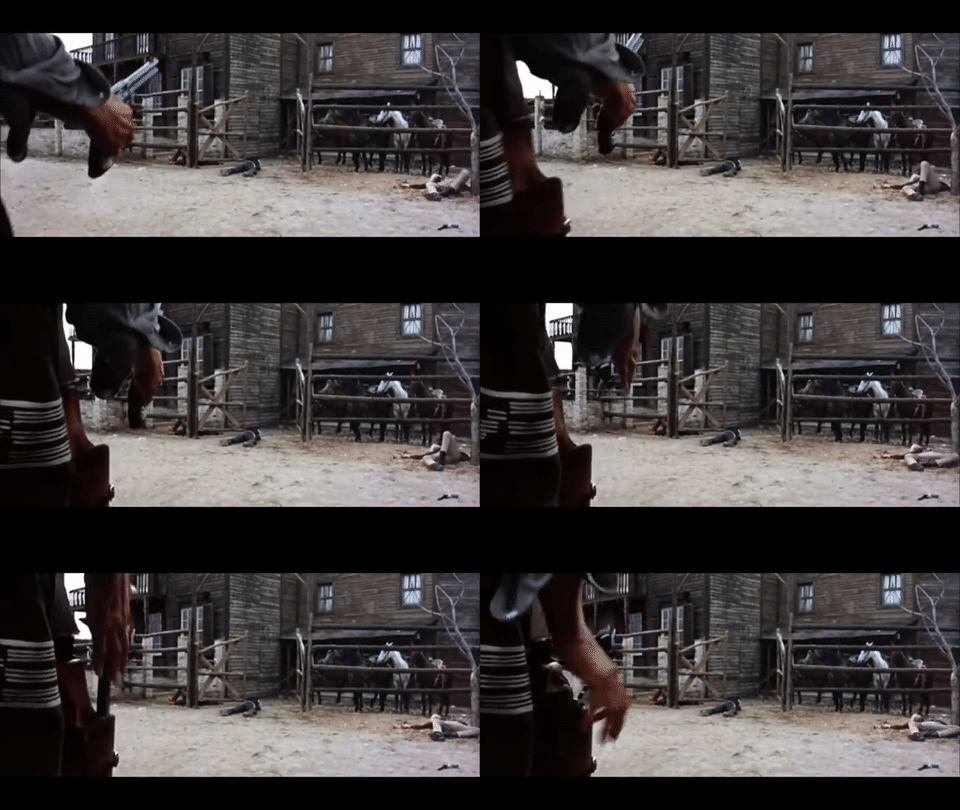
You begin to pickup small details like the movement of the outlaw’s leg, or the subtle spinning of the gun before he re-holsters it. The magic of the GIF is you can get even deeper into a scene by isolating moments that might otherwise pass you by.

gun_flip

Nothing like a GIF-themed Daily Create to get the ds106 creative juices flowing, thanks CogDog!

Posted in 106movies, digital storytelling, Western 106 | Tagged , , , , | 3 Comments

Personal APIs and Academic Libraries

Roger Schonfeld’s “Improving Privacy by Rethinking Architecture” post on The Scholarly Kitchen blog does an excellent job of exploring the question of privacy and third-party data collection for researchers and academic libraries:

By having comparatively little user activity data on their own hands, and fragmenting those data they do keep, libraries may feel they have sidestepped an ethical dilemma [researching anonymously]. But they surely have missed the opportunity to build the personalized discovery and research information management tools that scientists and other academics need. In doing so, libraries have underserved researchers and other users, putting themselves at a competitive disadvantage relative to other providers. But at the same time, they have not placed limits on the data gathering and usage of content providers and other vendors nearly as strictly as they often claim for themselves.

It’s a tricky issue, and Schonfeld adriotly underscores the irony of outsourcing research services as a means of exonerating your library, while at the same time forcing the community you serve into much more precarious conditions. And while steps need to be taken to manage the sharing of data with these third-party services, the deeper issue he gets at is that our thinking assumes the current state of IT infrastructure. What if that infrastructure was designed in such a way that academics had control over the data they shared while doing their research. Not only as a means of privacy protection—though definitely that—but also as a means to extend such a “decentralized architecture” to serve as individualized research archives (a personal cyberinfrastructure).

I was excited Schonfeld highlighted the Personal API project Reclaim Hosting is working on with Brigham Young University presently, and I really liked the way in which he extrapolates the vision of providing students more control over their data to researchers controlling access to their own scholarly work, and changing some of the basic ways we understand sharing and publishing one’s work.

If successful, it is possible to imagine such a decentralized architecture being extended to serve the needs of a researcher account in terms of library resources and content platforms. Indeed, I have argued that a cross-platform user account controlled by the researchers themselves would bring vast improvements in the processes of authorizing access to an appropriate copy of an information resource, while dramatically improving one’s control of one’s own data. Such an architecture represents a sea-change compared with today’s systems and it is no small thing to imagine the costs and logistical complexities of a transition.

The logical and political complexities of such a transition are no small thing to say the least. And while organizations like BYU that have visionary folks like Kelly Flanagan and Phil Windley leading the charge are rare, Schonfeld’s final note suggests quite hopefully that alternatives are both possible and important:

Even so, the work that Reclaim Hosting and BYU are undertaking is more than just experimental. It suggests that, when the political and organizational stars align, an entirely different architecture for the control of user data is possible.

That is so awesome, and why not? The time has come, and I know for certain that numerous other institutions are keen on what the folks at BYU are doing, and are prepared to double down on giving people more power over the online identities, personal data, and digital domains. Reclaim is in the air!

Posted in reclaim | Tagged , , , | Leave a comment

Johnny Guitar

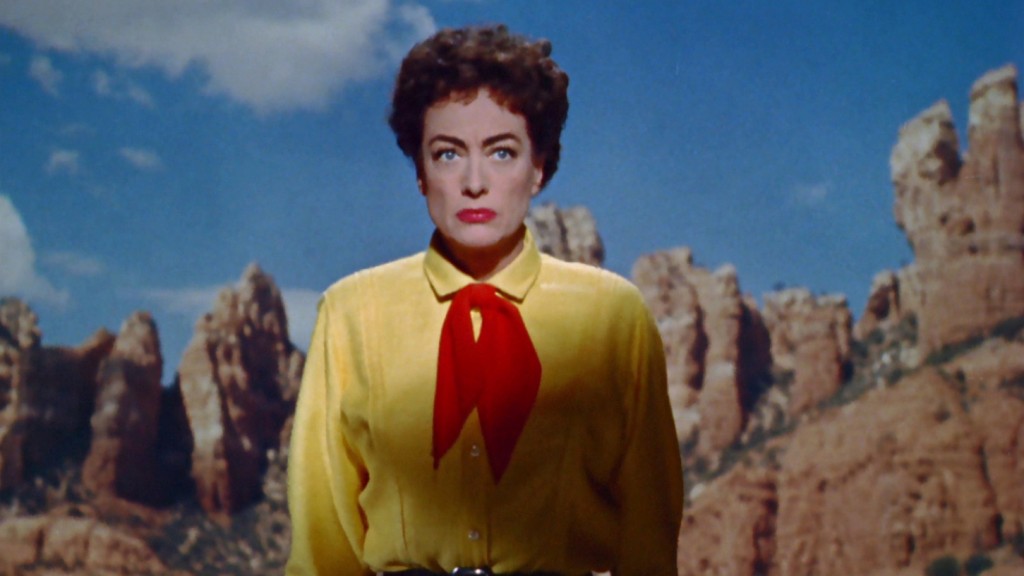
John Crawford as Vienna in Johnny Guitar

John Crawford as Vienna in Johnny Guitar

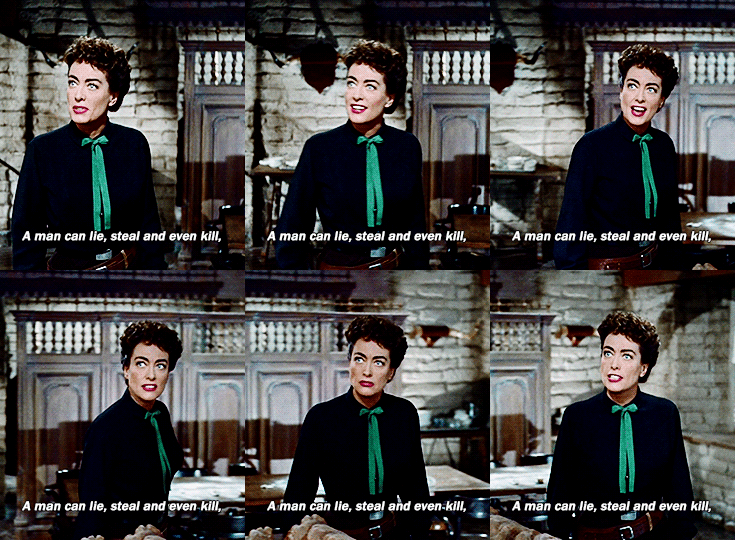
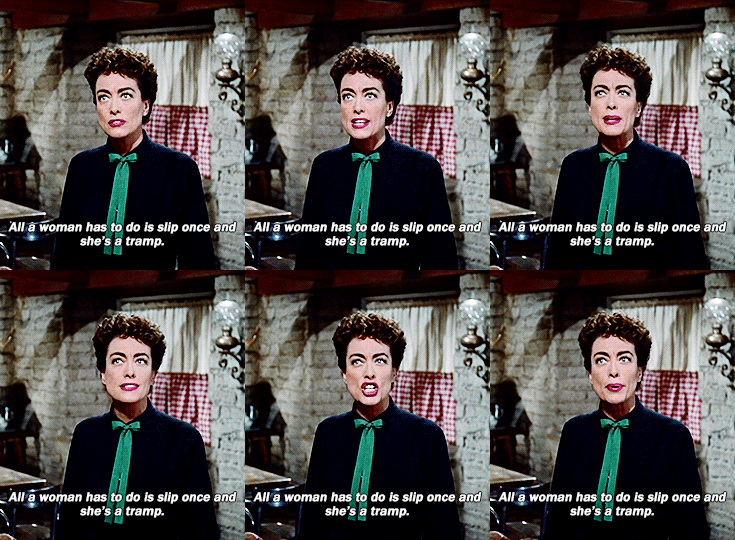
After seeing today’s Daily Create priming folks to do some research for the coming Western-themed ds106, I got the urge to write about a particular Western (although not a Spaghetti Western) that rules: Nicholas Ray’s 1954 Western dream vision Johnny Guitar. It has got to be one of the most unique Westerns ever made. Joan Crawford is, per usual, a complete bad ass, and I have always had a soft spot for Sterling Hayden. According to the Criterion extras on The Killing, Hayden notes that he and Crawford fought like cats and dogs during the making of the film. Some of that dynamic comes across in the brilliant “lie to me” scene below:

Johnny Guitar centers around Vienna’s (Joan Crawford) refusal to cow to the threats of her community, which can be seen as subtext alluding to Joe McCarthy’s political witch-hunt during the early 1950s. This is nowhere more apparent than in the brilliant piano scene in which Vienna refuses to turn over her friends.

This moment puts it alongside Fred Zinneman’s High Noon (1952), which provides a critique of those in Hollywood who did not stand-up to the House of Un-American Activities Committee.* But unlike High Noon, which features Gary Cooper as the hero, Johnny Guitar foregrounds Crawford as the strong, aggressive, nonconformist who challenges the status quo. One of the few staunchly feminist Westerns of the era.

joan-johnnie-gif-250 4394f4cd40f61fb2a63536e1cc7a77c8joan-johnnie-gif-252

Add to that the fact that it’s so beautifully shot in colors drenched in celluloid technicolor, and you have a nearly perfect movie. In his book The Films in My Life, François Truffaut described it as the “Beauty and the Beast of Westerns, a Western dream.”  Truffaut was struck by Ray’s use of bold colors, poetic dialogue, and cowboys vanishing and dying “with the grace of ballerinas.”

So, if you are getting ready for #western106 and want a film working on many levels, Johnny Guitar will not disappoint. Not only is it a gorgeous film, but it also demonstrates the amazing range the Western genre has for commenting and critiquing the cultural values embedded in the historical moment a given film was made. While Westerns share a lot of similarities, the joy of the genre is exploring the differences within the genre over the history of film. Hell, it’s the beauty of art all told.

________________________________

*On the other hand, Western film giant John Wayne called High Noon “the most un-American thing I’ve ever seen in my whole life”.[1]

Posted in 106movies, digital storytelling, Western 106 | Tagged , , , , | 2 Comments

Reclaiming an Aesthetic

For about a year and a half now—ever since the Reclaim Your Domain Hackathon in LA—I have been talking about an aesthetic for the Reclaim movement. I think that was probably the wrong approach. A movement probably shouldn’t have just one aesthetic, but a diverse range of aesthetics that share a loose set of principles (i.e., reclaiming the web). The real magic of the community would be sharing and riffing on how each of the various nodes within this scene shape their work for their specific context. In other words, how they define their own aesthetic or their own sound—so to speak.

The music metaphor has been tricky in the past, but it’s also hard to avoid because it is so resonant with so many. Over a year ago at Davidson College I did a very short presentation on the idea of Indie Web Domains:

What if we thought about universities doing domains projects, kinda like indie labels promoting unknown bands and seeding a local scene. Domains could provide an infrastructure of support and promotion for the faculty, students, clubs, groups, projects, etc. that is all done in their own space. Reinforcing a DIY ethic inherited from punk. What if each school was known by the variety of it’s different approaches, ideas, and visions for what the independent web means.

A Domains project at a school could be one way of providing independent, open source alternatives to the Clear Channel LMSs that everywhere define the monotonous beat of most of edtech. It helped refine the idea that each distinct community would define what reclaiming the web means for them. We began to think about Reclaim Hosting as an independent provider of edtech for individuals, courses, and institutions alike.

Cut to April of last year in Barcelona, I found myself sitting around a table with Audrey Watters, Sheila MacNeil, Martin Weller, Doug Belshaw, and this bloke I never met before Bryan Mathers (you like that Britishese, right?). I was going back and forth with this lively, very British group (Audrey counts in that assessment 🙂 ) about the idea of Reclaim Hosting as akin to an independent record store that both aggregates and highlights all the awesome bands both locally and beyond. One of the many things that struck me while reading Michael Azerrad’s Our Band Could be Your Life was how local records stores and clubs cultivated an alternative scene and formed the basis of an international network of independent culture. Bands like Black Flag were so important because they were early activators of that network for US Hardcore punk—much of how I think about the line-up of UMW’S DTLT from 2011 through 2015.

Anyway, the conversation came and went as most good ones do. I didn’t think anything of it until out of the blue Bryan Mathers sent me the following sketch he made based on some of the ideas we talked about around that table in Barcelona a couple of months earlier.
Reclaim Hosting logo v1

And this simplified version without the “Empowering Community” bit on the record label.Reclaim Hosting logo v1 - simple

That must have been back in May or June, I’m not sure. But I loved it and I talked with Tim Owens and Lauren Brumfield about revamping our site over the summer to start reflecting this new aesthetic but before we could the semester started for us sometime in early July and never slowed down. A good thing, no doubt, but I was anxious to revisit this project. In fact, Adam Croom officially christened the movement Indie Ed-Tech in a joint presentation we gave at dLRN, and I rode the idea for the rest of the year. Audrey Watters aspirational year-end post about Indie Ed-Tech laid the whole thing out beautifully, as she is wont to do. I reached out to Bryan in early December and told him we wanted to officially adopt his art as Reclaim’s logo, and might he be interested in exploring more creative work with us as a broader aesthetic. Luckily for us, he’s interested and has agreed! In fact, Bryan runs a non-profit digital creative agency, Wapisasa, that is community-based and develops young people’s creative talents. What a perfect match!

We had an awesome discussion in late December wherein we mapped out a creative project we will be working on over the course of 2015 based on a bunch of sketches—which I loved—that he provided after our first chat. He even gave me a quick reworking of the Reclaim logo that reverses the colors and includes the Indie Edtech idea on the label!

Reclaim Hosting logo v2 - reversed

The color re-working is specifically to replace the logo on our site which is currently blue-themed, and provides the first piece of an ongoing story. We will be rolling out the aesthetic over the coming year little-by-little, as a kind of ongoing exploration of the independent record store metaphor in relationship to what we do and the various people, courses, organizations and institutions we work with. We will be building out a catalog of work, so to speak, and I couldn’t be more excited by the prospect.

But as Bryan and I were talking about all of this we recognized that this is just one visual approach to try and tell stories around what we are doing, and we hope others join in a create their own. The idea, as I said at the beginning of this post, that there are many aesthetics that fuel a broader vision of what we want the web to be, so let 1000 alternatives bloom! In fact, the way we are planning the whole catalog idea, we are trying to build in room for just that, but more on that in another post.

Posted in reclaim | Tagged , , , | 3 Comments

Reclaiming 2015

Image Credit: "Keep on Reclaimig" by Alan Levine

Image Credit: “Keep on Reclaimig” by Alan Levine

2015 was a rough year on many fronts. In the U.S. racial tensions continued to boil over; the richest few didn’t getting any poorer; mass shootings reached epidemic levels; and American politics have become even more farcical than many thought possible. Globally, ISIS continues to terrorize and their victims have become our targets. And to round it off, the bizarre weather continues to freak us all out. I don’t live in bubble, and all these things effect me given I exist in this moment, but at the same time 2015 may have been one the best year on record for me personally, which feels odd to write given everything that came before it. Anto and I have been dreaming of spending an extended amount of time in Italy with our friends and family there for more than a decade. This year we made it happen. I officially quit my day job at Mary Washington in June—where I worked for just under a decade—and the family got on a plane to Europe in September. I followed shortly after. The whole thing happened pretty fast, and the change has been refreshing on so many levels,* but watching the kids navigate a new language, culture, and extended family they’d only experienced in small fragments up and until now has been worth the risk alone.

But I’m not sure it was all that much a risk thanks to the insanely hard work and unbelievable organizational acumen of my partner and friend Tim Owens.
Reclaim Hosting went full blown in 2015, and thanks to Tim’s laying of the groundwork for the previous year and a half we found ourselves in a situation where we both could go full time. We were also able to bring on UMW alum Lauren Brumfield and Joe McMahon this year. What’s more, we remain truly fortunate for the continued positive feedback and support from so many folks within the higher ed community of North America and beyond. We have built Reclaim entirely on word of mouth, and we try and repay the favor with exceptional support for whomever is trying to establish their presence on the web.

So for me 2015 has been humbling and exhilarating all at once. I love what we are doing,
and I think the Reclaim Hosting blog reflects the fact that we are #4life—long live the blog! And even despite our blogging (or is it because of it?), we still have individual and institutional partners who know who we are, what we stand for, and want to keep pushing on alternatives. We have a lot to be thankful for in that, and I really do think 2016 is going to see even more headway in making personal cyberinfrastructure, content syndication, and the personal API easier and better.

And to echo Jennifer Vinopal, what better way to end 2015 then with a mention in William Fenton’s article “Beyond Academia.edu: Taking Control of Your Online Presence” in PC Magazine:

Happy New Year everybody, and thanks for reclaiming!

P.S. Did I mention 2016 is Reclaim’s year? We called it first 🙂

______________________________________

* Being outside the U.S. has some real psychic advantages, especially given the list I started this post out with.

Posted in reclaim, Reclaim Italy | Tagged | Leave a comment

Using External SMTP Servers for Forwarded Email with Google Apps Address

In the spirit of Documentation December at Reclaim Hosting, I’m following up on a tutorial I wrote about Sending Mail from a Forwarded Email Address through Gmail. I was having issues adding my [email protected] email account to my Gmail account as a sender. I checked and double-checked my SMTP settings, but no luck. I kept recieving the error message “Authentication failed. Please check your username/password.” I was stuck in a weird authentication limbo, and according to this forum thread I was not alone.

What was worse, none of their suggested solutions worked for me. I then went to the oracle Tim Owens who noted Google requires the use of external SMTP servers for sending to additional addresses, and given we are using Google Apps servers for our Reclaim Hosting email accounts, they’re probably not be considered external. And if there is anything resembling a theme in my life these days, it is the following: Timmmmyboy was right!

I used the SMTP servers and credentials for our Mandrill email account and it worked perfectly, the credentials look something like the following.

SMTP Host: smtp.mandrillapp.com
Port: 587
Username: [email protected]
Password: yourmandrillpassword


Posted in Documentation December, reclaim | Tagged , , , , , | Leave a comment

The Schizophrenia of Outsourcing EdTech

tumblr_m6tpsfSN2f1qgcra2o1_500

In a recent post about agency and domains I suggested that when it comes to third party services tracking student data at universities and colleges, I’m fairly certain that most folks involved in securing those products have little to no idea of what data is actually being tracked:

I would bet there has been little to no transparency about what student data universities are tracking, and whom they are sharing it with. Hell, I’m sure a number of universities aren’t even aware themselves of what data these third party applications are collecting.

This is an idea that a few folks picked up on, and called me out on in comments such as this one:

I don’t know where you work or where (or even if) you went to college. There is a law called FERPA that regulates the sharing of academic records within the institution and with outside parties. Colleges and universities hire many lawyers to comply with FERPA. There may be little transparency to the student, but there is plenty of transparency within the institution, to the government and to accrediting bodies.

Despite the fact that FERPA was supposedly designed to give students control over who sees certain education records publicly*—making the lack of transparency to students antithetical to FERPA—the fear and loathing bat that FERPA has become is usually good for a quick, silence-inspiring win. But for all the energy expended conjuring the evil spirits of FERPA to prevent anything interesting from happening on campus when it comes to edtech and the web, it seems that it has little to no impact on the tech giants to which many K-12 schools, colleges, and universities blissfully outsource their innovation. My suggestion that schools have little or no idea of what data is being collected was echoed in this article by Andrea Peterson in today’s Washington Post about Google’s tracking of student data through their various applications:

Fewer than a quarter of service agreements spelled out why the school district was disclosing student information to a vendor and less than 7 percent restricted vendors from selling or marketing data about students, according to the study.

“I think officials in most school districts in the U.S. are completely ignorant about the information they are giving out about their kids,” said Joel Reidenberg, a Fordham University law professor and one of the authors of the study.

Let’s repeat that, “Completely ignorant about the information they are giving out about their kids!” It’s a far stronger statement than the one I made, but it does seem to accurately highlight the almost schizophrenic distinctions between the hostile environments so many experience when it comes to experimenting locally with ed-tech versus an almost infantile trust in our corporate overlords when it comes to outsourcing. It also points to deeper issues of a culture of education that is driven not by exploration, freedom, and possibility, but an ever-increasing risk-averse, technocratic environment that not only chokes out innovation, but begins to erode its community’s welfare through ignorance and inaction.

_________________________________

  • What constitutes an education record is a bit blurry, making FERPA the bat it has become internally to shut down most conversations about sharing publicly on the web.
Posted in Uncategorized | Tagged , , | 4 Comments