OU Creating Again

OU_create

OU Create

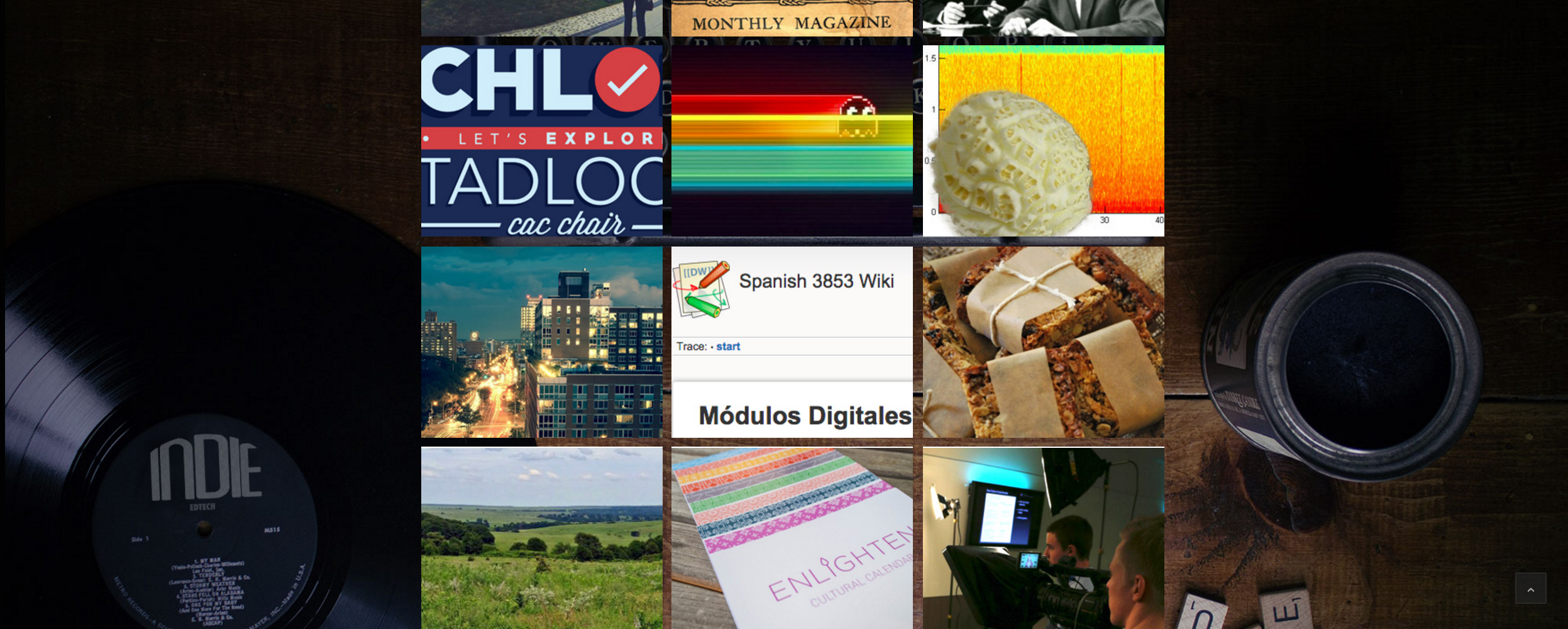
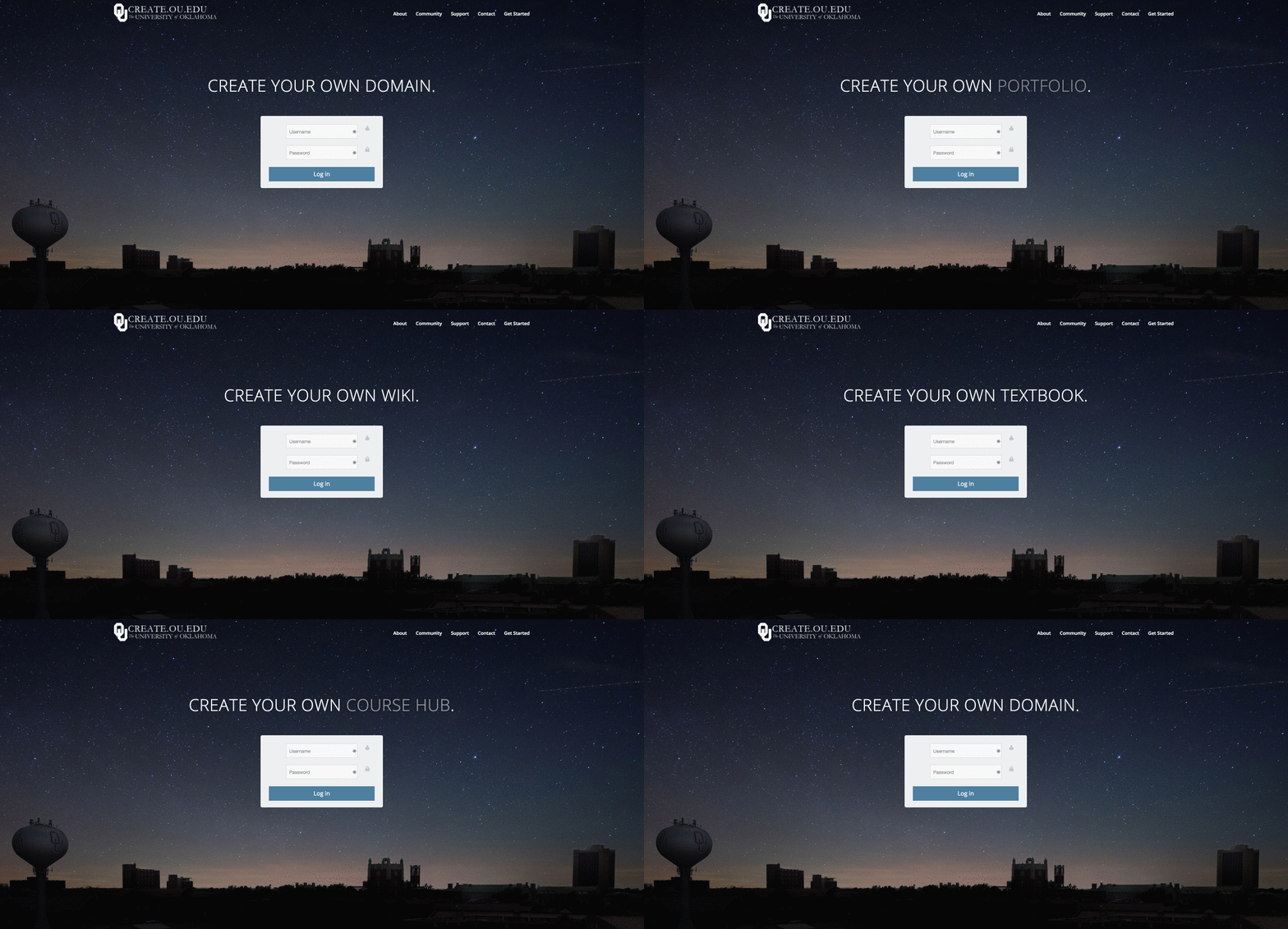
University of Oklahoma’s Domain project OU Create has gotten a redesign, and I absolutely love what they have done. The above GIF—which is just the tip of the iceberg of their new site—captures the possibilities of a Domains project better than any post I could write (linger on it). OU continues to push hard on their domains work, and the fruit is everywhere apparent. They are a brilliant example of the fact that you don’t need an army to run a domains project, just some old school hard work and dedication. What’s more, they are subtle. Check out the subtle love letter to indie edtech in the background of another section of the homepage. Can you find the indie album?

Screenshot 2016-01-22 18.08.53

OU Create

The fact that Oklahoma is have so much fun building out their domains project is everywhere obvious, but their ability to also build an aesthetic and an ethos around their work is a sign that this could be a much broader shift in the academic web culture of the university.  And that’s the thing. It’s the work that matters, and it’s everywhere apparent at Oklahoma!

Posted in reclaim | Tagged , , | Leave a comment

The Forgotten Advantages of VHS

Posted in Console Living Room | Tagged , | 2 Comments

bavaconsole

I spent a few industrious days back in Fredericksburg. For all the smack I talk on the burg, it was good to be back. I got to spend some quality time with Tim talking Reclaim Hosting and more. I also got to meet up with some UMW folks like Mark Snyder, Zach Whalen, Jon PinedaBecky Brown, Jeremy LaRochelle, and Garrett Bush. I was pleasantly reminded how many good people I’ve gotten to know over the years.

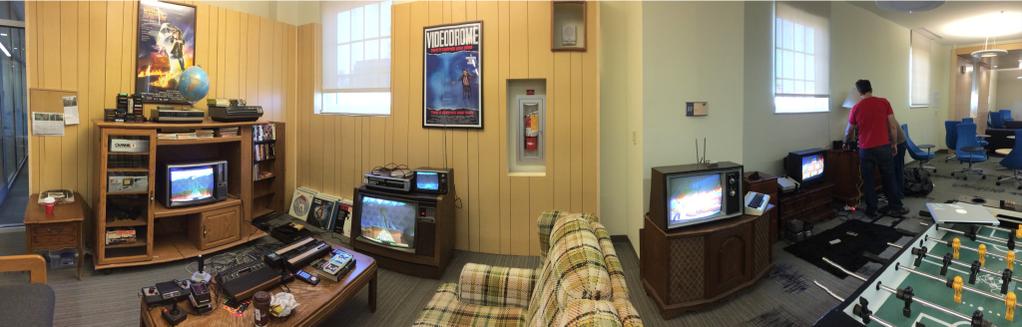
I haven’t been gone from Fredericksburg or UMW for long enough for a return to be of any real concern, but I did have some business to attend to. I needed to do some work on casa bava, which has been on the market for a few months now. I ran out the door in early October for Italy (minus one cat), and I left a few loose-ends unattended in my haste. I took a few days to clean the house, boxing up some more stuff, fix the kitchen faucet, repair the basement sink, and collect some stuff we left behind. But probably the most important piece of business I needed to attend to was retrieving all the stuff I contributed to the Console Living Room exhibit that ran for the last nine months at UMW.

CCelBNJWgAAayMN

The Console Living Room at UMW

I got an email a few weeks back from Zach letting me know that the exhibit was finally being retired. I was a bit sad, but at the same time I took solace in the fact that it’s being ephemeral may make it that much more powerful in the collective imagination of many, many generations to come. [Like it or not, this is how I think.] What’s more, it was only supposed to last two months max, but it resonated with folks and ran for a solid 9 months. Upon hearing it was over, I was eager to try and save all the things I bought for the exhibit, such as a refurbished betamax player, a Panasonic VCR, a component stereo system and speakers,  at least two TVs, two Atari 2600s, several game cartridges, tons of VHS and beta tapes, albums, cassettes, comics, games, books, and more. It was a treasure trove of stuff for me, and a part of me felt sick thinking I might never see it all again. Zach agreed to take some time out of his weekend and meet me at UMW to deal with the aftermath.

UMW Console: the aftermath

There wasn’t much left of the actual exhibit. Pretty much all the furniture was gone, and in it’s place was five TVs and a record player piled up in the corner. It looked like a Nam June Paik art installation. Zach had put all the actual media in a storage closet, so we spent an hour or so sorting it out and boxing it up for me to take home.

Remains of the day

There was a lot of stuff, in fact a table full, and we made short work of splitting it up and accounting for who loaned us what, etc. It was kinda of nice to sit around with Zach for part of an afternoon and reflect on the exhibit, enjoy how cool it was, and bring some closure to the whole thing. It meant a lot to both of us, and it was one of the coolest projects I have ever been a part of at UMW. The planning process last Spring was pretty much two months of unadulterated fun imagining, shopping, and then building out the living room. And if that wasn’t enjoyable enough, the great reward of watching so many others from around campus enjoy it in real time through a shared physical space sealed it. So, we wrapped it up and brought everything back to my house that is currently for sale.

Bavaconsole

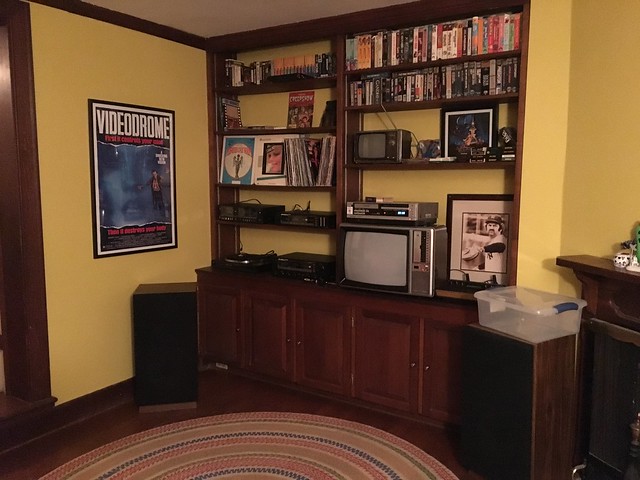
But rather than keeping it packed up, I got the urge that night to actually set the exhibit up again in my den. Completely irrational, I know. I won’t even really be able to enjoy it but for more than a few days, but I couldn’t help myself. I spent the better part of the next morning transforming my den into a 1980s console living room, which I am affectionately calling #bavaconsole. I came back to Freddy to pack up and pare down, but instead I accumulated and unpacked even more junk. For the record, no one can ever accuse me of being practical. That said, it makes me very, very happy knowing it is there, and that’s all that matters.

Posted in Console Living Room | Tagged , | Leave a comment

Coffee and #ds106 at FredXchange

CYw1qiyWcAAUQyn

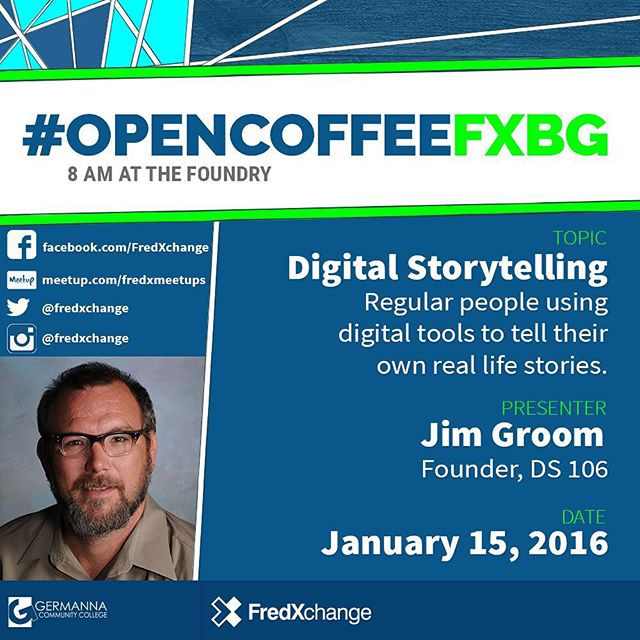
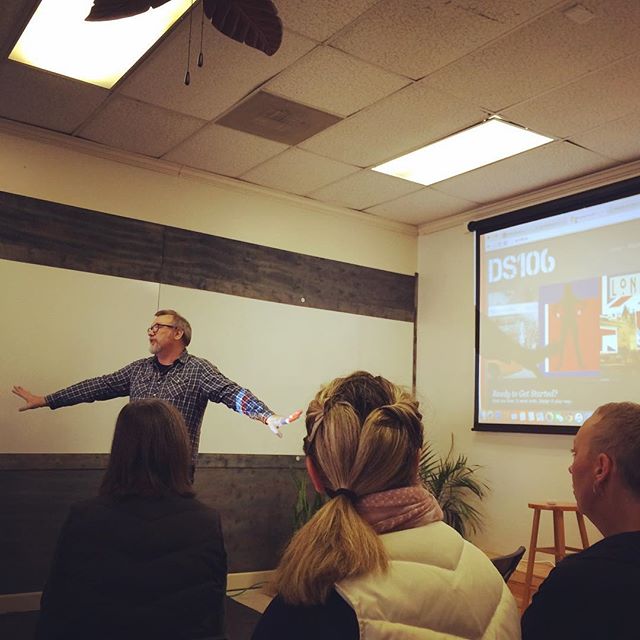
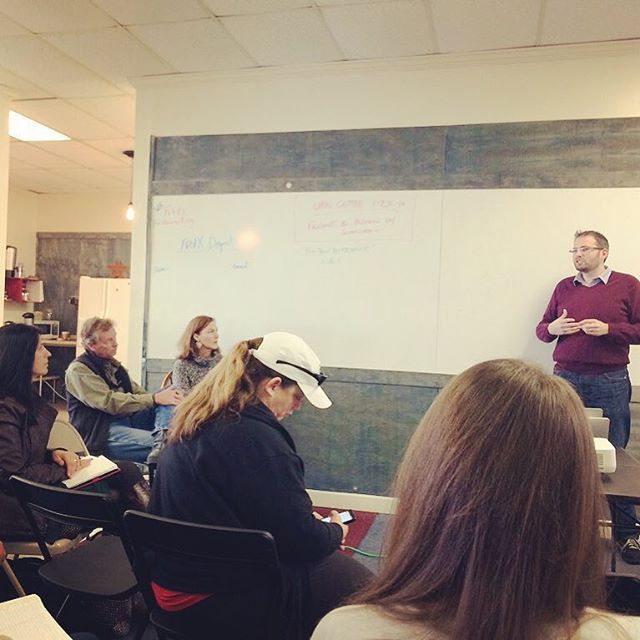
I am back in Fredericksburg for a few days for some business and house cleaning. I head up to NYC on Tuesday, so it will be a fairly quick turn here, but it’s always exhilarating to spend some quality time with my pardner Tim Owens. Yesterday was particularly eventful because we we’re invited to talk at an Open Coffee Event hosted at the Foundry, the new co-working space  in Fredericksburg brought to you by the good people of the FredXchange.

12407529_203904386621759_989721171_n

The story of how this came about is another bizarre testament to the wonder of the web. Libby O’Malley, one of the movers and shakers behind FredXchange, emailed me out of the blue a few weeks back asking me if I wanted to talk with the folks at the FredXchange about the venerable and righteously right ds106. She informed me that she had found out about that international gem through doing a google search for “Digital Marketing Degree,” and ds106 was mentioned as a free alternative in an article that was a top-hit . I think it may have been this article, but I’m not sure. Look ma, no SEO!!!

Crazy, I told her I am in Italy living like a pimp daddy in the old country, to which she suggested I come in via Google Chat. As much as I love the internet, I hate remote presentations. They can be done well, but the amount of work it takes to create the conditions of a good remote presentation versus simply being there is staggering. That said, I did know I would be in Freddy for a few days and threw that out and she agreed. I’m glad she did.

12547195_217760811892155_1759698265_n

I have been in repose in my mountain villa in Italy mustering as much thought leader mojo as possible. It’s hard work, and I don’t recommend it for the faint of heart. Being a visionary is extremely demanding, especially in a country that is steeped in the hairy legacy of Lucio Battisti. But ed-tech pioneers persevere, and I knew it was time to get back on the road after 3 months of intensive meditation. And what did I do? I got nostalgic about the past—but I blame that on my new surroundings.

More seriously, I hadn’t presented for a few months, which is a good while for me. It felt good to talk about ds106. It just never gets old, and once I get going I feel as passionate about it as I did in 2011. It was pure in my heart. Tim and I didn’t have a presentation prepared, or even a plan really. We talked briefly about an outline on the car ride over. Early days of the Bluehost experiment at UMW -> UMW Blogs -> ds106 -> Domain of One’s Own -> Reclaim Hosting. It’s interesting to look at that narrative progression and to see ds106 at the center of the story. I think that’s pretty accurate. ds106 galvanized a community, brought Tim and I into contact, and reaffirmed that the Domain of One’s Own experiment wasn’t all that crazy at scale. I took the first 10-15 minutes talking about the Blue Host Experiment, UMW Blogs, and the beginnings of ds106, and Tim took the last 10-15 minutes talking ds106, Domain of One’s Own, and Reclaim Hosting.

10413901_1645532262375051_656298805_n-1

It was quite fun, and I really enjoyed being back in front of a group of people talking about this stuff with Tim. One of the things about my work with Tim that is so rewarding is that we truly do have an amazing partnership. We agree on the fundamental principles undergirding Reclaim Hosting: fierce independence and freedom online! What’s more, we push each other to keep going further. Tim has an insane standard for the quality of work and support that defines Reclaim, and every day I wake up knowing that it is the goal. When people come to Reclaim they get the best ed-tech support anywhere. Period. I stand by that statement. Try me, I dare you.

It was awesome to be back in Fredericksburg hanging with Tim Owens sharing the work we’ve done thus far and planning for what’s to come. In short, taking care of dot.bizness.

Posted in digital storytelling, Domain of One's Own, reclaim | Tagged , , , | Leave a comment

Luke Skywalker liked me!

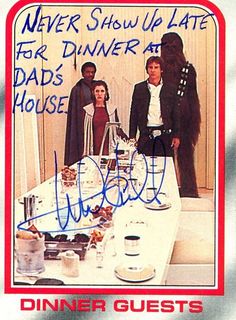
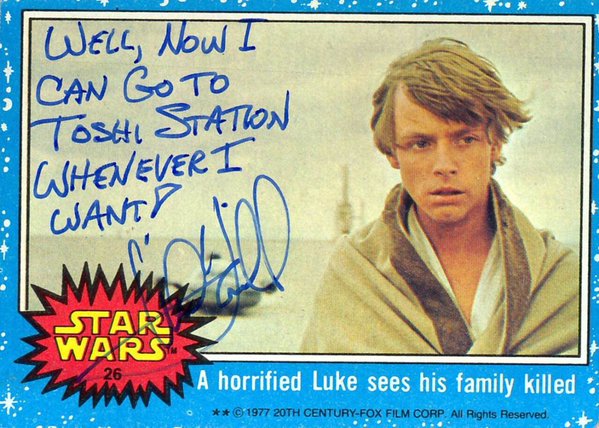
Before this get subsumed into the black hole that is Twitter’s timeline, I just wanted to leave a trace of the real Mark Hamill liking one of my tweets. I know it is shameless, and even more given that I stopped being impressed by that franchise since The Empire Strikes Back (1980)—and more recently I’ve begun to actively resent it.  That said, few events in my childhood were more impactful on my young imagination than Star Wars (1977). Sitting in a theater during the 1970s watching a young Luke Skywalker dodge a Tuscan Raider’s gaffi stick blew my mind. Luke was my boyhood hero from about 1977 through the early 80s, some pretty formative years. So, it was not nothing when Mark Hamill liked a Tweet of mine—who needs paparazzi when you have Twitter?

But probably more interesting to folks is the conditions through which this happened. Through a random Retweet in my stream I discovered that Mark Hammil was using Twitter to confirm the authenticity of various autographs people had from him on their Star Wars collectibles with the hashtag #beatthedealers. That is a wild enough use of twitter I hadn’t considered, but what pushed me to Tweet about it was some of Hamill’s hysterical autographs:

CXTADdmUkAA_Wll

Or this one:

CXVvhL2WEAAIoRT

Or my very favorite this one:

CXS9YHdUQAADa5k

This might all be part of the behemoth marketing event that is the Star Wars franchise, but for a moment Luke Skywalker seemed real to me again thanks to Twitter. Hamill seemed to be enjoying the moment, throwing a ton of fans some love, and reaffirming for me yet again that we live in bizarre times. What’s more, it didn’t hurt my own dad cred when I showed my kids that Luke Skywalker liked my tweet. They almost listened to me on that day 🙂

Posted in film, fun, pop culture, star wars, twitter | Tagged , , , , | Leave a comment

Installing Omeka S Alpha on Reclaim Hosting via Command Line

omeka-298x300Early yesterday morning I got two requests to setup Omeka S for folks on Reclaim Hosting. The first question I asked myself is, “What the hell is Omeka S?” Thanks to Sharon Leon’s post on the software, I now know:

Omeka S shares an ethos with Omeka Classic(2.x), but none of its code. There are a nice range of features for Omeka S that should make it appealing both to cultural heritage institutions and academic and research libraries, including:

*the ability to administer many sites from a single installation;
*a fully functioning Read/Write REST API, which the system uses to execute most of its own core operations;
*the use of JSON-LD as the native data format, which enmeshes the materials in the LOD universe;
*native RDF vocabularies (DCMI Terms, DCMI Types, FOAF, BIBO);
*and a set of modules to aid integration with Fedora, DSpace, Zotero.

Omeka S seems to be the next generation of Omeka, and the fact that it has  a multisite feature built-in, as well as REST API functionality and JSON data format is more than promising. The interest amongst Reclaimers yesterday was most likely spurred by this post on Digital Humanities Now featuring Sheila Brennan’s presentation on Omeka-S at IMLS’s Focus conference in New Orleans.

The good folks at the Roy Rosenzweig  Center for History and New Media have been a constant source of support for us at Reclaim Hosting since the very beginning, and Reclaim never forgets its friends! What’s more, Omeka continues to be one of our most heavily used applications, so it makes good sense that we would try and support folks exploring Omeka S. That said, it’s still Alpha software, so there is no Installatron installer for it yet.

In order to install Omeka S I had to do a little commando lining thanks to some tips from Tim “R2D2” Owens. I tried to download and upload the zip file through CPanel’s file manager, and then install the application from there, but that continually failed me.  So, that may not work for folks on Reclaim Hosting. That said,  I can vouch for the following method using terminal/command line.

Note: Before you start the installation, you need to create a database and user for this application. Use the MySQL Database Wizard in CPanel to create a database and be sure to record the username, database name, and password. Also, you should probably create a subdirectory or subdomain that you will install the application in. For the purposes of this tutorial, that subdomain will be called “test.”

First, login to your terminal. You do this using the FTP username and password  you received in the Welcome email from Reclaim Hosting. Once you have them, the login looks like this:

ssh [email protected]

After that, you will be prompted for the password, be sure to use the FTP password we sent you in Welcome email.

Now you use the following commands to get your application up and running.

Run the following command from inside the folder you created, for this example that will be the directory test.

wget https://github.com/omeka/omeka-s/releases/download/v0.4.0-alpha/omeka-s.zip

Then unzip the application:

unzip omeka-s.zip

Now we need to move everything in the omeka-s folder up one level in the test directory.

mv omeka-s/*

This following command moves all the hidden files in the omeka-s folder up one level as well.

mv omeka-s/.* .

The next commands removes the omeka-s directory, which should now be empty.

rm -rf omeka-s*

Finally, we will need to edit the database.ini file and add the database info we creating using the MySQL Database Wizard.
Use the following command to edit the file:

nano config/database.ini

Now you will add the database details to the file, it should look something like this:

user     = "testacct_admin"
password = "yrp@ssw0rd"
dbname   = "testacct_omekas"
host     = "localhost"
;port     =
;unix_socket =

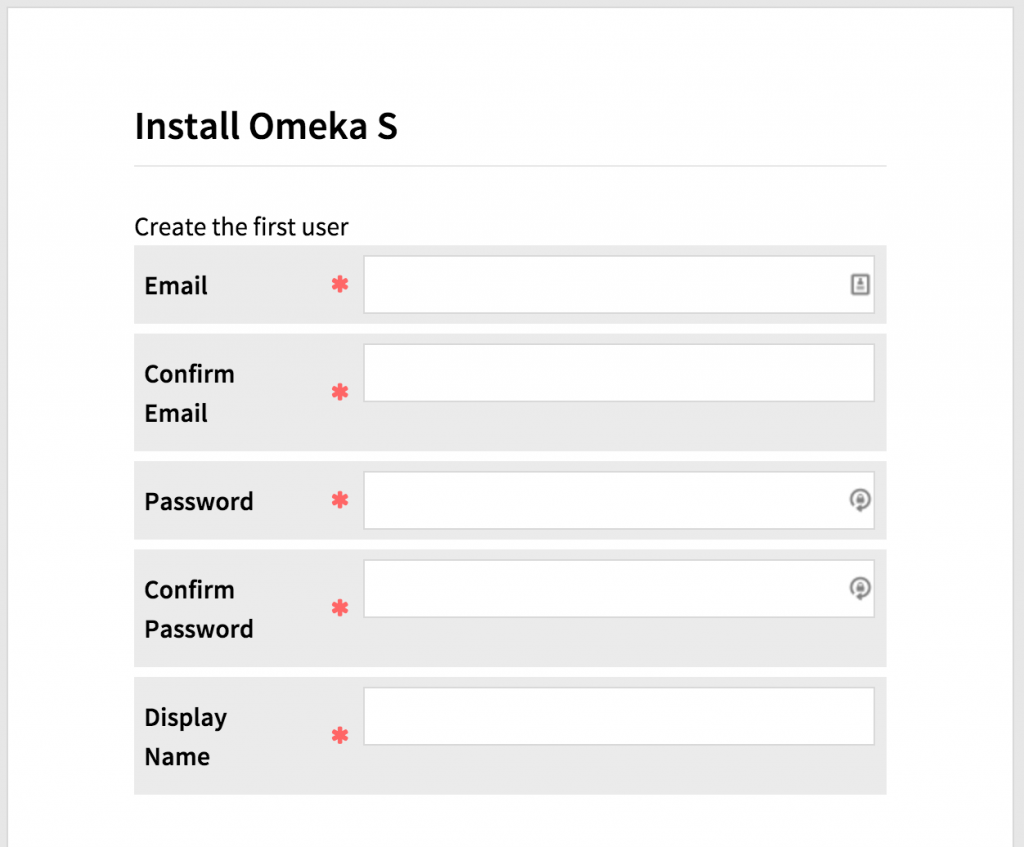
Click ctrl + x to save the database.ini file, and you should be all set. Now you jsut need to navigate to the URL you were installing Omeka-S, such as http://test.mydomain.com, and you should see the following screen asking for you to create the first user and password:

Omeka-S
__________________________

For server admins only:
If you are managing the server and installing Omeka-S for a client, use the su command to assume the role of that user so there is no need to change permissions afterwards. For example, if I was logged in as root user, and wanted to assume the role of jimgroom, I would type the following command as soon as I login:

su jimgroom
Posted in reclaim | Tagged , , | 5 Comments

UMW Blogs Stats by City from 2010-2016

In yesterday’s post about the last six years of stats on UMW Blogs, I suggested that, based on the aggregate number of users, sessions, and pageviews, UMW Domains has not cut significantly into the usage of UMW Blogs:

So, there goes the theory that UMW Domains would cut significantly into the usage of UMW Blogs. It may not have grown as much as it did from 2010-2013, but it has not declined significantly either. Interesting. One of the things it points to right away is that there seems to be more than enough demand for both. I have no idea what the future will bring to this system, and I am officially off the case.

But even after writing that something seemed wrong about it. There’s a finite number of faculty and students doing digital work at UMW, and the introduction of an entire web hosting platform would have to impact UMW Blogs usage on campus to some degree. So, while mulling over this inconsistency in my post I figured one way at this question might be to look at the number of people accessing UMW Blogs in and around Fredericksburg, Virginia over the last 6 years. That is data Google Analytics gives you, and they even let you import it neatly in Google Spreadsheets. So, I did. Below are six graphs ranking the top ten highest number of sessions from cities around the world by year.

2010
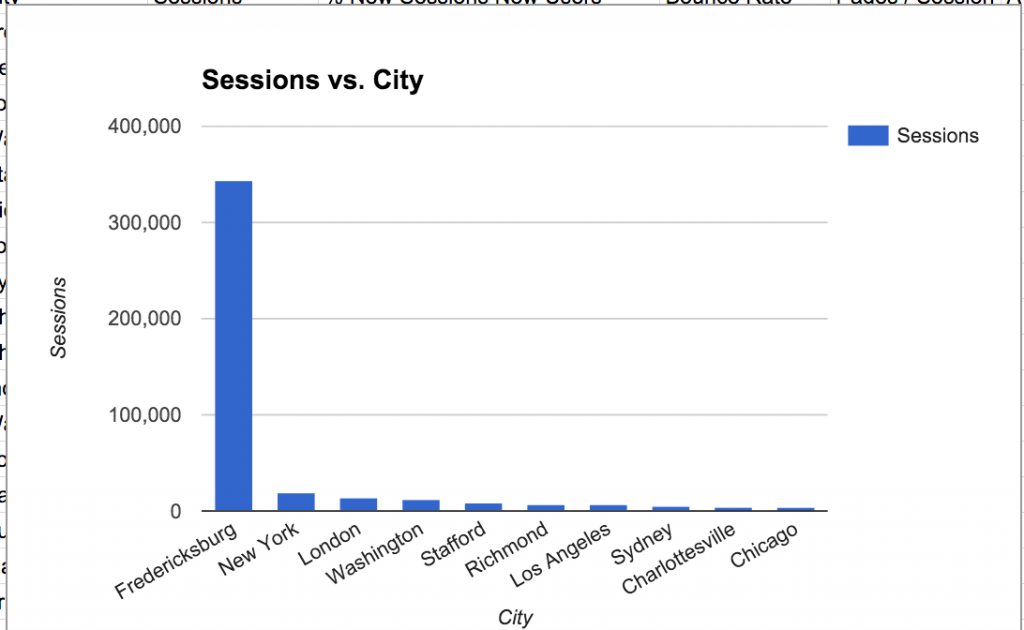
Number of sessions on UMW Blogs in 2010 from cities around the world.

Number of sessions on UMW Blogs in 2010 from cities around the world.

City Sessions
Fredericksburg 344,539
New York 18,946
London 13,921
Washington 11,744
Stafford 8,110
Richmond 7,461
Los Angeles 6,281
Sydney 4,607
Charlottesville 4,222
Chicago 4,109

In 2010 it’s fairly clear that Fredericksburg (as well as neighboring cities in the region like Stafford, Richmond, and D.C.) make up a vast majority of the site’s traffic. NYC and London have a decent showing, but it predominantly Mid-Atlantic.

2011
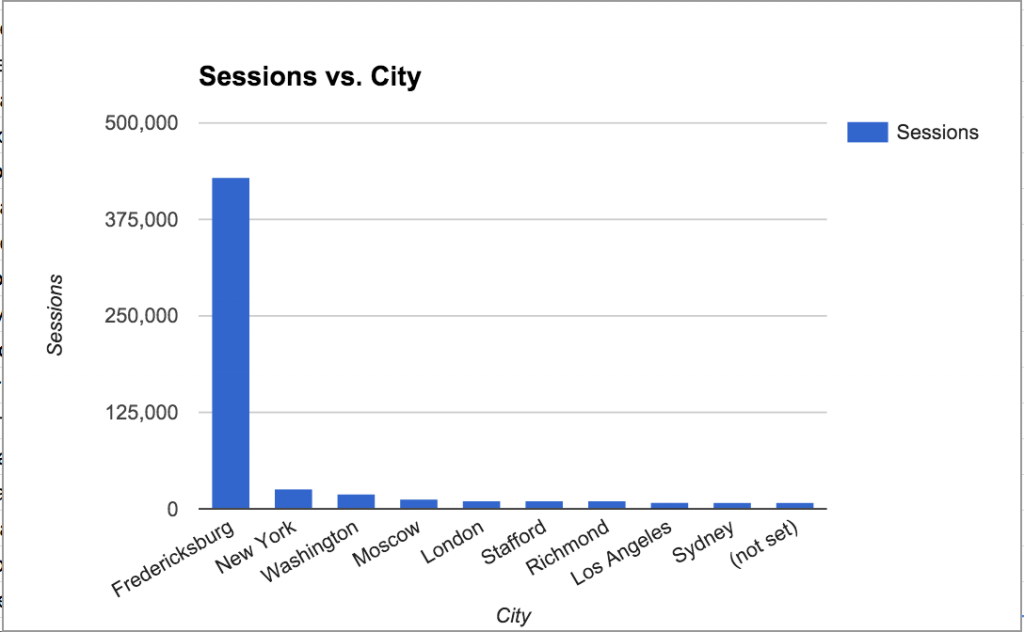
Number of sessions on UMW Blogs in 2011 from cities around the world.

Number of sessions on UMW Blogs in 2011 from cities around the world.

City Sessions
Fredericksburg 430,483
New York 25,836
Washington 20,753
Moscow 12,155
London 10,459
Stafford 10,109
Richmond 10,065
Los Angeles 9,711
Sydney 9,579
(not set) 9,463

In 2011 the traffic is even more centered around the Fredericksburg region than 2010, but traffic all around is growing, and we even see two new trends: our first non-english speaking city, Moscow, and the first appearance of “(not set)” in the top ten. Not set could refer to many things, one is there was no pageview associated with the hit. This might also suggest more folks are browsing more securely, which would be an interesting trend moving forward on UMW Blogs if that were the case.

2012
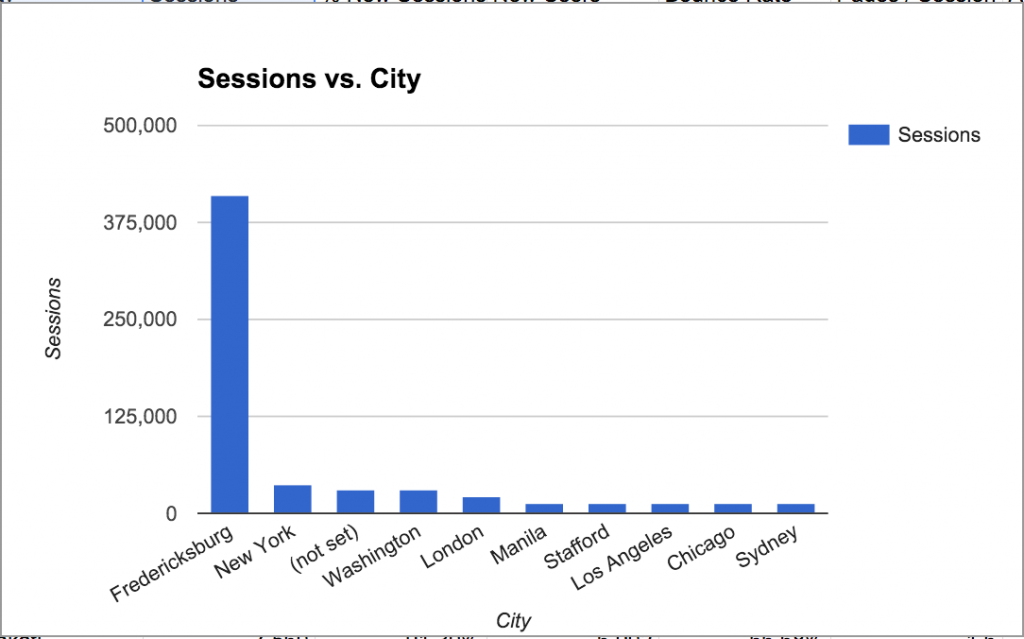
Number of sessions on UMW Blogs in 2012 from cities around the world.

Number of sessions on UMW Blogs in 2012 from cities around the world.

City Sessions
Fredericksburg 410,571
New York 36,585
(not set) 30,545
Washington 29,744
London 22,928
Manila 13,577
Stafford 12,764
Los Angeles 12,474
Chicago 12,273
Sydney 12,121

In 2012 we see a slight decline in Fredericksburg sessions, with an uptick in NYC, London, and Manila. Notice how many more (not set) sessions there are.

2013
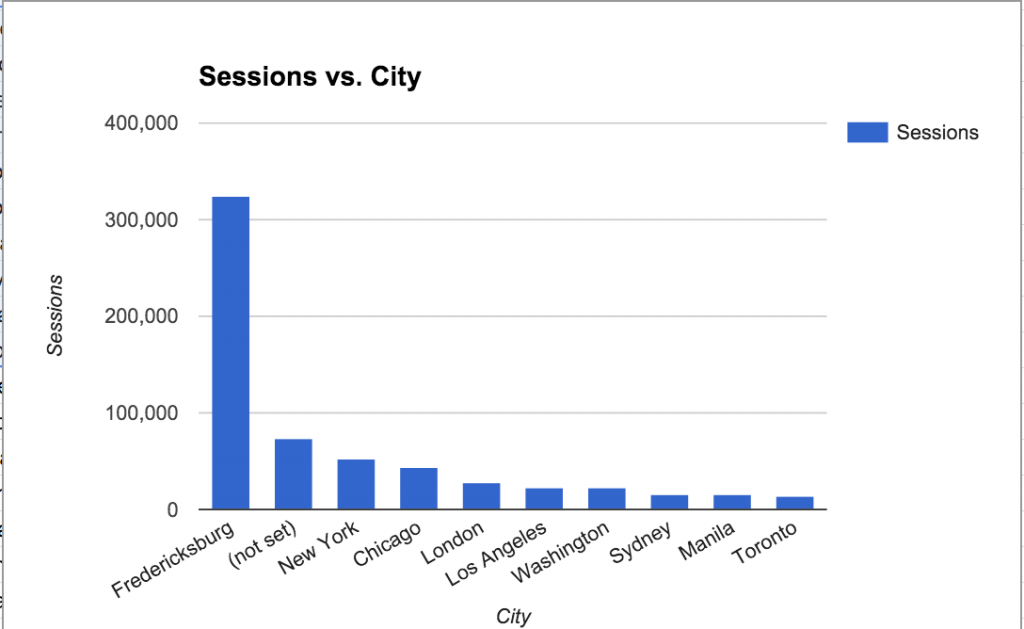
Number of sessions on UMW Blogs in 2013 from cities around the world.

Number of sessions on UMW Blogs in 2013 from cities around the world.

City Sessions
Fredericksburg 323,705
(not set) 72,931
New York 53,312
Chicago 43,717
London 28,328
Los Angeles 22,679
Washington 22,183
Sydney 16,611
Manila 16,004
Toronto 13,937

2013, the year we officially introduce UMW Domains, we do see a fairly significant falloff in the Fredericksburg area. With international cities like Sydney, Manila, and Toronto burying regional cities like Stafford and Richmond that were more prevalent in prior years. Also, sessions from (not set) more than doubled from 2012, while NYC, London, Manila, Chicago, and LA increased sessions while Washington DC did not. We have the first Canadian city in the top-ten: Toronto. And, if these numbers say anything, it could be that increasingly UMW Blogs is garnering a far more global reach.

2014
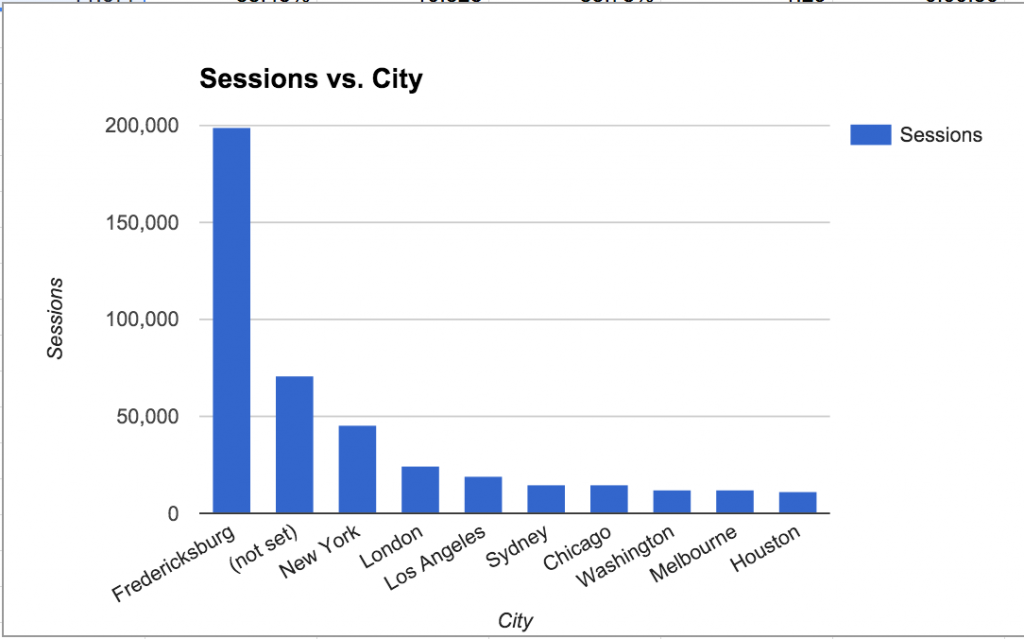
Number of sessions on UMW Blogs in 2014 from cities around the world.

Number of sessions on UMW Blogs in 2014 from cities around the world.

City Sessions
Fredericksburg 199,501
(not set) 70,722
New York 45,261
London 24,123
Los Angeles 19,676
Sydney 15,241
Chicago 14,673
Washington 12,063
Melbourne 11,876
Houston 11,677

2014 marks a fairly dramatic loss of sessions from the Fredericksburg area. With less than 200,000 sessions, Fredericksburg now has fewer than half the peak number of 430,000 in 2011. Something that would be consistent with the growth of UMW Domains. Also, the (not set) entries are pretty significant now.

2015
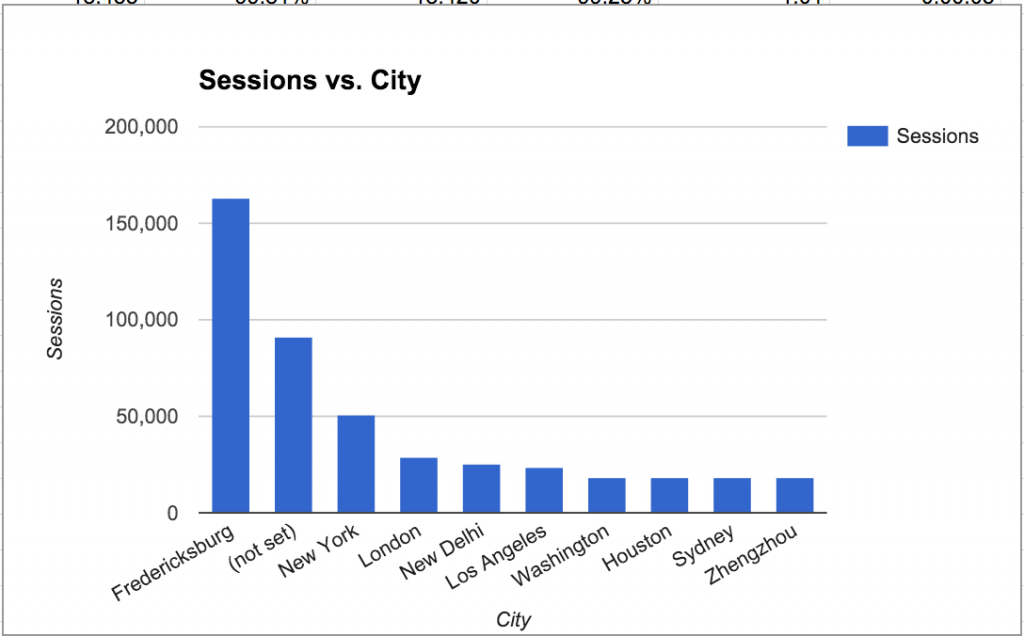
Number of sessions on UMW Blogs in 2015 from cities around the world.

Number of sessions on UMW Blogs in 2015 from cities around the world.

City Sessions
Fredericksburg 163,200
(not set) 91,388
New York 51,123
London 28,742
New Delhi 25,702
Los Angeles 23,906
Washington 18,713
Houston 18,707
Sydney 18,470
Zhengzhou 18,455

Last year we can see the continued fall off of Fredericksburg, and the climb of (not set). What we also see is a pretty wide array of large cities from around the world now. New Dehli, India and Zhengzhou, China represent two new cities in the top ten, and at a glance the decline in localized traffic has been offset by the increase in international traffic. In 2010, the Fredericksburg area accounted for almost 90% of the sessions from the top ten. In 2015, the Fredericksburg area accounted for only 50% of the sessions from the top ten. Whereas the overall number of sessions increased by 1.2 million between 2010 and 2015.

Conclusions?

I think I could say something about the long tail of the internet and all that, but I’m not exactly sure what that means. But it is a bit clearer to me, however, that UMW Blogs is a resource that stretches far beyond Fredericksburg now. I think its evolution from predominantly local resource to having a far more global reach (at least according to number of sessions in regards to cities around the world) is really interesting. That said, it’s use at UMW does seem to be falling off, which raises an interesting question. Is a university like UMW in the business of providing a resource like UMW Blogs that might serve an audience beyond it’s immediate community? What’s more, what are universities broader commitment to some vision of sustaining and archiving a rich resource like this that might be time finite, something that has broader implications for the web.

On the other side of that equation, I’m also compelled by the idea of those cities and with just one session. There are more than a few of those. There’s some equally interesting data on the other end of the telescope, but more on that in my final post in this impromptu series. What I have enjoyed about this interlude into UMW Blogs stats is it has pushed me to think about what these numbers mean from a couple of vantage points. I am not all that compelled by big data in the end, but I am interested in working through how people use these numbers to make sweeping generalizations, and exploring the possibilities and limitations of that kind of storytelling.

Posted in UMW Blogs | Tagged | Leave a comment

My Favorite Watering Hole

My Favorite Ita

I cheated a bit on today’s Daily Create, which asked us to “take a photo of your favorite watering hole.” As soon as I saw the prompt I knew I was going to recycle a short video I took a few months back when I was first discovering the new environment I found myself in Italy.

The above video features a fountain in front of Villa Mersi, a majestic Villa located directly in front of my kids’ school in Villazzano, Italy. I took the clip and uploaded it to Vimeo. Then I used GIFFY to make a quick GIF. I don’t have too many applications on my machine these days; I’m doing almost everything online. But I debated downloading GIMP and MPEG Streamclip to make this one perfect, but I chilled. I think the point of this GIF, and the post more generally, is that my immediate surroundings could not be further from the reality of the Old West. I think that is part of the reason I am excited about the Western-themed version of ds106. It’s a link back to the mythical motherland.

tex-2That said, Italy is well-known for its own fascination with the West, the Spaghetti Western being the more popular example. But there is another pop culture exploration of the American West in Italy that is not as well-known in the U.S., the comic Tex, based on the fictional character Tex Willer. The comic has been around since the late 1940s, and it is still in every Tabacchi you go into. I think I am going to spend some time exploring Tex, given it will help me establish my Italian as well as give me a different perspective on the global phenomenon that is the Old West.

Posted in digital storytelling, Western 106 | Tagged , , | Leave a comment

Six Years of Stats on UMW Blogs

Today is the first time in ten years I will not be beginning a semester at UMW —and that number is 20 years if you count CUNY and UCLA. I’ve spent a long, long time in higher ed, and I’ve always been a fan of the beginning of the semester, seemed to be filled with so much promise and possibility. That said, I am enjoying the fact that on day one of Spring semester at Reclaim Hosting I am entirely caught up and my plate is clear. A great way to start the year, even if it cannot last.

One of the projects Reclaim Hosting has taken on over the last few months is migrating and hosting Virginia Commonwealth University’s WordPress Multisite install Rampages. The site is one of the biggest multisite installs running at a university I know of, with more than 12,000 users and almost as many sites—it’s massive. What’s more, it has grown at an exponential rate over the last two years, and it shows no signs of slowing. Tim has led the charge migrating and customizing this install to deal with the resource demands of scaling such a site. I hope we can provide a more detailed explanation of how he set it up, but it’s still being tweaked and balanced for performance, so we (royal for Tim) will have our hands full with that early this semester.

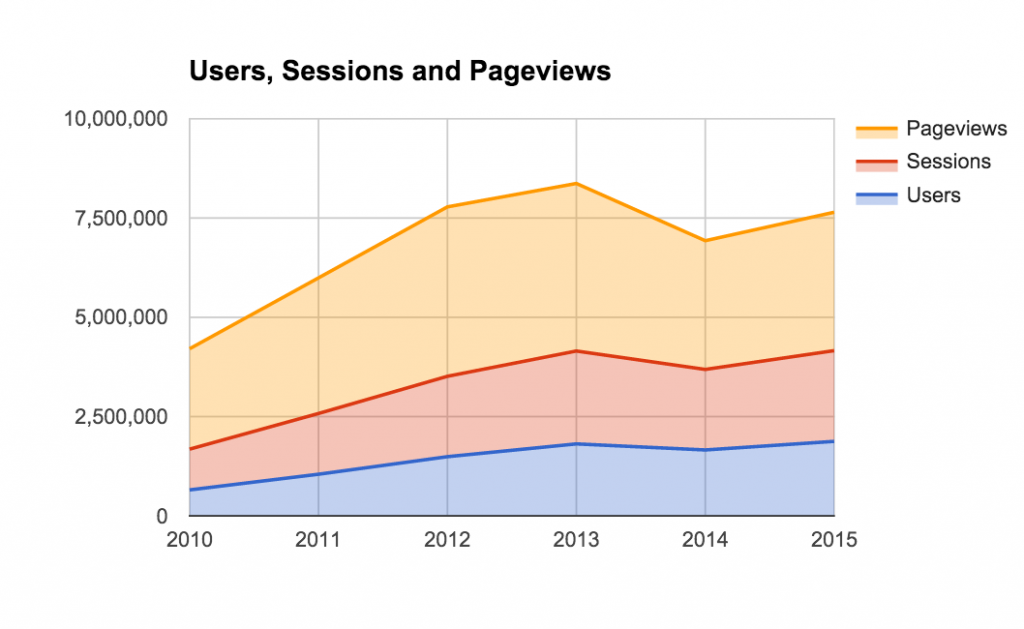
While trying to gauge the setup and the demands on such a system, I was looking through some of the historical traffic we got on UMW Blogs over the last six years, and once I got into it I couldn’t help myself. I’ve been pretty good about letting the work I’ve done at UMW go. In fact, it was fairly easy given the group I worked with is entirely gone now. But one thing we theorized about in 2013 and 2014 was the idea that UMW Blogs role would wane with the advent of UMW Domains. It makes sense, right? The more folks you have getting their own web hosting and domains, the less that need a blogging platform like UMW Blogs. So, given I have the historical data for UMW Blogs in Google Analytics, I ran a quick comparison year over year from 2010 through 2015 measuring the number of  sessions,* users, and pageviews for each year to test this theory.

Screenshot 2016-01-11 16.32.46

Update: Previous graph was had sessions and users mislabeled, that is now fixed.

Turns out that the year we started Domain of One’s Own was the biggest year for pageviews on UMW Blogs historically. And while there was a slight dip in 2014 for users and sessions (with a bigger decline in pageviews), that was not true in 2015. In fact, the number of sessions and users were both the highest on record, and the number of pageviews was up by more than 260K.

2010 2011 2012 2013 2014 2015
Sessions 1,026,145 1,529,364 2,024,241 2,338,962 2,027,602 2,284,683
Users 653,938 1,048,703 1,490,398 1,812,565 1,659,803 1,876,137
Pageviews 2,527,780 3,414,883 4,266,295 4,218,162 3,241,595 3,484,666

So, there goes the theory that UMW Domains would cut significantly into the usage of UMW Blogs. It may not have grown as much as it did from 2010-2013, but it has not declined significantly either. Interesting. One of the things it points to right away is that there seems to be more than enough demand for both. I have no idea what the future will bring to this system, and I am officially off the case. Nonetheless, the numbers provide one testament to this platform that for more than 8 years has proved to be a remarkable open resource. And if we look at just the last 6 years it has served for almost 9 million users who had more than 11 million sessions resulting in 20+ million pageviews. That’s a lot of fish.


_______________________

*Sessions includes repeating visitors from the same IP, whereas users is a distinct user.

Posted in UMW Blogs, umw domains | Tagged , , | 2 Comments

Daily Patterns

Transformative

The above photo, “Transformative,” was my entry for the first #ds106 Daily Create four years ago. The assignment was a straightforward photo assignment: “Create a photograph that features a repeating pattern.” Simple, suggestive prompts like this were very much in the vein of the now defunct Daily Shoot. In fact, the shuttering of the Daily Shoot was the reason we started the Daily Create.

Four years later I find myself on a Daily Create roll. In fact, as I have been doing my creative exercises for #western106, it has inspired four posts over the last four days that I am really proud of. A simple prompt to get the creative juices flowing. In fact, that was the whole idea of the Daily Create for ds106: reinforce the power of the creative habit. That said, I personally come in an out of the Daily Create based on time and interest. My regular creative habit is blogging, but when I mix the two, I find the results much more compelling than usual. Fact is, ds106 has always been a performance enhancing drug for the bava, one that has continued to prove transformative for my practice.

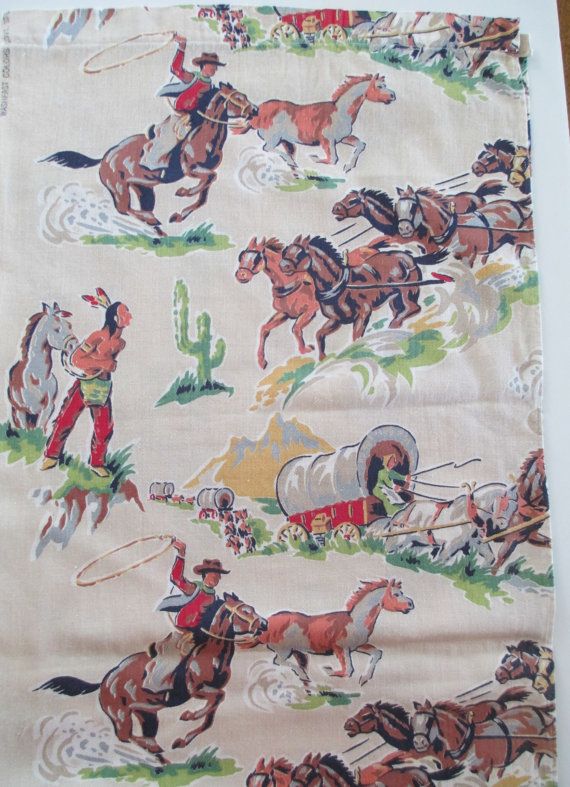
So, for today’s Daily Create I got to thinking of patterns in the Western. And immediately my mind went to Western wallpaper. I was a child of the 70s, so there were still remnants of Western wallpaper while I was growing up. The Western was not only a popular movie genre in the 50s and 60s, it was a broader cultural phenomenon that informed wardrobes, furniture, and even wallpaper. In fact, Western wallpaper was common for a boy’s room, and I remember seeing it in so many of my friends rooms over the years. Here is piece of wallpaper I found on Etsy that is fairly typical of that era, and talk about a pattern!

21b051e10f817947acffff24d5925784

What I love about patterned wallpaper like this is that it’s kind of like a movie. There is a sense of dynamism and movement, despite the fact that everything is static. I think what would be cool would be to create a retro wallpapered room with a pattern like this on LCD walls and build in subtle animated GIFs. Now there is a project for the next house I live in 🙂

Posted in digital storytelling | Tagged , , | Leave a comment