The Psychology of Movie Trailers and the Long Game of #ds106

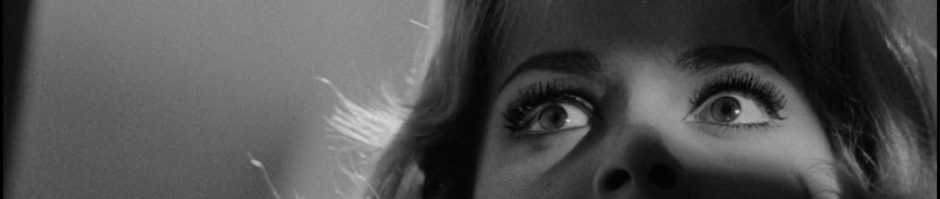
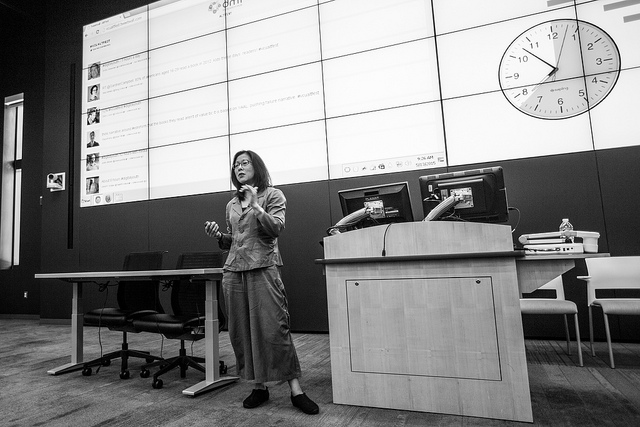
This past week we had the unique opportunity of having an incoming Freshman, Anna Rinko, present to a room full of UMW faculty about the psychology of movie trailers. She was the kickoff speaker for the two-day Digital Media Workshop Andy Rush ran for creating course trailers. It was pretty awesome to have a high school senior introduce the topic based on her research into the physical and emotional effects of movie trailers.

But Anna Rinko is not just any high school senior. Oh no, she’s the soon-to-be-crowned valedictorian of King George High School, as well as a student in the Commonwealth Governor’s School. She also walked last month at a local Virginia Community College after completing her Associates degree entirely online—all before graduating high school. Crazy, right? Anna Rinko is the real deal. And arguably her path to greatness can be traced back to a little class she took during a Summer Enrichment Program here at UMW almost three years ago: ds106—the Breakfast Club edition 🙂

The Breakfast Club Animated GIf of "Two Months Bender"

Anna was part of a two-week ds106 course I ran back in the summer of 2012—which was a total blast. She was hard to forget because she fell in love with video mashups. I featured two of her early trailers on the bava in a postmortem wrap-up of the Breakfast Club edition:

And that’s just the tip of the iceberg. We had another awesome mashup wherein Anna took <em>Bedknobs and Broomsticks</em> (1971) and remixed it to be a horror film:

[media id=24]

Or her trailer of Prehistoric Women which focuses on the truly stronger sex—yet another politicized video in all its b-movie glory!

[media id=26]

Since that summer Anna has been sending me links to her more than 50 mashup trailers she’s done since she took ds106 three years ago. It’s like we’re email pen pals, although she did all the work. I was just like, “You rule!” Earlier this year Anna asked me to be a faculty adviser on her senior research project that culminated in the 15 minute presentation you can see above. I was truly blown away by how articulate, poised, and generally awesome she is. It’s easy to see why she has accomplished as much as she has in so little time. She conducted a research study on people’s reaction to trailers. As part of the project, she created her own trailer called “Absolute Peace” to show to her research subjects, and then collected information about their reactions. She created the trailer from select BBC videos and used the soundtrack for the Iron Man 3 trailer for maximum effect. It’s a pretty amazing trailer that captures the zeitgeist of our moment

But she didn’t stop at creating the trailer, she collected data and reported back on how her own experiment corroborated the research she had done about the psychological effects of movie trailers, and how that breaks down along gender lines. Brilliant stuff, you can see the slides to her talk here.

One of the things I was surprised to find out was that she applied to UMW. I was not surprised to learn, however, that she was awarded the prestigious Washington Scholarship, which translates into a full-ride for 4 years at UMW. She has accepted, and I have no doubt she will be a truly brilliant addition to UMW. It’s hard to comprehend what she will be able to accomplish at university given how much she has already done in high school. She is operating at an intellectual level well beyond her years, and she handles it all with so much grace and humility it’s hard not to be thrilled for her.

I have to sadly come to terms with the fact that I can take no credit for any of Anna’s awesome. I was fortunate enough to meet her mother, Terry Rinko, at the Digital Media Workshop, and it’s apparent where so much of her sharpness, curiosity, poise, and generally pleasant disposition originate. But I have to say that one of the great rewards of having been doing ds106 for as long as I have now (more than 5 years) is witnessing how a course like this can light a fire in someone as genius as Anna, starting her down a path wherein web-based media creation and storytelling becomes yet another way for her to express her brilliance. Listening to her present to a room full of UMW faculty was definitely one of the best moments I’ve had in my ten year career at Mary Washington.
Posted in digital storytelling, Uncategorized | Tagged , , , | 2 Comments

Six of One

the-prisoner-intro

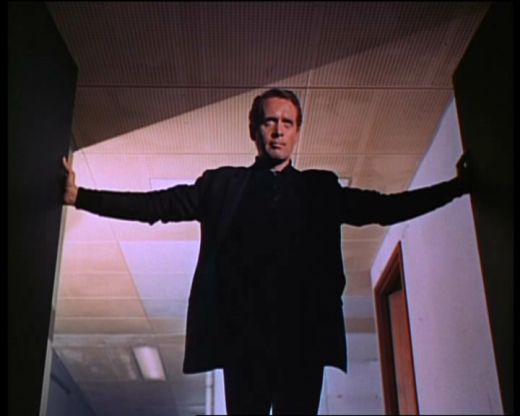
I’m thrilled Talky Tina suggested the 1960s U.K. TV series The Prisoner as the theme for this summer’s open version of ds106 for two reasons: 1) it’s a brilliant show, and 2) it’s a welcome opportunity to get back in the creative habit. Someone (not me!) has created an impromptu site for the “course” at prisoner106.us, and we’ll have to start aggregating relevant posts off a prisoner106 tag once we get a sense of whose playing along. In the interim, the #ds106 or #prisoner106 hashtags will be good places to check-in if you’re interested.

the-prisoner-lotus-o

I’m taken with this theme because it locates me in a very specific historical time and place. UCLA in 1994. I was working on campus in the Audio Visual Services department, and the office was just recently equipped with networked computers that had this new fangled technology called the web. I was enamored. At the same time I was turned on to this psychedelic British show that was all about a government agent that is abducted and imprisoned after resigning his post. People told me it was more than a just a show: it’s an allegory for the police state; a meditation on surveillance; a pastel postcard of dystopia. I tend to think about it as a proto fairy tale version of The Wire —it always comes back to America for me 🙂

hqdefault

Anyway, so what did I do with the world wide web in 1994? Well, exactly what I do with it 20 years later, seek out stuff I am interested in. One of those things was The Prisoner, and I found in 1994 what looks an awful lot like this Six of One site (or was it this one)—the Prisoner fan appreciation site. In fact, I think it still has the same design as it did in the mid 1990s 🙂 I was particularly taken by the story of this fan appreciation group’s first honorary president, which is the bit that anchors this website to my random web searches 20 years ago:

The Honorary President of the society was Patrick McGoohan, who responded to the first contact from Six of One with a telegram which read:

“Profoundly grateful to you and the Society for your interest and understanding. Am honored to accept Honorary Presidency. Blessings to you all. Half a dozen of the other. Be seeing you.” – Patrick McGoohan

The enduring quality of Six of One comes from the fact that we recognize each individual member’s right to interpret the series in his or her own way – or not to bother at all! We provide a forum for debate but at the end of the day everyone makes up his or her own mind. Six of One is run by a number of stalwart members who contribute their spare time to making the society work – from day-to-day administration to stage management of major events such as our Conventions.

How cool that McGoohan engaged the community, and in turn they used his telegram as a springboard to discuss the importance of respecting the multiplicity of interpretations the series engenders. Hence their name, Six of One, which plays off McGoohan reference to “half a dozen of the other” in his telegram. So awesome.

villagemap

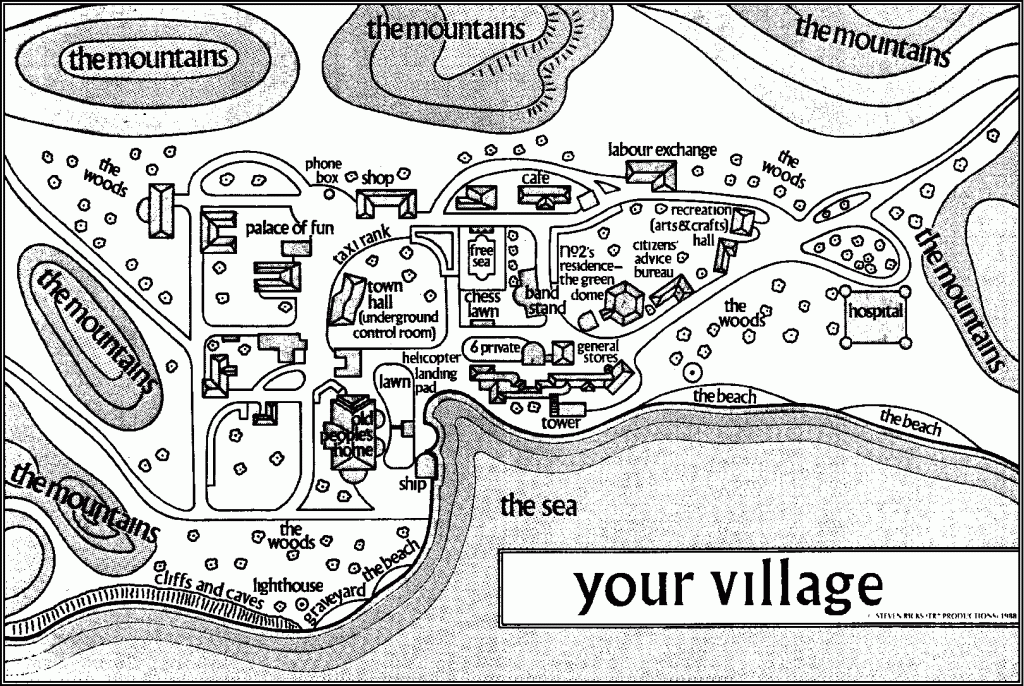
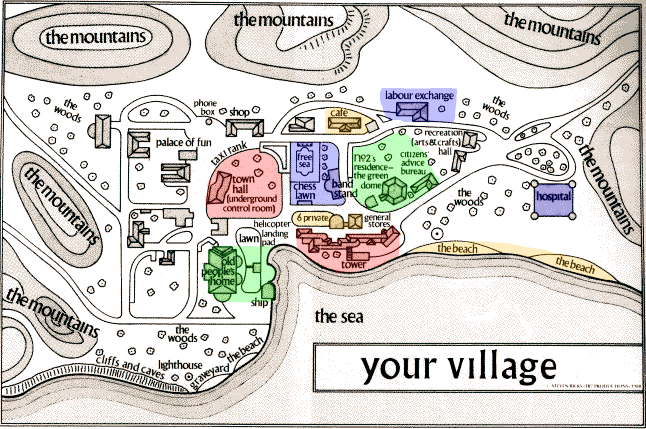
The other thing I would find myself searching for back in the day, and my watching of episode 1, “The Arrival,” two nights ago reminded me of, were the maps of “The Village” (in black & white and color).

map_prisoner

I have to think of a fun assignment for the maps. I just loved this detail of the show. What struck me most back in 1994—which dates me a bit—was that I could download this map (as well as my tax forms) onto my computer and print them out. It seemed truly amazing to me at the time, it was one of the few times in my life when I was truly blown away by a technology.

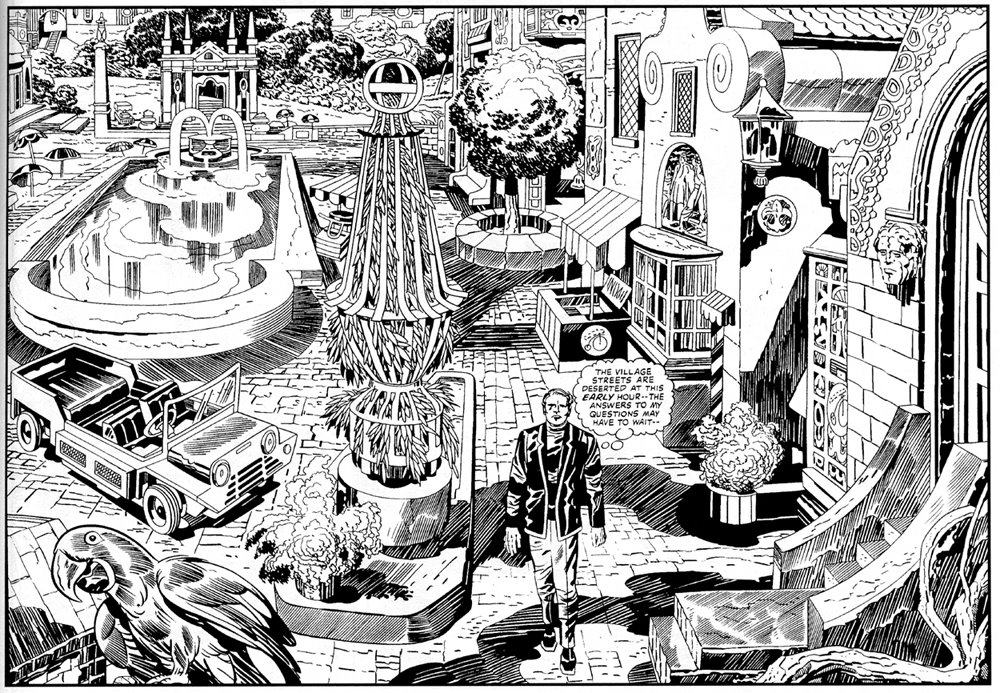
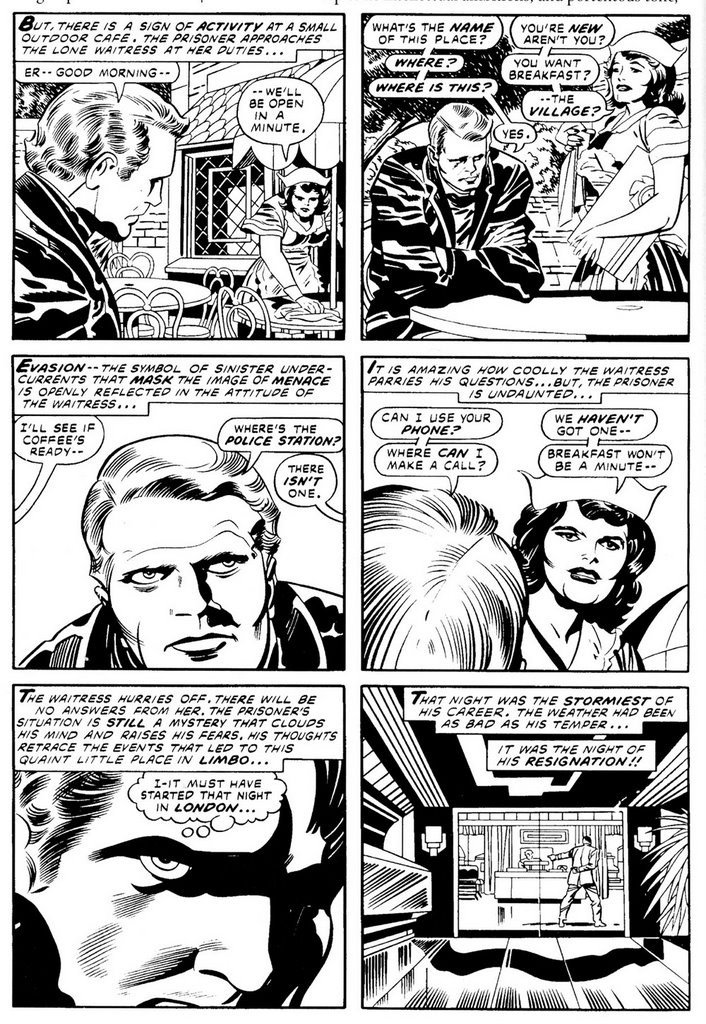
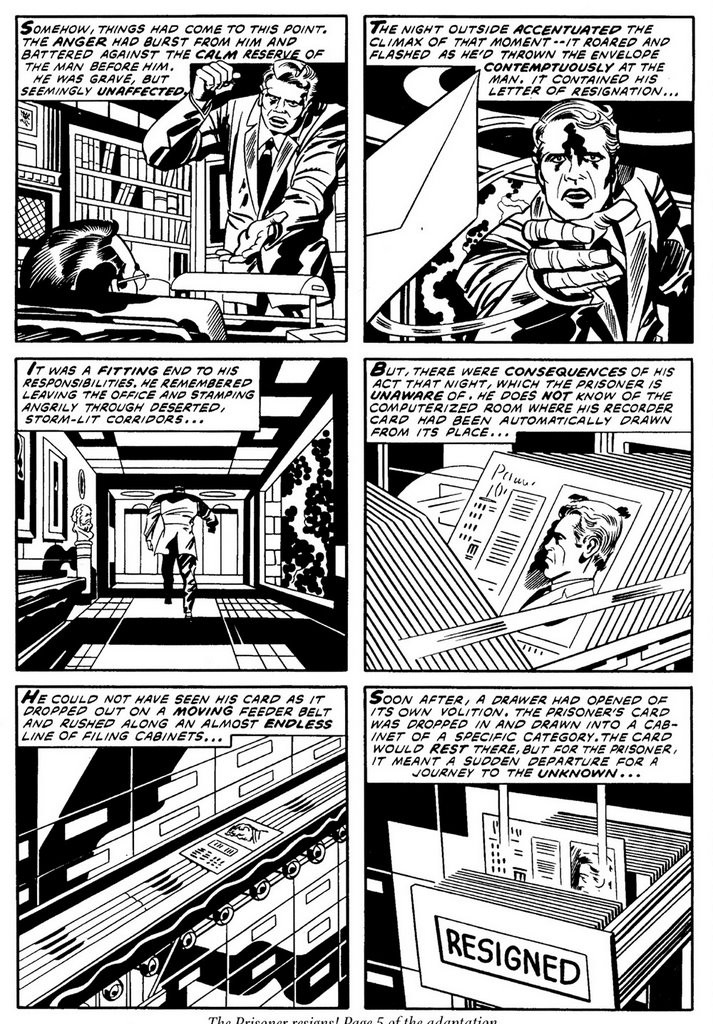
Interestingly enough, while looking for those maps in 2015 I came across yet another Prisoner gem that I think Paul Bond (who is a ds106 prisoner #4life) would appreciate: Jack Kirby’s illustrations of  a planned, but never completed, comic book version of the series. They are gorgeous:

PRISONER_p02_03.1

Page from Jack Kirby’s never completed The Prisoner comic book series

I just want to bust out my pastel crayons and color the images in. What a cool coloring book this would be for the kids!

PRISONER_p04.1 PRISONER_p05.1 The theme of resignation weighs heavily on my mind these days, and I love the way Kirby visuals the opening scene in comic cells. More fodder for some prisoner106 art. Oh yeah, there are also 3 novels based on the series that came out in the late 60s and early 70s.  There were also two video games based on the series made for the Apple II. I want to get my hands on those!
Yesterday Grant Potter posted a link to video about the banned episode of The Prisoner. As he noted in his post:

in the environment of a country torn by the ethics of a military draft, the allegory of refusing to bear arms for the Harmony’s sake proved too much for the network.

https://www.youtube.com/watch?v=AyWbryqboa8

Turns out I still use the web for much of the same things I did 20 years ago. It’s just easier to share my ideas these days (this post being a great example of that), and the congregation of folks around the culture that defines us has never had more potential for good, old-fashioned fun. We are not a number, we are free INTERNAUTS.

Update: Upon another watching of the short video about the banned episode “Living in Harmony” Grant shared, turns out UCLA was one of the campuses featured in the bit about the violent political upheavals in the states. Interesting convergence, especially since the other link here during precisely the moment that video discusses is UCLA linking up with the Stanford Research Institute (SRI) on the ARPANET to give the birth to the internet in October of 1969. Reminds me of Repo Man’s lattice of coincidence that controls the world.

Posted in digital storytelling, Uncategorized | Tagged , | 2 Comments

Interminably Looped

Lately I find myself in in the unfortunate position of being nostalgic for my own thinking, perhaps a sign I’m in need of a change. Last year I had a conversation with the great Vanessa Gennarelli about ds106 and community building. I’m both surprised and thrilled that ds106 remains fascinating to folks, and I never get tired talking about it. That said, I have less and less to do with its magic every passing day. The above clip is a snippet from that conversation culled and interminably looped by the indefatigable Mariana Funes,  This bit was fodder for a longer post by Mariana about teaching happening in the comments. She sums up her pedagogical philosophy as follows:

This semester has made it clear that I am just not interested in the kind of teaching that does not allow me to converse meaningfully with all my students and allows my students to converse with each other and with me.

Amen. And it aligns quite well with how I aspire to teach ds106, although I sometimes fall quite short—such as this past semester when I didn’t comment, interact, converse, and get to know the students nearly as well as I would have liked. That’s my loss. They did a very good job getting to know each other, despite my lack this go around.

But it reminded me of a general sense I have these days that I’m further and further away from the things that get me excited. I’m more a middle manager than anything else, and that is starting to wear thin for me. I have lost all interest in managing people, and my creative and intellectual work is starting to suffer. I’m part of an amazing independent web hosting company that  Tim Owens and I have built over the last two years, but I rarely talk about it on the bava? Why?

Because I feel somehow it’s not right. Despite the fact the work we do at Reclaim Hosting further promotes the work we’ve done (and still do) at UMW, crossing the streams pushes into “murky” territory. I need to feel free to blog the way I want to. In fact, I’ve spent most of this year between two worlds. Imagining the possibilities of the one, while trying to manage the reality of the other. It’s been unfair to both, so I am coming to a moment when I need to make a decision.

I’ve been at UMW for near on a decade now. So much of my edtech identity is tied up with Mary Wash, and my professional relationships run far and deep on campus. My work at UMW has been the result of countless explorations and experiments with faculty partners. We’ve been given space, if not resources, that have enabled so many of cool things to thrive. Whether or not that was always intentional is another question, but it happened nonetheless, and the trace of what was is the “post facto evidence of relationships happening in time and space.” But time goes on, and as much as I love my proclivity for nostalgia, I’m at my best getting excited for what’s to come. Dreaming about the adjacent possible, and pushing for another way. It’s hightime to reclaim my future 🙂

Posted in reclaim | Tagged , | 6 Comments

We’re Only #HumanMOOC

Almost two months ago I was invited to talk about “triggering events to promote cognitive presence” for the Human MOOC. I spent the time talking about the Summer of Oblivion, a ds106 course I taught  during the Summer 2011 at UMW that went off the pedagogical rails in the best of all possible ways. Special thanks to Robin Bartoletti and Whitney Kilgore for running the session, and Dave Hallmon and Maha Al-Freih for driving the twitter play-by-play.

I framed the discussion around the idea of “pedagogies of uncertainty,” a phrase I took from Ray Land after hearing him talk at Elon University back in 2011. I was presenting at the same conference as professor Land, and his framing of threshhold concepts was perfect to help make sense of what it is we were doing in ds106. We were working to dislodge assumed roles of authority, identity, and agency by creating a character, Dr. Oblivion, to teach this online course. Oblivion went missing, the TAs became power hungry, and the course started to teeter on the brink of disaster. In fact, it was a part of a larger narrative that students began to both engage in and rebel against at once, laying bare some of the assumptions we approach online learning with. Last semester’s work with Noir 106 was a another twist on that approach wherein students created and explored their own online fictional environment, taking ownership of the narrative arc of the course.

In fact, I just gave a presentation at VCU ALTfest with Paul Bond titled “Building the Plane in the Air (and letting students chart the course).” This talk outlines how we’ve come to embrace a pedagogy of uncertainty over the course of our numerous teaching experiments the last few years, effectively designing our syllabi around serendipity, student agency, openness, and uncertainty. It’s been some of the most fun I’ve had in the classroom, and possibly the coolest part is I’m not doing it alone. I’ve yet to teach a class by myself since the Summer of Oblivion, which speaks volumes about the importance of collaborative teaching when it comes to uncertainty and decoupling the classroom from a  strict relationship between faculty and students. For example, the Summer of Oblivion had several different “faculty,” “TAs,” and other “authority figures,” but none of them were reliable or stable.

Anyway, this is yet another opportunity I’ve been afforded to talk about Dr. Oblivion and the Summer of Oblivion, the thing I may be most proud of during my time at UMW. And let there be no mistake, it took all of DTLT and many, many more folks to make it great. I was just one of the players in a course that ran off the pedagogical tracks 🙂

Posted in digital storytelling | Tagged , , | 2 Comments

5 Videos Featuring Digital Projects at UMW

Last week I went on a 48-hour video creation and editing binge. It was prompted by an end of the year celebration surrounding the Digital Scholars Institute (DSI), which recognizes some of the amazing work happening around campus. My part of the program was to sit down with a few folks and get a short 2-3 minute video highlighting the digital project(s) they’re working on. I liked this for three reasons: 1) it forced me to make something, 2) it allowed me to start playing with the cyclorama we have in our media production studio, and 3) I got to hear about all the cool projects happening on campus. I already blogged about the video featuring Zach Whalen talking about UMW’s Console Living Room exhibit. So the following videos represent the other projects I highlighted as part of the DSI event last week. I still have a few more in the hopper, but I figured it might make sense to get this stuff out there in the meantime.

Studio Art professor and Gallery Specialist Rosemary Jesionowski discusses the ongoing project she is undergoing to digitize the Ritterhof Martin Gallery collection.

Suzanne Huffman, UMW’s Digital Resources Librarian, discusses the various projects happening in Simpson Library’s Digital Gallery.

Professors Betsy Lewis (Modern Languages) and Andréa Livi Smith (Historic Preservation) discuss their student-driven database WordPress sites. Betsy’s database focuses on Spanish Journals from the 19th and 20th century, whereas Andi’s is survey database of properties in Fredericksburg

Creative Writing professor Warren Rochelle discusses his Wood Between the Worlds project, which Ryan Brazell helped him imagine. What’s more, Ryan wrote a brilliant overview of their project thinking.

Finally, Katherine Perdue, Assistant Systems Librarian, discuss her work creating a web-based interface to access and explore the 80+ years of the student newspaper that has been digitized and hosted on the Internet Archive.

https://www.youtube.com/watch?v=mawVPQkEfkQ

______________

I had a lot of fun with these videos. I brushed up on my Final Cut skills, which are rudimentary. More than anything, I started playing with what you can do with the background on a clean green screen to help supplement the story. I used the green screen to actually show the gallery archive that has been digitized in the background or demonstrate how the high-end digital book scanner works as person being interviewed talks. I even used the video background in the case of Andi and Betsy to poke fun at them 🙂 It was a pretty fun project, and I think these videos can live on as a quick testament to a few of the digital projects we were working on in 2015 at UMW. They are far from perfect, but they did help to remind me how much I enjoy working with video.

Posted in umw | Tagged , , , | Leave a comment

Rasberry PiCade

17433542488_02d038002c_z

Image credit: Tom Woodward

I had a great time at VCU’s ALTfest today. I got to hear Mimi Ito‘s inspiring keynote about #learningheroes—I love that hashtag! I was able to catch up, albeit too briefly, with an old favorite. I also had the honor of co-presenting with two long-time collaborators Paul Bond and Jerry Slezak. Paul and I talked about our various experimental teaching collaborations over the last three years, and then Jerry and I provided an overview of UMW’s new Information and Technology Convergence Center (ITCC). It was a really warm and responsive atmosphere for sharing projects and ideas. Kudos to the VCU folks for making it happen.

Image credit: Tom Woodward

One of my favorite parts of ALTfest was the expo space where they featured everything from a letterpress to Oculus Rift to 3D printers to Leap Motion. It was a compelling carnival of tech possibilities (a nice alternative to vendors), and I had a blast spending some time with Andrew Ilnicki, the Director for Academic Technology for VCU Arts. He showed me some of the impressive projects he’s been working on with Google Glass and Leap Motion. In fact, Andrew is responsible for this post because after we finished talking, he pointed me to the HackRVA setup across the way.

Image credit: Tom Woodward

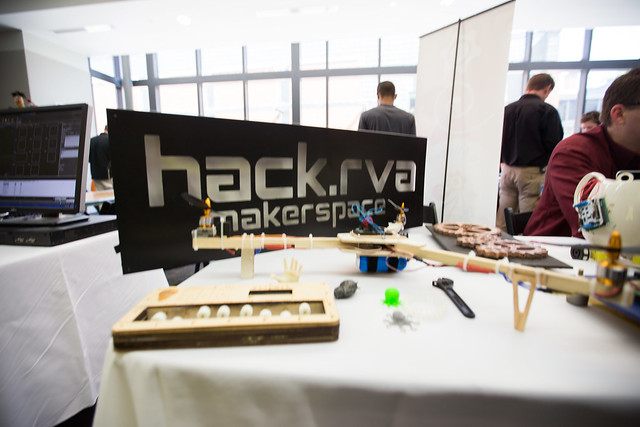
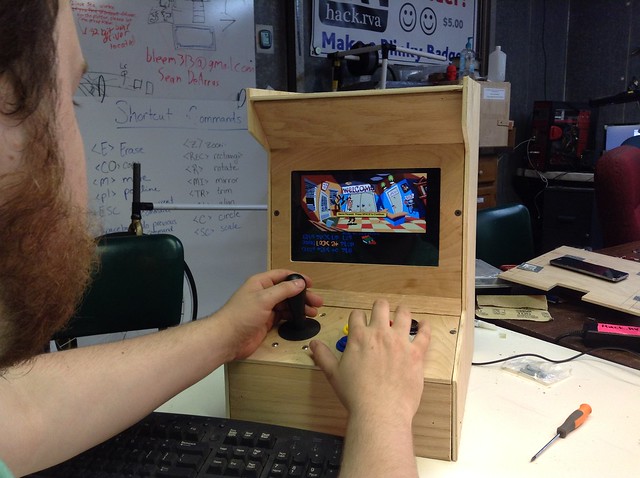
The folks at HackRVA created a mini arcade out of a Rasberry Pi 2 they named the R-piCade. It’s pretty amazing. It plays old gold MAME emulated arcade games like Ms. Pac-man, Donkey Kong, etc, as well as games for the PS1, Nintendo 64, and a few other consoles. What I loved most about it though is the form factor. It’s a table top, portable arcade system.

Image credit: HackRVA Makerspace

I’ve been wanting to build a full-size arcade game with a similar emulation setup, but time and energy has proven elusive. But after seeing this gem, I started to think smaller. The HackRVA Makerspace is having a Rasberry Pi session in mid-July, and planning another session in August dedicated to building a Rasberry piCade. I am committed. Additionally, they have open sessions for doing stuff just like this every Saturday from 1-5 PM, so I could plan a few trips this summer and make it happen. Hope springs eternal in the classic gamer’s heart 😉

Posted in video games | Tagged , , , , | 4 Comments

Zach Whalen on the Vectex and #umwconsole

I have been spending the last two days capturing video of folks at UMW talking about the various digital projects they’re working on. I’m doing this in part for the Digital Scholars Institute (DSI) soirée this Thursday (I like short deadlines), as well as an excuse to make something. We have some pretty cool new digs in terms of a media production studio as well as bitching editing suite, so I’ve been having some fun while Rome burns. The first video I finished was the one above featuring Zach Whalen discussing the UMW Console Living Room exhibit by way of the 1982 game console Vectrex.

It was Zach’s idea to bring in the Vectrex console as a prop, as well as to have the built-in game Minestorm playing in the background. And while Zach was responsible for everything compelling in this video, I shot and edited it—so screw you! What’s cool about this for me is that Zach’s DSI talk about the Vectrex earlier this year is what got us started down the rabbit hole that was the UMW Console exhibit. So, at least for me, the DSI has yielded some really fun, collaborative work this year. I am looking forward to more.

Posted in Console Living Room, Digital Scholars Institute, Uncategorized | Tagged , | 1 Comment

Noir106 Highlight Reel

Maggie Stough’s Highlight Reel from Noir106

There were many, many amazing things about this semester’s noir-themed version of ds106. And I want to try and capture some of them before they slip into oblivion over the next couple of weeks. I’ll start with one of the more radical moves we’ve taken with this class in a long while: including UMW student Maggie Stough, who took the course in the fall, to help design the spring edition. Maggie was part of the planning process from the very beginning, and helped us broaden the original vision of the class from Tech Noir to the Noir genre more broadly—which worked brilliantly and allowed for far more play.

On top of helping us build the syllabus and frame the narrative arc of the course, she  created a transmedia narrative which really took off during the last five weeks of the semester. It propelled the course into brave new territory that we really haven’t explored yet. Students creating characters, building out detective agencies, and articulating complex stories around a series of cases we provided. It was truly a remarkable framework for designing engaged, interactive, and student-driven curriculum. Her work was nothing short of genius, and she documented the whole process on her Noir106 Archive site.

So let this post be a testament to the awesome work Maggie contributed to noir106 as both a student and an instructor, as well as a place holder to note we have only yet begun to imagine the full implications of what Maggie has helped us build in noir106 for the comingiterations of the multi-headed hydra of a creative course!

Posted in digital storytelling | Tagged , , | 3 Comments

#ds106: A Universe in which I have Hair and a Gun

CD9DBYDUsAAKLrR

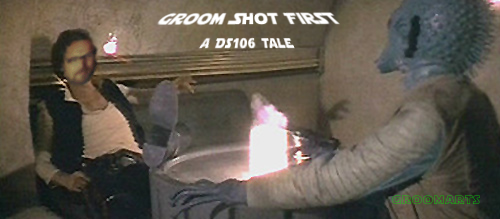
One of this semester’s #ds106 stand-outs (and there were more than a few) was Spenser Scott. He was #4life. And as he was finishing up the semester he wisely chose to do the highest form of ds106 assignment: Jim Groom Art. In fact, he not only did the assignment, but he made a brilliant tutorial for GIMP so others can pay homage to this gloriously beautiful celebrity 🙂

One of the things that Kathy Onarheim noted (who, might I add, has been an amazing open, online presence this spring) on Spenser’s tutorial post is how far he has come with his image editing this semester. And it is so true, take a look at the “Groom Shot First”  comparatively (brilliant concept, btw). What’s more, one of the best photoshops I’ve see all semester was Spenser’s “Groom(ing) the Ewok,” in which the presence of a human face is just barely visible, making it all the more brilliant. The subtlety of his photoshopping makes it.

Groom-Ewok

Posted in digital storytelling | Tagged , | Leave a comment

The Smallest Possible Blog Post About SPLOTS or TSPBPASPLOTS

Increasingly intrigued with SPLOTS.
640px-rorschach_like_inkblot-svg

Posted in Domain of One's Own | Tagged , | 1 Comment