Password Management Ground Zero for Digital Literacy

During the open infrastructure panel at the OpenVA conference in Virginia Beach this past Fall, Martha Burtis had a great little tear about how we should focus less on centrally integrated IT systems that hide complexity, and push towards loosely coupled systems that reflect more accurately how the web works. She went on to advocate that rather than endlessly pursuing the holy grail of single sign-on, institutions should we spend time showing their community how to use a password manager. It’s a great, provocative bit, and captures Martha acumen quite nicely:

It’s a moment I have thought about many times since, and while I was traveling during the second week of the Domain of One’s Own Faculty Initiative this spring, Martha sat in for me with my cohort. She introduced them all to the password management tool LastPass, and effectively changed their digital lives 🙂 I am only half kidding. If you have worked with faculty or students regularly, you quickly realize how difficult managing passwords is for most folks. I often tell #ds106 internauts that the biggest technical challenge they’ll face in the course is managing their various passwords, and it’s absolutely true.

Password management tools like LastPass (we use that to collectively manage our DTLT passwords thanks to Ryan Brazell) and 1Password (we use that for Reclaim Hosting  thanks to Kin Lane) have increasingly become essential to my regular web workflow. With the advent of UMW Domains (not to mention all of our servers for Reclaim) I have as many as 25-30 different logins for work alone. Remembering them is impossible, and storing them locally on my browser or in my keychain is not only risky, but they don’t travel well (or at all) to other computers. Turns out learning a password management tool was one of the most useful lessons for me this year, and that was also the case for several UMW Domains faculty in my cohort, thanks to Martha.

I’m starting to think password management should be ground zero for literacy when it comes to managing your online world. It was immediately apparent how big an impact it made on faculty in the cohort. That might be why Kin Lane suggests your first step to reclaiming your online world is taking inventory of all your online services (as well as the logins and passwords) so you can actually begin to understand how extensive your online world is, and how much you need to start managing that presence. The lesson is both practical and conceptual all at once, it’s a great way to start any conversation around managing one’s identity online.


Posted in digital identity, umw domains | Tagged , , , , , | 6 Comments

Making GIFs with IMGUR

giphy

I’m not really good enough at making GIFs to be a snob, but for the last four years I’ve pushed the process of making GIFs with a combination of a lightweight video editing tool like MPEG Streamclip to edit and export the video clip as stills and an image editing program like GIMP, Photoshop, etc. to actually make it. What’s more, this process assumes you’ve already ripped or downloaded the video from a DVD or YouTube. I’ve been so sold on this method I wrote a tutorial a number of years ago that somewhat codified the process for ds106 (at least with free and open tools like GIMP).  Wanna make a GIF? Embrace it…fear it!

Embrace-DS106

Amy Fanghella’s latest GIF implores you to embrace and fear the difficulty 🙂

Don’t get me wrong, I am still a fan of GIMP and Streamclip for GIFs, although noir106er Amy Fangella’s brilliant tutorial for making GIFs for #ds106 she published today illustrates there are many ways to skin the GIF cat. [As an aside, Amy’s post is as much a way of understanding her ds106 experience through the GIF, as it is a tutorial—and it’s reflections on how we learn through these forms that are the true gold of that course.] But when Michael Branson Smith came to UMW a couple of weeks ago to lay down some GIF magic (more on that Special Presentation in a blog post coming soon), he turned Zach Whalen and I on to IMGUR’s Video to GIF—a SPLOT-like feature of this image service. And let me tell you, it is very, very slick.

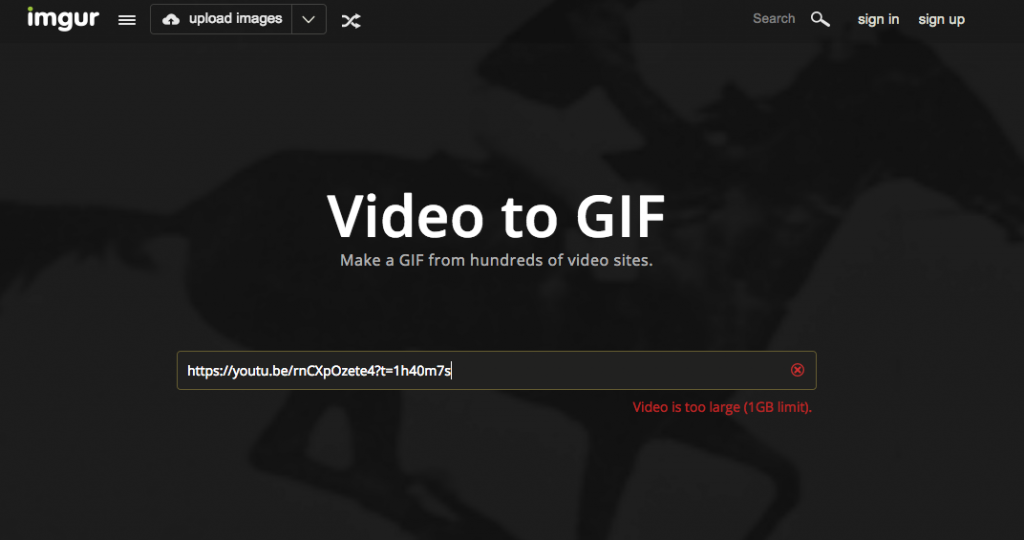
Screen Shot 2015-04-25 at 9.07.31 PMIt allows you to copy and paste the URL of a video hosted online (although the video has to be less than 1 GB), and provides a dead simple way to grab the scene and make a GIF using YouTube, Vimeo, your own uploaded video, etc. No downloading, no GIMP, no Photoshop, no nothing!

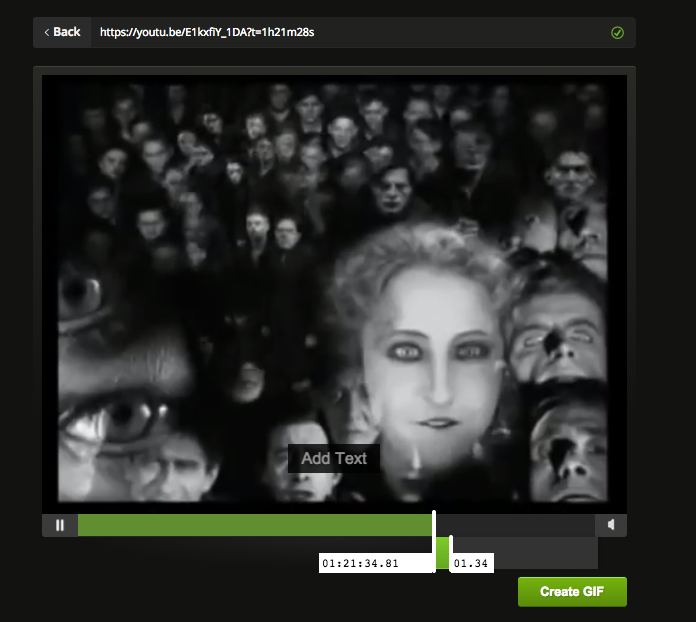
Screen Shot 2015-04-25 at 9.17.16 PM

As you can see from the screenshot above, you just drag the editor to the in and out points of that video, and it will automatically create an animated image of the selection. It obviously can’t do the finer GIF work that requires timing, masking, etc. But for quick and dirty, it’s quite impressive.

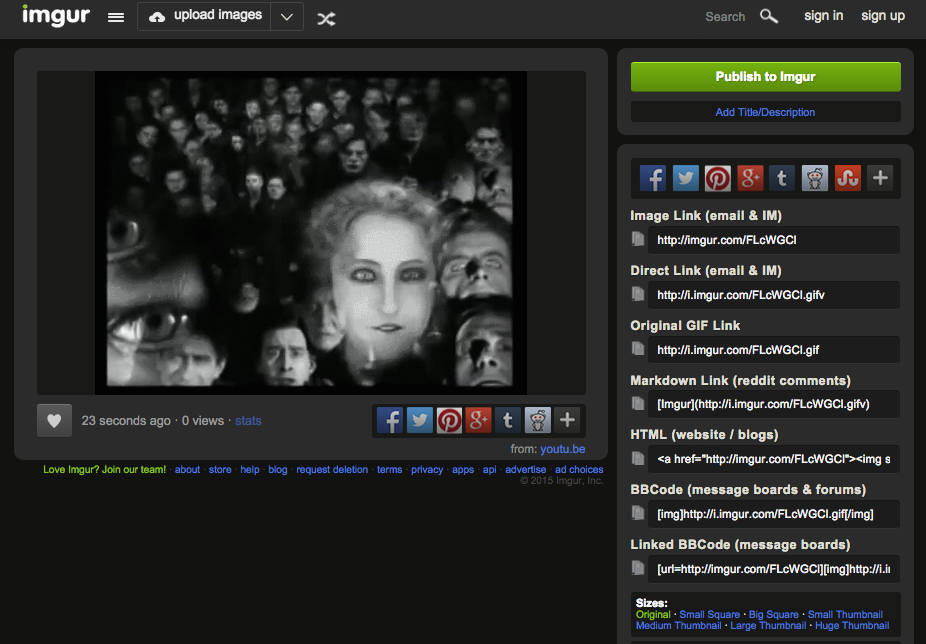
Screen Shot 2015-04-25 at 9.18.25 PM

What’s more, it gives you the GIF in a number of ways: HTML, Markdown, GIF link, GIF video, etc. While I think getting into a more robust image editor and understanding the art of the GIF can be valuable on many levels, it’s hard to argue with the fast, free, and out of control possibilities of IMGUR’s Video to GIF tool when you are trying to turn people on to the art of the GIF.

http://i.imgur.com/FLcWGCl.gif

Posted in digital storytelling | Tagged , , , , | 7 Comments

Noir106: No Stain No Problem

It’s been a very strange year at UMW for many, many reasons, but none more than the fact that one of our students was allegedly murdered by another student last week. I can’t imagine anything that could hit a community harder; it’s deeply distressing. Unfortunately, I have no profound words of consolation, and as a parent I have no idea how you even begin to deal with such a thing. It’s dark and ugly, and nothing seems more alien to our campus.

It’s all the more strange for me because I have spent the last two and half years teaching courses on Hardboiled Fiction, True Crime, The Wire, and this semester Noir 106. I’ve been on a pretty consistent run of dealing with literary, historical and cultural approaches to violence and crime in fiction, films, TV series, as well as interrogating the all encompassing genre/style/philosophy of noir. Up until a week ago it seemed fairly innocuous. It was, in ds106 fashion, a creative exploration of histories, texts, popular culture, and genre, but that’s not so much the case now. Now it seems downright haunting.

And it’s even weirder when you see a Tweet like this from your student in that context:

Now I never abducted a cat or murdered three people, but the No Stain No problem agency for noir106 put together one of the most elaborate and brilliant narratives I have seen in my five years of ds106. This group of five students/noir characters, Stella Vaughn (Kelsey Roach), Blair Morgan (Mia Boleis), Michael Ol’ Mick Bretton (Cuyler Matteson), Billy Steel (Brian Burns), and Jack Sadler (Philip Dorch), did a truly remarkable job building a narrative around the case of Meowdred Peirce: the missing noir cat. You see, for the last four weeks students in ds106 have been working in groups, or individually, to create a detective agency (in this case they were the cleaning agency “No Stain No Problem” turned Scooby-Doo detectives) to solve the case we assigned to them (there were four cases in all).

This group spent two weeks weaving together all sorts of remarkable bits and pieces from the course into a creative, compelling narrative that explored noir themes of abduction, violence, and murder that have played out in so many of the works we have read and watched. None of us saw what was coming last week, how could we? The recent events made the class that much more powerful and alienating simultaneously.

So, the following case videos and supplementary evidence may be harder than ever to watch given the specific context in which they are presented. That said, I wanted to acknowledge the unbelievable work that these students did in the conceptualization and execution of their project. They were true professionals, and the work they did is pretty epic. I think begins to suggest a whole new level of narrative development that we have not really seen in #ds106 at UMW heretofore.

Some of this is because of the brilliant work conceptualizing and scaffolding the last third of the semester Maggie Stough, Paul Bond, and Martha Burtis brought to the experience. But, in the end, the students in #ds106 once again rose to the creative occasion and made some serious art, dammit. The current climate at UMW will make it difficult for many to appreciate what has happened in noir106 this semester, which is more than understandable, but it has  been nothing shortly of remarkable, and brings an already stellar course to a whole different galaxy of creative possibilities.

EPISODE 1- HARRISON, IDAHO (NSNP)

EPISODE 2- TECOLOTITO, NEW MEXICO (NSNP)

EPISODE 3- BONNIEVILLE, KENTUCKY (NSNP)

EPISODE 4- FREDERICKSBURG, VIRGINIA (NSNP)

Posted in digital storytelling | Tagged , | 1 Comment

OpenVA 2.1: My Last Hurrah

On Saturday, May 2nd the College of William and Mary will hosting a 3-hour workshop on Open Educational Resources (OER). The event will consist of a keynote by none other than Gardner Campbell, that ne’er do well from VCU. And two focused panels that will be engaged in a lively discussion around the OER landscape and what constitutes OER. Is it all licenses and textbooks? I’m thrilled one of my favorite open educators, Sue Fernsebner, will be representing UMW. You can read more about the details of this event on the OpenVA website here.

The event is limited to 50 folks, and it’s but full—not to mention free! So if you are interested smash the registration link now! Major kudos to Jamison Miller for putting this together in no time. It will go a long way towards keeping the spirit of OpenVA alive, and pave the way for the next iteration of the OpenVA committee which will be officially formed at the end of May. Ironically enough, I won’t be around for that party. UMW’s Provost wanted Jeff McClurken to be on that committee, and who am I to argue with the bosses?

It’s been an excellent opportunity to work alongside some great folks, understand how SCHEV operates, and realize there’s still so much talent and enthusiasm around Virginia yet to be tapped. That said, three years is more than enough time on any committee, and it’s high time some new blood take what we started in some bold new directions.

Posted in openva | Tagged | Leave a comment

There are Only Minds: MCI’s 1997 Cyberutopian TV Spot

I have spent the last day and half in Boulder, Colorado thanks to the kind folks at University of Colorado, Boulder’s Arts & Sciences Support of Education Through Technology (ASSET). I presented a version of the talk I gave at the University of Oklahoma in January, and I’m getting more and more compelled by the prevalence of transportation metaphors for explaining the web. I may have the whole thing nailed by June, just in time for Barcelona.

Last night at dinner, I had a compelling discussion with Phoebe Young and Noah Finkelstein about some of the themes in the talk, including the idea of the web we lost 25 years after its inception. This is a central part of the talk, and is framed by this clip from Orson Welles‘s Magnificent Ambersons (1942). The scene takes place at the dawn of the automobile age (mid-1910s) and Joseph Cotton’s character seems rather prescient in the way he pontificates on how cars will change everything, even the way we think.

I love this scene because he’s circumspect and rather ambivalent about the impact of this technology on humanity. What’s more, it makes a neat parallel with how the web has changed everything, yet we continue to have a deeply ambivalent relationship with its presence. During this discussion Phoebe described a MCI commercial from 1997 that she uses in her American History survey course to try and capture a sense of the utopian zeitgeist around the early moments of the web during the 90s. A web that has “no race, no genders, no age, no infirmities…only minds.  Utopia? The INTERNET!” It’s a truly remarkable document of a moment of seemingly unlimited promise and possibility.

And while the discussion turned to the fact that this was a telecom commercial selling a product using cyberutopia as the pitch, Phoebe’s point about how far we’ve fallen from the limitless sense of possibility of the web resonated. I worked it into my presentation today—albeit awkwardly—because I wanted to try and illustrate that very point. This sense of a virtual communications network that solves the deeper social inequalities around race, gender, and class may have always already been misguided, but that’s the allure of a revolutionary technology, right?.

This utopian impulse for social justice 25 years later—however muted and dulled by the cynicism capital necessarily breeds—still drives much of the work the best folks are doing in edtech on the web. And while MCI’s attempt to erase class, race, gender, age, and infirmity is fraught from the get go, the idea of connecting and augmenting minds from around the globe irrespective of these categories is a utopian narrative still heavily traded on in educational technology. Just look at the fervor around MOOCs leveling the global playing field of education over the last few years. The deep desire to believe we can start connecting and augmenting the world’s minds regardless of privilege and station dies hard. The difference 18 years later is we know we are being sold a bill of goods, but we still desperately want to believe. Hope springs eternal, and that is a very dangerous and powerful thing.

Posted in Uncategorized | Tagged , , , , | Leave a comment

Domain of One’s Own and WordPress Networks

I’ve had a pretty jam-packed semester, and now that it’s almost over I feel the need to capture at least some of it. We ran our third Domain of One’s Own Faculty Initiative with 23 participants across at least ten disciplines and two colleges. This brings the total number of faculty who’ve gone through this program at right about 80. That’s a third of our faculty. The intentional and consistent development of faculty, and by extension students, over time is the approach that makes this initiative more than just a numbers game to tout we have “full saturation.” We’re committed to scaling intelligently, while rolling out and developing a community around the immediate possibilities web hosting and a personal domain offer—and that gets more compelling every year.

Case in point, this year my cohort, made up of seven of UMW’s finest faculty (there were 3 other cohorts with 16 more faculty), got interested in setting up WordPress multisite installs so they could create a network of sites for their personal portfolios, course spaces, research sites, etc. The idea makes a lot of sense, but when we started this a few years ago I steered away from this option because getting your own domain and web hosting seemed enough overhead. This year that all changed.  Everyone in the cohort was comfortable with WordPress (a remarkable fact in and of itself), so we could take the time to explore the abstraction of what a managing a Network of WordPress sites entails. Dealing with questions like: How do you manage themes and plugins differently? What are subdomains versus subdirectories? How can you syndicate between sites? etc.

The process reinforces the longitudinal impact of so much of the work DTLT has done over the last decade from the Bluehost experiment to UMW Blogs to UMW Domains. It also points to a progression in what’s possible thanks to how much we have invested as a community and how much easier things have gotten since 2005. With the application installer Installatron we can have folks do a one-click install of multisite. After just minutes they can be up and running with dynamic, wildcard subdomains. That struck me hard yesterday while I was taking a faculty member through the process. I spent a couple of years of my life on this very blog struggling through that very thing back n 2006 and 2007, now it’s a checkbox on an installation form.

Screen Shot 2015-04-22 at 1.21.05 AM

Easy doesn’t suck in this instance because we can spend our time examining what it means to manage a network of sites. For example, the benefits of various sites pulling from the same fleet of plugins and themes but only needing to run updates in one place. I felt like the discussions around the application(s) helped us work through managing online presence, creating an online scholarly identity, and taking a hands on approach to controlling, owning, and archiving the work they do online. I’ve been at it so long with WordPress that I sometimes forget how crazy the arch of faculty development at UMW has been. Just about any faculty member with 20 minutes to spare can create an infrastructure that defined my career path just 8 short years ago. Nutty.

Anyway, enough of that. Below is a quick rundown of how you can create wildcard subdomains within CPanel. Even that seems easier than it was back in the day of editing vhost files. I’m stealing the majority of this tutorial from Namecheap because they do a better job on it than I could. I just add my own 2 cents here and there, as usual.

This assumes you have already setup WordPress as multisite, as easy as the click of a button on UMW Domains and Reclaim Hosting.You will need to copy a line of code to your wp-config.php and then access Tools–>Setup Network to choose subdomains. After that, you’ll be given  code to copy into both the wp-config and .htaccess files. You can see a good tutorial on that process here. In order to create a wildcard subdomains in CPanel, you do the following:

1) Log into your cPanel

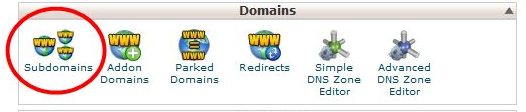
2) Navigate to the menu ‘Subdomains’ under ‘Domains’ section

wildcard_subdomain_1.jpg

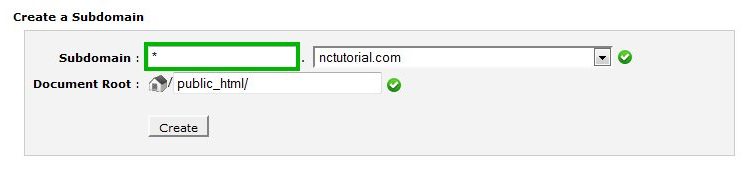
3) Create a subdomain‘*’ pointing it to the necessary folder ( you will need to specify the path in the field ‘Document Root’ ).

wildcard_subdomain_2.jpg

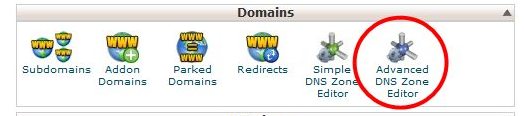
4) Go to the menu ‘Advanced DNS Zone Editor’

wildcard_subdomain_3.jpg

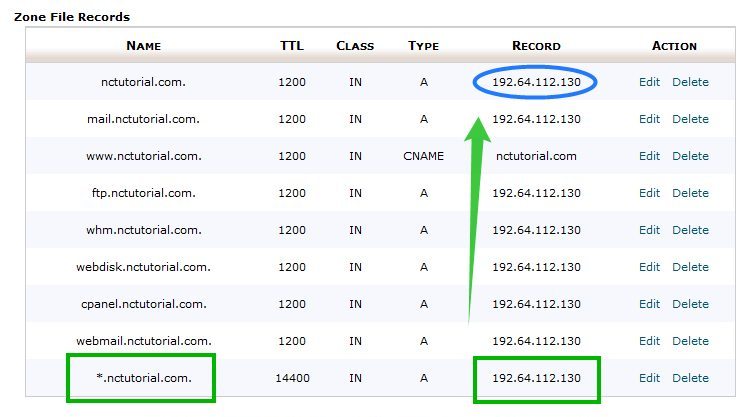
5) Make sure that there is an A record for *.yourdomain.com created and pointed to the server IP address ( it could coincide with the IP address of your main domain or ftp.yourdomain.com is pointed to).

wildcard_subdomain_4.jpg

6) Now you will need to wait until the propagation is over ( it should take N seconds, where N – isTTL for this A record; you can edit it manually and reduce the number to speed up the process ) and then the wildcard subdomain will work correctly.

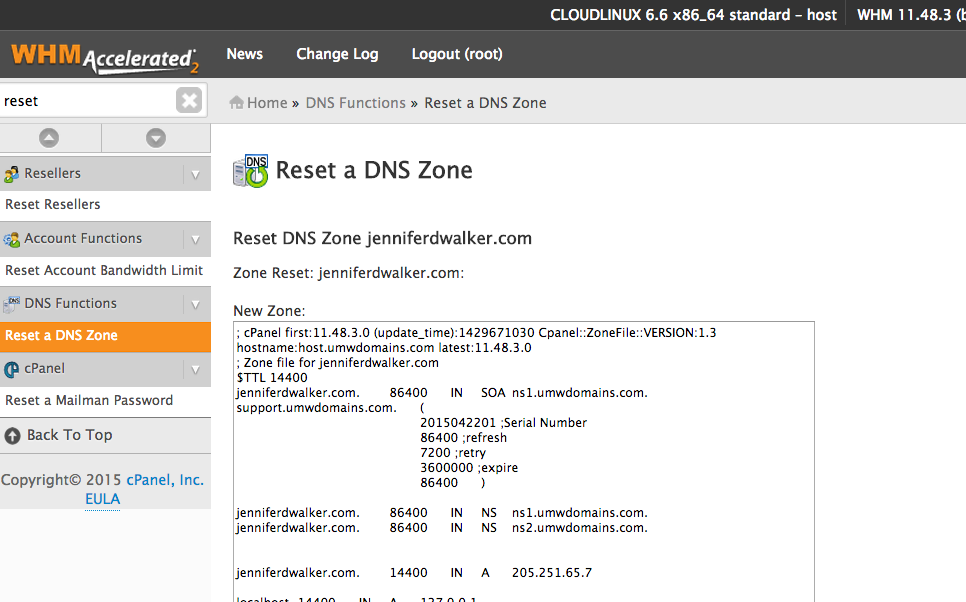
The final step I needed to do for the folks on UWM Domains at the server level in WHM is to reset the DNS Zone for the particular account that is installing a WordPress multisite with wildcard subdomains. This was the bit I got hung up on, but my server admin skills are getting better and better with every passing day. Soon I may even be competent.

Screen Shot 2015-04-21 at 10.56.07 PM

Posted in Domain of One's Own, Faculty Initiative, WordPress, wpmu, wpmued | Tagged , , , | 3 Comments

A Decade of Teeth

X01217

Today I got a titanium thread implanted in my jaw. This is the first step in the process of replacing a tooth I lost five years ago because of an abscess. I have another visit in four or five months to actually get the implant put in, but in the meantime my gums have to heal. Why the hell am I writing about this? I don’t know exactly, but it struck me is that for 10 years (since I moved from Brooklyn to Fredericksburg) I’ve been slowly getting my teeth back on track after close to 15 years of neglect during my even poorer years in undergraduate and grad school.

Yeah, teeth. I had one of my wisdom teeth pulled (the other three are there and awesome), a root canal, a crown, a couple of cavities, the abscessed tooth pulled, and now an implant. I need one more crown and I will have gotten my teeth (like my taxes), to a point where I’m actually caught up. Maybe that’s why I am blogging about my teeth. 2015 has been a good year for catching up on variety of outstanding work, debts, teeth, etc. After a decade of raising three kids, working an insane amount, staying one step ahead of the bill collectors, and making sure my teeth were perfect, I feel like I’m finally making some progress on at least one of those fronts. As I age, I am starting to realize time is the great equalizer. If you’re able to work at something (or at someplace) for long enough, you are more than likely to break on through. That’s been the case, at least for my teeth, this year. I can see the light at the end of the tunnel, and it’s golden bright!

Dr Teeth


Posted in bavatuesdays, family | Tagged , , , , | 3 Comments

GIFs have Never Been Bigger at UMW

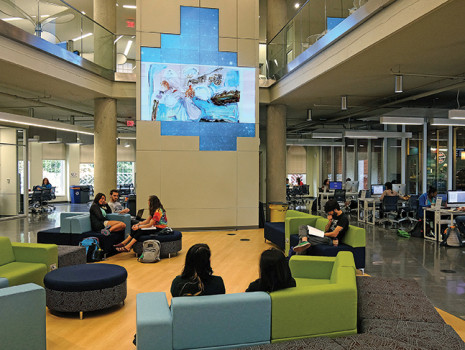
Possibly the coolest thing about UMW’s Information and  Technology Convergence Center (ITCC) is the media wall.

ITTC-Building-15-MediaWall-horiz-465x350

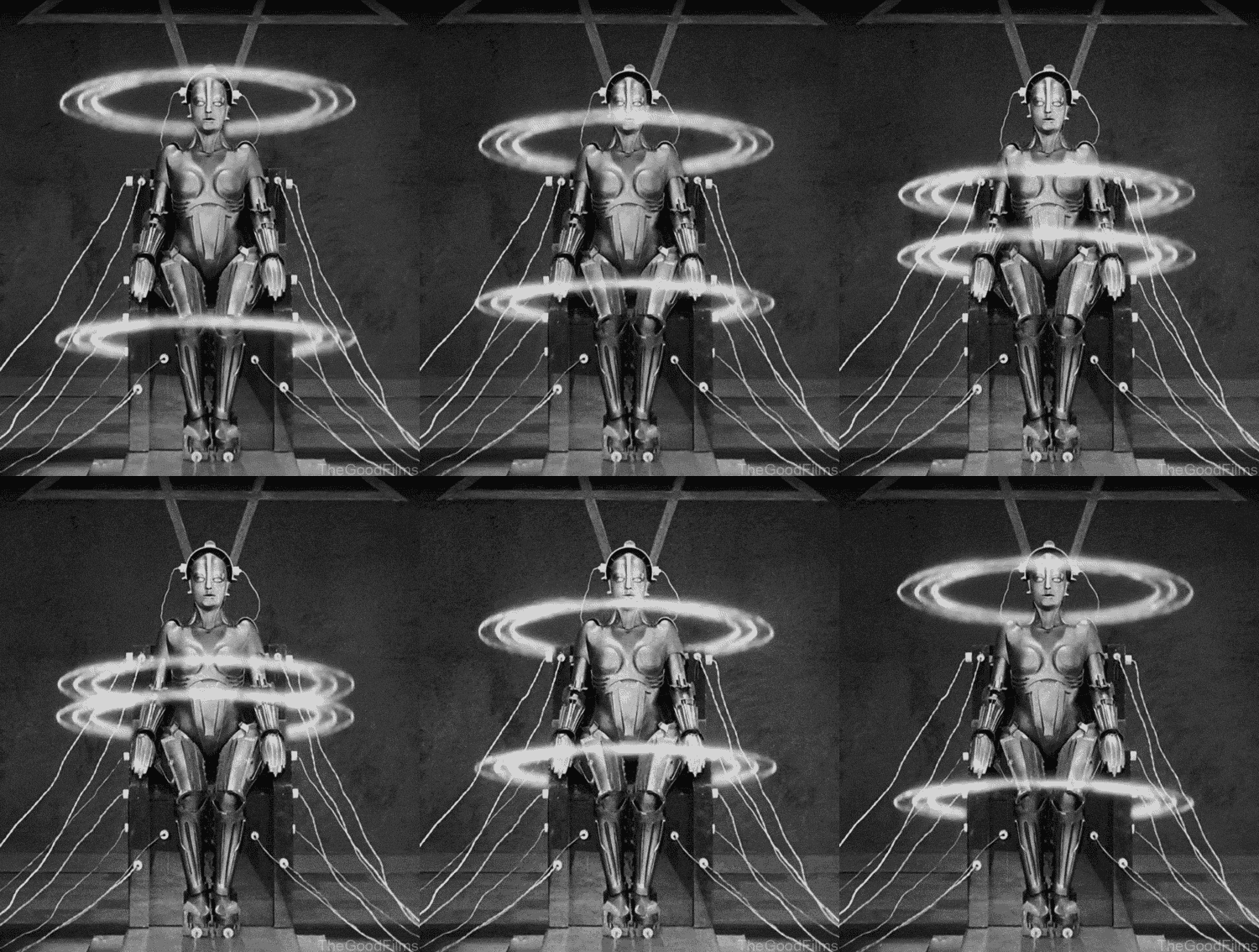
It’s designed to be a canvas for a variety of media creations, and it is centrally located in the atrium between the second and third floors. It is made up of 43 individual squares in an organic pattern using Laser Phosphor Display technology (Prysm). The idea was to run UMW community work on there regularly, but one of the challenges we face is we don’t have enough student media work to program the wall regularly. We’ve tried to make up for this by continuously running films on the media wall, such as The Cabinet of Dr Caligari and Fritz Lang‘s MetropolisAndy Rush is all about German Expressionist cinema.

tumblr_mh5nq4Ynuu1r3d8abo1_500

But in a recent meeting about the wall, the ITCC building manager Cartland Berge noted that a student from the photography club (I think he said his name was Sam) thought “cinemagraphs” (the fancy word for animated GIFs, kinda like movie versus film or cinema) might be a good fit for the media wall. EXACTLY PRECISELY!

http://i.imgur.com/V9n8QQf.gifv

While the media wall won’t just be GIFs, it make total sense, at least for now, that they represent a significant portion of the programming as we work on collecting more media content from the community over time. As to how we solicit GIFs and the process for putting them on the wall—that all still needs to be worked out. But, in the meantime, I took advantage of Michael Branson Smith‘s residency at UMW earlier this week to build a GIF template.

umw-video-wall-pattern (1)

Being the awesome GIF artist that he is, he knocked it out in minutes. I was fascinated by how he built the above template to get the pixel dimensions for the unique shape of UMW’s Media Wall. He created a large image filled with 20 x 20 pixel, color-coded squares and made it the desktop background for the Mac mini that runs the media wall. Once on the wall, he could count off how many pixels for each of the sides of the unique pattern. I was really tripped out by how he figured this out: simple and genius. I’ll see if we can’t get a copy of the color-coded background image to illustrate what I’m talking about. Think of the space between these two paragraphs as place holder #1 in the meantime.

<img place holder #1 />

Once he had the template, we were faced with the challenge of what the first GIF on the media wall should be. We decided on the”eye in the sky” from Blade Runner to reinforce the age of transparency/surveillance the ITCC building represents.

After that, Michael had a vision with this Travis Bickle GIF from IWDRM

He then got on a roll, busting out this brilliant gem from Scooby-Doo.

And here’s another look at that same GIF to give you a sense of how big these GIFs are. Thanks to Thomas Lackert for providing scale.

Zach Whalen and I played around with some more GIFs yesterday. We had the unfair GIF up, as well as the Super Mario Cloud GIF.

unfair3

Zach has the modified GIF he created for the media wall, so I’ll just put the original up until I get his version. Consider it placeholder #2 in this post. Damn I’m impatient, and I will have some updating to do 🙂

cory-arcangel-super-mario-clouds

The GIFs on the wall are just running in a browser, so Zach and I got to talking about the possibility of pointing the browser at a script that pulls from a collection of curated GIFs, and works through them intentionally or randomly at some predefined interval(s). I think he’s already experimenting with the code. And might I just add here that having Zach as an embedded faculty member at DTLT this semester has been a total blast—without  question the highlight of the year at UMW for me. It represents exactly what we wanted the building to be in the first place: a convergence of staff, faculty, and students around the possibilities of digital media. It’s really fun to finally be doing just that, and collaborations like #umwconsole and the GIF Wall are just the beginning.

Posted in digital storytelling, umw | Tagged , , , | 5 Comments

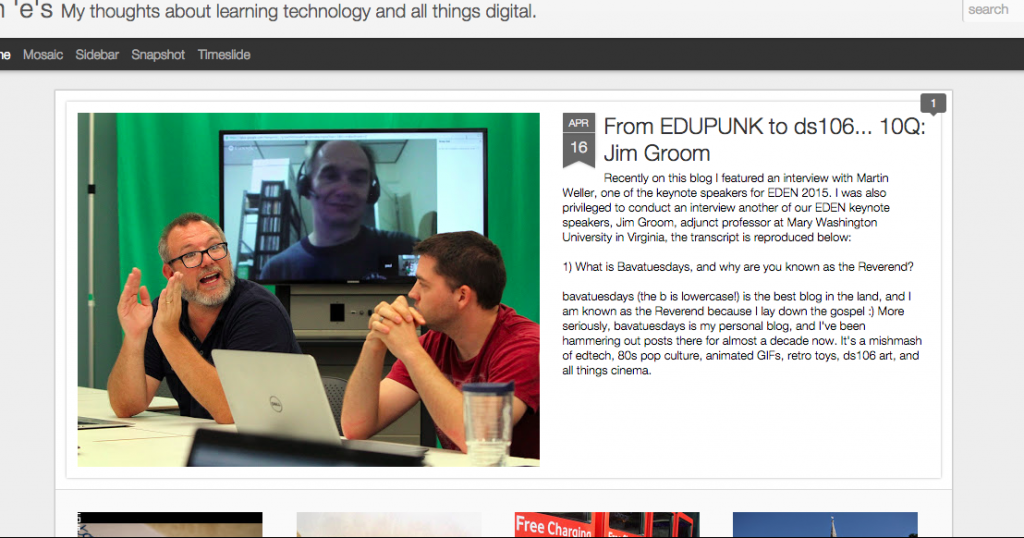
“From EDUPUNK to ds106” Interview

I had a lot of fun doing this interview for Steve Wheeler in anticipation of my presentation at the EDEN Online Conference in Barcelona in June. This will be my first time presenting in Europe, and I am toying with the ideas about pulling a Ben Franklin and presenting in a coonskin hat 🙂 More seriously, I am a bit nervous given how much of my talks are so geared towards US pop culture and fairly specific milieu of higher ed that may not translate cleanly in Europe. Either way, I look forward to the challenge. What’s more, I have the luxury of knowing that I can only be the warm-up band for the great Audrey Watters. The fact gives me some freedom to experiment, knowing full well  she can carry the intellectual water for the both of us. TEAM AMERICA!!!

As for the interview, major kudos to Steve Wheeler for starting with a question that set a pretty loose and fun (at least for me) tone to the whole interview. Namely: “What is Bavatuesdays, and why are you known as the Reverend?” 

To which I answered as follows:

bavatuesdays (the b is lowercase!) is the best blog in the land, and I am known as the Reverend because I lay down the gospel 🙂 More seriously, bavatuesdays is my personal blog, and I’ve been hammering out posts there for almost a decade now. It’s a mishmash of edtech, 80s pop culture, animated GIFs, retro toys, ds106 art, and all things cinema. It’s a “b blog” in that it pretends to nothing more than schlock, and it achieves its goal regularly. The actual name comes from the maestro of Italian horror films Mario Bava. It’s a reference to a film club some friends and I imagined wherein we would watch Mario Bava films on Tuesday nights. The club never materialized, but the name stuck with me for some strange reason. I thought it might be a cool band name, but given I have no musical talent, I reserved the domain and settled for a blog. The rest is the underground history of the web.

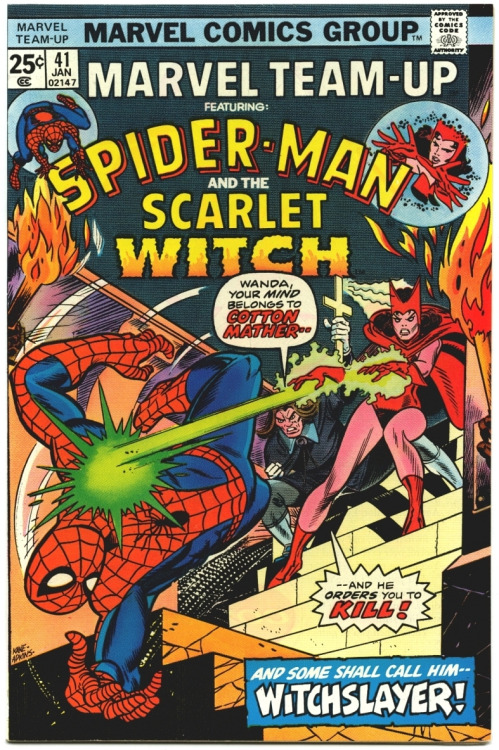
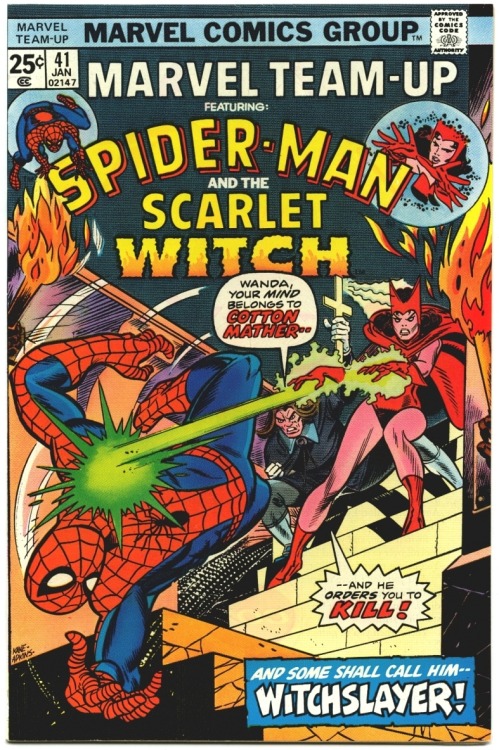
tumblr_njwetsPNOU1rn55nzo1_500As for the title Reverend, I was given that nickname by Chip German (then CIO of University of Mary Washington) back in 2006 or 2007. I think because I started to sound a bit like a fervent preacher when I started talking about teaching, learning and technology. I’ve played the role of evangelist at UMW for almost a decade, and I always hated the term evangelist when used outside of its religious context, so I made a point of reframing edtech as a faith system akin to Cotton Mather’s Puritanism. My avatar is actually a headshot of Cotton Mather from the 1977 Marvel Team-Up comic featuring Spider-Man, Scarlet Witch, and Cotton Mather as a super-villain. In another life I was an early American literature Ph.D. student, so the marriage of biblical exegesis, fear mongering, and bullshitting comes easy.
And that’s just the first question! Blown away? I knew that you would be. Read the rest here. Special thanks to Steve Wheeler for pushing me to try and frame my work more broadly, and helping me mentally prepare for the bava’s European Invasion: “The EDUPUNK to ds106” tour to a sold out edtech conference filled with slightly more sophisticated conference chicken! 🙂  #4life

Posted in bavatuesdays | Tagged , , , , | 4 Comments

Remixing the Console

CCelBNJWgAAayMN

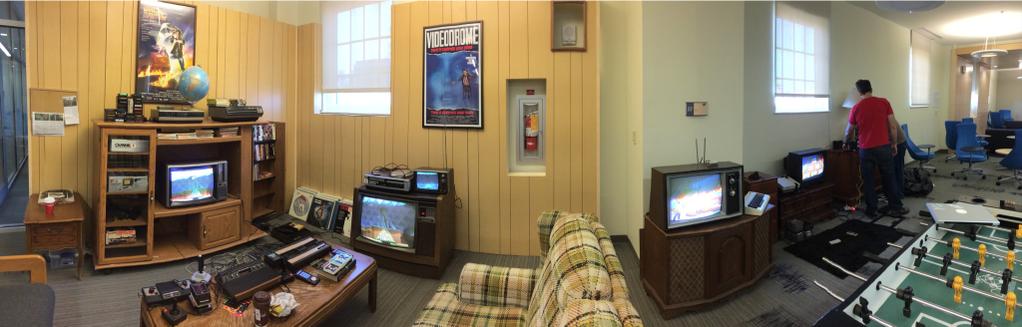
Andy Rush’s Pano of the #umwconsole

Today was the first of a two-day marathon on the ground with Michael Branson Smith (MBS) as embedded artist in the Console Living Room. It was awesome. Within the first hour he had all five of our TVs broadcasting to UHF channel 38 a fully programmed day of CBS. Starting with games shows like the $25,000 Pyramid, Wheel of Fortune and The Price is Right, it then moved onto soaps like As the World Turns and The Young and the Restless. During the afternoon game the re-runs like Gilligan’s Island, The Brady Bunch, Good Times, Sanford and Son and MASH. At 6:00 PM the CBS Evening News came on, after that we moved into primetime with The Dukes of Hazzard (there was more be we had to leave by the time Dukes was finishing).

I can’t begin to tell you how transcendent the space began to feel broadcasting TV all day. Possibly the most interesting part of the broadcasts were the commercials. MBS cut advertisements back into the shows he found online. It transformed the console into a very focused space for the study of network television in the 80s. An experience that is almost impossible to emulate online. The myriad assumptions about who we were in the 80s  erupt from the broadcast. It’s almost impossible not to be pulled into a deeper set of questions about what this exhibit is trying to do. Once he started broadcasting the TV, I knew I was going to be spending most of the next 6 months programming TV channels. We actually made some headway in the department by getting me set up with my own hardware and software for getting my own channel setup, but that will need its own post.

After we got the TV setup, MBS worked with two sections of Zach Whalen‘s Games and Culture class to remix the exhibit. The idea was provide students an overview of what’s possible with free and easy tools for your phone like Vine, to.be,  phogy, fyu.se, etc., and try and capture elements of the living room from the perspective of aesthetics and design. Below are some of my personal favorites, but you can browse many more on the #umconsole Twitter tag. Enjoy, cause I know I am!

Print “Living In The Eighties”

https://vine.co/v/euwp6Ahe61a

80s Videodiscs
https://vine.co/v/eudVFdw7I0i

Flipping through some Atari Games
https://vine.co/v/eudvzuHYhVp

3D Atari
https://vine.co/v/eupBv3zXvDt

3D Cobra
https://vine.co/v/eupBm5ZnZzX

Vertical Hold
https://vine.co/v/eud1ijd6Xbb

Oils and Soaps
https://vine.co/v/eudWhLhU196

Girls fashion in 1979 Sears Catalog

https://vine.co/v/euwgIJVQLW7

I am not a model
https://vine.co/v/eud1HYJhgnB

E.T. > Donkey Kong?
https://vine.co/v/eud65dibxJM

Werewolf by night…
https://vine.co/v/eud9H2raaHu

Foosball
https://vine.co/v/eud3P5vqKiX

There were a number of very cool to.be GIFs, but I can’t get them to embed. So, I am gonna leave a couple of them below.

Psychedelic TV

Microsurgeon

Pac-man

Posted in Console Living Room | Tagged | Leave a comment