Mine it Out

So Minecraft fever has hit the bava household hard over the last month or so. All three of my kids are pretty deep in, including my 4 1/2 year-old Tommaso. He does some basic mining and battling, but more than anything Tommy’s into the seemingly endless Minecraft user-created music videos. In fact, those videos are what started the Minecraft rage we’re currently living through at my house. Miles came home from school talking about Minecraft music videos like “Don’t Mine at Night” (playing off Katy Perry’s “Last Friday Night”), “Like an Enderman” (playing off Psy’s “Gangnam Style”), and “Fallen Kindgom” (playing off Coldplay’s “Viva la Vida”) to name just a few of the early endless refeshes. My personal favorite music video is “Mine it Out” (playing off will.i.am’s “Scream and Shout”).

The videos refer to themselves as Minecraft parodies, and I guess that makes some sense. But having watched and heard a fair number of them now, many of them don’t really feel like parodies at all. They’re often catchy and tongue-in-cheek reworkings of the original, but they don’t seem to be trivializing Minecraft or the song—-rather they’re often a creative celebration of both. I’ve come to love these music videos, the amount of creative energy invested in each of them is mindblowing. And that’s just a small indication of just how amazing the Minecraft moment has been more globally for an outpouring of shared creativity. It’s gotta be one of the most hopeful elements of the internet I’ve seen over the last three or four years. And if my kids are any indication, it’s got some life left yet.

Posted in fun | Tagged , , | 12 Comments

Piranha Attack at Lake Anna

1505117524_e34ec14652_z

Image credit: lcrfs “PIRANHA IN AMAZON RIVER”

I was talking with Martha Burtis in the office during the week, and she off-handedly mentioned a Pirahna attack in nearby Lake Anna. My imagination ran with the possibility, so today I did some research and found the original posting on the VA Outdoors forum thread I believe she was referring to from 2009.

A resident at Lake Anna reported that their 12 year old son was throwing a stick into the water for their Labrador retriever Sam to fetch when suddenly the dog started emitting loud yelps and frantically started swimming to shore. When Sam got to the shore, he had severe wounds to his legs and torso and was bleeding badly. Sam was taken to a veterinarian who treated the dog and called the State of Virginia Department of Game and Fishes. Game Wardens used nets in the area of the attack and subsequently netted about a dozen Piranhas, the largest about 2 pounds. Officials stated that it is not unusual for aquarium owners to release Piranhas into lakes when the fish get too large for their aquariums; but usually Piranhas cannot survive the cold climate that is present in Virginia. Fish and Game officials speculate that the warm waters near the Lake Anna Nuclear facility allow the Piranhas to survive. Officials are consulting with biologists about how to address the problem; meanwhile they are going to issue an official warning to people to avoid getting into the water until the Piranhas can be eliminated from Lake Anna.

Sam is resting quietly in the hospital recovering from his wounds. Anyone wishing to send cards please send to the following address:
FOS Veterinary Clinic
412009 Gotcha Lane
Fredericksburg, VA 225678

It’s such an awesome story. Turns out it’s an April Fools prank from 2009, and the story is a textbook example of balancing the fantastic and the believable. The pirhanas attacked a dog, not a human. The dog was hurt, but not torn to pieces by the ravenous fish. The placing of this story in Lake Anna, which is a manmade lake to cool the North Anna Nuclear Generating Station, makes the whole thing somewhat plausible. My favorite bit has to be “Fish and Game officials speculate that the warm waters near the Lake Anna Nuclear facility allow the Piranhas to survive.” So good—I was totally sold. I also like how they give a not so subtle gotcha in the vet’s address.

I think this would make a pretty awesome writing assignments for ds106. Have students come up with a plausible April Fools Day prank. It has to be subtle and fantastic at once, it can’t name anyone real. It might go terribly wrong, but that’s a risk for just about any ds106 assignment 🙂 The thing I like about this one is how hard it is!

Posted in digital storytelling | Tagged , | 5 Comments

Independence Day Virus

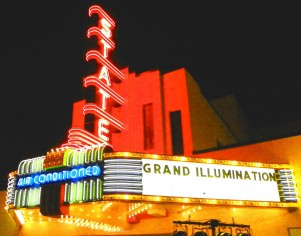
STATE THEATRE 12-19-12Today the whole family went to the State Theater in Culpepper, Virginia to watch the 1996 alien disaster movie Independence Day, which seems approporaite on the 4th of July. It was the first time we went to this historic theater since it was re-opened after twenty years of sitting dormant. It was returned to it’s 1930-era moviehouse grandeur with art deco adornment, a single screen auditorium as well as a balcony. It’s equipped for projection of digital, 35 MM, and nitrate films. The last two formats are particularly relevant given it’s around the corner  from the Library of Congress’s Packard Campus. And the two have a working relationship which means the State Theater has access to one of the greatest audio visual archives in the world.  It’s cool to see Culpepper embrace the fact that it’s poised to be a film mecca in the middle of rural Virginia. I really love the incongruence there.

As for the feature, the last time I saw Independence Day was in a movie house in Los Angeles—although I can’t remember which one. I was not a fan, but I was also at the height of my film education so my standards were a bit more stringent. The film is certainly a Hollywood pot boiler, but it laughs at itself and is a lot more tongue-and-cheek than I gave it credit for the first go around. It’s notable for bringing disaster films into the era of compuer generated special effects. And, to be honest, there’s no greater guilty pleasure on the 4th of July than an over-the-top patriotic celebration of the U.S. of A. Love it or leave it!

Independence Day Virus GIF

ID4 virus

All that said, my fascination watching it for the first time in nearly twnety years had less to do with American Empire than technology—can we distinguish the two anymore? The plotline of the movie depends on humans figuring out the weakness of these ruthless alien trawlers of our natural resources. While they’re a far more technologically advanced civilization, the story ultimately rests on infecting the alien network with a virus which needs to be uploaded into the Mothership’s local network via computer. You can view the scene that provides the explanation of this theory for giving the aliens a virus here. It’s absurd for a number of reasons, but the idea of human computers seamlessly interfacing with an advanced alien civilization’s network is foremost amongst them. And much has been written about this already on the internet.

Although if you you can suspend disbelief, the film also marks a moment wherein the idea of networking becomes akin to our own designation as an advanced technological civilization. It’s 1996, a large part of the U.S., and the world beyond, is just getting familiar with the everyday idea of networking on a personal level. With the meteoric rise in popularity of the World Wide Web, the introduction of a virus through a network to an alien species wouldn’t seem nearly as crazy as it might have just three years earlier. It’s actually something can actually relate to. The plotline of Independence Day is in many ways about a broader conceptual global shift in humanity as a highly technological civilization. We actually are beginning to understand the basic implications of networks on a rudimentary level as a populace.

This is something the film is conscious of given its playful reference to another film about dramatic advances in humanity’s evolution: 2001: A Space Odyssey. The moment when the characters played by Will Smith and Jeff Goldblum are heading off to save the world, when Goldblum opens his laptop he is greeted with an image of the eye of HAL and a playful “Good Morning, Dave…”

This is yet reasong to create the database of internet technology as seen in film and TV that I discussed already in this post.

Posted in movies, The Internet Course | Tagged , , , | Leave a comment

Faulkner at Mary Wash

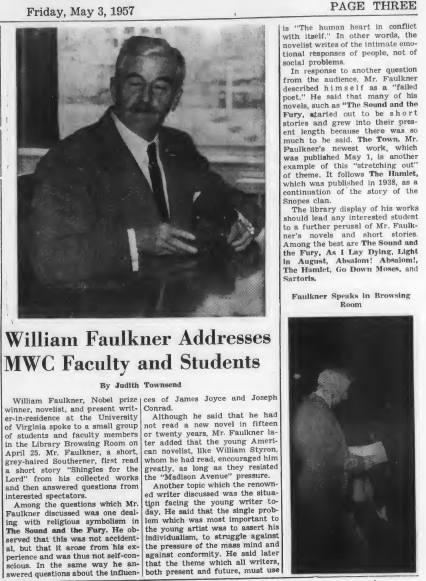
Honorary DTLTer Shannon Hauser wrote an awesome post today in which she tracks down audio of a 1957 reading at Mary Washington by the titan of U.S. literature William Faulkner. (At the time Mary Washington was the University of Virginia’s women’s college.) Shannon points to an article in the school newspaper of the event, noting Faulkner’s presence didn’t even make the front page. How is that possible? In 1957 Faulkner had not only won the Nobel Prize for literature, but he was probably the most celebrated writer in the world. Depsite all that, according to the Bullet only a small group of students and faculty came out to hear him read his short story “Shingles of the Lord.” So crazy, although I wonder if my own admiration for Faulkner’s literary brilliance colors my incredulity.

Either way, the fact that Faulkner was here and spoke about his work matters to me. It reminds me what college was for me in my freshman year: an experience to grapple with the world’s most confounding genius, in particular The Sound and the Fury. Below are the links to the audio from his visit to mary Washington, and major kudos to Shannon for bringing this bit of Mary Washington history into the light.

At MWC Tape 1 – April 25th, 1957

At MWC Tape 2 – April 25th, 1957

Posted in literature | Tagged , , , | Leave a comment

Dr. Chip Oblivion

Game Cards from the UMW Canvas Game

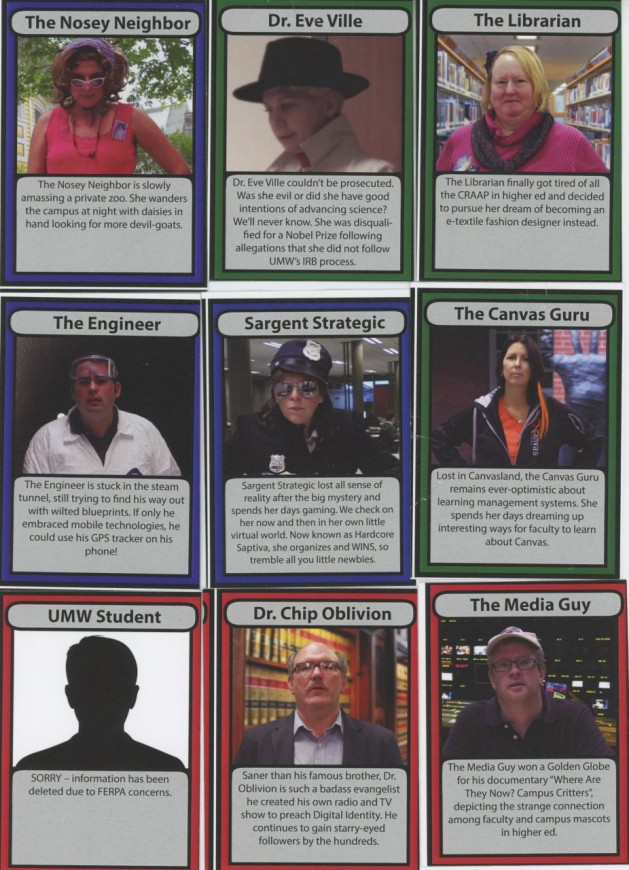
Our student aide this summer, Patrick Burnett, designed the above playing cards for a game that Mary Kayler and Lisa Ames have been creating for faculty and students to explore the resources available in Canvas, our learning management system at UMW. It’s still a work in progress, but I was pretty excited about the playing cards 🙂

As you can see above, there are a bunch of folks from DTLT (Andy, Tim, Martha, and Lisa) who play a part in this game. Ryan also has a part in this madness, but he seems to have been snubbed—or is it spared?—a playing card 🙂 I love the whole idea of having playing cards for our group, I want to wrap them up with a hard, powdery stick of bubble gum.

The game introduces Dr. Chip Oblivion who just so happens to be the twin brother of Dr. Brian Oblivion—the UMW professor who went missing during the now infamous Summer of Oblivion ds106 course. Chip Oblivion is a digital copyright lawyer focusing specifically on digital identity and the value of self online. This is a guy you want fighting for your avatar. You can see a couple of really shorts bits from Chip Oblivion below. I just can’t seem to quit the Oblivion. Online personas #4life.

You can see trailer for the Canvas game, which was adeptly shot and edited by Andy Rush, below. The video already made it’s debut at InstructureCon 2014 as part of a presentation about the game given by Lisa and Mary. I’m looking forward to playing this game and seeing how all this craziness comes togther, I’m just hoping I don’t have to log into an LMS to play it 😉

Posted in fun | Tagged , , , | Leave a comment

A New Wave of Open

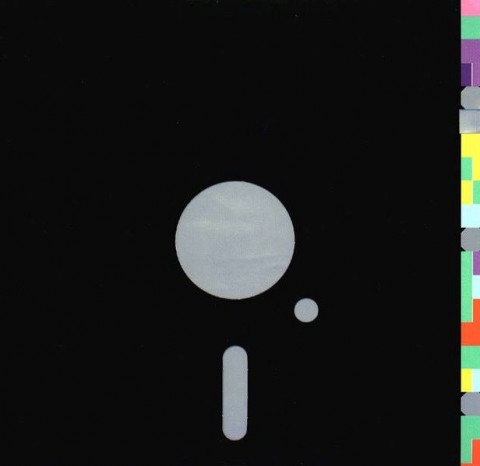
NewOrderBlueMondayDavid Wiley rules for many reasons, but one that I want to point out in this post which was inspired by his most recent post is how well he distills how empowering students and faculty to truly own their work online can radically change the way we think about publishing more broadly. He understands the value and focus of the learning management system for so many, and uses that as the example wherein using the POSSE model (or publishing on your own site an syndicating elswhwere) can start to change the way we imagine these systems. The LMS as a syndication hub, not a vertically integrated destination for all our learning needs.
The question immediately arises – when will we be able to POSSE into our formal learning environments? Could it be done today? For example, could we write a Known plugin that would let us POSSE into Canvas? Knowing what I do of their API, I think we could.

How would that change students’ relationships with their courses and institutions? Maybe this is already where the Reclaim folks are going, and I’m only just catching up, but give each student (1) their own domain, (2) a Known install, and (3) the ability to POSSE into the LMS – and just think about the implications. What does “submitting” homework mean now? What does an e-portfolio mean now? How do assessments need to change when there are worked examples of assignments everywhere? And where was I ever going to point the Evidence metadata in an open badge before students had this?

Here at UMW Tim Owens and Martha Burtis have already been experimenting with Canvas’s API over the last few months, and what David is suggesting in his post is right inlien with what we’ve been imagining. And we could do something like what he’s imagining here in the very near future. We’re a Canvas school, and we would love to start pushing hard on some of these frontiers alongside others to see how Domain of One’s Own and Canvas integrate more cleanly for this kind of “reclaim personal publishing” approach.

Like David, I am really excited for what I imagine as a new wave of open that actually positions that term in direct relationship between the person publishing online and the work they produce within a variety of personal, social, and institutional settings. Open as in control is interesting to me because it takes these two ideas that have been imagined as diametrical opposites in regards to the LMS, and pits them in a seemingly natural juxtaposition when it comes to owning your work.

What’s happenign more broadly right now is folks all over the world are re-thinking this very question of control when it comes to their own work. The move to re-decentralize the web is afoot, and it makes sense we start digging into the implciations for higher ed of this emergent online consciousness of the value of having some control over one’s own digital trace. What if open is focused on being able to manage your contexts and share outside of pre-determined commerical structures? I’m really excited to see where Wiley takes his exploration of “the relationship between POSSE and ‘open'” in a future post. It’s time he reclaimed open, if you will 😉

Posted in reclaim, reclaimopen | Tagged , , | 11 Comments

Even the Soviets Loved Silicon Valley

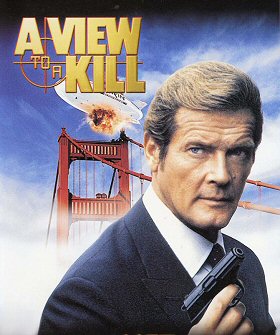
I already posted about how the major plotline of the 1985 James Bond film A View to a Kill is all about ending the domination of Silicon Valley. Another bit from this film along those lines I thought I should mention while thinking about it,at the end of the film Soviet General Anatol Gogol presents Bond with the Order of Lenin (the highest decoration bestowed by the Soviet Union) for preventing Silicon Valley from being destroyed. A gesture that the British secret service higher-ups question, saying “I’d thought the KGB would have celebrated if Silicon Valley had been destroyed.” To which General Gogol answers, “On the contrary, Admiral, where would Russian research be without it?”

This scene struck me that already in the mid-1980s the writing was “on the wall” (no pun intended) for the imminent fall of the Soviet Union and the start of a post-Cold War era. In less than five years Bond will need a new enemy as communism crumbles, and I love how this film seems to suggest that in this final moment. What’s more, I love how even the commies can’t help but love Silicon Valley back in 1985. So good.

Posted in movies, Uncategorized | Tagged , , | Leave a comment

Calling Car 106

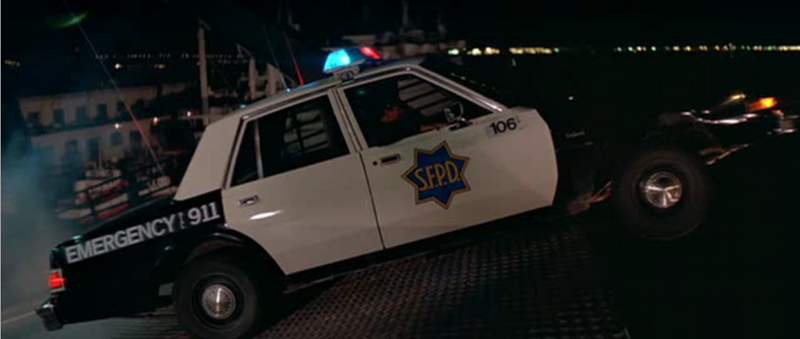
viewtoakill_106

Car 106 from the Bond film A View to a Kill

For a long time I’ve wanted to get a shot of a police car numbered 106. There’s one in the Fredericksburg Police Department fleet that I see from time to time, but given I have no cellphone/smart phone, I don’t usually have a digital camera handy to catch it in those unexpected moments. But while watching the 1985 Bond film A View to a Kill the other night one of the patrol cars pursuing Bond around the streets of San Francisco was 106. I figured that might be worth a quick “Illustrate 106” assignment.

You can see the 106 clearly in the image above. This image comes from the scene right before this car, which is stuck on a drawbridge raising vertically, crashes back into another police car. The gravitational pull of ds106 was extremely strong twenty five years before the class even started. #4life.

Posted in digital storytelling | Tagged , , , | 4 Comments

End the Domination of Silicon Valley

avtakThe other night Anto and I watched the 1985 Roger Moore Bond film A View to a Kill. Moore is my Bond, whereas Anto is a bit more partial to Pierce Brosnan—we don’t mention Sean Connery or Daniel Craig in our home. I forgot so much about this film, including the dominant plotline wherein the villian Max Zorin, played by Christopher Walken, is a psychopathic, Nazi created steroid baby that was raised by the KGB who wants to destroy Silicon Valley. He’s a villain’s villain. There’s a scene in the film, excerpted below, that takes place on a Zeppelin flying above San Francisco in which Zorin lays out his plan to end the domination of Silicon Valley.  I couldn’t help but think Audrey Watters might be able to use this clip in a future talk 🙂

In fact, in a very lofi 80s way the film feels relevant to our technological moment in a number of rather campy ways. There’s another scene, featured below, wherein Zorin is talking to Bond while at the same time using a hidden camera, ostensibly connected to the internet and his computer, to establish Bond’s identity as 007 through facial recognition software that’s presumably being instantaneously checked against a database of such images. Inconceivable! The Galaxian-inspired graphics are awesome, as well. Technology which seemed insane in 1985 is pretty quotidian in 2014. Add the commentary about Silicon Valley’s cultural and market domination to the mix—and  this film is 30 years ahead of its time.

One of the clips on YouTube I found that cracked me up is a recut of the back and forth between Zorin and Bond during the facial recognition software scene. Some fan cut it up to be truly bizarre and uncomfortable, I really love it. The one finger keyboard click is all the rage.

Another fun computer scene is the one wherein Bond’s sex kitteny collaborator Stacey Sutton (Tanya Roberts) accesses geological information about the earthquake that happened seconds ago on her shiny new Apple computer. Her nightgown makes it all the more palatable, I imagine.

And as an added bonus, though not Silicon Valley related, A View to a Kill was the first Hollywood movie to introduce the idea of snowboarding to a popular audience. The opening sequence of the film, included below, has Bond essentially inventing the art of snowboarding out of mortal necessity. This has got to be one of my favorite scenes from any Bond, and the fact I had an original Burton snowboard in the mid-1980s had a lot to do with this fact. A View to a Kill is some awesome 80s schlock, I can’t recommend it enough.

And to leave you with a final gem from this film, Zorin, played to a tee by Walken, is one of the classic psychotic Bond Villains of all times. In the following scene he is massacring workers in his own mine who are trying to escape a flood he created. All of which is a part of his merciless plot to manufacture an earthquake strong enough to submerge all of Silicon Valley.

“Good, right on shedule.”

Posted in movies | Tagged , , , | 9 Comments

Sun Setting on My Vacation

Sunset from our last night in Montauk

Tomorrow marks my return to work after a two week vacation.  I spent the majority of the trip with my family in Montauk, a fishing town located on the eastern most tip of Long Island. It’s most definitely my favorite place to visit during the summer. I’ve yet to experience more beautiful beaches than those on Eastern Long Island. I took a bunch of photos during the trip, and you can see the Montauk album here if you’re into that kinda thing.

La Famiglia in Montauk

One quick note, I’ve been playing around with Trovebox (previously known as OpenPhoto), which is an open source photo management and sharing tool. Thanks to Tim Owens I got the self-hosted version up and running before the vacation, and I’ve been playing with it for the last two weeks. The interface is simple and slick. What’s more, all my photos are being uploaded directly to my Amazon S3 account, so no issues with storage space on UMW Domains. Also, I like the idea of my photos offloaded to a hyper redundant storage environment like S3, separate from the application.

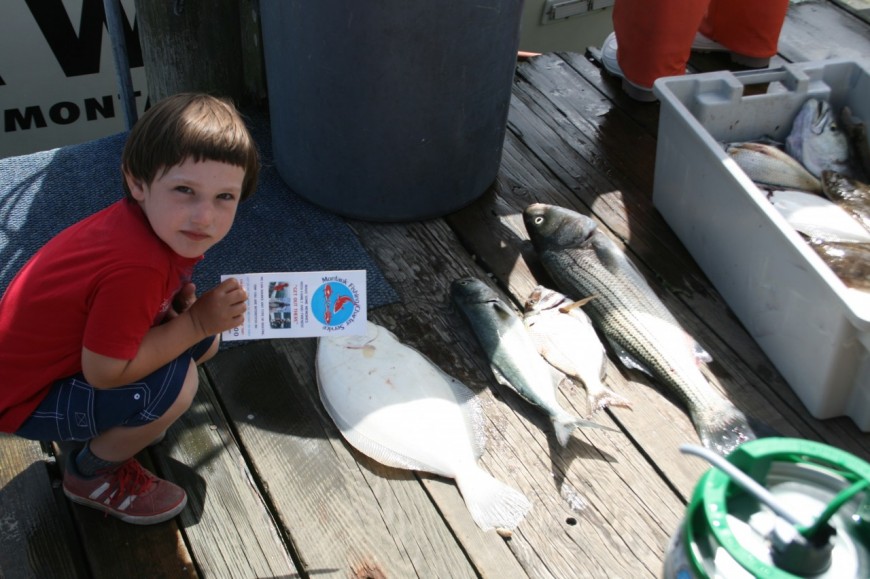
Tommy and the fishes

One thing I would like to explore is how I can upload my photos to S3 and Flickr simultaneously, and have the metadata I add in Trovebox be reflected in S3, Flickr, or any other application I push it too. POSSE #4life, or publish on your own site and syndicate elsewhere.

Posted in fun | Tagged , , , | 2 Comments