ds106 Defends the Open Web

I just listened to Brian Bennett’s follow-up audio to the compelling explanation of what ds106 is that he published last week. His audio producing talents are razor sharp, and this follow-up piece was particularly compelling for me because it starts out describing a failure, namely the moment wherein more almost fifty ds106 students’ sites were hacked by emre5807. It was any instructor’s nightmare, and my first reaction was far from phlegmatic. At the same time, I always found online violations far less scary that physical ones, and as we talk about in the podcast—getting hacked is part of being online.

Chalkstar to Rockstar #06 – ds106 Defending the Open Web

As I was listening to the audio I realized that I actually have video of the moment wherein I spend the first ten minutes of class playing the character detective Kim Droom. I deliver the news of the hacking to everyone in character as a long-haired police detective from New Jersey. If you listen to the class reaction it doesn’t sound like a defeated group as a result of this failure. In fact, it seemed to bring them closer together as a class. What other folks would consider failure might actually be a way to build community and making something together as a community that’s moves beyond the isolated, competing bodies just for the best grade. We all deserve more, we all deserve Kim Droom 🙂

This Week in ds106: Kim Droom vs Enre5807 from umwnewmedia on Vimeo.

Posted in digital storytelling | Tagged , , | Leave a comment

Minding the Future Program at a Glance

It’s hard to believe both Minding the Future and OpenVA are less than a week away now. I’ve finally gotten the titles and abstracts of the 10-minute talks happening in the afternoon along with a sneak preview of some of the issues to be discussed in the closing panel discussion. This should be a pretty amazing day, and I think we should be able to stream it all live at http://ds106.tv. Stay tuned for more on that front. In the meantime, feast your eyes on this, a conference about the future of education that can actually resist the popular urge to advocate systemically dismantling and defunding higher ed 😉
_____________________________________________

2:30-3:00 Alan Levine’s “Memorable/Unmemorable”
If asked whether they would like to be remembered, almost no one would answer “No”. But multiple choice questions can be trickier than they seem. The education future some are painting for us is a path focused on a destination, reached via an unmemorable journey.

3:00 -3:30 Kin Lane’s “Access, Interoperability, Privacy and Security Of Technology Will Set The Stage For The Future of Education”
The future of education will be fueled by the access and interoperability introduced by common, everyday web and mobile applications that our children use in school and at home, and we depend on as adults in our workplaces and personal lives. By providing proper access and interoperability in applications, bundled with the healthy education of end-users around these features, and fully respecting user’s privacy and security, technologists can help define the future of education and evolve the next generation of citizens who are web literate by default, and never stop learning, creating and sharing.

3:30 – 4:00: Audrey Watters’s “A Future with Only 10 Universities”
Sebastian Thrun’s claims that in 50 years, we’ll only have 10 institutions “delivering higher education and Udacity has a shot at being one of them.” What (horror) has to happen in order to get us to “ten.”

4:00 – 4:30 David Wiley’s “Implications of the Open Content Infrastructure”
Open infrastructures radically decrease the cost (and therefore risk) of experimentation, which consequently increases the pace of innovation. For example, the open communications infrastructure known as the internet radically reduced the cost of experimenting with new services and business models dealing in information (c.f. the costs and risks of experimenting with pre-internet “publication” business models for disseminating information or enabling communication). Over the last decade, individuals, foundations, and governments have built an open content infrastructure (OER) on top of the open communications infrastructure (internet). This open content infrastructure has enabled a second wave of low cost / low risk experimentation in a range of content-related fields including education and research.

4:30 – 5:00:  Jon Udell’s “Observable work and the reinvention of apprenticeship”
For most of human history the work of the world was directly observable. A young person saw, and often participated in, the farming and the hunting and the building. Then the adults vanished from the scene. They had all gone to the factory or the office. Work became opaque to the young.

Now work is again becoming observable. Increasingly both the processes and products of work are represented digitally, in ways that can enable learners and practitioners to connect. Will universities nurture those connections?

5:00 – 6:00 Break/Food and Refreshments

6:00 – 7:30 Panel on the Future of Higher Ed moderated by Jeff McCLurken 

This panel will include all of the day’s speakers responding to a wide variety of questions—a sampling of whcih can be found below:

  • What have been the most exciting developments in higher education over the last 5 years?
  • What will be the most exciting developments in higher education in the next 5 years?What developments concern you?
  • Who are the major players (people, institutions, businesses, foundations) in the digitally enabled higher education landscape?  What are their goals?  Who pays for this transformation?
  • What role does the defunding of higher education, especially at the state level, have to do with these changes?
  • What is the role of the state and federal government in these conversations?  What is it likely to be, going forward?
  • Business and technology leaders have been telling those of us in higher education that we have our heads in the sand, that MOOCS in particular are going to wash over us and we will be out of business. So, do public institutions of higher education have their collective heads in the sand when it comes to MOOCs, online learning, and “electronic delivery revolution”? If so, what are we missing and why?
Posted in openva | Tagged , | Leave a comment

The Insanity of Gender Trouble

A girl that thinks to assume the mask of a man, can shuffle off the baptismal name given her and take the name Alvin J. Ward, take the place of a man and marry a woman—Your Honor knows there was madness at the bottom of that.”
Colonel Gantt, testifying for the Defense
“The Pity of It,” Memphis-Appeal Avalanche 26 February, 1892

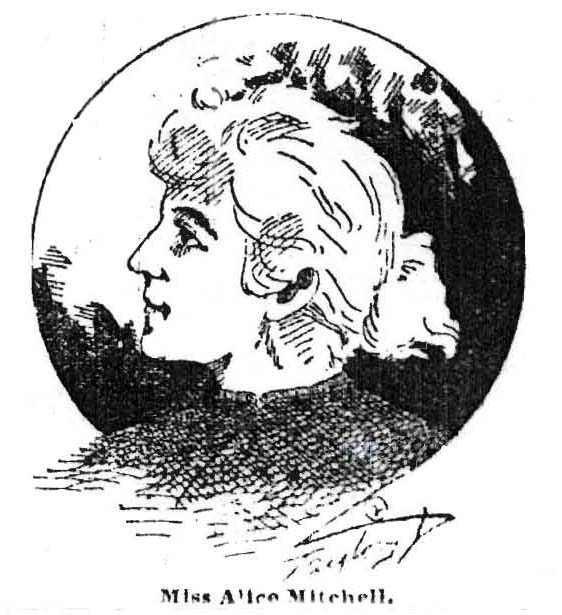
alice_MitchellThe above quote represents one of the most striking bits of Sonja Livingston‘s “Mad Love: The Ballad of Fred & Allie” creative nonfiction piece demonstrating how strictly defined and deeply inscribed gender roles were 100 years ago. No question they still are, but the fact that any deviation on this count was immediately and summarily recognized as insanity. It’s striking because it serves as a sobering reminder just how firmly our assumptions about what’s right, natural, and good are constantly corrected through a cultural lens. We’re still seeing this battle play out in terms of LGBT and gender equality—marking yet another moment in the battle for social justice for an underrepresented minority. And that becomes that much more complicated when you take these cultural assumptions in 1892 and frame them within a shocking and grisly murder between illicit lovers?

The brutal murder of Frederica Ward by Alice Mitchell in on the streets of Memphis, Tennessee in broad daylight amongst witnesses in January 1892 was just that. A shocking murder that became scandalous when Alice Mitchell openly admitted her intentions to assume the role of a man, marry Frederica, and live happily ever after as man and wife. Such a possibility was nothing short of madness, yet Livingston’s retelling of this tale more than 100 years later when this very issue is the most profound civil rights battle of our moment—it takes on a deeper sense of immediacy. This is a form of constructed insanity we’ve been trying to break free from for decades, and we’ve never been so close, just ask the thousands of gay, lesbian, and trans couples that have marriage unions recognized by various states around the U.S. So, the insanity of gender trouble becomes much ore about a culture’s evolving sense of tolerance (or intolerance depending how you want to understand this).

Yet, it would be unfair to suggest everyone at the time thought Alice Mitchell was insane, which becomes especially clear to me when the fact that lesbian relations were seemingly accepted at rich boarding schools like the one Frederica and Alice attended as a means to prevent some of the more apparent heterosexual scandals before a condoned wedding. The sense of same sex relations as experimentation and play before one grows up hetero is a fascinating moment in this narrative, and gives way to a sense of the hypocrisy at work within a class structure that can support such possibilities. And as
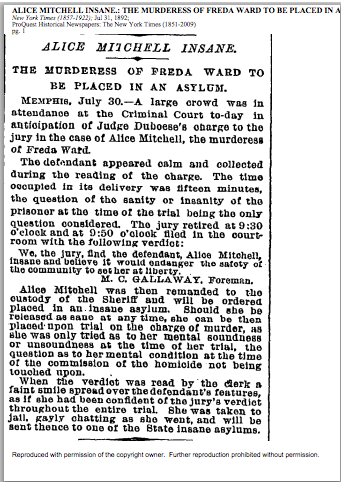
Paul Bond notes in this post, would this even be a story if it didn’t happen amongst the Memphis gentry. I found two articles in the New York Times database of articles at the time that tend to suggest that reporters were not so sure Mitchell was crazy as much as she was sly.  For example, there is this article that makes Mitchell seem like a cold, calculating murderer who knew insanity was an out:

Screen Shot 2013-10-08 at 2.36.49 PM

As the last paragraph notes from this trial piece:

When the verdict [criminal insanity] was read by the clerk a faint smile spread over the defendant’s features, as if she had been confident of the jury’s verdict throughout the entire trail. She was taken to jail, gayly chatting as she went…

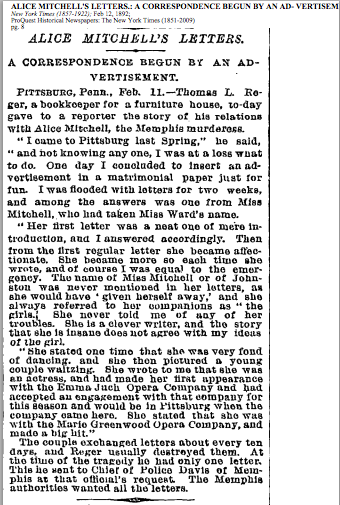
There is another article in the Times from roughly six months earlier, February 12, 1892, in which the NYT reporters were seemingly looking for evidence that Mitchell was anything but insane. The following article tries to links letters from Mitchell to a book dealer in Pittsburgh to who notes that she “is a clever writer, and the story that she is insane does not agree with my idea of the girl.”

Screen Shot 2013-10-08 at 3.31.41 PM

What’s interesting here is that you start to get a sense that there is a bit of a struggle around the idea of insanity in this case. And the possibility that Mitchell playing to the fears and prejudices of the culture when it comes to homo and/or transexuality is how they in many ways beat the rap of capital punishment. And this isn’t just the NYT reporters, you also have a very similar sentiment in a local, popular ballad about the two, the last two stanzas of which reads as follows:

There goes that Alice Mitchell,
With arms strong tightly bound down,
For the crime she did in Memphis,
She’s bound for Bolivar now.

And they won’t do anything to her–
She has two of the best lawyers in town–
But if they served Alice Mitchell right,
They would simply cut her down.

With a wealthy family and good lawyers you could be crazy too, but could you be queer? So questions of class, insanity, and gender converge in a case that offers up some interesting ideas of how so many cultural factors work together to give us just one perspective of a mutlifaceted incident as any event, no less a crime wherein people’s fates can be decided. The idea of truth as a construct of one’s position within a culture becomes more and more difficult to ignore, if not escape altogther.

Posted in True Crime | Tagged , , | Leave a comment

If I could bronze one tweet…

…about UMW’s DTLT it would be this one by Mike Caulfield.

Alternative EdTech driving the tone of innovation for the next forty years. Rock, not rot!

Posted in fun | 7 Comments

Domain of One’s Own: a Toolkit for User Innovation

I’ve been asked the following question a lot over the last year:

What’s the difference between UMW Blogs and Domain of One’s Own?

Why build and support something like Domain of One’s Own when you already have UMW Blogs? I’ve previously gone about answering this question by discussing the differences in terms of the limits of a centrally hosted version of WordPress in the case of UMW Blogs, etc. But that’s really missing the point, the difference has nothing to do with WordPress, per se. That fact became crystal clear to me after seeing this tweet from Jon Udell:

Udell continues to be one of the most subtley profound thinkers in the edtech space—a field tangential, at best, to his work as a Microsoft researcher—in that he deeply understands how essential it is to understand technologies,  to graft a concept by Anton Chekov from a literary to a technical context, as “potentiality.” The idea that within the use of every technical tool there’s more than just the consciousness of that tool, but also the possibility to spark something beyond those predefined uses. The only real way to galvanize that potentiality is to provide the conditions of possibility—a toolkit for user innovation like Domain of One’s Own.

UMW Blogs is a powerful tool for publishing on campus, and I don’t want to minimize its impact at UMW over the years. Hundreds of people have found ways to use it beyond a blog, effectively re-imagining its potential by pushing it beyond any predefined limits. At the same time though, UMW Blogs was not necessarily an open ended toolkit for user innovation, it was specifically a tool to scale the publishing on campus to as many people as possible. And that’s why seven years later Domain of One’s Own is necessary at UMW. This is a space that we can freely offer every student and faculty member as a fullblown toolkit for innovation that they are the master of, so to speak. A step beyond UMW Blogs in that it empowers anyone at UMW to build something like UMW Blogs.

That’s the thing, Domain of One’s Own is remarkable because it gives everyone in our community the toolkit to build and innovative around their own community publishing platform, or a million other tools we haven’t yet dreamed of. What’s more, it is not tool specific. Unlike UMW Blogs, Domain of One’s Own is not all about WordPress because it’s a platform for installing a wide range of open source tools, or even a techncial environment for going about building your own. It’s a garage of sorts 🙂 I was recently asked by a UMW Bullet reporter if I thought UMW Blogs was somehow threatened by the presence of Domain of One’s Own, and rather than being threatened the later is the apotheosis of the former.

So, suffice it to say that I’m more than excited that Udell is coming to the “Minding the Future” event here at UMW in little more than a week. I’m wondering if he’ll be working through this idea of the user innovation toolkit and what that might mean in a context that explores the future of technically framed education. I’m not sure folks fully comprehend just how epic “Minding the Future” will be! Udell is just one of five of the awesome folks coming to down to lay it down!

Posted in Domain of One's Own | Tagged , | Leave a comment

Tech Noir

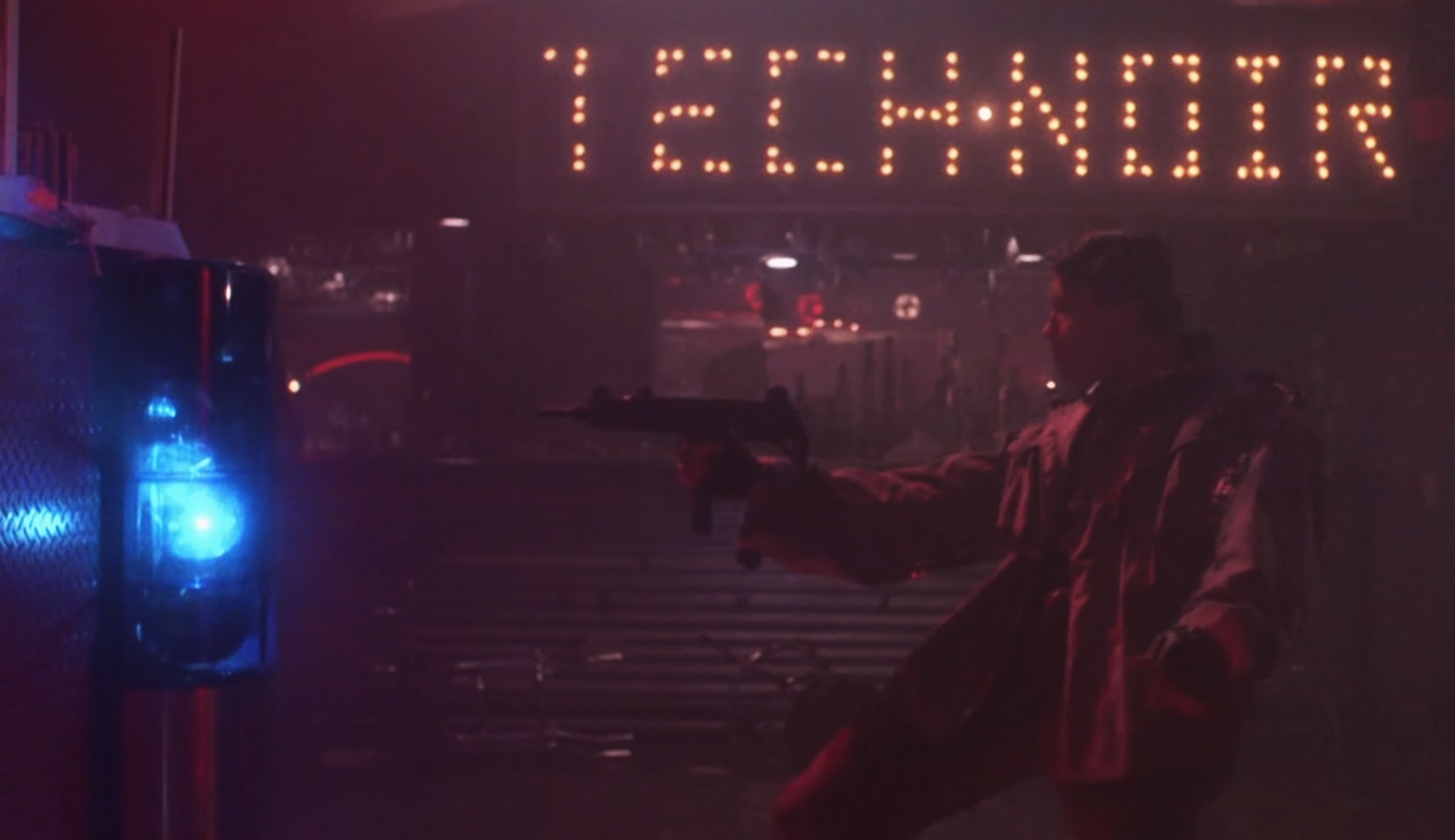
Watched Terminator (1984) tonight and love that Kyle Reese and the Terminator first open fire on one another is a kind of punk/new wave bar call Tech Noir (according to the Wikipedia article it’s the inspiration for an entire genre of noir).

TechNoir

The Wikipedia article is underdeveloped, and it would be a great thematic focus for a course on culture during the 1980s. A push to develop the concept of tech and noir during a decade that brought us everything from the C64 to cyberpunk to Max Headroom. How can we understand the emergence and convergence of  techology, literature, film, and theory in the 1980s? The idea of a course focused specifically on the material culture of a decade is one GNA Garcia and I kicked around last year, and I still would really like to do it.

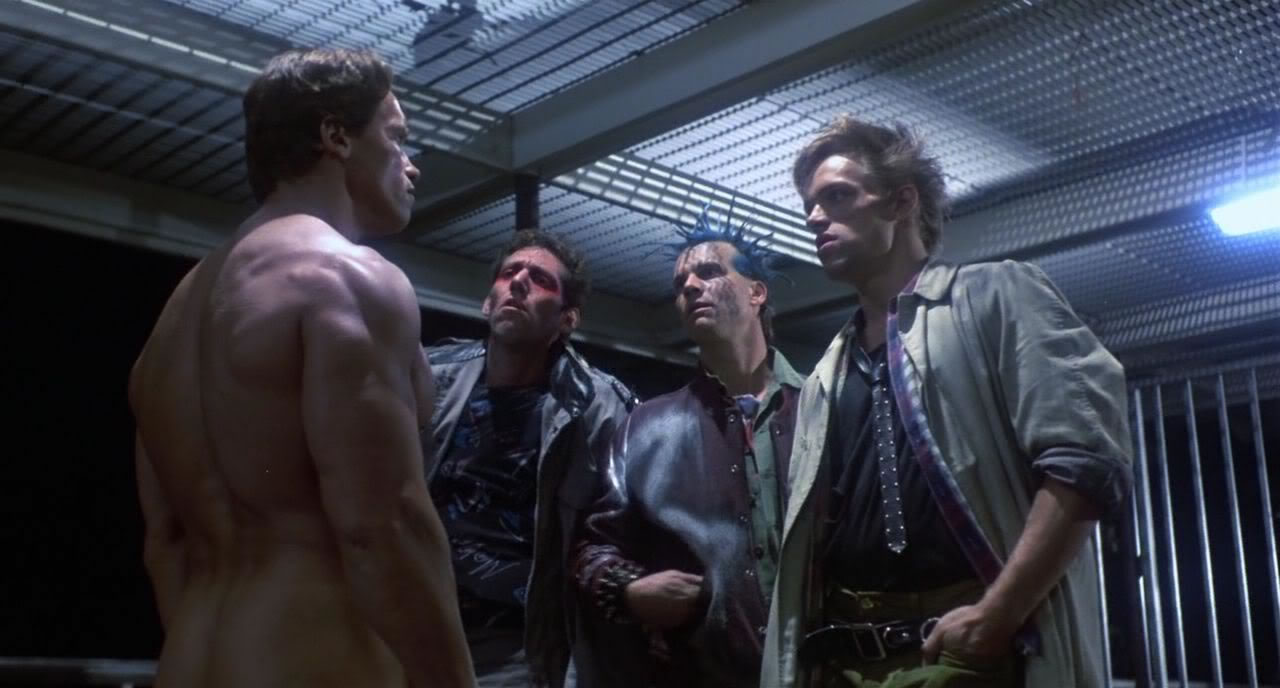
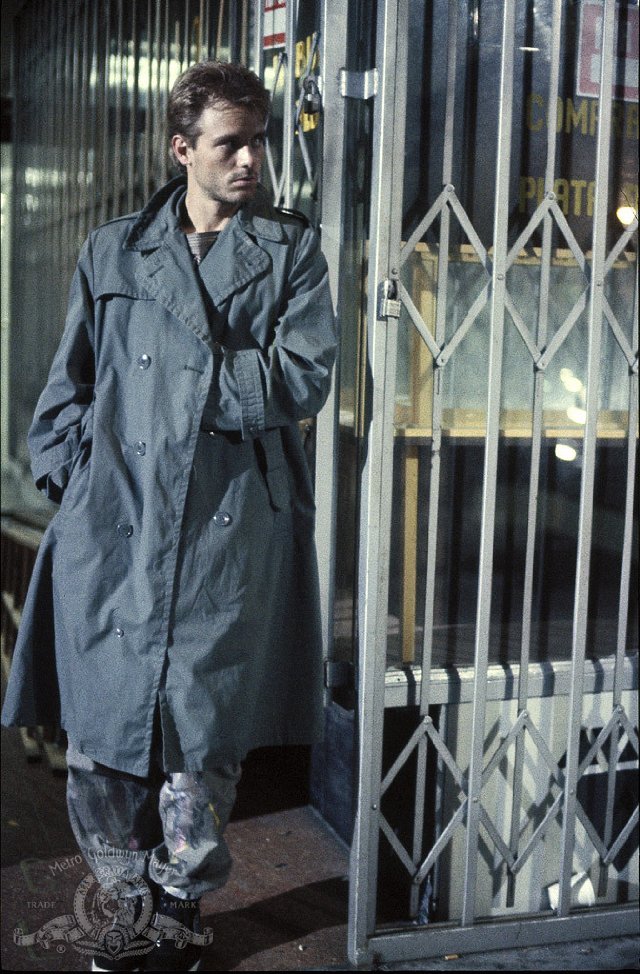
It strikes me just how much the aesthetics of punk and new wave are both fundamental and caricatured in Terminator. From the very beginning of the film the Terminator steals his clothes from a pack of punks (one of them being a young Bill Paxton) and Kyle Reese lifts a mod trench coat, paint-stained pants, and hightop Nikes that bizarrely dresses each of them up in the decade. The style of the 1980s was truly futuristic, just ask Devo, Flock of Seagulls, and Grace Jones. Now we all know James Cameron has tremendous debts to pay to Blade Runner and Escape from New York, but that’s why it would be such and interesting class to teach 🙂 There is a lot of interesting popular culture around a vision of a techno-dystopia in a very little bit of time.

The Terminator and a Pack of Punks (can you find Bill Paxton?)


Terminator

Posted in movies | Tagged , , , , , , | 2 Comments

Abel Ferrara Interview with Conan O’Brien

Writing my last post about a parody of Mike Francesa of “Mike and the Mad Dog” fame it sent me down a rabbitt hole that led me to the above 1996 interview between Abel Ferrara and Conan O’Brien. Abel Ferrera is one of those directors I love and hate at once. His early exploitation films like The Driller Killer and Ms. 45 are pretty solid “video nasties” that feature a pretty sordid 1970s NYC. What’s more, I truly loved his early 90s films like King of New York and Bad Lietuenant, but his later films like The Addiction and The Funeral (not to mention his terrible remake of Invasion of the Body Snatchers titled Body Snatchers).

Like I said, love/hate relationship with his films, but at the same time the above interview captures what a nut he must be. A reported addict (which is winked at by Conan in the interview) and hardcore New Yorker, there’s no two ways that Ferrara’s a total character. What’s more, the begining of Bad Lietutenant starts with Chris Russo on the radio going crazy about the Mets in the 1986 World Series. It’s an asbolutely brilliant opening to a movie that pays homage to the insanity of NYC’s sports culture. I love the film for that alone, such an awesome touch that localizes a narrative in a specific time and place through its mediated culture. Anyway, that is a quick snopsis of the rabbitt hole I fell down that brought me to this video that had me hysterically laughing. For some reason I am in a NY state of mind when it comes to culture today.

Posted in movies | Tagged , , , | Leave a comment

Revolution Radio: NY Sports Talk Radio in 1776

I spent many years listening to sports radio in NYC, and Mike Francesa and Chris Russo (who made up the Mike and the Mad Dog show on AM radio for almost twenty years) were an extremely entertaining duo. They talked and screamed about sports for three hours a day and made for a great pair. Russo played the over-the-top screaming maniac, and Francesa comes across more calmly and rationally, but with an air of arrogance. The two have gone on with their own radio talkshows since they split in 2008. Francesa is still on NY sports radio as well as part of the YES Network. Russo has his own national sports radio show on SiriusXM. The video above looks particularly at Francesa after the split, and what’s brilliant is that the impressario Mike Zaun has him down to a science. From his mannerisms to his way of talking to his means of arguing, it’s fun to watch. But the real stroke of genius is recontextualizing it within the Revoltuionary War casting Francesa as a Loyalist pundit/commentator. Simply brilliant!

Hat tip to Tom Dargan for the link!

Update: Francesa addresses the parody on his show with “I’ve never watched YouTube” 🙂 So awesome, “God bless the guy!” What a New York response.

Posted in fun | Tagged , , | 1 Comment

Developing Story: ds106 Explained!

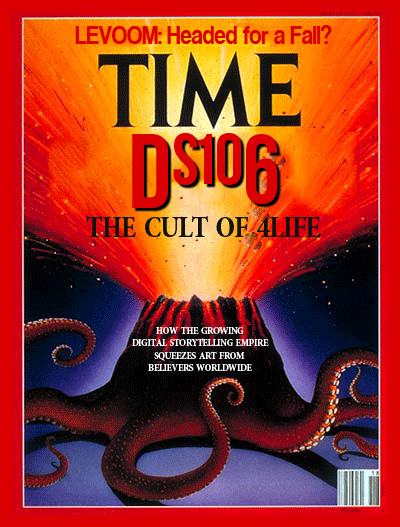
Image Credit: Martha Burtis’s’ The Cult of 4Life

One of the most difficult things about ds106 is talking about it to someone who hasn’t experienced it. And that’s not because it is some insider “you had to be there” mentality, but beause it is multifarious and protean. It can be many things to many people, and it is constantly changing based on the people enagaged in it at any given time. It might also be difficult for me because I am so close to it in a lot of ways. Nonetheless, I have given a number of presentations wherein I try and contextualize it as part of an ethos of open and experimentation that has been a guiding principle of the teaching and learning philosophy at  UMW’s DTLT. At the same time, ds106 is also much more than one edtech group’s philosophy, it’s something informed and continually shaped by a community beyond UMW. I guess that is why it’s both so interesting and hard to explain all at once.

Nonetheless, I think the best explaination I’ve heard of the developing story that is ds106 was produced by Brian Bennett for his “Chalkstar to Rockstar” podcast series. Brian was part of the ds106zone this Summer, and the audio show he worked in as part of a larger group about the existential crisis that is ds106 was some of the best audio ever produced for ds106, and his skills are getting even sharper. I thought the audio was going to play as a rather straight interview he did with Alan Levine and I, but it’s not that at all. Rather, it’s a deftly edited narrative that provides a powerful look at the various course experiments within a larger creative community that’s organized around a driving ethos of openness, collaboration, and fun. If you find yourself trying to wrap your head around ds106, I highly recommend taking 20 minutes and listening to the audio linked below, it is brilliant.

Chalkstar to Rockstar Episode 5: ds106 is the 5th Dimension of Teaching and Learning”

Posted in digital storytelling, Uncategorized | Tagged , , , , | Leave a comment

Dirty Snow Hardboiled

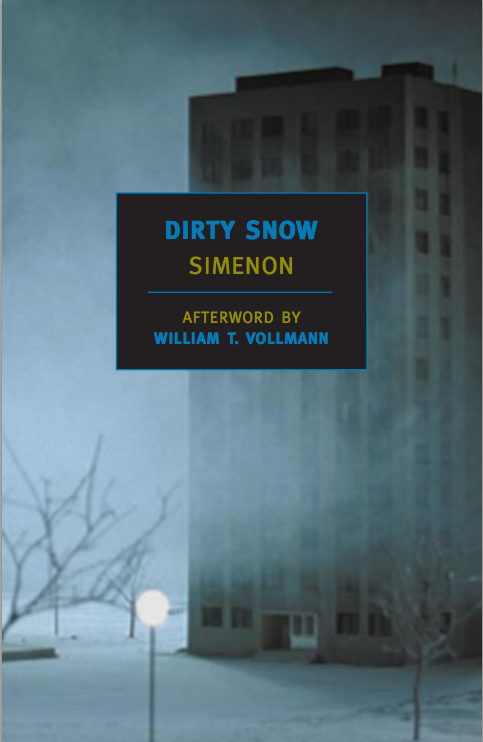
Georges Simenon's Dirty SnowMore than six months ago I finished reading Georges Simenon‘s novel Dirty Snow. It still haunts me regularly. There’s only one other book that I’ve read over the last decade that has had the same, harrowing effect on me: Cormac Mccarthy’s Blood Meridian. But unlike Simenon’s novel, you can actually argue that McCarthy’s novel has some vision of violence as regenerative, a space for interrogating history, literature and our culture more generally. I’m not sure any such value can be found in Dirty Snow, it’s a thoroughly horrific vision of a compeltely desensitized and frozen world in the midst of an occupational war. A deep-freeze of humanity that highlights a series of horrific, unneccessary acts of violence that only add to the base condition of depravity and brutality on the ground.

I started reading this novel after having taught the Hardboiled literature course last Fall, and it was interesting to read a hardboiled novel from the European perspective ostensibly inspired by the German occupation of France or Belgium during World War II. And while Dirty Snow is published in 1948, just six years after The Stranger, it makes Camus’s materpiece seem almost light-hearted and hopeful. It’s as if Simenon introduces a new vision of existential atomization and dehumanization that compeltely empties out the possbilities for meaning that seem to buoy that philosophy in a sort of individualied hope after reason.

Reading this novel after working through texts by Hammett, Chandler, Fante, Caine, Highsmith, etc. makes them all seem like quaint onlookers of the horrific void at the center of the existential crisis in the Western World. At the point when hardboiled fiction and film had become almost formulaic in the U.S. during the late 1940s and early 1950s, Simenon’s Dirty Snow blows up the genre, not unlike Kiss Me, Deadly—though with none of its humanity. Interestingly enough, Simenon wrote this novel while an expatriate in Tuscson, Arizona, of all places. He left Europe soon after the end of Wordl War II under the pale of accusations he had cooperated with the Nazis.

I’ve been a fan of William T. Vollmann’s for a while, and part of the reason I bought Dirty Snow more than eight years ago was because he wrote the afterword which you can find in it’s entirety here. In his essay on the novel he echoes an idea James Ellroy mentioned about Raymond Chandler’s Marlowe, something I wrote about last Fall as the Hardboiled class was ending. Vollman argues, like Ellroy, that Chandler’s protagonist Marlowe is soft:

Raymond Chandler’s protagonist, the private eye Marlowe, to whom the word “hardboiled” has been so oten attached that it’s now stuck like chewing gum, is actually a softy: compassionate, even ethicalin the bourgeois sense. He doesn’t mind being nasty to stuck-up rich bitches or hiding the occasional dead body; all the same, he preserves what strikes the reader as a comically dated horror of drugs and pornography, he avoids sexual gratification on the job, and, above all, he’ll never betray a client, much less a friend. Loyalty! Decency! As technology and corporatism impel us more and more to treat each other like things, those two words approach irrelevance, except between intimates, and sometimes even then. This is why with each passing decade, Marlowe’s corpse decomposes ever more rapidly into a skeleton of outright sentimentality. To some readers he already seems as quaint as Fenimore Cooper‘s Deerslayer.

Wow, Ellroy has nothing on Vollmann when it comes to gonzo critique! This is how I felt about Chandler’s novels but couldn’t even begin to frame it so brilliantly—simply put Marlowe  doesn’t age well. On the other hand, Simenon’s Dirty Snow makes Cormac McCarthy’s The Road seem like a bedtime story. Vollmann goes on to make the comparison between Chandler and Simenon that much more powerfully:

Chandler’s novels are noir shot through with wistful luminescence; Simenon has concentrated noir into a darkness as solid and heavy as the interior of a dwarf star.

Makes me think I should put Dirty Snow on the syllabus if I were to ever teach the Hardboiled course again, but I’m just not sure I want to, or even can. Reading this book the first time took something out of me. I can only swallow so much unrelenting brutality and inhumanity in a novel. That said, nothing approximates the cultural sense of horror and inhumanity that has come to represent the post-war era wherein there can be no poetry, as Adorno told us.

Having written all this I haven’t even told you anything about the novel, alas, I goes you must find out for yourself. Just consider yourself warned, there are no rainbows and unicorns to be found anywhere, ever.

Posted in Hardboiled | Tagged , , | 1 Comment