12

My Cat 12

I’m a bit late for yesterday’s Daily Create, but when I saw the assignment was based around the theme of 12 I couldn’t resist. I have a long love affair with the number 12, I was born on the 12th and I also loved Terry Bradshaw growing up. What’s more, it has always seemed like one of the foundational numbers of Western Civilization akin to three or seven: the 12 disciples of Christ, 12 months in a year, the 12 labors of Hercules, etc. Fact is, 12 is not a throwaway number, it has real cultural gravity. So, it makes sense that since my early twenties I wanted to name my first child 12. Not twelve, but 12—it had to be numeric.

But (and some would say thankfully) that never happened, not because I wouldn’t have named my first kid 12, but because before I could fate got in the way. I found a stray cat rolling around on the sidewalk outside my apartment in Brooklyn in the Fall of 1998. I never owned my own pet before, and the neighborhood kids were begging me to give her a home. Beign the sap that I am, I did. What’s more, I named her 12. Not only sparing my first child that cruel fate, but also creating a deep link between man and feline that is still going strong. Twelve never seems to age, I took the above image of her basking in the morning sun on my blogging chair in the den.

I dig 12. She was never a particularly affectionate cat, on the contrary she spent much of the first three or four years of our relationship attacking me. Despite this she has been a loyal companion, and has been a constant in some of the most awesome and painful moments of my life over the last fifteen years. She was there when I was married, when my mom died, when my three kids were born. What’s more, she makes the list when my youngest lists who’s who in our family—12 is not a just number, she’s a free cat! So, when seeing yesterday’s Daily Create I had to take the occasion to capture her presence amongst us. She’s been with me for so long now I’m afraid I’ve started to take her for granted. I don’t want to, because I know I’m gonna miss it when she finally decides to join all the other cats in that great internet in the sky.

Posted in digital storytelling | Tagged , , , | 8 Comments

The Strange Wonderland that is UMW Blogs

Professor Mara Scanlon just sent me a link to this post by a student in her Advanced Literary Studies Methods course (English 295). The final paragraph of that awesome blog post reminds me how vital it is to be part of an educational community that allows for rabbit holes:

Let’s go down this rabbit hole that is the “Bridge to the Blog” together, and leave behind the sensible world of the classroom–we now enter the strange Wonderland that is UMW Blogs, where madness pervades and anything is possible.

Did I ever mention how much I love UMW Blogs?

Posted in UMW Blogs | Tagged , | Leave a comment

Ohio Gang on Boardwalk Empire


The Ohio Gang

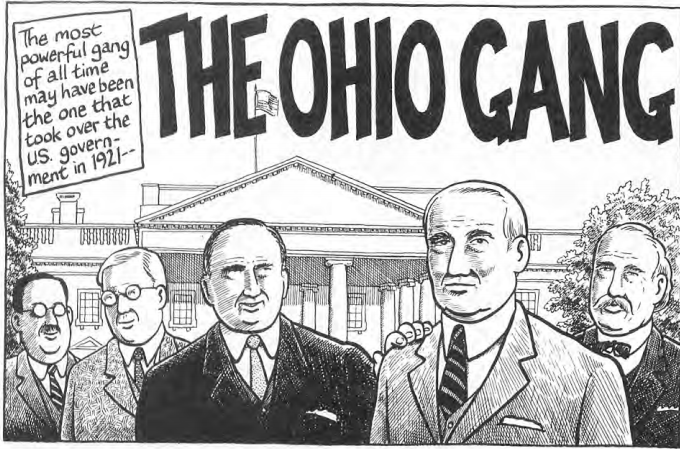
After the laughing attack that started tonight’s True Crime class, we actually got to some book learning. Tonight’s readings focused on political crime. In particular, we looked at muckraker Lincoln Steffens’s “Shame of the Cities” as well as Paul Rose’s vision of the Ohio Gang from his graphic novel The Big Book of Thugs. The Ohio Gang was a group of politicians and businessmen from Ohio that came to Washington D.C. with president-elect Warren Harding and proceeded to architect a wholesale rape of the nation’s coffers.

The HBO series Boardwalk Empire explores the legendary corruption duirng the days of “normalcy” by integrating some of the exploits of the Ohio Gang into seasons one and two. In particular, it follows the narrative of how Harry Dougherty brought Harding to national prominence and power. After Harding’s election Dougherty becomes Attorney General, soon after it shifts to his distrust of assistant Attorney General Jesse Smith who seems to be cracking under the pressure of guilt. Turns out the “supposed” suicide of Smith is believed by many to have been an attempted murder by Gaston Means. I love that Empire embeds a vision that dramatizes this history somewhat faithfully. What’s more, the show makes a point of demonstrating what an idiot Harding was with his “bloviating,”, not to mention the fact he fathered a bastard child with a teenage mistress. Here’s the clip that frames exactly that from season 1:

True Crime meets graphic novels meets HBO, that’s pop culture hard at work for this class!

Posted in True Crime | Tagged , , , , | Leave a comment

Au Revoir After Hours

Thanks to the above tweet by Ed Webb I got to see a brilliant swede of Martin Scorsese’s 1985 film After Hours brilliantly done by NYC-based band Au Revoir Simone as the music video for their song “Crazy.” If you are a fan of Scorsese’s minor masterpiece from the 80s, this is a must see. Oh wow!

And if you liked that, I recommend “Somebody Who” by them as well. The music video can’t compare, but it’s a song I find myself digging as of late.

Posted in fun, music | Tagged , , , | Leave a comment

The True Crime Girdlers

Screen Shot 2013-09-26 at 10.00.27 PM

Created with Room Planner

At the start of the True Crime seminar this evening the entire class got into a laughing fit. I’ve actually never had anything like this happen before (though there was fist fight in a class I taught at CUNY back in 1997), just about everyone in the room was giddy. In fact, it quickly became contagious. For a few minutes the group couldn’t stop laughing, which was nothing short of awesome. I was just as giddy as most of them so I don’t remember how it happened exactly, but I think it had something to do with “the girdle.”

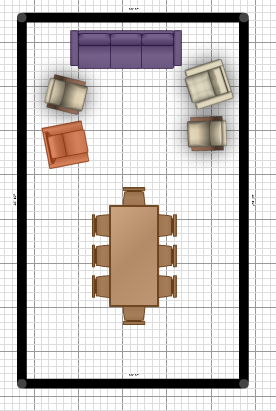
“What do I mean by ‘girdle’?” you ask. Well, the semianr meets in the DTLT offices—the layout of which is mapped in the diagram to the right. There’s a long conference table that seats about eight, and a series of chairs and couches in a horshoe where the other six or seven students sit. In passing I referred to this part of the class as “the girdle” which was a reference to “The Condition of the Working Class in England”  by Friedrich Engels. There’s a part of that essay where Engels refers to the ways in which you can map the layout of industrial cities in England, such as Manchester, based on class:

All Manchester proper, all Salford and Hulme, a great part of Pendleton and Chorlton, two-thirds of Ardwick, and single stretches of Cheetham Hill and Broughton are all unmixed working-people’s quarters, stretching like a girdle, averaging a mile and a half in breadth, around the commercial district. Outside, beyond this girdle, lives the upper and middle bourgeoisie, the middle bourgeoisie in regularly laid out streets in the vicinity of the working quarters. [Link.]

I used this off-the-cuff reference during the first week because it was hard to see those students sitting on the couch and in the chairs. They seemed like the invisible working class of those industrial cities, so I started referring to them as the girdle, invisibly surround the inner city.  The nickname is one I used for the first few weeks to refer to this part of the room, but as of now it has become the source of  identity for the class. Up and until now the students that sit in the girdle has been in flux. This is mainly because each week a group of three students lead the discussion from the conference table, so there can be no one girdle. That said, as of tonight—based on the laughing fit I can’t remember the exact origins of—the girdle understands itself as a distinct group from the conference table inhabitants. There is a self-proclaimed “Queen of the Girdle” and when Girdlers want to say something they raise there hand and say “girdle has something to say,” or just “girdle.”

I love this! A laughing fit to start the class, an emerging identity anchored in the spaces where we learn, and a sense of community that can only happen through a sense of fun and irreverence. I find it interesting that the identity of this course is emerging through classroom space, which I don’t think was the case with the #emoboilers (the students in the Hardboiled course last Fall). Their identity was more linked to the emo tweets of a few students.

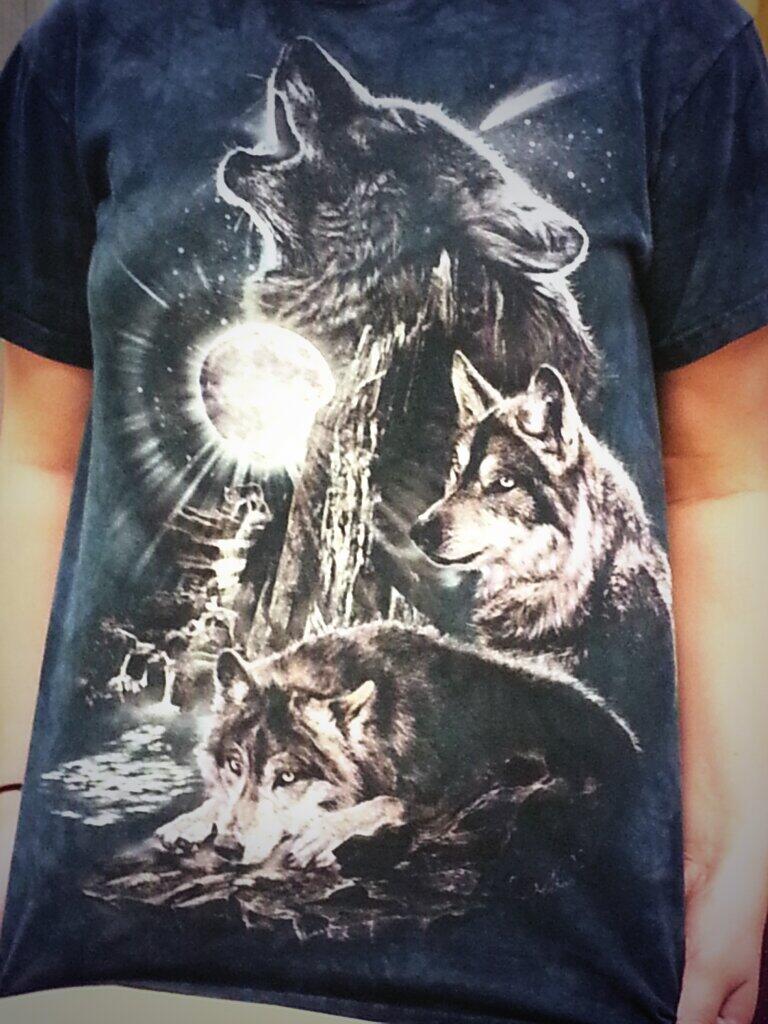
All this said, I’m also wondering if tonight was such an awesome class because one of the students was wearing a variation of the Three Moon Wolf shirt. The cosmic powers of that shirt are well known to many. I can’t say for sure, but there is one thing I am certain of: this True Crime group has been a total blast thus far—and I couldn’t be happier with how the semianr has gone thus far. And I haven;t even mentioned the content yet. So much of a course is embedded in the relations between those within it.

three_moon_wolf

Posted in True Crime | Tagged , , | 1 Comment

Where have the Online Neighborhoods Gone?

After linking to the “One Terabyte of Kilobyte Age Photo Op” Tumblr in my last post, I started reading around a bit on the Geocities research blog. This post by Olia Lialina (pioneer web artist and theorist) about Neocities got me thinking a lot about how we are framing Domain of One’s Own here at UMW. Neocities is a project by Kyle Drake to “help me keep the creative, independent internet alive!” and it’s built in the spirit of Geocities. Lialina has some deeply insightful observations that she jotted down as soon as the service went public this Summer that I’m finding helpful to think more broadly about building community around DoOO.

We have the basic hosting worked out, we’re currently exploring more sophisticated syndication, but we still need to figure out how to imagine community more broadly. In this regard I think the same is true for Reclaim Hosting—in order for both to be more than just hosting they have to be able to expose what’s happening around the community.

As she was testing out Neocities soon after its launch, Lialina notes that….

There are still people out there who can write HTML, want to have their homepages made by hand and want to express themselves through HTML code. What seems lost is the idea (or skill) to make links to each other, manually, to build anything outside of your own “profile”. Neocities users do not link to other users’ pages, except user youpi and myself.

This idea of isolation in managing one’s own site is a theme that recurs through the first impressions. What’s more, I think it’s also apparent for anyone who has been blogging for a while. The slow death of the blogosphere is just that, the cultural amnesia that links between sites and people is what makes the web. Like with syndication, we want this to happen as a part of a siloed service like Facebook or LinkedIn—the idea of a personal profile seems almost divorced from the social self online—and that is something we need to challenge with DoOO.

There is also a discussion about the changing rhetoric around Geocities over time. In 1996 and 2004 Geocities was referred to as a priosonhouse of one’s content. Free web hosting services like Geocities “were seen as a prison for creativity and self expression.” There was a push to controlling your own webspace through commodity web hosting services like Bluehost and the like. But the rhetoric around Neocities, an updated verion of Geocities in many ways, is framed by Kyle Drake as a….

….place for the users to be “in complete control of the content and presentation they provide to their audience”. It is of course an over-over-statement. However, compared to the industrialized nothingness Facebook offers, any “pimp my profile” service can be regarded as offering “complete control”.

This is fascianting to me because the critiquing of Geocities in 1996 and 2004 was not so much about ownership as it was about ease of use. For the replacement was not cheap commodity web hosting for most folks, but rather “the industrialized nothingness Facebook offers.” So much so that something like a simple, third-party service for hosting HTML pages seems like the second coming of Freedom online. What an interesting shift in the rhetoric of the web over the last 15 years or so. There’s a dissertation in that alone.

But what is most interesting and useful for me in her early impressions is the fact that Neocities is cultivating a series of disconnected sites that don’t foster community. No one is linking to anyone else, and that frames the “beginning of the end.”

Very bad move: Calling it Neocities and not starting with neighborhoods. When Yahoo bought Geocities, they only offered vanity profiles and discontinued neighborhoods and suburbs. Users became isolated, it was the beginning of the end.

How do we build neighborhoods in DoOO and Reclaim Hosting? Is it around topics? -interests? -academic disicplines? -academic departments? -courses? -people? I imagine some combination of all these will be the case? And the more I think about it the more the idea of rolling out DoOO by a class of students, i.e. freshamn, didn’t make all that much sense for the project. The success of DoOO is going to depend as much on academic programs, courses, departments, and individuals—and like everything else we’ve done at UMW it will depend on an organic push. I’m just wondering what the idea of “neighborhoods” looks like for DoOO and how we might start experimenting along those lines.


Posted in Domain of One's Own, reclaimopen | Tagged , , , , , , | 10 Comments

The Long History of Domain of One’s Own

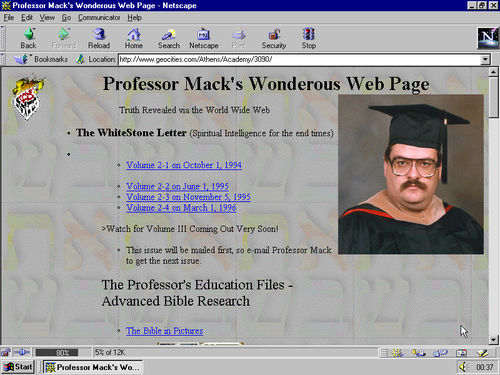
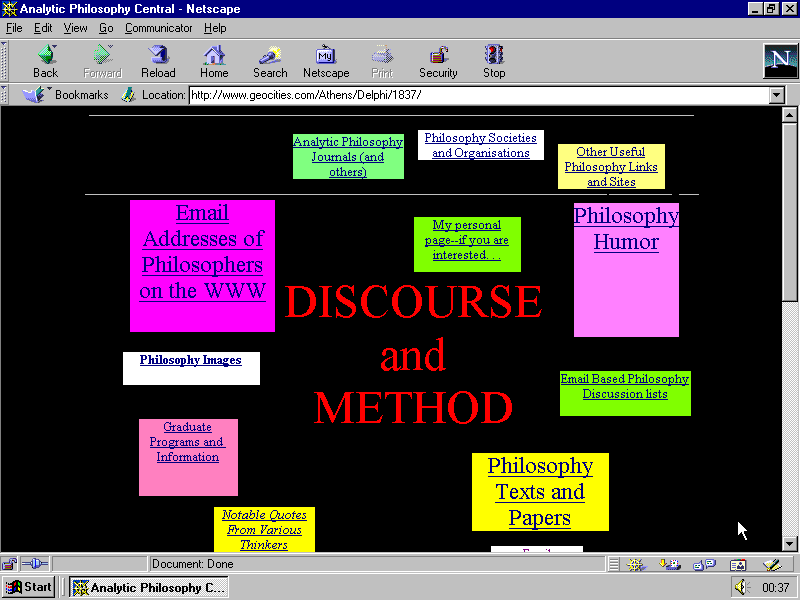
I found this image on the Tumblr “One Terabyte of Kilobyte Age Photo Op” which consists of random images taken from an archive of Geocities sites. It’s part of the Geocities research blog run by Olia Lialina and Dragan Espenschied. According to the Tumblr description:

Screenshots are automatically generated from a stash of old Geocities home pages, rescued by the Archive Team in 2009. The files are processed from oldest to newest.

I love this kind of stuff, and when I saw this screenshot I couldn’t help but think that the Domain of One’s Own project is part of a long history of faculty and students alike creating “homepages” on the web. Geocities was the old gold equivalent of helping people get up and running making a site, learning some absic HTML, FTPing files to a server, and generally understanding how the whole web thing works. I had my own Geocities site I back in 1994 that was dedicated to American Modernist literature. That was my first experience with writing on the web. The tools have come a long way in many respects over the last decade, but the idea is basically the same. Everything that is old is new again.

Posted in Domain of One's Own | Tagged , | 4 Comments

Aggregating Comments into a Distributed Course Hub Recipe

comment-box_mediumWe been thinking a lot about new methods of syndication at DTLT, but I have to admit we won’t be writing off RSS just yet. I do hope that one day we can synch comments between in psots seamlessly between a course hub and student blog—or event abstract comments out all together—but in the meantime I’m still using FeedWordPress to aggregatate and display comments from a distributed constellation of student blogs to my course aggregator blog. What follows is a howto for just that.

I actually aggregated all the comments feeds from the True Crime seminar blogs last week and it’s a bit of a workaround, but it works. To do this grab all the blog URLs for your students’ blogs and append /comments/feed. So, http://truecrime.umwblogs.org/comments/feed will aggregate all the comments for that blog, and so on. This is an imperfect method because not all posts for a single blog are related to a particular course, but in my instance, t least, it works.

Once you have all the comment feeds for the student blogs on their own line in a text document you can copy and paste them into an OPML file builder. I found one at FeedShow Goodies here.

FeedShw Goodies OPML Builder

Once all the feeds, each on their own line, are entered click the “Create OPML” button to get the code for the OPML file. Once you have it just copy and paste that into a plain text document and save it as recent_comments.opml (or something like that, just make sure extension is opml).

recent_comments_opml

Once that’s all done, head over to FeedWordPress in the course aggregator blog and click the green “Import Source List” button to import the OPML file.

FeedWordPress Import OPML File

Once you import the OPML file (which brings in the comment feed for each of the student blogs individually) you then need to edit each of the comment feeds and add a unique category to it such as “Comments.” This allows each of the posts that come into the aggregator course hub to have a shared category that you can both exclude from the front page, as well display in the Sidebar as recent comments.

Comments category in FWP

At this point once you assign all incoming posts from the comment feeds to the Comments category you’re ready for the last two steps.

Add the Ultimate Category Excluder plugin to your blog and exclude posts in the Comments category from the front page of your blog. You don’t want all the comments to show up as posts in the blog flow, or at least I don’t. You want them for two reasons: 1) to show the most recent 10 comments from around the blogs in the sidebar (how to do that is the final step coming up next) and 2) for the ability to filter by the comments category in the Posts section of the course blog to see all comments made by students over the course of the semester.

ultimate_category_excluder

The final step is to install the List Category Posts plugin on your blog and set it up in the sidebar so that the 10 most recent posts in the comments category are listed. Here’s how my sidebar widget looks on my True Crime course blog:

category_posts_list

And that should be it, a whole lot of steps for a rather simple thing, but so it goes in the world of a hacker who has no programming skills.

Posted in WordPress | Tagged , , | 2 Comments

Reclaim the Chronicle

RECLAIM_LOVE_GRAPHIC_grandeMark Sample wrote a really good post laying out what Reclaim Hosting is all about on ProfHacker yesterday. He lays out the nuts and bolts of what something like this means:

Reclaim Hosting is a web hosting service for educators and students, providing simple one-click installation of a variety of web apps, including WordPress, Omeka, MediaWiki, and many others….And indeed, the one-click installation of popular web applications is only part of what Reclaim Hosting offers its users. Each domain includes secure FTP access, an email account, the ability to run Cron jobs (which execute scripts and programs at regular intervals), and SSH/Shell Access, meaning students can work on the command line, programming in Perl and Python. In short, students get all the benefits of a typical shared server hosting service (say, Dreamhost) for the cost of several slices of pizza.

I’m a big fan of pizza, so I love that closing analogy. One of the other things we’ve started realizing recently thanks to Martha Burtis’s work on creating customized packages using “Installatron” (an aptly named application installer) is that we can start offering particular WordPress installations that are customized to be out-of-the-box solutions to something like course syndication. The idea that faculty and/or students can deploy a fully- functioning syndicated course hub in seconds is really exciting. This is an idea we’re working though currently at DTLT, and you can see the early stages of thinking through this here. This approach is done with WordPress, and it populates free plugins and some custom code that enables students to automatically push their work to the course hub.

And while some might balk at the automation of this, it by no means precludes anyone from hacking away, building their own, or taking this in a bold new direction. What this does is makes the syndicated course setup that much more seamless for faculty to use, which I ‘ve found makes a huge difference in their willingness to experiment with such an option. The fact that the experimentation with this through Domain of One’s own has made such an idea possible already justifies this project, but add to that the fact that we are using Reclaim Hosting as a way to make these possibilities available to as many faculty and students as possible is downright awesome.

Screen Shot 2013-09-20 at 2.12.20 PM

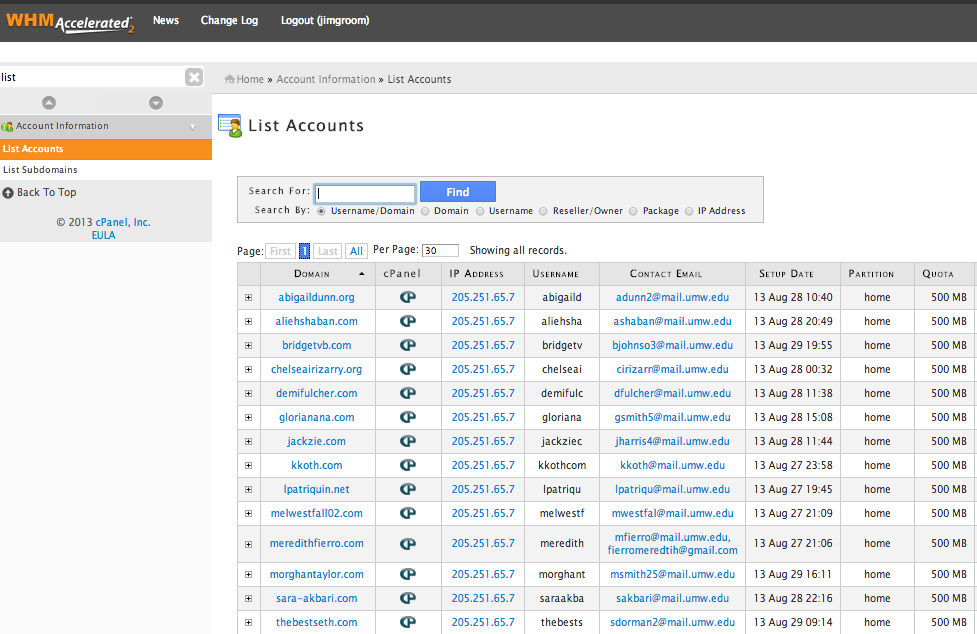
Another feature I’m beginning to explore in the True Crime Freshman Seminar with  the students, all of whom have their own web host and domain as part of UMW’s Domain of One’s Own, is being able to help them manage their web hosting by being able to access their cPanels (see image above). With this setup I can act as a server admin for all of their sites and  help them out with issues that in the past I found difficult to resolve when teaching ds106. I can help them trouble shoot DNS issues, installation problems, plugin snafus, databases problems, etc. If you’re using Reclaim Hosting as a way to show your students how to manage web hosting, maintain their own space online, and get familiar with the affordances of web hosting—this is one possibility for enabling some powerful support. That said, you might want to let them know as much,  becuase with great power comes great responsibility.

Posted in reclaimopen | Tagged , , , , | 1 Comment

Hometown Heroes

Looks like Martha Burtis and I are hometown heroes thanks to ds106. Reporter Lindley Estes of the Free Lance-Star published an edited version of a post from yesterday’s UMW Newsletter EagleEye announcing ds106 as one of five winners of the Reclaim Open Learning contest. When I look at the other amazing projects that ds106 sits alongside of it gets me really excited. I’m really proud of the work we do at DTLT, and recognition that not only connects UMW to think tanks like MIT’s Media Lab and UC Irvine’s DML Research Hub, but also to our local community is the best of both worlds.  UMW is world class in a local kinda way!

Posted in digital storytelling, reclaimopen | Tagged , | Leave a comment