What are they looking for?

Every so often I check in on search terms to see what people are looking for when they inadvertently find the bava. And, as you can imagine, it’s anything but edtech. This range of search terms makes me happy—though the 1976 snuff film has me a bit concerned 🙂 My traffic was basically cut in half a year or two ago when I stopped writing about stuff like WordPress, EDUPUNK, and edtech more generally (though I still very much write about these things, but outside the perceived vision of an edtech blog).

A strictly edtech blog (or any other kinda of one-trick space) always seemed an unnecessarily limiting idea for me. From the very beginning my blog was an extension of the myriad influences and ideas that make me who I am—all of which are far more compelling as a fragmented narrative then some singular notion of a field. What makes a field interesting is how you bring your own ideas of culture to it in hopes that some new combinations will inspire something beautiful. And while I understand it’s not the only way, it makes it that much easier for me to write so regularly. I mean where else would I put my Fisher Price A-Frame posts? bavatuesdays 4life!

Posted in fun | Leave a comment

Four Things I Did Today

Today was a pretty productive day around the house. I’ve been ever more the homebody these days, and I am actually starting to get a rhythm now that my travel has been pared back to the absolute minimum—a reality I am loving. The ramp-up to Christmas was always a special thing for me as a young boy. One of my favorite memories of my mom is of her going all out each and every Christmas. She spent her personal fortune on our Christmas mornings—and while for many that would seem irresponsible and wreckless—as a child on the receiving end of that mania it was nothing short of awesome! And even now as that child looking back on it 30 years later it holds much of its original magic. I’ve come to the realization that the irrationality behind the Christmas holiday as it is practiced currently is the greatest thing about it. But that’s not what this post is about.

This post is about 4 things I did today in chronological order.

1) The first thing I did was put up the Christmas lights around casa bava. I did a pretty awesome job on them if a must say so myself. The garlands above the icicles along the top are inspired and don’t make the lights look nearly as naked and lonely as they usually do in this arrangement. What’s more, the garlands around the column were first hand-wrapped with love and care in white lights. I have a bit more to do outside, but I have already kicked all my neighbors asses.
A Clean, Well-Lighted Place

2) After that, Antonella and I built a train set on our Christmas tree (I put that bad boy up yesterday). It’s something we bought last year for the tree thinking it went under the tree only to find out it goes in/on the tree. We already had all our decorations up so we decided to wait until this year, and now we have a full blown engine driving around our douglas fir. Epic! (We also crushed our neighbors with this detail.)

The Christmas Tree Train

The Xmas Tree Train Wide shot

3) Window hardware. I have been working on the kitchen and dining room lately and I have been meaning to strip and clean the hardware on the windows but still haven’t. And, as it turns out, two of our windows had been lockless for too long. I secured them back on for the time being, and hopefully I’lll finish this with one of the free days I’ll have this Christmas break (we get almost 3 weeks this year—how sick is that!).

The Only Windows Hardware in my house

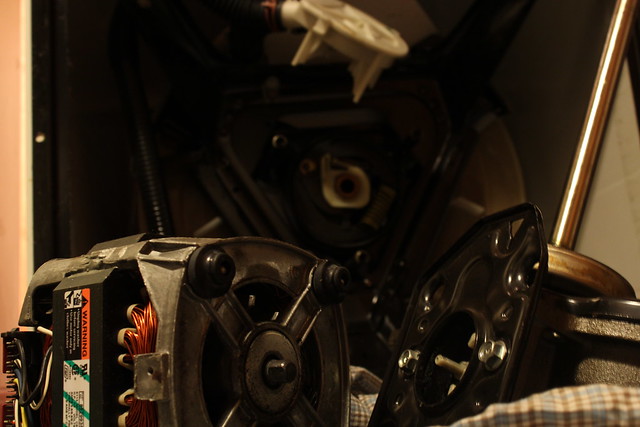
And last, but not least, I pulled apart my broken washing machine to see if I couple fix it myself instead of forking over much needed Chistmas money. And thanks to this YouTube video by Bill Newberry—who is awesome for posting it—I figured out it was a broken motor coupling, and I’ve already ordered it from Repair Clinic. Winning.

Image of a borken Kenmore 80s Series Motor Couping

And here is the engine and transmission for my washing machine that I took out. It feels so good to be able to do stuff like this—I love that people share their expertise in ways that make it so easy to do it yourself.

Kenmore 80s Series Engine and Tranmission

NOBODY!

Posted in fun | Tagged | 4 Comments

An Internet of Attractions

As of late my two year old son, very soon to be three, has eschewed all forms of narrative video on YouTube. He’s dispensed with the Thomas the Tank Engine scam (that series is all about being a useful worker, akin to 19th century British imperial labor propaganda), and has opted for simple videos people have posted of trains passing by while they’re waiting to cross the tracks. One of his favorites is this minute-long video of a train crossing in Roberts, Oregon:

I’m often sitting right next to him while he spends time whipping around YouTube looking for trains, and what struck me about the above video is the number of views it has: 21.5 million. Let me say that again: 21.5 million views. Insane! What it got me thinking about is how many people might be doing just what my son is, cruising around to watch these videos that are non-narrative. In fact, it reminds me of this post I wrote back in 2008 when I was describing the magic of Ray Harryhausen’s animations in the original (and in my heart only) Clash of the Titans (1981) as attractions in and of themselves, almost extra-narrative. It was a riff on film historian Tom Gunning’s idea of a “Cinema of Attractions.” His theory suggests there were myriad non-narrative forms of cinema from 1895-1908, but as the dominant Hollywood narrative began to congeal from 1910 to 1917 (famously cemented in 1917 with the cinematic grammar of D.W. Griffith’s Birth of a Nation) the almost constant state of transformation of the medium for its first twenty years began to ossify into a much more linear and delimited narrative style. To quote Gunning:

[Cinema prior to 1908] did not see its main task as the presentation of narratives. This does not mean that there were not early films that told stories, but that this task was secondary, at least until about 1904. That transformation that occurs in films around 1908 derives from reorienting film style to a clear focus on the task of storytelling and characterization.

Rather than using film for outright entertainment purpose, the “cinema of attractions” offers the viewer something different: “the chance to take a journey somewhere else-a place to which he will likely never physically travel…films sought to transport the viewer through space and time, rather than to simply tell a story,” as Lila E. Stevens points out in her discussion of documentary film here. This idea strikes me as akin to a way of understanding the emergence of the visual vernacular and minimalistic design impulse of the web more recently. The web is in many ways an internet of attractions more than it is a medium germane to more traditional narrative forms that we have come to expect given our immersion in 20th century film, television and radio.

Some of the criticism about ds106 I’ve heard over the last three years as a course has been it doesn’t spend enough time on the the actual storytelling—which I read as more traditional ideas of digital storytelling. When I started preparing the first ds106 course in 2009 the idea of digital storytelling was often associated with the slideshow made in iMovie featuring the Ken Burns effect set to your favorite song about a moment that’s “changed your life.” I know this is an over simplification, but at the same time that’s still the model set forth as digital storytelling. I pretty consciously wanted to eschew that like my son began avoiding Thomas the Tank Engine videos. I wanted to explore the internet of attractions:  the idea of digital representation, experimental sound, video essays, movie posters, animated GIFs, etc, as the non-narrative forms that we are communicating with on the web.

Heretofore I’ve been arguing around this point suggesting that these are stories too, but in many ways that was a cop out. They aren’t stories in the same way we have come to expect narrative from television, film, and radio—and in many ways that is why I was attracted to them and why ds106 moved further and further away from the idea of storytelling as we’ve known it. The internet of attractions is a compelling frame to start understanding the emergence of a web-based vernacular that isn’t “digital storytelling” per se. I haven’t even begun to discuss how this is also dependent upon a much larger context of interacting and playing within pop culture allusions. This idea of the Internet of Attractions is obviously still quite raw in my mind, but it is the first useful quasi-theoretical frame I’ve come up with to start understanding how what we are doing when we communicate on the web with pictures, GIFs, design assignment, quick photoshops, sounds, etc. is not exactly digital storytelling as it is currently being understood.

Posted in digital storytelling, Internet of Attractions | Tagged , | 10 Comments

A Domain of One’s Own Elevator Pitch?

Image credit: Jose R. Borras “elevator”

Last night I was invited by Steve Hargadon to talk about Domain of One’s Own as part of his Future of Education series. It was a fun talk because I don’t really have a pitch for Domain of One’s Own as of yet—although it quickly became apparent that’s what some folks were looking for. The idea is still free-flowing, top-of-my-head thinking about our work at UMW over the last seven years starting with the Bluehost experiment to UMW Blogs to ds106.  In fact, as I noted earlier today Haley Campbell may be the one who is most effectively communicating the spirit behind this initiative.

As for the Domain of One’s Own elevator pitch (which I was asked to give by Steve to placate  the back channel’s demand for clarification), I’m really not overly interested in simplifying the idea too much at this point. I would rather it remain a bit amorphous and undetermined. I want it to be shaped by those who participate in the process, and by extension, define its contours. With UMW Blogs, and ds106 as well, we found there’s a real value to letting the meaning of an initiative like this emerge without too quickly packaging it as an eportfolio or personal brand. In my mind it’s a discursive practice whereby the meaning emerges as a result of the ongoing thinking and participation, to know it you must become part of it—-but I’m not sure too many folks would appreciate that as an elevator pitch!

I had fun with the chat room last night, they were pretty feisty–which in turn got me riled up. At some point I started repeating: “THIS is the antidote to the nonsense!!! THIS is the antidote to the nonsense!!!” The conversation went from Domain of One’s Own to MOOCs to me going at it with the chat room—now that’s the arc you want your presentation to take 🙂 Anyway, if you are interested the video archive of the presentation is here (which will let you see the chat which is important to get a sense of my reactions) and then there’s the straight audio here. Finally, the talk was cross-casted to ds106radio, and there Grant Potter had some fun sampling some Lebowski bombs over the discussion (my favorite version).

Posted in Domain of One's Own | Tagged , , | 4 Comments

A Domain of One’s own and the Realism of the Web

We’re lucky to be doing what we’re doing here at the University of Mary Washington. We’ve been on a pretty hot streak for the last seven or eight years when it comes to innovation, and for many of us the Domain of One’s Own is an exciting, authentic culmination of years of work distributed amongst thousands of people. I could come up with a laundry list of things we’ve been working towards over that time period: openness, liberation, fun, alternatives, empowerment, etc.

But the most intelligent and inspired vision of what we’ve been after was recently articulated by Haley Campbell, a UMW senior and ds106 internaut, who absolutely nailed what this moment of teaching and learning through the web means for our faculty and students alike. She frames the realism as the web as departure from the rhetoric of the web as a scary, alterior space to one that we more fully inhabit, take ownership of, and by extension shape and are shaped by. A sense of being on the web that for me is at the heart of Domain of One’s Own. At it’s heart this project is not about an eportfolio or self-promotion or being the first search result on Google—though it can be any and all of those things—its about becoming through this medium, integrating it into the very fabric of your identity both online and off. And the short clip below of Haley talking about the realism of the web brought it all home for me:

Haley Campbell on the Realism of the Web from umwnewmedia on Vimeo.

When you’ve got a spokeswoman like Haley, it’s hard not to get excited about Domain of One’s Own at UMW. And last night was another good example that its quickly moving from collective fantasy to communal reality. We had our Open Dialogue about the initiative and were greeted with upwards of 25 new faculty who are interested in joining a 6-week mini-course this Spring to experiment with their own domains and web host. None of which would be possible without our partnership with Mary Kayler, who runs our Center for Teaching Excellence and Innovation, who has been nothing short of awesome to work with. Through her expertise and excitement we’ve been able to frame this as a much larger teaching and learning initiative that will be supporting faculty technically, pedagogically, and financially ( a holy trinity! 🙂 ). Next up is to try and do just as much for all Freshman come Fall 2013, but more on that in time—baby steps!

What’s even crazier is Mary Kayler came in early this week with a copy of Martin Weller’s The Digital Scholar which she had be reading over the weekend and asked me if I knew this British character from the Open University. I fessed up, and we decided to make it the defining reading of the mini-course for faculty, and hopefully have him talk with the faculty remotely or, even better, here in the flesh in Civilwarland!

Posted in Domain of One's Own | Tagged , | 3 Comments

Hardboiled Week 14: Black Dahlia, Alternative History, and the Rise of Smut and Gore

Audio of Hardboiled discussion of James Ellroy’s The Black Dahlia 11-29-2012

Tonight’s class was a bit low energy given how late we are in the semester and how much reading I have thrown at the #emoboilers—but as they say what doesn’t kill you just leaves a vicious scar. Early on during our discussion of Ellroy’s The Black Dahlia it was painfully apparent how few students had actually done all the reading, for shame! Nonetheless, the discussion was still quite interesting, at least for me, because we covered a few very big and important themes running through the novel.

We started with an update on the plot (which was limited given how few had read it all) and then moved on to Ellroy’s hardboiled prose and his ability to take both violence, gore, and smut to its logical extreme for the detective genre. We looked particularly at the description of Black Dahlia’s body as it is first seen in the field (Chapter 7) or the coroner’s matter-of-fact narration of the autopsy of Betty Short’s remains. From there we read through Harry Sears’ interrogation of Red (Chapter 10), which in my mind marks some of the most brutal and realistic hardboiled prose of the novel—the way in which you begin to identify with the routinized abuse and horror that is supposed to lead to some kind of  truth is unnerving. And finally, in Chapter 24 we looked at the over-the-top sexual depravity and abject smut of the Satan Club that Bucky Bleichert visits in Enseñada, Mexico as he is searching for Lee Blanchard.

We also discussed the vision of Los Angeles as cultural mythos, the idea of the West as a space to recreate one’s self, to get discovered, to become a star. A place to escape,  a space  filled with the “sincere fantasies” of a multitude of beautiful dreamers. While at the same time a graveyard riddled with the nightmare realities of all those who are ultimately forced to wake up.

We also spent part of the evening discussing the alternative history (and history more generally) that pervades the vision of The Black Dahlia. Between the violence, language, gore and smut it’s a book that in many ways could only have been written about the 1940s from the vantage pint of the 1980s. Part of a more general moment in US literary culture in which novelists was pushing the revisionist history of the 19th century West—think Cormac McCarthy’s Blood Meridian (1985), the 19th Century South—think Toni Morrison’s Beloved (1987), and 1940s L.A. that is framed in The Black Dahlia. We even talked about more than that, but I guess that’s where the audio comes in 🙂

Posted in Hardboiled | Tagged , , | 1 Comment

Hardboiled Week 14: James Ellroy, The Black Dahlia, and Other Twisted Obsessions

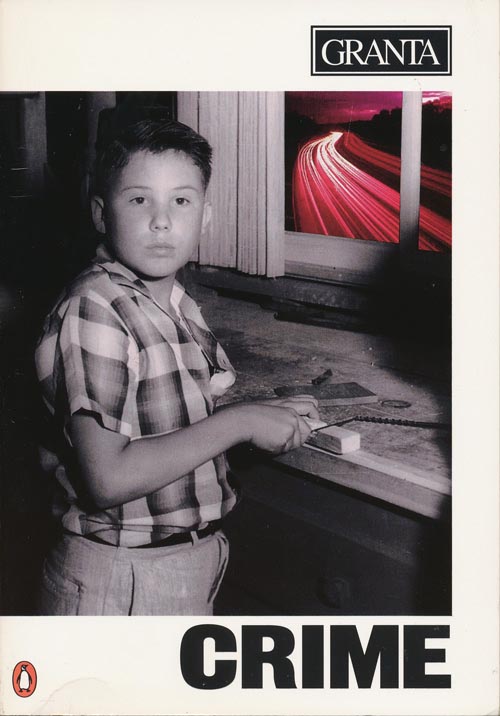
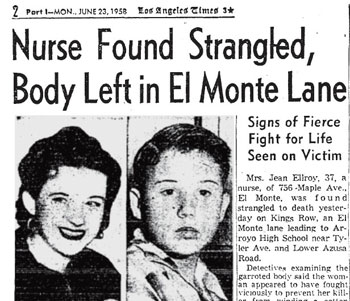
I can remember the exact moment I heard about James Ellroy for the first time. It was the Fall of 1994 and I was working at UCLA’s Audio Visual Services scheduling AV needs for the campus community when my co-worker Steve Roberts (who had amazing taste for both film and literature) started talking to me about this crazy dude who writes novels inspired by his own mother’s murder. What struck me most from that conversation was the image of the writer as a 10 year old on the cover of that special Crime-themed issue of Granta Magazine (#46) that was taken by the press at the exact moment he was being informed by the police his mother had been murdered. It’s an image that has been burned onto my memory ever since. The fact that this guy had an image of himself as a boy at the very moment he learned about his mom’s death forever frozen in time fascinated me at first, then it started to haunt me a bit, and then it got me interested in his novels—something I am still thankful to Steve Roberts for two decades later.
Despite the “death of the author” we’ve been living with for decades now, it’s still not all that easy to divorce a writer’s biography from their work. And in the case of Ellroy it is next to impossible, in fact his life story has all but defined his work. As Paul Bond noted in a recent post on Ellroy:

Ellroy had written a half-dozen crime/detective novels before The Black Dahlia. They were good, but not outstanding. He knew as he was writing those early works that he needed to write the Dahlia, but that he also needed to develop as a writer in order to do it justice. He said, in My Dark Places, “I knew I could link Jean and Betty and strike 24-karat gold.” When he was ready, he wrote it and it made him a star.

And as Bond also noted, the Freudian implications here are limitless. As an adolescent Ellroy transferred his mother’s murder onto the highly publicized and grisly murder of  Elizbeth Short, also known as The Black Dahlia, which occurred a decade earlier in 1947. And like the Dahlia case, Jean Ellroy‘s murder in 1958 remains unsolved to this day.    And that lays the rich, complicated historical context for the novel The Black Dahlia which is in many ways provides a framework of “true crime” within which Ellroy’s masterfully written fiction about the underbelly of 1940s Los Angeles can wreak havoc.

And that is how we opened last night’s class (which unfortunately was not recorded), discussing the the dedication of the novel, which goes like this:

To Geneva Hilliker Ellroy
1915-1958

Mother:
Twenty-nine years later,
This valediction in blood

Much of what I prefaced the dedication with above is what we discussed for the first half of class. Ellroy’s biography, his mother’s murder and the projection of all of this onto the Black Dahlia case.  From there we started discussing the Prologue to the novel, which in many ways is just as interesting. Ellroy chooses to frame his novel against the historical backdrop of the Zoot Suit Riots of 1943—a choice that immediately highlights the racial violence of 1940s Los Angeles and the two-tiered system of law and order as it applied to racial and ethnic minorities and the white power structure. While escaping the chaos of the Zoot Suit Riot in the Prologue, the novel’s protagonists (Bucky Bliechert and Lee Blanchard) collar petty thief Tomas Dos Santos, whose most recent victim died of a heart attack:

Tomas snatched a purse off a hairbag on 6th and Alvarado, she keeled of a heart attack and croaked, Tomas dropped the purse, ran like hell. Left a big fat juicy set of prints on the purse….he’s dead meat. Manslaughter Two’s a gas chamber jolt for spics. Hepcat here’s about six weeks away from the big adios. (7)

Immediately the deeply structural prejudices of 1940s L.A. are laid bare and only reinforced throughout the novel. The Black Dahlia presents a world of blatant racism and grisly violence—both institutional and individual—against Latinos, African-Americans, Women, Children, and any other under represented contingent. It’s a world dominated by the white, male power structure—-and while the first third of the novel both champions and reinforces this with the boxing match between our two protagonists—the victims of this power structure is everywhere apparent. The chasm between nationalism and racism that opens this book with the Zoot Suit Riots is very hard to suture shut with a boxing match. The characters represent a one vision of this narrative world, but from the very start it’s impossible for it to exist in isolation. As Bucky Beichert remarks in the Prologue as he steps out into the riotous streets:

I was terrified because the good guys were really the bad guys.

Sailors were kicking in windows all over Evergreen; marines in dress blues were systematically smashing street lights, giving themselves more and more darkness to work in. Eschewing inter-service rivalry, soldiers and jarheads overturned cars parked in front of a bodega while navy youths in skivvies and white bell-bottoms truncheoned the shit out of an outnumbered bunch of zooters on the sidewalk next door. (5-6)

For me the heart of this book is immediately framed in the prologue: a violent, racist, cruel society that is a dream vision of predation and obsession wherein telling the good guys from the bad is the stuff of fairy tells. All of which hits harder when you think of how the moment of World War II, and those soldiers who served, were canonized in the 1990s by Tom Brokaw as the Greatest Generation—a  nostalgic vision of a time when America knew the good guys from the bad: :”a simpler time.”  A truism if you were part of the white power structure that everywhere rules the world of The Black Dahlia.

When Ellroy is at his best, and that is definitely the case in The Black Dahlia, L.A. Confidential, White Jazz, and American Tabloid he viciously tears off the safe, popular facade of U.S. History during the 40s, 50s, and 60s and injects a raw vision of events filled with thugs, thieves, and murderers—an alternative history of the submerged power structure of U.S. culture that can only be told in retrospect—a literary vision that reaches its height in The Cold Six Thousand. And as it turns out very similar to another contemporary masterpiece of historical fiction written in the 1980s by Cormac McCarthy: Blood Meridian. It would be a bit of a toss-up to say whose vision of the past was more insane, but if I were to be brutally honest I think McCarthy might edge him out a bit in the violence department with Blood Meridian—but Ellroy is definitely more fun 🙂

If you’re still with me at this point I apologize this has being so long-winded, but I’m trying to summarize last night’s class as best I can given the recording was botched. Nonetheless, I’ll try and wrap up now, though I really do love writing about Ellroy. Towards the end of the discussion we started talking about the main characters and their telltale scars. Lee Blanchard’s inability to forgive himself for the abduction, and assumed murder, of his nine year old sister 20 years earlier. Bucky Beichert’s struggle with his “kraut” father (a liability at the time) as well as his guilt over sending two of his Japanese-American friends off to Manzanar to get on the LAPD. Kay Lake’s emotional and physical scars born of her relationship with  crime boss Bobby Dewitt. And to tie the three together, all the respective scars of the novels main characters bring them together around a shared, twisted obsession with the grisly murder of Elizabeth Short—what becomes the collective nightmare fantasy of all of them, and what pushes the narrative into a benzedrine-inspired hallucination of ghosts, demons, and corpses. But more on that tomorrow.

Posted in Hardboiled | Tagged , , | 3 Comments

Indemnity Only and Hardboiled Feminism

Sara Paretsky

I couldn’t get this post up sooner because I went offline for a long Thanksgiving weekend, but I feel compelled to share out the class discussion of Sara Paretsky’s Indemnity Only before I started talking about James Ellroy’s The Black Dahlia.

The continuation of our discussion of Sara Paretsky’s Indemnity Only (you can find the audio and context for the first part of the discussion here) last Tuesday centered around how we might understand Indemnity Only as a feminist text within the context of detective fiction. GNA brought up some excellent points about just this idea in her comments on the first discussion about V. I. Warshawski, and by extension Paratesky:

Unfamiliar with this author’s work, I wonder how her own gender liberates (or restrains, impacts) her to make her hard-boiled female protagonist more or less feminine. Is the protagonist a feminine character? Or is she a hard-boiled detective with a vagina? Does she have to be different in gendered ways to achieve success?

To seek clues to the answers to my questions I followed the Wikipedia link provided in this post and then found the Gale Biography in Context page for Paretsky which states:

“Warshawski is a feminist, her view of the world honed by experiences with an underground abortion referral service, civil rights freedom marches, and a stint in the public defender’s office; as a private investigator she continues her work for women, for equality, and for fairness. Her targets in each of the novels are entrenched social institutions, secure in their power and privilege.”

This comment addresses the protagonist and not the author. Or does it? Could a female writer birth and nurture a female protagonist through a hard-boiled scape, across time without embedding herself within the character?

Further, and not least, could Paretsky’s own feminism and pro-social agenda be laid out and evidenced by her long-term commitment to a single character, one she has made iconic within the genre? Is V.I. Warshawski Paretsky’s manifesto?

Brilliant questions for someone who hasn’t even read the text yet! I can’t imagine what insanity would be unleashed once she has 🙂 But for me these are crucial issues brilliantly articulate and they served as the topic of conversation for out class a week ago.  You can find the audio below, but unfortunately the last 15-20 minutes was cut off due to my computer’s battery running out of juice. We stop right around the discussion of second wave versus third wave feminisms, and the entire class was free range fun. We spent most of the time talking about Feminism, the Equal Rights Amendment, National Organization for Women,  contemporary women’s movements, Pussy Riot, and the 80s—which I always love to reminisce about with a group of students born after 1993. Enjoy!

Indemnity Only Class Discussion, Part 2 – 11/20/2012

Posted in Hardboiled | Tagged , , , , | Leave a comment

A Magnificent Resuscitator

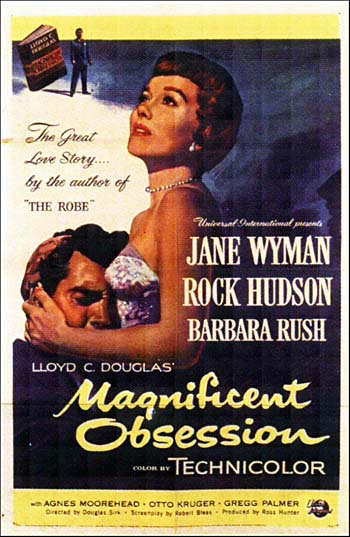
Anto and I have been on a Douglas Sirk kick the last couple of weeks, and there is so much to love about his melodrama of the 1950s. I’ve been particularly taken with Magnificent Obsession (1954) starring Jane Wyman and Rock Hudson (who return the following year to star in All that Heaven Allows). Between the lavish technicolor-flushed interiors and exteriors, the dreamlike suspension of reality, and an over-the-top sense of cause and effect I just can’t get the film out of my mind. I started doing some reading around to see what people had written about it, and found Laura Mulvey’s Fetishism and Curiosity (chapters 1 and 2 in particular) does a great job framing the theoretical discourse of gender and performance that emerged around Sirk’s melodramas during the 70s and 80s. Mulvey articulates a feminist critique that uses psychoanalytic readings to build on and complicates the Marxist interpretations of Sirk’s films during 50s and 60s:

The sphere of the feminine had to find a voice which could provide critical commentary on its genre, the domestic melodrama. At the same time, the ‘interiority’ of the domestic had to open up to reveal a new terrain, the terrain of the ‘unspeakable’. Feminism would provide the voice and vocabulary which could transform the content aspect of the melodrama, re-evaluating the domestic interior space, while psychoanalytic theory would provide the concepts which could transform the interiority of the ‘unspeakable’ into the unconscious, transforming the stuffy kitschiness of the melodrama into the stuff of dreams and desire. (33)

In Sirk’s melodramas Marx meets Freud for Mulvey, what is seemingly kitsch is actually the space through which the performance of gender transforms the domestic melodramas of the 1950s into a critical commentary. Sidney Lumet noted about melodrama: “In a well-written drama, the story comes out of the characters. The characters in a well-written melodrama come out of the story.” And while it seems Lumet is suggesting the characters are born of the demands of the story in melodrama rather than letting the characters define the story in drama—Mulvey’s reading would actually have the characters literally coming out of the story as a self-reflexive performance of their pre-defined role of woman:

Rather than performing as spectacle for consumption, the female figure performs the woman who must perform, and for whom performance is invested in appearance. Performance, appearance, masquerade and their erotics shift from the surface of the screen into the story itself….the artifice of successful femininity constantly cracks and out of their characters’ vulnerability rise towering star performances. (39)

Such a reading of performance that moves outside of the story might also be mapped retrospectively onto Rock Hudson’s double life as gay man and Hollywood screen lover, and the struggles to protect his public persona as heterosexual heart throb. In fact, reading Mulvey makes me want to dig deeper into the questions of gender, performance, and the melodrama of the 1950s. There’s a ton more scholarship to read around this topic, but in terms of films I think Vincent Minnelli’s melodramas are next up, namely Tea and Sympathy (1953), Home from the Hill (1960), and The Bad and the Beautiful (1952) to start. It’s funny how two seemingly diametrically opposed genres such as melodrama and noir are catching my fancy simultaneously these days. Both seem to deal with the collective fantasy of Hollywood, just from very different class and gender contexts.

Anyway, none of this is what I meant to talk about in this post. Actually, all I really wanted to do is share this re-edited clip I created from Magnificent Obsession that focuses on the crazy cause and effect narrative that starts the films. To quote Mulvey:

The film’s opening premise is that Bob Merrick, a very rich and self-indulgent playboy obsessed with the thrill of speed, has an accident through his own irresponsibility, as a result of which Dr Phillips, head of the local hospital and much-loved and respected philanthropist, dies. Dr Phillips succumbs to a heart attack because the medical equipment he depended on [the resuscitator!] , in an emergency, is tied up saving Bob Merrick. The film story emphasises this sequence of cause and effect. The immature and irresponsible younger man causes the death of a man who occupies the place of the law, culture and moral worth invested in the Symbolic order. (46)

I loved the whole over-the-top cause and effect dynamic surrounding the resuscitator that starts the film, it’s what recently dragged me in and has me wanting more. I’d been a fan of melodramas like Tea and Sympathy, All that Heaven Allows, and Imitation of Life for a while, but after Magnificent Obsession I’m intrigued more broadly with melodrama as film genre along with its theoretical tributaries. All thanks to the resuscitator, I guess it’s the little things, I just wonder whose curiosity died so that mine could live  đꙂ

Magnificent Obsession Resuscitator from Jim Groom on Vimeo.

Posted in movies | Tagged , , , , | 1 Comment

My GIFs Just Ain’t What They Used to Be

I recently wrote about all the GIFs I’ve made over the last two years, but something I forgot to mention is how much the quality of the GIFs I’ve made lately suck. I had a pretty solid workflow in which I used an old version of Mac the Ripper to grab the VOB files from the DVD I was working with and then I would pull them into MPEG Streamclip to export the stills I was using as images and then finish up in GIMP—you can see a detailed tutorial of the process here.

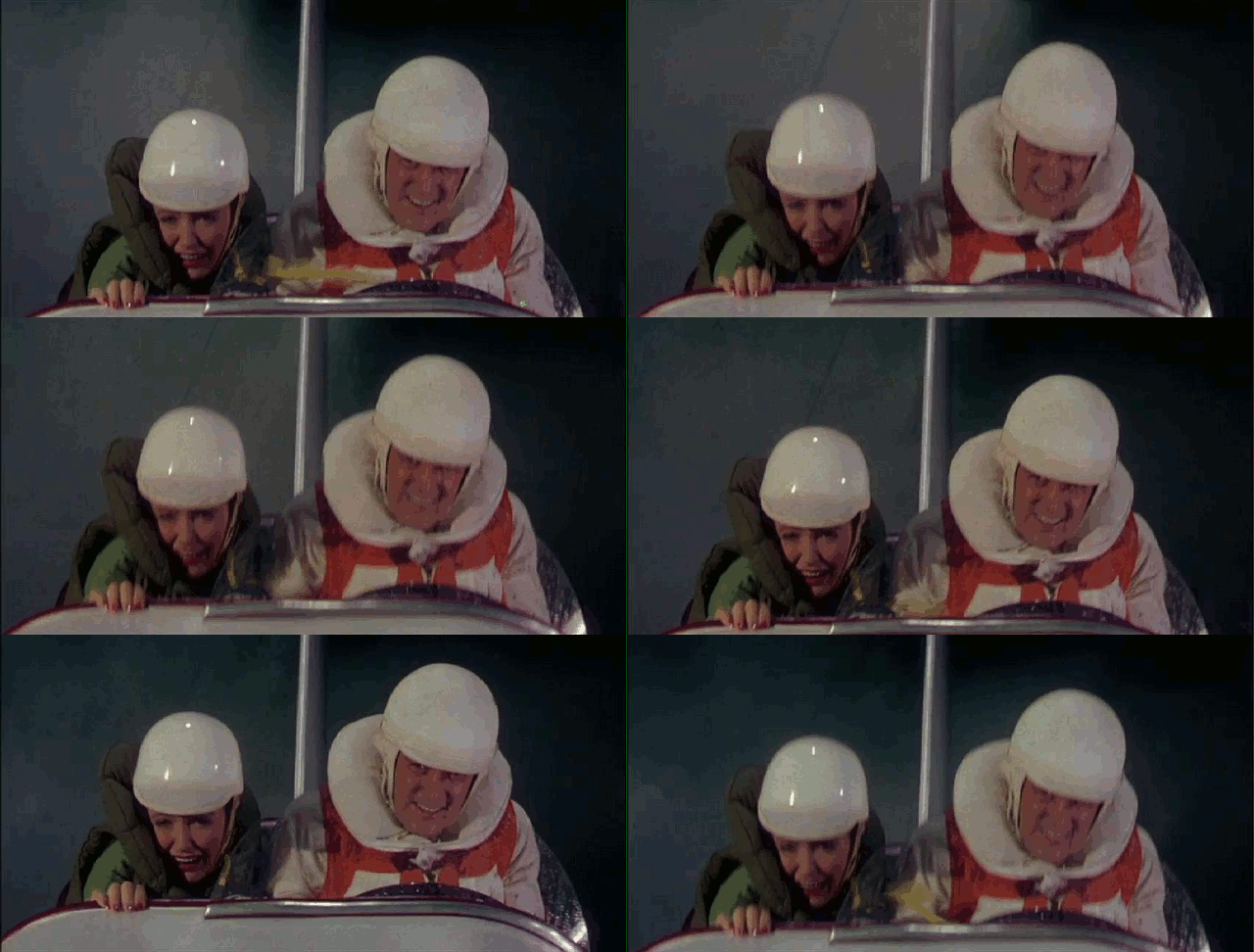
When I recently upgraded to a new MacBook Pro I was finally pushed to use the latest Mac OS. The casualty of this “progress” was the old school DVD ripping software Mac the Ripper which no longer works with the latest Mac OS. I understand Mac the Ripper was outmoded and the programmers were GNU violating jackasses, but despite all that the rips were high quality. I switched to Handbrake for ripping but that software doesn’t seem to let me rip to the raw files which means I always get a compressed file from the rip. Compression on top of compression reduces the quality of the GIFs accordingly. In fact, I have yet to make a GIF in Handbrake that I’m  happy with. I just experimented with a clip from the begininng of Douglas Sirk’s Magnificent Obsession (1954) which you can see below.

A little pixelation in the water is understandable, but what’s going on here seems a bit excessive in both the water flume, the helmets, and the faces. Also, the colors are shot. I really need a better ripping software to test my theory, the only other possibility is GIMP is killing the GIFs, but I’m not sure how that could be.  Anyone have ripping software for the Mac besides Handbrake they like?

Posted in Uncategorized | Tagged , , , , | 6 Comments