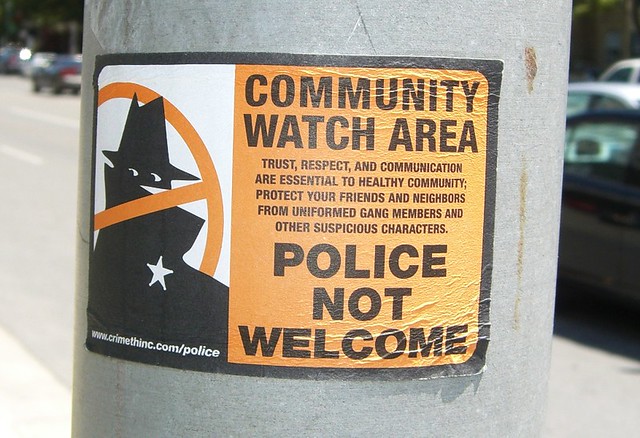
Toban Black's "Policing and Community"
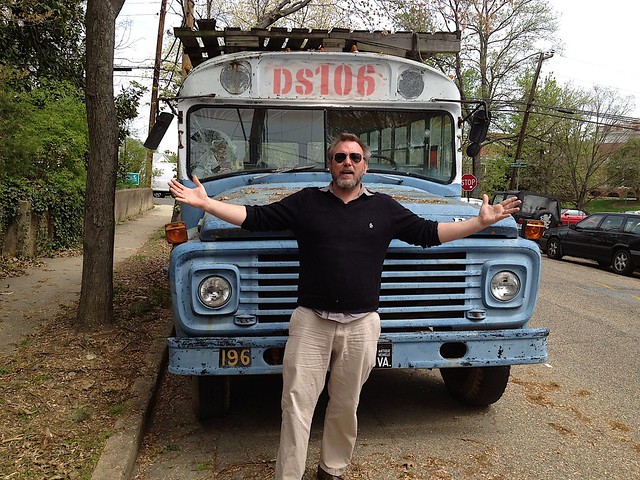
One of the things I’ve been wrestling with since ds106 went open and online back in Spring 2011 is how to represent innovation as a communal, rather than an individual, phenomenon. And this topic seems particularly relevant now that I have been asked to write something for the Chronicle of Higher Education’s ebook follow-up to the “12 Tech Innovators” article in which I was named one of the lucky 12. As much as I try and downplay it, I have to recognize that I’ve directly benefited from being crowned one of the 12 tech innovators in higher ed. I’ve been asked to give talks at various colleges, and there’s been a fair amount of professional praise and recognition from colleagues and administrators both within and beyond the University of Mary Washington (UMW). I’d be lying if I said a part of me doesn’t really appreciate and relish the recognition, but at the same time I have to acknowledge it alienates me a bit from the communities that are responsible for my designation as an innovator in the first place. And while this tension is not necessarily new to me given the eruption around the term EDUPUNK back in 2008, it does remain an uncomfortable space that over time I’ve learned to embrace to the degree it solidifies and even furthers the work we do at UMW’s Division of Teaching and Learning Technologies (DTLT).
I also understand that as a result of this I’ve become somewhat of a figurehead for the amazing work Gardner Campbell and Chip German started at UMW seven or eight years ago. Work that has engendered projects such as UMW Blogs, ds106, and the soon to be realized Domain of One’s Own —all of which were born from ideas and conversations amongst an amazing core of people at DTLT I’ve worked with over the last seven years: Martha Burtis, Jerry Slezak, Andy Rush, Patrick Murray-John, Tim Owens, and most recently Alan Levine. What’s more, this doesn’t even begin to cover the amazing faculty at UMW. There are so many that I couldn’t begin to credit them all, but I should at least recognize early pioneers of UMW Blogs like Mara Scanlon, Steve Greenlaw, Jeff McClurken, Claudia Emerson, Carole Garmon, Jeremy LaRochelle to name a few. On top of that there are literally thousands of UMW students that continue to make UMW Blogs (an open, educational publishing platform) a vibrant intellectual community that was also a blast to browse and read.
When you look closely enough at the innovative work of any one person you quickly realize that it’s built around and on top of the work of a much larger community. And while I understand it’s simpler to enshrine a single individual for an achievement, I also know from personal experience that it often obfuscates the deeply social and distributed relations that make any of it possible—and that remains a deep problem with the focus on credit and reward in the culture that we live in, our current educational system exemplifying the worst of that ethos.
But in an attempt to avoid being totally self-effacing, which is terribly out of character for me, I’ll say that one of the things I’ve brought to both UMW Blogs and ds106 was the willingness to promote and champion the work happening around a series of seemingly dislocated “academic” acts. What was happening in UMW Blogs, and later ds106, was no longer simply an educational exercise in creative solipsism destined to the dustbin of LMS history, but rather a brave new interfacing of the ideas of students and faculty with the wondrous, wide open world of the web, and that alone was magical. My role in this was to yell and scream on my blog how awesome all that work was and how amazing that it’s all just sitting out there on the open web for anyone to read, comment on, and re-use. UMW Blogs was not so much an attempt to replace the LMS as it was a new space to foster community on campus by opening up the awesome work our faculty and students were doing to each other and the world beyond. What’s more, it led to us thinking differently about our role as a public institution by sharing the work and resources our community creates publicly.
As of today UMW Blogs gets almost 5 million page views a year from all around the world, and as a result we’ve effectively become an open, free resource which in turn changes the way we think about everything we do on a regular basis—and it takes an entire community to effect such a shift in the culture. There’s both hubris and humility in the leap UMW took to open: you have to believe in the work that’s happening within the community (which I certainly do!) while at the same time be prepared to be openly critiqued as a result (which I don’t think is a bad thing).
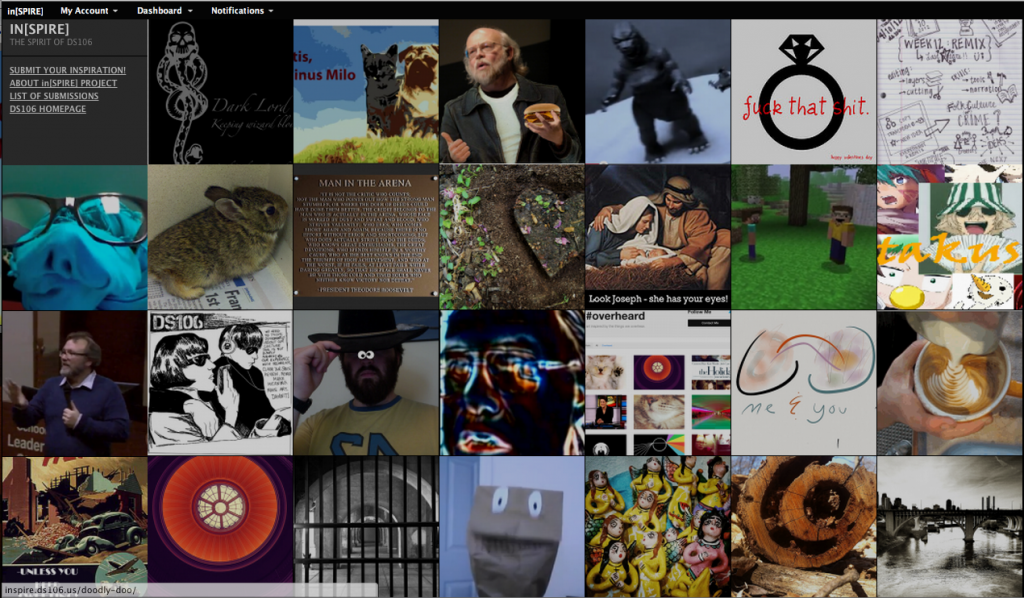
All of which brings me to ds106, the open, online digital storytelling class that I started teaching at UMW in Spring 2010. When it was opened up to the larger, online community in Spring 2011 I quickly realized just how much more powerful a class can be when it harnesses a community of people beyond the confines of a course (and that ability to harness a community for ds106 was made possible by years spent cultivating a network of colleagues). ds106 may have started as a class I taught at UMW, but it is much more than that now. It is a creative community of people who want to make things, share them, and give feedback to others. Watching a class transform into a community is an amazing thing to behold, but my part in that is limited to the willingness to let go of my role at the center of it. My innovation in many ways is letting the open, online community take over, by trusting the unplanned collisions of ideas, by embracing the experiments that emerged, and by continuing to promote and champion the work of students and faculty at UMW and beyond.
More than anything else I’m a community organizer, and what I do is not premised on technical prowess, individual genius, or some notion of visionary leadership—but rather the belief, born of personal experience, that people want to be part of a fun, creative community that feeds into the work they do in every facet of their personal and professional life. That is what ds106 is and continues to be, and people like Alan Levine, Martha Burtis, Grant Potter, Giulia Forsythe, Tim Owens, Ben Rimes, Dr. Garcia, Zack Dowell, Tom Woodward, Rowan Peter Peter Rowan, Todd Conaway, to name just a few, are the folks that made ds106 more than just a class, they made it a community of creative practice. I may have started a class called CPSC 106 at UMW in Spring 2010, but I have only a modicum of responsibility for the community that is ds106—that could only happen because a group of people came together and opened themselves up to one another. They shared who they are, what they know, what turns them on, and as a result a community was born. And it seems to me now that every class should be such a community, every class should aspire towards becoming a community. That is the dream, that is why we do what we do. ds106 has become the realization of what school can and should be, and for me that is the real innovation and it can’t be attributed to any one person—it can only be attributed to the age old, and seemingly forgotten, innovation of communities coming together to help one another out.